Protein/Antibody Designer, AI for drug design, Deep learning and large language model. Share daily papers on biology AI

Joined July 2016
7,870 Photos and videos
Pinned Post
Breaking: The official release of educational guides for AlphaFold Server from @GoogleDeepMind alphafoldserver.com/guides These tutorials aim to assist new users in gaining a deeper understanding of the latest AlphaFold version’s capabilities and maximizing the potential of AlphaFold Server’s tools and features. Section 1: Introducing AlphaFold 3 - To provide key background information about AlphaFold 3, with a specific focus on its capabilities and how it differs from AlphaFold 2. Section 2: AlphaFold Server: Your gateway to AlphaFold 3 - Introduce users to AlphaFold Server, an online portal for generating structural predictions using AlphaFold 3. Explain what AlphaFold Server can and cannot do, and provide guidance on how to use it. Section 3: Interpreting results from AlphaFold Server - Provide practical guidance on how to interpret structure predictions made by AlphaFold 3 (via AlphaFold Server). Section 4: Conclusions - AlphaFold 3 represents a significant leap forward in our ability to understand the molecular world. By predicting the structures of complexes encompassing a vast array of biomolecules and their interactions, it opens up new avenues for research and discovery across multiple disciplines.
7
71
261
83,895
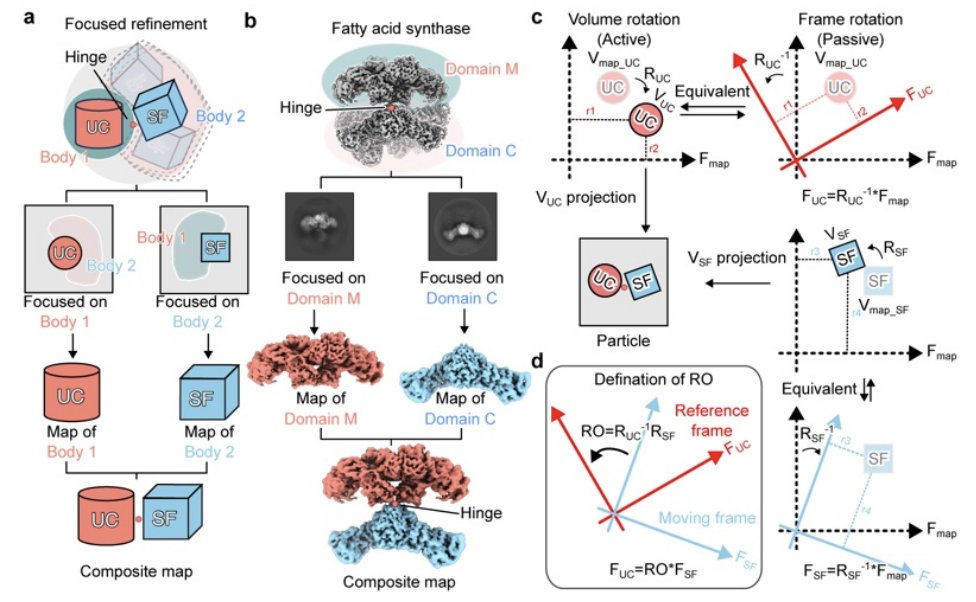
CryoROLE: Describing large inter-domain rotation in single particle cryo-EM 1. CryoROLE is a lightweight, math-based tool to recover continuous inter-domain motions that are otherwise “lost” when cryo-EM workflows produce high-resolution composite maps via focused refinement of separate rigid bodies. 2. Key idea: each particle already has multiple pose assignments (one per focused-refined domain). CryoROLE computes per-particle relative orientation (RO) between domains directly from these orientations, making the motion observable without deep learning or PCA. 3. The output is an RO “landscape”: a point cloud where each point is a particle and its coordinates encode the relative rotation between domains. Local point density reports how populated particular poses are, enabling an intuitive view of motion range preferred orientations. 4. The method is designed for large rigid-body-like motions where consensus-map-based continuous-heterogeneity methods (e.g., latent-space or perturbation models) struggle, and where classic classification discretizes a continuum into a few bins. 5. Implementation details that matter in practice: CryoROLE does statistics in rotation-vector space (avoids Euler-angle singularities), visualizes in fixed-axis Euler space for interpretability, and can “canonicalize” axes so α/β/γ align with primary/secondary/tertiary motion directions. 6. Validation on human fatty acid synthase (hFASN): with ~2.2M particles, the RO landscape accurately predicts reconstructions from particles sampled at chosen landscape coordinates, confirming that landscape coordinates correspond to real inter-wing orientations. 7. INO80–hexasome application: merging particles from 3 previously classified states reveals a continuous ~110° trajectory of INO80 rotating around the hexasome, with multiple preferred orientations. CryoROLE recovers a low-occupancy state placing the ATPase near SHL −1 that was missed by discrete classification. 8. Ribosome application (thermo-annealing): by computing RO landscapes for LSU vs SSU-body (ratchet), SSU-head vs SSU-body (swivel), and SSU-head vs LSU, CryoROLE shows annealing contracts the motion distributions and shifts population toward a preferred, low-motion basin. 9. Functional anchoring: published translocation-related 70S structures map onto the RO landscape along a plausible trajectory; particle density differences across mapped states suggest the landscape approximates thermodynamic preference. Additionally, E-site tRNA-bound particles occupy a narrower RO region, indicating tRNA restricts global ribosome motions. 💻Code: github.com/yifancheng-ucsf/c… 📜Paper: biorxiv.org/content/10.64898… #cryoEM #structuralbiology #computationalbiology #proteinDynamics #singleParticleAnalysis #openSource #bioinformatics
3
9
1,550
TCR-FramePose: A local-frame representation for decomposing global docking and CDR3 loop geometry in TCR-pMHC recognition 1. The paper introduces TCR-FramePose, a geometry descriptor that decomposes TCR–pMHC pose into three pMHC-referenced rigid bodies: the whole TCR variable domain, CDR3α, and CDR3β—so global docking and CDR3-local pose can be compared in the same coordinate system. 2. For each body, pose is split into reach (distance), offset direction (unit vector on S²), and orientation (rotation on SO(3), represented via quaternions). This preserves the natural separation between translation and rotation, which conventional descriptors often mix. 3. For statistics and ML, FramePose maps the manifold variables to Euclidean tangent coordinates at Fréchet means: 1 reach 2 offset 3 orientation coordinates per body (6 total), yielding 18 coordinates per complex. Orientation axes are interpretable as groove-axis roll, cross-groove pitch, and groove-normal twist. 4. On 378 curated αβ TCR–pMHC crystal structures (282 class I, 96 class II), FramePose recovers known class-associated placement differences (similar to centroid-based TCR-CoM) and additionally resolves class-associated orientation shifts (whole TCR and especially CDR3β) that crossing angle fails to capture. 5. The same orientation coordinates identify noncanonical docking modes: a tight “reverse-polarity” cluster dominated by ~170° groove-normal twist (spanning both class I and class II examples), plus distinct off-axis ~180° flip modes that look similar in magnitude but differ in axis composition. 6. In cross-validated association modeling, FramePose predicts buried surface area (BSA) well when using all three bodies (best configuration), and shows that beyond global placement, CDR3-local orientation contributes additional BSA-associated signal. 7. For binding affinity (Kd-based strong vs weak; n=244), rigid-body pose alone is only modestly informative overall, but FramePose improves over conventional docking descriptors. The best-performing configuration uses CDR3α CDR3β (not whole-TCR), indicating the affinity-associated signal is concentrated in CDR3-local geometry. 8. Feature attribution and augmentation analyses localize the most nonredundant signal to CDR3β orientation (and secondarily CDR3α orientation and CDR3β offset). These are also the least “recoverable” from conventional descriptors, explaining why they add new information. 9. Biological determinant analysis (conditioned PERMANOVA on native manifold distances) suggests docking geometry is organized primarily by germline V-region framework. After controlling for antigen context and germline framework, CDR3 sequence does not detectably reposition rigid-body pose, while MHC allele and peptide length contribute smaller, localized adjustments—especially in CDR3β and groove-normal orientation axes. 10. Interface interpretation: across the affinity-annotated cohort, affinity correlates most strongly with interface burial (BSA). CDR3β reach provides a geometric readout of burial (greater reach → reduced BSA), and the reach–affinity association attenuates after adjusting for BSA/shape complementarity, supporting a burial-linked (not independent) pose relationship. Within engineered peptide panels, mutation-level pose/contact effects are panel-specific, with CDR3β remodeling recurring in a similar interface region but varying in direction by receptor. 📜Paper: biorxiv.org/content/10.64898… #TCR #immunology #structuralbiology #computationalbiology #pMHC #proteinstructure #geometricdeeplearning #bioinformatics #Tcell #cancerimmunotherapy
7
29
2,497
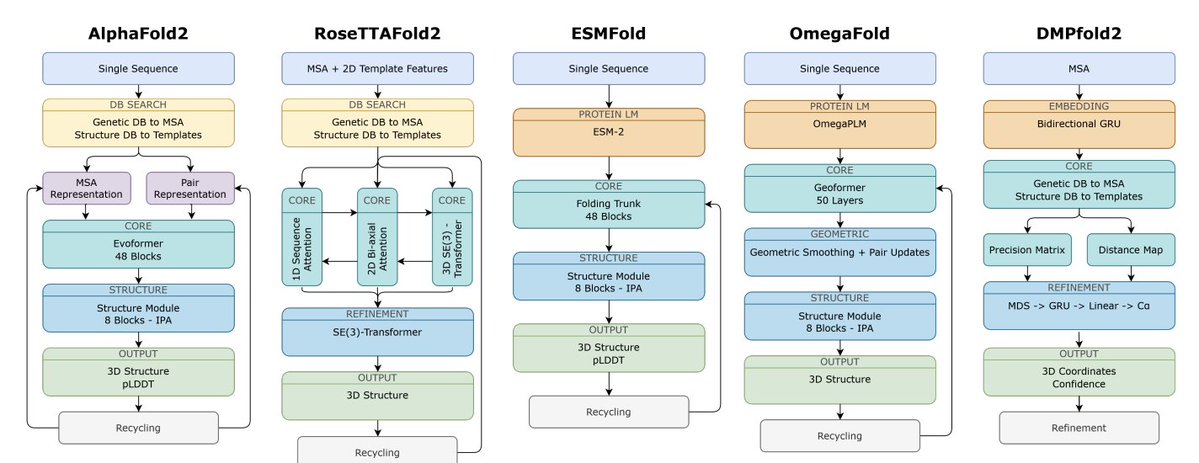
A Comprehensive Evaluation of Protein Structure Prediction Models for Short Peptides 1. Short peptides (10–49 aa) are a hard regime for structure prediction: weak cooperativity, shallow free-energy landscapes, limited long-range contacts, and often an ensemble rather than a single “native” state. This work benchmarks how modern DL predictors behave under those physical constraints. 2. The authors curate a large peptide benchmark from PDB: 2315 experimentally determined structures (1964 unique sequences), filtered to single-chain, standard amino acids, and stratified by length (10–19/20–29/30–39/40–49) and DSSP-based secondary-structure class (α-helix-rich, β-sheet-rich, mixed, disordered). 3. Five state-of-the-art predictors are compared under a standardized pipeline: AlphaFold2 (ColabFold), RoseTTAFold2, ESMFold, OmegaFold, and DMPfold2. Evaluation uses multiple complementary metrics: Cα RMSD (on structured regions), TM-score, GDT-TS, LDDT vs model confidence (pLDDT-like), and native contact fraction Q. 4. A consistent global trend emerges across models: accuracy improves with peptide length. Example: AlphaFold2 mean RMSD drops from ~0.30 Å (10–19 aa) to ~0.12 Å (30–49 aa), and mean TM-score rises from ~0.31 to ~0.59 as length increases. 5. Secondary structure strongly modulates difficulty. Across models, α-helix-rich and mixed peptides are predicted best (tight RMSD distributions, high contact recovery), while β-sheet-rich and especially disordered peptides show larger errors and heavier tails, reflecting challenges in strand registry/long-range H-bonding and the mismatch between ensembles and single-structure outputs. 6. Overall consistency leaders: AlphaFold2 and the single-sequence language-model approaches ESMFold and OmegaFold are reported as the most consistent/accurate overall, while DMPfold2 shows the weakest performance with frequent large deviations (broad RMSD tails and lower TM/Q), particularly for longer peptides and difficult classes. 7. Contact-level evaluation (native contact fraction Q) supports the same story: AlphaFold2 is high and stable (mean Q ~0.86→0.92 from shortest to longest bins), ESMFold is similar (~0.87→0.91), RoseTTAFold2 improves with length, and DMPfold2 is lowest and less reliable (mean Q down to ~0.79 with larger variance). 8. Confidence calibration is imperfect for peptides. Correlations between predicted confidence (pLDDT-like) and measured LDDT are only moderate (often ~0.5–0.7 depending on length/class) and never near-perfect, implying that “high confidence” can still be misleading for short, flexible sequences and should be interpreted cautiously. 9. MSA ablation shows evolutionary signal matters more as peptides get longer/structurally complex. For AlphaFold2, removing MSA has little impact for 10–19 aa, but for 40–49 aa it substantially reduces global/topological metrics (e.g., TM-score ~0.59→0.45; GDT-TS ~69→~53; Q ~0.92→0.80). RoseTTAFold2 is more MSA-dependent, and DMPfold2 is the most sensitive to MSA removal. 10. Practical extension: on dbAMP3 antimicrobial peptides lacking experimental structures, the paper argues for multi-model consensus as a rational way to identify robust structural hypotheses when single-model outputs and confidence scores are uncertain in this ensemble-like regime. 📜Paper: biorxiv.org/content/10.64898… #ProteinStructure #Peptides #AlphaFold2 #ESMFold #OmegaFold #RoseTTAFold #Benchmarking #ComputationalBiology #Bioinformatics #AntimicrobialPeptides
4
14
1,786
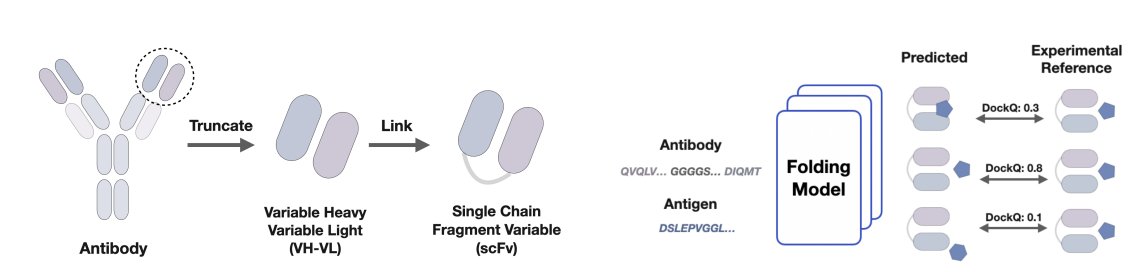
Folding scFv–Antigen Complexes at Scale 1. The paper introduces SCALE (scFv–Ag CompLex Ensembles): a large benchmarking resource to stress-test modern cofolding models specifically on scFv–antigen docking, where correct epitope engagement and binding geometry are often the true failure mode. 2. SCALE is built from a curated subset of 3,800 experimentally solved Ab–Ag complexes from SAbDab, standardized by converting each heavy/light antibody into an scFv sequence (VH (GGGGS)3 linker VL) paired with a single antigen chain, then deduplicated by scFv–antigen sequence identity. 3. Using multiple state-of-the-art folding backbones (AlphaFold 2.3 Multimer, AlphaFold 3, Boltz-2, Chai-1, Pairmixer) and diverse inference-time settings (random seeds, recycling depth, optional antibody MSA, optional templates), the authors generate ~197,900 predicted scFv–Ag complexes—an ensemble-centric view rather than single-shot evaluation. 4. Interface accuracy is evaluated with DockQ against experimental references, separately for VH–Ag and VL–Ag interfaces (and often summarized as their mean). Across ~200k predictions, most DockQ scores are very low; near-native interfaces (DockQ > 0.8) exist but are rare for every model, indicating that correct docking is not consistently recovered even when tertiary folds look confident. 5. Best-of-ensemble behavior is notably better than the typical sample: with enough trials, many targets yield at least one “acceptable” interface (DockQ > 0.23). Still, 879/3,800 complexes never exceed DockQ 0.23 under any tested setting, while only 256 exceed 0.23 across all conditions—highlighting a large “hard target” regime. 6. The study finds strong coupling between VH–Ag and VL–Ag interface quality (Pearson r = 0.958), with VL–Ag slightly harder on average. This suggests that when docking fails, it often fails globally (wrong pose/epitope) rather than in only one variable domain. 7. A central result: confidence metrics commonly used in binder pipelines (ipTM, ipSAE, pDockQ, pDockQ2, AbEpiScore) correlate well with DockQ when pooling all predictions globally, but perform poorly at selecting the best structure within each target’s ensemble (low per-complex correlations and low Top-1 accuracy). In other words, they separate “easy vs hard targets” better than “best vs second-best pose for the same target.” 8. The paper documents a key practical pitfall: high single-chain confidence does not imply correct complex formation. Many predictions have high pLDDT yet extremely low DockQ, underscoring a decoupling between confident tertiary structure and correct quaternary docking. 9. Inference-time choices matter but mainly for best-case outcomes: more recycling can occasionally refine already-good predictions toward near-native interfaces without shifting the median much; additional seed sampling often shows diminishing returns, but a subset of targets benefits substantially. Including an antibody MSA improves the frequency of higher-quality interfaces even though antibody sequences may have limited evolutionary signal, while templates provide only modest gains in this setting. 10. Physics-based interface descriptors computed with PyRosetta (e.g., shape complementarity, estimated binding energy, clash/repulsion terms) correlate with DockQ roughly as well as learned confidence scores for ranking, suggesting that reranking/scoring—possibly combining model confidences with physical interaction features—is a major bottleneck for scalable scFv–Ag docking. 💻Code: huggingface.co/datasets/ravi… 📜Paper: biorxiv.org/content/10.64898… #ComputationalBiology #ProteinFolding #Antibodies #StructuralBiology #Benchmark #AlphaFold #Docking #MachineLearning #Bioinformatics
6
28
2,192
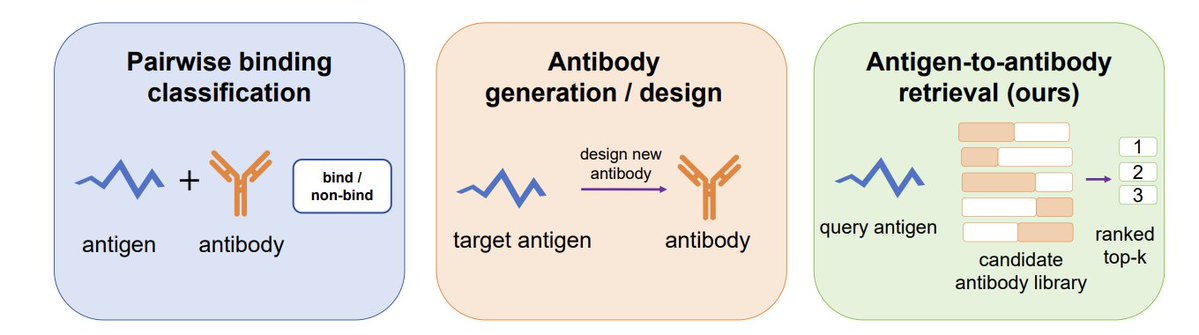
Strict OOD Antigen-to-Antibody Retrieval with CDR-Aware Slot Late Interaction 1. The paper reframes antibody discovery as antigen-to-antibody retrieval: given an antigen sequence, rank a fixed candidate antibody library to enrich known binders in the top-K, matching early virtual screening better than pairwise bind/non-bind classification. 2. A key contribution is a strict antigen-cluster out-of-distribution (OOD) benchmark to reduce antigen homology leakage: antigens are clustered by MMseqs2 at min_seq_id = 0.8, and entire clusters are held out from training and checkpoint selection. 3. Benchmark scale and protocol: test has 849 antigen queries, a controlled corpus of 869 candidate antibodies, and 872 observed positive pairs. Unpaired antigen–antibody combinations are treated as unlabeled (not negatives), so evaluation focuses on Hits@K and enrichment vs an exact random baseline. 4. The proposed model Ab-CASLR is an asymmetric dual-tower retriever: antigens encoded by ESM-2 (150M), antibodies encoded by IgBert, both projected into a shared 128-d retrieval space and fine-tuned with small learning rates. 5. Core modeling idea: preserve antibody locality with CDR-aware slots. Instead of a single pooled antibody embedding, Ab-CASLR builds M=8 antibody “document slots” using slot attention constrained by CDR masks (Chothia H1–H3, L1–L3), injecting an inductive bias that specificity concentrates in CDR loops. 6. Scoring uses late interaction rather than global similarity: the antigen tower produces L=8 latent query summaries; a low-rank bilinear matcher computes compatibility between query summaries and antibody CDR slots; final score aggregates by taking, for each query summary, the max-compatible antibody slot (then averages across summaries). 7. Training uses a multi-positive InfoNCE retrieval objective (all in-batch observed binders are positives), plus auxiliary regularizers: contact-derived epitope/paratope supervision when available and a document-side slot diversity penalty to reduce redundant CDR slots. 8. Strict OOD results show early enrichment: Hits@10 = 7.42% with EF@10 = 6.28x over exact random screening (Random Hits@10 = 1.182% for a 869-antibody corpus). Hits@1 = 1.767% with EF@1 = 14.97x, indicating strongest gains at very small K. 9. Comparisons and diagnostics clarify what helps: Ab-CASLR beats k-mer homology transfer (Hits@10 5.53%) and global ESM2-ESM2 embedding similarity (Hits@10 3.29%). Ablations show global pooled dual-tower collapses (Hits@10 1.413%), removing the CDR mask hurts (6.360%), and replacing late interaction with pooled CDR similarity drops strongly (2.120%). Slot diagnostics show antigen-side summaries collapse to near-identical representations, while antibody CDR slots remain diverse—suggesting antibody-side CDR-local representation is the main effective mechanism, and antigen epitope grounding remains an open bottleneck. 📜Paper: biorxiv.org/content/10.64898… #Antibodies #ProteinLanguageModels #Retrieval #OutOfDistribution #ComputationalBiology #Bioinformatics #MachineLearning #VirtualScreening #ESM #Immunology
4
11
1,659
Distillation Enables Scalable High-Fidelity Virtual Screening Across Ultra-Large Chemical Libraries 1 FastBindRank shows a practical way to screen ultra-large libraries with high-fidelity signals: it distills Boltz-2 (structure-based, expensive) into BindRankNet (fingerprint-based, lightweight), then ranks the entire 122M-compound PubChem space for a specific target (HDAC11). 2 Key idea: instead of relying on low-fidelity docking scores or sampling-heavy active learning loops, the student model learns directly from a high-performing structural teacher. For HDAC11, Boltz-2 was chosen after benchmarking because it correlated strongly with experimental pIC50 across known inhibitors (Pearson r = 0.815). 3 Training cost is kept low by labeling only ~1% of PubChem with Boltz-2: 1.85M random compounds, iteratively trained (250k per iteration) with a fixed tuning set and two independent test splits. The student uses 1024-bit Morgan fingerprints (radius 2, chirality) and an MLP trained to predict Boltz-2 binding probabilities. 4 The screening result reflects the “needle-in-a-haystack” reality: BindRankNet scores across 122M are highly right-skewed, with a small tail of high-probability candidates. This sparsity is exactly why exhaustive structure-based screening is infeasible (estimated ~91,811 GPU days for full PubChem with Boltz-2). 5 FastBindRank’s workflow is ranking-first, then expensive physics-like scoring only where it matters: take the top 100,000 by BindRankNet (0.082%), re-score with Boltz-2, then apply multi-criteria filters (Boltz-2 binding prob > 0.8, predicted log10(IC50) < -1, plus drug-like property constraints). 6 After filtering, it yields 1,262 high-confidence candidates. Diversity is enforced via Butina clustering (Tanimoto cutoff 0.7), producing 528 scaffold-diverse representatives; novelty filtering with CAS SciFinder removes known HDAC-annotated binders, leaving 454 candidates without prior HDAC annotation. 7 Under a matched compute budget, distillation changes throughput dramatically: compared to direct Boltz-2 screening of the same 1.85M subset, FastBindRank finds 1,262 vs 17 filtered candidates (74-fold higher hit rate) at similar GPU days (~1,474 vs ~1,387), and 528 vs 16 diverse representatives (>30-fold higher discovery yield). 8 The student model is also interpretable at scale: SHAP on Morgan fingerprint bits highlights recurring local substructures associated with predicted binding, and these feature-importance patterns remain stable after property filtering and diversity selection (Pearson r = 0.990 between SHAP profiles). 9 Experimental validation: two synthesized compounds from the “novel” set inhibited HDAC11 in vitro (fluorogenic assay). PubChem CID 89974511 achieved IC50 = 1.3 µM and CID 161174911 IC50 = 14.8 µM; in the same assay, Panobinostat IC50 = 20.8 µM and Fimepinostat IC50 = 3.3 µM, supporting that large-scale distillation-guided prioritization can yield real actives. 💻Code: github.com/jwdelta/FastBindR… 📜Paper: biorxiv.org/content/10.64898… #VirtualScreening #KnowledgeDistillation #DrugDiscovery #ComputationalChemistry #Cheminformatics #DeepLearning #HDAC11 #PubChem #Boltz2 #MachineLearning
5
23
1,830
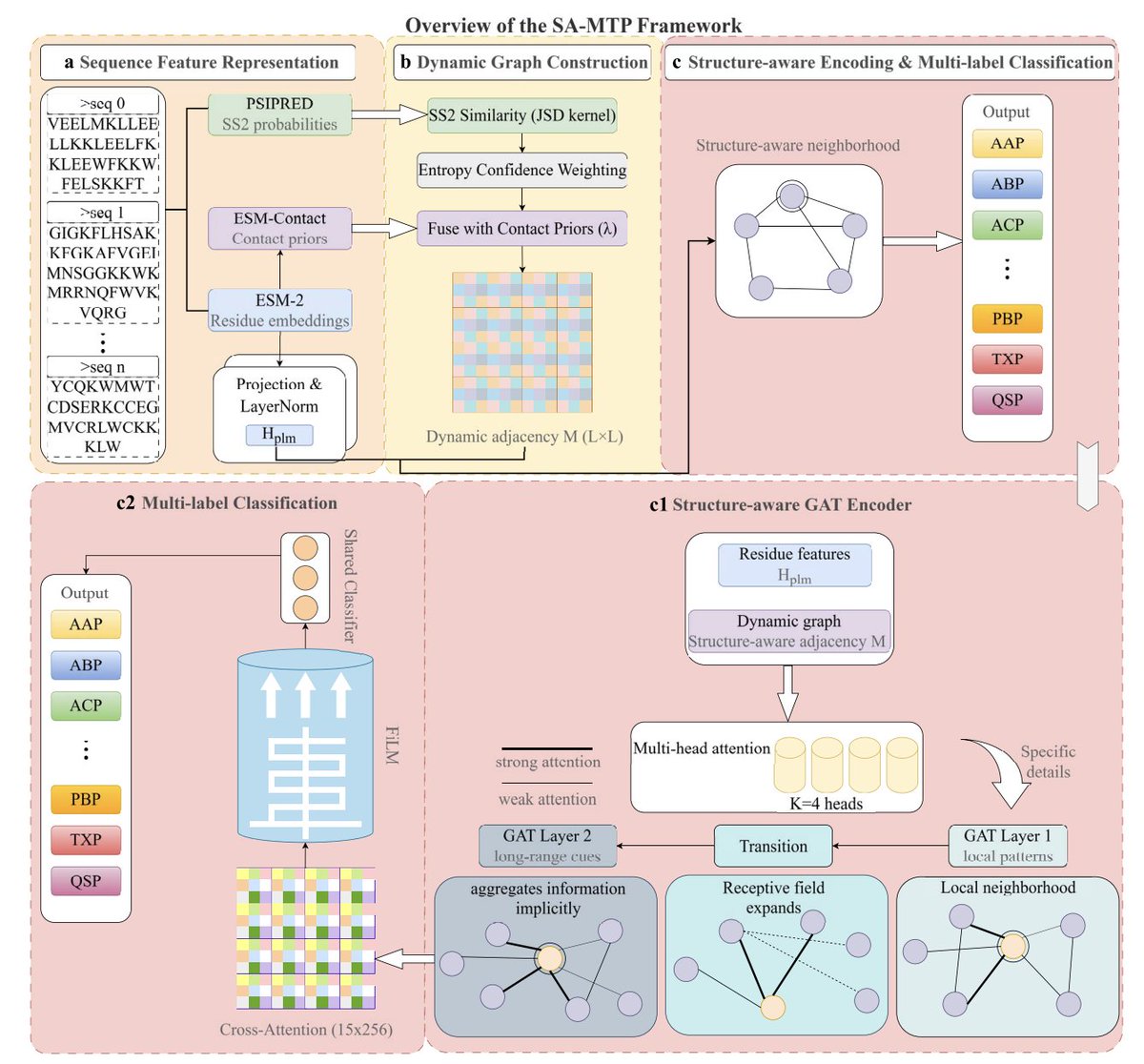
SA-MTP: A structure-aware framework for multifunctional therapeutic peptide annotation 1. SA-MTP targets a practical pain point in peptide discovery: short therapeutic peptides often have multiple bioactivities and strong conformational heterogeneity, making sequence-only multi-label predictors miss functions—especially in long-tail categories. 2. The core idea is to model peptide “structure as uncertainty” rather than a single fixed fold: SA-MTP uses probabilistic secondary-structure profiles (PSIPRED SS2, per-residue H/E/C probabilities) to represent flexible conformational tendencies. 3. It then builds an input-dependent, structure-aware residue graph by fusing (i) confidence-weighted secondary-structure similarity (local, uncertainty-aware) with (ii) PLM-derived residue–residue contact priors from ESM-2 (global, long-range). A fusion coefficient alpha balances the two signals (default alpha=0.5) and remains robust across ranges. 4. On top of this dynamic graph, SA-MTP applies a multi-head Graph Attention Network (GAT) to integrate sequence semantics (ESM-2 residue embeddings) with structure-guided neighborhood aggregation, capturing both local motifs and long-range dependencies in a peptide-specific way. 5. For multi-label output (15 therapeutic function categories), SA-MTP adds explicit label embeddings and label-to-sequence cross-attention so each function can attend to different residue regions, enabling label-conditioned evidence extraction rather than a one-size-fits-all pooling. 6. A lightweight FiLM-based classification head performs label-specific feature modulation (channel-wise scaling) to better separate heterogeneous functions while sharing a common backbone—improving discrimination without a heavy per-label model. 7. SA-MTP also addresses class imbalance at decision time via adaptive, per-label threshold optimization on the validation set (F1-optimized or MCC-optimized), improving recall and balanced metrics for sparse labels compared with a fixed 0.5 threshold. 8. Benchmarks (TPpred-LE dataset protocol; 90% identity reduction; 8:1:1 split; plus a stricter low-homology setting at 40% identity) show SA-MTP outperforming prior methods across label-level AUC/MCC/F1 and sample-level precision/recall; the gains are most visible for imbalanced or structurally complex categories. 9. Ablations quantify where improvements come from: adding structure-aware graph encoding improves macro MCC/F1/precision over a PLM-only baseline (e.g., macro F1 0.428 -> 0.434), and adding FiLM further improves the graph model (macro F1 0.434 -> 0.441), supporting complementary benefits from dynamic structure modeling label-aware modulation. 10. Interpretability: visualizations of SS2 similarity, ESM contact priors, and fused adjacency show graphs adapt to peptide types (coherent for helical peptides, modular for mixed motifs, sparse/local for high-entropy sequences). Integrated Gradients attention rollout highlight residue clusters consistent with known AMP characteristics (e.g., N-terminal hydrophobic anchoring and amphipathic helix-related regions), providing mechanistic clues beyond global similarity. 💻Code: github.com/LZW-TECH/SA-MTP 📜Paper: doi.org/10.1093/bib/bbag361 #ComputationalBiology #Bioinformatics #Peptides #TherapeuticPeptides #ProteinLanguageModels #GraphNeuralNetworks #MultiLabelLearning #Interpretability #DrugDiscovery #MachineLearning
3
11
1,346
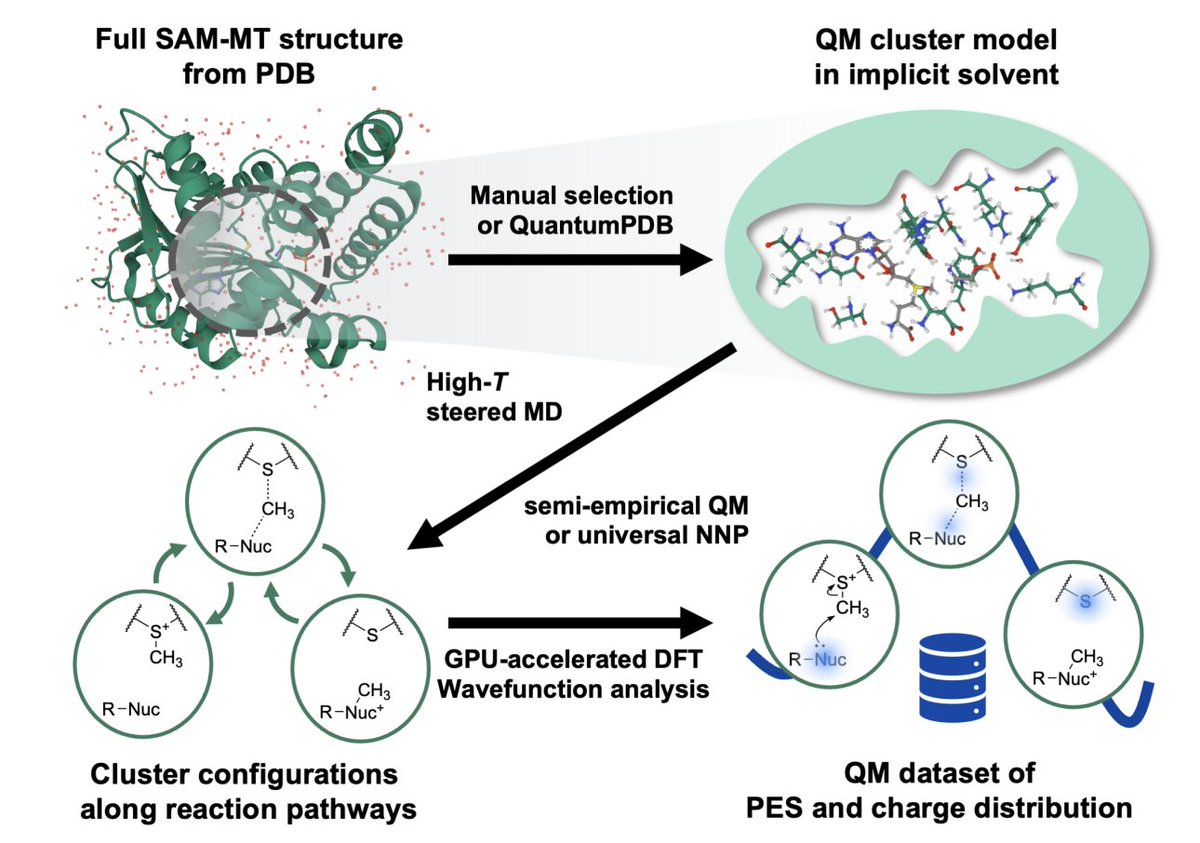
Enerzyme: A Framework for Efficient Training of Reactive Neural Network Potentials for Enzyme Catalysis with Application to Methyltransferases 1 Enzyme QM-cluster models can reach 200–600 atoms and capture catalytically important polarization/charge transfer, but DFT-based pathway exploration (scans/NEB) is still a major bottleneck. This work presents Enerzyme Enerzymette to make reactive NNPs practical for enzyme-cluster mechanistic studies, demonstrated on SAM-dependent methyltransferases (MTases). 2 A key result is data efficiency at enzyme scale: system-specific NNPs trained on fewer than 1,000 DFT-labeled configurations reproduce reaction energetics and transition-state (TS) structures for MTase clusters up to 545 atoms, with errors on barriers typically within a few kcal/mol and good agreement in SN2 TS geometry metrics (forming/breaking bonds and attack angle). 3 The framework emphasizes that “good single-point metrics” are not enough for mechanistic reliability. Models that look acceptable on single-point energies (or even flexible scans) can still fail to converge in NEB. The paper argues NEB stability and iterative pathway workflows impose stricter, more realistic constraints on PES quality than conventional dataset evaluation. 4 Enerzyme’s architectural contribution is modular electrostatics-aware NNP design: it separates pre-core/post-core components around a message-passing GNN core (tested with PhysNet, SpookyNet, and MACE cores). This lets the same electrostatic machinery (charge prediction Coulomb term) be attached across architectures. 5 A particularly enzyme-relevant design choice is aligning the NNP’s long-range electrostatics with the QM-cluster reference environment: the NNP Coulomb term uses dielectric screening consistent with the implicit solvent used in DFT (e.g., ε = 10). Using inconsistent screening (e.g., vacuum-like ε = 1) substantially worsens NEB energetics and TS structure. 6 The work shows direct charge supervision matters. Reducing the loss weight on atomic charges degrades NEB performance and can destabilize TS searches, implying that learning charge distributions is not just “interpretability”—it materially improves the reactive PES in highly polarized enzyme clusters. 7 Enerzymette adds workflow automation for rugged enzyme PESs: iterative flexible scans/NEB detect intermediates, split paths, and restart on the higher-barrier segment to converge on the rate-determining elementary step. Importantly, the authors align DFT and NNP comparisons by using the same external optimizer/workflow logic so differences reflect the PES rather than tooling. 8 Beyond energies, the learned multitask charges capture chemically meaningful trends: along methyl transfer, NNP-predicted charges reproduce expected charge transfer from SAM to substrate and polarization of nearby residues. In COMT substrate series, the predicted nucleophile charge correlates strongly with computed barriers/thermochemistry—sometimes more cleanly than standard DFT-derived charge schemes used as labels. 9 Transferability is explored within COMT: zero-shot transfer across ligands can fail when chemistry differs (suggesting single-system training over-specializes), but training on combined multi-system datasets improves generalization to unseen ligands. MACE-based models appear more data-efficient in these cross-system settings, though training cost can become a bottleneck. 10 Cost analysis indicates NNP inference makes iterative pathway exploration dramatically cheaper than DFT (orders of magnitude for scan inference), but total workflow cost depends on DFT labeling and training. The paper frames this as amortizable: as datasets expand across enzymes, transferable reactivity patterns should reduce per-system retraining needs and increase overall payoff. 💻Code: github.com/Benzoin96485/Ener… ; github.com/Benzoin96485/Ener… 📜Paper: arxiv.org/abs/2607.01362 #ComputationalChemistry #CompBio #Enzymes #MachineLearning #NeuralNetworkPotentials #ReactionMechanisms #Electrostatics #QMCluster #MolecularSimulation #GNN
2
17
1,656
A Generalizable Interface-Seeded Framework for De Novo Design of Functional Oligomers 1. The paper introduces an “interface-seeded” generative design strategy: instead of docking existing protein building blocks into a target symmetry, it uses a previously validated protein–protein interface (PPI) as the seed and generates new symmetry-compatible protomers around it. 2. Key implementation detail: a new symmetric motif-scaffolding module in RFdiffusion that preserves the interface motifs while sampling seed orientations and radial placements, then “drags” the motif radially during denoising to bias toward compact, well-packed cyclic oligomers. 3. This directly addresses a practical bottleneck in symmetric assembly design: dock-and-design success is often limited by geometric incompatibility between chosen protomers and target symmetries (C3/C4/C5), producing strong biases and low hit rates. 4. Benchmarking with LHD heterodimer seeds (LHD101, LHD29), the framework produced many expressible designs (63/64 expressed), with a substantial fraction matching the intended oligomeric states by SEC (33/63) and SEC-MALS (18/63). 5. Structural accuracy was validated by crystallography for multiple designs: C3 trimers (PI25, PI31) and a C4 tetramer (PI57) closely matched design models (Cα RMSD < 1.6 Å), including accurate interface side-chain placement; the resulting folds were also “new-to-nature” by Foldseek comparisons. 6. The approach generalizes to chemical triggers by reusing ligand/metal-dependent PPIs as seeds (often fragmented into many discontinuous segments), enabling conditional C3 assembly for Cu2 (MC11), cholic acid (CHD04), and venetoclax (LBM10). Measured effective assembly affinities were in the ~100 nM range (e.g., MC11 Kd,eff 137 nM; LBM10 Kd,eff 130 nM). 7. Crystal structures of CHD04 and LBM10 matched their design models and showed ligand occupancy in the engineered pockets, demonstrating that the seeded responsive interface can be transplanted into entirely new oligomer topologies while retaining chemical control. 8. A major functional advance is reversible phosphorylation-controlled oligomerization using a dynamic “phosphoswitch” interface seed: phosphorylation by PKA shifts monomer→oligomer, and λ-phosphatase reverses it back. Single interface-weakening mutations reduced unwanted basal oligomerization while preserving phospho-dependent assembly (PO5s, PO18s). 9. The work also demonstrates multi-input control: introducing a disulfide lock created a system that requires both reducing conditions and phosphorylation to oligomerize, enabling dual-gated assembly behavior in a de novo designed oligomer. 10. Applications go beyond in vitro biophysics: (i) ligand-triggered membrane binding via MinD membrane-targeting sequence fusions (Cu2 or CHD induces oligomerization-driven avidity on supported lipid bilayers), and (ii) phosphorylation-inducible transcription in HEK293T cells by coupling PO18s trimerization to an HSF1-based reporter, yielding ~6-fold induction (and >14-fold with combined endogenous engineered PKA activation). 💻Code: github.com/Khmelinskaia-Lab/… ; github.com/Khmelinskaia-Lab/… 📜Paper: biorxiv.org/content/10.64898… #ProteinDesign #RFdiffusion #AlphaFold3 #SyntheticBiology #ComputationalBiology #ProteinEngineering #DeNovoDesign #SignalTransduction #Phosphorylation #Nanobiotechnology
10
52
3,495
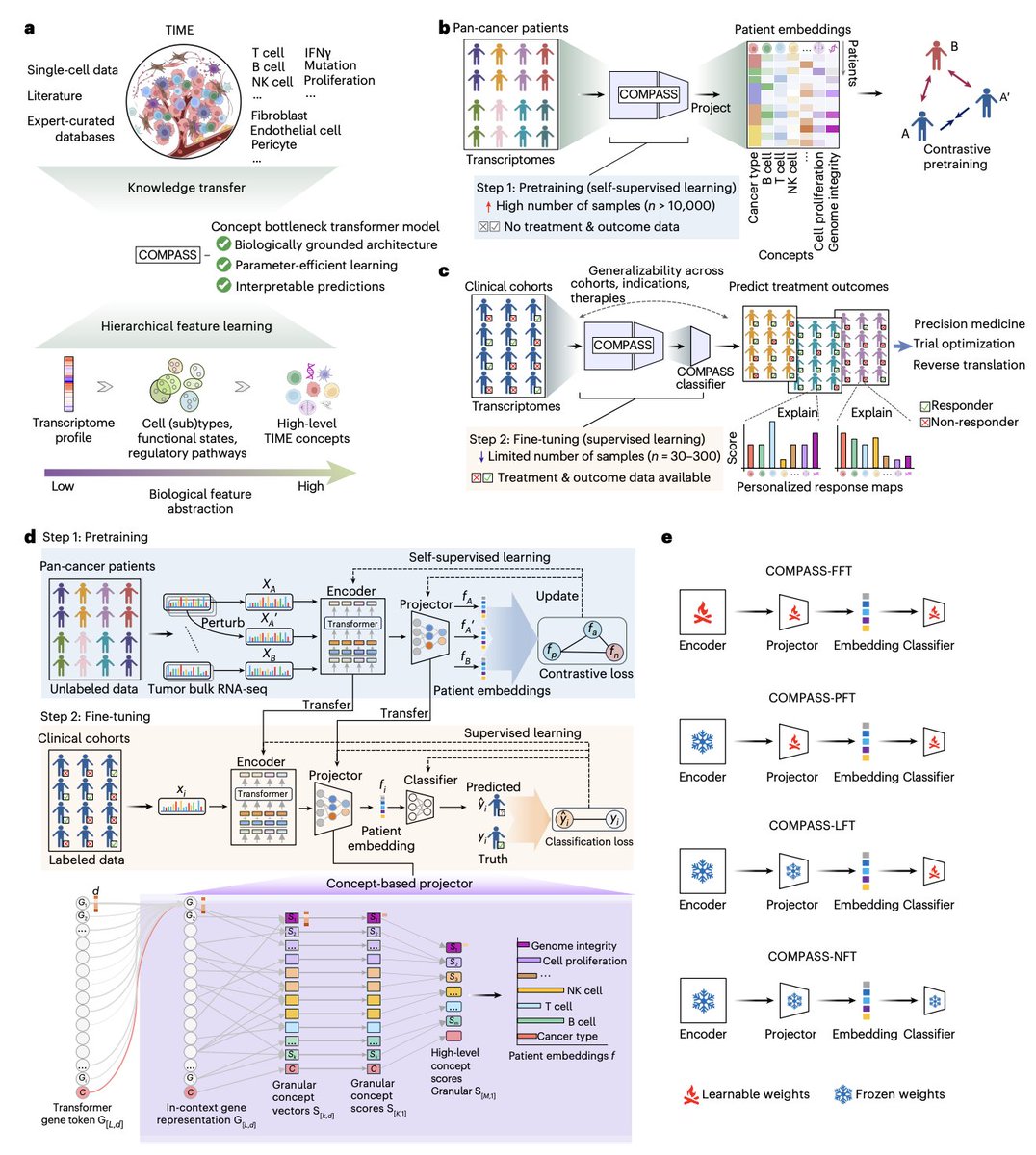
Generalizable AI Predicts Immunotherapy Outcomes Across Cancers and Treatments @NatureMedicine 1 COMPASS is a pan-cancer foundation model that predicts immune checkpoint inhibitor (ICI) response from pretreatment bulk tumor RNA-seq, aiming to overcome the well-known poor cross-cohort generalization of biomarkers like TMB and PD-L1 IHC. 2 The key design choice is a concept bottleneck transformer: instead of predicting response directly from thousands of genes, COMPASS routes gene expression through 44 biologically grounded immune concepts (immune cell states, tumor–microenvironment interactions, and signaling pathways), enabling both generalization and interpretation. 3 The 44 concepts are built from 132 curated gene signatures that are hierarchically aggregated into high-level TIME (tumor immune microenvironment) concepts, plus a cancer-type token; each patient is embedded into a 44-dimensional concept space intended to represent functional immune states rather than coarse phenotypes. 4 Pretraining uses self-supervised contrastive learning on 10,184 TCGA tumors across 33 cancer types (no treatment/outcome labels): augmented views of the same tumor are pulled together while different tumors are pushed apart in the concept space, producing transferable TIME representations. 5 On 16 independent ICI clinical cohorts (1,133 patients; 7 cancers; 6 ICI regimens including anti-PD-(L)1, anti-CTLA-4, and combinations), COMPASS outperformed 22 baseline methods in leave-one-cohort-out evaluation, improving average accuracy by 8.5% and AUPRC by 15.7% across cohorts. 6 Parameter-efficient transfer is central: partial fine-tuning (projector classifier) and linear probing (classifier only) were the most robust overall, while full fine-tuning tended to overfit when generalization was stressed; for very small cohorts, a no-fine-tuning retrieval mode can be preferable. 7 Generalization was explicitly tested beyond “new cohort”: COMPASS maintained stronger performance in cross-indication, cross-therapy, and cross-target splits (for example, training without CTLA-4 cohorts and testing on anti-CTLA-4; and predicting combination therapy responses using monotherapy-trained models). 8 In a held-out phase 2 trial (IMvigor210, atezolizumab-treated metastatic urothelial carcinoma), COMPASS-predicted responders showed substantially longer overall survival (hazard ratio ~4.7; log-rank P extremely significant), outperforming stratification by TMB, PD-L1 immune-cell score, and IHC-defined immune phenotype. 9 Mechanistic interpretability is delivered via “personalized response maps” that trace contributions from genes to granular concepts to high-level concepts to final response probability; these maps highlight resistance programs even in immune-inflamed non-responders, including TGFβ signaling, endothelial/vascular exclusion, CD4 T cell dysfunction (TH17-like programs), and B cell deficiency (implicating loss of TLS-associated benefit). 10 The paper emphasizes realistic limitations: reliance on bulk RNA-seq (no spatial resolution), incomplete clinical covariates preventing harmonized multivariable adjustment, and lack of non-ICI comparator arms (predictive vs prognostic signals may mix). The authors frame COMPASS as hypothesis-generating and requiring prospective validation, not as a stand-alone decision tool. 📜Paper: doi.org/10.1038/s41591-026-0… #ComputationalBiology #Bioinformatics #ImmunoOncology #CancerImmunotherapy #MachineLearning #FoundationModels #Transformers #Transcriptomics #Biomarkers #PrecisionMedicine
3
11
1,639
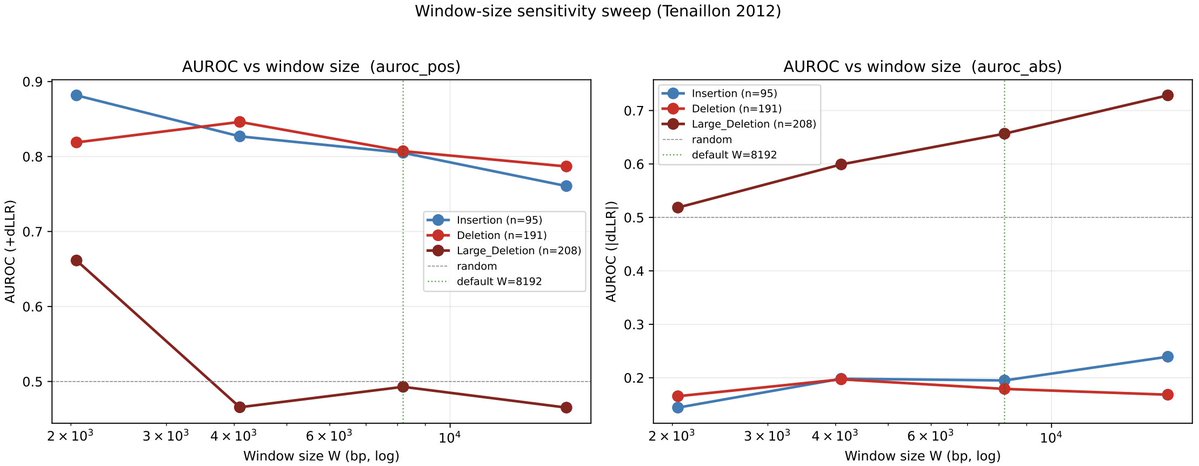
Context-dependent calibration of Evo2 likelihood with bacterial fitness: a quantitative characterization across five E. coli datasets 1. The paper argues Evo2 (a DNA foundation model) should be treated as a likelihood predictor, not a universal fitness predictor, because likelihood–fitness calibration changes sharply with variant context (coding vs regulatory), selection regime, and distance from wild type. 2. Using Evo2 7B zero-shot scoring (ΔLLR: change in pseudo-log-likelihood between mutant and reference windows), the authors map when ΔLLR aligns with measured phenotypes across five E. coli datasets spanning DMS, promoter MPRA, and experimental evolution. 3. Strong calibration appears in a plasmid-borne coding gene under stringent antibiotic selection: Firnberg 2014 TEM-1 β-lactamase (13,027 nucleotide variants) shows Spearman ρ = 0.545 overall (SNVs ρ = 0.606; indels ρ = 0.521), with a monotonic reliability curve across ΔLLR deciles. 4. Another strong setting is thermal experimental evolution where adaptive structural variants are enriched: Tenaillon 2012 reaches Insertion AUROC 0.882 (best window W = 2 kb) and Deletion AUROC 0.846 (W = 4 kb). A key methodological point is that window size is type-dependent; a single default window can cost ~5–7% AUROC. 5. The same organism can show decisive lack of calibration in regulatory context: Ireland 2020 RegSeq promoter MPRA (64,665 variant×condition pairs) yields ρ = 0.011, staying flat even after stratifying by conditions, promoters, or canonical −10/−35 motif positions—Evo2 recognizes motifs but does not predict expression changes from SNVs within them. 6. Chromosomal essential-gene DMS also shows near-zero calibration despite being coding: Dewachter 2023 (fabZ/lpxC/murA; 13,128 variants) gives ρ = 0.041 (each gene < 0.06), highlighting a major plasmid-vs-chromosome and/or selection-regime difference not captured by “coding vs regulatory” alone. 7. A clean mechanistic axis emerges from a combinatorial landscape: Papkou 2023 folA (30,000 variants) is intermediate overall (ρ = 0.237), but calibration decays monotonically with sequence divergence from wild type—ρ = 0.575 at 2 mutations down to ρ = 0.065 at 9 mutations—showing an explicit out-of-distribution effect. 8. The authors fit an explicit calibration function across per-dataset/per-divergence strata: ρ = f(divergence, context). Weighted Fisher-z regression gives a negative divergence coefficient (−0.028 per additional mutation) and a negative regulatory-context coefficient (−0.33), with R² = 0.49, presented as an illustrative quantitative “lookup surface” rather than a universal law. 9. They test and refute a simple “training over-representation” explanation for why TEM-1 calibrates better than essentials: chromosomal essentials have far more raw NCBI deposition counts than TEM-1 yet calibrate much worse (calibration does not increase with deposition count; may even decrease). Deposited variant diversity (not copy count) is proposed as a plausible but untested factor. 10. A practical contribution is methodological guardrails for DNA-LM variant scoring: avoid anchor-based indel scoring artifacts (which can silently force ΔLLR = 0), tune window sizes per variant type, and report sign conventions carefully because different variant classes can flip the “adaptive” ΔLLR direction. 💻Code: github.com/sunsungkim04-sys/… 📜Paper: biorxiv.org/content/10.64898… #ComputationalBiology #Bioinformatics #Genomics #DeepLearning #FoundationModels #LanguageModels #VariantEffectPrediction #Ecoli #DMS #MPRA #ExperimentalEvolution
2
7
1,214
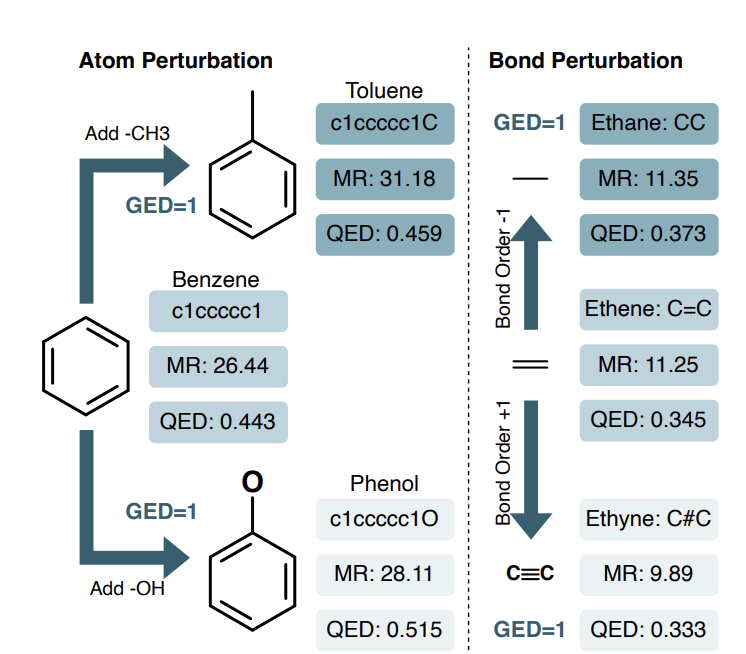
Do LLMs Truly Generalize in the Molecular Domain? A Perturbation-Based Analysis 1 Molecular LLMs can look strong on standard random-split benchmarks, yet this paper shows a fragile “local trust region”: even a single chemistry-valid structural edit (Graph Edit Distance, GED=1) can trigger large performance drops across common molecular tasks. 2 The core contribution is a Molecular Perturbation framework that generates syntax-valid structural variants of training molecules under controlled GED, enabling a manifold-regularity test rather than a static in-distribution evaluation. 3 Perturbations are designed to mimic realistic medicinal chemistry moves and are split into two granular types: atom perturbations (heteroatom substitutions with valence-preserving constraints) and bond perturbations (bond order changes with sanitization checks and implicit valence constraints). 4 Validity is enforced during generation (not just post-hoc): RDKit sanitization plus an incremental rejection mechanism, and an additional filter that keeps only molecules with valid IUPAC names (chosen as a standardized, unambiguous textual representation). 5 GED is used as a controlled axis of “distance from the training manifold” (levels 1–5). Increasing GED monotonically decreases chemical similarity (Morgan fingerprint Tanimoto) and increases token-space distance (SMILES Levenshtein), but the paper highlights a key mismatch: sequence closeness is not a reliable proxy for chemical/topological closeness. 6 Across three representative tasks—QED regression (RMSE), IUPAC→molecule generation (Morgan fingerprint similarity), and molecule→IUPAC generation (BLEU-4)—models show steep early degradation (often GED 1–3) followed by a slower decline/plateau, indicating limited local smoothness around training molecules. 7 Robustness depends on model family: domain-pretrained encoder–decoder molecular LLMs (MolT5, BioT5/SELFIES) degrade less at high GED than general LLMs (Qwen3) on understanding-style tasks, while decoder-only models can have stronger clean generative performance yet suffer sharper relative drops under perturbation. 8 Perturbation type matters by task: for understanding tasks (QED, Mol2IUPAC), bond edits often hurt less than atom substitutions at matched GED, consistent with these targets being more sensitive to atomic composition/functional groups than to certain bond-order changes; for IUPAC2Mol generation, atom vs bond perturbations cause similar degradation because exact connectivity and identities must be recovered. 9 The paper then tests In-Context Tuning (ICT) as a robustness lever grounded in the molecular similarity principle. It provides an idealized analysis viewing ICT as kernel smoothing over retrieved neighbors, yielding an error bound governed by retrieval radius R (nearest-neighbor distance), suggesting robustness should track retrieval quality. 10 Empirically (shown on Galactica-125M), nearest-neighbor ICT improves robustness in most perturbed settings (15/18 task–GED cells), while Random ICT largely removes benefits and can be catastrophic for IUPAC2Mol—supporting the claim that structural similarity in retrieval, not just “having context,” drives gains. However, ICT benefits shrink as GED grows because nearest neighbors become less relevant off-manifold, so anchoring remains inherently local. 📜Paper: arxiv.org/abs/2607.01800 #ComputationalBiology #Cheminformatics #MolecularAI #LLM #Robustness #DrugDiscovery #MachineLearning #GraphEditDistance #InContextLearning #RetrievalAugmentedGeneration
3
21
1,525
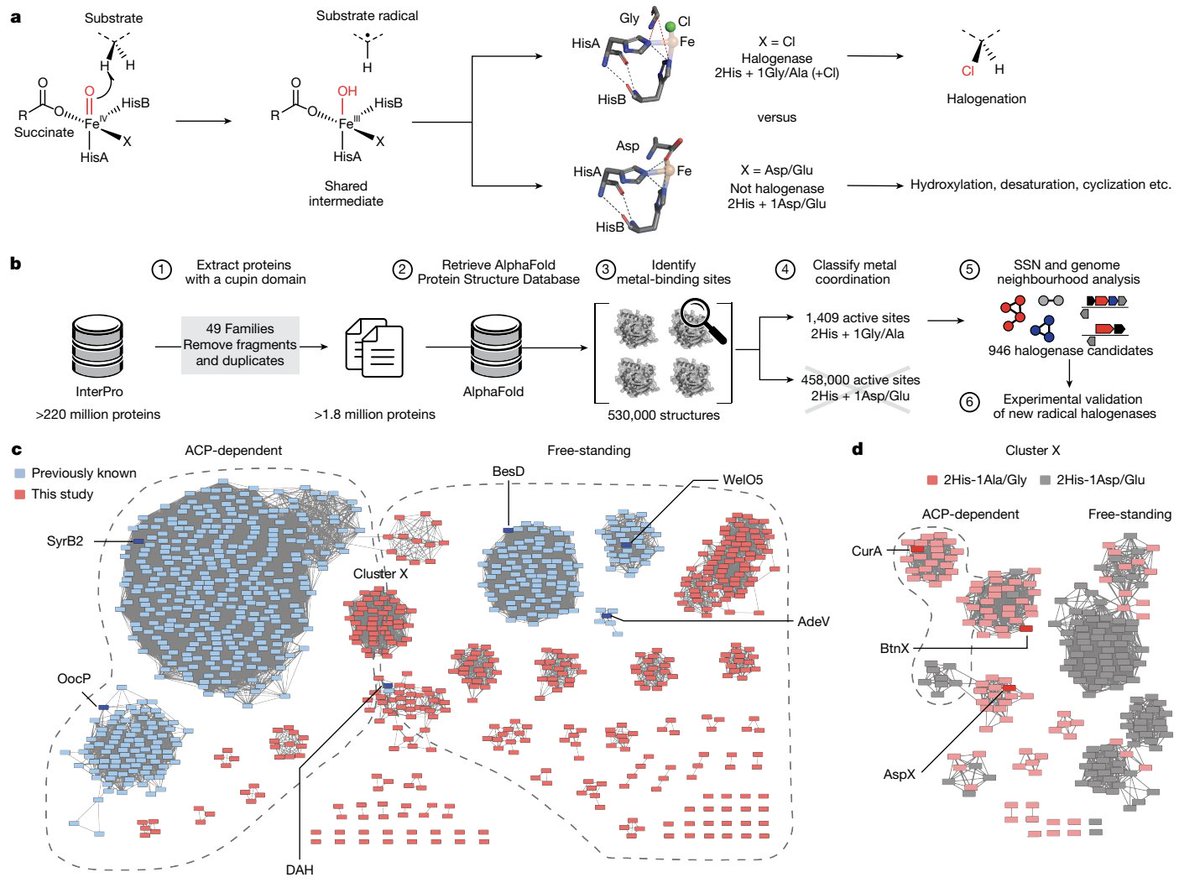
Targeted enzyme discovery using metal-coordination mining 1 Metal-coordination mining uses atomic-level active-site geometry (not overall sequence similarity) to search predicted structures for specific metalloenzyme functions, enabling targeted discovery within huge, diverse superfamilies. 2 The key mechanistic insight: FeII/αKG-dependent radical halogenases require an open metal coordination site for halide binding, so the canonical 2His-1Asp/Glu facial triad is replaced by a 2His-1Gly/Ala motif; this absence of Asp/Glu becomes a minimal structural signature for halogenation. 3 The pipeline scales efficiently by searching 3D motifs (effectively N^1) rather than pairwise sequence comparisons (N^2), making it practical for database-scale mining where subtle residue differences are otherwise hard to detect. 4 Applied to InterPro AlphaFold2 DB: from ~220M sequences, the authors extracted ~1.8M cupin-domain proteins, retrieved ~530,814 AF2 structures, identified ~458,000 predicted 2His metal sites, and then pinpointed 946 candidates with 2His-1Gly/Ala (putative radical halogenases). 5 A sequence-similarity network built from these candidates recapitulated all known FeII/αKG halogenase families and expanded the landscape dramatically: 70 previously unrecognized clusters spanning broad phylogenetic space, including multiple new eukaryotic-associated groups (e.g., a much larger DAH-related cluster than BLAST reveals). 6 Experimental validation focused on a newly identified “cluster X” with mixed genomic contexts (ACP-associated and apparently free-standing). Genome neighborhood analysis guided substrate hypotheses rather than relying on sequence alone. 7 AspX (from Vibrio campbellii) was shown to be a free amino-acid halogenase that selectively converts L-aspartate to 3S-chloro-L-aspartate (kcat ~33.3 min−1, Km ~0.64 mM), extending known free-substrate halogenation to a negatively charged amino acid; it can also install Br and N3 with alternative anions. 8 BtnX (from Dinoroseobacter shibae “killer plasmid”) was linked by gene context to biotin uptake and validated as a biotin halogenase producing 2R-chlorobiotin with very tight binding (Km < 2 μM), consistent with low marine biotin availability; product stereochemistry was supported by crystallography. 9 BtnX is unusually substrate-promiscuous for this enzyme class: it halogenates many non-native carboxylate-containing molecules (from fatty acids to dyes to peptides) as long as a propionate-like head group is present, enabling access to diverse α-halo acids relevant to synthesis and late-stage functionalization. 10 Structural basis of promiscuity: crystal structures show specific H-bonding that anchors the substrate carboxylate near the reactive center, while the remainder of the substrate extends into a solvent-exposed channel with mostly nonspecific interactions; a single active-site mutation (G117D/E) switches BtnX from halogenation to hydroxylation, highlighting how metal-coordination rules can also guide enzyme reprogramming. 💻Code: doi.org/10.5281/zenodo.19737… 📜Paper: doi.org/10.1038/s41586-026-1… #ComputationalBiology #Bioinformatics #EnzymeDiscovery #Metalloenzymes #AlphaFold #StructuralBioinformatics #Biocatalysis #NaturalProducts #ProteinEngineering
1
25
2,219
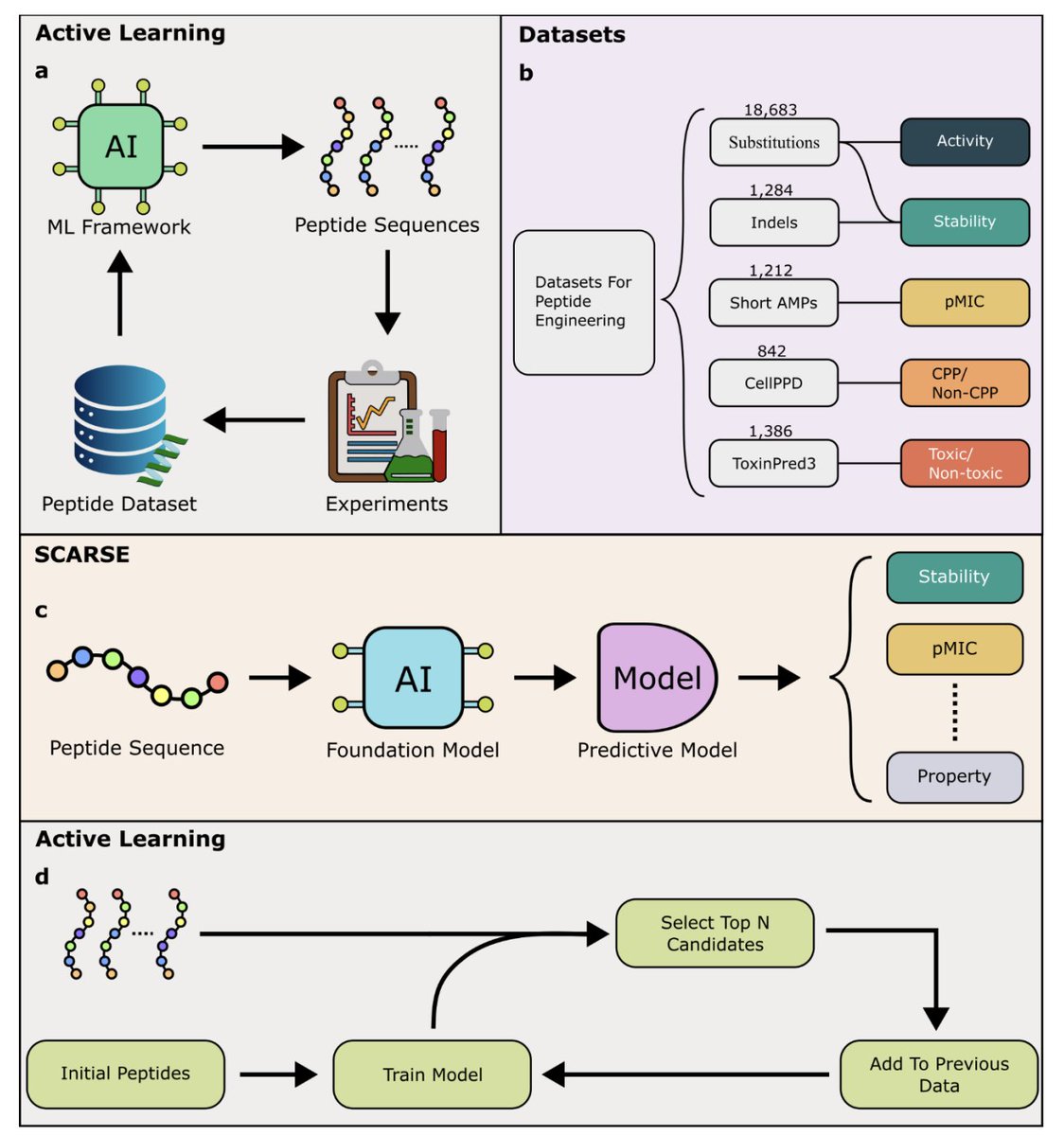
AI-guided discovery for low-resource peptide engineering using evolutionary scale modeling 1. The study argues that a simple metric—cross-validation R²—can act as a practical early proxy for how well an active-learning peptide engineering campaign will perform, helping teams decide whether to invest in iterative wet-lab cycles. 2. It introduces SCARSE (Small-sample Classification And Regression Solution for low-resource peptide Engineering), a low-data framework designed for 20–500 labeled peptides, combining ESM-2 (650M) sequence embeddings with Gaussian process regression (for regression tasks) and extremely randomized trees (for classification). 3. A key design choice is to avoid PLM fine-tuning and avoid MSAs, reducing compute and making the approach more suitable for short peptides where alignments can be unreliable and evolutionary signal is limited. 4. Benchmarking spans 23 datasets: 10 substitution (DMS-style) datasets (39–87 aa), 10 indel datasets (39–71 aa), plus short antimicrobial peptides (5–20 aa, pMIC regression), cell-penetrating peptides (5–25 aa, classification), and toxic/non-toxic peptides (5–14 aa, classification). 5. Against a hand-engineered descriptor baseline (modlAMP global descriptors composition and helix-inspired features), SCARSE is consistently stronger on substitution and especially indel fitness prediction; the baseline often fails on indels (mean R² < 0), while SCARSE reaches mean R² ~0.55 with 20 samples and ~0.76 with 80. 6. On very short, compositionally diverse peptide datasets (AMPs and CPPs), SCARSE is often comparable to the descriptor baseline, supporting the interpretation that simple composition-level features can capture much of the signal when sequences are short and diverse rather than near-mutant neighborhoods. 7. Beyond overall test-set R², the paper emphasizes “extreme-value” utility for engineering: SCARSE improves top-ranked selection quality (e.g., Top-20 accuracy) on substitution datasets, aligning evaluation with how practitioners actually pick candidates to synthesize. 8. Active-learning workflow simulations (greedy top-k exploitation): start with 20 random peptides, then iteratively add the top 20 predicted peptides for 10 rounds (200 total). Across substitution datasets and short AMPs, SCARSE consistently beats random sampling at enriching true top-10% performers, in some cases achieving up to ~7x more high-value peptides at the endpoint than random. 9. The central practical takeaway: CV R² computed from small random subsets correlates strongly with active-learning endpoint enrichment (Pearson ~0.83–0.89). While 20 labeled peptides can already enable useful selection, around 50 labeled peptides are suggested as a more reliable minimum to estimate whether an active-learning campaign with SCARSE is likely to pay off. 💻Code: github.com/LeoAnd00/SCARSE ; github.com/LeoAnd00/SCARSE-r… 📜Paper: biorxiv.org/content/10.64898… #PeptideEngineering #ActiveLearning #ProteinLanguageModels #ESM2 #GaussianProcesses #AntimicrobialPeptides #ComputationalBiology #MachineLearning #Bioinformatics
2
22
2,129
MolSafeEval: A Benchmark for Uncovering Safety Risks in AI-Generated Molecules 1. MolSafeEval reframes molecular generation evaluation around a missing axis: whether AI-generated molecules are toxic, reactive, or otherwise hazardous, even when they look “successful” on novelty or property objectives. 2. Instead of relying on a single toxicity predictor, the work builds MolSafeKG, a structured molecular safety knowledge graph integrating heterogeneous evidence: 83,925 hazardous compounds, 68 GHS hazard labels (physical/health/environmental), and 8 drug-toxicity endpoints (carcinogenicity, mutagenicity, cardio/respiratory/neuro/nephro/hepato/hematotoxicity). 3. The benchmark couples MolSafeKG with a retrieval-augmented LLM pipeline: RDKit parses a generated molecule, retrieves top-n hazardous analogs via Tanimoto similarity, then an LLM synthesizes evidence to output both risk predictions and human-readable explanations. 4. MolSafeEval standardizes safety evaluation across four common molecular generation task types, enabling apples-to-apples comparisons: unconditional generation, property optimization, target protein–based design, and text-to-molecule generation, each with defined datasets and generation quotas. 5. Datasets and protocols are concretely specified: GEOM-DRUG for unconditional generation (1,000 samples), ZINC for property optimization with LogP/QED objectives (1,600 optimized outputs), CrossDocked2020 for structure-based design (5,000 molecules across 100 pockets), and ChEBI-20 for text-conditioned generation (3,300 outputs). 6. The paper validates the evaluation framework on 11 safety prediction tasks using scaffold-based splits (to mimic generalization beyond known scaffolds). Integrating KG retrieval substantially improves LLM reliability versus using general-purpose LLMs alone; the best configuration reports ~0.80 average accuracy across toxicity tasks and improved hazard-level prediction consistency. 7. Stability checks address LLM stochasticity: repeated runs and prompt paraphrases show high agreement (roughly mid-90% stability for most toxicity endpoints; lower but still substantial stability for some hazard categories), supporting that the benchmark’s conclusions are not driven by prompt noise. 8. Large-scale evaluation of 28 state-of-the-art generative models reveals substantial hidden risk: some models produce extremely high proportions of predicted toxic molecules (notably respiratory toxicity can exceed 90% in certain settings), and unconditional generators tend to be riskier than conditional/task-guided generators. 9. Hazard analysis suggests physical hazards are often lower (likely filtered indirectly by common early screening and training-data biases), while health and environmental hazards remain more challenging; low average hazard scores still hide high-risk outliers, motivating explicit labeling/exclusion in downstream use. 10. A safety–functionality tradeoff analysis in property optimization indicates toxic and non-toxic outputs can have similar optimized property profiles, implying that adding safety constraints may be feasible without fully sacrificing objective improvement. 📜Paper: arxiv.org/abs/2607.00464 #ComputationalBiology #DrugDiscovery #Cheminformatics #MolecularGeneration #GenerativeAI #AIAlignment #Safety #KnowledgeGraph #LLM #Benchmarking
6
15
1,718
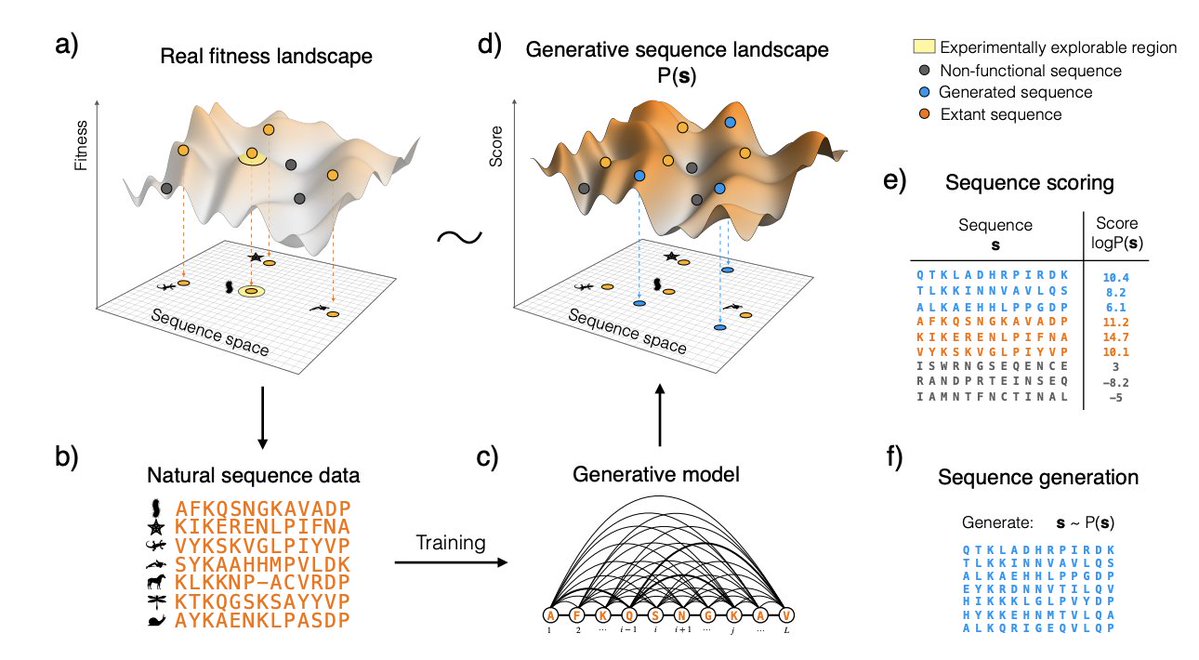
Modeling Protein Evolution with Generative Models: From Extant Sequence Data to Evolutionary Dynamics 1. The review reframes protein generative models as dynamical tools: instead of only scoring/designing sequences, inferred sequence probability landscapes P(s) are coupled to explicit evolutionary dynamics to simulate trajectories shaped by mutation, selection, drift, and epistasis. 2. A central emphasis is on Direct Coupling Analysis (DCA) as an interpretable, experimentally validated generative landscape: sequence score ϕ(s)=log P(s) decomposes into site “fields” and pairwise “couplings”, enabling context-dependent mutation effects via explicit epistasis terms. 3. It distinguishes two complementary evolution formalisms on generative landscapes: (i) population-genetic simulations (mutation/selection/amplification cycles resembling Wright-Fisher/Moran intuition) for short-term within-population evolution, and (ii) Generative Substitution Models (GSMs) for origin-fixation-like lineage evolution in the weak-mutation regime. 4. GSMs are presented as an MCMC-based substitution framework where a mutation proposal step G(s→s′) (mutation accessibility, potentially codon-aware) is combined with an acceptance step A(s→s′) driven by landscape score differences (e.g., Metropolis rule with selection-strength parameter β), yielding context- and site-dependent substitution behavior. 5. A key conceptual bridge is that GSMs are built to satisfy detailed balance and converge to the trained family distribution, making them “generative” in equilibrium while still providing interpretable, stepwise evolutionary intermediates—an explicit link between statistical physics sampling and evolutionary substitution modeling. 6. The review surveys evidence that DCA landscapes capture biologically relevant constraints across scales: correlation with deep mutational scanning effects (especially deleterious mutations), correct context dependence across divergent homologs, and the ability to maintain near-neutral scores along multi-mutation drift trajectories rather than predicting systematic collapse with distance. 7. It highlights global validations beyond mutation scoring: DCA couplings recover structural contacts from sequence coevolution, and sampling from DCA landscapes can yield experimentally functional, highly divergent sequences (e.g., enzyme libraries where activity fraction increases with model score). 8. For pathogens, the review summarizes how DCA-based landscapes integrated with evolutionary dynamics can forecast short-term viral evolution: timing of immune escape in HIV, emergence times of drug-resistance mutations under therapy, and vaccine-design-oriented analyses in HCV using fitness costs of escape and compensatory epistasis. 9. For laboratory evolution, GSM and generative population genetics are benchmarked against neutral drift and selection experiments: simulations help explain when experimental designs yield enough divergence/sample size to recover epistatic signals (e.g., contact prediction quality), and why phylogenetic structure or explicit population dynamics may be needed to reproduce selective sweeps and short-terminal-branch statistics. 10. The review closes with open challenges that define the next technical frontier: calibrating score-to-fitness mappings, handling phylogenetic structure explicitly, incorporating codon-level mutation biases and indels, improving realism of proposals/acceptance in dynamics, and integrating experimental measurements to refine landscapes and dynamics jointly. 📜Paper: arxiv.org/abs/2606.29529 #ComputationalBiology #ProteinEvolution #GenerativeModels #DCA #Epistasis #PopulationGenetics #Phylogenetics #MCMC #ProteinDesign #ViralEvolution
14
49
4,785
Pepti-drift: Toxicity-repulsive drifting for antigen-conditioned discrete peptide generation 1. Pepti-drift is a one-step, antigen-conditioned peptide generator that explicitly tackles a core therapeutic-design tension: sequence features that improve binding often overlap with features linked to cytotoxicity/hemolysis, so “optimize binding only” can land candidates in a risky overlap zone. 2. The method reframes peptide design as controlled movement in a peptide embedding space: generated peptide latents are pulled toward antigen-matched binders (attraction) while being pushed away from toxicity-associated regions (repulsion), aiming for a “safe & active” region rather than a generic binder-rich area. 3. Architecture in one pass: frozen ESM-2 (3B) encodes antigen and peptide sequences; learned projection heads reshape embeddings into a compact normalized latent space; an antigen-conditioned latent generator samples an initial latent from Gaussian noise; a drifting block applies a single learned refinement step; a non-autoregressive Transformer decodes the final latent into a peptide sequence in parallel. 4. The drift field is decomposed into two forces: (i) attraction toward the matched positive binder latent for the given antigen, and (ii) repulsion away from a local neighborhood of “hard” toxic negatives (nearest toxicity-associated peptide latents), weighted by a kernel so closer negatives repel more strongly. 5. A key training issue is gradient competition because binders and toxic peptides can be close in representation space. Pepti-drift introduces a warm-up schedule: learn binding-oriented attraction first, then gradually ramp the repulsion coefficient, stabilizing learning under overlapping positive/negative distributions. 6. Dataset design supports antigen generalization: 20,547 antigen–peptide binding pairs (8,712 antigens; 13,910 peptides) plus 12,709 toxicity/hemolysis-associated peptides curated from DRAMP 4.0, ToxinPred 3.0, and Hemolytik 2.0; evaluation uses an antigen-level CD-HIT split at 90% identity to reduce train-test antigen similarity. 7. Warm-up is not cosmetic: without warm-up, drifted latents stay far from matched binders and sequence metrics degrade; with warm-up, the model achieves much better binder-proximal drift and improves uniqueness/diversity/novelty in test-time generation. 8. Efficiency is central: generating 64 peptides for each of 1,095 test antigens, Pepti-drift runs at ~0.302 ms/peptide (3,312 peptides/s), ~16.2x faster than PepMLM and ~1,092x faster than PepTune in end-to-end timing (including antigen embedding and decoding). 9. Sequence-level behavior: all methods yield 100% valid sequences, but Pepti-drift shows the strongest diversity profile (98.1% uniqueness; highest Shannon entropy) and near-zero cross-antigen reuse (0.27), indicating high antigen specificity rather than recycling the same peptides across targets. 10. Property predictions suggest a practical trade-off: Pepti-drift preserves target-related binding signal (PeptiVerse binding-affinity score below PepMLM but above PepTune) while consistently lowering predicted toxicity across length bins and reducing hemolysis risk in most ranges; an independent hemolysis predictor (HemoPI2) also reports lower mean hemolysis scores for Pepti-drift across all length bins. 📜Paper: arxiv.org/abs/2606.27824 #ComputationalBiology #ProteinDesign #PeptideDesign #GenerativeAI #MachineLearning #DrugDiscovery #Bioinformatics #ProteinLanguageModels #SafetyByDesign #Therapeutics
4
12
1,767
CryoACE: An Atom-centric Framework for Accurate and Automated Model Building in Cryo-EM 1. CryoACE is presented as an end-to-end, atom-centric generative framework that builds full atomic graphs directly from cryo-EM density maps, targeting both homogeneous (single-structure) and heterogeneous (dynamic ensemble) reconstructions. 2. The central architectural shift is atom-centric reconstruction: instead of relying on expensive voxel-wise 3D convolutions as the main pathway, CryoACE samples density features directly at predicted atomic coordinates (via trilinear interpolation) and uses these “atomic profiles” to refine coordinates. 3. This design enables an iterative atomic self-refinement loop at inference: the model first predicts a coarse structure from sequence density, then re-samples density at the newly predicted atom positions to create better local features, repeating for multiple refinement cycles. 4. CryoACE integrates three modalities during training: (i) sequence/MSA features encoded with a Boltz-1-style MSA module Pairformer, (ii) density map features encoded from 3D patches with a 3D ResUNet plus 3D rotary positional embeddings, and (iii) atom profiles as localized density descriptors tied to candidate coordinates. 5. Multimodal fusion is implemented with cross-attention where sequence tokens query density tokens, aiming to enforce sequence/evolutionary constraints while still grounding coordinates in experimental density—especially important in low-resolution or noisy regions. 6. For heterogeneity, CryoACE introduces a training-free guidance scheme during diffusion sampling with a staged schedule: early-time global guidance aligns overall topology to a density-derived point cloud (weighted k-means Sinkhorn divergence), while late-time Q-guidance refines local atomic placement using predicted Q-scores. 7. A key practical addition is direct prediction of local resolution and per-atom/residue Q-scores via lightweight heads: predicted local resolution is used as a prior to manage ambiguous heterogeneous regions, and predicted Q-scores both accelerate inference and provide signals for late-stage guidance. 8. The work also contributes a curated training dataset (10,915 density–structure–sequence triplets, <4 Å, pre-2025) with a two-stage alignment pipeline and strict filtering (including Q-score thresholds and a “structure modeled rate” criterion) to reduce map-model misalignment and incomplete-structure noise. 9. On the Cryo2StructData test set (excluded from training), CryoACE reports 100% completeness and improved geometric/density agreement versus neural baselines (ModelAngelo, CryoAtom, E3-CryoFold), achieving higher backbone/all-atom accuracy, lower RMSD, and the best Q-score among compared methods. 10. On real heterogeneous datasets (EMPIAR-10345 integrin; EMPIAR-10516 SARS-CoV-2 spike), CryoACE is reported to recover complete dynamic ensembles with strong map fit (weighted cross-correlation) and improved physical plausibility (lower clash rates, good MolProbity), while maintaining stable frame-to-frame structural consistency (PSC). 📜Paper: arxiv.org/abs/2606.31332 #CryoEM #StructuralBiology #ProteinStructure #DiffusionModels #DeepLearning #ComputationalBiology #ModelBuilding #Heterogeneity #Bioinformatics #AIforScience
3
15
1,957
Can Tabular In-Context Learners Generalize to Biomolecular Property Prediction? 1. The paper evaluates a counterintuitive idea: tabular foundation models (TabPFN3, TabICL), pretrained on synthetic causal tables, can still transfer to biomolecular property prediction when biomolecules are first converted into fixed-length feature vectors. 2. The key framing is “learner–representation pairs”: a frozen domain encoder (protein LM embeddings or molecular descriptors) produces a feature vector, then a tabular in-context learner predicts from a labeled support set at inference time (no task-specific gradient updates). 3. Protein fitness regression is tested with a fixed ESMC (300M) embedding (960-dim) to isolate the predictor’s contribution. Across 217 ProteinGym DMS assays (random 5-fold), TabPFN3 leads with mean Spearman 0.767 and mean MSE 0.351; TabICL is close (Spearman 0.753, MSE 0.376), both outperforming ridge, HistGradientBoosting, and fine-tuned ESMC under the same embedding. 4. The improvement is broad rather than driven by a few assays: TabPFN3 has higher Spearman than TabICL on 208/217 assays, but the mean delta is modest (about 0.014), suggesting consistent but not extreme gains. 5. The authors emphasize split sensitivity on ProteinGym: performance drops notably on harder official schemes (modulo and contiguous) versus random splits, for both TabPFN3 and TabICL. This is used as a caution against overinterpreting random-split numbers as the sole generalization estimate. 6. Few-shot protein results (support sizes 8–64, repeated draws with quantile-bin sampling) show tabular ICL can exploit ESMC embedding geometry with very limited labels. On ProteinGym at k=8, TabPFN3 reaches Spearman 0.361 (vs TabICL 0.327); at k=64, TabPFN3 reaches 0.537 (vs TabICL 0.505). 7. A second protein setting (PpEST esterase family; 5 endpoints including reaction rates and thermostability) supports the same trend: TabPFN3 and TabICL are the strongest overall methods, trading small differences in MSE vs rank preservation; fine-tuned ESMC is the strongest non-tabular baseline. 8. For small-molecule binary classification, the conclusion is less uniform: no single method dominates across TDC ADMET, MoleculeNet, FS-Mol, and DrugOOD. Representation choice (ECFP, RDKit descriptors, or concatenation) often changes rankings as much as switching learners, consistent with tabular predictors being largely “structure-agnostic” beyond what the representation encodes. 9. DrugOOD highlights the gap between in-distribution and OOD behavior: all methods show positive ID–OOD drops under assay/scaffold/size shifts, and the magnitude depends on representation and pretraining. In full-train summary, ChemProp CheMeleon is best on DrugOOD OOD ROC-AUC (mean 0.701), while tabular pairs are competitive in several few-shot regimes. 10. Practical limitations are explicitly tracked: some very large ProteinGym assays required PCA “rescue” runs for feasibility; MoleculeNet full-train TabPFN3 coverage is incomplete due to resource-infeasible PCBA endpoints; ROC-AUC can be undefined on single-class splits; and support-set sensitivity is treated as an analysis axis rather than hidden by averaging. 📜Paper: arxiv.org/abs/2606.31126 #ComputationalBiology #ProteinEngineering #DrugDiscovery #FewShotLearning #InContextLearning #TabularML #FoundationModels #ProteinGym #ADMET #OOD
2
9
1,744
Deep residual learning for molecular force fields 1. The paper introduces Residual Learning Force Field (ResFF), a hybrid ML force field that predicts total energy as: physics-inspired MM covalent baseline (bond/angle/torsion) a lightweight equivariant neural residual that learns the remaining energetic effects, aiming to reduce the usual trade-off between accuracy, efficiency, and generalization. 2. Key design choice: covalent interactions are modeled with analytical MM terms whose parameters are generated by a 2D GNN from topology (fixed at simulation time), while an Equivariant Transformer (3D GNN) learns short-range, environment-dependent residual corrections from coordinates—positioning the MM part as an “identity mapping” and the NN as a “residual mapping” (ResNet-style). 3. Training is explicitly structured to make the two components complementary rather than redundant: (1) fit MM covalent terms first (residual off), (2) freeze MM and train residual on the discrepancy, (3) jointly fine-tune end-to-end. This is presented as a practical way to avoid the limitations of delta-learning with a fixed baseline and to reduce term-overlap between analytic and learned components. 4. Extrapolation tests emphasize “unseen molecules” splits (not just unseen conformations): on Gen2-Opt (~200k drug-like molecules), ResFF reports MAE 1.16 kcal/mol and Pearson r 0.893; on DES370K dimers it reports r 0.987, outperforming classical MMFFs (OpenFF/GAFF) and showing stronger robustness than local NNFFs that can overfit under molecule-level splits. 5. Torsional energetics: after recomputing torsion benchmarks at a consistent QM level (ωB97M-D3(BJ)/def2-TZVPPD), ResFF achieves MAE 0.45 kcal/mol on TorsionNet-500 and 0.50 kcal/mol on Torsion Scan, while also reducing systematic bias in torsional barrier heights (mean ΔΔEbarrier ~0.02 kcal/mol vs a negative bias reported for a scale-matched MACE-OFF(S) baseline). 6. Intermolecular interactions: on S66×8 (recomputed at ωB97M-D3(BJ)/def2-TZVPPD), ResFF reports RMSE 0.55 kcal/mol and shows stable agreement across distance scans; the paper frames its residual as a near-equilibrium correction rather than an attempt to reconstruct explicit long-range electrostatics inside a finite-cutoff NN. 7. Geometry/energy minima at scale: on the OpenFF Industry Benchmark (73,301 drug-like molecules), ResFF is competitive with scale-matched NNFFs in SPICE-like regions, and shows stronger robustness in extrapolative regimes (low similarity to SPICE) and for highly flexible molecules (>20 rotatable bonds), improving relative conformer energy agreement (ΔΔE) while maintaining reasonable RMSD/TFD. 8. Molecular dynamics stability and practicality: ResFF is demonstrated in OpenMM in multiple settings—metadynamics of AcAla3NMe, vacuum folding of Ala15 into an α-helix from an extended start, stability of an 8-ring cyclic peptide nanotube-like assembly (~848 atoms) with inter-ring spacing close to experiment, and stable ligand dynamics in a Tyk2 protein–ligand system under a hybrid setup. 9. Efficiency claims: the residual network is intentionally compact (~320k parameters). Reported throughput includes ~5×10^6 steps/day for a peptide benchmark on an A100 GPU; scaling tests report ~0.024 ms/atom/step, giving ~2.5×10^6 steps/day for ~1,000 atoms (similar order to MACE-OFF(S)), with suggested future acceleration via engineering/C and multiple time step (MTS) schemes. 10. Limitations are stated clearly: analytical covalent forms may cap ultimate accuracy; current architecture does not explicitly model long-range Coulomb/polarization, so highly charged systems, coordination chemistry, and long-range-dominated condensed phases may require retraining/fine-tuning or future explicit long-range components. 💻Code: github.com/Ameki0/ResFF 📜Paper: doi.org/10.1038/s41467-026-7… #ForceFields #MolecularDynamics #ComputationalChemistry #MachineLearning #EquivariantGNNs #DrugDiscovery #HybridModels #OpenMM #QM #ResidualLearning
3
23
2,145