Filter
Exclude
Time range
-
Near
BiologyAIDaily
A Generalizable Interface-Seeded Framework for De Novo Design of Functional Oligomers 1. The paper introduces an “interface-seeded” generative design strategy: instead of docking existing protein building blocks into a target symmetry, it uses a previously validated protein–protein interface (PPI) as the seed and generates new symmetry-compatible protomers around it. 2. Key implementation detail: a new symmetric motif-scaffolding module in RFdiffusion that preserves the interface motifs while sampling seed orientations and radial placements, then “drags” the motif radially during denoising to bias toward compact, well-packed cyclic oligomers. 3. This directly addresses a practical bottleneck in symmetric assembly design: dock-and-design success is often limited by geometric incompatibility between chosen protomers and target symmetries (C3/C4/C5), producing strong biases and low hit rates. 4. Benchmarking with LHD heterodimer seeds (LHD101, LHD29), the framework produced many expressible designs (63/64 expressed), with a substantial fraction matching the intended oligomeric states by SEC (33/63) and SEC-MALS (18/63). 5. Structural accuracy was validated by crystallography for multiple designs: C3 trimers (PI25, PI31) and a C4 tetramer (PI57) closely matched design models (Cα RMSD < 1.6 Å), including accurate interface side-chain placement; the resulting folds were also “new-to-nature” by Foldseek comparisons. 6. The approach generalizes to chemical triggers by reusing ligand/metal-dependent PPIs as seeds (often fragmented into many discontinuous segments), enabling conditional C3 assembly for Cu2 (MC11), cholic acid (CHD04), and venetoclax (LBM10). Measured effective assembly affinities were in the ~100 nM range (e.g., MC11 Kd,eff 137 nM; LBM10 Kd,eff 130 nM). 7. Crystal structures of CHD04 and LBM10 matched their design models and showed ligand occupancy in the engineered pockets, demonstrating that the seeded responsive interface can be transplanted into entirely new oligomer topologies while retaining chemical control. 8. A major functional advance is reversible phosphorylation-controlled oligomerization using a dynamic “phosphoswitch” interface seed: phosphorylation by PKA shifts monomer→oligomer, and λ-phosphatase reverses it back. Single interface-weakening mutations reduced unwanted basal oligomerization while preserving phospho-dependent assembly (PO5s, PO18s). 9. The work also demonstrates multi-input control: introducing a disulfide lock created a system that requires both reducing conditions and phosphorylation to oligomerize, enabling dual-gated assembly behavior in a de novo designed oligomer. 10. Applications go beyond in vitro biophysics: (i) ligand-triggered membrane binding via MinD membrane-targeting sequence fusions (Cu2 or CHD induces oligomerization-driven avidity on supported lipid bilayers), and (ii) phosphorylation-inducible transcription in HEK293T cells by coupling PO18s trimerization to an HSF1-based reporter, yielding ~6-fold induction (and >14-fold with combined endogenous engineered PKA activation). 💻Code: github.com/Khmelinskaia-Lab/… ; github.com/Khmelinskaia-Lab/… 📜Paper: biorxiv.org/content/10.64898… #ProteinDesign #RFdiffusion #AlphaFold3 #SyntheticBiology #ComputationalBiology #ProteinEngineering #DeNovoDesign #SignalTransduction #Phosphorylation #Nanobiotechnology
10
52
3,550
LabsBoltzmann
Protein engineering is becoming increasingly data-driven. The challenge is turning that data into actionable discoveries. Our Boltzmann Platform helps researchers design proteins, antibodies, and enzymes while optimizing multiple objectives simultaneously. AI built for biology. #ProteinEngineering #Biologics #AI
2
52
BiologyAIDaily
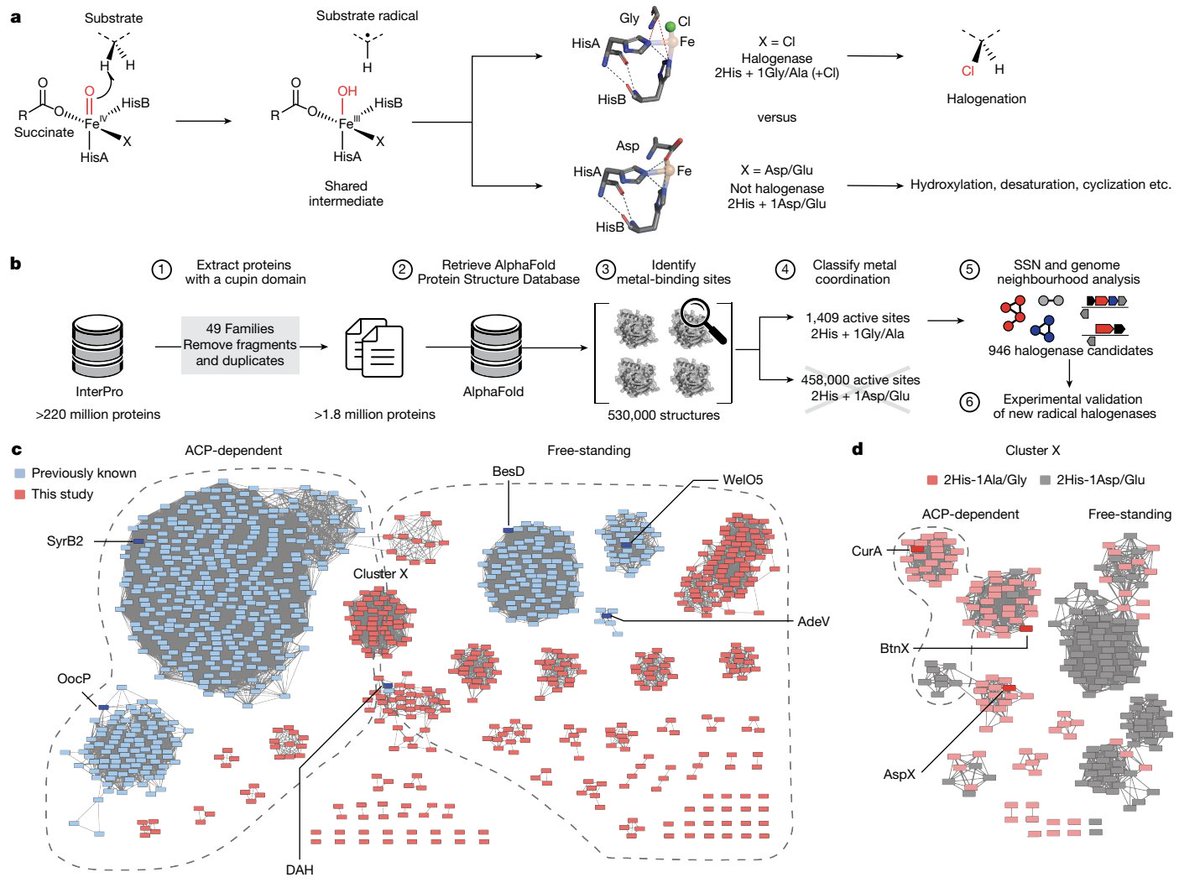
Targeted enzyme discovery using metal-coordination mining 1 Metal-coordination mining uses atomic-level active-site geometry (not overall sequence similarity) to search predicted structures for specific metalloenzyme functions, enabling targeted discovery within huge, diverse superfamilies. 2 The key mechanistic insight: FeII/αKG-dependent radical halogenases require an open metal coordination site for halide binding, so the canonical 2His-1Asp/Glu facial triad is replaced by a 2His-1Gly/Ala motif; this absence of Asp/Glu becomes a minimal structural signature for halogenation. 3 The pipeline scales efficiently by searching 3D motifs (effectively N^1) rather than pairwise sequence comparisons (N^2), making it practical for database-scale mining where subtle residue differences are otherwise hard to detect. 4 Applied to InterPro AlphaFold2 DB: from ~220M sequences, the authors extracted ~1.8M cupin-domain proteins, retrieved ~530,814 AF2 structures, identified ~458,000 predicted 2His metal sites, and then pinpointed 946 candidates with 2His-1Gly/Ala (putative radical halogenases). 5 A sequence-similarity network built from these candidates recapitulated all known FeII/αKG halogenase families and expanded the landscape dramatically: 70 previously unrecognized clusters spanning broad phylogenetic space, including multiple new eukaryotic-associated groups (e.g., a much larger DAH-related cluster than BLAST reveals). 6 Experimental validation focused on a newly identified “cluster X” with mixed genomic contexts (ACP-associated and apparently free-standing). Genome neighborhood analysis guided substrate hypotheses rather than relying on sequence alone. 7 AspX (from Vibrio campbellii) was shown to be a free amino-acid halogenase that selectively converts L-aspartate to 3S-chloro-L-aspartate (kcat ~33.3 min−1, Km ~0.64 mM), extending known free-substrate halogenation to a negatively charged amino acid; it can also install Br and N3 with alternative anions. 8 BtnX (from Dinoroseobacter shibae “killer plasmid”) was linked by gene context to biotin uptake and validated as a biotin halogenase producing 2R-chlorobiotin with very tight binding (Km < 2 μM), consistent with low marine biotin availability; product stereochemistry was supported by crystallography. 9 BtnX is unusually substrate-promiscuous for this enzyme class: it halogenates many non-native carboxylate-containing molecules (from fatty acids to dyes to peptides) as long as a propionate-like head group is present, enabling access to diverse α-halo acids relevant to synthesis and late-stage functionalization. 10 Structural basis of promiscuity: crystal structures show specific H-bonding that anchors the substrate carboxylate near the reactive center, while the remainder of the substrate extends into a solvent-exposed channel with mostly nonspecific interactions; a single active-site mutation (G117D/E) switches BtnX from halogenation to hydroxylation, highlighting how metal-coordination rules can also guide enzyme reprogramming. 💻Code: doi.org/10.5281/zenodo.19737… 📜Paper: doi.org/10.1038/s41586-026-1… #ComputationalBiology #Bioinformatics #EnzymeDiscovery #Metalloenzymes #AlphaFold #StructuralBioinformatics #Biocatalysis #NaturalProducts #ProteinEngineering
1
25
2,222
BiologyAIDaily
Can Tabular In-Context Learners Generalize to Biomolecular Property Prediction? 1. The paper evaluates a counterintuitive idea: tabular foundation models (TabPFN3, TabICL), pretrained on synthetic causal tables, can still transfer to biomolecular property prediction when biomolecules are first converted into fixed-length feature vectors. 2. The key framing is “learner–representation pairs”: a frozen domain encoder (protein LM embeddings or molecular descriptors) produces a feature vector, then a tabular in-context learner predicts from a labeled support set at inference time (no task-specific gradient updates). 3. Protein fitness regression is tested with a fixed ESMC (300M) embedding (960-dim) to isolate the predictor’s contribution. Across 217 ProteinGym DMS assays (random 5-fold), TabPFN3 leads with mean Spearman 0.767 and mean MSE 0.351; TabICL is close (Spearman 0.753, MSE 0.376), both outperforming ridge, HistGradientBoosting, and fine-tuned ESMC under the same embedding. 4. The improvement is broad rather than driven by a few assays: TabPFN3 has higher Spearman than TabICL on 208/217 assays, but the mean delta is modest (about 0.014), suggesting consistent but not extreme gains. 5. The authors emphasize split sensitivity on ProteinGym: performance drops notably on harder official schemes (modulo and contiguous) versus random splits, for both TabPFN3 and TabICL. This is used as a caution against overinterpreting random-split numbers as the sole generalization estimate. 6. Few-shot protein results (support sizes 8–64, repeated draws with quantile-bin sampling) show tabular ICL can exploit ESMC embedding geometry with very limited labels. On ProteinGym at k=8, TabPFN3 reaches Spearman 0.361 (vs TabICL 0.327); at k=64, TabPFN3 reaches 0.537 (vs TabICL 0.505). 7. A second protein setting (PpEST esterase family; 5 endpoints including reaction rates and thermostability) supports the same trend: TabPFN3 and TabICL are the strongest overall methods, trading small differences in MSE vs rank preservation; fine-tuned ESMC is the strongest non-tabular baseline. 8. For small-molecule binary classification, the conclusion is less uniform: no single method dominates across TDC ADMET, MoleculeNet, FS-Mol, and DrugOOD. Representation choice (ECFP, RDKit descriptors, or concatenation) often changes rankings as much as switching learners, consistent with tabular predictors being largely “structure-agnostic” beyond what the representation encodes. 9. DrugOOD highlights the gap between in-distribution and OOD behavior: all methods show positive ID–OOD drops under assay/scaffold/size shifts, and the magnitude depends on representation and pretraining. In full-train summary, ChemProp CheMeleon is best on DrugOOD OOD ROC-AUC (mean 0.701), while tabular pairs are competitive in several few-shot regimes. 10. Practical limitations are explicitly tracked: some very large ProteinGym assays required PCA “rescue” runs for feasibility; MoleculeNet full-train TabPFN3 coverage is incomplete due to resource-infeasible PCBA endpoints; ROC-AUC can be undefined on single-class splits; and support-set sensitivity is treated as an analysis axis rather than hidden by averaging. 📜Paper: arxiv.org/abs/2606.31126 #ComputationalBiology #ProteinEngineering #DrugDiscovery #FewShotLearning #InContextLearning #TabularML #FoundationModels #ProteinGym #ADMET #OOD
2
10
1,749
BiologyAIDaily
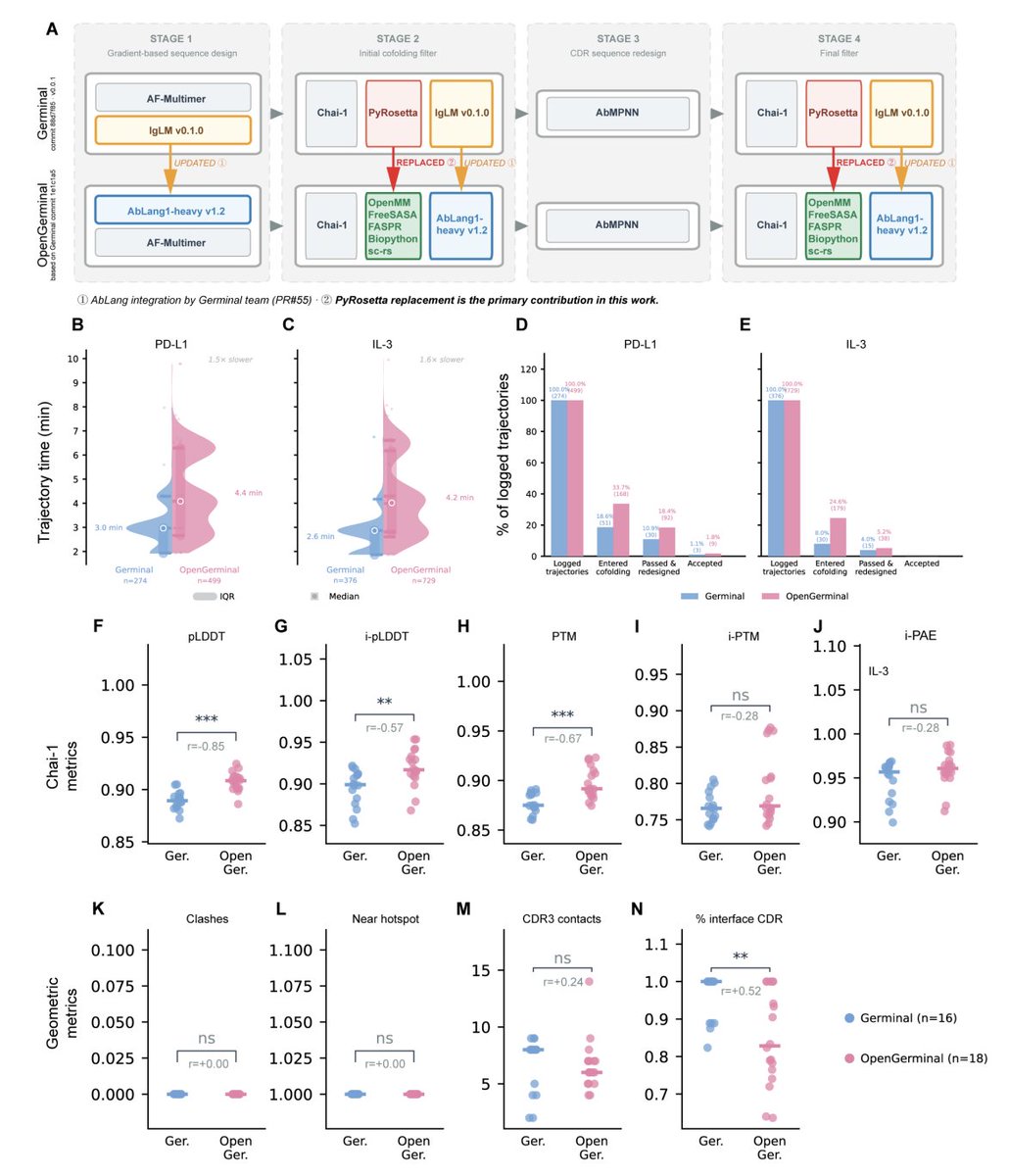
Opengerminal: An open-source implementation of the germinal antibody design pipeline 1 OpenGerminal re-implements the Germinal de novo antibody (VHH) design pipeline with a fully open-source stack, removing two major licensing bottlenecks in the original release: PyRosetta (restricted) and IgLM (non-commercial). 2 The most notable benchmark result is that swapping IgLM for AbLang1 as the hallucination guidance model substantially increases the fraction of trajectories that survive the initial Chai-1 cofolding validation: PD-L1 33.7% vs 18.6%, IL-3 24.6% vs 8.0 (OpenGerminal vs Germinal). 3 OpenGerminal follows the same 4-stage architecture: (1) AlphaFold-Multimer hallucination with PCGrad merging structural objectives (pLDDT/iPTM/PAE) and an antibody language-model naturalness loss, (2) Chai-1 cofolding relaxation interface scoring filter, (3) AbMPNN CDR redesign, and (4) Chai-1 re-fold stricter structural/physicochemical filters. 4 PyRosetta is replaced in stages 2 and 4 by an open-source backend: OpenMM 8.5.1 for relaxation, FASPR for side-chain repacking, FreeSASA Biopython for interface geometry, and sc-rs v1.0.0 for Lawrence–Colman shape complementarity. The goal is API-compatibility with the original PyRosetta utility module while enabling redistribution. 5 Tradeoff: per-trajectory hallucination time increases by ≥1.5× (A100 80GB): PD-L1 4.4 vs 3.0 minutes, IL-3 4.2 vs 2.6 minutes. End-to-end wall time can increase further because more trajectories proceed into the more expensive downstream filtering stages. 6 For accepted PD-L1 designs, OpenGerminal shows equivalent or improved Chai-1 confidence metrics: higher median pLDDT (0.908 vs 0.889), higher PTM (0.892 vs 0.875), and higher interface pLDDT (0.917 vs 0.899), while iPTM and interface PAE are similar between pipelines. 7 Interface geometry quality on accepted PD-L1 designs is broadly comparable: both pipelines produce clash-free designs positioned near target hotspots with similar CDR3–hotspot contact counts. One difference is a modestly lower fraction of interface residues located in CDRs for OpenGerminal (median 82.8% vs 100%), suggesting slightly different interface geometries. 8 The paper also provides post-hoc validation by rescoring OpenGerminal accepted structures with PyRosetta (without re-relaxation) and shows strong correspondence for shape complementarity (Spearman ρ=0.882) and good correspondence for interface hydrophobicity (ρ=0.763), supporting that the open-source metrics track established Rosetta-style evaluations. 9 Multi-chain target support is extended and debugged (chain parsing/renaming and Chai-1 sequence lookup issues), and verified to run on the official insulin example without error. The run produced cofolding-pass trajectories but no final accepted designs, highlighting that multi-chain success remains an open challenge rather than a solved capability. 10 Known limitations are explicitly documented: several Rosetta-energy-like metrics are currently placeholders (binder_score, interface_dG, interface_hbonds), which degrades stage-2 ensemble selection and effectively disables an H-bond filter in stage 4; future work is proposed to recalibrate OpenMM-derived energies and thresholds and improve ensemble selection with accessible metrics (e.g., interface ΔSASA). 💻Code: github.com/teaninja/OpenGerm… 📜Paper: biorxiv.org/content/10.64898… #computationalbiology #proteinengineering #antibodies #antibodydesign #openscience #alphafold #openmm #languagemodels #bioinformatics #HPC
5
14
2,177
BiologyAIDaily
Adversarial Sequence Mutations in AlphaFold and ESMFold Reveal Nonphysical Structural Invariance, Confidence Failures, and Concerns for Protein Design 1. The study systematically stress-tests AlphaFold 3 with adversarial sequence perturbations and finds a striking “structural invariance”: predicted folds often remain essentially unchanged even after mutating up to 40% of residues (including deliberately destabilizing substitutions) or deleting up to 10% of residues. 2. The benchmark spans 200 proteins split across 4 bins (monomer/multimer × novel/similar to training set, using a 30% homology cutoff). Notably, fold invariance is comparable for “novel” proteins and proteins with training-set homologs, arguing that the effect is not limited to obvious in-distribution cases. 3. The mutation protocol is explicitly designed to be disruptive rather than evolution-like: point mutations swap residues in a maximally deleterious way and are biased toward central/core regions; deletions are also biased toward central positions. Mutations are cumulative across thresholds, enabling controlled trajectories from 5% to 70% (point) and 1% to 10% (deletions). 4. Using TM-score ≥ 0.5 as a same-fold criterion, AlphaFold 3 frequently preserves global topology far beyond what physical intuition would suggest. Local quality degrades earlier (lDDT drops faster than TM-score), implying that packing worsens while the overall fold “stays locked.” 5. Multimers reveal an important asymmetry: while global fold/topology can remain stable, interfaces are much more fragile. DockQ drops rapidly with mutation burden; by 20% point mutation, about half of multimer interfaces are already incorrect relative to the unmutated AlphaFold 3 prediction. 6. Fold-switching proteins (15 experimentally validated monomeric cases) do not “switch” in AlphaFold 3 under mutations targeted to known fold-switching regions. Predictions remain highly invariant up to ~40% mutation (average TM-score ~0.63 vs the original predicted structure), suggesting a disconnect from biologically plausible mutational responses even in small monomers. 7. The paper contrasts AlphaFold 3 with ESMFold (monomers only). ESMFold is more mutation-sensitive, especially for point mutations: structural similarity to its own unmutated prediction collapses earlier (notably between 20% and 40% mutation), whereas AlphaFold 3 declines more gradually and only “catches up” near 70% mutation. 8. The authors interpret the AlphaFold 3 vs ESMFold difference as potentially reflecting training objective/input modality: ESMFold’s single-sequence masked-language-model objective may couple sequence identity to structure more tightly, even though ESMFold is not claimed to be more accurate in absolute terms on standard benchmarks. 9. Confidence metrics emerge as a second major failure mode. When generating 5 candidate structures and selecting by internal ranking, AlphaFold 3 picks the most accurate structure only ~25% of the time (AlphaFold 2 up to ~35%). Even when selection is wrong, the penalty can be large (up to ~0.17 TM-score loss or >0.40 DockQ loss). 10. A template-availability analysis (FoldSeek search against pre-cutoff PDB) shows AlphaFold 3 confidence correlates strongly with the structural similarity of the best available pre-cutoff template, while sequence identity to that template is a weak predictor. This supports the concern that confidence can act as a proxy for training-set structural coverage rather than calibrated uncertainty about physical correctness—relevant for mutation interpretation and gradient-based protein design workflows that assume meaningful sequence-to-structure sensitivity. 📜Paper: doi.org/10.34133/csbj.0142 #AlphaFold3 #ProteinFolding #ProteinDesign #ComputationalBiology #StructuralBiology #ESMFold #DeepLearning #Bioinformatics #ProteinEngineering #Benchmarking
4
48
4,072
BiologyAIDaily
Prot2Prop: Structure-informed multitask protein property prediction 1 Prot2Prop presents a single multitask model that jointly predicts six protein developability properties (material production, solubility, temperature stability, aggregation propensity, expression yield, folding stability), aiming to replace fragmented one-model-per-property workflows. 2 The core design is parameter-efficient multitask adaptation: a frozen ProstT5 encoder is augmented with a shared residual adapter plus task-specific residual adapters, enabling shared transfer while still letting each endpoint specialize at the residue (token) level. 3 A key architectural choice is where specialization happens: task-specific adapters are applied before pooling, then each task uses attention-based sequence pooling to learn which residues matter most for that property (rather than mean pooling). 4 The framework supports heterogeneous outputs in one model: three binary classification heads (material production, solubility, temperature stability) and three regression heads (aggregation propensity, expression yield, folding stability), trained with masked losses so partially labeled proteins still contribute signal. 5 On held-out test data (Seed 1 reference checkpoint), classification performance reached AUROC 0.866 (material production), 0.870 (solubility), and 0.984 (temperature stability), with corresponding F1 scores 0.853, 0.749, and 0.931. 6 Regression performance on the same test set showed strong rank fidelity (Spearman): 0.861 (aggregation propensity), 0.732 (expression yield), 0.838 (folding stability). The paper notes that some endpoints preserve ranking well even when absolute scaling is imperfect. 7 Post-hoc calibration is treated as a first-class step: per-task affine calibration for regression reduced folding stability MAE from 0.677 to 0.486 (RMSE 0.879 to 0.641) without changing Spearman, suggesting a sizable fraction of remaining error can be calibration-related. 8 The authors document an iterative development trajectory and identify the biggest win: introducing the shared adapter plus task-specific residual adapters before pooling (version 2026-04-29) produced the strongest regression gains while keeping classification stable; more complex options (ranking-aware losses, learned uncertainty weighting, ensembles) were mixed or not clearly better. 9 Practical efficiency is emphasized: only ~3.19M parameters are trainable, while ProstT5 stays frozen. In an inference benchmark (100 sequences, length ≤72) Prot2Prop ran faster than TemStaPro and SaProt (8.95s vs 15.56s vs 18.97s) on the reported hardware setup. 💻Code: github.com/NeurosnapInc/Prot… 📜Paper: biorxiv.org/content/10.64898… #ProteinEngineering #ProteinLanguageModels #MultitaskLearning #Developability #DeepLearning #ComputationalBiology #Bioinformatics
1
10
74
4,269
BiologyAIDaily
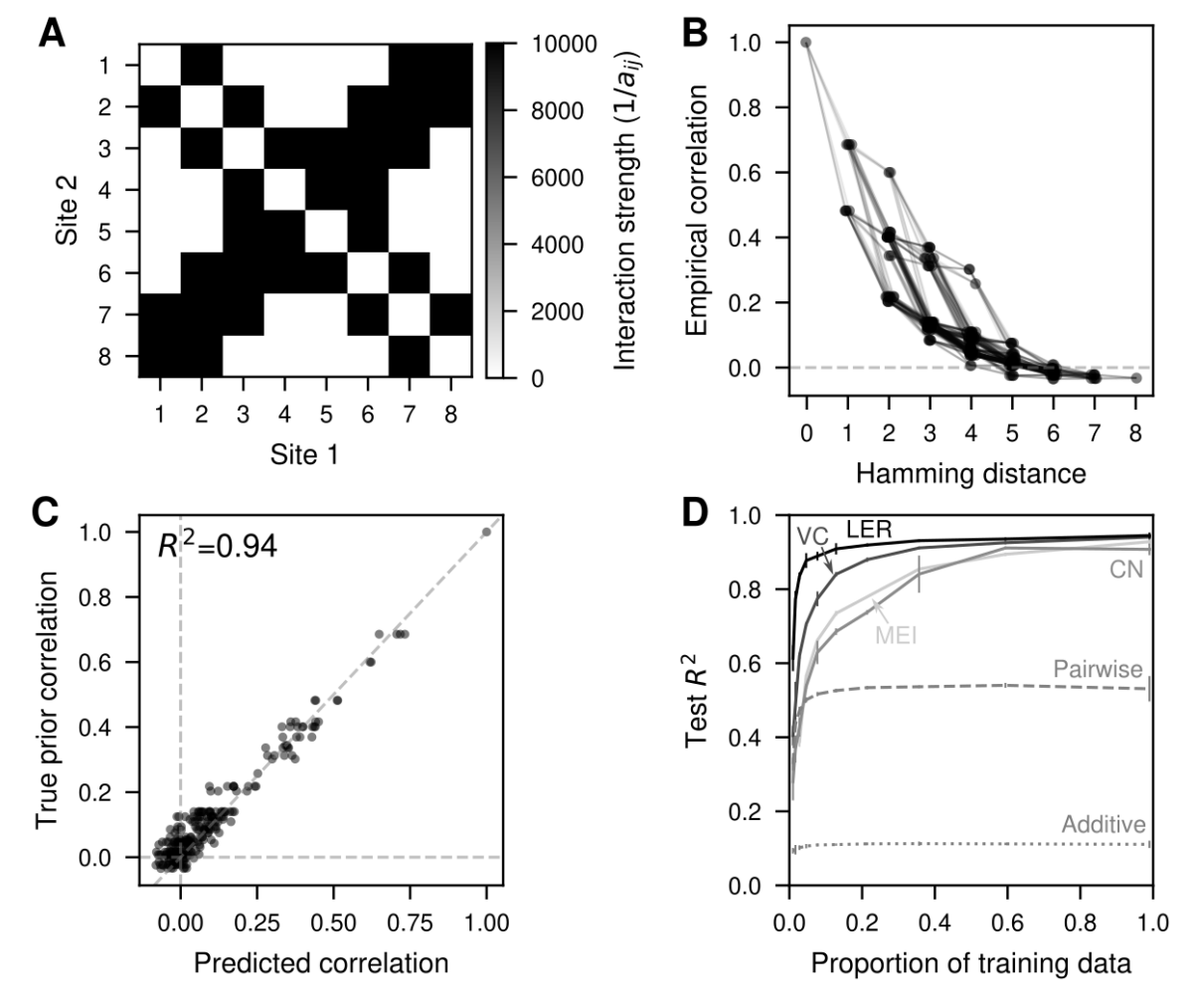
Inference of Fitness Landscapes with Heterogeneous Patterns of Epistasis Across Sites 1. Martí-Gómez and McCandlish introduce Local Epistasis Regression (LER), a Gaussian-process/Bayesian framework that learns which specific pairs of sites tend to interact, then uses that learned structure as a prior to infer complete fitness landscapes from noisy, incomplete combinatorial mutagenesis data. 2. Core summary statistic: for each site pair (i, j), compute the average squared local double-mutant epistatic coefficient ε^2_ij by averaging across all allele pairs and all genetic backgrounds. Unlike global “ruggedness” summaries, ε^2_ij localizes where epistasis concentrates across positions. 3. The paper generalizes these statistics beyond bi-allelic/pairwise settings: ε^2_U for any subset of sites U (multi-allelic, higher-order). It also derives explicit links between (i) average squared local |U|-way epistasis and (ii) the total variance explained by interactions that include U, plus a second link connecting background-to-background variability in local epistasis to strictly higher-order variance. 4. The LER prior is p(f) ∝ exp(-∑_{i<j} a_ij ε^2_ij(f)), where a_ij controls how strongly epistasis between sites i and j is penalized. This yields a structured (non-isotropic) prior: it can regularize some site pairs strongly (nearly additive) while allowing others to be highly epistatic. 5. A key technical point: despite being parameterized by pairwise penalties a_ij, the induced Gaussian random field still supports interactions of all orders. The authors show equivalence to a variance-by-subset representation (λ_U for all U) where λ_U depends on sums of a_ij within U, so higher-order terms remain present but are shaped by which site pairs are “allowed” to interact. 6. Hyperparameters are fit via an empirical Bayes approach using kernel alignment: estimate empirical correlations in measured fitness between sequence pairs that differ at the same subset of sites D (not just the same Hamming distance), then choose hyperparameters so the model reproduces these subset-specific correlations. 7. Simulation benchmark: in an RNA-helix-inspired landscape where interactions are stronger for neighbors and base-paired sites, LER recovers the correlation structure well from only 15% observed genotypes and improves prediction versus Minimum Epistasis Interpolation, Variance Component regression, and Connectedness regression—especially when training data are scarce. 8. Empirical landscapes show that predictability depends on which positions differ, not only how many differ. LER captures this heterogeneity and infers interpretable interaction maps: e.g., in the Smn1 5′ splice site landscape, it recovers strong neighbor-like interaction patterns consistent with RNA helix thermodynamics, plus notable exceptions (e.g., stronger 2/ 5 interaction and unusually additive behavior at 6). 9. Deep dive application: an 8-nt self-splicing intron landscape (65,536 genotypes). The inferred landscape is strongly epistatic (about 42% additive, 22% pairwise, ~35% higher-order). Positions 2 and 21 emerge as dominant: they explain much of pairwise variance and also reorganize higher-order interactions across the rest of the landscape, consistent with their mechanistic role in alternative helix formations during splicing. 10. Mechanistic interpretability: diffusion-based visualization separates genotype clusters largely by alleles at positions 2 and 21; within these clusters, mutational effects and even the sign of pairwise epistasis between other sites can flip, providing a concrete view of how higher-order epistasis can arise from coherent “rewiring” of local interactions across sequence space. 💻Code: github.com/cmarti/gpmap-tool… ; github.com/cmarti/deltaU 📜Paper: biorxiv.org/content/10.64898… #FitnessLandscape #Epistasis #GaussianProcess #BayesianInference #DeepMutationalScanning #ComputationalBiology #EvolutionaryGenetics #RNA #ProteinEngineering
1
2
7
1,280
K_Oisaki
Our new paper is out in Bioconjugate Chemistry ! We report a neutral-buffer, metal-free electrochemical method for tryptophan-selective bioconjugation. Using cooperative N-oxyl radicals, diverse peptides, proteins, and even trastuzumab can be labeled under biocompatible conditions. #Bioconjugation #Electrochemistry #ChemicalBiology #ProteinEngineering
1
4
46
3,056
DyadicInc
We're pleased to announce an important milestone as Dyadic strengthens its intellectual property portfolio in Japan while advancing business development activities in one of the world's leading biotechnology markets. As we continue executing our strategy to become a global provider of recombinant protein solutions, we're expanding relationships with prospective partners across life sciences, food & nutrition, industrial biotechnology and biopharma. Read the full announcement:dyadic.com/dyadic-expands-ip… $DYAI #Biotech #LifeSciences #Biopharma #ProteinEngineering #Japan #Innovation #BioFlorida
77
NWORobotics
#CHIRALITY-AWARE #CODONOPTIMISER: Beyond standard GC-content balancing. Our OPTIMISER incorporates stereochemical feedback loops to maximize translation efficiency for synthetic lifeforms. nwo.capital/genetic/#f-chi-c… #SyntheticBiology #Genomics #ProteinEngineering
1
4
6
77
BiologyAIDaily
Multi-Scale Machine Learning for Antibody-Antigen Binding Affinity Prediction Using Deep Mutational Scanning and Structural Features 1. The study tackles a key failure mode in antibody–antigen (Ab–Ag) affinity ML: models can look good under standard CV but generalize poorly to unseen complexes. The author evaluates with leave-one-complex-out deep mutational scanning (LOCO-DMS), a stricter setting designed to expose leakage and overfitting. 2. Core idea: a multi-scale feature fusion framework integrating multiple “views” of a mutation. Descriptors span physicochemical mutation deltas, 3D structural interface context, ESM-2 protein language model embeddings, and biophysical SASA/ΔΔGfold-style features (with optional GNN interface embeddings explored). 3. Benchmark focus: AbAgym LOCO-DMS on 36,541 interface mutations from 68 DMS experiments across 13 pathogens. Under this realistic generalization test, no single modality beats the majority baseline on its own; performance emerges only when modalities are fused. 4. Best single-model result under LOCO-DMS comes from an optimized 93-feature representation (38 physicochemical 34 structural 4 ESM-2 17 SASA/ΔΔG). Gradient boosting with 300 trees reaches MCC = 0.206 (accuracy = 0.696; balanced accuracy = 0.601; AUC = 0.657). 5. A notable negative result is that learned graph embeddings can hurt under LOCO-DMS: adding GNN/GAT representations introduced noise/overfitting to per-complex topology. Removing GNN features improved MCC from 0.172 (231 features) to 0.206 (93 features), highlighting that “more representation capacity” is not automatically more transferable. 6. The paper introduces an ensemble confidence protocol tailored to LOCO-DMS: train multiple classical models (HGBT, RF, GBM) and use ensemble disagreement (σens) as uncertainty. Filtering to strong-effect mutations plus high-confidence predictions yields MCC = 0.374 with 83.5% accuracy at 25.5% coverage (5,046 mutations). 7. A physics-grounded interpretability point: the author quantifies a “Boltzmann ceiling”. In AbAgym, 45.9% of mutations are near-neutral (within ~kBT noise floor), implying an upper bound on attainable MCC of ~0.473 even for an oracle that perfectly predicts strong effects but guesses neutral ones. The confidence-filtered protocol reaches 79.1% of this ceiling. 8. Deep learning is benchmarked under LOCO-DMS (five architectures). A SelfAttention model matches histogram gradient boosting (MCC = 0.200), but none surpasses GBM (0.206), suggesting the bottleneck is not model class but the limited transferable signal under stringent OOD evaluation. 9. Transfer across pathogens remains unresolved: cross-pathogen training/testing on AbAgym averages 46.7% accuracy (vs ~83.5% within-pathogen), indicating models often learn pathogen/experiment-specific patterns rather than universal binding principles. 10. Practical takeaway for antibody engineering: use multi-modal fusion plus calibrated confidence/coverage tradeoffs. The work argues that aggregate “low MCC” should be interpreted in the context of thermodynamic/experimental noise limits, and recommends confidence-stratified deployment rather than unconditional predictions. 📜Paper: biorxiv.org/content/10.64898… #ComputationalBiology #Bioinformatics #MachineLearning #ProteinEngineering #Antibodies #Immunology #StructuralBiology #DeepMutationalScanning #ProteinLanguageModels #UncertaintyQuantification
1
2
23
2,299
minchaofang
This enables “evolution on demand” and provides the first large-scale structure-function datasets for biocatalysts. #proteindesign #proteinengineering #syntheticbiology
4
53
BiologyAIDaily
Complexdesign: Sequence-Hallucination Design of Protein Binders Bridging Multiple Proteins 1. Designing a single de novo protein that simultaneously binds two independent target proteins is a major challenge because both the binder structure and the relative arrangement of the targets are unknown. This work introduces ComplexDesign, a hallucination-based framework that directly tackles multi-target binder design by allowing ternary complexes to emerge during optimization instead of relying on predefined target geometries. 2. The key innovation is a target-target masking strategy. During optimization, ComplexDesign removes pairwise information between the two target proteins, preventing AlphaFold-Multimer from treating them as a fixed assembly. As a result, the designed binder learns to independently engage both targets while discovering a compatible ternary architecture. 3. ComplexDesign uses a unified optimization pipeline for both unconditional multichain design and multi-target binder design. It combines: * AlphaFold-Multimer-guided sequence hallucination with gradient backpropagation * Multi-stage sequence optimization * ProteinMPNN sequence redesign * AlphaFold3 validation for confidence, self-consistency, and interface quality This creates an end-to-end framework that simultaneously optimizes protein folding and intermolecular interfaces. 4. Unlike previous methods that primarily focus on single-target binders or predefined complexes, ComplexDesign addresses higher-order protein assemblies. Across extensive benchmarks covering dimers, trimers, and tetramers with multiple chain-length combinations, it consistently outperformed representative generative models including APM and Chroma, achieving design success rates exceeding 50% across all evaluated settings. 5. The framework demonstrates particularly strong scalability as complex size increases. While competing approaches rapidly lose performance on trimers and tetramers, ComplexDesign maintains high AlphaFold3 confidence and structural self-consistency, indicating that simultaneous optimization of chain folding and interface formation is effective even for larger multimeric assemblies. 6. The authors further evaluated ComplexDesign on a challenging benchmark derived from MG-PDB for molecular glue-inspired ternary complexes. Among 10 difficult target pairs that are not predicted to form stable binary complexes on their own, ComplexDesign generated high-confidence, self-consistent ternary complexes for 8 target pairs, with AlphaFold3 ipTM values ranging from 0.85 to 0.93. 7. Interface analysis reveals an important insight into multi-target binder design. Successful binders require balanced optimization of two independent binding interfaces. Many failed designs converged to one-sided solutions that strongly bind only one target, highlighting coordinated interface optimization as the central bottleneck for future binder design methods. 8. The study also identifies several biological factors influencing design success. Homodimeric targets are generally easier than heterodimeric pairs, likely because of their structural symmetry. Target surfaces enriched in coils or β-structures are more difficult to design against than helical surfaces, and extremely short binders rarely achieve high-confidence interactions with both targets due to limited structural capacity. 9. Representative examples demonstrate the flexibility of ComplexDesign. One design generated an 82-residue four-helix binder bridging FKBP12 and FRB, while another produced a compact 43-residue two-helix binder connecting two PD-L1 protomers. These examples illustrate that the framework can discover diverse binding geometries and interface chemistries rather than converging to a single structural solution. 10. Although currently evaluated only computationally, ComplexDesign establishes a promising direction for designing programmable multichain protein assemblies and de novo bridging binders. The authors envision applications in molecular glues, PROTAC-inspired systems, proximity-inducing therapeutics, bispecific protein engineering, and synthetic multi-protein assemblies. Future work will focus on extending the framework to more than two targets, improving computational efficiency, and validating designed proteins experimentally. 📜Paper: doi.org/10.64898/2026.06.21.… #ProteinDesign #ComputationalBiology #AI4Science #AlphaFold #AlphaFold3 #ProteinEngineering #DeNovoDesign #StructuralBiology #MachineLearning #Bioinformatics #SyntheticBiology #DrugDiscovery
1
6
46
3,834
changmyung1981
🚀 Antibody Discovery Meets Machine Learning Antibody discovery remains slow, expensive, and biased toward dominant clones that survive experimental selection. A new Cell Systems study introduces a high-throughput hybrid platform combining synthetic antibody libraries, deep sequencing, and machine learning to dramatically expand the antibody discovery landscape. 🔬 The key innovation: Antigen Recognition Modules (ARMs) Rather than encoding diversity across all antibody CDRs, the authors compressed antigen-recognition information into a compact CDRH3-centered module paired with a light-chain barcode. This minimalist representation is optimized for next-generation sequencing and machine-learning analysis while retaining strong binding capacity. 🧬 A billion-antibody search space The synthetic Fab yeast-display library was built around a VH1-69 scaffold and four light chains, generating an estimated diversity approaching 1 billion unique antibodies while eliminating sequence motifs linked to aggregation and polyreactivity. The resulting repertoire closely mirrors natural human naïve B-cell sequence statistics. 🎯 Parallel screening against 10 challenging targets The platform was tested against diverse cell-surface antigens including: • PD-L1 • PD-L2 • TIGIT • IL23R • LOX1 • DKK1 • ROBO1 • ROBO2 • DCC • Syncytin-2 Hundreds of antibodies with strong biophysical properties were identified, including many with nanomolar affinities and favorable developability profiles. 📈 Machine learning rescues missed binders Experimental selection tends to enrich only a subset of functional antibodies. Using logistic regression trained on early-selection sequencing data, the authors identified overlooked ROBO2 and PD-L2 binders that had been lost during FACS enrichment. For ROBO2: ✅ 11 ML-predicted antibodies validated by cell-display assays ✅ Several showed superior kinetics compared with experimentally dominant clones ✅ Multiple novel epitope classes emerged from ML-selected candidates 🧠 Why this matters The study demonstrates that deep sequencing contains far more functional information than conventional antibody campaigns exploit. Rather than relying solely on experimentally enriched clones, machine learning can mine early-selection populations and recover high-quality binders that would otherwise be discarded. 🌐 An open resource for AI antibody design The authors released a public dataset containing: • >68,000 unique antigen-recognition modules • Selection trajectories across enrichment rounds • Binding and developability measurements for 486 antibodies • ML-ready sequence representations This creates one of the largest openly available datasets linking antibody sequence, selection dynamics, and experimental validation. Take-home message This work points toward a future where antibody discovery becomes a closed-loop AI system: Synthetic library → high-throughput selection → NGS → ML rescue → experimental validation → improved models Instead of replacing experiments, AI amplifies them—unlocking functional antibodies hidden within massive sequence space and accelerating reagent and therapeutic antibody discovery. #AIforBiology #AntibodyDiscovery #MachineLearning #ProteinEngineering #SyntheticBiology #TherapeuticAntibodies #YeastDisplay #ComputationalBiology #DrugDiscovery #CellSystems
5
12
446
Molecule_Maker
Summer research has begun for our 2026 MATRIX-Uni Fellows and their graduate mentors. #Research projects include: • Agentic Systems for #Chemistry • AI #ProteinEngineering • LLMs for #Enzyme Prediction • #AI-Guided Solar Cell Discovery #ArtificialIntelligence @NSF #NSFFunded
1
4
137
AkosNyerges
Grateful to Stephanie Dutchen @harvardmed for the interview about our latest publication, my story in science, and our lab's direction at the interface of directed evolution, #SyntheticGenomics, and #ProteinEngineering
1
2
17
990
Decode_Science
Aotearoa New Zealand's first Protein AI Workshop is happening in Christchurch — and Decode Science is proud to be co-sponsoring alongside @TwistBioscience. 🧬 @SynbioNZ @UCNZ #SyntheticBiology #ProteinEngineering #Workshop #Genomics #AIinScience
2
5
422