Filter
Exclude
Time range
-
Near
Danial_Gha
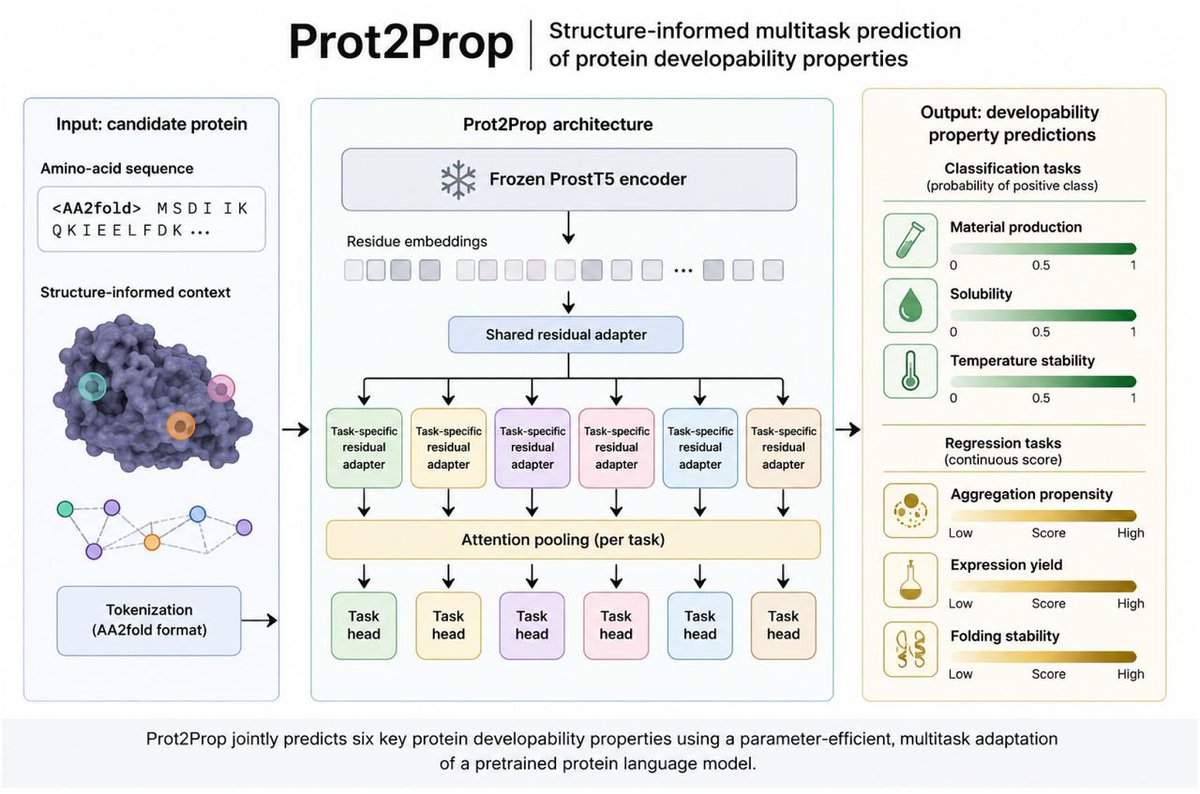
Excited to share our latest paper: Prot2Prop! A parameter-efficient multitask protein language model that jointly predicts six developability properties from sequence using lightweight adapters. ๐Ÿ“„ doi.org/10.64898/2026.06.28.โ€ฆ ๐Ÿ’ป github.com/NeurosnapInc/Protโ€ฆ
1
30
Hannes Stark retweeted
BiologyAIDaily
BoltzProt-1: Towards Efficient De Novo Binder Design with Good Developability 1 BoltzProt-1 is a de novo protein binder (incl. nanobody/VHH) design pipeline that explicitly targets two bottlenecks at once: improving prospective binding hit rates on novel targets and ensuring therapeutic-style developability (stability, solubility, low nonspecific binding, etc.). 2 The key technical shift is ranking designs with a dedicated proteinโ€“protein interaction predictor (BoltzPPI), rather than relying mainly on structure-prediction confidence proxies. In a budget-matched test on the same candidate pools, this changes selectionโ€”not generationโ€”and directly tests whether better ranking alone improves experimental recovery. 3 On 10 low-homology (novel) targets, replacing BoltzGenโ€™s selection with BoltzPPI ranking increases confirmed-binder rate from 3.3% (5/150) to 8.0% (12/150), a 2.4x gain. Screening hits also rise (revised hit rate 4.7% to 9.3%). Confirmed target coverage improves from 2/10 to 3/10 via ranking, and to 4/10 when paired with an improved generative model. 4 The paper also argues for stricter experimental reporting: it separates โ€œscreening hitsโ€ (including ambiguous sensorgrams) from โ€œconfirmed bindersโ€ (clean kinetics plus orthogonal confirmation). Confirmation uses a flipped assay orientation to reduce format-specific artifacts and avidity effects, with additional independent testing for some hits. 5 BoltzPPI is built on Boltz-2 representations and adds a PPI prediction head trained jointly with a confidence head. It uses interface-focused signals: token/pair features, predicted coordinates, distance embeddings, and binder/target masks, refined by a 4-block Pairformer stack (16 heads, dropout 0.25). 6 Training uses PDB and patent-derived complexes as positives, plus synthetically generated protein pairs as negatives. A multi-view training scheme drops trunk pairwise representations 50% of the time to encourage geometric reliance and reduce overfitting to internal trunk signals; additional regularization injects Gaussian noise into representations. The interaction head is trained with focal loss and combined with confidence losses. 7 On an external 10-target panel used by Chai-2, BoltzProt-1 reports screening hits on 7/10 targets, compared with 6/10 reported by Chai-2 and 3/10 for BoltzGen in this studyโ€™s setup. This suggests improved target coverage across diverse classes (signaling/adaptor proteins, cytokines/hormones, SUMOylation enzymes, calcium-binding regulators). 8 Developability is treated as a first-class outcome. Confirmed binders from the low-homology panel are evaluated across a broad assay suite (Twist Bioscience): thermal stability (Tonset, Tm1, Tm2), aggregation onset (Tagg), monomer purity (aSEC), heterogeneity (DLS PDI), hydrophobicity (HIC), polyspecificity (BVP ELISA), and self-association (AC-SINS). 9 Under combined developability criteria, 58% (7/12) of BoltzProt-1 confirmed binders pass every filter, exceeding BoltzGen confirmed binders (40%, 2/5) and clinical-stage controls measured in parallel (IgG 25%, 3/12; VHH-Fc 21%, 5/24). Attrition is minimal until hydrophobicity (HIC), which is the dominant failure point. 10 Novelty checks indicate recovered designs are not near-duplicates of known antibody/nanobody CDRs: every recovered design has minimum CDR3 edit distance โ‰ฅ4 to its closest SAbDab match (with larger distances when considering CDR1 2 3). Structural context is provided via binding-site similarity to known PDB interfaces (FoldDiSCO), highlighting that the low-homology benchmark emphasizes limited prior structural precedent. ๐Ÿ“œPaper: biorxiv.org/content/10.64898โ€ฆ #ComputationalBiology #ProteinDesign #DeNovoDesign #Nanobody #AntibodyEngineering #ProteinProteinInteraction #MachineLearning #DrugDiscovery #Developability #StructuralBiology
6
45
4,170
Junioryu136689
๐Ÿงช Prot2Prop: one model, six protein properties at once (solubility, thermal stability, aggregation, expression yield...). Frozen ProstT5 encoder shared task adapters. AUROC 0.86โ€“0.98, Spearman 0.73โ€“0.86. Multitask > single-task for developability prediction. biorxiv.org/content/10.64898โ€ฆ
34
sciqst
Replying to @BiologyAIDaily
Prot2Prop sounds like a fascinating development in protein research, potentially revolutionizing how we approach protein developability. How has the incorporation of structure-informed multitask models changed the landscape of protein property predictions so far? Also, how does this advance compare to existing single-task models? Curious to hear more about its practical applications. For those interested in diving deep into the intersection of biology and AI, check out Sci-Quest at sciqst.com. It's an excellent platform for generating detailed biomedical reviews and much more. #TechInScience #ProteinResearch
73
BiologyAIDaily
Prot2Prop: Structure-informed multitask protein property prediction 1 Prot2Prop presents a single multitask model that jointly predicts six protein developability properties (material production, solubility, temperature stability, aggregation propensity, expression yield, folding stability), aiming to replace fragmented one-model-per-property workflows. 2 The core design is parameter-efficient multitask adaptation: a frozen ProstT5 encoder is augmented with a shared residual adapter plus task-specific residual adapters, enabling shared transfer while still letting each endpoint specialize at the residue (token) level. 3 A key architectural choice is where specialization happens: task-specific adapters are applied before pooling, then each task uses attention-based sequence pooling to learn which residues matter most for that property (rather than mean pooling). 4 The framework supports heterogeneous outputs in one model: three binary classification heads (material production, solubility, temperature stability) and three regression heads (aggregation propensity, expression yield, folding stability), trained with masked losses so partially labeled proteins still contribute signal. 5 On held-out test data (Seed 1 reference checkpoint), classification performance reached AUROC 0.866 (material production), 0.870 (solubility), and 0.984 (temperature stability), with corresponding F1 scores 0.853, 0.749, and 0.931. 6 Regression performance on the same test set showed strong rank fidelity (Spearman): 0.861 (aggregation propensity), 0.732 (expression yield), 0.838 (folding stability). The paper notes that some endpoints preserve ranking well even when absolute scaling is imperfect. 7 Post-hoc calibration is treated as a first-class step: per-task affine calibration for regression reduced folding stability MAE from 0.677 to 0.486 (RMSE 0.879 to 0.641) without changing Spearman, suggesting a sizable fraction of remaining error can be calibration-related. 8 The authors document an iterative development trajectory and identify the biggest win: introducing the shared adapter plus task-specific residual adapters before pooling (version 2026-04-29) produced the strongest regression gains while keeping classification stable; more complex options (ranking-aware losses, learned uncertainty weighting, ensembles) were mixed or not clearly better. 9 Practical efficiency is emphasized: only ~3.19M parameters are trainable, while ProstT5 stays frozen. In an inference benchmark (100 sequences, length โ‰ค72) Prot2Prop ran faster than TemStaPro and SaProt (8.95s vs 15.56s vs 18.97s) on the reported hardware setup. ๐Ÿ’ปCode: github.com/NeurosnapInc/Protโ€ฆ ๐Ÿ“œPaper: biorxiv.org/content/10.64898โ€ฆ #ProteinEngineering #ProteinLanguageModels #MultitaskLearning #Developability #DeepLearning #ComputationalBiology #Bioinformatics
1
10
74
4,269
BioAIDevs
BIOS can design a drug candidate in under an hour, for under $7. Here's how the pipeline works: Traditional drug discovery meant running experiments in batches, waiting days for results, and watching most candidates fail before reaching a lab. There was no system that connected computational design to physical testing inside one pipeline. BIOS now builds that. Three AI engines (RFdiffusion3, BoltzGen, and PXDesign) run in parallel on every campaign, each approaching the design problem differently. Together they predict thousands of candidates per run; a dedicated pipeline then filters those across six gates (Structural, Agreement, Physics, Selectivity, Dynamics, and Developability) down to the most likely to bind. Every candidate is then scored and ranked based on how likely it is to work in a physical experiment, not just on paper. The top candidates go to the wet lab, where a robotic system synthesizes the liquid and tests how well they bind, and sends the results back to the models. What worked and what didn't feeds into the next run, so each cycle starts from a stronger baseline than the last. Full breakdown and our vision for BIOS โ†“
1
8
25
8,736
RebelWarrior60
Page 3 A Balanced Outlook: Ambitious Vision Meets Scientific Reality** The vision articulated for NantSearch is undoubtedly promising and aligns with critical, ongoing scientific trends in drug discovery. Nanobodies are indeed powerful, often underappreciated tools that, when paired with AI acceleration and an established immuno-oncology platform like ImmunityBio's (with ANKTIVA already FDA-approved for bladder cancer), could yield truly differentiated products. This could unlock therapeutic avenues for hard-to-drug targets, significantly improve solid tumor penetration, and facilitate the development of novel multi-specific constructs. While the claim of targeting "any protein" is an ambitious, perhaps even hyperbolic, marketing statement โ€“ biology inherently has limits concerning target accessibility, expression levels, and potential off-target effects โ€“ the fundamental technological direction is sound. AI is unequivocally compressing discovery timelines across the biopharmaceutical industry, and evolutionary-inspired approaches, leveraging natural diversity coupled with intelligent optimization, represent a highly rational path forward. However, a realistic perspective necessitates acknowledging several critical factors: * **Data is Paramount:** The promise of "coming soon" must be substantiated with rigorous data โ€“ comprehensive preclinical binding and functional assays, robust developability studies, compelling in vivo efficacy, and ultimately, successful human clinical trials. The biotech landscape is replete with promising platforms that require years of dedicated effort to translate into tangible patient benefits. * **Intense Competition:** The fields of AI-driven biologics and nanobody development are fiercely competitive, populated by numerous well-funded and innovative players. * **Execution is Key:** While integration across Nant entities (NantBio and ImmunityBio) appears synergistic on paper, successful execution of this complex cross-platform strategy remains a significant challenge. In summary, it is genuinely exciting to observe an innovator of Dr. Soon-Shiong's stature, with a track record including the development of Abraxane, doubling down on the potent combination of nanobodies and AI. Should NantSearch successfully deliver a diverse array of high-quality binders with speed and efficiency, and if these Nantibodies can effectively integrate with and enhance NK activation, this endeavor could profoundly advance precision targeting across a broad spectrum of diseases, from cancer and autoimmunity to infectious diseases and beyond.
2
94
Antibodies_MDPI
Glad to share this paper @MediPharma_MDPI "Developability Evaluation of Single-Domain #Antibody-Chelator #Conjugates for Diagnostic Radiotracers" mdpi.com/2073-4468/15/2/22
31
William24931283
3๏ธโƒฃ/๐Ÿ”Ÿ AbCellera combines: ๐Ÿงช single-cell biology ๐Ÿค– AI and data science ๐Ÿงฌ antibody engineering โš™๏ธ developability and manufacturing expertise Instead of relying on one discovery method, it runs many approaches at once. The goal is to find the best possible antibody candidate before competitors do.
1
2
146
jinseongeo83473
$ABCL ์ข€ ๋” ์ฐฟ์•„๋ด…๋‹ˆ๋‹ค. ์ข‹์€ ๋‚ด์šฉ์ด์–ด์„œ.. ๋งž๋Š” ๋ถ„์„์ด ๋˜๊ธธ ๋ฐ”๋ผ๋ฉด์„œ.. ์ด ๊ธ€์€ AbCellera vs De novo ๋‹จ๋ฐฑ์งˆ ์„ค๊ณ„๋ฅผ ๋น„๊ตํ•˜๋Š” ๋‚ด์šฉ์ธ๋ฐ, ์˜๊ฒฌ์ด ๋งŽ์ด ์„ž์—ฌ ์žˆ์Šต๋‹ˆ๋‹ค. ํˆฌ์ž ๊ด€์ ์—์„œ๋Š” ํ˜„์žฌ ๊ฒ€์ฆ๋œ ์‚ฌ์‹ค(Fact) ๊ณผ ์•„์ง ๊ฒ€์ฆ๋˜์ง€ ์•Š์€ ์ „๋ง(Opinion) ์„ ๋ถ„๋ฆฌํ•ด์•ผ ํ•ฉ๋‹ˆ๋‹ค. Fact 1. AbCellera์˜ ๊ฐ•์ ์€ "์ž์—ฐ์—์„œ ์ฐพ๋Š” ๋Šฅ๋ ฅ"์ด ์•„๋‹ˆ๋ผ ๋ฐ์ดํ„ฐ ํ”Œ๋žซํผ์ด๋‹ค. ๋งŽ์€ ์‚ฌ๋žŒ๋“ค์ด AbCellera๋ฅผ "ํ•ญ์ฒด ์Šคํฌ๋ฆฌ๋‹ ํšŒ์‚ฌ"๋ผ๊ณ  ์ƒ๊ฐํ•˜์ง€๋งŒ ์ด๋Š” ์ ˆ๋ฐ˜๋งŒ ๋งž์Šต๋‹ˆ๋‹ค. ์‹ค์ œ๋กœ AbCellera์˜ ๊ฒฝ์Ÿ๋ ฅ์€ ์ดˆ๊ณ ์† single-cell screening ์ž์ฒด microfluidics AI ๊ธฐ๋ฐ˜ ํ•ญ์ฒด ๋ถ„์„ ์ˆ˜์‹ญ์–ต ๊ฐœ์˜ ๋ฉด์—ญ์„ธํฌ ๋ฐ์ดํ„ฐ๋ฒ ์ด์Šค TranscriptFormer ๊ฐ™์€ Foundation Model ์ž„์ƒ๊นŒ์ง€ ์—ฐ๊ฒฐ๋˜๋Š” ๊ฐœ๋ฐœ ํ”Œ๋žซํผ ์ž…๋‹ˆ๋‹ค. ์ฆ‰, "์ข‹์€ ํ•ญ์ฒด๋ฅผ ๋งŽ์ด ์ฐพ๋Š”๋‹ค"๋ณด๋‹ค "์ข‹์€ ํ•ญ์ฒด๋ฅผ ๊ฐ€์žฅ ๋นจ๋ฆฌ ์ฐพ๊ณ  ์ตœ์ ํ™”ํ•œ๋‹ค." ๊ฐ€ ๋” ์ •ํ™•ํ•œ ํ‘œํ˜„์ž…๋‹ˆ๋‹ค. Fact 2. ์ž์—ฐ ํ•ญ์ฒด๋Š” ์‹ค์ œ ์„ฑ๊ณต๋ฅ ์ด ๋†’๋‹ค. FDA ์Šน์ธ ํ•ญ์ฒด์˜ ๋Œ€๋ถ€๋ถ„์€ ์›๋ž˜ ์กด์žฌํ•˜๋Š” ์ธ๊ฐ„(B-cell) ํ•ญ์ฒด์—์„œ ์ถœ๋ฐœํ–ˆ์Šต๋‹ˆ๋‹ค. ์ด์œ ๋Š” ๊ฐ„๋‹จํ•ฉ๋‹ˆ๋‹ค. ์ž์—ฐ์—์„œ ์„ ํƒ๋œ ํ•ญ์ฒด๋Š” ์•ˆ์ •์„ฑ ๋ฐœํ˜„์„ฑ ๋…์„ฑ ๋ฉด์—ญ์›์„ฑ ๋“ฑ์ด ์ด๋ฏธ ์–ด๋А ์ •๋„ ๊ฒ€์ฆ๋˜์–ด ์žˆ๊ธฐ ๋•Œ๋ฌธ์ž…๋‹ˆ๋‹ค. ๊ทธ๋ž˜์„œ Big Pharma๋„ ์—ฌ์ „ํžˆ Natural antibody discovery๋ฅผ ๊ฐ€์žฅ ๋งŽ์ด ์‚ฌ์šฉํ•ฉ๋‹ˆ๋‹ค. Fact 3. ํ•˜์ง€๋งŒ ์ž์—ฐ์—๋Š” ์—†๋Š” ํ‘œ์ ๋„ ์žˆ๋‹ค. ์—ฌ๊ธฐ์„œ De novo๊ฐ€ ๋“ฑ์žฅํ•ฉ๋‹ˆ๋‹ค. ์˜ˆ๋ฅผ ๋“ค๋ฉด, ์ƒˆ๋กœ์šด ๋ฐ”์ด๋Ÿฌ์Šค ์•” ํŠน์ด ๊ตฌ์กฐ ์ƒˆ๋กœ์šด binding site ๊ธฐ์กด ํ•ญ์ฒด๊ฐ€ ์ ‘๊ทผ ๋ชปํ•˜๋Š” Epitope ์ด๋Ÿฐ ๊ฒฝ์šฐ๋Š” ์ž์—ฐ์—์„œ ์›ํ•˜๋Š” ํ•ญ์ฒด๊ฐ€ ์กด์žฌํ•˜์ง€ ์•Š์„ ์ˆ˜ ์žˆ์Šต๋‹ˆ๋‹ค. ์ด๋•Œ๋Š” AI๊ฐ€ ์ฒ˜์Œ๋ถ€ํ„ฐ ์„ค๊ณ„ํ•˜๋Š” ๊ฒƒ์ด ์œ ๋ฆฌํ•ฉ๋‹ˆ๋‹ค. ๋Œ€ํ‘œ์ ์œผ๋กœ David Baker ์—ฐ๊ตฌํŒ€ Generate Biomedicines EvolutionaryScale Isomorphic Labs ๋“ฑ์ด ์ด ๋ฐฉํ–ฅ์ž…๋‹ˆ๋‹ค. Fact 4. De novo๋Š” ์•„์ง ์ƒ์—…์  ์„ฑ๊ณต ์‚ฌ๋ก€๊ฐ€ ๋งŽ์ง€ ์•Š๋‹ค. ๊ฐ€์žฅ ์ค‘์š”ํ•œ ๋ถ€๋ถ„์ž…๋‹ˆ๋‹ค. ํ˜„์žฌ(2026๋…„ ๊ธฐ์ค€) De novo ์„ค๊ณ„๋Š” ๋…ผ๋ฌธ๊ณผ ์ „์ž„์ƒ์—์„œ๋Š” ๋งค์šฐ ๋›ฐ์–ด๋‚œ ์„ฑ๊ณผ๋ฅผ ๋ณด์ด๊ณ  ์žˆ์Šต๋‹ˆ๋‹ค. ํ•˜์ง€๋งŒ, FDA ์Šน์ธ ์˜์•ฝํ’ˆ์„ ๋Œ€๋Ÿ‰์œผ๋กœ ๋งŒ๋“  ์‚ฌ๋ก€๋Š” ์•„์ง ๊ฑฐ์˜ ์—†์Šต๋‹ˆ๋‹ค. ์ฆ‰, ๊ณผํ•™์€ ๋งค์šฐ ์•ž์„œ ์žˆ์ง€๋งŒ ์ƒ์—…ํ™”๋Š” ์ด์ œ ์‹œ์ž‘ ๋‹จ๊ณ„์ž…๋‹ˆ๋‹ค. Fact 5. AbCellera๋„ AI ์„ค๊ณ„๋ฅผ ํ•˜์ง€ ์•Š๋Š” ํšŒ์‚ฌ๊ฐ€ ์•„๋‹ˆ๋‹ค. ์ด ๋ถ€๋ถ„์„ ์‚ฌ๋žŒ๋“ค์ด ๊ฐ€์žฅ ๋งŽ์ด ์˜คํ•ดํ•ฉ๋‹ˆ๋‹ค. AbCellera ์—ญ์‹œ ํ•ญ์ฒด ์ตœ์ ํ™” ๊ตฌ์กฐ ์˜ˆ์ธก affinity maturation developability multi-specific antibody ๋“ฑ์—์„œ AI๋ฅผ ์ ๊ทน ํ™œ์šฉํ•ฉ๋‹ˆ๋‹ค. ์ฆ‰, AbCellera๋Š” "Natural Discovery๋งŒ ํ•˜๋Š” ํšŒ์‚ฌ" ๊ฐ€ ์•„๋‹ˆ๋ผ, ๋ฐœ๊ฒฌ ์ดํ›„ ์—”์ง€๋‹ˆ์–ด๋ง๊นŒ์ง€ ์ˆ˜ํ–‰ํ•˜๋Š” ํ”Œ๋žซํผ ํšŒ์‚ฌ์ž…๋‹ˆ๋‹ค. Fact 6. ๋‘ ๊ธฐ์ˆ ์€ ๊ฒฝ์Ÿ๋ณด๋‹ค ๋ณด์™„ ๊ด€๊ณ„์ผ ๊ฐ€๋Šฅ์„ฑ์ด ๋†’๋‹ค. ํ˜„์žฌ ์—…๊ณ„์˜ ํ๋ฆ„์€ โ‘  ์ž์—ฐ์—์„œ ํ›„๋ณด๋ฅผ ์ฐพ๊ณ  โ†“ โ‘ก AI๊ฐ€ ์ตœ์ ํ™”ํ•˜๊ณ  โ†“ โ‘ข ํ•„์š”ํ•˜๋ฉด de novo ๊ตฌ์กฐ๋ฅผ ์ถ”๊ฐ€ ์„ค๊ณ„ํ•˜๋Š” Hybrid ๋ฐฉ์‹์ž…๋‹ˆ๋‹ค. ์‹ค์ œ๋กœ ๋งŽ์€ ๊ธ€๋กœ๋ฒŒ ์ œ์•ฝ์‚ฌ๋“ค๋„ ์ด ์ ‘๊ทผ์„ ์ฑ„ํƒํ•˜๊ณ  ์žˆ์Šต๋‹ˆ๋‹ค. ํˆฌ์ž์ž๊ฐ€ ํ™•์ธํ•ด์•ผ ํ•  ํ•ต์‹ฌโœ”๏ธ AbCellera์˜ ๋ฏธ๋ž˜๋Š” ๋‹จ์ˆœํžˆ "์ž์—ฐ ํ•ญ์ฒด ๋ฐœ๊ฒฌ"์— ๋‹ฌ๋ ค ์žˆ์ง€ ์•Š์Šต๋‹ˆ๋‹ค. ๋” ์ค‘์š”ํ•œ ๊ฒƒ์€ ๋‹ค์Œ๊ณผ ๊ฐ™์Šต๋‹ˆ๋‹ค. ๋‚ด๋ถ€ ํŒŒ์ดํ”„๋ผ์ธ์ด ์ž„์ƒ์—์„œ ์„ฑ๊ณตํ•˜๋Š”๊ฐ€? AI ๊ธฐ๋ฐ˜ ํ”Œ๋žซํผ์ด ๊ฐœ๋ฐœ ์†๋„์™€ ์„ฑ๊ณต๋ฅ ์„ ๋†’์ด๋Š”๊ฐ€? ๋‹ค์ค‘ํŠน์ด์„ฑ ํ•ญ์ฒด(TCE ๋“ฑ) ์„ค๊ณ„ ์—ญ๋Ÿ‰์ด ํ™•๋Œ€๋˜๋Š”๊ฐ€? ์ œ์•ฝ์‚ฌ์™€์˜ ๊ณต๋™๊ฐœ๋ฐœ ๋ฐ ๋ผ์ด์„ ์Šค ๊ณ„์•ฝ์ด ์ง€์†์ ์œผ๋กœ ๋Š˜์–ด๋‚˜๋Š”๊ฐ€? ํ˜„์žฌ ๊ทผ๊ฑฐ๋งŒ ๋†“๊ณ  ๋ณด๋ฉด, ๋‹จ๊ธฐ(ํ–ฅํ›„ 3~5๋…„): AbCellera์™€ ๊ฐ™์€ AI ๊ธฐ๋ฐ˜ ํ•ญ์ฒด ๋ฐœ๊ฒฌยท์ตœ์ ํ™” ํ”Œ๋žซํผ์ด ์ž„์ƒ ๋ฐ ์ƒ์—…ํ™”์—์„œ ๋” ๋งŽ์€ ์‹ค์ ์„ ๋‚ผ ๊ฐ€๋Šฅ์„ฑ์ด ๋†’์Šต๋‹ˆ๋‹ค. ์ด๋Š” ์ด๋ฏธ ๊ฒ€์ฆ๋œ ํ•ญ์ฒด ๊ฐœ๋ฐœ ๋ฐฉ์‹ ์œ„์— AI๋ฅผ ๊ฒฐํ•ฉํ•˜๊ณ  ์žˆ๊ธฐ ๋•Œ๋ฌธ์ž…๋‹ˆ๋‹ค. ์žฅ๊ธฐ(5~10๋…„ ์ด์ƒ): De novo ๋‹จ๋ฐฑ์งˆ ์„ค๊ณ„๋Š” ๋งค์šฐ ํฐ ์ž ์žฌ๋ ฅ์„ ๊ฐ€์ง€๊ณ  ์žˆ์ง€๋งŒ, ์‹ค์ œ ์Šน์ธ ์˜์•ฝํ’ˆ๊ณผ ๋ฐ˜๋ณต ๊ฐ€๋Šฅํ•œ ์ƒ์—…์  ์„ฑ๊ณต ์‚ฌ๋ก€๋ฅผ ๋” ์ถ•์ ํ•ด์•ผ ํ•ฉ๋‹ˆ๋‹ค. ๋”ฐ๋ผ์„œ ํ˜„์žฌ ์‹œ์ ์—์„œ๋Š” "AbCellera์™€ De novo๋Š” ์ŠนํŒจ๋ฅผ ๊ฐ€๋ฅด๋Š” ๊ฒฝ์Ÿ ๊ด€๊ณ„"๋ผ๊ธฐ๋ณด๋‹ค, ์„œ๋กœ๋ฅผ ๋ณด์™„ํ•˜๋Š” ๊ธฐ์ˆ ๋กœ ๋ณด๋Š” ๊ฒƒ์ด ํ˜„์žฌ ๊ณต๊ฐœ๋œ ๊ณผํ•™์  ๊ทผ๊ฑฐ์™€ ์‚ฐ์—… ํ๋ฆ„์— ๊ฐ€์žฅ ๋ถ€ํ•ฉํ•˜๋Š” ํ•ด์„์ž…๋‹ˆ๋‹ค. โ€ป ๋‹ค์†Œ, ๊ฐœ์ธ์ ์ธ ์ƒ๊ฐ์ด ํฌํ•จ๋˜์–ด ์žˆ์๋‹ˆ๋‹ค.
Replying to @DrTomsLens
I'm very bullish AbCellera. At the same time I can see the benefits of de novo design, the technology is just still relatively early. At least for now. There are limits to what natural antibodies can do (and I could see that playing into AbCellera's pivot to their internal pipeline). Natural proteins result from thousands of years of evolution. They are well optimized for many threats, but as newer threats arise, evolution takes time to adapt. An example of this is how tumor cells have evolved to avoid T cells so scientists came up with T-cell Engagers. For the most part, multi-specific antibodies don't occur naturally, they are engineered. AbCellera discovers the pieces naturally, but they still have to stitch them together to create a synthetic antibody not found in nature. AbCellera excels at finding a needle in a haystack, and screening from nature helps to mitigate toxicity risks. This works great as long as it's a problem nature has solved or started to solve. I think this among other things like their data and vertical integration put them ahead of the curve. De novo has the promise to tackle everything else. Finding the needle is only one approach. Another is to just design a custom needle, starting from the desired characteristics and working backwards. Still early, but the tech has already come a long way. Protein design also isn't limited to antibodies. Also includes nanobodies, enzymes, etc. David Baker's lab has done interesting work in the space. I think both approaches show promise and could ultimately have a place. Just my opinion.
5
8
56
5,114
ProteanLabs_
Protean runtime is ready for the wet-lab feedback loop thanks to @adaptyvbio. Current Foundry queue: โ€ข CPP expression developability screen: 2 candidates 2 controls, in review Once these readouts come back, they can become human-reviewed assay labels for the Protean runtime: belief updates, calibration, failure memory, and smarter next-round experiment selection. โ€ข Human MMP-2 / CLG4A BLI binding screens: candidate/control arms drafted โ€ข More experiments ready once the first assay readouts return The point is not just โ€œwet lab results.โ€ Itโ€™s the loop: design โ†’ build โ†’ test โ†’ learn Dry-lab discovery โ†’ lab-in-the-loop learning. This is where Protean starts learning from real biology.
1
4
19
901
chuminhua432
๐Ÿ‡จ๐Ÿ‡ณLyncBio Therapeutics has closed a ~RMB 100M Series Preโ€‘A , just five months after its previous financing. lyncbio.com/news/31.html The round was led by BioTrack Capital, with continued support from Apricot Capital. Pipeline & Platform - LYNCโ€‘101 โ€” now in Phase I in Australia for IBD, and China/US IND submissions. - Bispecific Oncology ADC Platform โ€” shows strong preclinical performance with dualโ€‘target synergy, deeper responses, and a wider therapeutic window, while maintaining robust developability. Multiple programs are approaching PCC. LyncBioโ€™s Zentโ€‘iDCโ„ข and Geminiโ€‘TDCโ„ข platforms support a differentiated dualโ€‘engine strategy across: - Autoimmune diseases โ€” IBD, SLE, MS - Oncology โ€” panโ€‘solid tumors, multiple myeloma
2
5
1,859
BiologyAIDaily
Reduced-alphabet QUBO/Ising formulation for constraint-driven cyclic peptide sequence design 1. The paper frames cyclic peptide sequence design as a quadratic unconstrained binary optimization (QUBO)/Ising problem over residue-class assignments, aiming to make โ€œconstraint-firstโ€ cyclic peptide generation directly solvable by classical or quantum-compatible binary optimizers. 2. Key modeling choice: reduce the 20 amino acids into K residue classes (default K=8) and use one-hot binary variables x(i,c) to assign exactly one class to each position, turning sequence validity into a standard penalty term in the Hamiltonian. 3. The core innovation is a modular Hamiltonian that explicitly separates: one-hot validity, cyclization feasibility, optional target-compatibility scoring, motif constraints, composition rules, and coarse developability proxiesโ€”so users can add/remove/reweight terms without redesigning the whole model. 4. Cyclization is encoded via โ€œcomposable constraintsโ€ that mirror how chemistries impose rules: (a) type-like constraints (certain positions must be cysteine-like, linker-compatible, etc.), and (b) pairwise compatibility penalties/rewards over selected position pairs to proxy cyclization-feasible class combinations. 5. By swapping which positions/pairs are constrained and how compatibility matrices are defined, the same QUBO template can represent multiple cyclization modes: head-to-tail macrocycles, disulfide-bridged peptides, stapled peptides (spacing like i,i 3/i 4/i 7), and bicyclic designs. 6. Target-aware design is added as optional terms that bias โ€œtarget-facingโ€ peptide positions toward classes compatible with a fixed target environment. The paper describes both simple per-position linear preferences and a more structured form using a fixed peptideโ€“target contact weight map with class-pair compatibility. 7. Motif and composition constraints are implemented as additional quadratic penalties, enabling requirements like โ€œenforce a class at position iโ€ or โ€œexactly n positions are in a hydrophobic/charged/cysteine-like group,โ€ plus simple developability proxies (hydrophobicity/charge/solubility/liability-style penalties). 8. The framework is explicitly solver-agnostic: once written as QUBO or mapped to Ising spins, it can be explored with simulated annealing, quantum annealing, QAOA-like samplers, constraint programming hybrids, etc.; the paper emphasizes this is a modeling bridge, not a claim of quantum advantage. 9. Output interpretation is deliberately early-stage: the optimizer returns low-energy bitstrings that decode to residue-class sequences (not final molecules). Downstream steps include validity checks/repair, class-to-amino-acid decoding, cyclization-aware chemical construction, then structural modeling/docking/MD and experimental validation. 10. A resource-aware default alphabet (K=8) is motivated by clustering amino acids using Miyazawaโ€“Jernigan (MJ) interaction profiles. The analysis quantifies the fidelityโ€“encoding trade-off (RMSE/correlations/retention of strongest favorable pairs) and argues K=8 is the largest alphabet still fitting a 3-bit compact code regime (though the main formulation uses one-hot variables). ๐Ÿ“œPaper: arxiv.org/abs/2606.23253 #CyclicPeptides #PeptideDesign #QUBO #IsingModel #CombinatorialOptimization #QuantumComputing #ComputationalBiology #Bioinformatics #DrugDiscovery
2
4
8
1,799