Filter
Exclude
Time range
-
Near
BiologyAIDaily
BoltzProt-1: Towards Efficient De Novo Binder Design with Good Developability 1 BoltzProt-1 is a de novo protein binder (incl. nanobody/VHH) design pipeline that explicitly targets two bottlenecks at once: improving prospective binding hit rates on novel targets and ensuring therapeutic-style developability (stability, solubility, low nonspecific binding, etc.). 2 The key technical shift is ranking designs with a dedicated protein–protein interaction predictor (BoltzPPI), rather than relying mainly on structure-prediction confidence proxies. In a budget-matched test on the same candidate pools, this changes selection—not generation—and directly tests whether better ranking alone improves experimental recovery. 3 On 10 low-homology (novel) targets, replacing BoltzGen’s selection with BoltzPPI ranking increases confirmed-binder rate from 3.3% (5/150) to 8.0% (12/150), a 2.4x gain. Screening hits also rise (revised hit rate 4.7% to 9.3%). Confirmed target coverage improves from 2/10 to 3/10 via ranking, and to 4/10 when paired with an improved generative model. 4 The paper also argues for stricter experimental reporting: it separates “screening hits” (including ambiguous sensorgrams) from “confirmed binders” (clean kinetics plus orthogonal confirmation). Confirmation uses a flipped assay orientation to reduce format-specific artifacts and avidity effects, with additional independent testing for some hits. 5 BoltzPPI is built on Boltz-2 representations and adds a PPI prediction head trained jointly with a confidence head. It uses interface-focused signals: token/pair features, predicted coordinates, distance embeddings, and binder/target masks, refined by a 4-block Pairformer stack (16 heads, dropout 0.25). 6 Training uses PDB and patent-derived complexes as positives, plus synthetically generated protein pairs as negatives. A multi-view training scheme drops trunk pairwise representations 50% of the time to encourage geometric reliance and reduce overfitting to internal trunk signals; additional regularization injects Gaussian noise into representations. The interaction head is trained with focal loss and combined with confidence losses. 7 On an external 10-target panel used by Chai-2, BoltzProt-1 reports screening hits on 7/10 targets, compared with 6/10 reported by Chai-2 and 3/10 for BoltzGen in this study’s setup. This suggests improved target coverage across diverse classes (signaling/adaptor proteins, cytokines/hormones, SUMOylation enzymes, calcium-binding regulators). 8 Developability is treated as a first-class outcome. Confirmed binders from the low-homology panel are evaluated across a broad assay suite (Twist Bioscience): thermal stability (Tonset, Tm1, Tm2), aggregation onset (Tagg), monomer purity (aSEC), heterogeneity (DLS PDI), hydrophobicity (HIC), polyspecificity (BVP ELISA), and self-association (AC-SINS). 9 Under combined developability criteria, 58% (7/12) of BoltzProt-1 confirmed binders pass every filter, exceeding BoltzGen confirmed binders (40%, 2/5) and clinical-stage controls measured in parallel (IgG 25%, 3/12; VHH-Fc 21%, 5/24). Attrition is minimal until hydrophobicity (HIC), which is the dominant failure point. 10 Novelty checks indicate recovered designs are not near-duplicates of known antibody/nanobody CDRs: every recovered design has minimum CDR3 edit distance ≥4 to its closest SAbDab match (with larger distances when considering CDR1 2 3). Structural context is provided via binding-site similarity to known PDB interfaces (FoldDiSCO), highlighting that the low-homology benchmark emphasizes limited prior structural precedent. 📜Paper: biorxiv.org/content/10.64898… #ComputationalBiology #ProteinDesign #DeNovoDesign #Nanobody #AntibodyEngineering #ProteinProteinInteraction #MachineLearning #DrugDiscovery #Developability #StructuralBiology
6
45
4,168
LabsBoltzmann
Thermal stability, solubility, antigen binding, and CDR mapping, all in one prediction run. Our Boltzmann platform checks predictions against both ESM and ProtBert models, so you're never betting your candidate ranking on a single algorithm. #Biologics #AntibodyEngineering #MachineLearning
5
285
BiologyAIDaily
SAbDab2: The structural antibody database in the age of machine learning 1. SAbDab2 re-engineers the long-running Structural Antibody Database for ML workflows, adding ML-grade curated structures plus standardized, versioned train/test splits to reduce data leakage and enable fair benchmarking across models. 2. The key conceptual change is the introduction of SAbDab2 IDs: unique identifiers for single-domain and paired VH–VL variable regions defined by IMGT-numbered sequences, grouping identical variable domains across different PDB entries, constructs, and bound states. 3. By grouping structures under a single SAbDab2 ID, users can directly compare apo vs holo conformations, study flexibility, track epitope diversity, and perform redundancy filtering without relying on PDB-centric organization. 4. The pipeline is modernized around PDBx/mmCIF (now standard in the PDB) and anticipates the PDB move to 12-character identifiers (e.g., pdb_00001abc), improving robustness for future deposition formats and identifiers. 5. Antibody identification/numbering is upgraded to ANARCII (language-model-based), enabling better recognition of alternative formats including shark-derived VNARs, while flagging ambiguous cases for manual review. 6. SAbDab2 systematically supports engineered constructs by splitting multiple numerable domains within a single author chain into logical chains (e.g., A1/A2), enabling correct handling of scFvs, diabodies, DVD/CODV, single-chain diabodies, and other multi-domain designs. 7. Antibody instances are paired via conserved IMGT position 104 proximity (Cα distance threshold), then classified into structural types (FV, Fab, Fab Fc, SD-H, SD-L, VNAR) and annotated with construct types (e.g., SCFV, DIABODY, FULLAB). 8. Antibody–antigen complexes are refined by proximity-based antigen assignment to CDR residues, splitting antigens by molecular type and restricting to author-defined biological assemblies when available; SAbDab2 also allows antibodies themselves to be annotated as antigens. 9. Scale at the May 27, 2026 snapshot: 21,237 antibody instances from 11,085 PDB IDs, corresponding to 6,540 unique SAbDab2 IDs; engineered formats are prominent (e.g., 1,551 scFvs, 64 diabodies), reflecting modern therapeutic and engineering trends. 10. The released ML-grade subset focuses on high-quality X-ray/cryo-EM structures (≤3.5 Å), crops antibody variable regions to IMGT 1–128, removes/trim anomalies, excludes antibody-type antigens, and provides two split strategies: an antibody-only similarity split (ab-split) and an antibody antigen similarity split (ab-ag-split) to prevent leakage through shared antigens. 📜Paper: biorxiv.org/content/10.64898… #AntibodyEngineering #StructuralBiology #ProteinData #MachineLearning #Benchmarking #Bioinformatics #ComputationalBiology #Immunoinformatics
11
42
3,981
BiologyAIDaily
EasyNano: rapid epitope-targeted nanobody CDR design via differentiable distogram optimization with ESMFold2 1 EasyNano is a rapid pipeline for epitope-targeted nanobody CDR redesign that runs in ~10–20 minutes per target on a high-end personal workstation, aiming to make “design-to-candidate” iteration practical without GPU clusters. 2 The core idea is to optimize CDR residue logits by gradient descent through the ESMFold2-Fast distogram (a differentiable proxy), rather than trying to directly optimize ipTM (expensive and not practical as an inner-loop objective). 3 EasyNano introduces an explicit epitope-targeting objective: a dedicated CDR-to-epitope proximity loss (ELU penalty when expected CDR→epitope distance exceeds 8 Å), enabling user-specified epitope steering instead of “bind anywhere”. 4 To prevent framework pose drift during optimization, EasyNano computes a structure prior using full ESMFold2 (1.3B) on the WT framework–target complex, then constrains optimization with a CA-coordinate distogram mask prior; this anchoring is critical for stable epitope-focused design. 5 The method uses a three-stage workflow: (i) full-model structure prior (~30 s), (ii) differentiable CDR optimization with ESMFold2-Fast (~10–17 min; 60 steps; Adam; cosine temperature schedule), (iii) full ESMFold2 evaluation (~15 s per candidate) to obtain calibrated ipTM/pTM for ranking. 6 A practical insight from systematic sweeps: the wild-type logit initialization bias (β) is the key hyperparameter controlling CDR mutability. Too high (β≥5) freezes CDRs; too low (β≤1) causes chaotic drift. β≈2 (with moderate prior weight) enables meaningful, stable mutation. 7 On weak binders, EasyNano can yield large ipTM gains: Ty1/RBD improved from 0.143 to 0.702 ( 0.559; 5.7σ above random CDR baseline), with 11/22 CDR mutations and reduced CDR→epitope distance (16.6 Å → 10.7 Å). 8 It also improves clinically relevant cases while respecting constraints: KN035/PD-L1 increased ipTM 0.251 → 0.459 ( 0.208; 2.2σ), introducing 7/32 mutations while preserving the H3 disulfide, consistent with constrained-but-targeted optimization. 9 On already-strong binders (e.g., VHH72/RBD and VHH3/TNFα), EasyNano largely preserves ipTM (small ∆), suggesting the approach does not necessarily degrade optimized interfaces when headroom is limited. 10 De novo scenario: starting from a manually docked non-cognate framework near AQP4 loop C, CDR-only design improved ipTM 0.117 → 0.538 (4.6-fold). Multi-seed runs revealed distinct local minima; a single framework micro-tuning mutation (W116Y) stabilized the high-ipTM basin, highlighting a practical interplay between pose basins and CDR optimization. 💻Code: github.com/[organization]/Ea… 📜Paper: arxiv.org/abs/2606.12772 #Nanobody #ProteinDesign #AntibodyEngineering #ComputationalBiology #ESMFold #DeepLearning #DifferentiableOptimization #EpitopeTargeting #Bioinformatics
1
7
43
3,043
BiologyAIDaily
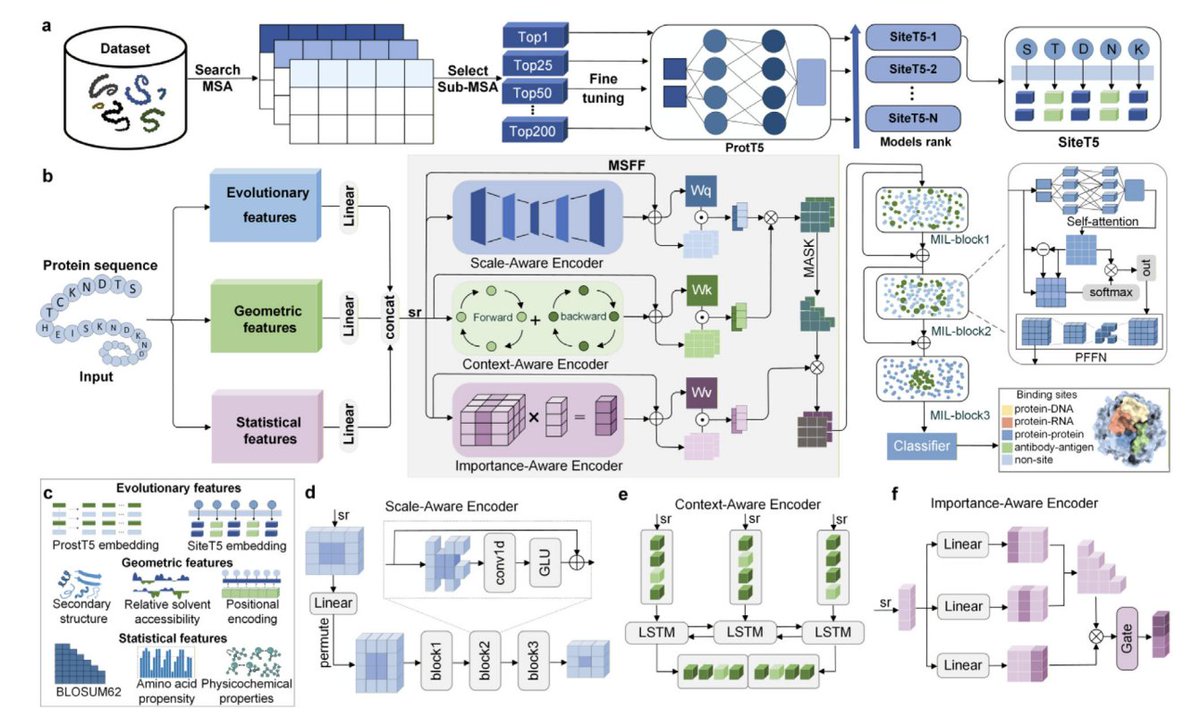
ProSiteHunter: A Unified Framework for Sequence-Based Prediction of Protein-Nucleic Acid and Protein-Protein Binding Sites 1. ProSiteHunter is presented as a unified, sequence-only framework that predicts residue-level binding sites across four interaction types: protein-DNA, protein-RNA, protein-protein, and antibody-antigen, aiming to replace the usual “one model per interface type” fragmentation in sequence-based predictors. 2. The core idea is multi-source sequence representation: it combines (i) a task-specific fine-tuned protein language model SiteT5 for evolutionary/functional-site signals, (ii) ProstT5 embeddings for structure-related priors, plus (iii) geometric descriptors derived from sequence-predicted properties (secondary structure, relative solvent accessibility, symmetric position encoding), and (iv) statistical descriptors (BLOSUM62, physicochemical properties, amino-acid propensity). 3. A key architectural contribution is the Multi-Source Feature Fusion (MSFF) module with “three-track semantic parsing”: Scale-Aware Encoder (multi-kernel 1D CNNs for local patterns), Context-Aware Encoder (BiLSTM for bidirectional semantics), and Importance-Aware Encoder (gated self-attention for long-range dependencies). These tracks are mapped into Q/K/V and fused via cross-attention for dynamic alignment across feature spaces. 4. A second stage, Multi-Level Interaction Learning (MIL), stacks gated multi-head self-attention blocks plus position-wise feed-forward networks to iteratively refine interface signals, producing per-residue binding probabilities (thresholded at 0.5 for site calls). 5. SiteT5 is introduced as a task-adapted PLM derived from ProtT5-XL-UniRef50, fine-tuned with evolutionary information from sub-MSAs (generated with HHblits on UniRef30). Fine-tuning uses LoRA and updates only the last four decoder layers, yielding a relatively small number of trainable parameters while specializing to binding-site patterns. 6. On GraphBind-style temporal splits for nucleic-acid interfaces, ProSiteHunter reports strong gains over prior sequence methods (e.g., CLAPE variants, iDRNA-ITF, DRNApred), emphasizing PRAUC improvements under heavy class imbalance (site:non-site ≈ 1:10), alongside higher ROCAUC/F1/MCC. 7. On protein-protein binding sites (Seq-InSite dataset) and antibody-antigen epitopes (SEMA conformational epitope dataset), the same unified design remains competitive, reporting improvements over methods such as Seq-InSite/ISPRED-SEQ for PPI and CALIBER for antibody-antigen, with particularly notable PRAUC gains on the epitope task. 8. The paper positions ProSiteHunter as complementary to structure predictors: it highlights cases where structure-based approaches (including AlphaFold3) can mis-localize interfaces when structures are imperfect or when binding involves flexible regions, while sequence-driven predictions remain stable and can flag “local flexible sites.” 9. Ablations support the design rationale: removing SiteT5 or ProstT5 embeddings causes the largest drops (SiteT5 removal being most damaging), while removing geometric/statistical features yields smaller but consistent degradations; removing MSFF or MIL leads to substantial performance loss, with MSFF identified as the larger contributor. 10. A downstream demonstration integrates ProSiteHunter-predicted epitopes into an in-house antibody-antigen interaction predictor (Multi-sAAI), reporting improved interaction classification metrics (ROCAUC/F1/precision/recall) and case studies where predicted epitope features sharply increase predicted interaction probabilities for known therapeutic or broadly neutralizing antibody scenarios. 📜Paper: doi.org/10.1002/advs.75931 #ComputationalBiology #Bioinformatics #ProteinScience #ProteinLanguageModels #DeepLearning #ProteinInteractions #EpitopePrediction #PPI #ProteinDNA #ProteinRNA #AntibodyEngineering #DrugDiscovery
4
20
1,952
BiologyAIDaily
AgentPLM: Agentic Protein Language Models with Reasoning-Augmented Decoding for Protein Sequence Design 1. AgentPLM reframes protein sequence design from a one-shot “generate then hope it satisfies constraints” process into an agentic loop: the model can pause mid-generation, query biophysical oracles (ESMFold, FoldX, AutoDock Vina), and then continue with updated context to correct issues online. 2. Core idea: Reasoning-Augmented Decoding (RAD) expands the PLM’s action space beyond amino acids to include tool-call actions. Tool calls do not advance the sequence position; instead, they enrich the context at the same position and the model re-scores the next residue choice, enabling conditional correction without explicit backtracking. 3. A key mechanism in RAD is the Structural Self-Consistency (SSC) score: it measures whether oracle feedback is “surprising” relative to the model’s internal representation of the partial sequence. If SSC drops below a threshold, RAD can force a tool call (subject to min-gap and max-budget constraints), acting as an uncertainty-resolution safety net. 4. Architecture details that make tool-use practical: (i) tool-call tokens are added to the vocabulary and initialized using embeddings from short natural-language tool descriptions (to avoid random special-token training), (ii) a Tool Context Encoder (TCE) uses cross-attention to map heterogeneous oracle outputs (coordinates/pLDDT, scalar ΔΔG, docking vectors) into the PLM hidden space. 5. To avoid blowing up context length with tool outputs, AgentPLM uses a Trajectory Memory Buffer (TMB): it compresses up to Bmax tool-call embeddings into a fixed-size memory vector and injects it via layer-wise gated residual updates, giving O(1) additional memory cost while conditioning on the full tool-call history. 6. Training contribution: Contrastive Agent Policy Optimisation (CAPO) extends Direct Preference Optimisation to full trajectories (residue actions tool calls). It contrasts “winner” trajectories (high fitness with coherent oracle use) against “losers” (low fitness or contradictory oracle signals), teaching not just what sequences look good, but when oracle feedback is worth paying for. 7. CAPO dataset construction: generate 1,000 sequences per task with a reference policy (frozen ESM-2), evaluate with the oracle suite, pair top-10% vs bottom-10%. Tool-call positions are retrospectively annotated using SSC thresholds to mark where oracle feedback would have been informative. 8. Benchmarks span five settings with standardized oracle APIs and controlled splits: ThermoStab-75 (ΔTm with fold-class splits), AntibodyOpt-VH (KD, with 89 antigens fully withheld for test), EnzymeDesign-EC3 (kcat/Km under ≤30% identity splits), PPI-Interface (binding improvement with monomer stability constraint), and ProteinGym ZeroShot-Fitness (no tools at test time). 9. Results: AgentPLM leads across all tasks. Notable gains include AntibodyOpt top-10% hit rate 52.41% vs 27.38% (ProtAgent) vs 12.37% (passive ESM-2), EnzymeDesign normalized kcat/Km 1.89 vs 1.34 (ProtAgent) vs 0.43 (ESM-2), ThermoStab 7.64°C vs 5.19°C (ProtAgent), and stronger PPI improvements (more negative ΔGbind). 10. Mechanistic evidence: trajectory plots show stepwise fitness jumps aligned with oracle calls, consistent with online correction. Integrated-gradient attribution around destabilizing FoldX calls shows attention concentrating locally near the problematic region after the tool output is incorporated; across 500 trajectories, 87% of destabilizing calls trigger significant local attribution increases, while stabilizing calls do not. 📜Paper: arxiv.org/abs/2606.02386 #ProteinDesign #ProteinLanguageModels #ComputationalBiology #MachineLearning #AI4Science #AntibodyEngineering #EnzymeDesign #StructuralBiology #ReinforcementLearning #ToolAugmentedAI
2
22
1,966
BiologyAIDaily
Site4Drug: Predicting Drug-Binding Target Sites with an AI Agent 1 Site4Drug targets an upstream bottleneck in drug discovery: deciding where on a protein to intervene (site selection), not just what binds. It outputs a ranked list of targetable regions with explicit constraints, evidence summaries, risk flags, and an auditable decision log—especially relevant for membrane proteins where accessibility, topology, and PTMs often derail otherwise “reasonable” sites. 2 A key design choice: modality is not required as an input. From the same evidence used for site discovery, Site4Drug recommends a binding modality (epitope/antibody- or peptide-like vs pocket/small-molecule vs other), aiming to avoid selecting chemically plausible but biologically occluded sites. 3 The method is “constraint-first” and modality-aware. Evidence is aggregated from three feasibility signal classes computed from sequence: (i) coarse topology/accessibility priors via Kyte–Doolittle hydropathy heuristic TM detection, (ii) PTM propensity via MusiteDeep calls expanded into typed neighborhood masks (e.g., glycosylation masks), and (iii) motif/domain context via ScanProsite plus cysteine counts as a proxy for disulfide-constrained segments. 4 Candidate regions are proposed and ranked by an LLM as spans directly (JSON), then validated and enriched with deterministic features (TM overlap, PTM-mask overlap by type and density, motif overlaps, cysteine counts, mean hydropathy). Each candidate receives typed “risk flags” (e.g., TM-overlap, glyco-mask-overlap, PTM-dense, disulfide-constrained, hydrophobic-core, motif-overlap) so failures can be debugged rather than treated as opaque model errors. 5 Beyond a single LLM output, Site4Drug adds a specialist-agent panel for reranking: BioAgent, ChemAgent, and RiskAgent critique candidates with claim→evidence→impact, and a DecisionAgent synthesizes a final modality decision and adjusted ranking while staying restricted to evidence already in context. This is intended to improve reproducibility and traceability in “agentic” site selection. 6 Evaluation is modality-aware because no single benchmark exists for “therapeutic site selection.” The authors curated 89 total cases: 55 small-molecule pocket targets (S), 26 antibody epitope targets (A), and 8 mixed-modality targets (AS). Pocket “ground truth” was approximated from co-crystal structures as residues within 4 Å of ligand, mapped back to FASTA coordinates via Needleman–Wunsch alignment. 7 On the pocket benchmark (Group S AS, n=63), Site4Drug achieved statistically significant overlap with reference pockets for 20/63 targets at top-1 and 18/63 at top-5 (hypergeometric test p<0.05). Performance was comparable to fpocket run on AlphaFold3 structures (20/63), despite Site4Drug not taking structure as input; fpocket on ligand-bound RCSB structures was near-ceiling (62/63), as expected due to ligand-induced geometry/orientation leakage. 8 A sequence-only ablation (removing explicit TM/PTM/motif/cysteine evidence fields) substantially underperformed: with one attempt, significant overlap was 3/63 (top-1) and 3/63 (top-5); with 3-attempt voting, 7/63 (top-1) and 6/63 (top-5). This supports the claim that explicit feasibility evidence (not just generic sequence patterning) materially improves site localization. 9 On the antibody epitope benchmark (ABCD-derived, n=26 with usable epitope annotations), Site4Drug achieved significant overlap for 8 cases at top-1 and 11 cases at top-5 (p<0.05). The authors note this setting is smaller and noisier due to sparse epitope position annotations, but it demonstrates recovery of epitope-like regions from sequence-derived constraints. 10 As a structural plausibility check, predicted sites were mapped onto AlphaFold3 structures for the 63 pocket cases and assessed via per-residue PLDDT. In most cases, the top-1 predicted site had higher mean PLDDT than the broader top-5 set (only 9 exceptions), suggesting the ranking tends to prioritize more structurally confident regions even without direct structure input. 11 Module 2 is presented as a design handoff interface: epitope spans can be routed to peptide/antibody binder generation (e.g., BoltzGen), and pocket spans to small-molecule scoring/screening (e.g., DrugCLIP/BindCLIP). Proof-of-concept on EGFR: DrugCLIP run on a pocket constructed from the predicted region retrieved top hits with motifs similar to known EGFR inhibitors (despite those inhibitors being absent from the ligand DB), and epitope-mode spans were used to generate peptide binders evaluated with AlphaFold3-based interaction metrics. 12 Limitations highlighted: lack of a large standardized benchmark; risk of leakage complicating comparisons to structure-trained ML pocket models; current single-chain input (no quaternary structure); sensitivity to topology when using partial sequences; incomplete use of curated annotations (e.g., explicit disulfide bonds); and early post-training (SFT) showed shortcut behavior, implying future training may need biologically grounded reward/preference signals. 💻Code: github.com/winterrykim/Site4… 📜Paper: arxiv.org/abs/2606.01816 #ComputationalBiology #Bioinformatics #DrugDiscovery #ProteinDesign #LLM #AIAgents #MembraneProteins #PTM #AntibodyEngineering #SmallMolecules
1
7
1,288
BiologyAIDaily
Scaling antibody language models improves structure aware representation for antibody engineering 1 AbLingua introduces a structure-aware way to pre-train antibody language models by changing the basic “unit” of meaning from single amino acids to overlapping tripeptides, aiming to better capture local cooperative interactions that drive folding and CDR conformations. 2 The work scales an antibody-specific encoder (BERT-style) up to 1.7B parameters, trained on 1.4B antibody sequences from OAS (unpaired; ~1.2B heavy and ~200M light), positioning it as a large encoder-based foundation model specialized for antibodies. 3 Core technical contribution: TripleAA tokenization. It converts sequences into overlapping 3-residue tokens with boundary markers, expanding the vocabulary from 20 amino acids to 21,952 fixed-length tokens, avoiding variable-length “label island” issues and making residue-level supervision easier to align. 4 Pre-training is modified with Context Residue Transformation (CRT): (i) joint mask masks all tokens containing a chosen central residue to prevent leakage from overlapping tripeptides, and (ii) joint replacement replaces the central residue consistently across overlapping tokens while sampling replacements from natural amino-acid frequencies. 5 The paper reports predictable scaling behavior for antibody LMs when using this tokenization: increasing parameters and data volume reduces perplexity following power-law-like trends, supporting the idea that antibody LMs can benefit from scaling when the encoding granularity matches biology. 6 Paratope prediction: AbLingua-1.7B is evaluated for unified prediction across both CDR and framework (FR) residues, addressing strong class imbalance (FR paratopes are rare). Fine-tuned performance is reported around 72% recall and 75% F1, outperforming multiple antibody/protein LMs and surpassing an MSA-based specialized baseline after full fine-tuning. 7 A structural case study (RSV complex PDB 6apb) suggests attention concentrates on known binding residues within CDRH3 (not just broadly on the loop), indicating the pre-trained representations can localize functionally relevant sites without explicit paratope supervision during pre-training. 8 Neutralization prediction across SARS-CoV variants: using CoV-AbDab-derived datasets (11,008 sequences; separated by epitope region NTD/RBD and variant), AbLingua-1.7B yields more stable AUROC across variants than general protein LMs, with performance dropping most on highly mutated Omicron BA.1/BA.2 yet remaining usable (reported AUROC ~65% for the hardest cases). 9 Therapeutic discovery setting (HER2 CDRH3 binder prediction): combining AbLingua embeddings with a downstream ResNet improves recall on noisy high-throughput labels and generalizes to an independent gold-standard BLI-tested set; validation recall is reported at 58%, and test recall up to 85% with more training data, with robustness across differing numbers of CDRH3 mutation positions. 10 Unsupervised analyses: AbLingua embeddings better separate (via UMAP) B-cell developmental stages and virus-specific antibody groups (HIV/Ebola/SARS) without labels, and token-level projections show more context-sensitive representations for frequent residues compared with baselines, consistent with the intended structural-awareness of the tripeptide vocabulary. 📜Paper: doi.org/10.1038/s42003-026-1… #AntibodyEngineering #ProteinLanguageModels #ComputationalBiology #Immunoinformatics #MachineLearning #DeepLearning #Therapeutics #BERT #ScalingLaws #Bioinformatics
4
11
1,438
BiologyAIDaily
Energy-guided combinatorial co-optimization of antibody affinity and stability 1. The paper presents LAffAb (Libraries of Affined Antibodies), a non-iterative, structure- and energy-guided strategy that designs multi-point CDR mutants directly from an antibody–antigen co-crystal structure, aiming to improve affinity while co-optimizing stability/developability. 2. Core idea: first map “mutation tolerance” across CDRs using Rosetta atomistic calculations (alanine scan hydrogen-bonding contribution) to avoid positions where mutations would disrupt buried polar networks or distort CDR backbone geometry; then restrict candidate substitutions using antibody sequence statistics (MSA/PSSM, and special handling for CDR H3). 3. The design philosophy explicitly targets a “smooth” local sequence space: individually tolerated mutations are chosen to reduce negative epistasis when combined, enabling one-shot construction of combinatorial libraries enriched for functional, stable variants rather than iterative single-mutation campaigns. 4. Benchmark on D44.1 anti-lysozyme (HEWL) (starting KD ~5 nM): tolerance mapping found only 18/59 CDR positions safely mutable, mostly not directly contacting antigen—highlighting that affinity can be improved via mutations that stabilize CDR conformations rather than adding new interface contacts. 5. Despite the constrained mutable set, LAffAb produced a 6,912-variant combinatorial library (up to 9 mutations). After phage selection, 19/22 sequenced colonies were unique designs (parental sequence purged), typically carrying 4–8 mutations—suggesting many distinct high-performing solutions rather than convergence to a single “best” sequence. 6. Experimental validation for four selected D44.1 designs (6–7 mutations) reformatted as full IgG: up to ~4x higher CHO expression yield, increased thermal stability, and large affinity gains by SPR; the best design reached ~50 pM KD (>30-fold improvement), demonstrating simultaneous affinity and stability improvement from a one-shot design. 7. Deep sequencing of selection rounds showed breadth rather than collapse: even after four rounds, ~30% of the designed sequences appeared at least once; importantly, designs with higher mutational load were not depleted, and mutual-information analysis indicated very low inter-position coupling (minimal epistasis), supporting the tolerance-mapping premise. 8. A stringent therapeutic-style test used 6G08 targeting FcγRIIb, where specificity vs the close homolog FcγRIIa (93% extracellular identity) must be maintained. From only 10 designed variants (each with 6 mutations), 8 bound FcγRIIb and 2 improved affinity up to ~30-fold while showing weak FcγRIIa binding in cell assays—indicating LAffAb can improve affinity without broadly increasing cross-reactivity. 9. Developability optimization without affinity loss was demonstrated on Urelumab (anti-4-1BB), known for high reversible self-association and suboptimal Fv pI. Screening 38 low-energy vs 14 high-energy designs showed low-energy designs were significantly more thermostable; 24 low-energy designs maintained affinity within ~2-fold of parent, and 6 designs combined near-parent affinity with improved developability (aggregation resistance, reduced self-association, reduced nonspecific binding). 10. Practical lessons/limitations: success depends on accurate bound structures and interaction modeling; a Cetuximab case failed, likely due to missing ordered water networks in the design structure (water-mediated interactions not modeled), emphasizing that water and structural resolution can be decisive for CDR mutational tolerance and design outcomes. 💻Code: github.com/Fleishman-Lab/LAf… 📜Paper: biorxiv.org/content/10.1101/… #AntibodyEngineering #ProteinDesign #Rosetta #ComputationalBiology #Biologics #Developability #StructuralBiology #PhageDisplay #SPR
7
36
2,316
InSilicoMeds
📅 One week until #PEGSummit! Catch Stefania Evoli at Poster C061 In just one week, the 22nd Annual PEGS Boston Summit kicks off, and we are thrilled to highlight the work of our very own Application Scientist, Stefania Evoli! If you are attending in person, don't miss the chance to discuss the future of antibody engineering. Stefania will be presenting her latest research on how hybrid modeling is changing the game for developability predictions. Poster Title: Enhancing Antibody Developability Prediction with Hybrid Sequence–Structure Modeling Poster Number: C061 Date: Thursday, May 14, 2026 Time: 10:50 a.m. – 2:05 p.m. Location: Omni Boston Hotel at the Seaport Antibody developability is a critical hurdle in drug discovery. Stop by to see how Insilico Medicine is leveraging hybrid sequence-structure models to predict success earlier and more accurately. See you in Boston! 🧬#PEGSBoston #AntibodyEngineering #DrugDiscovery #AIinPharma #Biotechnology #InsilicoMedicine @PEGSboston
2
4
296
BiologyAIDaily
Comparative Structural Analysis of Protein Complexes With SPICE 1 SPICE (Structural Protein Interaction Complex Evaluator) is a web-based platform for rapid, customizable structural analysis of protein complexes directly from PDB structures, targeting common bottlenecks in interface characterization and variant comparison. 2 The core differentiator is modular workflow design: users select only the analyses they need (checkbox-style), which the authors report can reduce typical turnaround from minutes to seconds while keeping the workflow reproducible and easy to rerun. 3 SPICE emphasizes comparative, multi-complex analysis as a first-class feature: it can evaluate wild-type vs mutant complexes, different binding partners, or homologs, then aggregate results into differential tables/plots rather than requiring manual post-processing across tools. 4 The platform covers interface interaction detection (hydrogen bonds, salt bridges, disulfide bonds) with explicit geometric criteria, enabling consistent, residue-level interaction accounting across complexes and across variants. 5 Interface mapping is residue-centric: residues within a proximity threshold (typically 5.0 Å) are labeled as interface, with per-residue contact frequency and contact-type breakdowns to help identify hotspots and compare how specific positions change across variants. 6 Energetics and accessibility modules include SASA/BSA (via FreeSASA; Lee–Richards with 1.4 Å probe), RSA-based residue classification, and optional per-residue van der Waals interaction estimates (Lennard–Jones 6–12) to highlight favorable packing vs potential steric clashes (relative rather than absolute energies). 7 Geometry/quality assessment is integrated into the same workflow: Ramachandran plots (with interface residues highlighted), side-chain chi/rotamer analysis, bend angles for backbone curvature, and interactive inter-residue distance heatmaps with tunable cutoffs. 8 For multi-complex comparisons, SPICE supports synchronized side-by-side 3D inspection (optional alignment via Biopython for visualization), and mutation impact summaries such as ΔVDW vs ΔSASA scatter plots to separate energetic vs geometric drivers of binding changes. 9 Case studies illustrate (i) antibody D1.3–lysozyme (1A2Y) for single-complex interface discovery, contact profiling, distance matrices, and per-residue burial/VDW mapping; and (ii) PD1–pembrolizumab (5GGS) vs a single-mutation variant to localize mutation-driven shifts in burial, contacts, bond types, and energetics with coordinated plots 3D exploration. 💻Code: github.com/fbabd/PyPdbComple… 📜Paper: doi.org/10.1093/nar/gkag415 #StructuralBioinformatics #ProteinProteinInteractions #ProteinComplexes #WebServer #AntibodyEngineering #DrugDesign #ComputationalBiology #PDB #BioinformaticsTools
1
7
1,010
BiologyAIDaily
MsgaBpred: A B-cell epitope predictor integrating AlphaFold3-predicted structures with multi-scale GCNs and pre-trained language model ESM-C 1 MsgaBpred is an end-to-end B-cell epitope predictor that takes only an antigen sequence, generates a 3D structure with AlphaFold3, and predicts epitope residues without requiring experimentally solved structures—targeting the key bottleneck for conformational epitope discovery. 2 The core idea is a dual-branch architecture: (i) additive attention over per-residue embeddings to capture global context and highlight important residues, and (ii) a residue-level protein graph processed by a two-layer multi-scale GCN to capture spatially clustered epitope “patches” formed by non-contiguous residues in 3D. 3 The model fuses three complementary feature sources per residue: ESM-C (2560-d sequence/evolutionary embedding), ESM-IF1 (512-d inverse-folding embedding conditioned on structure), and DSSP-derived structural descriptors (secondary structure, rASA, and torsion angles). Each modality is projected to a shared 256-d space before concatenation to avoid feature dominance. 4 The protein graph encodes both sequence adjacency and true long-range 3D contacts: sequential edges (|i−j|<3), plus radius edges (Cα distance <10Å) and KNN edges (k=10) for residues far apart in sequence (|i−j|≥5). This explicitly models folded-structure neighborhoods that define conformational epitopes. 5 The multi-scale GCN uses parallel 1-, 2-, and 3-hop aggregations per layer, then fuses them; residual mixing with a learnable λ is used to mitigate over-smoothing. Ablations show the GCN branch is essential: removing it causes large drops (AUC −17.6%, AUPR −12.3%), while attention contributes additional gains (AUC −1.1%, AUPR −1.5% when removed). 6 On the Epitope3D benchmark (245 unbound antigens; 200 train with 10-fold CV, 45 held-out test; no ≥70% identity leakage), MsgaBpred outperforms strong baselines including BepiPred-3.0, DiscoTope-3.0, GraphBepi, and EpiGraph, improving over the best baseline (EpiGraph) by ~2% AUC and showing more balanced gains across BACC/F1/MCC. 7 Statistical validation focuses on discrimination: DeLong test shows the AUC improvement is significant (MsgaBpred 0.7287 vs EpiGraph 0.7103; p=0.0212). Threshold-dependent metrics (BACC/F1/MCC) show small, non-significant differences, consistent with AUC capturing ranking quality across all thresholds. 8 The paper benchmarks representation choices: swapping ESM-C for ESM-2 (150M/650M) or ProtT5 reduces performance (ESM-C version reaches AUC 0.744, AUPR 0.227). For structure-aware encoding, ESM-IF1 outperforms 3Di tokens and slightly exceeds SaProt within this modular fusion design. 9 Structure quality directly affects epitope prediction: using native experimental structures performs best, but AlphaFold3 structures are close (only ~0.9% AUC and ~0.6% AUPR drop vs native), while AlphaFold2/ESMFold structures degrade more. GDT (AlphaFold3 vs native) correlates positively with AUC, linking structural accuracy to downstream epitope detection. 10 A concrete case study (3BIK_A; 27 epitope residues) illustrates patch-level benefits: MsgaBpred achieves AUC 0.88 and AUPR 0.5087 with 23 TP, outperforming EpiGraph and GraphBepi in precision-quality tradeoffs, while failures are often associated with topologically isolated epitopes on flexible/extended loops where local graph connectivity is weak. 💻Code: github.com/Moon-kind-W/MsgaB… 📜Paper: doi.org/10.1371/journal.pcbi… #ComputationalBiology #Bioinformatics #Immunoinformatics #EpitopePrediction #BcellEpitopes #AlphaFold3 #ProteinLanguageModels #GraphNeuralNetworks #VaccineDesign #AntibodyEngineering
1
4
28
2,289
BiologyAIDaily
In silico discovery of nanobody binders to a G-protein coupled receptor using AlphaFold-Multimer @NatureComms 1. The study demonstrates a prospective, fully in silico nanobody discovery workflow that finds real GPCR binders: AlphaFold-Multimer (AF-M) screening of 10,000 synthetic VHH sequences yielded nanobody antagonists of the itch/inflammation GPCR target MRGPRX2, validated by cell binding and functional assays. 2. A key insight is that AF-M can separate binding vs non-binding nanobody–GPCR pairs using confidence/readout patterns from predicted complexes, despite the lack of antibody–antigen co-evolution. The authors benchmarked on curated post-training-cutoff structures/binding pairs and constructed matched negative controls by permuting nanobody–antigen pairings. 3. They identify AF-M outputs that are most informative for GPCRs (AUROC > 0.65 for several), including pTM and interface-focused metrics (interface PAE, interface pLDDT), plus pDockQ. They combine six scaled metrics into a single ranking score (LCF) intended to be more robust than any single metric. 4. For GPCRs, the approach is especially useful in the regime that matters for screening: the very top-ranked predictions. Precision among the top 5% (AUC5%) is extremely high (0.93–1.0 across top metrics/LCF), suggesting AF-M ranking can strongly enrich for true GPCR binders when only a small number of hits are tested experimentally. 5. The same AF-M strategy does not generalize well (yet) to soluble proteins or non-GPCR membrane proteins in their benchmarks: AUROCs hover near chance and top-5% precision is low (≤0.22). The authors attribute the GPCR advantage to the growing number of GPCR–nanobody structures in the PDB and more stereotyped binding modes on GPCR extracellular surfaces. 6. Prospective screen details: they generate 10,000 “naive” nanobody sequences matching a published yeast-display library design (CDR3 lengths 7/11/15; position-specific amino-acid distributions; largely excluding Cys/Met). AF-M predictions were run without templates to reduce bias, and sequences with developability liabilities (e.g., CDR glycosylation motifs, predicted polyreactivity) were filtered out. 7. From 10,000 designs, 179 sequences exceeded a threshold defined by the best negative-control LCF in the GPCR benchmark set; 177/179 were predicted to bind extracellularly (consistent with desired competition against endogenous ligands). Ten candidates spanning the ranking distribution were expressed as Fc fusions for testing. 8. Experimental validation: three top-ranked nanobodies (Sim8619 rank 1, Sim9877 rank 5, Sim4784 rank 7) bind MRGPRX2 on ROSA mast cells and on MRGPRX2-transfected HEK293T cells with nanomolar affinities. Reported Kd values include ~20–200 nM depending on clone and cell context; Sim8619 and Sim9877 show high specificity vs other peptide-binding GPCRs (MC4R, CXCR3), while Sim4784 shows some MC4R off-target binding. 9. Functional validation: the three binders are not agonists (no mast-cell degranulation on their own), but act as antagonists by suppressing compound 48/80-induced degranulation. AF-M models place them in the orthosteric pocket; targeted mutagenesis on nanobody (e.g., Sim8619 R102A) and receptor (E164/D184) supports predicted salt-bridge interactions for specific clones, and competition assays show reduced Gi signaling Emax and right-shifted EC50 for orthosteric agonists (48/80 and substance P). 💻Code: github.com/kruselab/MRGPRX2-… 📜Paper: doi.org/10.1038/s41467-026-7… #ComputationalBiology #ProteinStructure #AlphaFold #Nanobody #AntibodyEngineering #GPCR #VirtualScreening #DrugDiscovery #Immunology #MachineLearning
1
11
98
14,494
BiologyAIDaily
Predicting Antibody Self-Association with Sequence–Structure Fusion Models: The Central Role of CSI-BLI in Early Developability Screening 1. The study argues CSI-BLI (clone self-interaction biolayer interferometry) should be treated as an “anchor” early developability assay: it is plate-based, automation-compatible, low material (~15 µg/antibody), and measures weak/reversible self-association that often underlies downstream liabilities. 2. In a 246-mAb panel, CSI-BLI shows a moderate positive association with high-concentration viscosity (Spearman ρ ≈ 0.35), comparable to AC-SINS (ρ ≈ 0.34). It also correlates strongly with multiple non-specific binding (NSB) ELISA readouts (e.g., BVP, ssDNA, cardiolipin), consistent with self-association and polyspecificity often co-occurring. 3. For viscosity risk classification, the best-performing simple model was LDA with leave-one-parental-group-out CV to avoid leakage among related variants. Top feature sets combined NSB ELISAs with self-association assays (CSI-BLI and/or AC-SINS), reaching F1 ≈ 0.57 with accuracy ≈ 0.86, emphasizing multi-assay complementarity. 4. Beyond formulation risk, CSI-BLI is linked to pharmacokinetics: in hFcRn Tg32 mice (41 antibodies from a replicated 43-IgG1 panel), CSI-BLI strongly associates with non-target-mediated linear clearance (Spearman ρ ≈ 0.65), comparable to top nonspecificity assays and stronger than AC-SINS and some classical developability metrics. 5. To reduce wet-lab burden, the paper introduces in silico CSI-BLI classification for two formats: 1499 IgGs (30% positive) and 988 VHHs (33% positive). Evaluation uses edit-distance–controlled hold-outs (IgG: ≥20 Levenshtein edits; VHH: ≥10) plus group/cluster-aware CV, explicitly targeting generalization beyond close sequence neighbors. 6. A key modeling contribution is a residue-aligned sequence–structure fusion architecture: ESM-2 (650M) provides per-residue sequence embeddings, AlphaFold-predicted structures are encoded as residue graphs via a GVP message-passing network, and a disentangled multi-stream attention module fuses content, chain-aware positional information, and structure through explicit channels (e.g., C→S and S→C). 7. Hold-out performance shows format-dependent difficulty (IgG harder than VHH). The structure-aware PLM-GNN-Disentangled model yields the best F1 on both: VHH F1 = 0.7586; IgG F1 = 0.5727. A sequence-only “PLM-Disentangled” variant improves over a standard PLM baseline, indicating the fusion design adds value even without structural inputs. 8. In parallel, the study builds interpretable biophysical descriptor models from AlphaFold structures sequence/structure-derived physicochemical features (from tools including MOE, Schrödinger BioLuminate, CamSol) with cluster-aware feature selection to reduce multicollinearity/sparsity. Soft-ensemble models are robust on hold-outs (VHH F1 = 0.7227; IgG F1 = 0.5673), competitive with transformer models especially for IgG. 9. Interpretability highlights mechanisms: SHAP analyses (focused on VHH where performance is higher) prioritize charge/dipole, hydrophobicity, and aggregation propensity across CDRs and frameworks. Supervised clustering in SHAP space suggests multiple “modes” of high CSI-BLI (e.g., charge-dominated vs hydrophobicity/aggregation-dominated), which can guide engineering strategies. 10. Attention-component analysis shows how the deep model uses modalities: without structure, attention mass concentrates in positional interaction channels; when the structural stream is added, mass shifts toward cross-modal CS/SC pathways. Yet performance gains are modest, suggesting structure often reinforces signals already captured by PLM positional context, while still improving sensitivity/F1 on challenging splits. 📜Paper: biorxiv.org/content/10.64898… #AntibodyEngineering #Developability #ProteinLanguageModels #AlphaFold #GNN #Biophysics #MachineLearning #ComputationalBiology #Bioinformatics #Biologics
2
19
1,653
BioAI_Pharma
Dissecting the Black Box of AlphaFold in Protein–Protein Complex Assembly biorxiv.org/content/10.64898… AlphaFold achieves high accuracy in predicting protein–protein complexes, yet the principles of their assembly remain unclear. Here, we present a unified interpretability framework for AlphaFold-Multimer and AlphaFold3 to dissect these mechanisms. We find that inter-protein coevolution is not a major driver; instead, complex formation is largely governed by monomer geometry and interface-level pattern matching, including backbone complementarity and residue interactions. Tracking the propagation of distance constraints during inference reveals a hierarchical process where monomer structures form first, followed by inter-chain interactions. This shows that cross-chain geometry is inferred from monomer features rather than coevolutionary signals. In antigen–antibody complexes, lower accuracy arises from flexible, noncanonical interfaces, highlighting conformational variability and atypical interactions as key challenges for improving immune complex prediction. #AlphaFold3 #BioAI #AlphaFoldMultimer #MSA #AntibodyEngineering #StructuralBiology
1
5
443
BiologyAIDaily
Dissecting the Black Box of AlphaFold in Protein–Protein Complex Assembly 1. Li, Mu, and Yan present evidence that inter-protein coevolution (the usual explanation for AlphaFold complex success) is not the dominant driver of complex assembly in AlphaFold-Multimer or AlphaFold3; instead, assembly largely follows from monomer geometry plus interface-level matching. 2. A time-segregated benchmark (PDB 2022-01-01 to 2024-12-20; training cutoff 2021-09-30) is built to reduce leakage: 200 homodimers and 316 heterodimers, evaluated mainly with DockQ across AFM and AF3. 3. Controlled MSA experiments separate “pairing” from “having MSAs”: AFM Paired MSA vs Block MSA (no cross-chain pairing) vs Randomly Paired MSA. Mean DockQ changes are minimal across these conditions, implying explicit paired-MSA coevolution contributes little for most targets. 4. The paper further removes potential “latent” inter-protein coevolution in unpaired MSAs by regenerating UniRef100 MSAs with species annotations and enforcing zero species overlap between partner MSAs; AFM/AF3 performance remains essentially unchanged, arguing against hidden species-level coevolution being a key signal. 5. The proposed mechanism: AlphaFold first establishes strong intra-chain geometric constraints (monomer folding/geometry), then infers inter-chain constraints downstream via geometric compatibility and interface sequence pattern matching; cross-chain organization is progressively refined through layers and recycling. 6. Template-driven tests support the geometry-first view: supplying high-quality bound-state monomer templates enables complex prediction accuracy comparable to MSA-based runs, and experimentally determined bound monomer templates perform even better; adding MSAs on top of such templates yields little additional gain. 7. A key nuance is “bound vs unbound” monomer geometry: predicted unbound monomer templates degrade complex accuracy, and the difference is concentrated at interface regions. Interface TM-score correlates with complex DockQ (reported Pearson r ≈ 0.575), highlighting interface conformation as a main determinant. 8. Interface residue identity is essential, not just backbone shape: mutating up to 10% of residues to glycine shows that interface mutations nearly abolish prediction accuracy under both MSA-based and template-based settings, while non-interface mutations have only moderate effects—consistent with a backbone sidechain “pattern matching” interface recognition. 9. The paper introduces AlphaFold-Constraint Propagation Mapping (AF-CPM), using OpenFold to extract Evoformer-layer pair representations and convert them (via the distogram head) into layer-wise contact probability maps (<12 Å). These visualizations show intra-chain constraints forming before inter-chain contacts, directly supporting hierarchical constraint formation. 10. For antigen–antibody complexes (154 nonredundant cases), paired MSAs still do not help; bound-state monomer templates help most. The limiting factor is attributed to immune-interface plasticity and atypical interface statistics (e.g., enrichment of Tyr/Trp on the antibody side), with CDR-H3 local accuracy strongly linked to docking success; AF-CPM suggests antigen–antibody assembly may require more recycling to converge as interface constraints emerge late. 💻Code: github.com/ChengfeiYan/AF-CP… 📜Paper: biorxiv.org/content/10.64898… #AlphaFold #AlphaFoldMultimer #AlphaFold3 #ProteinComplexes #ProteinStructure #MSA #Interpretability #AntibodyEngineering #ComputationalBiology #StructuralBiology
12
58
4,202
BiologyAIDaily
Deep learning assessment of nativeness and pairing likelihood for antibody and nanobody design with AbNatiV2 1 AbNatiV2 updates AbNatiV’s VQ-VAE nativeness scoring into a toolkit that covers both nanobodies (VHH) and conventional antibodies, and adds a paired model (p-AbNatiV2) that explicitly scores VH–VL pairing likelihood for design and engineering. 2 The most practically new capability is p-AbNatiV2: a cross-attention VQ-VAE fine-tuned on 3.7M paired human VH/VL sequences, producing partner-aware humanness at residue/chain/pair levels plus a pairing-likelihood score trained with noise-contrastive learning. 3 On held-out pairing tests, p-AbNatiV2 assigns the native partner a higher pairing score in 74% of 1-vs-1 comparisons, and ranks the native pair in the top 5 in >35% of 1-vs-50 comparisons—substantially ahead of recent pairing models (Humatch and ImmunoMatch, ~60% in 1-vs-1; ~16–18% top-5 in 1-vs-50). 4 For nanobodies, the paper expands training data to ~21M camelid VHH sequences by curating recent repertoires and adding ~9.2M newly sequenced in-house alpaca VHHs, addressing a key limitation of AbNatiV1 (limited VHH diversity and poor generalization to newer repertoires). 5 Architecturally, AbNatiV2 modernizes the transformer VQ-VAE with rotary positional embeddings, gated attention, and SwiGLU layers, and introduces a focal reconstruction loss that down-weights easy-to-reconstruct conserved positions to better learn higher-order residue dependencies and reduce germline bias. 6 AbNatiV2 improves VHH nativeness classification, especially against “artificial” PSSM-generated sequences (PR-AUC 0.984 vs 0.961 in AbNatiV1), and remains strong on a “diverse” VHH test set far from training data (PR-AUC 0.977 vs 0.926), indicating better robustness beyond near-neighbor sequences. 7 The model is also more sensitive to context-dependent nativeness changes: when CDRs are grafted onto a universal VHH framework, AbNatiV2 detects nativeness loss for 90% of grafts (vs 64% for AbNatiV1 on the same test), supporting CDR-grafting decisions and scaffold compatibility checks. 8 For human antibodies, AbNatiV2 scales training to ~19.7M VH and ~21.2M VL sequences from OAS, and introduces a unified VL model spanning kappa and lambda; the largest gain is improved discrimination vs rhesus VL (PR-AUC 0.949 vs 0.808/0.851 for AbNatiV1’s separate Vκ/Vλ models). 9 The paired model’s training design emphasizes interpretability and out-of-distribution behavior: it learns from both “easy but confident” mismatched negatives (across B-cell classes/studies/species) and “hard but noisy” shuffled negatives, helping avoid spuriously high pairing scores on non-human or artificial sequences (a failure mode observed for one comparator). 10 Beyond scoring, the paper introduces a paired humanization workflow that jointly optimizes VH and VL with p-AbNatiV2 while monitoring pairing likelihood to reject mutations that degrade pairing; it complements existing nativeness-guided humanization and design pipelines by adding explicit partner-compatibility constraints. 💻Code: gitlab.doc.ic.ac.uk/sormanni… 📜Paper: doi.org/10.1080/19420862.202… #abdesign #antibodyengineering #nanobody #deeplearning #proteinengineering #computationalbiology #transformers #VQVAE #immunoinformatics #developability
4
18
1,428
BiologyAIDaily
Tokenizing Loops of Antibodies 1. The paper introduces Igloo (ImmunoGlobulin LOOp Tokenizer), a multimodal tokenizer that represents antibody CDR loops at the loop/substructure level (not residue level), encoding both sequence and backbone dihedral angles (phi/psi/omega) into a loop token. 2. Core idea: train a self-supervised transformer with a contrastive objective so that loops with similar backbone dihedral-angle patterns map close in latent space. Similarity is defined using a dihedral distance metric (preferred over RMSD because RMSD can miss 180° dihedral flips that invert side-chain orientations). 3. Igloo addresses a long-standing limitation of canonical CDR clustering: incomplete coverage (e.g., many H3 loops do not map to canonical clusters). Igloo assigns tokens to all loops while still recovering canonical conformations for 90.6% of SAbDab loops that have canonical labels. 4. Training scale and data mix: 807,815 loop regions total, combining 108,167 experimentally resolved loops (SAbDab STCRDab) and 699,648 predicted loops from paired OAS sequences via Ibex structure prediction, with careful sequence-identity splits to reduce leakage. 5. Architecture and objectives: dihedral angles are embedded via unit-circle features (cos/sin), added to amino-acid embeddings, then processed with a BERT-style transformer using a learnable <cls> token as the loop representation. Training uses (a) multimodal masking and reconstruction, (b) dihedral-distance contrastive learning with positive/negative pairs, and (c) a vector-quantized codebook to produce discrete tokens for fast lookup. 6. Structure retrieval benchmark (paratope retrieval): given a query loop, retrieve the closest loops from a structural database. Igloo achieves state-of-the-art Precision@20 across CDRs, and for the hardest loop (H3) improves retrieval of similar dihedral backbones by 6.1% over the prior best baseline (0.402 vs 0.379 for D < 0.47). 7. Discrete-token clustering: without being given loop-type annotations, the learned codebook clusters are highly homogeneous by loop type and length (type purity 0.983; length purity 0.965), and show strong agreement with established canonical cluster partitions. 8. Igloo tokens as special tokens in antibody language models: IglooLM inserts a loop token at each CDR boundary and fine-tunes from IgBert (420M). On AbBiBench binding-affinity prediction for heavy-chain variant sets, IglooLM beats the base IgBert model on 8/10 antibody-antigen targets and performs comparably to much larger models (including ones with ~7x more parameters). 9. Generative design with structural control: IglooALM combines loop tokens plus residue-level multimodal tokens to sample loop sequences that are diverse yet structurally consistent. Compared to antibody inverse-folding baselines (AbMPNN, AntiFold), IglooALM generates loops with better self-consistency RMSD across many sequence-identity bins; a SARS-CoV-2 H3 redesign example reports ~0.27 sequence identity while staying <1 Å RMSD to the original loop. 10. Library prioritization at scale (zero-shot): on a HER2 CDR H3 mutagenesis library (38,860 variants), selecting sequences that share the same discrete Igloo token as a seed yields 55.3% binders, a ~1.9x enrichment over the library baseline (29.1%), and runs quickly (minutes) using sequence-based tokenization. 💻Code: github.com/prescient-design/… 📜Paper: tandfonline.com/doi/full/10.… #AntibodyEngineering #ProteinLanguageModels #CDR #StructuralBioinformatics #ContrastiveLearning #GenerativeAI #ComputationalBiology #Therapeutics
2
23
1,562
BiologyAIDaily
Tokenizing Loops of Antibodies 1. The paper introduces Igloo (ImmunoGlobulin LOOp Tokenizer), a multimodal tokenizer that represents antibody CDR loops at the loop/substructure level (not residue level), encoding both sequence and backbone dihedral angles (phi/psi/omega) into a loop token. 2. Core idea: train a self-supervised transformer with a contrastive objective so that loops with similar backbone dihedral-angle patterns map close in latent space. Similarity is defined using a dihedral distance metric (preferred over RMSD because RMSD can miss 180° dihedral flips that invert side-chain orientations). 3. Igloo addresses a long-standing limitation of canonical CDR clustering: incomplete coverage (e.g., many H3 loops do not map to canonical clusters). Igloo assigns tokens to all loops while still recovering canonical conformations for 90.6% of SAbDab loops that have canonical labels. 4. Training scale and data mix: 807,815 loop regions total, combining 108,167 experimentally resolved loops (SAbDab STCRDab) and 699,648 predicted loops from paired OAS sequences via Ibex structure prediction, with careful sequence-identity splits to reduce leakage. 5. Architecture and objectives: dihedral angles are embedded via unit-circle features (cos/sin), added to amino-acid embeddings, then processed with a BERT-style transformer using a learnable <cls> token as the loop representation. Training uses (a) multimodal masking and reconstruction, (b) dihedral-distance contrastive learning with positive/negative pairs, and (c) a vector-quantized codebook to produce discrete tokens for fast lookup. 6. Structure retrieval benchmark (paratope retrieval): given a query loop, retrieve the closest loops from a structural database. Igloo achieves state-of-the-art Precision@20 across CDRs, and for the hardest loop (H3) improves retrieval of similar dihedral backbones by 6.1% over the prior best baseline (0.402 vs 0.379 for D < 0.47). 7. Discrete-token clustering: without being given loop-type annotations, the learned codebook clusters are highly homogeneous by loop type and length (type purity 0.983; length purity 0.965), and show strong agreement with established canonical cluster partitions. 8. Igloo tokens as special tokens in antibody language models: IglooLM inserts a loop token at each CDR boundary and fine-tunes from IgBert (420M). On AbBiBench binding-affinity prediction for heavy-chain variant sets, IglooLM beats the base IgBert model on 8/10 antibody-antigen targets and performs comparably to much larger models (including ones with ~7x more parameters). 9. Generative design with structural control: IglooALM combines loop tokens plus residue-level multimodal tokens to sample loop sequences that are diverse yet structurally consistent. Compared to antibody inverse-folding baselines (AbMPNN, AntiFold), IglooALM generates loops with better self-consistency RMSD across many sequence-identity bins; a SARS-CoV-2 H3 redesign example reports ~0.27 sequence identity while staying <1 Å RMSD to the original loop. 10. Library prioritization at scale (zero-shot): on a HER2 CDR H3 mutagenesis library (38,860 variants), selecting sequences that share the same discrete Igloo token as a seed yields 55.3% binders, a ~1.9x enrichment over the library baseline (29.1%), and runs quickly (minutes) using sequence-based tokenization. 💻Code: github.com/prescient-design/… 📜Paper: tandfonline.com/doi/full/10.… #AntibodyEngineering #ProteinLanguageModels #CDR #StructuralBioinformatics #ContrastiveLearning #GenerativeAI #ComputationalBiology #Therapeutics
3
9
962