Filter
Exclude
Time range
-
Near
BiologyAIDaily
A Generalizable Interface-Seeded Framework for De Novo Design of Functional Oligomers 1. The paper introduces an “interface-seeded” generative design strategy: instead of docking existing protein building blocks into a target symmetry, it uses a previously validated protein–protein interface (PPI) as the seed and generates new symmetry-compatible protomers around it. 2. Key implementation detail: a new symmetric motif-scaffolding module in RFdiffusion that preserves the interface motifs while sampling seed orientations and radial placements, then “drags” the motif radially during denoising to bias toward compact, well-packed cyclic oligomers. 3. This directly addresses a practical bottleneck in symmetric assembly design: dock-and-design success is often limited by geometric incompatibility between chosen protomers and target symmetries (C3/C4/C5), producing strong biases and low hit rates. 4. Benchmarking with LHD heterodimer seeds (LHD101, LHD29), the framework produced many expressible designs (63/64 expressed), with a substantial fraction matching the intended oligomeric states by SEC (33/63) and SEC-MALS (18/63). 5. Structural accuracy was validated by crystallography for multiple designs: C3 trimers (PI25, PI31) and a C4 tetramer (PI57) closely matched design models (Cα RMSD < 1.6 Å), including accurate interface side-chain placement; the resulting folds were also “new-to-nature” by Foldseek comparisons. 6. The approach generalizes to chemical triggers by reusing ligand/metal-dependent PPIs as seeds (often fragmented into many discontinuous segments), enabling conditional C3 assembly for Cu2 (MC11), cholic acid (CHD04), and venetoclax (LBM10). Measured effective assembly affinities were in the ~100 nM range (e.g., MC11 Kd,eff 137 nM; LBM10 Kd,eff 130 nM). 7. Crystal structures of CHD04 and LBM10 matched their design models and showed ligand occupancy in the engineered pockets, demonstrating that the seeded responsive interface can be transplanted into entirely new oligomer topologies while retaining chemical control. 8. A major functional advance is reversible phosphorylation-controlled oligomerization using a dynamic “phosphoswitch” interface seed: phosphorylation by PKA shifts monomer→oligomer, and λ-phosphatase reverses it back. Single interface-weakening mutations reduced unwanted basal oligomerization while preserving phospho-dependent assembly (PO5s, PO18s). 9. The work also demonstrates multi-input control: introducing a disulfide lock created a system that requires both reducing conditions and phosphorylation to oligomerize, enabling dual-gated assembly behavior in a de novo designed oligomer. 10. Applications go beyond in vitro biophysics: (i) ligand-triggered membrane binding via MinD membrane-targeting sequence fusions (Cu2 or CHD induces oligomerization-driven avidity on supported lipid bilayers), and (ii) phosphorylation-inducible transcription in HEK293T cells by coupling PO18s trimerization to an HSF1-based reporter, yielding ~6-fold induction (and >14-fold with combined endogenous engineered PKA activation). 💻Code: github.com/Khmelinskaia-Lab/… ; github.com/Khmelinskaia-Lab/… 📜Paper: biorxiv.org/content/10.64898… #ProteinDesign #RFdiffusion #AlphaFold3 #SyntheticBiology #ComputationalBiology #ProteinEngineering #DeNovoDesign #SignalTransduction #Phosphorylation #Nanobiotechnology
10
52
3,495
BiologyAIDaily
BoltzProt-1: Towards Efficient De Novo Binder Design with Good Developability 1 BoltzProt-1 is a de novo protein binder (incl. nanobody/VHH) design pipeline that explicitly targets two bottlenecks at once: improving prospective binding hit rates on novel targets and ensuring therapeutic-style developability (stability, solubility, low nonspecific binding, etc.). 2 The key technical shift is ranking designs with a dedicated protein–protein interaction predictor (BoltzPPI), rather than relying mainly on structure-prediction confidence proxies. In a budget-matched test on the same candidate pools, this changes selection—not generation—and directly tests whether better ranking alone improves experimental recovery. 3 On 10 low-homology (novel) targets, replacing BoltzGen’s selection with BoltzPPI ranking increases confirmed-binder rate from 3.3% (5/150) to 8.0% (12/150), a 2.4x gain. Screening hits also rise (revised hit rate 4.7% to 9.3%). Confirmed target coverage improves from 2/10 to 3/10 via ranking, and to 4/10 when paired with an improved generative model. 4 The paper also argues for stricter experimental reporting: it separates “screening hits” (including ambiguous sensorgrams) from “confirmed binders” (clean kinetics plus orthogonal confirmation). Confirmation uses a flipped assay orientation to reduce format-specific artifacts and avidity effects, with additional independent testing for some hits. 5 BoltzPPI is built on Boltz-2 representations and adds a PPI prediction head trained jointly with a confidence head. It uses interface-focused signals: token/pair features, predicted coordinates, distance embeddings, and binder/target masks, refined by a 4-block Pairformer stack (16 heads, dropout 0.25). 6 Training uses PDB and patent-derived complexes as positives, plus synthetically generated protein pairs as negatives. A multi-view training scheme drops trunk pairwise representations 50% of the time to encourage geometric reliance and reduce overfitting to internal trunk signals; additional regularization injects Gaussian noise into representations. The interaction head is trained with focal loss and combined with confidence losses. 7 On an external 10-target panel used by Chai-2, BoltzProt-1 reports screening hits on 7/10 targets, compared with 6/10 reported by Chai-2 and 3/10 for BoltzGen in this study’s setup. This suggests improved target coverage across diverse classes (signaling/adaptor proteins, cytokines/hormones, SUMOylation enzymes, calcium-binding regulators). 8 Developability is treated as a first-class outcome. Confirmed binders from the low-homology panel are evaluated across a broad assay suite (Twist Bioscience): thermal stability (Tonset, Tm1, Tm2), aggregation onset (Tagg), monomer purity (aSEC), heterogeneity (DLS PDI), hydrophobicity (HIC), polyspecificity (BVP ELISA), and self-association (AC-SINS). 9 Under combined developability criteria, 58% (7/12) of BoltzProt-1 confirmed binders pass every filter, exceeding BoltzGen confirmed binders (40%, 2/5) and clinical-stage controls measured in parallel (IgG 25%, 3/12; VHH-Fc 21%, 5/24). Attrition is minimal until hydrophobicity (HIC), which is the dominant failure point. 10 Novelty checks indicate recovered designs are not near-duplicates of known antibody/nanobody CDRs: every recovered design has minimum CDR3 edit distance ≥4 to its closest SAbDab match (with larger distances when considering CDR1 2 3). Structural context is provided via binding-site similarity to known PDB interfaces (FoldDiSCO), highlighting that the low-homology benchmark emphasizes limited prior structural precedent. 📜Paper: biorxiv.org/content/10.64898… #ComputationalBiology #ProteinDesign #DeNovoDesign #Nanobody #AntibodyEngineering #ProteinProteinInteraction #MachineLearning #DrugDiscovery #Developability #StructuralBiology
6
45
4,168
BiologyAIDaily
Zero-shot design of drug-binding proteins via neural iterative selection−expansion 1. The work introduces NISE (neural iterative selection–expansion), a closed-loop algorithm that jointly optimizes protein sequence, protein structure, and ligand conformation—enabling true zero-shot design of small-molecule binders where prior deep-learning approaches struggled. 2. NISE alternates between two reciprocal neural conditionals: LASErMPNN samples sequences conditioned on a protein–ligand co-structure, and a co-structure predictor (RoseTTAFold-All Atom or Boltz-2) predicts the 3D protein–ligand complex from sequence ligand identity; designs are selected by tripartite self-consistency (backbone and ligand r.m.s.d.) plus ligand confidence. 3. A key conceptual shift is treating “self-consistency” as protein–ligand self-consistency (not just foldability): many sequences can be backbone self-consistent, but far fewer place the ligand in the intended orientation; ligand self-consistency becomes a stringent computational screen for productive binding. 4. LASErMPNN is a ligand-aware heterograph message-passing model trained on PDB co-crystal structures to decode both amino-acid identity and side-chain dihedrals; it includes a pretrained ligand encoder trained on quantum-derived atom properties (for example partial charges), improving generalization to new ligands and reducing design pathologies like overpacking. 5. On exatecan (a camptothecin payload with a hydrolysis-prone lactone), NISE redesigned a four-helix bundle binder from scratch starting only from backbone docked ligand coordinates; all 4 experimentally tested NISE designs bound exatecan (100% hit rate), with the best binder EPIC at Kd = 120 nM. 6. Against a traditional COMBS Rosetta pipeline (16 tested designs), only 3 bound exatecan and the best was ~70-fold weaker than EPIC; analysis suggests NISE’s advantage comes from iterative “resculpting” of backbone/packing and ligand placement, not just filtering with a structure predictor. 7. The authors then perform purely in silico affinity maturation (“neural proofreading”): LASErMPNN proposes single-site substitutions that reduce sequence NLL in the bound context; two substitutions (Q51N and M97L) each improve affinity >10×, and the double mutant improves EPIC ~100× to Kd = 1.2 nM without experimental feedback. 8. X-ray structures of EPIC (2.0 Å) and EPIC(Q51N) (2.2 Å) validate the designed binding mode and explain the affinity gain: Asn51 enables deeper burial and bidentate H-bonding to the hydroxyl and lactone carbonyl, with only ~sub-Å deviations from intended placement in the pocket core. 9. Functionally, EPIC variants protect exatecan’s lactone from hydrolysis: EPIC(Q51N/M97L) keeps >99% of exatecan in the ring-closed (bioactive) form for at least 50 hours in PBS pH 7.4, and protection persists even with high human serum albumin present—supporting drug-stabilizing delivery/sponge applications. 10. Generality is shown on apixaban using NTF2 scaffolds and Boltz-2 within NISE: 5 of 6 tested designs bound tightly (83% success), with the best (APEX) reaching Kd = 80 pM—nearly 10,000-fold tighter than prior LigandMPNN/Rosetta apixaban binder design reports on the same backbone family, and approaching the native target factor Xa affinity. 💻Code: github.com/polizzilab/LASErM… ; github.com/polizzilab/NISE ; github.com/benf549/CARPdock 📜Paper: doi.org/10.1038/s41586-026-1… #ProteinDesign #ComputationalBiology #DeepLearning #StructuralBiology #DrugDiscovery #GenerativeModels #ProteinLigand #DeNovoDesign #GNN #Boltz2 #RoseTTAFoldAllAtom
5
38
3,094
BiologyAIDaily
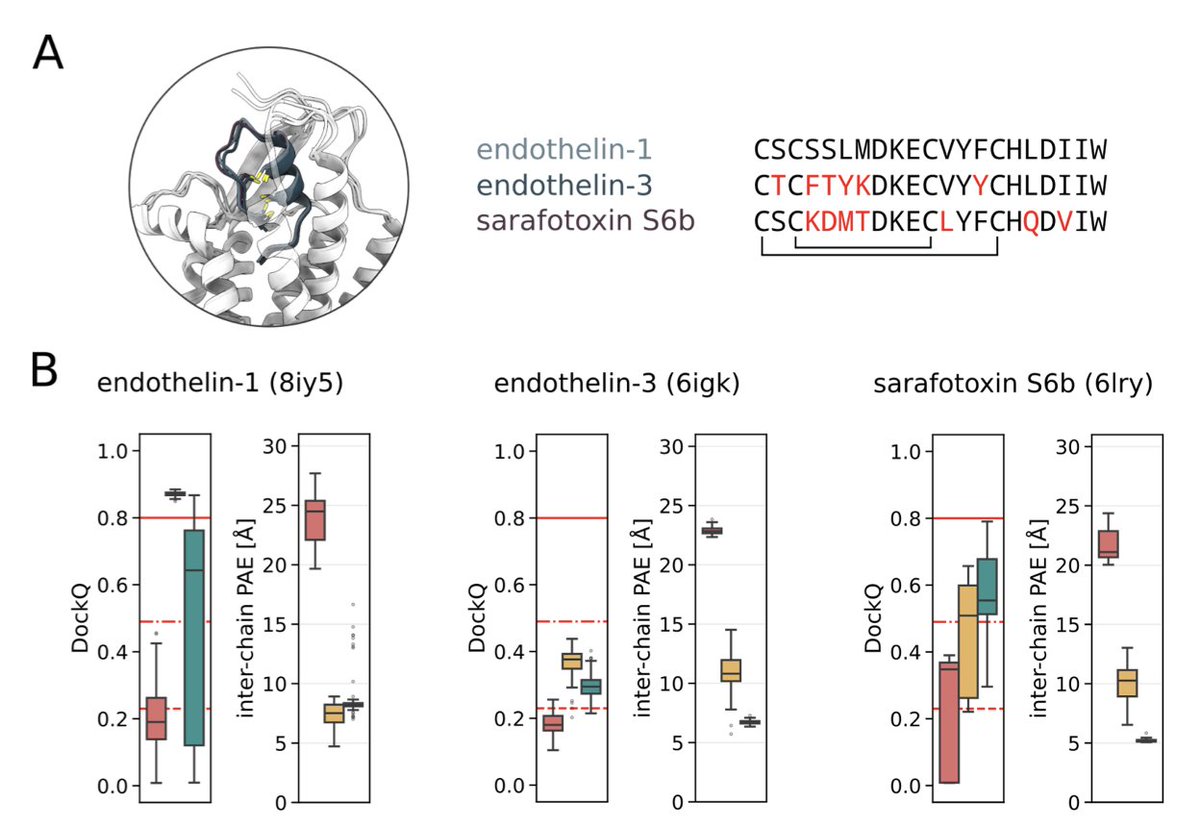
Complexdesign: Sequence-Hallucination Design of Protein Binders Bridging Multiple Proteins 1. Designing a single de novo protein that simultaneously binds two independent target proteins is a major challenge because both the binder structure and the relative arrangement of the targets are unknown. This work introduces ComplexDesign, a hallucination-based framework that directly tackles multi-target binder design by allowing ternary complexes to emerge during optimization instead of relying on predefined target geometries. 2. The key innovation is a target-target masking strategy. During optimization, ComplexDesign removes pairwise information between the two target proteins, preventing AlphaFold-Multimer from treating them as a fixed assembly. As a result, the designed binder learns to independently engage both targets while discovering a compatible ternary architecture. 3. ComplexDesign uses a unified optimization pipeline for both unconditional multichain design and multi-target binder design. It combines: * AlphaFold-Multimer-guided sequence hallucination with gradient backpropagation * Multi-stage sequence optimization * ProteinMPNN sequence redesign * AlphaFold3 validation for confidence, self-consistency, and interface quality This creates an end-to-end framework that simultaneously optimizes protein folding and intermolecular interfaces. 4. Unlike previous methods that primarily focus on single-target binders or predefined complexes, ComplexDesign addresses higher-order protein assemblies. Across extensive benchmarks covering dimers, trimers, and tetramers with multiple chain-length combinations, it consistently outperformed representative generative models including APM and Chroma, achieving design success rates exceeding 50% across all evaluated settings. 5. The framework demonstrates particularly strong scalability as complex size increases. While competing approaches rapidly lose performance on trimers and tetramers, ComplexDesign maintains high AlphaFold3 confidence and structural self-consistency, indicating that simultaneous optimization of chain folding and interface formation is effective even for larger multimeric assemblies. 6. The authors further evaluated ComplexDesign on a challenging benchmark derived from MG-PDB for molecular glue-inspired ternary complexes. Among 10 difficult target pairs that are not predicted to form stable binary complexes on their own, ComplexDesign generated high-confidence, self-consistent ternary complexes for 8 target pairs, with AlphaFold3 ipTM values ranging from 0.85 to 0.93. 7. Interface analysis reveals an important insight into multi-target binder design. Successful binders require balanced optimization of two independent binding interfaces. Many failed designs converged to one-sided solutions that strongly bind only one target, highlighting coordinated interface optimization as the central bottleneck for future binder design methods. 8. The study also identifies several biological factors influencing design success. Homodimeric targets are generally easier than heterodimeric pairs, likely because of their structural symmetry. Target surfaces enriched in coils or β-structures are more difficult to design against than helical surfaces, and extremely short binders rarely achieve high-confidence interactions with both targets due to limited structural capacity. 9. Representative examples demonstrate the flexibility of ComplexDesign. One design generated an 82-residue four-helix binder bridging FKBP12 and FRB, while another produced a compact 43-residue two-helix binder connecting two PD-L1 protomers. These examples illustrate that the framework can discover diverse binding geometries and interface chemistries rather than converging to a single structural solution. 10. Although currently evaluated only computationally, ComplexDesign establishes a promising direction for designing programmable multichain protein assemblies and de novo bridging binders. The authors envision applications in molecular glues, PROTAC-inspired systems, proximity-inducing therapeutics, bispecific protein engineering, and synthetic multi-protein assemblies. Future work will focus on extending the framework to more than two targets, improving computational efficiency, and validating designed proteins experimentally. 📜Paper: doi.org/10.64898/2026.06.21.… #ProteinDesign #ComputationalBiology #AI4Science #AlphaFold #AlphaFold3 #ProteinEngineering #DeNovoDesign #StructuralBiology #MachineLearning #Bioinformatics #SyntheticBiology #DrugDiscovery
1
6
46
3,833
BiologyAIDaily
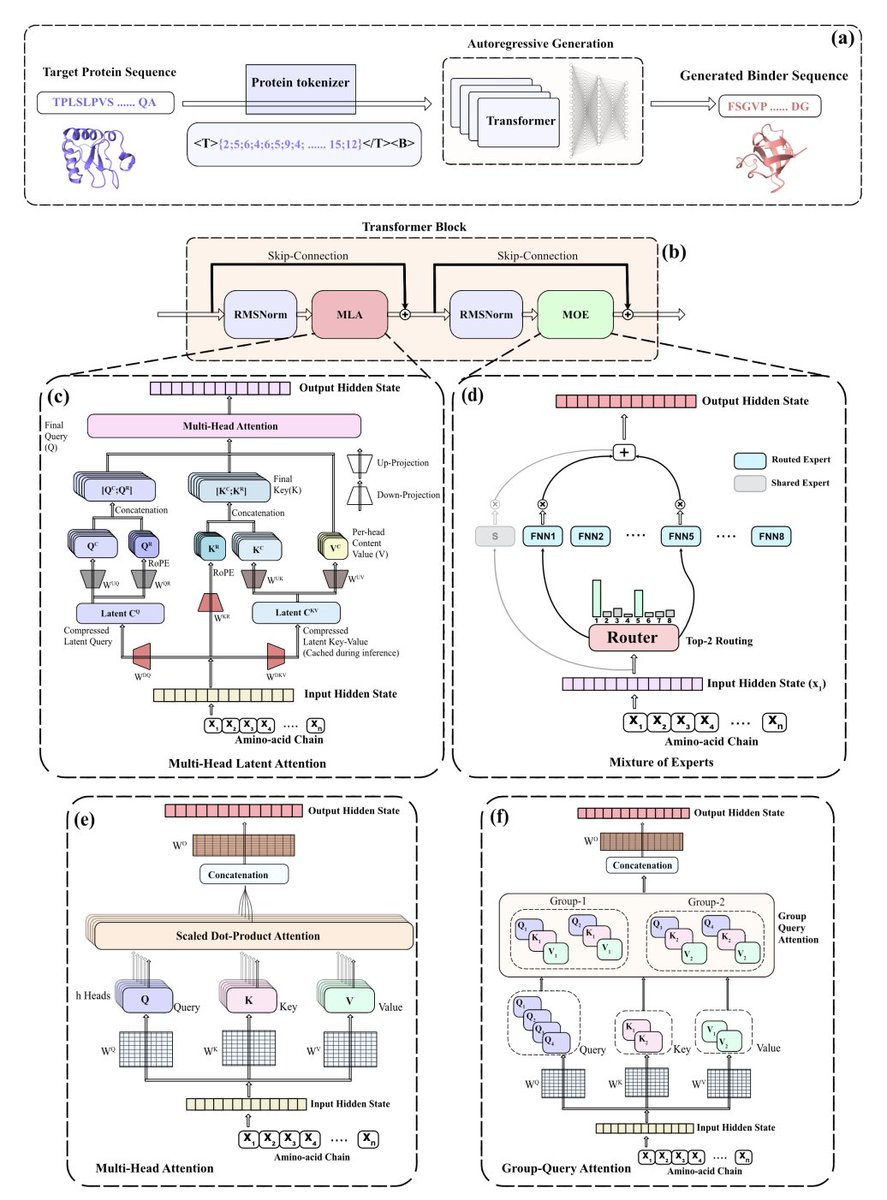
MoE-Bind: Guiding De Novo Protein Binder Generation with Sparse Experts 1. The paper introduces MoE-Bind, a sequence-only autoregressive protein binder generator that combines Multi-head Latent Attention (MLA) with a sparse Mixture-of-Experts (MoE) feed-forward stack, aiming to keep binder generation fast and structure-free at inference while improving quality per unit compute. 2. Key architectural idea: sparsify where most parameters live. Since transformer FFNs hold a large fraction of parameters, MoE-Bind replaces dense FFNs with top-2 routing over 8 SwiGLU experts (plus a shared always-on expert), so only ~2/8 of expert parameters activate per token while total capacity increases. 3. MLA targets the other bottleneck: KV-cache memory during autoregressive decoding with long receptor prompts. MoE-Bind compresses keys/values into a low-rank latent (rKV=64) and uses decoupled RoPE (separate positional subspace), yielding a large KV-cache reduction (reported 24× vs a GPT2-like MHA peer at the 100M tier). 4. Compute/parameter framing: the 100M-parameter MoE-Bind model has ~102.7M total params but ~38.8M active params per token, positioning it as “compute-matched” against ~38M dense baselines while often matching or exceeding ~100M dense baselines in structure-level metrics. 5. Training pipeline: pre-train on UniRef50 (character-level tokenization; 31-token vocab including delimiters/control tokens) with next-token prediction, then instruction fine-tune on high-confidence STRING v12 physical PPIs (score ≥900) after heavy redundancy reduction (MMseqs2 clustering at 40% identity, 80% coverage), ending with ~2.1M usable interaction pairs. 6. Leakage control is a major methodological emphasis. For DB5 evaluation, the authors build a strict 22-target benchmark by removing any DB5 proteins with ≥10% identity (≥80% coverage) to UniRef50 or STRING sequences, then also report a larger benchmark (78 unique targets) under a relaxed fine-tuning-only leakage filter and additional deduplication. 7. Structure-level evaluation uses structure predictors only for external assessment, not for inference-time filtering: AlphaFold2-Multimer (ColabFold) on the strict 22-target DB5 set, and Boltz-2 with MSA on the larger 78-target set. Hits are defined stringently as generated ipTM ≥ reference (native pair) ipTM for the same target. 8. Main structure-level results: on the 22-target AF2-Multimer evaluation, MoE-Bind achieves 6/22 hits (27.3%) vs MHA 3/22 and GQA 4/22; on the 78-target Boltz-2 MSA benchmark, MoE-Bind reaches 19/78 hits (24.36%), slightly higher than dense 100M baselines (GQA-100M 23.08%, MHA-100M 21.79%) and higher than compute-matched dense ~38M baselines (GQA-38M 20.51%, MHA-38M 16.67%) while activating ~38.8M params/token. 9. Sequence-level quality: MoE-Bind’s generated binders better match DB5 amino-acid composition, avoid long homopolymer runs (no 6–7 or ≥8 runs reported), show “controlled novelty” vs STRING (less mass at ~0% identity than dense baselines), and have improved predicted stability by instability index (median ~29–30, with ~2/3 below 40). 10. Interpretability contribution: routing analysis reports expert specialization at individual amino-acid and biochemical-group levels, arguing that proteins’ small, biochemically structured alphabet makes MoE routing more interpretable than typical natural-language MoE behavior, and suggesting future expert pruning/specialization guided by biochemical priors. 📜Paper: biorxiv.org/content/10.64898… #ComputationalBiology #ProteinDesign #ProteinEngineering #ProteinLanguageModels #MixtureOfExperts #Transformers #DeepLearning #Bioinformatics #PPI #DeNovoDesign
6
32
2,606
BiologyAIDaily
Vibeproteinbench: An Evaluation Benchmark for Language-interfaced Vibe Protein Design 1. VIBEPROTEINBENCH introduces a unified, language-interfaced evaluation for “vibe protein design,” where a single model must interpret open-ended natural-language intents and operate across a realistic end-to-end workflow, rather than solving isolated, schema-constrained subtasks. 2. The benchmark is organized into three connected stages that mirror computational protein design practice: Recognition (inferring properties from sequence), Rationale-guided Engineering (editing a wild-type sequence using mechanistic guidance), and Generation (creating novel sequences from functional or target-grounded specifications). 3. A key methodological contribution is “rationale-guided engineering”: each task provides expert-curated mechanistic rationales that partition residues into defective positions (allowed/required to change) and protected positions (must not change), forcing models to apply design logic instead of unconstrained rewriting. 4. Recognition tasks probe sequence–structure–function understanding via natural-language questions over: sequence-level physicochemical properties and motifs (e.g., GRAVY-based hydropathy bins, charge state, PROSITE motif spans), structure-level attributes derived from experimental structures (e.g., DSSP secondary structure and burial), and function/domain labels (e.g., ECOD, InterPro, GO). 5. Engineering tasks cover common optimization axes in practice: solubility, stability (fold stability and thermostability), and activity (including binding affinity and pocket expansion). Evaluation is multi-part: hard constraints (length preserved; protected residues unchanged; only defective positions mutated), rationale alignment (mutations follow the prescribed repair direction), and in silico validation (fold-quality gating with Protenix-v1 plus property-specific validators such as ∆∆G and docking-related checks). 6. Generation tasks cover two major “language intent” modes: (i) semantic function conditioning using GO term definitions (single MF, or MF paired with BP/CC), and (ii) binder design conditioned on explicit molecular targets (protein sequences or small-molecule SMILES), including practical lab-style constraints like miniprotein length (40–80 aa) and binding-site contact requirements. 7. The dataset construction emphasizes contamination control: a strict temporal cutoff (post 2025-09-01) for recognition and generation sources, plus literature-based filtering for engineering targets to remove proteins likely discussed in prior engineering/design papers. 8. Results across 12 LLMs show a steep capability drop along the workflow: recognition can be relatively high (best pass rate 75.3), but engineering and generation remain difficult (best pass rates 50.0 and 16.9). This suggests current models handle analysis-style prompts better than mechanistically grounded editing and functionally consistent de novo design. 9. Failure modes are diagnostic: engineering often fails at rationale alignment even when hard constraints are satisfied (some specialized models reach 100% on hard constraints yet near-0% rationale alignment). In generation, sequence validity and novelty are generally high, but functional consistency (GO match or interface validity) is the bottleneck, especially under multi-constraint prompts. 10. Cross-stage correlations support that the benchmark measures coherent underlying competence rather than unrelated quizzes (e.g., function/domain recognition correlates strongly with GO-conditioned generation, Spearman ρ up to 0.81), reinforcing the idea that robust vibe protein design requires integrated SSF understanding, mechanistic reasoning, and grounded generation. 📜Paper: arxiv.org/abs/2605.10978 #ProteinDesign #ComputationalBiology #Bioinformatics #LLM #Benchmark #ProteinEngineering #DeNovoDesign #AIforScience #GenerativeAI
3
28
1,697
BiologyAIDaily
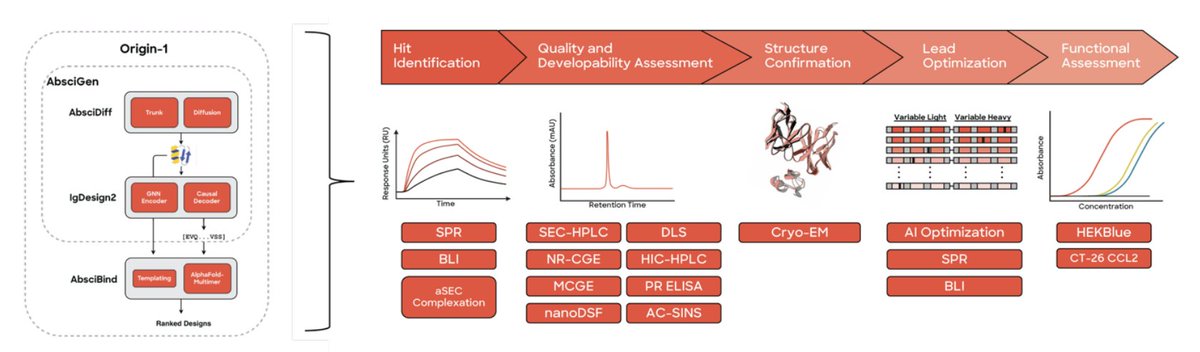
Origin-1: A generative AI platform for de novo antibody design against novel epitopes 1 Origin-1 targets “zero-prior” epitopes: binding sites on antigens with no available antibody–antigen or protein–protein complex structures, and with limited homology (≤60% identity) to proteins that do have known complexes—setting up a stringent generalization test. 2 The platform combines two stages: AbsciGen (design) and AbsciBind (score/select). AbsciGen itself is modular: AbsciDiff generates epitope-conditioned all-atom antibody–antigen complex structures, then IgDesign2 designs paired heavy light CDR sequences to match those structures. 3 AbsciDiff is a diffusion-based all-atom generator fine-tuned from Boltz-1, modified for antibody docking/design with (i) antibody- and docking-specific masking/conditioning, (ii) explicit epitope conditioning via a token-wise epitope vector, (iii) an intermediate “sequence hypothesis” head with recycling, (iv) optimized equivariant kernels, and (v) optional structural templates (endogenous templating used in final training). 4 IgDesign2 is a “generate-and-refine” sequence designer: a GNN encoder captures 3D geometry, a causal transformer decoder autoregressively generates CDRs, then a paired antibody language model refines heavy light sequences with structure-aware fusion at every layer—aiming to avoid treating chains independently. 5 AbsciBind addresses a practical bottleneck: folding-model confidence metrics often underperform for antibody–antigen complexes. It derives from AF_Unmasked and computes an ipTM-style score with improved awareness of heavy/light chain arrangement plus an antibody-aligned normalization; the final AbsciBind Score averages global and antibody-aligned interface assessments. 6 In silico benchmarking vs RFantibody on 10 “zero-prior” targets: AbsciGen produced many more high-scoring candidates by AbsciBind Score (23.5% of designs ≥0.5 vs 0.8% for RFantibody) and higher mean AbsciBind Score overall, while also yielding more human-like sequences by OASis humanness percentiles. 7 Low-throughput experimental validation: with fewer than ~100 designs screened per target, Origin-1 produced specific binders for 4 targets (COL6A3, AZGP1, CHI3L2, IL36RA). Hits were filtered for specificity (including off-target proteins TL1A and PRLR) and confirmed via orthogonal assays (SPR, BLI, solution complexation). 8 Structural accuracy was validated by cryo-EM for designs against COL6A3, AZGP1, and an optimized IL36RA variant: 3.0–3.3 Å maps and high agreement with design models (DockQ 0.83–0.91), with sub-angstrom to ~1.5 Å-range CDR RMSDs reported across loops—supporting atomic fidelity of both docking pose and designed paratope geometry. 9 AI-guided affinity maturation: adapting Efficient Evolution with AbsciBind multiple protein language models, they improved weak binders and produced functional antagonists. For IL36RA, optimization yielded sub-nanomolar affinities and a best cellular potency EC50 of 12.3 nM; cross-reactivity to mouse IL36RA enabled functional testing in a mouse cell assay as well. 10 Developability profiling (polyreactivity, self-association, hydrophobicity, thermal stability, aggregation/polydispersity, purity) showed most binders were within therapeutically acceptable ranges; importantly, IL36RA variants retained generally similar developability despite >1000-fold affinity gains, highlighting an attempt to co-optimize binding and drug-like properties. 💻Code: github.com/AbSciBio/origin-1 📜Paper: biorxiv.org/content/10.64898… #AntibodyDesign #GenerativeAI #ProteinDesign #ComputationalBiology #MachineLearning #CryoEM #DrugDiscovery #DeNovoDesign #ProteinEngineering #Bioinformatics
1
2
25
10,476
BiologyAIDaily
Origin-1: A generative AI platform for de novo antibody design against novel epitopes 1 Origin-1 targets “zero-prior” epitopes: binding sites on antigens with no available antibody–antigen or protein–protein complex structures, and with limited homology (≤60% identity) to proteins that do have known complexes—setting up a stringent generalization test. 2 The platform combines two stages: AbsciGen (design) and AbsciBind (score/select). AbsciGen itself is modular: AbsciDiff generates epitope-conditioned all-atom antibody–antigen complex structures, then IgDesign2 designs paired heavy light CDR sequences to match those structures. 3 AbsciDiff is a diffusion-based all-atom generator fine-tuned from Boltz-1, modified for antibody docking/design with (i) antibody- and docking-specific masking/conditioning, (ii) explicit epitope conditioning via a token-wise epitope vector, (iii) an intermediate “sequence hypothesis” head with recycling, (iv) optimized equivariant kernels, and (v) optional structural templates (endogenous templating used in final training). 4 IgDesign2 is a “generate-and-refine” sequence designer: a GNN encoder captures 3D geometry, a causal transformer decoder autoregressively generates CDRs, then a paired antibody language model refines heavy light sequences with structure-aware fusion at every layer—aiming to avoid treating chains independently. 5 AbsciBind addresses a practical bottleneck: folding-model confidence metrics often underperform for antibody–antigen complexes. It derives from AF_Unmasked and computes an ipTM-style score with improved awareness of heavy/light chain arrangement plus an antibody-aligned normalization; the final AbsciBind Score averages global and antibody-aligned interface assessments. 6 In silico benchmarking vs RFantibody on 10 “zero-prior” targets: AbsciGen produced many more high-scoring candidates by AbsciBind Score (23.5% of designs ≥0.5 vs 0.8% for RFantibody) and higher mean AbsciBind Score overall, while also yielding more human-like sequences by OASis humanness percentiles. 7 Low-throughput experimental validation: with fewer than ~100 designs screened per target, Origin-1 produced specific binders for 4 targets (COL6A3, AZGP1, CHI3L2, IL36RA). Hits were filtered for specificity (including off-target proteins TL1A and PRLR) and confirmed via orthogonal assays (SPR, BLI, solution complexation). 8 Structural accuracy was validated by cryo-EM for designs against COL6A3, AZGP1, and an optimized IL36RA variant: 3.0–3.3 Å maps and high agreement with design models (DockQ 0.83–0.91), with sub-angstrom to ~1.5 Å-range CDR RMSDs reported across loops—supporting atomic fidelity of both docking pose and designed paratope geometry. 9 AI-guided affinity maturation: adapting Efficient Evolution with AbsciBind multiple protein language models, they improved weak binders and produced functional antagonists. For IL36RA, optimization yielded sub-nanomolar affinities and a best cellular potency EC50 of 12.3 nM; cross-reactivity to mouse IL36RA enabled functional testing in a mouse cell assay as well. 10 Developability profiling (polyreactivity, self-association, hydrophobicity, thermal stability, aggregation/polydispersity, purity) showed most binders were within therapeutically acceptable ranges; importantly, IL36RA variants retained generally similar developability despite >1000-fold affinity gains, highlighting an attempt to co-optimize binding and drug-like properties. 💻Code: github.com/AbSciBio/origin-1 📜Paper: biorxiv.org/content/10.64898… #AntibodyDesign #GenerativeAI #ProteinDesign #ComputationalBiology #MachineLearning #CryoEM #DrugDiscovery #DeNovoDesign #ProteinEngineering #Bioinformatics
3
14
1,528
BiologyAIDaily
A hybrid physics-deep learning framework for combinatorial de novo design of small-molecule binding proteins 1. The paper introduces CLAIRE (CombinatoriaL Assembly with Integrated REfinement), a hybrid workflow that aims to make de novo small-molecule binder design more reliable by combining explicit physics-based interaction scaffolding with deep-learning-guided sequence/structure optimization. 2. Core idea: instead of asking generative models to “discover” atom-level protein–ligand hydrogen bonding after the fact, CLAIRE defines high-fidelity interaction motifs up front and then searches for backbones that can accommodate those motifs with tight geometric tolerances (distances within ~0.5 Å; angles/torsions within ~10–15°). 3. Motif innovation: the authors extend BSFF (Binding Sites from Fragments) by mining the PDB for residue–fragment interactions, spatially clustering them into discrete “interaction modes,” and preferentially using statistically overrepresented modes (not necessarily those best-scoring by Rosetta), capturing preferences like pi-stacking and cation–pi that energy functions may underweight. 4. Scaffold innovation: the authors generalize motif scaffolding beyond helical bundles by using LUCS to generate thousands of reshaped de novo NTF2-like alpha–beta scaffolds with finely varied pocket geometries, mimicking how nature reuses folds by subtle geometric shifts around functional sites. 5. Combinatorial matching: motifs and scaffolds are screened at scale using Rosetta Match; buried ligand placements are kept (≤30% ligand SASA exposed), yielding high matching throughput (reported as >160 buried matches per input motif across five diverse small molecules), enabling large libraries of candidate complexes. 6. Refinement step 1 (physics, targeted): HBRefine is introduced to fix a common failure mode in small-molecule binder design—buried unsatisfied polar atoms. It (a) mutates extraneous buried polar residues to hydrophobics when favorable and (b) proposes local mutations to create new H-bonds to any unsatisfied ligand polar atoms, then repacks and accepts changes if energetically non-worse. 7. Refinement step 2 (ML physics): ProteinMPNN redesigns residues outside the binding site to restore global sequence–structure compatibility after pocket remodeling; Rosetta FastDesign then redesigns using MPNN-derived profiles, followed by filtering for both binding metrics (e.g., interface H-bonds, shape complementarity, ddG) and stability metrics (e.g., packstat, exposed hydrophobics, global polar satisfaction). 8. Quantitative takeaway (in silico): HBRefine plus ProteinMPNN increases the fraction of designs passing stringent multi-metric filters by up to ~7-fold. When compared to RosettaFold Diffusion all-atom pipelines on progesterone/estriol, CLAIRE yields higher in-silico pass rates; the diffusion designs most often fail on ligand H-bond satisfaction and interface buried unsatisfied polar atoms. 9. Experimental validation on two similar steroids: 26 designs (13 estriol, 13 progesterone) were tested. All expressed solubly; ~58% were monomeric by SEC; 31% were well-folded by 15N-HSQC. Binding by NMR chemical shift perturbations was observed for 1 estriol design and 3 progesterone designs, i.e., 4/26 binders overall (notably higher than typical sub-1% reports for fully generative workflows). 10. Structural and mechanistic support: NMR structures for A1E (apo/holo characterization) and D2P (holo) agree well with models (non-loop Cα RMSDs ~1.5 Å vs AF2). Motif-residue point mutations (e.g., A1E N43V/S45V/Y85F; D2P Y14F/T98V) reduce binding signals, supporting that the designed polar contacts are functionally important. Designed binding modes differ from human estrogen receptor binding solutions and show higher interaction density, indicating novelty rather than copying natural motifs. 💻Code: github.com/cvgalvin/CLAIRE 📜Paper: biorxiv.org/content/10.64898… #ProteinDesign #ComputationalBiology #Rosetta #ProteinMPNN #AlphaFold2 #NMR #DeNovoDesign #SmallMoleculeBinding #HybridModels #StructuralBiology
1
6
37
2,523
BiologyAIDaily
Beyond Structure and Affinity: Context-Dependent Signals for de novo Binder Success 1. The study argues that de novo binder evaluation is still overly centered on structure confidence and affinity proxies, yet large public benchmarks show most designs fail experimentally and “good” in silico scores often do not predict in vivo success. 2. It re-analyzes two public datasets with very different deployment contexts: 11,984 CD20 binders used as CAR extracellular domains in primary human T cells (multi-gate: expression/recovery, enrichment, depletion) and 603 EGFR binders tested as standalone proteins (cell-free expression BLI binding). 3. Instead of structural scores, it uses “biology-informed” sequence descriptors from ML models trained on natural proteins (Orbion Astra suite) to quantify disorder, amyloid/aggregation propensity, topology-like character, PTM-site patterns, and broad protein/functional label probabilities—treating outputs as compatibility signals rather than literal annotations. 4. A key contribution is multi-gate analysis: the same feature can help at one experimental stage and hurt at another. In CAR-T, several descriptors flip direction between the expression gate and the enrichment gate, implying that single-objective ranking can select candidates that pass one stage but fail later. 5. The most transferable cross-benchmark signal is lower aggregation/amyloid propensity: sequences with lower predicted amyloidogenicity are more likely to succeed in both CAR-T enrichment and EGFR binding, suggesting aggregation risk is a broadly useful pre-synthesis filter. 6. PTM-site density emerges as a recurring univariate correlate of success in both benchmarks (higher predicted PTM-site counts associate with enrichment/binding). However, in EGFR it is partly length-confounded due to variable sequence lengths (13–250 aa), so it is more robust in the fixed-length CAR-T setting. 7. Several signals are architecture-dependent (significant in both datasets but reversing direction), consistent with different requirements for membrane-displayed CAR domains versus standalone binders: topology-like character, disorder (especially C-terminal), and disulfide-related sequence character can indicate success in one context and failure in the other. 8. Context-specific signals also appear. In CAR-T, phosphorylation-site-related descriptors show a strong association with depletion (a potential failure mode signal), while in EGFR the dominant success signal is low disorder (large effect), consistent with the need for compact, independently folding binders. 9. Practical takeaway: stacked biology-informed filters can enrich hits. In CAR-T (after controlling for known simple predictors like cysteine and K E fraction), adding filters for low amyloidogenicity, outside-topology-like character, and PTM sites ≥10 increases enrichment hit rate from 13.8% to 38.6% (2.8× lift) in a retrospective analysis, motivating context-aware pre-screening to reduce wasted synthesis/testing. 📜Paper: biorxiv.org/content/10.64898… #ProteinDesign #ComputationalBiology #Bioinformatics #MachineLearning #CAR-T #ProteinEngineering #DeNovoDesign #ProteinBinders #Benchmarking #Biophysics
5
19
1,497
BiologyAIDaily
LigandForge: A Web Server for Structure-Guided De Novo Drug Design 1 LigandForge is presented as an end-to-end, browser-based workflow for structure-guided de novo ligand design that explicitly couples pocket physics (3D voxel fields hotspots water thermodynamics) with synthesis awareness (retrosynthetic feasibility), aiming to reduce both licensing and programming barriers. 2 The core technical idea is a voxel-based property grid around the binding site: electrostatics, hydrophobicity, steric accessibility/excluded volume, openness/SASA-derived cavity boundaries, plus geometric descriptors (curvature/shape index). These fields provide directional gradients used to guide fragment placement and growth in 3D. 3 A notable feature is explicit handling of crystallographic waters: each water site is assigned replaceability and entropy/energy-related contributions, and high-energy waters are flagged as displacement targets to guide ligand functionalization with thermodynamic rationale. 4 Molecules are built via chemistry-aware fragment assembly from curated libraries organized by functional role (core scaffolds, linkers, substituents, bioisosteres). An attachment-point manager checks local hybridization (sp/sp2/sp3), aromaticity, and valence, while fragments are oriented using local field gradients to match pocket interaction demands. 5 Drug-likeness constraints are enforced during growth (not only after generation): MW 150–700 Da, LogP −4 to 7, rotatable bond limits, and heavy atom count constraints (10–50). This keeps candidates within practical physicochemical ranges throughout the assembly trajectory. 6 Multi-objective optimization combines pharmacophore/hotspot alignment, QED-based drug-likeness, synthetic accessibility, and novelty/diversity into a weighted composite score with target-class presets (e.g., kinase vs GPCR) that adjust weights for different binding-site archetypes. 7 Optimization supports reinforcement learning, genetic algorithms, and hybrid heuristics; chemical space coverage is maintained using fingerprint-based diversity control with DBSCAN clustering to reduce mode collapse and encourage scaffold variety. 8 Synthesis awareness is integrated as a hard filter/penalty: a retrosynthetic analyzer decomposes top candidates into routes and assigns difficulty, step/yield proxies, and feasibility. The final reward is scaled by route feasibility and penalized by difficulty, pushing optimization away from impractical structures. 9 Prospective evaluation used Boltz-2 co-folding/affinity prediction on three targets (D2R, EGFR, STAT5b-NTD). Across 10 runs per target (100 candidates/target), candidates reached micromolar predicted affinities, with submicromolar predictions for D2R; predicted poses recapitulated key motif interactions (D2R D3.32 salt bridge; EGFR hinge H-bonding in the ATP site). 10 Novelty was assessed against known actives (ChEMBL for D2R/EGFR; limited literature set for STAT5b-NTD): every generated molecule reportedly had Tanimoto similarity < 0.3 to the closest known active for its target, suggesting exploration of distinct chemotypes while retaining predicted binding competence. 💻Code: github.com/HTS-Oracle/Ligand… 📜Paper: biorxiv.org/content/10.64898… #DeNovoDesign #FragmentBasedDrugDesign #StructureBasedDrugDesign #Cheminformatics #RDKit #ReinforcementLearning #GeneticAlgorithms #Retrosynthesis #WebServer #DrugDiscovery
1
5
39
3,137
BiologyAIDaily
Ligand-guided Sequence–structure Co-design of De Novo Functional Enzymes 1. A new AI foundation model called ProteinNet achieves what was once considered exceptionally difficult: designing entirely novel enzymes from scratch that actually work in the lab, with catalytic efficiencies matching or exceeding natural enzymes despite sharing only ~50% sequence identity. 2. The 730-million-parameter model was trained on 720,993 protein-ligand complexes—over ten times more data than previously available—enabling it to learn the fundamental physics of how proteins bind and interact with small molecules. 3. Unlike conventional two-stage approaches that design structure first then sequence, ProteinNet co-designs both simultaneously using an interleaved architecture of Transformer layers for sequence dependencies and equivariant graph neural networks for 3D geometry. 4. The model incorporates three critical biological constraints: binding ligands for functional targeting, automatically identified functionally important residues, and NCBI taxonomic identifiers to steer designs toward evolutionarily plausible sequence spaces. 5. Experimental validation across three distinct enzyme families—chloramphenicol acetyltransferase, aminoglycoside adenylyltransferase, and thiopurine S-methyltransferase—demonstrated that 35-40% of designed candidates showed activity, with some outperforming natural enzymes. 6. One designed chloramphenicol acetyltransferase enabled E. coli survival at 500 μg/mL antibiotic concentration where the wild-type failed, while a designed aminoglycoside adenylyltransferase conferred resistance up to 2400 μg/mL spectinomycin. 7. The thiopurine methyltransferase designs revealed access to previously uncharacterized enzyme subfamilies, with one design showing distinct kinetic profiles from known enzymes, opening new regions of functional protein space for exploration. 8. Ablation studies confirmed that removing any component—ligand module, taxonomic identifiers, structure modeling, or functional residue constraints—significantly degraded performance, validating the integrated design philosophy. 9. ProteinNet outperformed established pipelines including RFdiffusion/ProteinMPNN and AlphaFold3/LigandMPNN on enzyme-substrate prediction, structural stability, and design fidelity metrics across ten major enzyme families. 10. The platform represents a shift from enzyme-specific models toward general protein-ligand interaction modeling, with potential applications extending beyond catalysis to therapeutic protein design and synthetic biology. 💻Code: github.com/songzhenqiao/Prot… 📜Paper: biorxiv.org/content/10.64898… #ProteinDesign #EnzymeEngineering #AIforScience #Bioinformatics #SyntheticBiology #DeepLearning #ProteinLigand #DeNovoDesign #FoundationModel #Biocatalysis
12
42
3,150
BiologyAIDaily
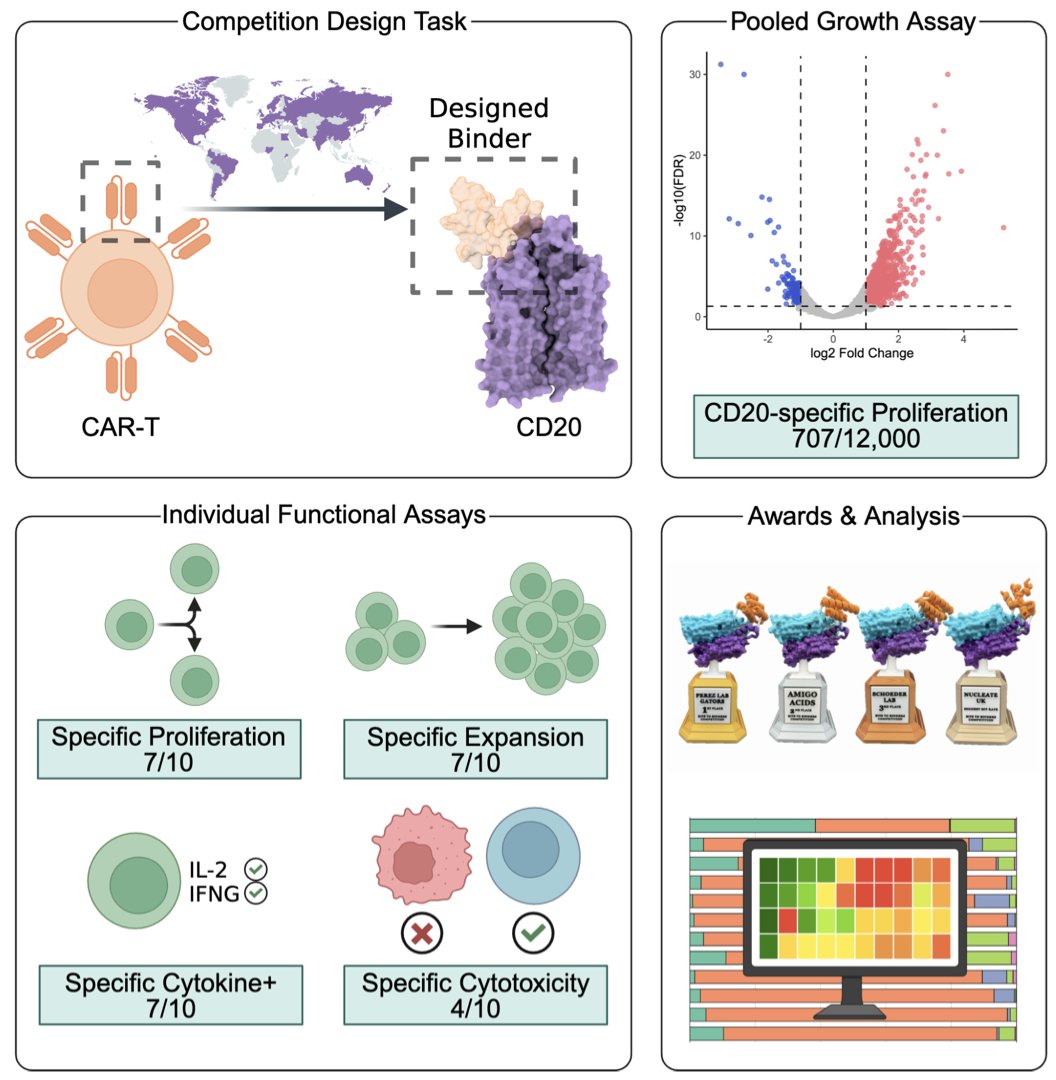
Validation and analysis of 12,000 AI-driven CAR-T designs in the Bits to Binders competition 1 The Bits to Binders competition represents the largest functional benchmark of AI-designed protein binders to date, with 28 teams from 42 countries submitting 12,000 de novo designs targeting CD20 for CAR-T cell therapy applications. 2 Unlike previous competitions that focused solely on binding affinity, this study evaluated designs through a complete therapeutic pipeline including expression, proliferation, cytokine production, and target-specific cell lysis—revealing that binding alone is insufficient for biological function. 3 The pooled CAR-T proliferation assay identified 707 functional designs (5.9% hit rate), with team success rates varying dramatically from 0.6% to 38.4%, highlighting how methodological choices profoundly impact outcomes even when using similar AI tools. 4 A striking finding: 98.9% of designs that failed to express were generated using ProteinMPNN or SolubleMPNN, with failures strongly correlated to lysine and glutamate-rich alpha helices that cause translational disruption through ribosomal stalling. 5 Simple sequence-based filters—avoiding high GC content, low DNA entropy, glutamate repeats, and excessive cysteines—could nearly double the success rate from 5.9% to 10.6%, outperforming complex deep learning confidence metrics like AlphaFold's ipTM. 6 Only 3 of 10 top-performing designs showed measurable binding affinity by SPR, suggesting that moderate affinity combined with avidity effects may be optimal for CAR-T function, challenging the assumption that higher affinity always yields better therapeutics. 7 The winning teams (Perez Lab Gators, Amigo Acids, Schoeder Lab, Nucleate UK London) shared common elements: diffusion-based generation, ProteinMPNN for sequence design, and iterative refinement, yet no single pipeline dominated. 8 This open dataset of 12,000 designs with comprehensive experimental annotations provides an unprecedented resource for training and validating next-generation protein design models that account for cellular expression and functional context. 💻Code: github.com/kosonocky/bits-to… 📜Paper: biorxiv.org/content/10.64898… #ProteinDesign #AI #CART #Immunotherapy #DeNovoDesign #RFdiffusion #ProteinMPNN #Benchmark #OpenScience #ComputationalBiology
7
25
2,543
BiologyAIDaily
Assessment of Generative De Novo Peptide Design Methods for G Protein-Coupled Receptors 1. This study presents a comprehensive two-part benchmark specifically designed for GPCR-targeting peptide therapeutics, addressing a critical gap in evaluating generative AI methods for this important drug target class. 2. The authors assembled a dataset of 124 unique GPCR-peptide complexes from GPCRdb, spanning class A and B1 receptors with peptides ranging from 3 to 73 amino acids, providing the first de novo design-centric benchmark for this field. 3. In the scoring assessment, RosettaFold3 and Boltz-2 significantly outperformed AlphaFold2 Initial Guess for predicting endogenous peptide binding modes, with Boltz-2 achieving the best median DockQ score of 0.56 and 62% of predictions being medium quality or better. 4. For generative sampling evaluation, the team generated 10,000 designs per target using BindCraft, BoltzGen, and RFdiffusion3 across three representative receptors, measuring both hotspot distance and structural diversity relative to native peptides. 5. The study reveals that current generative models struggle with the unique challenge of GPCR orthosteric pockets, often placing peptides on the exterior of the helix bundle rather than properly engaging the binding pocket, highlighting the need for improved sampling strategies. 6. This benchmark establishes crucial evaluation criteria for the peptide therapeutics community, emphasizing that robust filtering methods are essential given the lower feasibility of high-throughput testing compared to protein designs. 📜Paper: biorxiv.org/content/10.64898… #PeptideDesign #GPCR #DeNovoDesign #AlphaFold #RosettaFold #BindCraft #BoltzGen #RFdiffusion #StructuralBiology #DrugDiscovery #ComputationalBiology #Bioinformatics
6
36
2,836
BiologyAIDaily
BOND-PEP: Topology-Conditioned Bipartite Alignment for Evidence-Grounded Peptide Binder Generation 1. The paper introduces BOND-PEP, a retrieval-augmented framework that addresses a critical gap in peptide binder design: protein language models (PLMs) like ESM-2 and ESM-C perform well on full-length proteins but show dramatic performance degradation on short peptides, especially those ≤10 amino acids. 2. The core innovation is a bipartite alignment mechanism that converts retrieved binding evidence into explicit, residue-resolved conditioning states for peptide generation, rather than relying on implicit context encoding used by previous sequence-first methods. 3. The retriever component uses contrastive learning to "de-collapse" peptide representations in ESM embedding space, transforming peptides from a concentrated, indistinguishable region into a structured space where target-specific local neighborhoods emerge for effective retrieval. 4. The topology conditioner constructs protein-centric star graphs between query proteins and retrieved peptide candidates, performing bidirectional message passing to identify which candidate fragments are informative and where on the protein they constrain compatibility. 5. Ablation studies demonstrate that removing topology conditioning causes teacher-forcing perplexity to explode from 3.45 to over 350 and free-generation hit rates to collapse to near zero, confirming that retrieval alone is insufficient without proper conditioning. 6. The method achieves state-of-the-art results compared to existing peptide generation approaches, showing low perplexity, satisfactory hit rates, and high sequence novelty under fair evaluation protocols with controlled decoding budgets. 7. Visual analysis reveals that the model learns sparse, structured protein residue preferences that map to both interface-proximal binding hotspots and distal regions that likely stabilize binding-competent conformations. 8. BOND-PEP provides a practical, fully sequence-first route to controllable de novo peptide binder generation that operates without structural templates, making it applicable to targets lacking high-confidence structures or containing intrinsically disordered regions. 📜Paper: biorxiv.org/content/10.64898… #PeptideDesign #ProteinLanguageModels #DeNovoDesign #ComputationalBiology #DrugDiscovery #GenerativeAI #Bioinformatics
1
9
1,189
BiologyAIDaily
Navigating Heterogeneous Protein Landscapes Through Geometry-Aware Smoothing 1. A new study introduces Density-Dependent Smoothing (DDS), a breakthrough method that solves a fundamental problem in protein design: fixed noise levels in generative AI models fail to handle the sparse, island-like distribution of functional protein sequences. 2. Traditional diffusion models use a single global noise parameter, which forces an impossible trade-off—either oversmoothing dense functional clusters or fragmenting sparse regions and generating non-functional hallucinations. 3. DDS adapts stochastic smoothing to local sequence density by inversely coupling diffusion noise to estimated density: gentle refinement in high-density regions, controlled exploration in sparse regions. This geometry-aware approach removes the need for globally tuned noise parameters. 4. The method is implemented as a plug-in mechanism for discrete molecular sampling and consistently outperforms state-of-the-art diffusion and autoregressive models across antibody repertoires, therapeutic antibody design, antimicrobial peptide generation, and coronavirus antibody design. 5. Key validation results: On synthetic benchmarks, DDS achieves the lowest L1 error and best balance between mode recovery and spurious generation. On real biological tasks, it generates sequences with superior structural folding confidence (pLDDT 75.30) while avoiding the memorization pitfalls of fixed-noise baselines. 6. BLAST homology analysis reveals that high noise levels (σ=1.0) lead to 65.8% near-duplicate sequences, while DDS maintains structural validity with only 25% high-homology hits, demonstrating genuine evolutionary novelty rather than memorization. 7. The approach uses kernel density estimation on six biochemical properties (hydrophobicity, molecular weight, isoelectric point, aromaticity, instability index, β-sheet content) to map local geometry, with noise scales dynamically assigned per sample during training and inference. 8. This work establishes that respecting heterogeneous geometry is not an implementation detail but a prerequisite for reliable protein design, offering a path toward scalable and trustworthy molecular design beyond fixed-noise limitations. 📜Paper: arxiv.org/abs/2602.10422 #ProteinDesign #GenerativeAI #DiffusionModels #ComputationalBiology #AntibodyDesign #MachineLearning #Bioinformatics #StructuralBiology #AMPDiscovery #DeNovoDesign
5
39
2,115
BiologyAIDaily
Generative AI for Enzyme Design and Biocatalysis 1. Generative AI is revolutionizing enzyme design by moving beyond traditional directed evolution and rational design approaches, which often face limitations in exploring the full fitness landscape of proteins. 2. The field has witnessed a paradigm shift where de novo enzyme design success rates have dramatically improved after years of low efficiency, with modern models now capable of creating proficient enzymes for industrial applications. 3. Sequence-generating models fall into three categories: substitution models (ESM family, ProMEP), family expansion models (ProtGPT2, ProGen), and structure-conditioned models (ProteinMPNN, LigandMPNN), each serving distinct design workflows. 4. Backbone-generating models like the RFDiffusion family enable de novo design of protein structures from random noise, with conditioning options ranging from fragment-level to atomic-level precision for active site scaffolding. 5. A standout achievement includes a serine hydrolase designed with RFDiffusion showing catalytic efficiency of 2.2×10⁵ M⁻¹s⁻¹, approaching median natural enzyme efficiencies despite being entirely computationally designed. 6. ProteinMPNN has demonstrated remarkable stabilization capabilities, with one TEV protease variant showing 26-fold activity increase and 40°C higher melting temperature compared to wild type. 7. The AI.zyme pipeline combining ProteinMPNN with structure prediction achieved a 7.7-fold improvement in Kemp eliminase activity by testing only 7 designs with 45-55% sequence identity to the starting enzyme. 8. LigandMPNN extends capabilities to non-protein interactions, enabling direct redesign of ligand-binding residues for improved enantioselectivity in reactions like cyclopropanation and organogermane synthesis. 9. Current limitations include the inability to fully capture electrostatic pre-organization and dynamics, with models still learning statistical patterns rather than deducing chemical requirements autonomously. 10. The authors emphasize that experimental feedback loops are crucial for model improvement, with automated testing and reinforcement learning alignment showing promise for future generations of design tools. 📜Paper: arxiv.org/abs/2602.03779 #ProteinDesign #EnzymeEngineering #GenerativeAI #Biocatalysis #DeepLearning #SyntheticBiology #ProteinMPNN #RFDiffusion #DeNovoDesign #Bioinformatics
7
38
1,983
hello_gensi
What exactly is Protein Search? 🧬 Unlike De novo Design or Representation Learning, Protein Search focuses on "searching with an evolutionary perspective." Why is it harder than Web Search? ✅ Requires joint reasoning of missing modalities. ✅ Targets high-confidence evolutionary hypotheses. ✅ Matches true biological kinship, not just text similarity. Check out our detailed video! 👇 #AIforScience #MachineLearning #ComputationalBiology #ProteinSearch #StructuralBiology #DeNovoDesign #RepresentationLearning #SequenceAnalysis #Tweetorial #AcademicTwitter
1
5
98
BiologyAIDaily
De novo design of metalloproteases for targeted amyloid-β cleavage 1. Researchers have achieved a significant breakthrough in de novo protein design by creating metalloproteases capable of selectively cleaving specific peptide bonds within amyloid-β (Aβ), a key pathogenic factor in Alzheimer's disease. This work demonstrates the potential for programmable, sequence-specific proteolysis. 2. The study employs a two-step encapsulation strategy using the flow-based generative model Proteus2 to design clamp-like metalloproteases. This approach maximizes substrate sequence specificity by precisely positioning the target peptide bond and accurately scaffolding the catalytic residues. 3. Five designed enzymes were experimentally validated to cleave three distinct sites within Aβ with high specificity and minimal off-target activity. These enzymes accelerated peptide bond hydrolysis by over 10^7-fold compared to the uncatalyzed reaction, showcasing remarkable catalytic efficiency. 4. The designed metalloproteases exhibit substrate affinities (Km) comparable to natural enzymes, indicating robust recognition of physiological polypeptides. This opens new possibilities for therapeutic interventions targeting Aβ aggregation in Alzheimer's disease. 5. The computational strategy integrates target sequence information into the structure generation process, allowing for the customization of protease specificity. This method can be adapted to other protease classes, such as serine or cysteine proteases, expanding the scope of selective protein manipulation. 📜Paper: biorxiv.org/content/10.64898… #DeNovoDesign #Metalloproteases #AlzheimersDisease #Proteolysis #ComputationalBiology
2
15
77
9,846
BiologyAIDaily
HalluDesign: Protein Optimization and de novo Design via Iterative Structure Hallucination and Sequence design 1. HalluDesign introduces a novel framework for protein optimization and de novo design, leveraging the "hallucination" capabilities of AlphaFold3-style models to iteratively update protein structures and sequences. This method allows for fine-tune free, forward-pass only sequence-structure co-optimization, smoothing the rugged sequence-structure landscape and enabling rapid convergence. 2. The core innovation of HalluDesign lies in its ability to control the sampling space through structure conditioning at different noise levels. This versatility supports a wide range of applications, from local and global protein optimization to de novo design, making it a powerful tool for both refining existing structures and generating entirely new protein interactions. 3. HalluDesign demonstrates high success rates in experimental validations, including the design of protein binders for small molecules, metal ions, and phosphorylation-specific peptides. The framework's ability to rescue previously unsuccessful designs and optimize antibody CDR loops highlights its potential for biotechnological applications. 4. The study shows that HalluDesign can optimize protein-protein interactions and generate new biomolecular interactions with high accuracy. The use of Protenix, an AlphaFold3-style architecture built on protein language model embeddings, further enhances the framework's capability for de novo design from scratch, overcoming limitations of traditional methods. 5. HalluDesign's iterative approach and reliance on forward-pass only optimization make it computationally efficient compared to gradient-based methods. The framework's ability to work with various structure prediction models, including AlphaFold3 and Protenix, underscores its flexibility and adaptability for future advancements in protein design. 📜Paper: biorxiv.org/content/10.1101/… #ProteinDesign #AlphaFold #DeNovoDesign #ComputationalBiology #Biotechnology
1
9
44
2,444