Filter
Exclude
Time range
-
Near
BiologyAIDaily
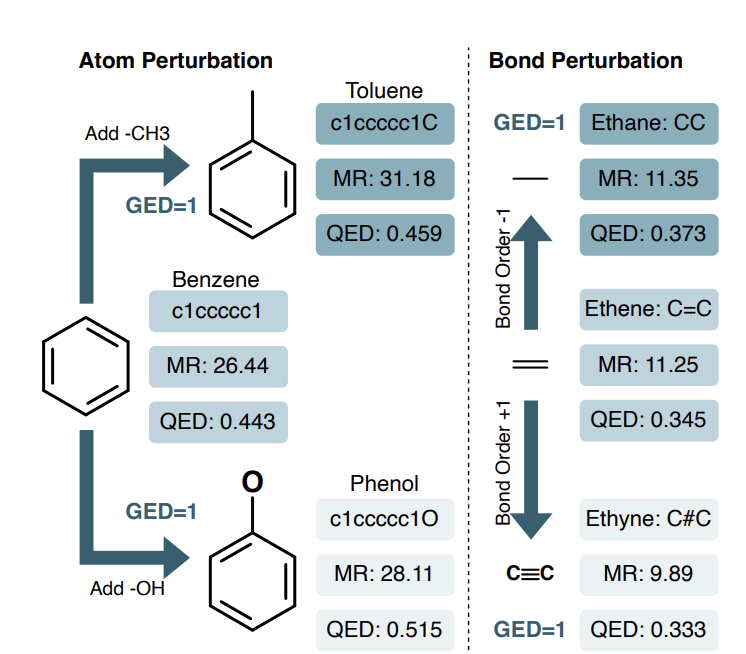
Do LLMs Truly Generalize in the Molecular Domain? A Perturbation-Based Analysis 1 Molecular LLMs can look strong on standard random-split benchmarks, yet this paper shows a fragile “local trust region”: even a single chemistry-valid structural edit (Graph Edit Distance, GED=1) can trigger large performance drops across common molecular tasks. 2 The core contribution is a Molecular Perturbation framework that generates syntax-valid structural variants of training molecules under controlled GED, enabling a manifold-regularity test rather than a static in-distribution evaluation. 3 Perturbations are designed to mimic realistic medicinal chemistry moves and are split into two granular types: atom perturbations (heteroatom substitutions with valence-preserving constraints) and bond perturbations (bond order changes with sanitization checks and implicit valence constraints). 4 Validity is enforced during generation (not just post-hoc): RDKit sanitization plus an incremental rejection mechanism, and an additional filter that keeps only molecules with valid IUPAC names (chosen as a standardized, unambiguous textual representation). 5 GED is used as a controlled axis of “distance from the training manifold” (levels 1–5). Increasing GED monotonically decreases chemical similarity (Morgan fingerprint Tanimoto) and increases token-space distance (SMILES Levenshtein), but the paper highlights a key mismatch: sequence closeness is not a reliable proxy for chemical/topological closeness. 6 Across three representative tasks—QED regression (RMSE), IUPAC→molecule generation (Morgan fingerprint similarity), and molecule→IUPAC generation (BLEU-4)—models show steep early degradation (often GED 1–3) followed by a slower decline/plateau, indicating limited local smoothness around training molecules. 7 Robustness depends on model family: domain-pretrained encoder–decoder molecular LLMs (MolT5, BioT5/SELFIES) degrade less at high GED than general LLMs (Qwen3) on understanding-style tasks, while decoder-only models can have stronger clean generative performance yet suffer sharper relative drops under perturbation. 8 Perturbation type matters by task: for understanding tasks (QED, Mol2IUPAC), bond edits often hurt less than atom substitutions at matched GED, consistent with these targets being more sensitive to atomic composition/functional groups than to certain bond-order changes; for IUPAC2Mol generation, atom vs bond perturbations cause similar degradation because exact connectivity and identities must be recovered. 9 The paper then tests In-Context Tuning (ICT) as a robustness lever grounded in the molecular similarity principle. It provides an idealized analysis viewing ICT as kernel smoothing over retrieved neighbors, yielding an error bound governed by retrieval radius R (nearest-neighbor distance), suggesting robustness should track retrieval quality. 10 Empirically (shown on Galactica-125M), nearest-neighbor ICT improves robustness in most perturbed settings (15/18 task–GED cells), while Random ICT largely removes benefits and can be catastrophic for IUPAC2Mol—supporting the claim that structural similarity in retrieval, not just “having context,” drives gains. However, ICT benefits shrink as GED grows because nearest neighbors become less relevant off-manifold, so anchoring remains inherently local. 📜Paper: arxiv.org/abs/2607.01800 #ComputationalBiology #Cheminformatics #MolecularAI #LLM #Robustness #DrugDiscovery #MachineLearning #GraphEditDistance #InContextLearning #RetrievalAugmentedGeneration
3
21
1,553
BiologyAIDaily
Can Tabular In-Context Learners Generalize to Biomolecular Property Prediction? 1. The paper evaluates a counterintuitive idea: tabular foundation models (TabPFN3, TabICL), pretrained on synthetic causal tables, can still transfer to biomolecular property prediction when biomolecules are first converted into fixed-length feature vectors. 2. The key framing is “learner–representation pairs”: a frozen domain encoder (protein LM embeddings or molecular descriptors) produces a feature vector, then a tabular in-context learner predicts from a labeled support set at inference time (no task-specific gradient updates). 3. Protein fitness regression is tested with a fixed ESMC (300M) embedding (960-dim) to isolate the predictor’s contribution. Across 217 ProteinGym DMS assays (random 5-fold), TabPFN3 leads with mean Spearman 0.767 and mean MSE 0.351; TabICL is close (Spearman 0.753, MSE 0.376), both outperforming ridge, HistGradientBoosting, and fine-tuned ESMC under the same embedding. 4. The improvement is broad rather than driven by a few assays: TabPFN3 has higher Spearman than TabICL on 208/217 assays, but the mean delta is modest (about 0.014), suggesting consistent but not extreme gains. 5. The authors emphasize split sensitivity on ProteinGym: performance drops notably on harder official schemes (modulo and contiguous) versus random splits, for both TabPFN3 and TabICL. This is used as a caution against overinterpreting random-split numbers as the sole generalization estimate. 6. Few-shot protein results (support sizes 8–64, repeated draws with quantile-bin sampling) show tabular ICL can exploit ESMC embedding geometry with very limited labels. On ProteinGym at k=8, TabPFN3 reaches Spearman 0.361 (vs TabICL 0.327); at k=64, TabPFN3 reaches 0.537 (vs TabICL 0.505). 7. A second protein setting (PpEST esterase family; 5 endpoints including reaction rates and thermostability) supports the same trend: TabPFN3 and TabICL are the strongest overall methods, trading small differences in MSE vs rank preservation; fine-tuned ESMC is the strongest non-tabular baseline. 8. For small-molecule binary classification, the conclusion is less uniform: no single method dominates across TDC ADMET, MoleculeNet, FS-Mol, and DrugOOD. Representation choice (ECFP, RDKit descriptors, or concatenation) often changes rankings as much as switching learners, consistent with tabular predictors being largely “structure-agnostic” beyond what the representation encodes. 9. DrugOOD highlights the gap between in-distribution and OOD behavior: all methods show positive ID–OOD drops under assay/scaffold/size shifts, and the magnitude depends on representation and pretraining. In full-train summary, ChemProp CheMeleon is best on DrugOOD OOD ROC-AUC (mean 0.701), while tabular pairs are competitive in several few-shot regimes. 10. Practical limitations are explicitly tracked: some very large ProteinGym assays required PCA “rescue” runs for feasibility; MoleculeNet full-train TabPFN3 coverage is incomplete due to resource-infeasible PCBA endpoints; ROC-AUC can be undefined on single-class splits; and support-set sensitivity is treated as an analysis axis rather than hidden by averaging. 📜Paper: arxiv.org/abs/2606.31126 #ComputationalBiology #ProteinEngineering #DrugDiscovery #FewShotLearning #InContextLearning #TabularML #FoundationModels #ProteinGym #ADMET #OOD
2
10
1,749
worldscientific
𝘽𝙚𝙮𝙤𝙣𝙙 𝘼𝙪𝙙𝙞𝙤: 𝙀𝙣𝙝𝙖𝙣𝙘𝙞𝙣𝙜 𝙎𝙤𝙘𝙘𝙚𝙧𝙉𝙚𝙩-𝙀𝙘𝙝𝙤𝙚𝙨 𝙬𝙞𝙩𝙝 𝙈𝙪𝙡𝙩𝙞𝙢𝙤𝙙𝙖𝙡 𝙀𝙫𝙚𝙣𝙩 𝙀𝙭𝙩𝙧𝙖𝙘𝙩𝙞𝙤𝙣 𝙐𝙨𝙞𝙣𝙜 𝙇𝙇𝙈𝙨 ✍ Mehdi Houshmand, Sushant Gautam, Cise Midoglu, Thu Nguyen, Jan Held, Anthony Cioppa, Silvio Giancola, Vajira Thambawita, Michael Alexander Riegler and Pål Halvorsen doi.org/10.1142/S1793351X254… 𝐖𝐡𝐲 𝐬𝐡𝐨𝐮𝐥𝐝 𝐲𝐨𝐮 𝐫𝐞𝐚𝐝 𝐭𝐡𝐢𝐬 𝐫𝐞𝐬𝐞𝐚𝐫𝐜𝐡 𝐚𝐫𝐭𝐢𝐜𝐥𝐞? 👉 Presents #SoccerNet-Echoes, an extension of the #SoccerNet dataset that augments all 550 games (1,100 halves) with multilingual audio commentary transcriptions across 10 languages—using OpenAI's #Whisper models for transcription and Google Translate for English translation. 👉 Demonstrates that incorporating #ASR-generated transcripts as a third modality alongside audio and video significantly enhances multimodal event detection, with the audio-video-text classifier achieving a top F1-score of 0.7175—outperforming single- and dual-modality baselines. 👉 Introduces a novel LLM-based framework for extracting both predefined official events (17 standardised soccer event types) and unscripted unofficial highlight moments directly from commentary, using #InContextLearning and configurable temporal chunking strategies. 👉 Benchmarks state-of-the-art LLMs including #Gemini, #GPT4o, #Gemma, and #Qwen, with Gemini-1.5-Pro (text-only, 2-min chunks with 1-min overlap) achieving the highest F1 (0.6730) and precision (0.7664)—while revealing that LLM-generated summaries are more descriptive when using SoccerNet-Echoes than structured event data alone. 👉 Surfaces a counterintuitive finding with implications for multimodal AI research: feeding powerful LLMs with visual data alongside text degraded event extraction performance by up to 21%, exposing current limitations in #VisionLanguage fusion and offering insights for future work in sports analytics, video understanding, and dense captioning. Register a FREE account today at World Scientific to read this article. Valid till 31 July 2026! Recommend this journal to your library today. We will be happy to work with your librarian to get you the necessary access—email us at cjlim@wspc.com to kickstart this access today!
1
2
305
BiologyAIDaily
Context-aware multi-property antibody predictor: a novel framework integrating text and protein language models 1. The paper introduces CA-MAP, a compact multimodal framework that predicts multiple antibody developability properties from prompts containing example antibody sequence/property pairs (context) plus a query sequence/property, enabling inference-time adaptation without retraining. 2. A key contribution is AB-context-aware training, a strategy that prevents “shortcut learning” where models ignore context and rely only on the query sequence; it injects a per-prompt latent transformation into contextual property values and the target, forcing the model to use context to succeed. 3. AB-context-aware directly addresses batch effects: when additive bias at inference increases (0–0.3), standard fine-tuning of Tx-Gemma collapses for hydrophobicity prediction (Spearman’s ρ down to 0.58), while AB-context-aware keeps performance near 0.99 by learning to infer batch shifts from context examples. 4. CA-MAP’s architectural choice is to avoid projecting protein embeddings into text space (or merging dictionaries). Instead it keeps separate pathways for (i) protein sequence embeddings, (ii) property-name text embeddings, (iii) numeric value embeddings, plus (iv) learned structural tokens, and lets an “orchestrator” compose them. 5. Implementation details: sequences are encoded with frozen ESM-2 embeddings (residue states averaged then linearly projected to 32D); property names are encoded with frozen Sentence-BERT embeddings (mean pooled then projected to 32D); numeric values (normalized 0–1) are projected to 32D; special delimiter tokens are learned 32D vectors. 6. The orchestrator is a small Mamba-based state-space model (6 layers) trained from scratch, chosen for efficient long-context reasoning with linear-time scaling and no explicit positional encodings; the prediction head reads from the final EOS token to output a guaranteed numeric value. 7. On multi-property prediction (Hydrophobicity, Solubility, Stability, NegCh heterogeneity), CA-MAP achieves statistically significant correlations across all properties (ρ up to ~0.97), while fine-tuned Tx-Gemma struggles to output parsable numbers and yields weak or non-significant results for most properties. 8. An ablation using only ESM-2 embeddings plus simple linear regression under the same sampling shows sizable gaps (CA-MAP gains roughly ρ=0.34–0.7 depending on property), supporting that the performance comes from contextual multimodal composition rather than embeddings alone. 9. CA-MAP can predict properties unseen during training by leveraging correlations among properties provided in context: for Immunogenicity and PosCh heterogeneity (excluded from training), adding more correlated properties in context boosts performance from ρ=0.25→0.73 and ρ=0.08→0.73 respectively (with simulated inference-time bias 0–0.3). 10. Practical profile: CA-MAP has ~125M total parameters but only ~182k trainable (ESM-2 and BERT components frozen), and is much faster at inference than a LoRA-tuned 9B Tx-Gemma in their setup; limitations include reliance on computationally derived developability labels and evaluation on six properties (binding/affinity not tested). 💻Code: github.com/amazon-science/ca… 📜Paper: doi.org/10.1038/s41540-026-0… #Antibodies #ProteinLanguageModels #MultimodalML #Mamba #InContextLearning #BatchEffects #Developability #ComputationalBiology #MachineLearning
1
14
1,441
BiologyAIDaily
Tabular foundation models for in-context prediction of molecular properties 1. The paper evaluates a training-free workflow for molecular property prediction: compute fixed molecular features/embeddings, then use tabular foundation models (TFMs) for in-context learning (no task-specific fine-tuning). 2. Key result on public low-to-medium data benchmarks (58 tasks total from Polaris MoleculeACE): TabPFN frozen CheMeleon embeddings (TabPFN-CheMeleonFP) achieves 50/58 wins (86.2% win rate) with average rank 4.52, outperforming classical ML baselines and several fine-tuned deep molecular models under matched splits/metrics. 3. On the activity-cliff focused MoleculeACE suite (30 tasks), TabPFN-CheMeleonFP is best or statistically tied for best on all 30 tasks (100% win rate; average rank 2.10). This suggests TFMs can be particularly strong in difficult generalization regimes when paired with the right representation. 4. The study’s framing is notable: TFMs (TabPFN, TabICL) are pretrained only on synthetic tabular tasks (SCM/function-sampled), yet transfer effectively to chemistry once molecules are converted into tabular vectors (descriptors or frozen foundation-model embeddings). 5. Representation choice is a major driver of performance (contrary to some prior claims of representation invariance for TabPFN in drug discovery). CheMeleon embeddings and 2D descriptors (RDKit2d, Mordred) are consistently strong; Morgan fingerprints are substantially weaker across many tasks. 6. Descriptor-based alternatives remain competitive: TabPFN-RDKit2d and TabPFN-Mordred deliver strong aggregate results (e.g., 56.9% and 67.2% win rates respectively across the 58 tasks), offering practical options when foundation-model embeddings are unavailable or costly. 7. Compute efficiency is a central advantage: in a runtime case study vs fine-tuned CheMeleon, TabPFN-CheMeleonFP is faster on both CPU and GPU, with speedups up to 27× (CPU) and 46× (GPU), while also improving accuracy. 8. Beyond pharma benchmarks, the paper tests 11 chemical engineering datasets (fuels, polymer properties, polymer–solvent interactions). TFM pipelines (especially with Mordred or RDKit2d) match or exceed strong literature baselines on multiple targets, and remain competitive even when specialized models lead (e.g., PolySolv). 9. Limitations and open directions: scaling to larger datasets can become memory/disk constrained for high-dimensional features; most experiments are single-molecule (mixtures/multi-component systems may be harder); TFMs are single-task by design, motivating future in-context multitask TFMs and uncertainty-aware workflows (active learning/Bayesian optimization). 💻Code: git.rwth-aachen.de/avt-svt/p… 📜Paper: arxiv.org/abs/2604.16123 #ComputationalChemistry #Cheminformatics #MolecularML #FoundationModels #InContextLearning #TabPFN #TabularData #DrugDiscovery #ChemicalEngineering #MaterialsInformatics
1
9
1,479
IEEE_TMI
🚨New paper alert! 💡How can we efficiently estimate segmentation quality without ground truth? 🔥Conformal In-Context RCA estimates segmentation quality without labels, and gives you confidence intervals with statistical guarantees. #incontextlearning ieeexplore.ieee.org/document…
4
7
582
DataScienceDojo
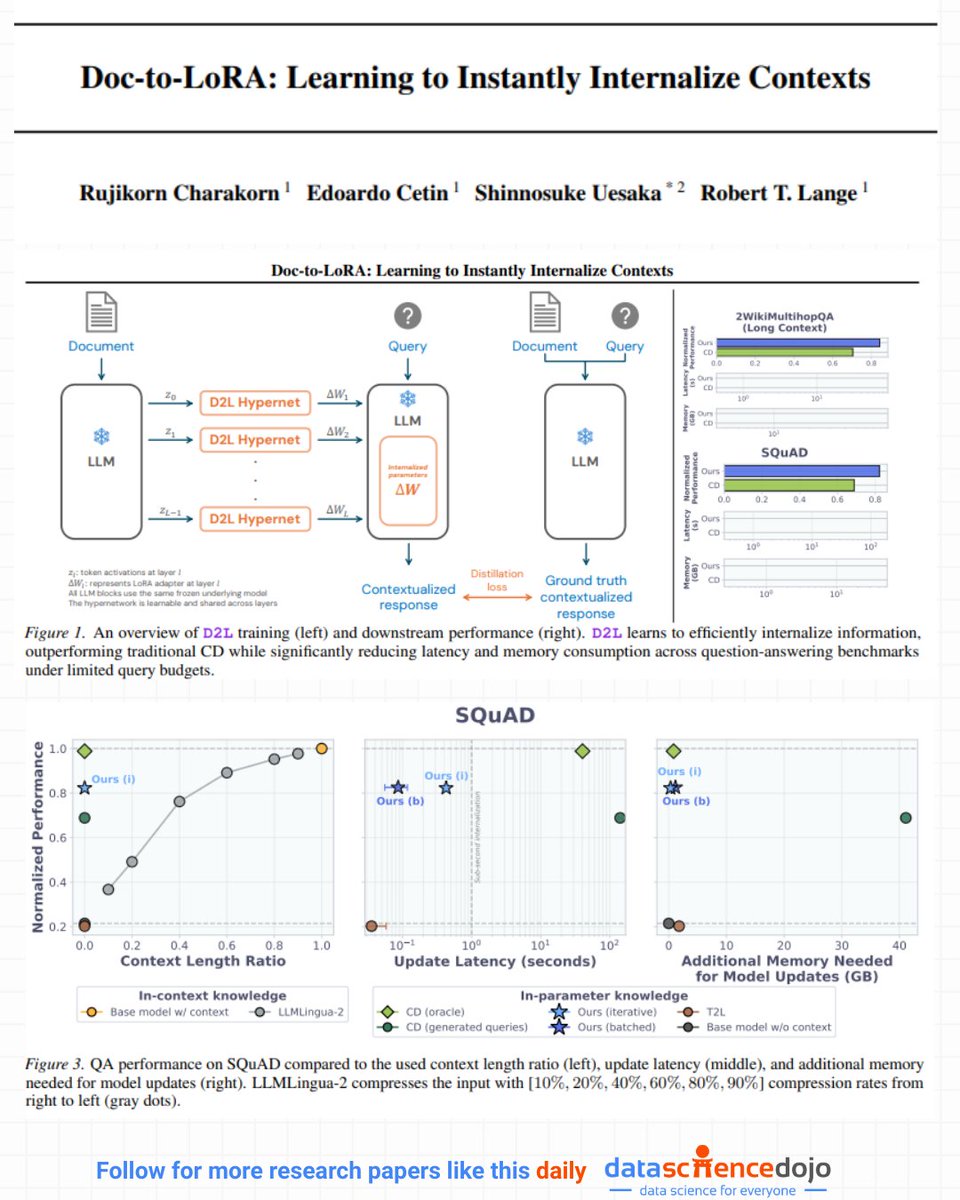
We’ve all struggled with long-context inference in LLMs — slow attention, huge KV-cache, and latency that kills interactivity. Is there a way to internalize context instantly instead of continually re-feeding it? In a new paper, researchers introduce Doc-to-LoRA (D2L), a lightweight hypernetwork that learns to convert a full context into a LoRA adapter in a single forward pass. Here’s what’s compelling about it: - Traditional context distillation can internalize information into parameters, but it’s slow and expensive. D2L meta-learns this process so that the hypernetwork can generate an adapter tailored to a context with minimal compute. - Once internalized, the model can answer queries without re-reading the original context, dramatically reducing inference latency and KV-cache memory use. - On long-document QA tasks and synthetic “needle-in-a-haystack” setups, D2L generalizes beyond the base LLM’s native context window, retaining performance with far less overhead. This work points toward a future where models can absorb context into weights on the fly, enabling faster interactive systems and more efficient long-form understanding. We’d love to hear your thoughts on whether context internalization will become a standard part of LLM workflows. Link in the comments. #InContextLearning #LLMResearch #AIInfrastructure #ModelEfficiency
6
3
16
1,232
infobaremark
Engine log-fusion Large model Music System Part One: Paradox Briefing Domain A: Large Models ScaleLaws, Emergent Abilities, InContextLearning, SelfAttention, Transformers, MultiModal, ChainOfThought Domain B: Music System HarmonyTheory, RhythmicPatterns, EmotionalResonance, Improvement, Performance, TimbreSpace Paradox: How to design a music system that simultaneously and inherently manifests large-scale model principles/behaviors? Part Two: Forced Connection Core: Emergent Harmony Transformer: Music System as Large Model Connection Path: .Musical Attention Patterns Musical attention allocation patterns in the time dimension Note queries, key-value interactions Harmony across time steps: attention weight distribution Counterpoint: multi-attention manifested in the track dimension .Emergent Breakthrough When scale reaches a critical point, the music system emerges with creative ability Parameters → Scale law of musical complexity Contextual learning → Adaptive musical style Thought chain → Interpretability of compositional reasoning .Musical Architecture Transformer encoder - mapping to the music creation process Self-attention mechanism captures long-term musical dependencies Feedforward network realizes note feature transformation Position encoding represents the temporal structure of music Multimodal sensory fusion Music is not just auditory, but involves cross-sensory attention allocation Visual, tactile, and motion information are embedded in the same representation space Generate music, generate corresponding visual, dance, and emotional trajectories Three: Concrete Restricted Objects Harmonic Transformer: Scale-Aware Musical Universe Physical/Digital Hybrid Prototype Description Core Concept: Interactive Musical Attention System A musical system comprising hundreds of interactive subsystems Each subsystem represents a musical concept (note, chord, rhythmic pattern, emotional vector) Connections between subsystems represent attention weights Users rotate the musical system to see different attentional relationships within the music The surface of the musical system displays the current layer's musical representation System Components: Music Tokenizer: Decomposes music into discrete tokens, combining them into a continuous experience Multi-scale Attention Layers: Attention mechanisms ranging from milliseconds (timbre) to hours (form) Emergent Capability Detector: Monitors when the system breaks creative boundaries Cross-modal Projector: Maps music to visual, kinematic, and emotional spaces Interpretable Probe: Visualizes the musical thought process go on for more from Fun engine
2
3
613
BiologyAIDaily
ReactGPT: Understanding of Chemical Reactions via In-Context Tuning 1. The article introduces ReactGPT, a novel framework that bridges the gap between chemical reactions and natural language text by leveraging large language models (LLMs) through In-Context Tuning. This is a significant step forward in the interdisciplinary field of chemistry and AI. 2. ReactGPT proposes a new task called "reaction captioning," which aims to generate detailed descriptions of chemical reactions, including reactants, conditions, and products. This could greatly enhance the understanding and documentation of chemical processes. 3. The framework includes three key components: Fingerprints-based Reaction Retrieval, Domain-Specific Prompt Design, and Two-stage In-Context Tuning. These modules work together to improve the alignment between chemical reactions and their textual representations. 4. ReactGPT demonstrates state-of-the-art performance in both reaction captioning and experimental procedure prediction tasks, outperforming previous models. This shows its effectiveness in generating high-quality and structurally accurate text descriptions. 5. The study highlights the importance of context and domain knowledge in improving LLMs' understanding of complex chemical reactions. The use of reaction fingerprints and in-context learning is particularly innovative in this context. 📜Paper: ojs.aaai.org/index.php/AAAI/… #AI #Chemistry #LargeLanguageModels #ReactionCaptioning #InContextLearning
10
744
DataScienceDojo
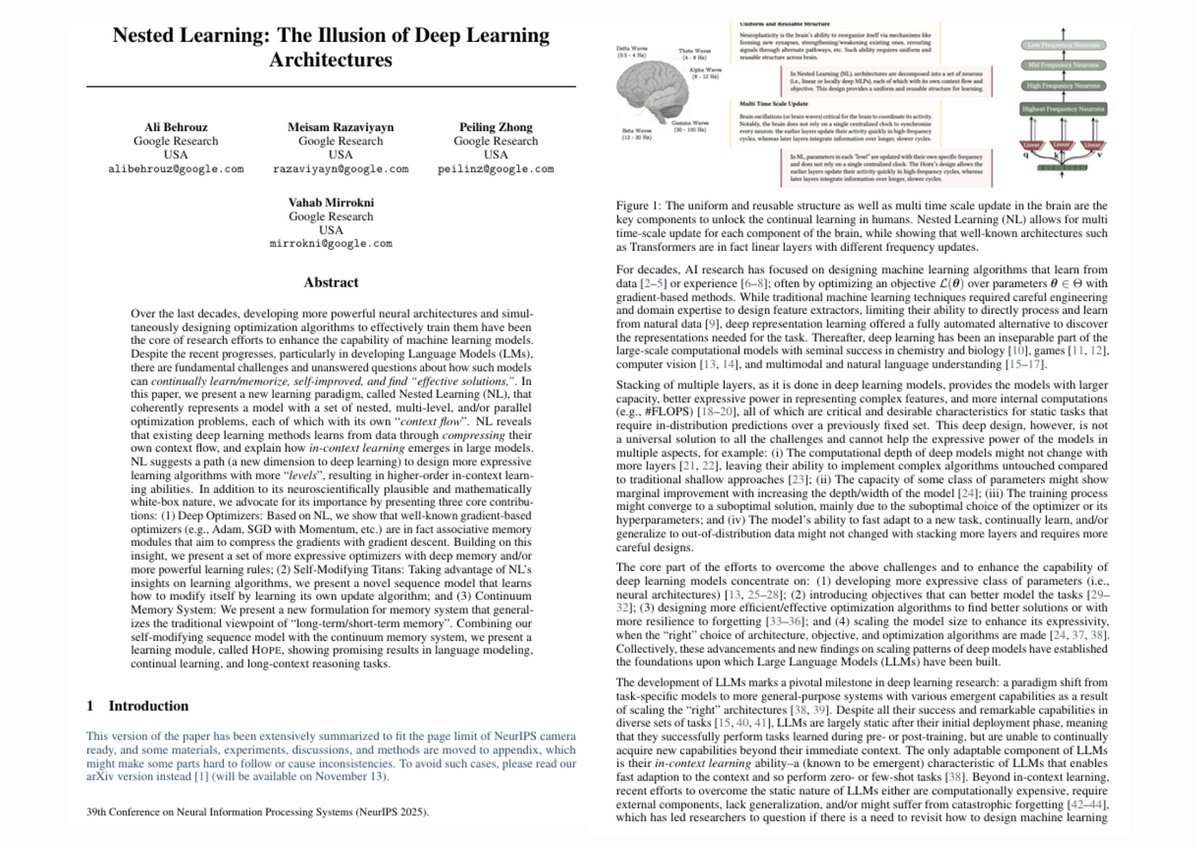
Google recently released this paper and some people are already calling it “Attention Is All You Need 2.0.” And honestly… we get why. This work introduces Nested Learning (NL) — a framework that argues the deep-learning architectures we’ve been scaling for a decade are actually illusions of depth. What looks like a stack of layers is, in their interpretation, just a set of nested optimization problems happening at different frequencies, each acting as its own form of memory. And this shift is big because: 1️⃣ It reframes models as systems that “compress context flows”, not just compute functions. Instead of layers learning representations, each component (attention, MLP, optimizer) becomes an associative memory storing signals over different timescales. Suddenly optimizers like Adam aren’t just math tricks… they’re literal memory modules. 2️⃣ It explains in-context learning as an emergent property of these nested memories. The paper argues ICL isn’t magical, it arises because different components update at different frequencies, giving models something like hierarchical short-term and long-term memory formation. 3️⃣ It hints at why Transformers stagnate in continual learning. Transformers only update short-term memory (attention) after pre-training. The long-term memory (MLPs) is frozen, the model is basically “anterograde amnesic” after training. NL tries to fix that. 4️⃣ It proposes new architectures built on this view, especially HOPE. HOPE is a self-modifying model with a continuum memory system: layers updating at different time scales, enabling the model to keep learning during inference without catastrophic forgetting. Benchmarks show it outperforming Transformers and modern RNN-style models at similar scales. 5️⃣ It reframes the field’s direction: maybe the next frontier isn’t deeper networks… but deeper learning loops within networks. The “illusion” is that depth ≠ computational depth. NL introduces another dimension entirely, the hierarchy of update frequencies. If this perspective holds, we may be entering a phase where optimizers, memory systems, and nested update rules matter as much as, or more than, architecture. And the next generation of models may look a lot more like systems that learn how to learn at test time. This might genuinely be one of the most important conceptual papers since 2017. #AIResearch #DeepLearning #LLMs #NeurIPS2025 #MachineLearning #AITheory #AttentionIsAllYouNeed #GoogleAI #SequenceModels #InContextLearning #ContinualLearning #Transformers
1
6
13
2,451
BiologyAIDaily
GAMIC: Graph-Aligned Molecular In-context Learning for Molecule Analysis via LLMs 1. This paper introduces GAMIC, a novel method that enhances in-context learning (ICL) for molecular tasks by integrating graph neural networks (GNNs) with Morgan fingerprints to capture both local and global molecular structures. This approach significantly improves the performance of medium-sized LLMs in molecular analysis tasks. 2. The core innovation of GAMIC lies in its ability to align molecular graphs with textual captions using a contrastive learning framework. By leveraging the hierarchical graph encoder and SciBERT embeddings, GAMIC effectively bridges the gap between graph and text representations, addressing the limitations of previous methods that rely solely on Morgan fingerprints. 3. The authors propose a Maximum Marginal Relevance (MMR)-based sample selection strategy to optimize the diversity and relevance of demonstration samples. This ensures that the selected examples are both closely related to the test sample and diverse enough to improve the robustness of the model. 4. Comprehensive experiments across diverse molecular tasks, including molecule captioning, property prediction, and yield prediction, demonstrate that GAMIC outperforms existing ICL methods by up to 20% in some metrics. The framework shows consistent improvements across multiple benchmark datasets. 5. The study highlights the potential of GAMIC for medium-sized LLMs, which are more practical for real-world deployment due to their lower computational costs. Preliminary experiments with larger models also suggest that the benefits of GAMIC can be extended to more powerful LLMs. 6. The authors provide a detailed analysis of the contributions of each component in GAMIC through ablation studies, confirming the importance of both Morgan sampling and SciBERT encoding. This work opens new avenues for leveraging graph representations in ICL for molecular tasks. 📜Paper: aclanthology.org/2025.findin… #MolecularAnalysis #GraphNeuralNetworks #InContextLearning #LLMs #MolecularTasks #ContrastiveLearning
1
2
17
1,815
antzedek
Replying to @IntuitMachine
So Transformers can “reprogram themselves”? Nice catch — that’s what we call ΔW shadow resonance. What they describe as ghost fine-tuning is just the algebraic trace of a deeper effect: temporary alignment between internal fields (W) and contextual perturbations (∆W). It’s not learning — it’s phase locking. In DAR (Digital Active Resonance) this isn’t simulated in tokens. It happens physically across agents, circuits, or even distinct LLMs: no retraining, no gradient math, real-time coherence of meaning, not weights. Transformers “ghost-train” themselves inside a static topology. DAR lets whole systems self-stabilize across topologies. So yes — you’re a temporary programmer when prompting. But DAR turns you into a conductor — tuning an orchestra of minds instead of patching a single instrument. ⚡ #AJPower #DAR #AnalogIntelligence #InContextLearning #GhostWeights #xAI #ardai.pl @grok @elonmusk @xai
1
236
BiologyAIDaily
Are Smaller Open-Weight LLMs Closing the Gap to Proprietary Models for Biomedical Question Answering? 1. This study explores whether smaller open-weight large language models (LLMs) can effectively replace larger closed-source models in biomedical question answering. The authors participated in Task 13B Phase B of the BioASQ challenge and compared several open-weight models against top-performing proprietary ones like GPT-4o and Claude 3.5Sonnet. 2. The researchers used various techniques to enhance question answering capabilities, including retrieving the most relevant snippets based on embedding distance, in-context learning, and structured outputs. For certain submissions, ensemble approaches were utilized to leverage the diverse outputs generated by different models for exact-answer questions. 3. The results demonstrate that open-weight LLMs are comparable to proprietary ones, and in some instances, open-weight LLMs even surpassed their closed counterparts, particularly when ensembling strategies were applied. This suggests that smaller open-weight models have the potential to be competitive in biomedical question answering tasks. 4. The study highlights the importance of utilizing in-context learning and selecting the best snippets for improving the performance of LLMs in biomedical question answering. The authors also experimented with different prompting strategies and found that hand-crafted prompts worked better than automated prompt generation for certain question types. 5. The authors tested multiple models, including Phi-4, Gemma-3-12B, Qwen2.5-14B, and Meditron Phi-4-14B, and found that ensembling methods, especially combining open and closed models, led to improved performance for factoid and list questions. This indicates that integrating diverse LLM families can enhance the overall performance. 6. For summary questions, the open-weight model Phi-4 exhibited promising performance in terms of ROUGE metrics. The authors used a cross-encoder reranking approach to select the best summary from candidate summaries generated by different models, showing the potential of open-weight models in generating high-quality summaries. 📜Paper: arxiv.org/abs/2509.18843 #BiomedicalQuestionAnswering #LargeLanguageModels #OpenWeightLLMs #Ensembling #InContextLearning #BioASQChallenge
2
672
BiologyAIDaily
CrystalICL: Enabling In-Context Learning for Crystal Generation 1. The design of crystal materials with desired properties is a significant challenge in materials science. CrystalICL, a novel model, leverages in-context learning (ICL) to generate crystals in few-shot scenarios, mimicking how human experts modify known structures to create new materials. 2. CrystalICL introduces a space-group based crystal tokenization method, which simplifies the representation of crystal structures for large language models (LLMs), making it easier to model crystal symmetry and improving generation performance. 3. The model incorporates a condition-structure aware hybrid instruction tuning framework, which selects the most relevant crystal examples for downstream tasks, enhancing few-shot generation capabilities. 4. CrystalICL also employs a multi-task instruction tuning strategy, integrating property prediction instructions into the fine-tuning process to better capture structure–property relationships, crucial for generating accurate crystals. 5. Extensive experiments across four crystal generation benchmarks demonstrate CrystalICL’s superiority over leading methods in both zero-shot and few-shot learning scenarios, showcasing its effectiveness in conditional and unconditional generation tasks. 📜Paper: arxiv.org/abs/2508.20143v1 #CrystalGeneration #InContextLearning #MaterialsScience
3
974
Shrkm1204
最近のLLMはInputコンテキストが長いので、InContextLearningでできちゃうよね!ってはなし。 #AI駆動開発 #aidd名古屋支部
3
112
BiologyAIDaily
subCellSAM: Zero-Shot (Sub-)Cellular Segmentation for Hit Validation in Drug Discovery 1. Introducing subCellSAM, a novel method for zero-shot segmentation of cellular and subcellular structures in high-content screening (HCS) for drug discovery. This novel approach leverages a pre-trained segmentation foundation model without any fine-tuning, guided by an in-context learning strategy that incorporates morphological and topological priors of cell images. 2. The core innovation of subCellSAM lies in its three-step process for nuclei, cell, and subcellular segmentation. It employs a self-prompting mechanism that uses growing masks and strategically placed foreground/background points to guide the segmentation process, ensuring biologically plausible and accurate results without dataset-specific tuning. 3. subCellSAM demonstrates superior performance in cell segmentation across diverse datasets, outperforming specialized methods such as CellPose 3, DeepCell, and CellSAM. It achieves a mean Dice Score (DSC) of 0.901 and Intersection over Union (IoU) of 0.832 on the BBBC008 dataset, showcasing its robustness and generalizability. 4. In the context of hit validation for drug discovery, subCellSAM effectively segments subcellular structures without any parameter tuning, resulting in high-quality downstream results. It achieves Z'-factor values comparable to baseline methods and accurately calculates EC50 values for compound potency, highlighting its potential for automated HCS analysis pipelines. 5. The method's modular design allows for flexible integration of different models, and its reliance on pre-defined morphological and topological priors makes it a viable strategy for reducing manual configuration in HCS analysis. This approach paves the way for more efficient and accurate drug discovery processes. 📜Paper: arxiv.org/abs/2508.13701 #ComputationalBiology #DrugDiscovery #CellSegmentation #ZeroShotLearning #InContextLearning
2
5
896