Filter
Exclude
Time range
-
Near
BiologyAIDaily
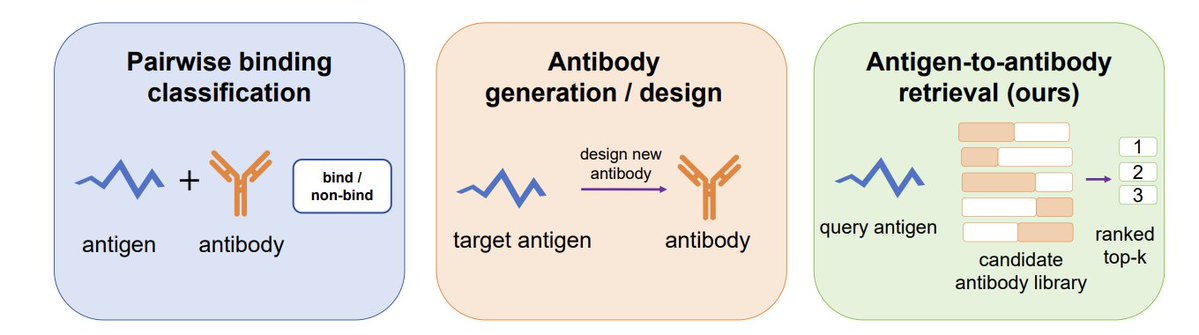
Strict OOD Antigen-to-Antibody Retrieval with CDR-Aware Slot Late Interaction 1. The paper reframes antibody discovery as antigen-to-antibody retrieval: given an antigen sequence, rank a fixed candidate antibody library to enrich known binders in the top-K, matching early virtual screening better than pairwise bind/non-bind classification. 2. A key contribution is a strict antigen-cluster out-of-distribution (OOD) benchmark to reduce antigen homology leakage: antigens are clustered by MMseqs2 at min_seq_id = 0.8, and entire clusters are held out from training and checkpoint selection. 3. Benchmark scale and protocol: test has 849 antigen queries, a controlled corpus of 869 candidate antibodies, and 872 observed positive pairs. Unpaired antigen–antibody combinations are treated as unlabeled (not negatives), so evaluation focuses on Hits@K and enrichment vs an exact random baseline. 4. The proposed model Ab-CASLR is an asymmetric dual-tower retriever: antigens encoded by ESM-2 (150M), antibodies encoded by IgBert, both projected into a shared 128-d retrieval space and fine-tuned with small learning rates. 5. Core modeling idea: preserve antibody locality with CDR-aware slots. Instead of a single pooled antibody embedding, Ab-CASLR builds M=8 antibody “document slots” using slot attention constrained by CDR masks (Chothia H1–H3, L1–L3), injecting an inductive bias that specificity concentrates in CDR loops. 6. Scoring uses late interaction rather than global similarity: the antigen tower produces L=8 latent query summaries; a low-rank bilinear matcher computes compatibility between query summaries and antibody CDR slots; final score aggregates by taking, for each query summary, the max-compatible antibody slot (then averages across summaries). 7. Training uses a multi-positive InfoNCE retrieval objective (all in-batch observed binders are positives), plus auxiliary regularizers: contact-derived epitope/paratope supervision when available and a document-side slot diversity penalty to reduce redundant CDR slots. 8. Strict OOD results show early enrichment: Hits@10 = 7.42% with EF@10 = 6.28x over exact random screening (Random Hits@10 = 1.182% for a 869-antibody corpus). Hits@1 = 1.767% with EF@1 = 14.97x, indicating strongest gains at very small K. 9. Comparisons and diagnostics clarify what helps: Ab-CASLR beats k-mer homology transfer (Hits@10 5.53%) and global ESM2-ESM2 embedding similarity (Hits@10 3.29%). Ablations show global pooled dual-tower collapses (Hits@10 1.413%), removing the CDR mask hurts (6.360%), and replacing late interaction with pooled CDR similarity drops strongly (2.120%). Slot diagnostics show antigen-side summaries collapse to near-identical representations, while antibody CDR slots remain diverse—suggesting antibody-side CDR-local representation is the main effective mechanism, and antigen epitope grounding remains an open bottleneck. 📜Paper: biorxiv.org/content/10.64898… #Antibodies #ProteinLanguageModels #Retrieval #OutOfDistribution #ComputationalBiology #Bioinformatics #MachineLearning #VirtualScreening #ESM #Immunology
4
11
1,690
HarryEJAnthony
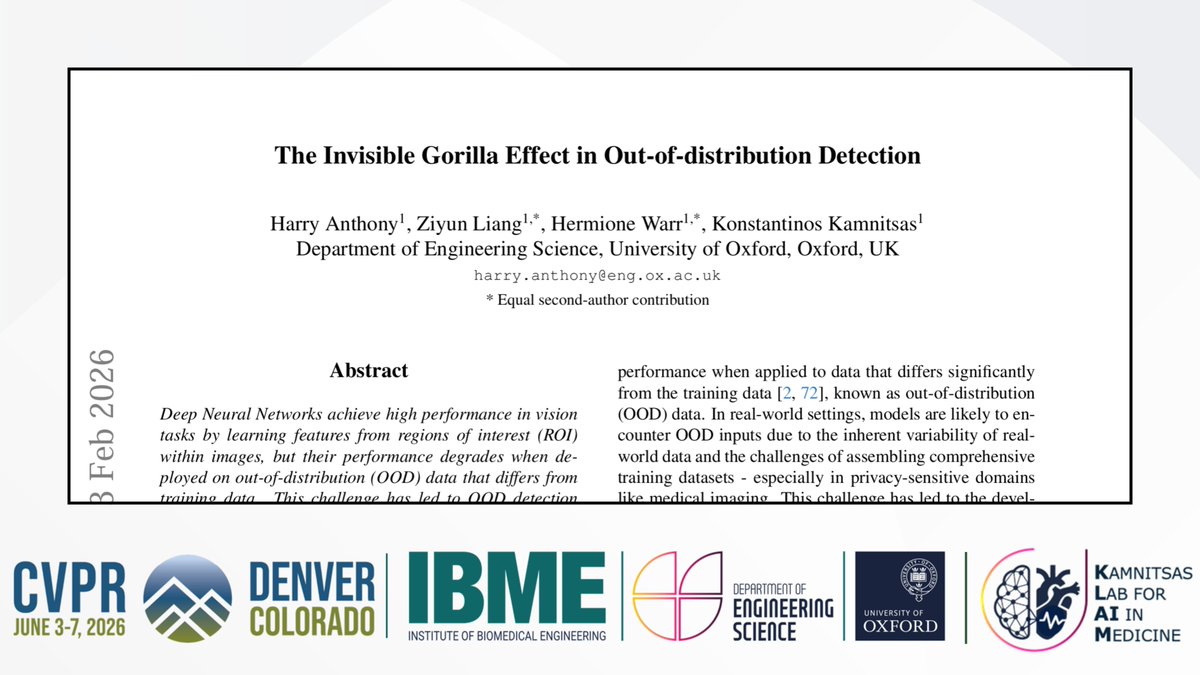
🧐 Delve into our paper: arxiv.org/abs/2602.20068 Many thanks to my Supervisor Prof. @KostasKamnitsas @UniofOxford and co-authors @ZiyunLiang_ & @Hermionegrace76 ! Funded by @EPSRC. I look forward to attending #CVPR2026 in Denver this June! 🏁(9/9) #ML #AI #Outofdistribution
2
165
BiologyAIDaily
Transforming Biological Foundation Model Representations for Out-of-Distribution Data 1. This study introduces USHER, a novel framework designed to adapt foundation model representations to handle out-of-distribution (OOD) data effectively. USHER addresses a critical challenge in biological data analysis where models trained on specific datasets fail to generalize to new experimental protocols or assays. 2. The core innovation of USHER lies in its ability to transform OOD embeddings back to the reference space of a foundation model using an expectation-maximization procedure. This method leverages Fused Gromov-Wasserstein optimal transport to align embeddings while preserving local structure, ensuring biological relevance. 3. USHER demonstrates significant improvements in integrating single-cell transcriptomics data from Xenium assays with standard scRNA-seq data. By correcting platform-specific biases, USHER enhances cell type clustering and enables cross-platform integration, which is crucial for comprehensive biological studies. 4. In addition to transcriptomics, USHER is also applied to histopathology imaging data, where it corrects artifacts introduced by MALDI mass spectrometry. This correction enables accurate cell-type classification and protein abundance imputation, showcasing USHER’s versatility across different biological data modalities. 5. A key advantage of USHER is its generalizability. The framework not only works for the specific samples used in training but also applies to other samples from similar experimental conditions, making it a powerful tool for adapting foundation models to new datasets without extensive retraining. 6. The study highlights that conventional batch correction methods fail to address the challenges posed by OOD data in biological foundation models. USHER’s approach of learning simple, low-complexity transformations provides a robust alternative that maintains the integrity of the original embeddings. 7. The authors emphasize the importance of preserving the biological structure captured by foundation models even when encountering OOD data. USHER achieves this by making only modest adjustments to the embedding space, ensuring that downstream tools relying on these models remain compatible. 📜Paper: biorxiv.org/content/10.1101/… #ComputationalBiology #FoundationModels #DataIntegration #SingleCell #Histopathology #OutofDistribution #USHER
1
4
18
1,314
BiologyAIDaily
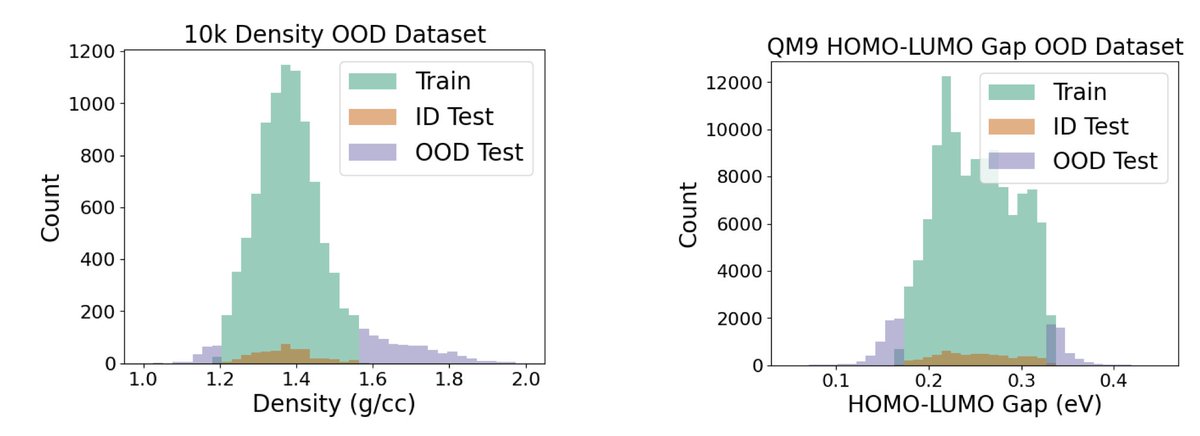
BOOM: Benchmarking Out-Of-distribution Molecular Property Predictions of Machine Learning Models 1. BOOM is the first systematic benchmark focused on evaluating the out-of-distribution (OOD) generalization performance of molecular property prediction models, a critical challenge for enabling ML-guided discovery of novel molecules. 2. The authors assess 12 ML models across 10 molecular properties using over 140 model-task combinations, revealing that even top models exhibit up to 3x higher error on OOD data compared to in-distribution (ID) test sets. 3. No current model shows robust OOD performance across all tasks. MACE leads in OOD performance on 5 of 10 tasks, while ET dominates ID tasks, indicating that strong in-distribution accuracy does not guarantee generalization. 4. Pretraining strategies like masked language modeling (MLM) significantly improve ID performance but fail to enhance, and sometimes degrade, OOD performance—highlighting a key limitation in current chemical foundation models. 5. The benchmark defines OOD splits based on the tails of molecular property distributions, aligning with real-world discovery goals where desirable molecules often lie outside known distributions. 6. 3D-aware models, especially those with E(3)-equivariance like EGNN and MACE, outperform SMILES-based transformers in OOD settings. Representation choice is thus more critical than scale for extrapolation. 7. Hyperparameter tuning targeting OOD performance offers some benefit, particularly for simple properties like density or heat of formation, but is not sufficient to close the generalization gap. 8. Data augmentation by including a small number of OOD molecules in training substantially improves generalization for 7 of 8 tasks tested, suggesting that even modest exposure to rare examples helps overcome distributional shifts. 9. ModernBERT, though a transformer model, incorporates architecture changes that improve OOD performance in tasks like HoF and Cv, narrowing the gap with graph-based models and showing promise for LLM-style scalability. 10. The study identifies specific property types (e.g., dipole moment, HOMO, LUMO) as persistent weak points for OOD prediction, likely due to the absence of explicit electronic structure features in most models. 11. BOOM provides an open-source benchmark, dataset, and codebase to standardize OOD evaluation and accelerate the development of chemically generalizable machine learning models. 12. This work positions OOD generalization—not just ID accuracy—as a new frontier for chemical ML, essential for reliable property extrapolation and robust molecular discovery. 📜Paper: arxiv.org/abs/2505.01912 #Chemoinformatics #OutOfDistribution #MachineLearning #MolecularDesign #GraphNeuralNetworks #MolecularProperty #Benchmarking #ML4Science #GNN #SMILES #Pretraining #DataAugmentation #BOOM
4
15
1,212
BiologyAIDaily
BOOM: Benchmarking Out-Of-distribution Molecular Property Predictions of Machine Learning Models 1. BOOM is the first systematic benchmark focused on evaluating the out-of-distribution (OOD) generalization performance of molecular property prediction models, a critical challenge for enabling ML-guided discovery of novel molecules. 2. The authors assess 12 ML models across 10 molecular properties using over 140 model-task combinations, revealing that even top models exhibit up to 3x higher error on OOD data compared to in-distribution (ID) test sets. 3. No current model shows robust OOD performance across all tasks. MACE leads in OOD performance on 5 of 10 tasks, while ET dominates ID tasks, indicating that strong in-distribution accuracy does not guarantee generalization. 4. Pretraining strategies like masked language modeling (MLM) significantly improve ID performance but fail to enhance, and sometimes degrade, OOD performance—highlighting a key limitation in current chemical foundation models. 5. The benchmark defines OOD splits based on the tails of molecular property distributions, aligning with real-world discovery goals where desirable molecules often lie outside known distributions. 6. 3D-aware models, especially those with E(3)-equivariance like EGNN and MACE, outperform SMILES-based transformers in OOD settings. Representation choice is thus more critical than scale for extrapolation. 7. Hyperparameter tuning targeting OOD performance offers some benefit, particularly for simple properties like density or heat of formation, but is not sufficient to close the generalization gap. 8. Data augmentation by including a small number of OOD molecules in training substantially improves generalization for 7 of 8 tasks tested, suggesting that even modest exposure to rare examples helps overcome distributional shifts. 9. ModernBERT, though a transformer model, incorporates architecture changes that improve OOD performance in tasks like HoF and Cv, narrowing the gap with graph-based models and showing promise for LLM-style scalability. 10. The study identifies specific property types (e.g., dipole moment, HOMO, LUMO) as persistent weak points for OOD prediction, likely due to the absence of explicit electronic structure features in most models. 11. BOOM provides an open-source benchmark, dataset, and codebase to standardize OOD evaluation and accelerate the development of chemically generalizable machine learning models. 12. This work positions OOD generalization—not just ID accuracy—as a new frontier for chemical ML, essential for reliable property extrapolation and robust molecular discovery. 📜Paper: arxiv.org/abs/2505.01912 #Chemoinformatics #OutOfDistribution #MachineLearning #MolecularDesign #GraphNeuralNetworks #MolecularProperty #Benchmarking #ML4Science #GNN #SMILES #Pretraining #DataAugmentation #BOOM
8
1,000
HarryEJAnthony
📣 New publication to be presented at @UNSURE_Workshop #MICCAI2024! ⚠️Individual #outofdistribution detection methods have strengths and weaknesses. 💡 Combining complementary methods can mitigate their weaknesses! 🧐 Dive into our research: link.springer.com/chapter/10… 🧵(1/10)
2
11
38
2,605
MDJDPathology
Replying to @StatsPapers
Excellent paper by @scemama_paul & Ariel Kapusta “Our results suggest that combining #Bayesian #deeplearning models with split #ConformalPrediction can, in some cases, cause unintended consequences such as reducing #OutOfDistribution coverage” #Uncertainty
1
60
HarryEJAnthony
📢 New publication to be presented @unsure_workshop #MICCAI2023! ⚠️Mahalanobis distance for #outofdistribution detection has shown mixed performance. 💡 Further research to find best practices required! 🧐 Dive into our research: arxiv.org/abs/2309.01488 #reliableAI 🧵(1/7)

ALT Illustration: Neural Network Feature extractor and Mahalanobis Distance for OOD Detection

1
6
19
3,515
detommaso_g
🚀 Fortuna starts supporting #OutOfDistribution (#OOD) #UncertaintyQuantification methods! We released #SNGP, a method that properly captures the lack of confidence in the model predictions as we move away from the data. ⭐️ Look, using SNGP is so easy! tinyurl.com/p25292vy
7
279
detommaso_g
Quantification of uncertainty #OutOfDistribution (OOD) is a huge challenge and a fervent research field. Fortuna (github.com/awslabs/fortuna) will soon support specific #OOD solutions. ⭐ To check what methods Fortuna already supports, see tinyurl.com/et34ue2u #MachineLearning
2
12
729
CleanlabAI
Insightful article by @_travistang who improved ResNet image classifier by 4 percentage points using cleanlab to fix issues in training dataset without changing model at all. To further improve results, try outlier detection too: `from cleanlab.outlier import OutOfDistribution`
2
12
844
harisaftab07
Pleased to share that my paper "Robust Intent Classification Using Bayesian LSTM for Clinical Conversational Agents (CAs)" has finally been published. #conversationalagents #patientsafety #healthcare #machinelearning #outofdistribution link.springer.com/chapter/10…
4
danilobzdok
Our paper on #distributionshift in human neuroscience now accepted at @PLOSBiology. Congrats to @oualid_benkarim for leading this quantitative analysis! #untracked #diversity #outofdistribution @enigmabrains @ABCD_ReproNim @BertrandThirion @phyzang
New preprint, led by @oualid_benkarim, examining out-of-distribution prediction in #ABIDE #HBN: Analytical tools are needed to get a handle on #untracked #diversity in multi-site cohorts biorxiv.org/content/10.1101/…
5
12
GScebba
We propose Detect-and-Segment, a two stage #DeepLearning approach to produce #wound #segmentation maps with high #generalization capabilities. The DS approach showed high performance on #OutOfDistribution testing and enabled the reduction of segmentation labels used for training.
1
2
danilobzdok
New preprint by @GoogleResearch: #Deeplearning models with higher expressive capacity can be more robust to #outofdistribution prediction arxiv.org/abs/2106.15831 @KordingLab @neuro_data @BoWang87
2
6
26
marinkazitnik
Questions in science/med require solving many related but different ML tasks, task-specific labels are scarce, test data are distributionally different from train data. Our approach paves the way to learning in these hard regimes #TransferLearning #OutOfDistribution
Excited to share our spotlight paper at #ICLR2020 "Strategies for Pre-training GNNs." We develop effective strategy/methods for pre-training GNNs and systematically study its effectiveness. Web site: snap.stanford.edu/gnn-pretra… Paper: openreview.net/forum?id=HJlW…
1
4
24