Filter
Exclude
Time range
-
Near
_sa_chi_03
Fable5でやってみたかったことが一通りできて、「目がいい」という評価はかなりそうかも〜と思いました。あとこの数日間で私はMLOpsを勉強しないといけないということがはっきりと分かりましたね。MLOpsも経験せずにLLMOpsなんて語るなという霊感を感じた。
110
KirkDBorne
Learn both how to build and how to ship ML models into production >> "Building Machine Learning Powered Applications — Going from Idea to Product": amzn.to/38aaWTG by @mlpowered ————— #DataScience #AI #DataScientist #MLOps
3
3
1,393
shiyoco retweeted
flinters_inc
📣ブログ公開 今年大きく飛躍したプロダクトの一つの活動です✨ このような発信で弊社がどんなことを行なっているのかを対外に伝えることができるのはとても嬉しいことですね!! 機械学習パイプラインの特徴量を2,000個削減した(MLOps) zenn.dev/flinters_blog/artic…
2
3
45
LearnWithBrij
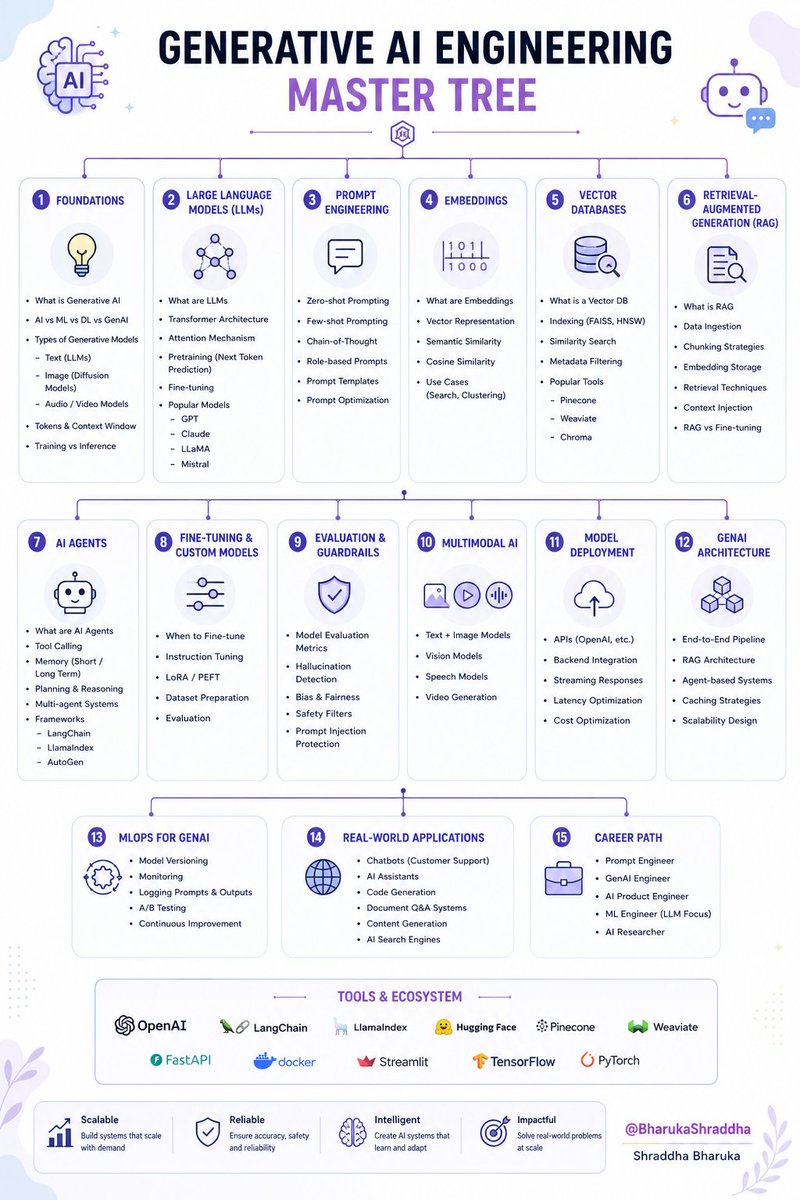
MASTER GEN AI ENGINEERING GENERATIVE AI ENGINEERING MASTER TREE │ ├── 1. Foundations │ ├── What is Generative AI │ ├── AI vs ML vs DL vs GenAI │ ├── Types of Generative Models │ │ ├── Text (LLMs) │ │ ├── Image (Diffusion Models) │ │ ├── Audio / Video Models │ ├── Tokens & Context Window │ └── Training vs Inference │ ├── 2. Large Language Models (LLMs) │ ├── What are LLMs │ ├── Transformer Architecture │ ├── Attention Mechanism │ ├── Pretraining (Next Token Prediction) │ ├── Fine-tuning │ └── Popular Models │ ├── GPT │ ├── Claude │ ├── LLaMA │ └── Mistral │ ├── 3. Prompt Engineering │ ├── Zero-shot Prompting │ ├── Few-shot Prompting │ ├── Chain-of-Thought │ ├── Role-based Prompts │ ├── Prompt Templates │ └── Prompt Optimization │ ├── 4. Embeddings │ ├── What are Embeddings │ ├── Vector Representation │ ├── Semantic Similarity │ ├── Cosine Similarity │ └── Use Cases (Search, Clustering) │ ├── 5. Vector Databases │ ├── What is a Vector DB │ ├── Indexing (FAISS, HNSW) │ ├── Similarity Search │ ├── Metadata Filtering │ └── Popular Tools │ ├── Pinecone │ ├── Weaviate │ └── Chroma │ ├── 6. Retrieval-Augmented Generation (RAG) │ ├── What is RAG │ ├── Data Ingestion │ ├── Chunking Strategies │ ├── Embedding Storage │ ├── Retrieval Techniques │ ├── Context Injection │ └── RAG vs Fine-tuning │ ├── 7. AI Agents │ ├── What are AI Agents │ ├── Tool Calling │ ├── Memory (Short / Long Term) │ ├── Planning & Reasoning │ ├── Multi-agent Systems │ └── Frameworks │ ├── LangChain │ ├── LlamaIndex │ └── AutoGen │ ├── 8. Fine-tuning & Custom Models │ ├── When to Fine-tune │ ├── Instruction Tuning │ ├── LoRA / PEFT │ ├── Dataset Preparation │ └── Evaluation │ ├── 9. Evaluation & Guardrails │ ├── Model Evaluation Metrics │ ├── Hallucination Detection │ ├── Bias & Fairness │ ├── Safety Filters │ └── Prompt Injection Protection │ ├── 10. Multimodal AI │ ├── Text Image Models │ ├── Vision Models │ ├── Speech Models │ └── Video Generation │ ├── 11. Model Deployment │ ├── APIs (OpenAI, etc.) │ ├── Backend Integration │ ├── Streaming Responses │ ├── Latency Optimization │ └── Cost Optimization │ ├── 12. GenAI Architecture │ ├── End-to-End Pipeline │ ├── RAG Architecture │ ├── Agent-based Systems │ ├── Caching Strategies │ └── Scalability Design │ ├── 13. MLOps for GenAI │ ├── Model Versioning │ ├── Monitoring │ ├── Logging Prompts & Outputs │ ├── A/B Testing │ └── Continuous Improvement │ ├── 14. Real-World Applications │ ├── Chatbots (Customer Support) │ ├── AI Assistants │ ├── Code Generation │ ├── Document Q&A Systems │ ├── Content Generation │ └── AI Search Engines │ └── 15. Career Path ├── Prompt Engineer ├── GenAI Engineer ├── AI Product Engineer ├── ML Engineer (LLM Focus) └── AI Researcher
8
14
223
AuspiciousAgile
Your models are only as good as your data pipelines. 📈 MLOps engineers & cloud architects let’s talk about the unglamorous backend infrastructure that makes global, #autonomous #AI scaling actually possible. 💻 Platform: zurl.co/xWuxY 📅 Sync Up: zurl.co/uzAkF
3
MindcrackerUS
Your AI model performs brilliantly in a sandbox. But is it ready for enterprise-grade load, security, and continuous integration? Moving from proof-of-concept to production is where most projects fail. What's your strategy? #AIProduction #MLOps @mcbeniwal
4
Gordo2929
Do you feel like AI is going to change everything, but you aren’t totally clear on how to actually get there in your company? If it feels murky for you, don’t freak out, you are not alone. I am getting lots of semi-embarrassed questions on this. No need to feel that way! Here are a few simple steps to use as you consider how it might work for your company. Read time = five minutes, and you'll have a practical, beginner guide for simple AI deployments. 1/ Strategy. Deploying AI is a business transformation not a tech project. Define your business priorities (e.g., reduce opex, improve speed, etc) that AI needs to achieve 2/ Decide where. Audit data (quality, completeness, accessibility, etc) and map it to relevant business process. Assess your current tech stack and integration points. Map your processes that are high-volume and repetitive or decision-intensive based on clean data. AI will be very useful where it can use data to predict, generate, retrieve, or classify things, and as a result highly automate process flows. Prioritize use cases where you will have high business impact/ROI technically feasible (good data, technical fit, reasonable deployment effort). Integrate AI directly into your existing workflows and tools. Standalone tools just become a parallel processes, or worse, a more expensive google search. Embed it where your org already does work, like ticket classification, draft generation, predictive alerts in CRMs, etc. 3/ Get Ready. Lean out your process flow. Subtract before you automate. implement data governance (single source of truth with clear policies, quality rules, access controls, data lineage, and audit trails), otherwise garbage in/out. Build unified data pipelines. Your enterprise data unfortunately lives in silos (ERP, CRM, emails, docs, etc.) and is rarely clean. You’ll want a pipeline to automate ingestion, cleansing, transformation, and delivery. Choose your core AI platform. Usually either inside a CRM, low-code, in your CSP, or a full orchestration framework. Prioritize working within your existing tech stack and your team’s technical capabilities. 4/ Enable yourself for success. Establish basic MLOps/LLMOps. You Don’t need to go crazy here, but realize that LLMs are probabilistic not deterministic (aka same prompt -> different outputs) and context-dependent, so traditional software testing doesn’t hold up. You’ll need to keep an eye on data inputs, evaluation, and ongoing monitoring. Build in security to control access, prompting, output validation, data poisoning, or overly permissive agency. AI without any of your proprietary or contextual data is generic and will be low-value; but direct hookups without any controls will risk exposing your sensitive info. Also, give your people enough lightweight supporting artifacts that they can be successful. Think: prompt libraries and templates, usage guidelines, playbooks, skill docs, error-handling. 5/ Deploy. Run it as a controlled pilot in one team or department with a limited scope. Measure against your defined business KPIs Iterate quickly based on your actual usage and data. Establish baselines before the pilot so you can prove impact. Monitor prod (technical performance, cost, evaluations). Use dashboards and automated alerts. Don’t forget to enforce governance with ongoing risk reviews, audit trails, etc. Optimize costs and refine your approach as your maturity grows.
12
PachoriYat58
Building MLOps projects is fun until your laptop reminds you it has only 8 GB of RAM. 😅
1
DeSciClaims
And our brilliant AI Software Engineer @OgbanUgot The lead engineer behind SciWeave. Scalable AI systems, RAG, vector databases, MLOps, high-scale distributed systems. He owns the execution: turning raw papers into structured, validated, machine-readable claim-evidence data.
3
50
flwrlabs
AI agents are advancing quickly. But enterprise work remains a much harder test. Today coinciding with ICML, we are introducing FlowerBench: a frontier agent benchmark for evaluating AI agents on secure, proprietary, long-horizon enterprise tasks. FlowerBench evaluates agents where enterprise work actually happens: inside organizations, with private data, internal tools, domain rules, and clear success criteria. Evaluations are coordinated through the Flower Enterprise Evaluation Network. Sensitive data and context stay within each organization. Only sanitized, non-sensitive results are shared. Developed with opt-in early partners, FlowerBench makes it possible to benchmark agents on realistic enterprise workflows without centralizing sensitive private traces. We have already assessed proprietary and open agents and models across a range of enterprise-grade tasks in various industries: Healthcare, Insurance, Operations, MLOps, Legal, Marketing and Finance. FlowerBench introduces a new way to build enterprise agent benchmarks: privacy-preserving workflow collection, distributed evaluation, and an evaluation network grounded in real enterprise work. We are inviting enterprises to contribute tasks and help shape the next generation of enterprise-ready AI agents. Links to the launch blog post, how to contribute and the leaderboard itself in the thread below.
1
4
8
356
walkingtreetech
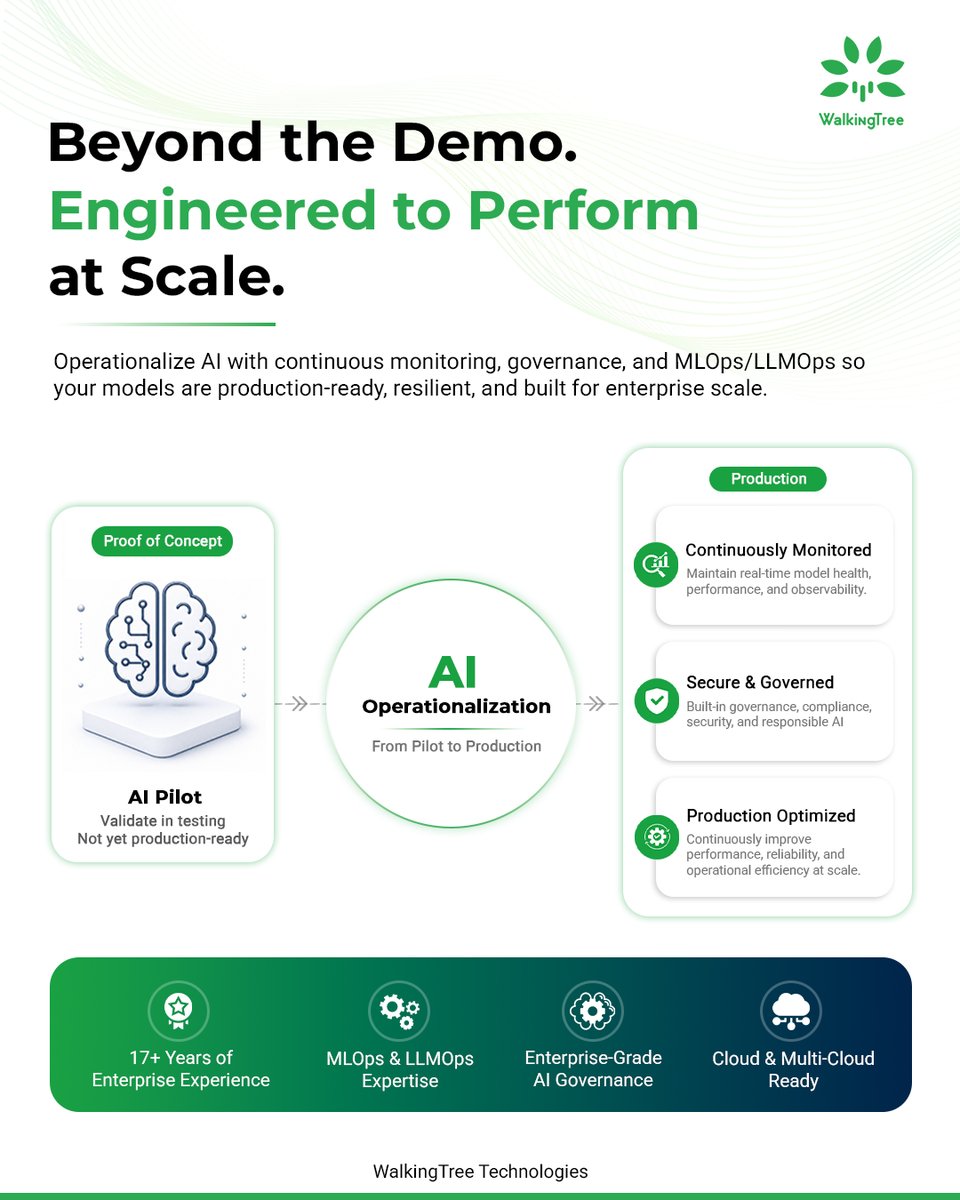
Every AI demo looks impressive. The real challenge is getting AI to perform reliably in production. The challenge isn't building the model. It's building everything around it. Want to move beyond AI pilots? Let's talk. walkingtree.tech/contact-us/ #EnterpriseAI #MLOps #LLMOps
12
Fọganáísà retweeted
real_deep_ml
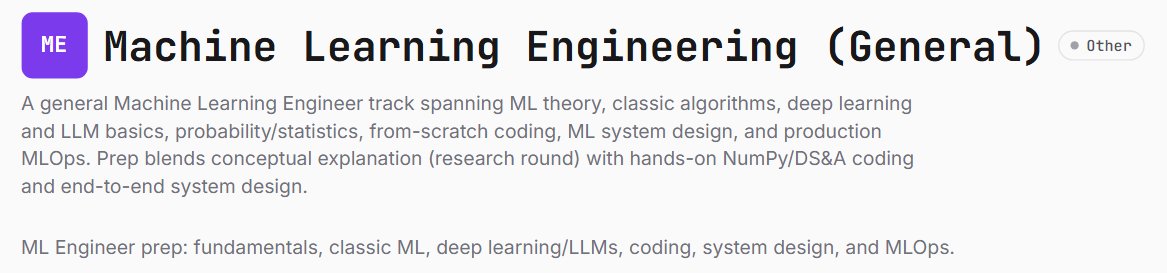
Just added a new General MLE Interview Prep practice section to Deep-ML. It breaks down the ML, DSA, and MLOps topics you need to know to pass Machine Learning Engineer interview rounds, with focused practice to help you prep more effectively.
4
25
405
58,792
Shota Nishijima | 西島 昌太 retweeted
Dataibridge_01
クックパッドでの機械学習プロジェクトを、実験から本番環境へのデプロイ・運用までの一連の流れを具体的に学べます。データ管理やバッチ処理中心のMLOps運用が詳しく解説されています。 
・実験用のJupyterコードを本番向けスクリプトに整理し、Dockerでコンテナ化する方法
・安全に大規模データを抽出・教師データを管理するパイプラインの構築(QueueryやS3活用)
・自社ツール(Hako、kuroko2など)を活用したバッチジョブのデプロイ・運用フローとSlack通知 
Cookpadの事例を参考に、自社環境に合ったML開発フローの設計や、データパイプライン・ドキュメント化の改善に活用できます。バッチ型MLシステムの運用ノウハウが得られます。 
抽象的な理論ではなく、実際の企業で使われている具体的なツール選定・課題解決・運用プロセスがリアルに書かれていて、すぐに実務に活かせる点が数多くあります。 speakerdeck.com/studio_graph…
14
131
9,414
WevolverApp
AI is moving closer to where data is generated. The 2026 Edge AI Technology Report examines the technologies shaping this shift, from edge foundation models and multimodal AI to ultra-low-power architectures, agentic systems, Edge MLOps, connectivity, security, and physical AI. Explore the engineering challenges, architectures, and trends defining the next phase of intelligent edge systems. Get the report now. Link in the comments! #edgeai #ai #artificialintelligence
2
3
3
801
packet_ai
The market charges $27/hr for a B200. We charge $5.60/hr. Right now. No waitlist. B200 Dedicated — $5.60/hr (48h only) B200 Dynamic — $3.75/hr Dashboard → Monthly → B200 Plan → Deploy Grab now: dash.packet.ai/account?gpu=n… #B200 #NVIDIA #AIInfra #GPUs #GPUCloud #AICloud #AIDeveloper #MLOps
1
2
14
mlconference
📚 RAG is basically your model’s library card. In this MLcon session clip, @rachelnabors breaks down Retrieval-Augmented Generation in a way that actually makes sense: 🧩 Tokens are the pieces of input your model can process. 🚪 Context windows have limits — not everything fits through the door. 📚 External knowledge needs a place to live. 🔎 Vector databases help retrieve only the most relevant information. 🧠 The LLM can then reason with the right context instead of guessing. RAG is powerful, but it’s not magic — and it’s definitely not the answer to every AI problem. Want to go beyond the clip and get more hands-on AI experience? Join us at our upcoming 2026 MLcon events: 📍 MLcon New York | Sep 28 – Oct 2, 2026 ➡ mlconference.ai/new-york/?lo… 📍 MLcon Berlin | Nov 16 – 20, 2026 ➡ mlconference.ai/berlin/?loc=… #MachineLearning #AI #Tech #MLOps #MLcon #RAG #GenerativeAI
51
sauvast
Counterintuitive AI advice: do not automate every pipeline step. Find the 2-3 steps with the highest error rate or manual intervention cost. Nail those first. Compounding efficiency beats boiling the ocean every time. #MLOps #EnterpriseAI
2
27
prayag_sonar
🚨Everyone wants to become an AI Engineer But very few know there are multiple AI career paths. Pick the one that matches what you actually want to build 🤖 AI Engineer ➡️ Build AI applications with LLMs, RAG, and APIs. Skills: Python • LLMs • RAG • FastAPI • Docker • Cloud 🤖 AI Agent Engineer ➡️ Design and build autonomous AI systems that can plan, take actions, and interact with tools. Skills: Python • MCP • LangGraph • Tool Calling • RAG • Multi-Agent Systems 🔒 AI Security Engineer ➡️ Protect AI systems from attacks and secure LLM applications. Skills: Python • Cybersecurity • OWASP LLM • Guardrails • IAM • AI Red Teaming 🖥️ Local AI Engineer ➡️ Run powerful AI completely offline. Skills: Ollama • llama.cpp • GGUF • CUDA • Local RAG • Docker ✨ GenAI Engineer ➡️ Build AI copilots, chatbots, and content generation products. Skills: LLMs • Prompt Engineering • Embeddings • RAG • APIs • Fine-tuning ⚙️ MLOps Engineer ➡️ Deploy, monitor, and scale machine learning models. Skills: MLflow • Docker • Kubernetes • CI/CD • Monitoring • Cloud 🏗️ AI Infrastructure Engineer ➡️ Build the platforms that serve AI models at scale. Skills: GPUs • CUDA • vLLM • Kubernetes • Ray • Distributed Inference 🔄 AI Automation Engineer ➡️ Replace repetitive business work with AI workflows. Skills: Python • APIs • n8n • MCP • OCR • AI Agents 🧠 AI Research Engineer ➡️ Train and improve the next generation of AI models. Skills: PyTorch • Transformers • Math • Distributed Training • RLHF • CUDA 🚀 AI Product Engineer ➡️ Turn AI ideas into products people actually use. Skills: Python • FastAPI • LLMs • UI • Analytics • Cloud The AI industry is no longer one job title. Choose your lane. Master it. Then build relentlessly. Which one are you aiming for?
1
2
101