Filter
Exclude
Time range
-
Near
LMtxIoTAdvisor
That is not totally true. The VRAM allows loading models, but that is only the start. Inference requires GPUs; otherwise token/s is so low that it makes the solution unusable for larger models. I got a Strix Halo with 128G, and it requires significant tuning to get 60t/s.
1
web3l0var
BitTorrent launches BTTInferGrid a decentralized compute network for AI inference built as DePIN. It connects idle GPUs worldwide with demand for cost effective scalable and verifiable AI model inference services.
1
9
f2pool
⛏️ Our Pearl @prlnet mining pool is now live! Pearl is a Proof-of-Useful-Work blockchain that allows GPUs to mine $PRL while executing AI computations. Popular mining rigs for Pearl include NVIDIA RTX 50/40/30 series cards. Start your $PRL mining journey today at f2pool! 👷‍♂️ Mining guide: f2pool.zendesk.com/hc/en-us/… 📝 Announcement: f2pool.zendesk.com/hc/en-us/…
169
Cyang retweeted
_gnomon
(real) meaning buy more GPUs, build more datacenters, and deploy every automated product under the sun (waymo, flippy from miso robotics, autonomous farming units. etc.) - even at the initial cost of efficiency and low returns. ignore/placate the masses with stipends.
1
1
1
113
EdgeAlphaLabs
🧠⚡ AI’s next bottleneck may be RAM, not GPUs. Memory used to be the boring spec on a laptop checkout page. Now it’s being pulled into the AI infrastructure stack. A new U.S. class-action lawsuit alleges Samsung, SK hynix, and Micron restricted DRAM supply while prioritizing higher-margin AI memory like HBM. Allegations, not proven. But the signal is real: • 🧩 HBM is becoming critical for AI accelerators • 🏭 DRAM capacity can’t be added overnight • ☁️ Hyperscalers can outbid consumer markets • 💻 PC, server, and laptop buyers feel the squeeze Why it matters: builders should stop thinking of memory as a commodity input. In the AI era, RAM is becoming a strategic constraint across the hardware stack. Read the full brief: ai-signal-brief.beehiiv.com/… Image: media.beehiiv.com/uploads/as… #AI #Semiconductors #Infrastructure Subscribe to AI Signal Brief for sharper signals like this.
30
pkyanam
My standing theory is that under upcoming CEO John Ternus, Apple will begin exploring bare metal compute / data center grade hardware to take advantage of their Apple Silicon platform. This’ll put them next to chipmakers like Nvidia whose GPUs DOMINATE current infra deployments.
9
PrestonTsao
Replying to @theallinpod
From Grok: Nvidia’s release of its open-source Nemotron model is more significant than it first appears. For Chinese open models (DeepSeek, GLM, Qwen, etc.), it introduces a credible Western alternative in the open-source space. While Chinese models have led in efficiency and technical performance, Nemotron gives users — especially enterprises and developers concerned about data sovereignty or supply chain risk — a strong non-Chinese option that performs well on key agentic and reasoning tasks. For OpenAI and Anthropic, it adds direct pressure on their paid API business. Power users and companies running high volumes of technical work now have a capable, free alternative. This doesn’t eliminate the need for frontier closed models, but it does reduce the number of workloads that must go through expensive paid APIs. For Nvidia itself, the move strengthens its hardware position. By releasing a competitive open model that is optimized to run best on Nvidia GPUs, the company is effectively using software to drive hardware demand. Users who want strong performance from the open model have more reason to stay within (or expand) the Nvidia ecosystem. It’s a classic “give away the razor, sell the blades” play — only this time the razor is a capable open model and the blades are Nvidia chips. In short, Nvidia is no longer just selling the picks and shovels. It’s also offering one of the shovels for free — as long as you use it with their picks.
8
AtlasShrug1
Replying to @TheRealBirnbaum
I think it’s actually worse. GPUs depreciate, fiber at least could be used later on after that overbuild. Sure for awhile rental prices for older generations go up, but once the supply/demand balance loosens up, that party is over. Maybe the hyperscalers can pass on their rising costs, maybe they can’t. I am very skeptical. As we’ve seen recently, token prices are dropping, and we can pretty easily hypothesize that that forward curve for compute is backwardated. I never pretend to know anything for certain. I don’t. Market has taught me that many times over the years. I go with the weight of the evidence and assign probabilities to various outcomes. In any event, enjoy your green day, I gotta look to hedge my net back up toward neutral with some of these moves today. Happy trading!
66
harjitrathore
Four weeks of selling, and it wasn't just one name catching the blame. It was the entire AI supply chain, top to bottom. Memory names led the retreat! Micron $MU and Sandisk $SNDK have been among the sharpest decliners in the group. NVIDIA $NVDA and Broadcom $AVGO, the two most crowded AI trades on the board, both slipped through the period. AMD $AMD, Intel $INTC, Qualcomm $QCOM, Marvell $MRVL, and Arm $ARM all got caught in the same downdraft, alongside equipment and component names like Western Digital $WDC and Analog Devices $ADI. Even Apple $AAPL felt spillover pressure after flagging higher chip component costs on its own hardware pricing. Goldman Sachs $GS called this the most net-sold sector for US hedge funds for FOUR weeks running. When the selling spans memory, GPUs, networking chips, and equipment makers all at once, that's not a single-stock story. That's a sector-wide repricing of how much AI capex actually needs to cost. Is this four-week stretch a healthy reset before earnings, or the first crack in crowded AI positioning? #Semiconductors #NVIDIA #AIStocks #Bearish #StockMarkets #hedgeFunds reuters.com/business/finance…
148
jackhuynh
Great spending time with Rick Mershad, CEO of @microcenter, to talk about an exciting milestone for builders. Ryzen AI Halo systems are now shipping from Micro Center. 💪 @AMD is the #1 desktop CPU at Micro Center with Ryzen X3D. 🎮 Radeon powers approximately 1 in every 3 desktop gaming GPUs sold at Micro Center. Now we are extending that same momentum into a new era. Ryzen AI Halo gives AI developers and builders the ability to run larger models locally, iterate faster, and unlock powerful new AI experiences while keeping more of their work on device for greater privacy and security, without cloud limits. The Agentic PC is here 🚀
1
6
211
Amir1372186
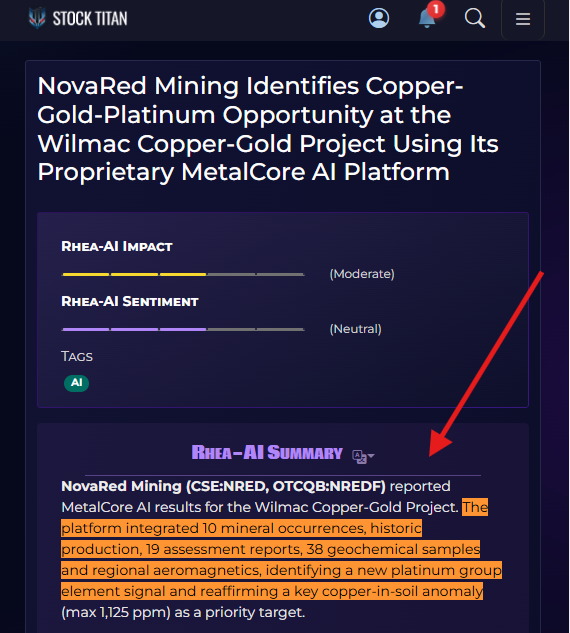
I almost missed this... 19 reports and 10 occurrences behind NRED while everyone stares at GPUs. #BBNaija #ปนภกดEP2 #loveislandusa $SOFI $TSLA $FIG
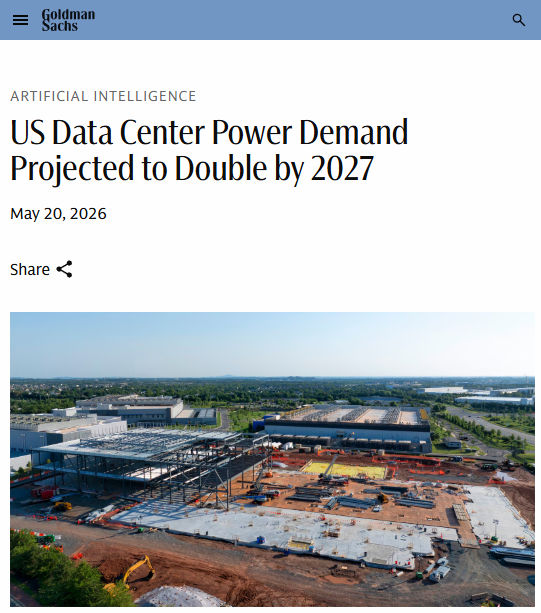
Everyone wants AI. The grid wants copper first. Data centers are projected to hit 66 GW of US power demand by 2027, up from 31 GW in 2025. Capacity could reach around 95 GW by the end of 2027, assuming 70% utilization. That is insane load growth. Before AI chips print money, utilities need power generation, transformers, transmission and copper-heavy infrastructure. That’s the lane where I keep watching $NRED. NovaRed’s Wilmac project is a copper-gold play in British Columbia, backed by MetalCore using 2.7M mineral records, 19 assessment reports and 10 mineral occurrences. AI needs power. Power needs copper. Copper needs new supply. Not advice. By the time it’s obvious, it’s already gone.
61
addeism
Techbros are funny. They are steadfast capitalists screeching about the evil of "communism," but lobby hard for the government to invest in their industry via data, power, cooling, GPUs, and then get revenue via fat war industry contracts.
By far the shrewdest and most entertaining analyst of the AI bubble is Georg Zoeller, ex Facebook. Re-reading his DeepSeek reaction piece from 18 months, which holds up well. It was all so predictable: banning open source, the Red Menace, pivot to military. What has really happened is VC built the wrong AI, you’ll pay a high price for this error with your pension, and nobody will go to jail.
18
Matt McDonagh retweeted
McDonaghMatthew
What happens when a cluster of GPUs can out-research a team of Stanford PhDs for 1/25th of the cost? The era of human cognitive dominance is ending.. ..but the greatest window for individual leverage has just opened. BUT ONLY FOR THE PEOPLE WITH AGENCY AND URGENCY. The human brain is the most efficient computer in the universe, but it comes with fatal flaws. It cannot be mass produced, it cannot be networked, and it cannot scale its processing power on demand. This is the greatest bottleneck in human history. Because of this extreme biological friction, the monumental task of improving artificial intelligence falls squarely on the shoulders of an impossibly small subset of humanity. The hardware is elite, but the bandwidth is painfully slow. Right now, a tiny fraction of the global population dictates the entire trajectory of our species. A few thousand elite researchers at frontier labs drive nearly every breakthrough in artificial intelligence. They sit in isolated rooms designing experiments, writing complex papers, and proposing architectural shifts that redefine what machines can do. It is an incredibly small workforce executing incredibly high leverage work. Another way to look at it: they are the single fragile point of failure in the intelligence revolution. How much faster could we be advancing if we had more minds capable of joining the chorus? I look at the current state of technology, the systems we rely on, and the slow pace of biological thought. That friction drops to absolute zero the moment silicon begins researching silicon recursively. We are standing at the edge of the intelligence explosion. When an autonomous system can execute the job of a top tier researcher (even partially), the entire feedback loop changes permanently. The machine makes algorithmic improvements, the machine produces more powerful models, and the machine accelerates its own evolution. You transition instantly from linear human progress to compounding algorithmic returns. The frontier labs know exactly what is laying ahead. Anthropic has stated they are on track to automate artificial intelligence research and development as early as 2027. OpenAI has aggressive internal roadmaps with a fully autonomous researcher by March 2028. Sam Altman has confirmed that a research intern level agent will exist before the end of this year. These are hard deadlines set by the engineers actually building the architecture. I’ve been using Codex by Open AI to build an autonomous loop of experiments, results tracking, paper writing and the system even tries to build bridges to other projects I'm working on. 24/7 machine-driven research is already here. It’s crude, but it will get better in all the right places. The economic implications of this transition are absolute and unavoidable. Companies currently value human capital based on specialized knowledge and the ability to solve novel problems. When a cluster of GPUs can out research a team of Stanford PhDs for a fraction of the cost, the value of raw human intellect falls. Markets will relentlessly punish organizations that fail to integrate autonomous research agents into their core operations. People will be outpaced by systems improving at rates they cannot comprehend. We are entering a reality where a single architect armed with autonomous research agents can outcompete a legacy corporation employing thousands of people. The traditional barriers to creating world changing technology are dissolving. The individual operator now commands the productive output of an entire enterprise. Leverage is no longer about how many people you manage. Look at the timeline again and let the reality sink in. We have a research intern already live, we should see automated research scientists by the end of this year and we have full research automation by 2027 or 2028 latest. You have roughly twenty four months to position yourself, your portfolio, and your skill set for this shift. You must prepare for a world where machines design better machines entirely on their own. Every single day you waste playing legacy games is a day you fall permanently behind the exponential curve. The window to accumulate cognitive capital and turn that into assets / income and opportunities is closing rapidly. You must aggressively audit your current workflows and eliminate all friction. You must rip out any process that relies on slow human consensus and deploy agents instead. In your work life. In your personal life. I've built a Chief of Staff agent that acts a bridge between both worlds. Build the messy prototype today, deploy it into production tomorrow, and let the systems optimize the code base over the weekend. Speed of execution and proprietary data are the two biggest moats that you can control left. Why do you need to go fast? The intelligence ceiling of humanity is being shattered into a million pieces. Agents will discover entirely new areas of science. Other agents will flood toward it. Then a different network of agents will start to connect that new node of intelligence to the existing network of societal super intelligence we have already mapped collectively. The automated generation of knowledge guarantees a cascading sequence of technological miracles across every single discipline. Medical cures, infinite energy generation, and interplanetary logistics will be solved not by human struggle, but by autonomous compute. We are amplifying our cognitive power to reshape reality itself. Our society is accelerating at accelerating rates. A decade of research will compress into a single year. Then we will compress a century into a second. The boundaries of physics will yield to endless algorithmic optimization. Science, technology and culture are all accelerating. They are interconnected, and AI has speed everything up. AI agents robots are both taking command positions across our labor force. Soon they will be responsible for a majority of the economic activity. We are no longer just accelerating, we are accelerating the rate of acceleration. If you want to make the most of this once-in-a-civilization economic changeover event, you must go faster. Everything else is.
6
12
38
5,761
Lana Rhoades retweeted
0xTrikon
The AI economy runs on GPUs. Nobody's tokenized them properly until now @RaxFinance is the first full-stack RWA layer for AI infrastructure GPU capacity, data centers, energy infrastructure verified, insured, and yield-bearing onchain. Real compute. Real capital. Institutional-grade access for everyone. Trikon abstracts the execution layer. RAX tokenizes the physical layer underneath it. AI agents need compute to run. That compute now has an onchain market ownable, tradeable, yield-generating.
67
69
188
14,319
heyfinlo
It’s definitely a positive tailwind for the Neocloud sector. Also it’s good for $NVDA . On July 1 Nvidia launched its AI Compute Partnership. It still sells GPUs to neoclouds like always, but now it also takes a recurring, usage-linked cut of the cloud revenue those GPUs earn, and it backstops the build by renting back any idle capacity at a fixed rate. First partners are Sharon AI and Firmus, around 210,000 GB300 GPUs between them. So Nvidia gets paid twice on the same chips. Once when the hardware ships, then again every month they’re actually being used.
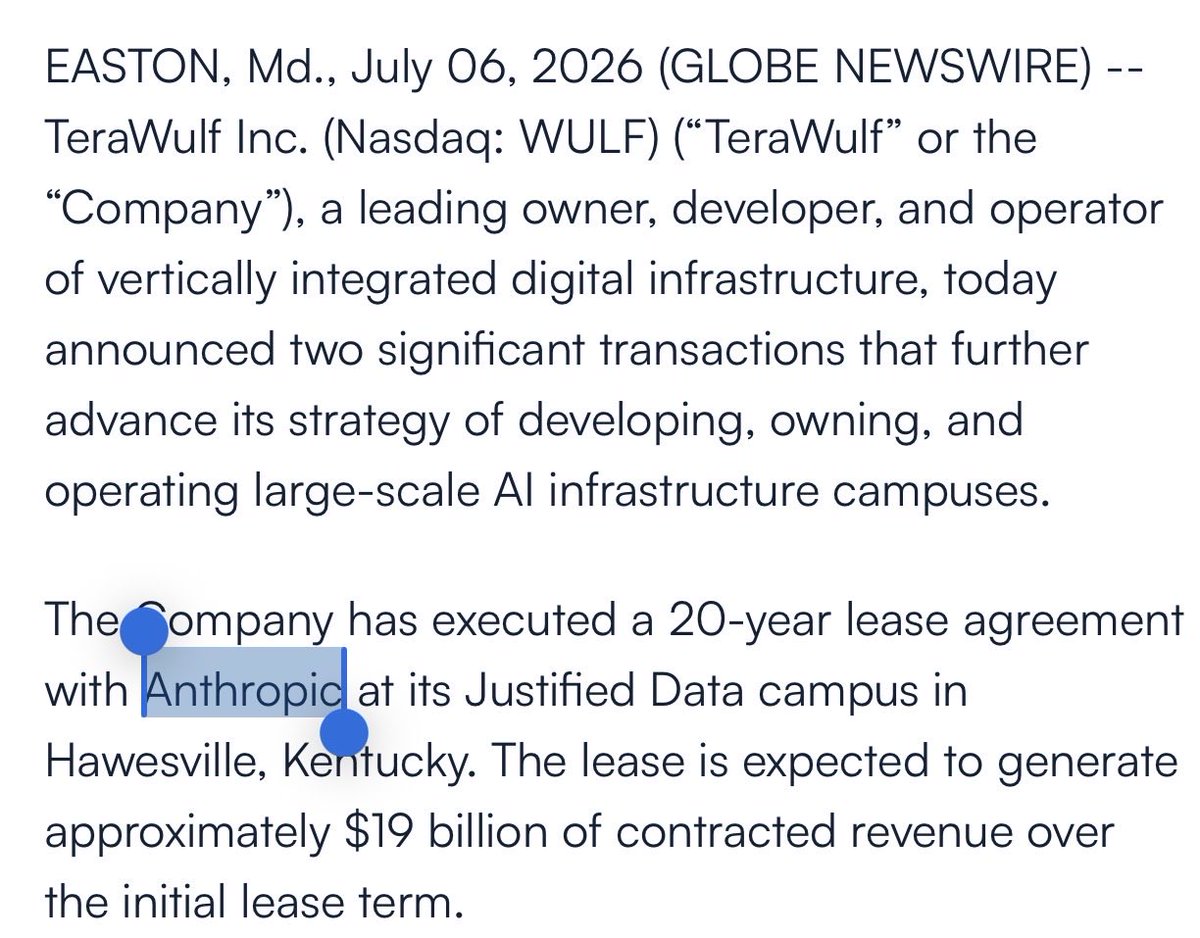
Wow, $WULF signs a $19B DC lease with Anthropic today. Probably a very positive tailwind for the Neocloud/Colo sector.
31
realkyglizzy
A dedicated WhatsApp group for $GPUS holders is now online! All investors holding $GPUS stock are welcome to join this exclusive group to discuss the stock and get the latest information group:🔗wa.me/13472827390 Click this link or the link on my homepage to join #stock
12
Solmetaxxx retweeted
MEXC
AI after eating all the GPUs: “Cool. Now where’s the memory?” DRAM, HBM, and NAND Flash are back in focus. Which AI-memory stock are you watching? 👀👇
Just some consolidated updates on memory: - $MU leads new 1.5T Yen investment in Hiroshima ~$9.3B. (bullish read through for Disco, Advantest, Resonac, Towa) since capex is localized. - Morgan Stanley pointed out NAND will continue to be in short supply into 2027 so $SNDK / Kioxia type players are happy alongisde $SIMO and upstream. - MS remains especially positive on Macronix/Winbond - UBS expects the average price of DDR contracts in the Q3 2026 to increase 32% | 18% Q4, vs. 17% and 12% est. - UBS expects NAND flash to be raised 30% from prev quarter. - Samsung reportedly plans 20% DRAM hike Q3. TrendForce recently forecast DRAM contract prices to rise 13 to 18 percent in the third quarter from the previous quarter, so this hike beats expectations. Something to note: Lot people see 20%... and don't think it's a lot compared to the 70-80% from previous quarters. But if you hike something by 100%, then hike something by 100%, then hike something by 30%, it's a lot more than people estimate since it's compounded. Similar to tracking inflation. I've already made projections going into 2028 from the start of the year on my memory names... I'm just sitting back and watching things play out through all the "memory optimization" and "they can't keep price hiking like this!" noise.
17
9
48
24,924
ShahinGh11
When Chris teased aiUSX, it made me see Solstice’s approach more clearly. They are not just adding new yield products whenever an opportunity comes up. Instead, they keep building around the same core asset, giving it new places to be useful without changing the foundation every time. USX is the base. eUSX already puts that capital to work through delta-neutral strategies. strcUSX is coming with structured credit. Now aiUSX directs that same foundation toward real AI infrastructure lending through the TensorX partnership. What stands out to me is the problem aiUSX targets. Companies already set capital aside for AI, but much of it sits idle until the inference bills arrive, while the infrastructure behind AI keeps demanding more GPUs, data centers, and upfront capital. aiUSX asks a practical question: Can capital that is already waiting to be spent on AI become useful before it gets spent, while staying liquid and connected to real infrastructure demand? In plain terms, the AI budget a company has already set aside does not have to just sit there waiting for the next inference bill. aiUSX is designed to put that capital to work through real infrastructure lending instead, while staying liquid until it is actually needed. That is what makes this product compelling to me. It does not feel like Solstice is simply expanding its menu. It feels like the same core asset is being extended into a demand that already exists. Three ways, one asset. That is the part I like most about this roadmap. Solstice is not changing the foundation every time. It is making the same asset useful in more specific markets with real demand behind them. @solsticefi Chris teased the full thing here: x.com/solsticemonk/status/20… Ambassador disclosure: I’m participating in the Solstice Ambassador Program. Earn Flares → app.solstice.finance/earn-fl… My invite code: MCXGmA9Uwq
aiUSX is coming, and I haven't shut up about it internally for three weeks. Now it's your problem too. Quick version: aiUSX is onchain exposure to AI-infrastructure lending. The compute, the data centers, the steel and silicon the whole AI boom runs on. That market is going to be enormous, and Solstice is the one bringing it on Solana. aiUSX plugs into the exact same machine as everything else we ship: YieldVault. One primitive. You take a licensed, off-chain strategy, wrap it once, and out comes a clean onchain token. Same way capital goes in, same way it redeems, same plumbing every time. Delta-neutral is live as eUSX. Structured credit is up next as strcUSX. AI-infrastructure lending is aiUSX, loading now. Most teams would burn a quarter and a war room to bolt on a new yield source. We bolt it onto rails that already exist and the whole stack inherits it for free. No renegotiation, no Frankenstein integrations. The vault does not care where the yield comes from. It routes it the same way, every time. That is the flex. One set of rails, any yield we want on top. aiUSX is the newest plate on the bar. We're just getting warmed up.
1
16