AI-guided discovery for low-resource peptide engineering using evolutionary scale modeling
1. The study argues that a simple metric—cross-validation R²—can act as a practical early proxy for how well an active-learning peptide engineering campaign will perform, helping teams decide whether to invest in iterative wet-lab cycles.
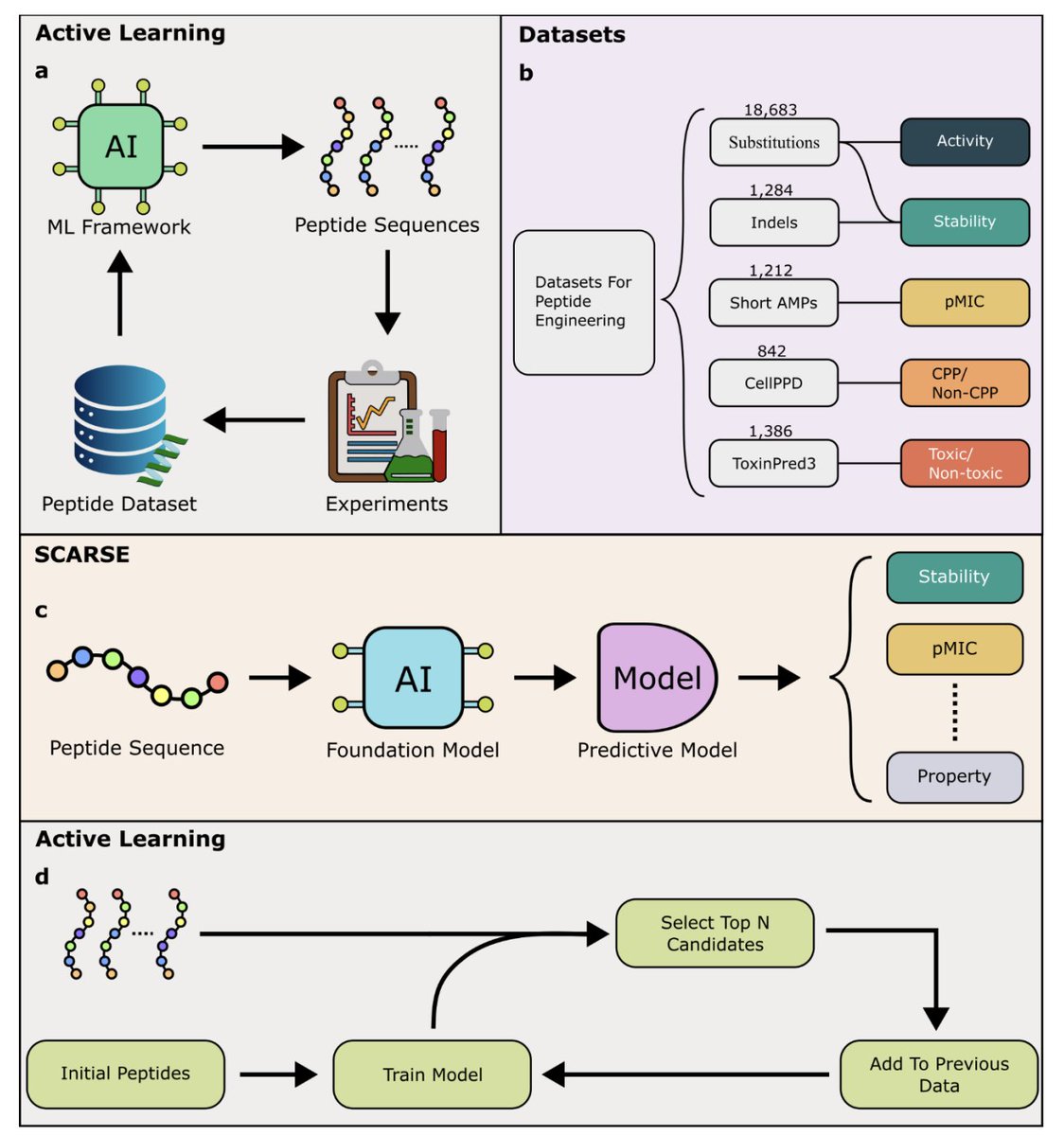
2. It introduces SCARSE (Small-sample Classification And Regression Solution for low-resource peptide Engineering), a low-data framework designed for 20–500 labeled peptides, combining ESM-2 (650M) sequence embeddings with Gaussian process regression (for regression tasks) and extremely randomized trees (for classification).
3. A key design choice is to avoid PLM fine-tuning and avoid MSAs, reducing compute and making the approach more suitable for short peptides where alignments can be unreliable and evolutionary signal is limited.
4. Benchmarking spans 23 datasets: 10 substitution (DMS-style) datasets (39–87 aa), 10 indel datasets (39–71 aa), plus short antimicrobial peptides (5–20 aa, pMIC regression), cell-penetrating peptides (5–25 aa, classification), and toxic/non-toxic peptides (5–14 aa, classification).
5. Against a hand-engineered descriptor baseline (modlAMP global descriptors composition and helix-inspired features), SCARSE is consistently stronger on substitution and especially indel fitness prediction; the baseline often fails on indels (mean R² < 0), while SCARSE reaches mean R² ~0.55 with 20 samples and ~0.76 with 80.
6. On very short, compositionally diverse peptide datasets (AMPs and CPPs), SCARSE is often comparable to the descriptor baseline, supporting the interpretation that simple composition-level features can capture much of the signal when sequences are short and diverse rather than near-mutant neighborhoods.
7. Beyond overall test-set R², the paper emphasizes “extreme-value” utility for engineering: SCARSE improves top-ranked selection quality (e.g., Top-20 accuracy) on substitution datasets, aligning evaluation with how practitioners actually pick candidates to synthesize.
8. Active-learning workflow simulations (greedy top-k exploitation): start with 20 random peptides, then iteratively add the top 20 predicted peptides for 10 rounds (200 total). Across substitution datasets and short AMPs, SCARSE consistently beats random sampling at enriching true top-10% performers, in some cases achieving up to ~7x more high-value peptides at the endpoint than random.
9. The central practical takeaway: CV R² computed from small random subsets correlates strongly with active-learning endpoint enrichment (Pearson ~0.83–0.89). While 20 labeled peptides can already enable useful selection, around 50 labeled peptides are suggested as a more reliable minimum to estimate whether an active-learning campaign with SCARSE is likely to pay off.
💻Code:
github.com/LeoAnd00/SCARSE ;
github.com/LeoAnd00/SCARSE-r…
📜Paper:
biorxiv.org/content/10.64898…
#PeptideEngineering #ActiveLearning #ProteinLanguageModels #ESM2 #GaussianProcesses #AntimicrobialPeptides #ComputationalBiology #MachineLearning #Bioinformatics