Filter
Exclude
Time range
-
Near
BiologyAIDaily
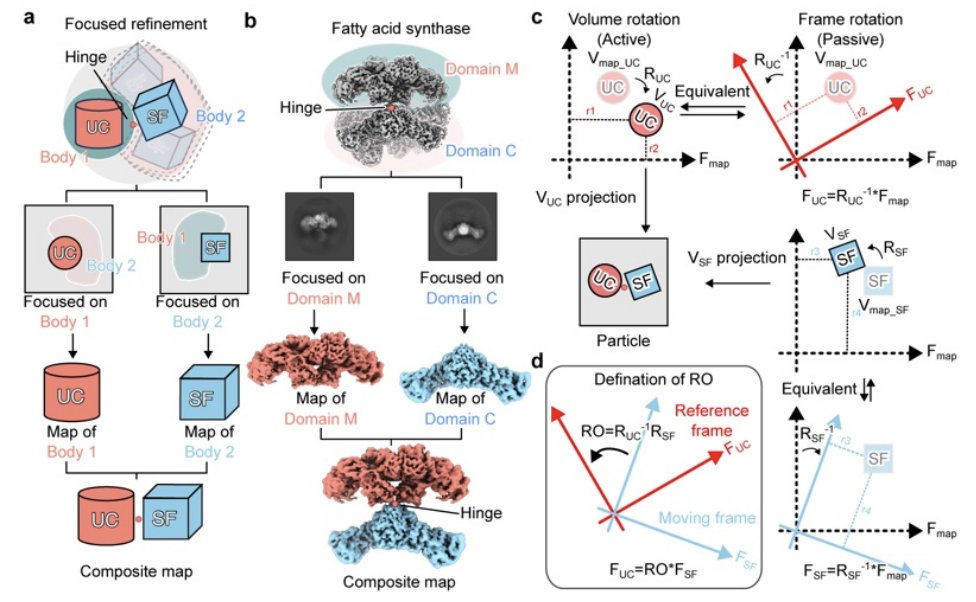
CryoROLE: Describing large inter-domain rotation in single particle cryo-EM 1. CryoROLE is a lightweight, math-based tool to recover continuous inter-domain motions that are otherwise “lost” when cryo-EM workflows produce high-resolution composite maps via focused refinement of separate rigid bodies. 2. Key idea: each particle already has multiple pose assignments (one per focused-refined domain). CryoROLE computes per-particle relative orientation (RO) between domains directly from these orientations, making the motion observable without deep learning or PCA. 3. The output is an RO “landscape”: a point cloud where each point is a particle and its coordinates encode the relative rotation between domains. Local point density reports how populated particular poses are, enabling an intuitive view of motion range preferred orientations. 4. The method is designed for large rigid-body-like motions where consensus-map-based continuous-heterogeneity methods (e.g., latent-space or perturbation models) struggle, and where classic classification discretizes a continuum into a few bins. 5. Implementation details that matter in practice: CryoROLE does statistics in rotation-vector space (avoids Euler-angle singularities), visualizes in fixed-axis Euler space for interpretability, and can “canonicalize” axes so α/β/γ align with primary/secondary/tertiary motion directions. 6. Validation on human fatty acid synthase (hFASN): with ~2.2M particles, the RO landscape accurately predicts reconstructions from particles sampled at chosen landscape coordinates, confirming that landscape coordinates correspond to real inter-wing orientations. 7. INO80–hexasome application: merging particles from 3 previously classified states reveals a continuous ~110° trajectory of INO80 rotating around the hexasome, with multiple preferred orientations. CryoROLE recovers a low-occupancy state placing the ATPase near SHL −1 that was missed by discrete classification. 8. Ribosome application (thermo-annealing): by computing RO landscapes for LSU vs SSU-body (ratchet), SSU-head vs SSU-body (swivel), and SSU-head vs LSU, CryoROLE shows annealing contracts the motion distributions and shifts population toward a preferred, low-motion basin. 9. Functional anchoring: published translocation-related 70S structures map onto the RO landscape along a plausible trajectory; particle density differences across mapped states suggest the landscape approximates thermodynamic preference. Additionally, E-site tRNA-bound particles occupy a narrower RO region, indicating tRNA restricts global ribosome motions. 💻Code: github.com/yifancheng-ucsf/c… 📜Paper: biorxiv.org/content/10.64898… #cryoEM #structuralbiology #computationalbiology #proteinDynamics #singleParticleAnalysis #openSource #bioinformatics
3
9
1,561
ActaCrystD
A practical guide for moving from X‑ray crystallography to cryo‑EM for structural biology  @uvmvermont @ActaCrystD @IUCr #CryoElectronMicroscopyCryoEM #StructuralBiology #SingleParticleAnalysis doi.org/10.1107/S20597983260…
2
5
208
BiologyAIDaily
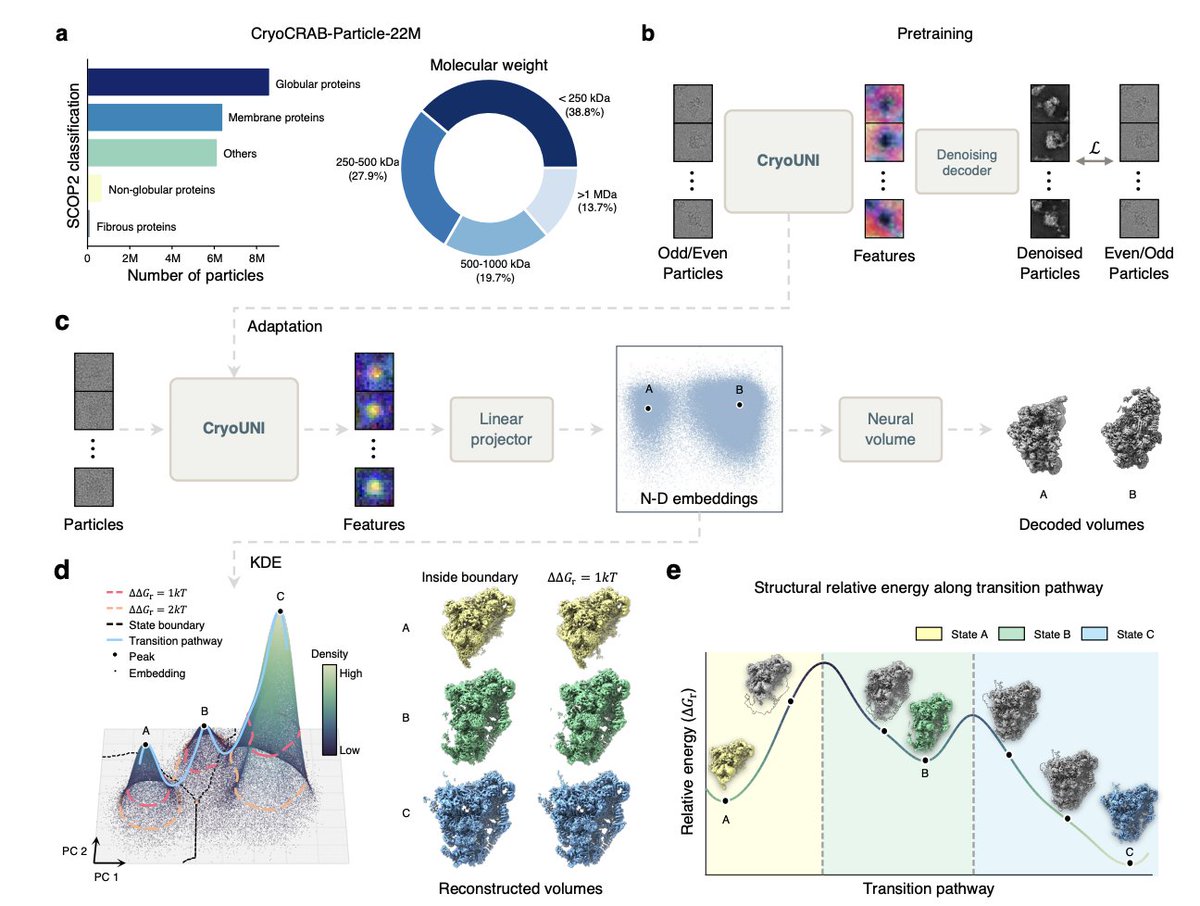
Learning Latent Conformational Landscapes Encoded in Cryo-EM 1. The paper argues that single-particle cryo-EM already contains a continuous, probabilistic “conformational landscape” (not just a few discrete classes), where the latent-space density reflects state occupancy and can be interpreted as a relative free-energy surface via Boltzmann statistics. 2. Core method: CryoUNI, a universal cryo-EM particle-image encoder pretrained on CryoCRAB-Particle-22M (22M particles; 746 species; broad SCOP2 diversity and molecular-weight range). Pretraining is self-supervised and explicitly designed to separate structural signal from noise using odd/even half-image denoising supervision. 3. Downstream heterogeneity modeling: CryoUNI is adapted with a VAE-style framework (CryoDRGN-like) where a lightweight projector maps encoder features to latent variables, and an implicit neural volume decoder reconstructs densities (in the frequency/Hartley domain) conditioned on the latent code. 4. Landscape analysis: WAVE (Watershed Analysis of Variational Embeddings) converts particle embeddings into a density field (KDE), detects density peaks as conformational states, partitions basins via marker-controlled watershed, and traces transition pathways through high-density regions by solving an Eikonal/Fast-Marching problem on a cost field defined by negative log-density. 5. A key conceptual claim is made operational: relative energies between states are inferred directly from density ratios, ΔGr = −kBT ln(ρA/ρB). This yields energy profiles along WAVE-traced pathways and provides a quantitative way to discuss barriers and intermediates from cryo-EM data. 6. Physical grounding test (integrin αvβ8, EMPIAR-10345): independent 20 µs all-atom MD simulations define a thermodynamic landscape of leg motion in spherical coordinates (θ, ϕ). CryoUNI’s learned latent axes align strongly with these physical coordinates (PC1–θ r=0.982; PC2–ϕ r=0.963), and CryoUNI volumes sampled across the landscape match MD snapshots in leg orientation and structural details. 7. Benchmarking on heterogeneous mixtures: on CryoBench Ribosembly (16 discrete assembly states), WAVE on CryoUNI embeddings automatically recovers all 16 states with 99.4% accuracy, and pairwise distances between latent peaks correlate with true structural similarity (Mantel r = −0.887). On Tomotwin-100, CryoUNI yields near-perfect separation (~99.96–99.98% accuracy across clustering methods), highlighting representation quality as the main driver. 8. Continuous heterogeneity case: on IgG-1D (a conformational continuum), CryoUNI captures a continuous manifold and improves per-particle reconstruction fidelity (highest mean AUC-FSC with low variance), suggesting the approach is not limited to discrete classification problems. 9. Biological discovery example (LIS1-mediated dynein activation, EMPIAR-12715): a global landscape organizes particles into three major basins (open-bent, open-straight, motor-bound), while local/hierarchical landscapes reveal sub-states, including a low-population open-straight intermediate with distinct LIS1 stoichiometry (Straight/2x) that would be attenuated in consensus reconstructions; overall, 12 sub-states are resolved with reconstructions spanning ~2.75–6.44 Å. 10. Experimental “closing the loop” (KCTD5/CUL3NTD/Gβγ, EMPIAR-11734): latent-density-derived energy thresholds guide particle selection to improve reconstruction consistency/resolution; WAVE also extracts continuous transition trajectories connecting four known basins (A→D→C and A→B→C), providing experimentally derived pathways consistent with prior simulation/morphing interpretations. 💻Code: github.com/Cellverse/cryouni 📜Paper: biorxiv.org/content/10.64898… #cryoEM #StructuralBiology #ComputationalBiology #MachineLearning #DeepLearning #ProteinDynamics #VariationalAutoencoder #MolecularDynamics #RepresentationLearning #SingleParticleAnalysis
2
22
2,046
BiologyAIDaily
Learning Latent Conformational Landscapes Encoded in Cryo-EM 1. The paper argues that single-particle cryo-EM already contains a continuous, probabilistic “conformational landscape” (not just a few discrete classes), where the latent-space density reflects state occupancy and can be interpreted as a relative free-energy surface via Boltzmann statistics. 2. Core method: CryoUNI, a universal cryo-EM particle-image encoder pretrained on CryoCRAB-Particle-22M (22M particles; 746 species; broad SCOP2 diversity and molecular-weight range). Pretraining is self-supervised and explicitly designed to separate structural signal from noise using odd/even half-image denoising supervision. 3. Downstream heterogeneity modeling: CryoUNI is adapted with a VAE-style framework (CryoDRGN-like) where a lightweight projector maps encoder features to latent variables, and an implicit neural volume decoder reconstructs densities (in the frequency/Hartley domain) conditioned on the latent code. 4. Landscape analysis: WAVE (Watershed Analysis of Variational Embeddings) converts particle embeddings into a density field (KDE), detects density peaks as conformational states, partitions basins via marker-controlled watershed, and traces transition pathways through high-density regions by solving an Eikonal/Fast-Marching problem on a cost field defined by negative log-density. 5. A key conceptual claim is made operational: relative energies between states are inferred directly from density ratios, ΔGr = −kBT ln(ρA/ρB). This yields energy profiles along WAVE-traced pathways and provides a quantitative way to discuss barriers and intermediates from cryo-EM data. 6. Physical grounding test (integrin αvβ8, EMPIAR-10345): independent 20 µs all-atom MD simulations define a thermodynamic landscape of leg motion in spherical coordinates (θ, ϕ). CryoUNI’s learned latent axes align strongly with these physical coordinates (PC1–θ r=0.982; PC2–ϕ r=0.963), and CryoUNI volumes sampled across the landscape match MD snapshots in leg orientation and structural details. 7. Benchmarking on heterogeneous mixtures: on CryoBench Ribosembly (16 discrete assembly states), WAVE on CryoUNI embeddings automatically recovers all 16 states with 99.4% accuracy, and pairwise distances between latent peaks correlate with true structural similarity (Mantel r = −0.887). On Tomotwin-100, CryoUNI yields near-perfect separation (~99.96–99.98% accuracy across clustering methods), highlighting representation quality as the main driver. 8. Continuous heterogeneity case: on IgG-1D (a conformational continuum), CryoUNI captures a continuous manifold and improves per-particle reconstruction fidelity (highest mean AUC-FSC with low variance), suggesting the approach is not limited to discrete classification problems. 9. Biological discovery example (LIS1-mediated dynein activation, EMPIAR-12715): a global landscape organizes particles into three major basins (open-bent, open-straight, motor-bound), while local/hierarchical landscapes reveal sub-states, including a low-population open-straight intermediate with distinct LIS1 stoichiometry (Straight/2x) that would be attenuated in consensus reconstructions; overall, 12 sub-states are resolved with reconstructions spanning ~2.75–6.44 Å. 10. Experimental “closing the loop” (KCTD5/CUL3NTD/Gβγ, EMPIAR-11734): latent-density-derived energy thresholds guide particle selection to improve reconstruction consistency/resolution; WAVE also extracts continuous transition trajectories connecting four known basins (A→D→C and A→B→C), providing experimentally derived pathways consistent with prior simulation/morphing interpretations. 💻Code: github.com/Cellverse/cryouni 📜Paper: biorxiv.org/content/10.64898… #cryoEM #StructuralBiology #ComputationalBiology #MachineLearning #DeepLearning #ProteinDynamics #VariationalAutoencoder #MolecularDynamics #RepresentationLearning #SingleParticleAnalysis
5
49
6,838
ActaCrystD
Hassan Zafar et al.: Breaking barriers: transitioning from X-ray crystallography to cryo-EM for structural studies #CryoElectronMicroscopyCryoEM #StructuralBiology #SingleParticleAnalysis @uvmvermont... #IUCr journals.iucr.org/paper?S205…
3
7
628
IUCrJ
Christos Savva et al.: Structure of Aquifex aeolicus lumazine synthase by cryo-electron microscopy to 1.42 Å resolution #CryoEM #SingleParticleAnalysis #AquifexAeolicusLumazineSynthase @kaust_news... #IUCr journals.iucr.org/paper?S205…
9
30
2,063
JApplCryst
Christoph Mueller-Dieckmann et al.: From solution to structure: empowering inclusive cryo-EM with a pre-characterization pipeline for biological samples #Vitrification #SingleParticleAnalysis ... #IUCr scripts.iucr.org/cgi-bin/pap…
1
3
174
WollertLab
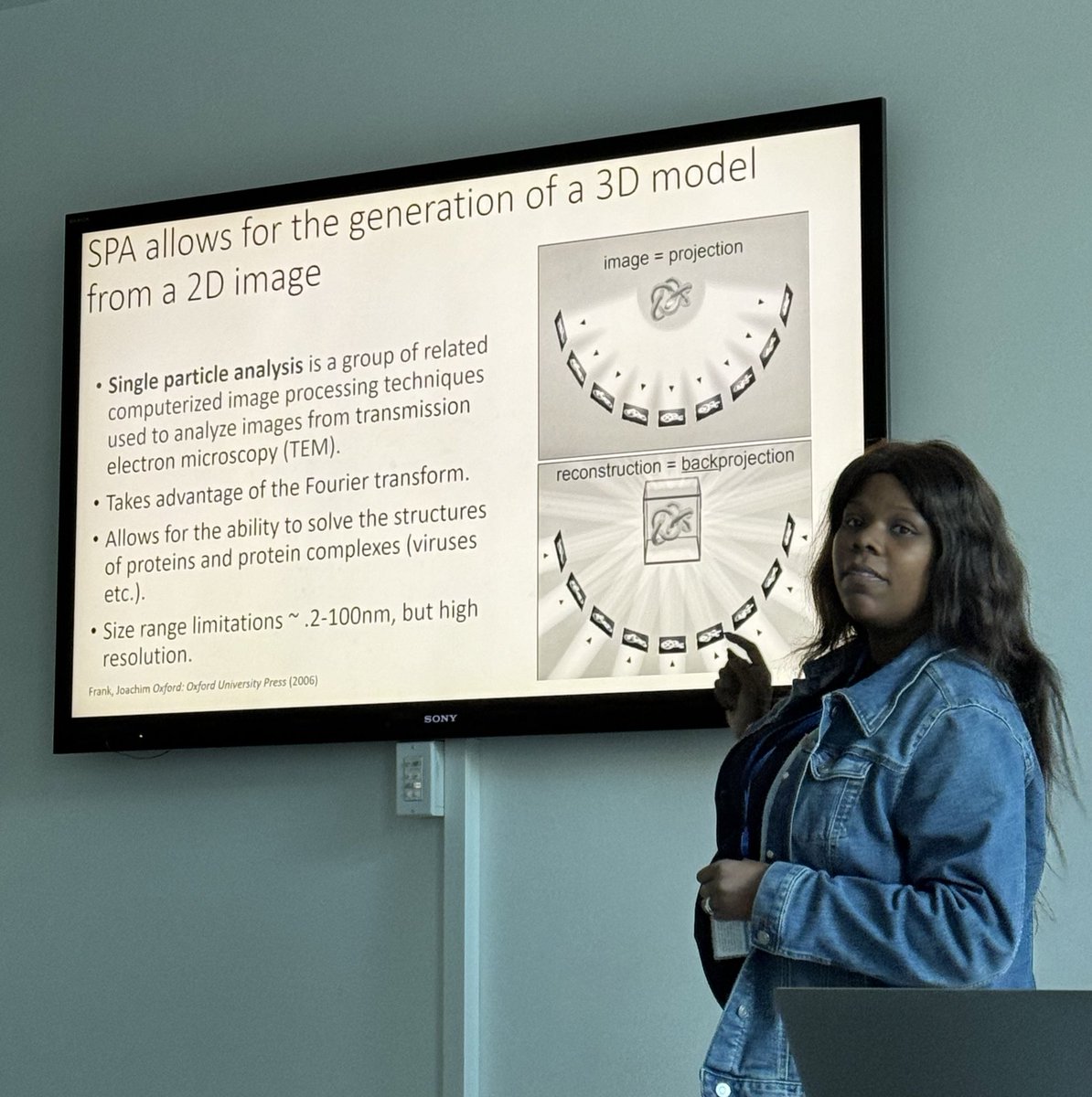
Insane lab meeting with our postdoc N’Toia introducing us #SingleParticleAnalysis pipeline for her project! 👀 #autophagy
3
10
820
JApplCryst
Yuanhao Cheng et al.: AutoEMage: automatic data transfer, preprocessing, real-time display and monitoring in cryo-EM #CryoEM #SingleParticleAnalysis #Automation ... #IUCr scripts.iucr.org/cgi-bin/pap…
4
218
HLXBIO
Gaining access to data shouldn’t come with unnecessary hurdles or high price points. We're here to make Cryo-EM affordable and accessible, ensuring everyone can tap into its incredible potential. #CryoEM #ElectronMicroscopy #SingleParticleAnalysis #CryoElectronMicroscopy
4
532
ActaCrystD
A new integrative framework in Scipion, called the Flexibility Hub, aims to simplify the interoperability of novel and popular heterogeneity algorithms to design more complete flexibility workflows @IUCr #SingleParticleAnalysis #ImageProcessing #CryoEM doi.org/10.1107/S20597983230…
8
55
8,342
ActaCrystD
D. Herreros et al.: Scipion Flexibility Hub: an integrative framework for advanced analysis of conformational heterogeneity in cryoEM @ActaCrystD @IUCr #SingleParticleAnalysis #ImageProcessing #CryoEM doi.org/10.1107/S20597983230…
6
11
1,420
JEOLUSA
JEOL's Dr. Jens Breffke checking out our latest installation of the CRYO ARM 300 - no room to back up and get it all in the photo! bit.ly/38t2IrY #SingleParticleAnalysis #cryoem #microscopy
2
7
1,265
LabWitwer
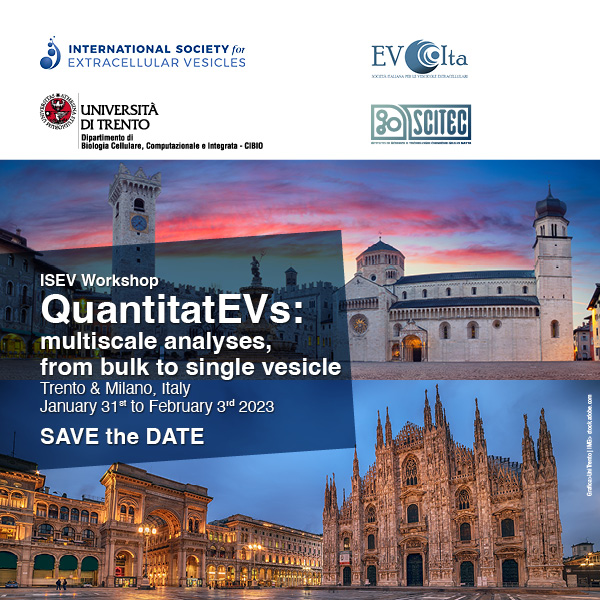
Less than a week left to apply for this exciting workshop on quantitative approaches to studying #ExtracellularVesicles #SingleParticleAnalysis #Omics @IsevOrg @IsevComms @EVItaSociety
To build #EV #TranslationalResearch through experimental and computational cutting edge approaches, join us at the @IsevOrg #QuantitatEVs #Workshop on bulk and single #EV. Apply here 👉👉 isev.org/quantitatevs @CIBIO_UniTrento @cnr_scitec @IsevComms @EVItaSociety @UniTrento
3
afonsomendes92
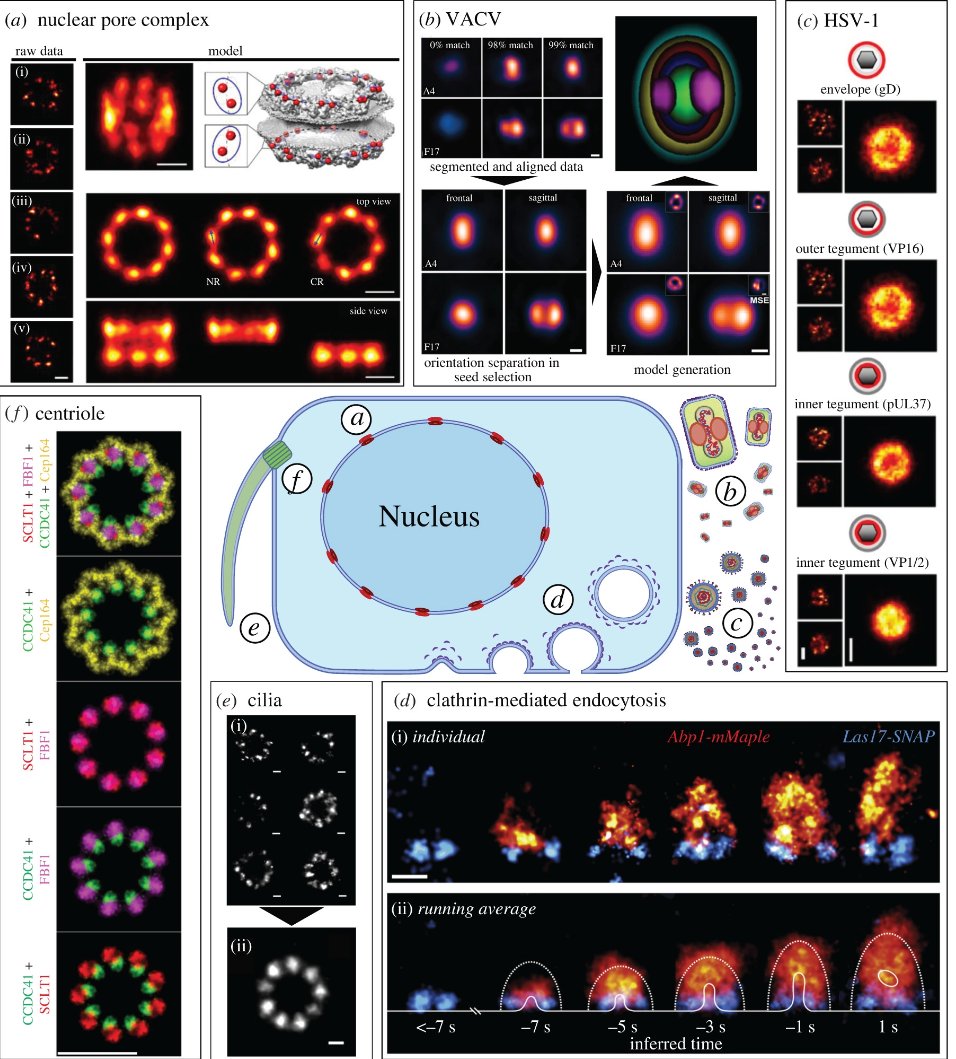
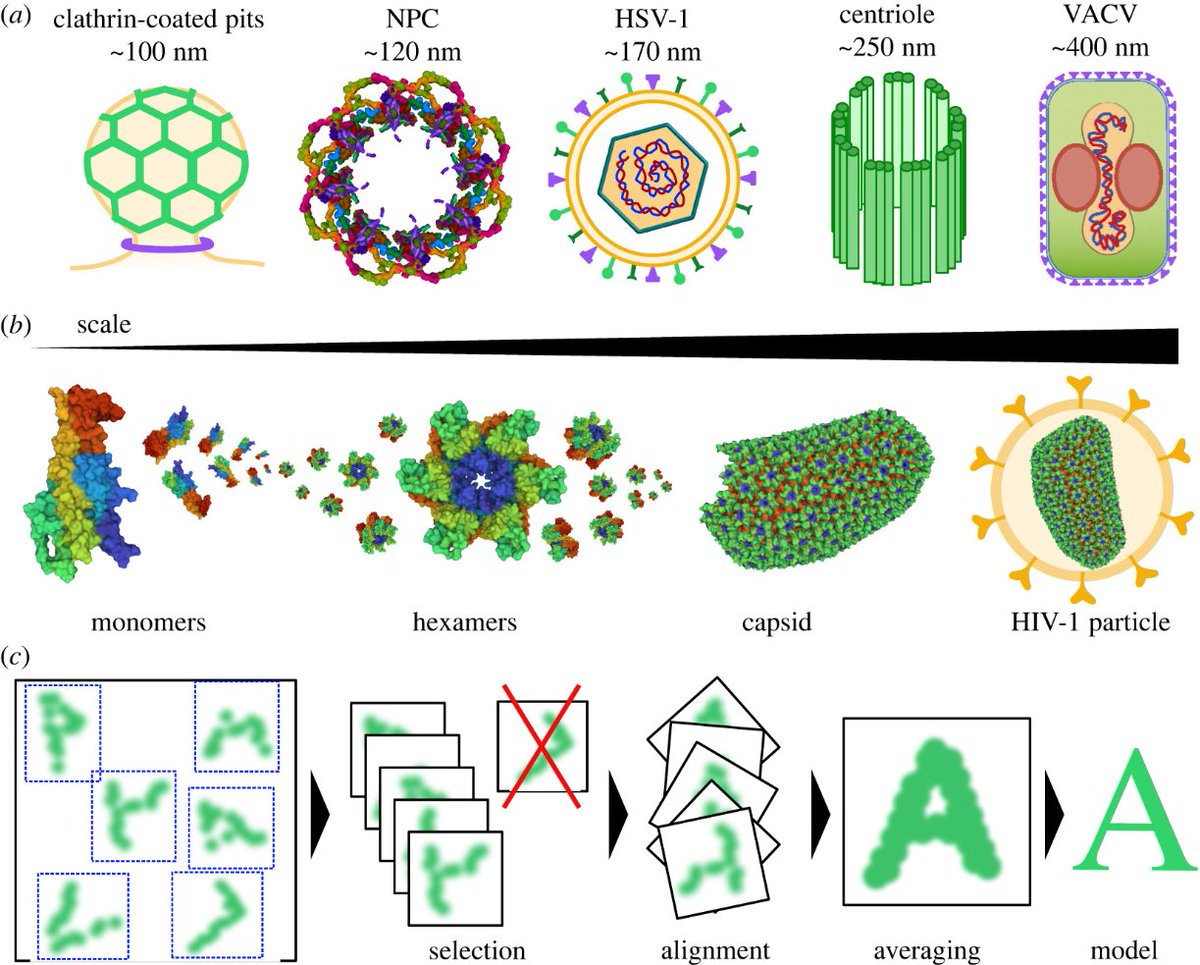
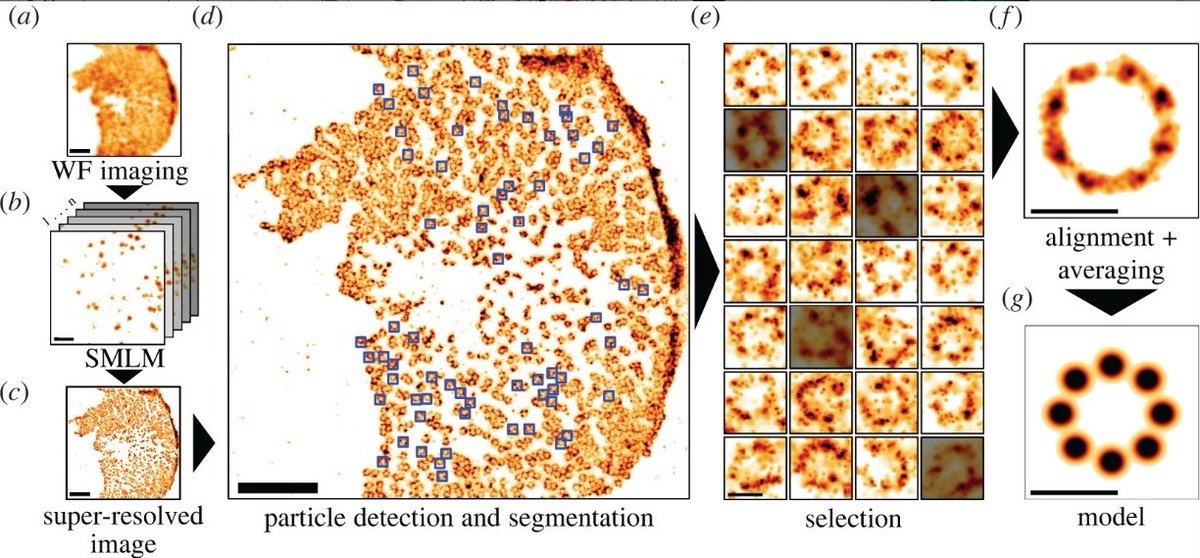
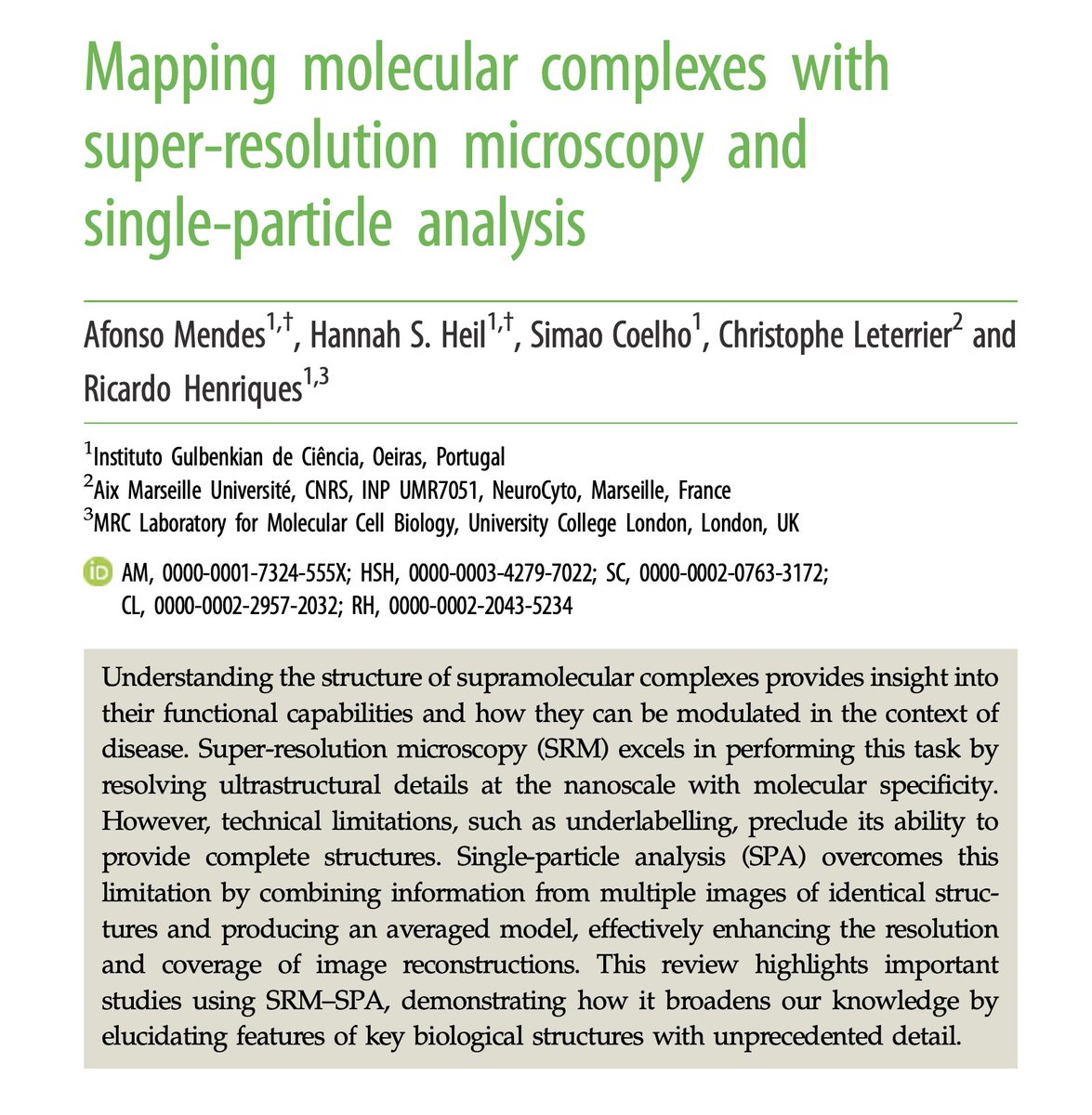
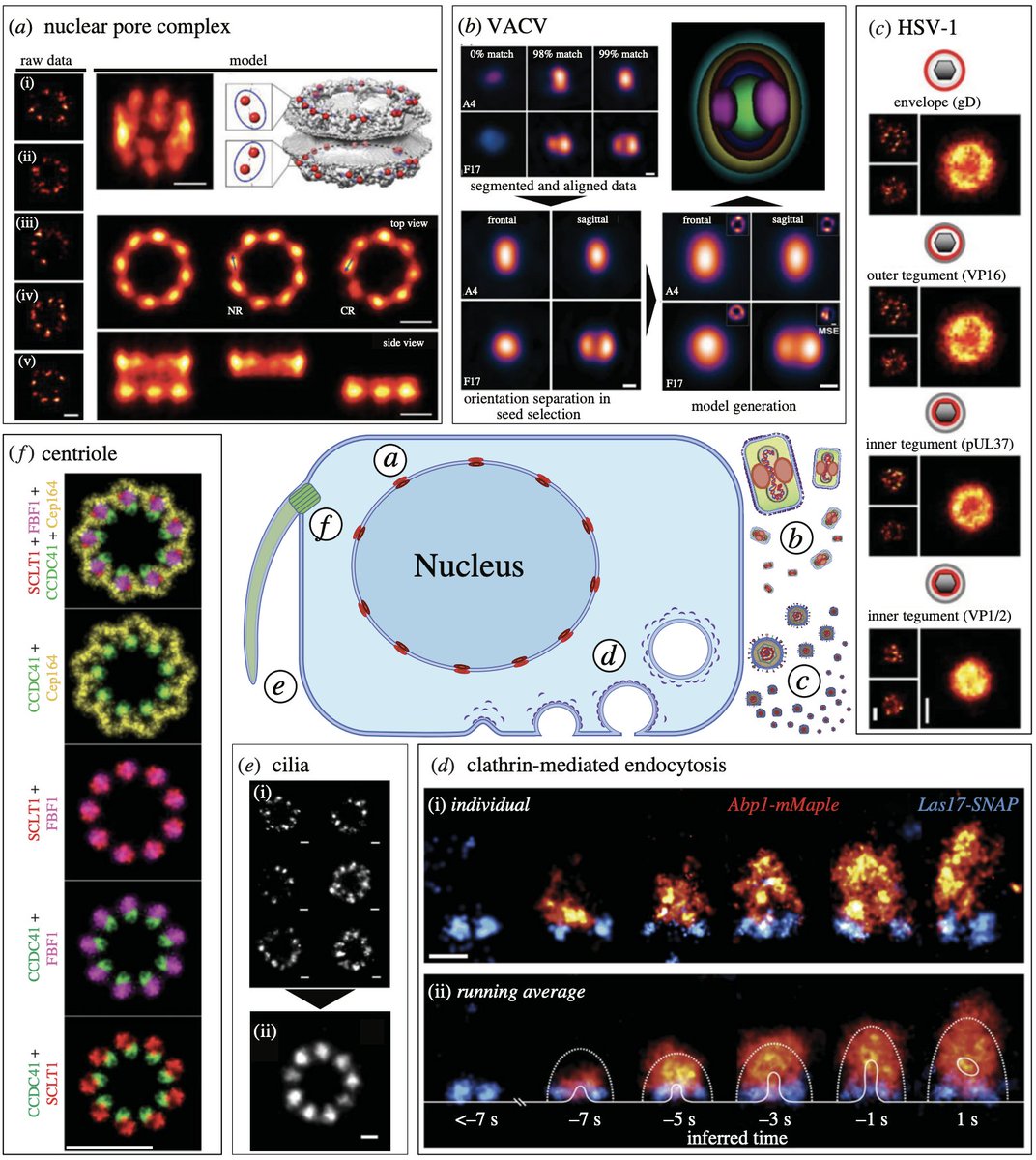
🥳 And we're on the air! Find out how molecular complexes are mapped using #SuperResolution #Microscopy and #SingleParticleAnalysis in our latest review at doi.org/10.1098/rsob.220079. Proud to put this out with @Hannah_SuperRes, @simaopc, @christlet, and @HenriquesLab!
10
60
aemiele1
Seminal review on #SuperResolution and #SingleParticleAnalysis
🚨🔬😍 Our review on mapping molecular complexes through #SuperResolution #Microscopy is out!! Highlighting many recent exciting studies. A brainchild of @afonsomendes92 and @Hannah_SuperRes in collaboration with @simaopc and @christlet. Check it out at doi.org/10.1098/rsob.220079
1
2