Filter
Exclude
Time range
-
Near
SamuelSaldana_V
My CERN contribution: Optimizing and scaling the Machine Learning inference pipeline in Lamarr. #CERN #HEP #MachineLearning #HPC #ScientificComputing #Lamarr
31
ThePhysicsMemes
Physicists: Tired of "black box" statistics recipes that feel like magic instead of science? ๐Ÿงช๐Ÿ“‰ Ivan Savovโ€™s "No Bullshit Guide to Statistics" is the curriculum weโ€™ve been waiting for. Written by a Physics MSc, it ditches memorization for a first-principles, computational approach. Why itโ€™s perfect for the lab: โœ… Computational Narrative: Use Python/Jupyter to simulate distributions instead of just staring at integrals. โœ… Rigorous Logic: Understand the "WHY" behind estimators, sampling distributions, and uncertainty quantification. โœ… Triple Threat: Covers Frequentist, Linear Models, and Bayesian perspectives on the same datasets. โœ… Research-Ready: From data cleaning with Pandas to complex Bayesian hierarchical models. Stop blindly applying p-tests and start building statistical intuition from the ground up. Whether you're analyzing experimental data or building models, this is how you make your findings bulletproof. Explore the notebooks: noBSstats.com ๐Ÿš€ #Physics #DataScience #Statistics #Python #ScientificComputing Check it out here: minireference.gumroad.com/l/โ€ฆ
1
322
SamuelSaldana_V
ACCELERATING DISCOVERY THROUGH AI Advancing AI-powered computing for LHCb at CERN to accelerate computing workflows while preserving physics precision. #CERN #LHCb #ArtificialIntelligence #MachineLearning #ScientificComputing #HPC #HighEnergyPhysics
1
44
JuliaHub_Inc
How do acausal component models scale into full system assembliesโ€”and why do they so often lead to DAEs? This recorded webinar explores how engineers can compose hierarchical physical models, understand the difference between ODEs and DAEs, and use symbolic manipulation to solve complex systems more efficiently. A valuable session for anyone looking to build high-fidelity models while improving simulation speed without sacrificing accuracy. hubs.li/Q04nw8YB0 #julialang #AcausalModeling #SymbolicComputation #ModelingAndSimulation #SystemsEngineering #ScientificComputing
1
9
494
Mat3ra_com
๐Ÿ“… ๐—จ๐—ฝ๐—ฐ๐—ผ๐—บ๐—ถ๐—ป๐—ด ๐—˜๐˜ƒ๐—ฒ๐—ป๐˜๐˜€ July brings two opportunities to connect with the Mat3ra community โ€” one in Lafayette and one online. ๐—๐˜‚๐—น๐˜† ๐Ÿฑ โ€” ๐— ๐—ผ๐—ป๐˜๐—ต๐—น๐˜† ๐—›๐—ฎ๐—ฝ๐—ฝ๐˜† ๐—›๐—ผ๐˜‚๐—ฟ: ๐—”๐—œ ๐Ÿฎ ๐—ฆ๐—ฐ๐—ถ๐—ฒ๐—ป๐—ฐ๐—ฒ | ๐—Ÿ๐—ฎ๐—ณ๐—ฎ๐˜†๐—ฒ๐˜๐˜๐—ฒ, ๐—–๐—” Join us for a casual gathering for people excited about AI and science โ€” from materials science and chemistry to biology and beyond. Meet researchers, builders, students, entrepreneurs, and curious minds in a welcoming local setting. ๐Ÿ”— mat3ra.com/events-posts/ai-2โ€ฆ ๐—๐˜‚๐—น๐˜† ๐Ÿฎ๐Ÿต โ€” ๐— ๐—ฎ๐˜๐Ÿฏ๐—ฟ๐—ฎ ๐Ÿฎ๐—— ๐—ช๐—ฒ๐—ฏ๐—ถ๐—ป๐—ฎ๐—ฟ: ๐—ฆ๐—ฒ๐—ฎ๐˜€๐—ผ๐—ป ๐Ÿฎ, ๐—˜๐—ฝ๐—ถ๐˜€๐—ผ๐—ฑ๐—ฒ ๐Ÿฐ | ๐—ข๐—ป๐—น๐—ถ๐—ป๐—ฒ Learn practical workflows for computing thermodynamic properties of materials โ€” including formation energy, zero-point energy, and phase diagrams โ€” with Quantum ESPRESSO from JupyterLab notebooks on the Mat3ra platform. ๐Ÿ”— mat3ra.com/events-posts/mat3โ€ฆ ๐Ÿ“ us02web.zoom.us/webinar/regiโ€ฆ Join us in Lafayette or online. #Mat3ra #MaterialsScience #ComputationalMaterials #ScientificComputing #HPC #CloudComputing #DFT #2DMaterials
79
comidoc
Python for Scientific Research โฑ๏ธ 4.4 hours โญ 4.36 ๐Ÿ‘ฅ 44,885 ๐Ÿ”„ Dec 2025 ๐Ÿ’ฐ $17.99 โ†’ 100% OFF comidoc.com/udemy/python-forโ€ฆ #Python #DataScience #ScientificComputing #udemy
93
StephaneRedon
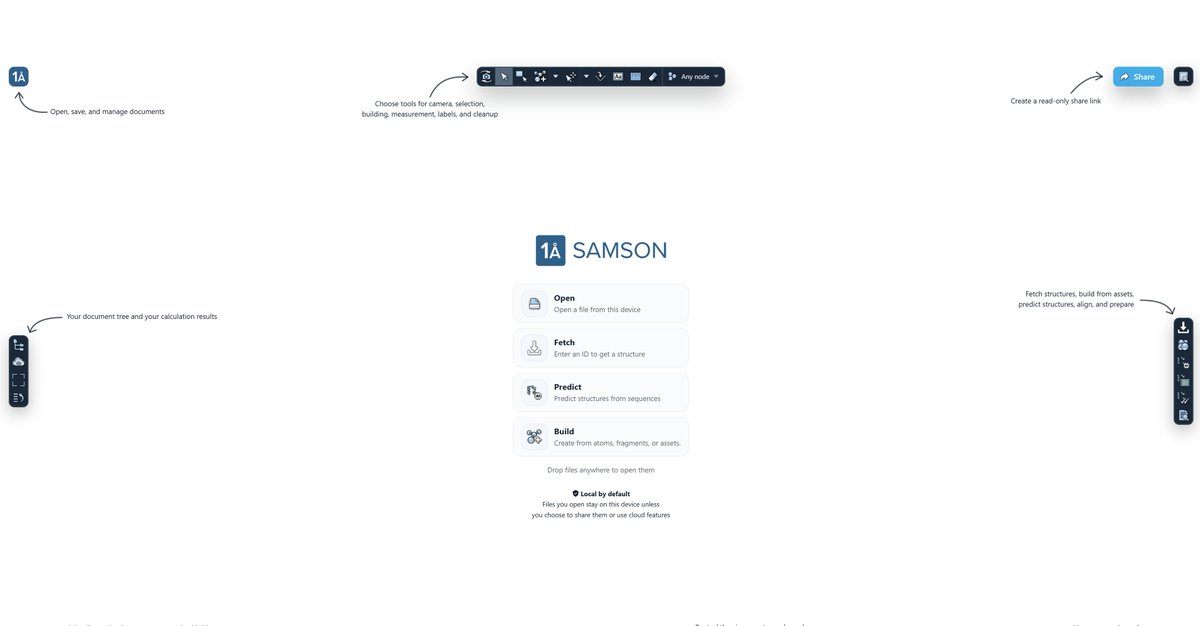
SAMSON Web is live: create, predict, render, and share molecular systems directly in your browser! Today, we are incredibly proud to introduce SAMSON Web: a browser-based molecular design environment. No installation. No plugin. No account required. Open SAMSON Web, create or import a molecular system, work on it directly in the browser, and share it. Not a screenshot. Not a video. A real interactive 3D molecular document. With the full context. With SAMSON Web, you can start in many ways: โ€ข open molecular files from your device โ€ข import and export common formats such as PDB, MOL2, and more โ€ข fetch structures from databases โ€ข predict structures (currently with AlphaFold 2, Boltz-2, and Chai-1x) โ€ข build from atoms, fragments, and assets โ€ข import cloud job results And once your system is in the browser, you can work on it: select, measure, prepare, align, minimize, annotate, edit, create a new version, and share again. Because one of the most important parts of SAMSON Web is sharing interactive documents. Scientific communication still relies too much on molecular images or movies. But molecular systems are three-dimensional. And they have context, annotations, associated data, versions, and intent. With SAMSON Web, you can share an interactive molecular document that preserves context in seconds. A collaborator, student, reviewer, customer, or colleague can open it in the browser, rotate it, zoom in, inspect annotations, associated logs and data, understand the model directly, and even edit their own copy. Remote collaborators, even during a Zoom or Teams session, can now explore designs as they want, edit, and send you back their changes. SAMSON Web also helps you create high-quality visuals directly in the browser: โ€ข advanced rendering effects โ€ข custom backgrounds โ€ข 3D skyboxes โ€ข path tracing โ€ข advanced materials โ€ข snapshots and render-ready scenes Modern molecular design produces much more than coordinates: prediction results, alignments, tables, metadata, trajectories, reports, annotations, and intermediate files. SAMSON documents preserve it all, and SAMSON Web also includes a Data Explorer to explore and edit rich scientific data next to molecular structures. The goal is to make molecular documents richer and more useful: scientific workspaces where structure, data, calculations, and interpretation live together. You start locally by default (files you open stay on your device unless you choose to share them or use cloud features). You do not need an account to create and share. Creating an account unlocks versioned documents and history, permission controls, and access to your data from anywhere. SAMSON Web is live. You can start in seconds. The link is in the first comment. #OneAngstrom #SAMSON #MolecularDesign #ComputationalBiology #DrugDiscovery #ProteinDesign #StructuralBiology #MaterialsScience #Nanoscience #AlphaFold #Boltz #Chai #MolecularVisualization #ScientificComputing #AIForScience
1
6
8
344
RandlesLab
It's a busy conference week for the Randles Lab! After presenting one paper at ICCS 2026 in Hamburg, Ayman Yousef is heading straight to PASC 2026 to present another paper on Wednesday, July 1. Title: "GPU Halo Replay: Lossless Twin Simulations for Flexible In Situ Analysis of Stencil-Based Solvers." This work, by Ayman Yousef, Aristotle Martin, Ph.D., and I, introduces GPU Halo Replay, a framework that enables lossless halo replay so analysis can be performed by dedicated computational twin simulations without slowing the primary simulation or sacrificing fidelity. If you're attending PASC and are interested in HPC, in situ analysis, scientific workflows, or scientific visualization, he would love to see you at the talk and discuss the paper! #PASC2026 #ICCS2026 #HPC #InSitu #ScientificComputing #Visualization #CFD
120
JuliaHub_Inc
From Aadhaar to JuliaHub, Dr. Viral B. Shah has spent his career building computing systems designed for real-world impact at extraordinary scale. In this interview, he reflects on co-creating Julia, helping architect Aadhaar and India Stack, and how those lessons now shape the next frontier of industrial #modeling and #simulation. It is a compelling look at compiler technology, scientific computing, physics-aware #AI, and how #Dyad is helping engineers move faster from design to validated, real-world performance. technologymagazine.com/news/โ€ฆ #julialang #ModelingAndSimulation #ScientificComputing #IndustrialAI #EngineeringInnovation
2
5
766
EGuerevitz
Daily Briefing โ€” Mathematics Applied to AI 1. Applied mathematics is moving to the center of frontier AI A growing consensus among researchers is that the next generation of AI breakthroughs will come less from simply scaling models and more from advances in applied mathematics. Optimization, numerical linear algebra, probability, uncertainty quantification, and dynamical systems are increasingly viewed as the core infrastructure required for trustworthy and efficient AI, particularly in healthcare, defense, and scientific computing. (SIAM) Why it matters: Mathematical innovation is becoming a competitive advantage. Better algorithms may deliver larger gains than simply adding more GPUs. 2. Transformer theory is becoming a research discipline A major international workshop this month focused on building unified mathematical theories for Transformers, diffusion models, and associative memories. Researchers are attempting to explain why these architectures work rather than relying solely on empirical scaling laws. (Chalmers University of Technology) Why it matters: A rigorous mathematical framework could dramatically improve model efficiency, reliability, and interpretability. 3. Optimization research is increasingly merging with machine learning A new summer school launched today in France highlights the convergence of mathematical optimization, operations research, and machine learning. Topics include mixed-integer optimization (MILP), surrogate models, hybrid metaheuristics, and AI-assisted optimization for logistics, healthcare, and energy systems. (GDR ROD) Why it matters: Hybrid optimization algorithms are expected to become a key ingredient in industrial AI over the next decade. 4. Mathematical reasoning remains one of AI's hardest frontiers A comprehensive survey released this month reviews the state of AI mathematical reasoning, covering large language models, neuro-symbolic systems, theorem proving, and verified mathematical discovery. The authors conclude that verification and formal proof techniquesโ€”not larger models aloneโ€”will likely define future progress. (arXiv) Why it matters: Reliable mathematical reasoning is essential for trustworthy AI agents capable of scientific discovery. 5. Algorithmic efficiency is replacing brute-force scaling Recent research compilations show increasing emphasis on sparse attention, efficient inference, reinforcement learning for reasoning, and hardware-aware algorithms rather than simply increasing model size. This trend echoes earlier successes such as AlphaTensor, which used reinforcement learning to discover faster matrix multiplication algorithms. (Sebastian Raschka's AI Magazine) Why it matters: This direction aligns closely with your interest in reducing AI energy consumption through better mathematics and algorithms rather than ever-larger compute clusters. Emerging trend to watch Across academia and industry, one theme stands out: the future of AI is becoming a mathematics problem again. The most influential work is shifting toward: Efficient optimization algorithms Sparse and structured linear algebra Mathematical theories of Transformers Formal verification of reasoning Energy-efficient inference through algorithmic innovation This trend strongly reinforces the idea that advances in mathematical foundations may unlock the next major leap in AI performance while reducing computational cost. #AI #ArtificialIntelligence #AppliedMathematics #MachineLearning #AIResearch #Optimization #Transformers #Algorithms #ScientificComputing #EfficientAI #LowJouleAI
1
56
JuliaHub_Inc
Pluto 1.0 is here, marking six years of continuous development of one of Juliaโ€™s most popular interactive notebook environments. This major release brings meaningful advances in reproducibility, sharing, accessibility, educational tooling, and developer experienceโ€”strengthening Plutoโ€™s mission to make scientific computing more interactive, approachable, and engaging for learners, educators, and researchers worldwide. #JuliaLang #Plutojl #ScientificComputing #OpenSource #DeveloperTools discourse.julialang.org/t/plโ€ฆ
1
3
40
2,723
JuliaHub_Inc
How can Julia users build portable CPU/GPU code from a single codebase? Join Oak Ridge National Laboratory scientists William F. Godoy and Philip Fackler for a live #webinar on JACC.jl and see how vendor-neutral parallel computing can simplify #HPC development while maintaining performance and productivity across hardware vendors. juliahub.com/events/build-poโ€ฆ #JuliaLang #HPC #GPUComputing #ParallelComputing #ScientificComputing
3
7
627
Apress
Scientists & engineers: #programming isnโ€™t optional anymore. Build strong foundations in #Bash and #Python while working with real datasets, algorithms, and efficient workflows tailored for research. #ScientificComputing #DataScience #STEMTools ๐Ÿ”— ow.ly/TwYk50YNGSp
4
188
CEMA_Africa
โณ 2 days to go! Join us on Wednesday, 10th June at 12:00 PM EAT and learn how scientific computing transforming health research and shaping the future of science? Register now: us06web.zoom.us/meeting/regiโ€ฆ #CEMASeminarSeries #ScientificComputing #AI #Technology
Save the Date! Wed,10th June, 2026 at 12PM EAT for the next #CEMASeminarSeries & learn about the role of #ScientificComputing in research, emerging careers in research software engineering & how AI is shaping science & innovation. Register: l1nq.com/ys0df6a or scan QR code
2
2
506
Apress
Scientists & engineers: #programming isnโ€™t optional anymore. Build strong foundations in #Bash and #Python while working with real datasets, algorithms, and efficient workflows tailored for research. #ScientificComputing #DataScience #STEMTools ๐Ÿ”— ow.ly/TwYk50YNGSp
1
4
270
InSilicoMeds
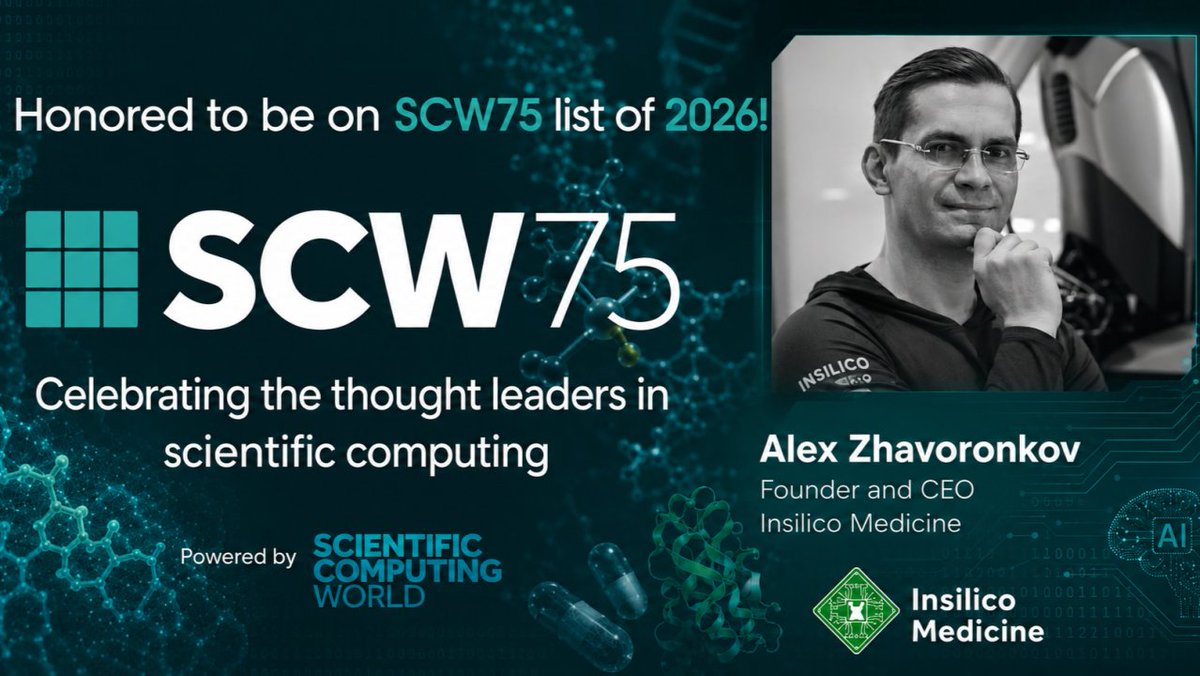
Congratulations to our Founder and CEO, Alex Zhavoronkov, PhD, on being named to the inaugural #SCW75 list by Scientific Computing World. The SCW75 recognizes 75 influential leaders advancing high-performance computing, AI infrastructure, laboratory informatics, and simulation across the globe. This recognition reflects Alex's long-standing commitment to applying AI and scientific computing to some of the most complex challenges in biology, chemistry, and human health. At Insilico Medicine, that vision has helped drive the advancement of 30 developmental candidates, including 13 clinical-stage pipelines, while expanding the impact of AI-powered molecular design beyond healthcare into sustainability applications. linkedin.com/pulse/insilico-โ€ฆ #InsilicoMedicine #AI #DrugDiscovery #ScientificComputing #GenerativeAI #Biotechnology #Longevity #PharmaAI
1
1
11
725
JuliaHub_Inc
How do you build high-performance Julia code that runs across #CPUs and #GPUs without rewriting for every vendor? Join Oak Ridge National Laboratory scientists William F. Godoy and Philip Fackler for a live #webinar on JACC.jl, and see how vendor-neutral parallel computing in Julia can simplify HPC development while maintaining performance, portability, and developer productivity. juliahub.com/events/build-poโ€ฆ #JuliaLang #HPC #GPUComputing #ParallelComputing #ScientificComputing
2
11
976
VivekIntel
Awesome Research Tools โ€” A Massive Collection of Tools Every Researcher Should Know ๐Ÿ’€๐Ÿ”ฅ Research is more than reading papers. It's writing, organizing, analyzing, visualizing, collaborating, and publishing. Awesome Research Tools brings together hundreds of tools covering academic writing, note-taking, data analysis, scientific computing, visualization, reference management, productivity, publishing, and open science. ๐Ÿง  Research smarter, not harder โœ๏ธ Write and publish efficiently ๐Ÿ“Š Analyze and visualize data ๐Ÿ”ฌ Build a modern research workflow ๐Ÿš€ Discover tools used by researchers worldwide Whether you're a student, researcher, engineer, or data scientist, this repository is a valuable starting point for building your research toolkit. ๐Ÿ”— github.com/emptymalei/awesomโ€ฆ #Research #DataScience #Academia #OpenScience #MachineLearning #PhD #ScientificComputing #Productivity #Learning #Technology
1
18
868