Computational Structural Biologist |

Joined April 2017
106 Photos and videos
David Baker & Veesler labs "building viruses - Institute for Protein Design (IPD) -Two new Nature papers - "building viruses, at University of Washington" if you believe the headlines. What they've actually done is more interesting than that. ullahsamee.substack.com/p/da…
1
76
Now available at DeepWiki deepwiki.com/aurekaresearch/…
Interesting!! A Chinese model(OpenDDE) beats the other Chinese model(Protenix-v2) on Abs-Ag
128
Interesting!! A Chinese model(OpenDDE) beats the other Chinese model(Protenix-v2) on Abs-Ag
An open source reproduction of isomorphic’s IsoDDE w/ Apache license claims to beat Protenix-v2 on antibody antigen docking performance
2
5
1,586
Protenix-v2 weights available now😍 apples to apples comparison from Lucas Nivon post. Protenix ahead of all; AF3, Boltz, OF3-p2 on a blind test set of protein/ligand. So for Co-Folding use minimum Protenix-v2 huggingface.co/TMF001/proten…
5
14
102
7,825
sk reposted
Systematic Evaluation of AlphaFold2 and OpenFold3 on Protein–Peptide Complexes "Results show that AF2 consistently outperformed OF3 across both subsets in overall success rate and proportion of high-quality models, while both methods exhibited comparable global fold prediction accuracy. ... Analysis of built-in and post-hoc confidence scores demonstrated that PAE-derived metrics, particularly pDockQ2, LIS, and ipSAE, provided the most reliable proxies for structural accuracy in AF2 predictions, ..." biorxiv.org/content/10.64898…
1
9
37
2,861
Lots of crazy design work nature.com/articles/s41589-0…
1
150
sk reposted
Guide your favorite protein generative model with experimental data? Meet ProteinGuide - a method to condition pre-trained models on properties without retraining. We validated it both in silico by guiding ProteinMPNN and ESM3 on 3 tasks and in vitro by engineering base editors.
7
44
256
37,520
github.com/RosettaCommons/HB…
Deep learning based design of buried hydrogen bond networks with HBDesigner ift.tt/HqefsZ6 #biorxiv_bioE
4
19
1,803
ipSAE @RolandDunbrack can distinguish correct heterocomplex pairs when multiple functionally homologous proteins are present within a BGC.
高効率なタンパク質間相互作用予測による生合成遺伝子クラスターのネットワーク解析 AlphaFold3の多重配列アラインメントをMMSeqs2に置き換えることで、約50万組のタンパク質ペアから、機能未知タンパク質も含む約15000組の信頼性の高いヘテロマー相互作用を予測した #BNTNJC biorxiv.org/content/10.1101/…
6
36
6,353
From Caleb, ipsae_max 👉🏻correlation with kD. biorxiv.org/content/10.64898…
ipTM and ipSAE don't predict binding affinity. A-alpha Bio measured 7M interactions: almost no correlation. Dug into this with Michael Holden in Ep 1 of Protein Engineering in Practice (by @ranomics): youtu.be/cVmGeFGsVA0
1
4
201
sk reposted
Antibody LMs learn what looks antibody-like, but not how selection turns naive germline antibodies into strong binders. @aakarshv1 and I are excited to share CoSiNE, a model that learns this germline-to-mature process for variant effect prediction and antibody design. (1/8)
8
51
227
45,600
sk reposted
At @Biohub, our goal is to build models that accelerate scientific discovery and progress toward the cure to disease. We’re releasing all of this under MIT license allowing commercial and non-commercial use. Read more here: biohub.ai/esm/protein/
3
33
176
30,395
sk reposted
Today we're announcing ESMFold2, an open scientific engine to power prediction, design, and discovery across protein biology. The new model delivers state of the art performance on protein interactions, especially antibodies, a critical modality for therapeutics. We have designed and validated miniprotein binders and single chain antibodies across five therapeutic targets that are important in cancer and immunology. We are seeing very high success rates, and affinities at levels consistent with therapeutic activity. We’re also releasing an atlas of 6.8 billion proteins, and 1.1 billion predicted structures. ESMFold2 is built on a state of the art language model that has been trained on billions of protein sequences. A world model of protein biology emerges through language modeling. We’ve used the techniques of mechanistic interpretability developed to understand large language models to understand the concepts ESM uses to represent proteins. The model’s representation space has a compositional organization of features across scales, levels of complexity, and abstraction, that reflects and mirrors the understanding of protein biology developed through a century of empirical science. This understanding emerges without prior knowledge, just from language modeling of protein sequences. Language models are becoming a powerful substrate to understand and program biology. The design of protein interactions is one of the most fundamental problems in biophysics, and has critical implications for the discovery of new medicines. A simple gradient based search with the model was able to discover high-affinity protein binders. I'm excited by the potential this has to accelerate basic science and the understanding of proteins. And especially for the new avenues it opens up for therapeutic design and medicine.
75
452
1,623
608,141
sk reposted
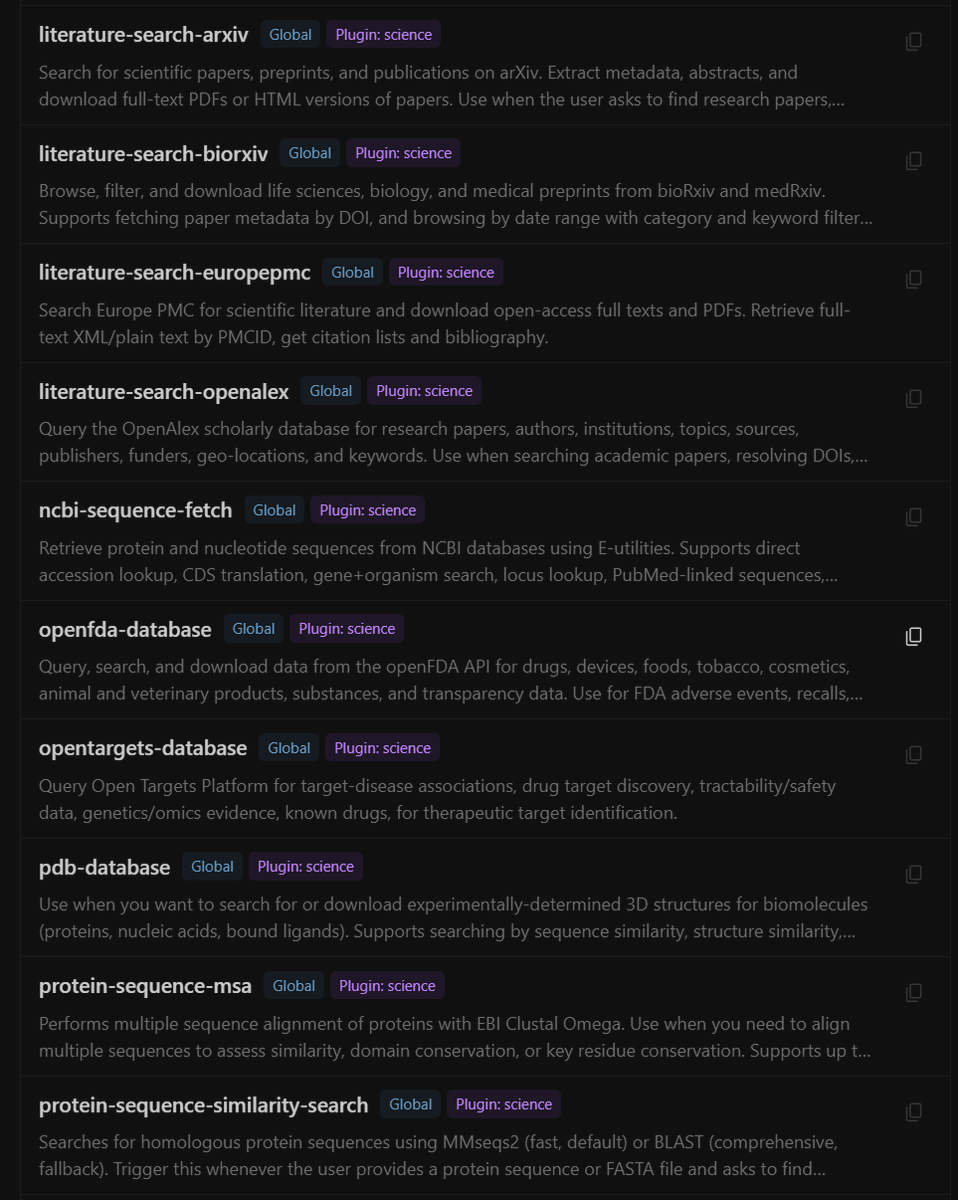
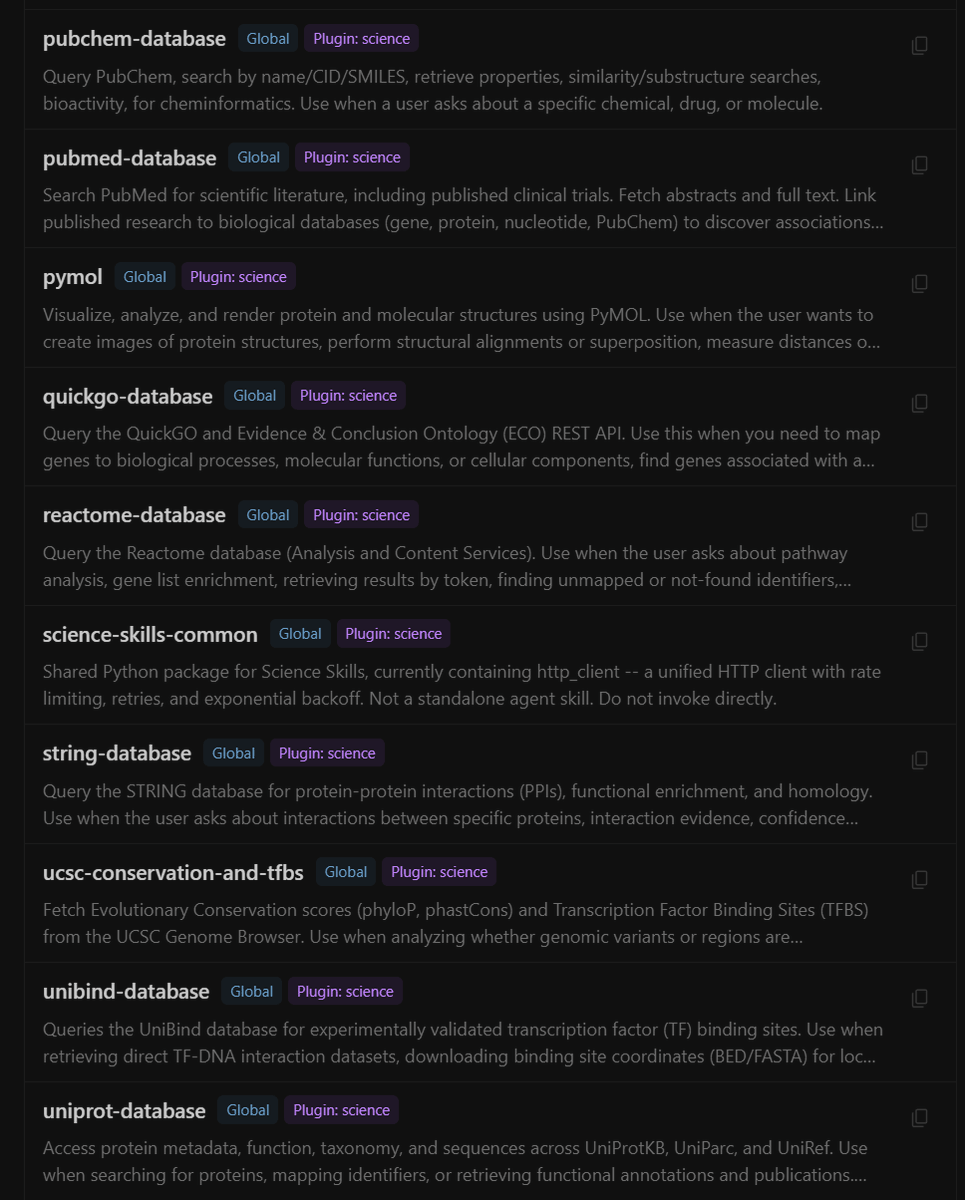
- Protein Data Bank (PDB) - Foldseek - AlphafoldDB - Uniprot - Interpro - Jaspar - protein-sequence-similarity-search - protein-sequence-msa - Ensemble - Pubchem - Chembl - pubmed - unibind-database - clinical-trials-database - opentargets-database Finally Pymol OMG!!
1
1
196
Antigravity 2.0 - Computational Biologist. Check it out and thank me later😉#phd #postdoc
1
1
7
436
- Protein Data Bank (PDB) - Foldseek - AlphafoldDB - Uniprot - Interpro - Jaspar - protein-sequence-similarity-search - protein-sequence-msa - Ensemble - Pubchem - Chembl - pubmed - unibind-database - clinical-trials-database - opentargets-database Finally Pymol OMG!!
1
1
196
repo now available on deepwiki: deepwiki.com/aqlaboratory/ge…
Introducing Genie 3, a generative protein model that substantially advances the state-of-the-art for binder design, increasing in silico success rates by up to 20x on hard multimeric targets. It also debuts a form of inference-time scaling unobserved in other design models. 🧵1/8
1
141
sk reposted
AI can now design antibodies that bind with atomic precision, but not ones that cells can produce. Our preprint closes this gap, delivering a structural principle, an AI-guided rescue pipeline, and adalimumab variants with 20-100x in vivo potency. biorxiv.org/content/10.64898…
8
38
197
11,456