AI for scientific discovery. Head of Science, Biohub. Founder and scientific director of the ESM project.

Joined April 2009
57 Photos and videos
Pinned Post
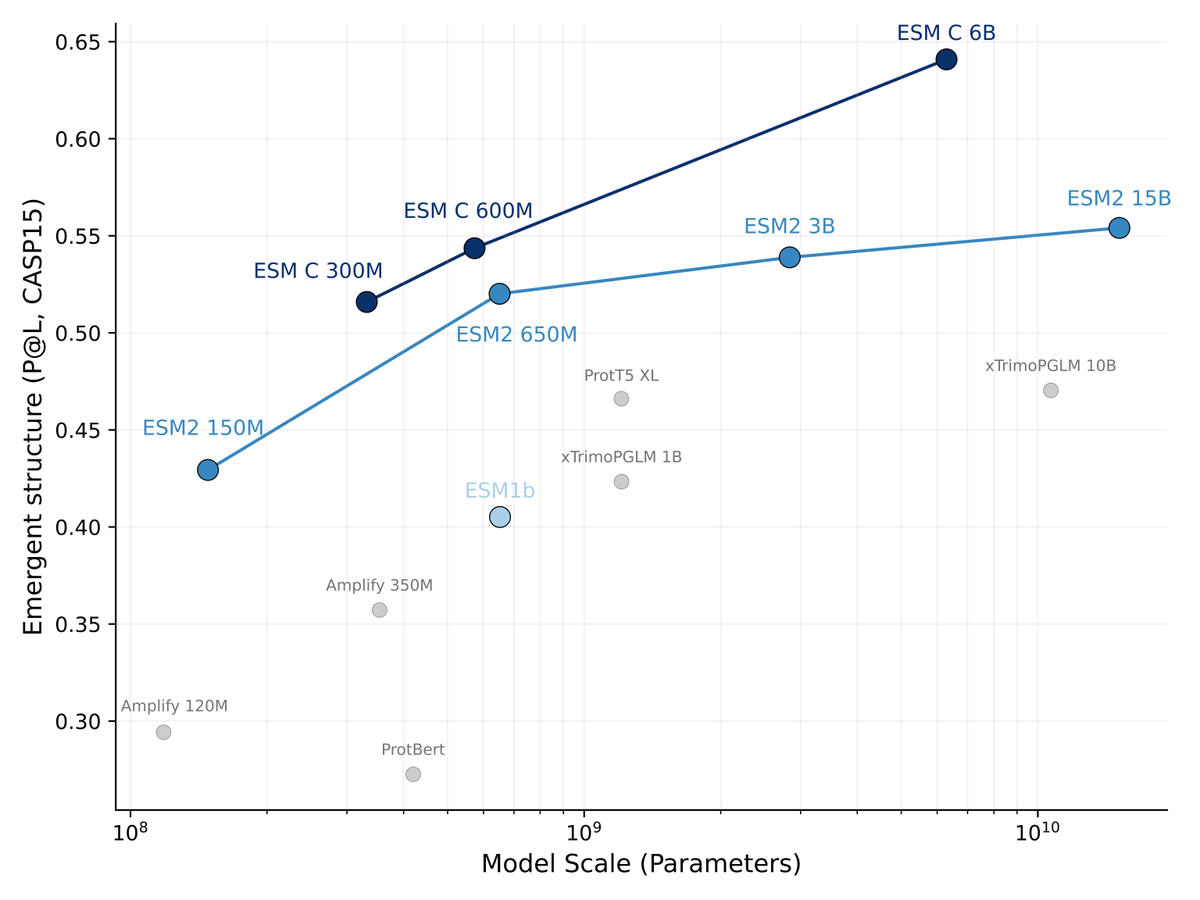
Today we're announcing ESMFold2, an open scientific engine to power prediction, design, and discovery across protein biology. The new model delivers state of the art performance on protein interactions, especially antibodies, a critical modality for therapeutics. We have designed and validated miniprotein binders and single chain antibodies across five therapeutic targets that are important in cancer and immunology. We are seeing very high success rates, and affinities at levels consistent with therapeutic activity. We’re also releasing an atlas of 6.8 billion proteins, and 1.1 billion predicted structures. ESMFold2 is built on a state of the art language model that has been trained on billions of protein sequences. A world model of protein biology emerges through language modeling. We’ve used the techniques of mechanistic interpretability developed to understand large language models to understand the concepts ESM uses to represent proteins. The model’s representation space has a compositional organization of features across scales, levels of complexity, and abstraction, that reflects and mirrors the understanding of protein biology developed through a century of empirical science. This understanding emerges without prior knowledge, just from language modeling of protein sequences. Language models are becoming a powerful substrate to understand and program biology. The design of protein interactions is one of the most fundamental problems in biophysics, and has critical implications for the discovery of new medicines. A simple gradient based search with the model was able to discover high-affinity protein binders. I'm excited by the potential this has to accelerate basic science and the understanding of proteins. And especially for the new avenues it opens up for therapeutic design and medicine.
75
452
1,623
608,148
Together with UC Berkeley we are announcing the laser phase plate - a breakthrough in atomic resolution imaging. This is the brightest continuous wave laser in the world, 100 million times the intensity of the surface of the sun. Phase contrast plays an important role in microscopy, but it was thought close to impossible for electron microscopy, where it would require interfering with an electron beam. Holger Mueller and Robert Glaeser proposed exactly this using a standing wave laser. It has taken over 15 years to make this a reality. Biohub partnered with UC Berkeley and Mueller to support this work and to engineer and build the technology. Contrast has been the critical barrier to achieving atomic resolution imaging of the cell. In cryo-electron tomography, a cellular imaging technology that uses electron microscopy, the low contrast makes it impossible to resolve anything but the largest proteins within their cellular context. The laser phase plate removes that barrier. With advances in AI this breakthrough in contrast will start to open up a new frontier in structural biology, that will allow us to see the molecular machines of the cell, and how they assemble into far more complex and dynamic systems, and understand how they work.
91
572
3,974
653,792
Great talking with RJ and Brandon on the Latent Space AI for Science podcast, about protein language models, scaling in biology, and the new ESMFold2.
🆕Biohub’s Protein World Model: ESMC-6B, ESMFold2, 6.8B proteins, 1.1B structures, antibody design, SAEs, & the bitter lesson for biology latent.space/p/esmfold2 @biohub Head of Science @alexrives explains why biology may scale like language modeling, how metagenomics unlocked the next ESM scaling curve, why protein LMs can learn structure/function from sequence alone, how sparse autoencoders reveal biology inside the model, why ESMFold2 can beat specialized systems on antibody-antigen prediction, and how Biohub’s $500M Virtual Biology Initiative aims to build predictive models of cells, disease, and eventually physiology.
4
9
53
10,114
Alex Rives reposted
🆕Biohub’s Protein World Model: ESMC-6B, ESMFold2, 6.8B proteins, 1.1B structures, antibody design, SAEs, & the bitter lesson for biology latent.space/p/esmfold2 @biohub Head of Science @alexrives explains why biology may scale like language modeling, how metagenomics unlocked the next ESM scaling curve, why protein LMs can learn structure/function from sequence alone, how sparse autoencoders reveal biology inside the model, why ESMFold2 can beat specialized systems on antibody-antigen prediction, and how Biohub’s $500M Virtual Biology Initiative aims to build predictive models of cells, disease, and eventually physiology.
7
12
38
23,535
At @Biohub, our goal is to build models that accelerate scientific discovery and progress toward the cure to disease. We’re releasing all of this under MIT license allowing commercial and non-commercial use. Read more here: biohub.ai/esm/protein/
3
33
176
30,395
We’re also releasing the largest atlas of protein structure and function. With 6.8 billion proteins, and 1.1 billion predicted structures, it enables analysis and protein discovery at the scale of life.
3
21
131
16,225
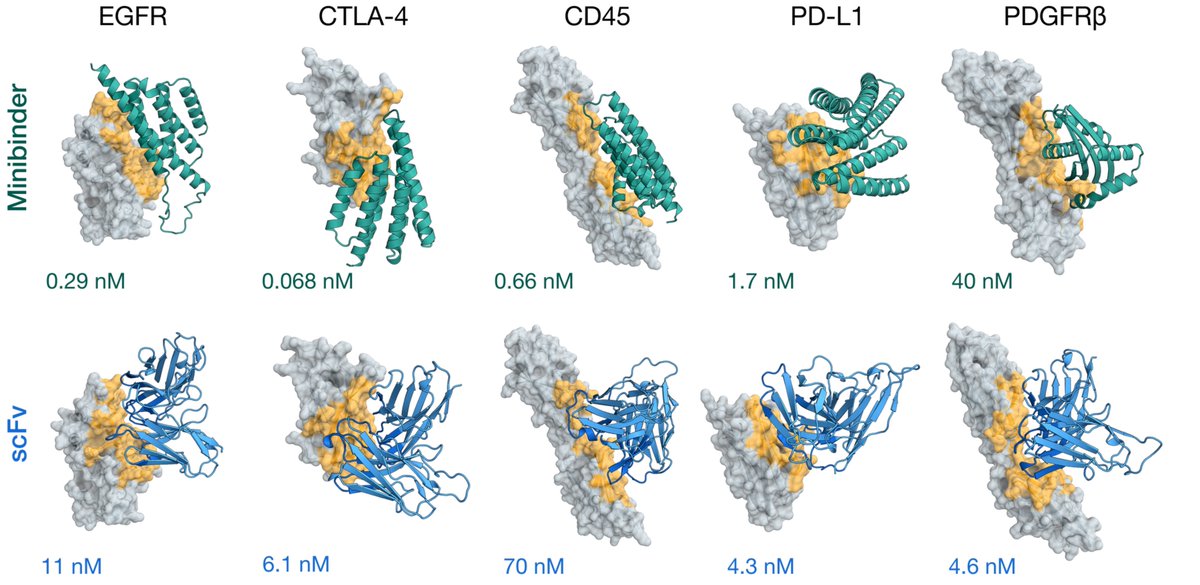
We designed miniproteins and antibodies for five targets that are important in cancer and immunology. We found binders with nanomolar affinities for all, and sometimes picomolar affinities, testing just 84 designs per target and modality. Scaling compute at inference time improved average success rates from 54% to 70% for minibinders and from 12% to 21% for single chain antibodies. We’ve obtained biophysical validation for the binders including a cryo-EM structure of one of the miniprotein binders in complex with EGFR, which confirms that the predicted structure is within experimental accuracy of the true structure.
3
7
63
9,337
ESMFold2 is blazing fast and has state of the art accuracy across benchmarks for structure prediction, especially for the challenging problem of predicting protein interactions, including the interaction of antibodies with their targets.
2
7
82
13,904
Alex Rives reposted
The AI revolution in science is powered by open source software. Let's fund it. Today we're launching the Open Source for Science Fund @os4science, a new multi-donor philanthropic fund by @RenPhilanthropy, seeded by @biohub and @wellcometrust, with support from @KavliFoundation and Research Software Alliance. 🧵os4science.org/news/open-sou… 1/4
4
26
114
53,672
Alex Rives reposted
Congrats @alexrives and @biohub team! Truly spectacular vision.
Scaling laws are powering AI. It’s time to scale biology. Today we’re launching the Virtual Biology Initiative to generate the data to unlock scaling laws in biology and build accurate predictive models of the cell. Digital representations of proteins are already expanding our understanding of life at the molecular level, and accelerating the design of molecules and medicines. Accurate digital representations of the cell could reveal the mechanisms that are responsible for disease, and show how to reverse them. The protein data bank, and worldwide repositories of protein sequence biodiversity were created through decades of work by the scientific community. The advances in artificial intelligence for proteins would not have been possible without them. The cell is orders of magnitude more complex, and we will need to create the data in just a few years rather than decades. This will require a coordinated global effort. We're partnering with Broad, Wellcome Sanger, Arc, Allen, Human Cell Atlas, Human Protein Atlas, NVIDIA, and Renaissance Philanthropy. Biohub is contributing to this effort as both a funder and a builder. We are developing microscopy to observe millions of cells in living organisms, and cryo-ET to resolve the cell in atomic detail. We're building instruments that expand the range of modalities and parameters that can be simultaneously measured. We’re developing molecular, cellular, and tissue engineering to create models of disease and design interventions. The data we generate will be available to the worldwide scientific community. We’re also committing $100M over the next five years to support work beyond Biohub. We invite other scientific teams and funders to join. Link: biohub.org/news/virtual-biol…
2
2
11
3,489
Alex Rives reposted
$500M towards open data in biology and an amazing set of partners committed to generating the data. It's exciting to think about what models built on this data will be capable of.
Scaling laws are powering AI. It’s time to scale biology. Today we’re launching the Virtual Biology Initiative to generate the data to unlock scaling laws in biology and build accurate predictive models of the cell. Digital representations of proteins are already expanding our understanding of life at the molecular level, and accelerating the design of molecules and medicines. Accurate digital representations of the cell could reveal the mechanisms that are responsible for disease, and show how to reverse them. The protein data bank, and worldwide repositories of protein sequence biodiversity were created through decades of work by the scientific community. The advances in artificial intelligence for proteins would not have been possible without them. The cell is orders of magnitude more complex, and we will need to create the data in just a few years rather than decades. This will require a coordinated global effort. We're partnering with Broad, Wellcome Sanger, Arc, Allen, Human Cell Atlas, Human Protein Atlas, NVIDIA, and Renaissance Philanthropy. Biohub is contributing to this effort as both a funder and a builder. We are developing microscopy to observe millions of cells in living organisms, and cryo-ET to resolve the cell in atomic detail. We're building instruments that expand the range of modalities and parameters that can be simultaneously measured. We’re developing molecular, cellular, and tissue engineering to create models of disease and design interventions. The data we generate will be available to the worldwide scientific community. We’re also committing $100M over the next five years to support work beyond Biohub. We invite other scientific teams and funders to join. Link: biohub.org/news/virtual-biol…
2
14
2,816
Alex Rives reposted
We will look back and see this as the start of a wonderful accelerator. And we @tahoe_ai are committed to building alongside these great orgs.
Scaling laws are powering AI. It’s time to scale biology. Today we’re launching the Virtual Biology Initiative to generate the data to unlock scaling laws in biology and build accurate predictive models of the cell. Digital representations of proteins are already expanding our understanding of life at the molecular level, and accelerating the design of molecules and medicines. Accurate digital representations of the cell could reveal the mechanisms that are responsible for disease, and show how to reverse them. The protein data bank, and worldwide repositories of protein sequence biodiversity were created through decades of work by the scientific community. The advances in artificial intelligence for proteins would not have been possible without them. The cell is orders of magnitude more complex, and we will need to create the data in just a few years rather than decades. This will require a coordinated global effort. We're partnering with Broad, Wellcome Sanger, Arc, Allen, Human Cell Atlas, Human Protein Atlas, NVIDIA, and Renaissance Philanthropy. Biohub is contributing to this effort as both a funder and a builder. We are developing microscopy to observe millions of cells in living organisms, and cryo-ET to resolve the cell in atomic detail. We're building instruments that expand the range of modalities and parameters that can be simultaneously measured. We’re developing molecular, cellular, and tissue engineering to create models of disease and design interventions. The data we generate will be available to the worldwide scientific community. We’re also committing $100M over the next five years to support work beyond Biohub. We invite other scientific teams and funders to join. Link: biohub.org/news/virtual-biol…
1
2
15
3,082
Alex Rives reposted
Great to see Biohub's investment in the future of AI and cell biology with its 5-year Virtual Biology Initiative programme. Beautiful alignment with the roadmap for HCA 2.0, and lots of excitement about future synergies.
Today we're announcing the Virtual Biology Initiative—a major new commitment to build the data foundation biology needs to power the next generation of AI models. Next-gen imaging. Molecular engineering tools. Open data infrastructure for the entire scientific community. Read the full story: bit.ly/3ONTkHO
7
6
29
5,970
Alex Rives reposted
Congratulations to @biohub and their partners on the announcement of the Virtual Biology Initiative – a global effort to build predictive models of cells and understanding of health and disease. @RenPhilanthropy is delighted to participate and I hope that more funders and scientific teams will back this critical effort.
Scaling laws are powering AI. It’s time to scale biology. Today we’re launching the Virtual Biology Initiative to generate the data to unlock scaling laws in biology and build accurate predictive models of the cell. Digital representations of proteins are already expanding our understanding of life at the molecular level, and accelerating the design of molecules and medicines. Accurate digital representations of the cell could reveal the mechanisms that are responsible for disease, and show how to reverse them. The protein data bank, and worldwide repositories of protein sequence biodiversity were created through decades of work by the scientific community. The advances in artificial intelligence for proteins would not have been possible without them. The cell is orders of magnitude more complex, and we will need to create the data in just a few years rather than decades. This will require a coordinated global effort. We're partnering with Broad, Wellcome Sanger, Arc, Allen, Human Cell Atlas, Human Protein Atlas, NVIDIA, and Renaissance Philanthropy. Biohub is contributing to this effort as both a funder and a builder. We are developing microscopy to observe millions of cells in living organisms, and cryo-ET to resolve the cell in atomic detail. We're building instruments that expand the range of modalities and parameters that can be simultaneously measured. We’re developing molecular, cellular, and tissue engineering to create models of disease and design interventions. The data we generate will be available to the worldwide scientific community. We’re also committing $100M over the next five years to support work beyond Biohub. We invite other scientific teams and funders to join. Link: biohub.org/news/virtual-biol…
7
9
62
8,223
Alex Rives reposted
Exactly what needs to be done. Biological data is the missing link. It may not be sexy or make for shiny announcements but building biological infrastructure is where the impact is. Huge props to CZI. biohub.org/news/virtual-biol…
30
24
201
17,867
Alex Rives reposted
🧬🤖 Thrilled to be part of this incredible initiative led by @alexrives and team! Excited to contribute at @sangerinstitute Can’t wait for the data we’ll generate and the models we’ll train 🚀 #AI #Genomics #SingleCell
Scaling laws are powering AI. It’s time to scale biology. Today we’re launching the Virtual Biology Initiative to generate the data to unlock scaling laws in biology and build accurate predictive models of the cell. Digital representations of proteins are already expanding our understanding of life at the molecular level, and accelerating the design of molecules and medicines. Accurate digital representations of the cell could reveal the mechanisms that are responsible for disease, and show how to reverse them. The protein data bank, and worldwide repositories of protein sequence biodiversity were created through decades of work by the scientific community. The advances in artificial intelligence for proteins would not have been possible without them. The cell is orders of magnitude more complex, and we will need to create the data in just a few years rather than decades. This will require a coordinated global effort. We're partnering with Broad, Wellcome Sanger, Arc, Allen, Human Cell Atlas, Human Protein Atlas, NVIDIA, and Renaissance Philanthropy. Biohub is contributing to this effort as both a funder and a builder. We are developing microscopy to observe millions of cells in living organisms, and cryo-ET to resolve the cell in atomic detail. We're building instruments that expand the range of modalities and parameters that can be simultaneously measured. We’re developing molecular, cellular, and tissue engineering to create models of disease and design interventions. The data we generate will be available to the worldwide scientific community. We’re also committing $100M over the next five years to support work beyond Biohub. We invite other scientific teams and funders to join. Link: biohub.org/news/virtual-biol…
1
2
19
3,991
Alex Rives reposted
Really thrilled by the framing and scale of this new @biohub initiative, including the combination of internal & external investment in tech-dev, open data, modeling and collaborative science, all good things!
Scaling laws are powering AI. It’s time to scale biology. Today we’re launching the Virtual Biology Initiative to generate the data to unlock scaling laws in biology and build accurate predictive models of the cell. Digital representations of proteins are already expanding our understanding of life at the molecular level, and accelerating the design of molecules and medicines. Accurate digital representations of the cell could reveal the mechanisms that are responsible for disease, and show how to reverse them. The protein data bank, and worldwide repositories of protein sequence biodiversity were created through decades of work by the scientific community. The advances in artificial intelligence for proteins would not have been possible without them. The cell is orders of magnitude more complex, and we will need to create the data in just a few years rather than decades. This will require a coordinated global effort. We're partnering with Broad, Wellcome Sanger, Arc, Allen, Human Cell Atlas, Human Protein Atlas, NVIDIA, and Renaissance Philanthropy. Biohub is contributing to this effort as both a funder and a builder. We are developing microscopy to observe millions of cells in living organisms, and cryo-ET to resolve the cell in atomic detail. We're building instruments that expand the range of modalities and parameters that can be simultaneously measured. We’re developing molecular, cellular, and tissue engineering to create models of disease and design interventions. The data we generate will be available to the worldwide scientific community. We’re also committing $100M over the next five years to support work beyond Biohub. We invite other scientific teams and funders to join. Link: biohub.org/news/virtual-biol…
1
4
69
11,630
Alex Rives reposted
This great news. BioHub is a very incredible initiative. Priscilla and Mark are setting a wonderful example with this. Excited to see what @alexrives and the folks do there.
Mark Zuckerberg and Priscilla Chan commit $500 million to AI biology trib.al/ME2x1PD
3
2
19
4,168
Alex Rives reposted
@biohub makes a major investment in an open data foundation for AI-accelerated biology! We at @arcinstitute are excited to be part of this effort through our existing and future partnerships with Biohub. Biological models need an ocean of high-quality data to explore.
Scaling laws are powering AI. It’s time to scale biology. Today we’re launching the Virtual Biology Initiative to generate the data to unlock scaling laws in biology and build accurate predictive models of the cell. Digital representations of proteins are already expanding our understanding of life at the molecular level, and accelerating the design of molecules and medicines. Accurate digital representations of the cell could reveal the mechanisms that are responsible for disease, and show how to reverse them. The protein data bank, and worldwide repositories of protein sequence biodiversity were created through decades of work by the scientific community. The advances in artificial intelligence for proteins would not have been possible without them. The cell is orders of magnitude more complex, and we will need to create the data in just a few years rather than decades. This will require a coordinated global effort. We're partnering with Broad, Wellcome Sanger, Arc, Allen, Human Cell Atlas, Human Protein Atlas, NVIDIA, and Renaissance Philanthropy. Biohub is contributing to this effort as both a funder and a builder. We are developing microscopy to observe millions of cells in living organisms, and cryo-ET to resolve the cell in atomic detail. We're building instruments that expand the range of modalities and parameters that can be simultaneously measured. We’re developing molecular, cellular, and tissue engineering to create models of disease and design interventions. The data we generate will be available to the worldwide scientific community. We’re also committing $100M over the next five years to support work beyond Biohub. We invite other scientific teams and funders to join. Link: biohub.org/news/virtual-biol…
2
6
51
4,824