doing a biology experiment

Joined July 2010
11 Photos and videos
@Biohub launched its ESM Workd Model last month. Our AI research team is growing. This is an incredible opportunity, if you want to innovate and push the boundaries of #frontierai #biology #foundationalmodel biohub.ai/esm/protein/about
1
3
662
This is such an incredible technical accomplishment... Congratulations to the team at @biohub and @UCBerkeley. New tech leads to new science. It's pretty amazing to have this on the Biohub campus.
Together with UC Berkeley we are announcing the laser phase plate - a breakthrough in atomic resolution imaging. This is the brightest continuous wave laser in the world, 100 million times the intensity of the surface of the sun. Phase contrast plays an important role in microscopy, but it was thought close to impossible for electron microscopy, where it would require interfering with an electron beam. Holger Mueller and Robert Glaeser proposed exactly this using a standing wave laser. It has taken over 15 years to make this a reality. Biohub partnered with UC Berkeley and Mueller to support this work and to engineer and build the technology. Contrast has been the critical barrier to achieving atomic resolution imaging of the cell. In cryo-electron tomography, a cellular imaging technology that uses electron microscopy, the low contrast makes it impossible to resolve anything but the largest proteins within their cellular context. The laser phase plate removes that barrier. With advances in AI this breakthrough in contrast will start to open up a new frontier in structural biology, that will allow us to see the molecular machines of the cell, and how they assemble into far more complex and dynamic systems, and understand how they work.
1
8
933
Salvatore Candido reposted
đź§µ around the interpretability work that helps connect ESMC embeddings to natural language - protein function at the micro level is around residue level mutations but at the macro level is around how they behave in the real world.
One early finding: evolutionary links between gene-editing enzymes across completely different branches of life — connections nobody had made before. This is what becomes possible when you can question protein space at scale, not just search it. Explore ESM Atlas: bit.ly/4dJcF6G
3
16
70
7,784
Also you can work with @ebetica if you come to Biohub. We have a lot of compute, frontier experimental biology institutes, and Zeming.
By the way, we're hiring at Biohub. Come hang out with us if you want to work on frontier AI or biology. We have thousands of GPUs, petabytes of data (biology is increasingly an engineering problem!) and billions of cells to image!
8
467
There is probably some "don't try this at home" joke here, but actually I think people should try it!
We’re excited to share the full binder design protocol. Check it out here: github.com/Biohub/esm/blob/m…. The notebook includes support for @modal to easily scale up binder generation. Give it a try and let us know how it works! You can read more about ESMFold2, ESMC, ESM Atlas, and the full results in the paper here: biohub.ai/papers/esm_protein….
1
8
826
Salvatore Candido reposted
Super excited to share what we've been working on! ESMC/ESMFold2 show that protein language modeling learns the principles of protein biology and can be used for state-of-the-art structure prediction and design. We also built an interactive atlas of over 6.8 billion proteins!
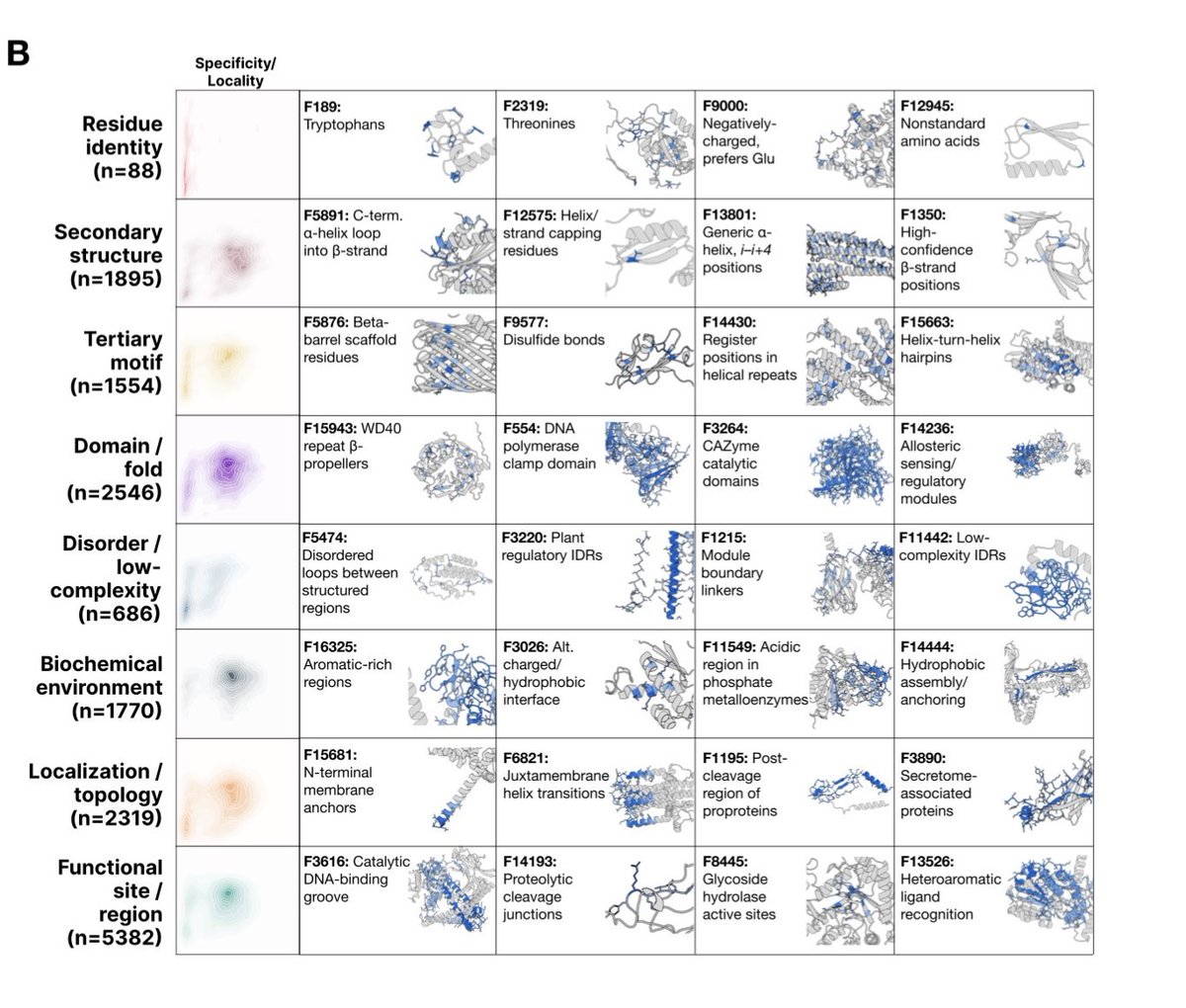
Today we're announcing ESMFold2, an open scientific engine to power prediction, design, and discovery across protein biology. The new model delivers state of the art performance on protein interactions, especially antibodies, a critical modality for therapeutics. We have designed and validated miniprotein binders and single chain antibodies across five therapeutic targets that are important in cancer and immunology. We are seeing very high success rates, and affinities at levels consistent with therapeutic activity. We’re also releasing an atlas of 6.8 billion proteins, and 1.1 billion predicted structures. ESMFold2 is built on a state of the art language model that has been trained on billions of protein sequences. A world model of protein biology emerges through language modeling. We’ve used the techniques of mechanistic interpretability developed to understand large language models to understand the concepts ESM uses to represent proteins. The model’s representation space has a compositional organization of features across scales, levels of complexity, and abstraction, that reflects and mirrors the understanding of protein biology developed through a century of empirical science. This understanding emerges without prior knowledge, just from language modeling of protein sequences. Language models are becoming a powerful substrate to understand and program biology. The design of protein interactions is one of the most fundamental problems in biophysics, and has critical implications for the discovery of new medicines. A simple gradient based search with the model was able to discover high-affinity protein binders. I'm excited by the potential this has to accelerate basic science and the understanding of proteins. And especially for the new avenues it opens up for therapeutic design and medicine.
1
7
34
2,504
Salvatore Candido reposted
Announcing ESMFold2, our new state-of-the-art structure prediction model capable of predicting structure from single sequences or MSAs. ESMFold2 improves on benchmarks of protein-protein interaction and is particularly strong on predictions of antibody-antigen complexes.
Today we're announcing ESMFold2, an open scientific engine to power prediction, design, and discovery across protein biology. The new model delivers state of the art performance on protein interactions, especially antibodies, a critical modality for therapeutics. We have designed and validated miniprotein binders and single chain antibodies across five therapeutic targets that are important in cancer and immunology. We are seeing very high success rates, and affinities at levels consistent with therapeutic activity. We’re also releasing an atlas of 6.8 billion proteins, and 1.1 billion predicted structures. ESMFold2 is built on a state of the art language model that has been trained on billions of protein sequences. A world model of protein biology emerges through language modeling. We’ve used the techniques of mechanistic interpretability developed to understand large language models to understand the concepts ESM uses to represent proteins. The model’s representation space has a compositional organization of features across scales, levels of complexity, and abstraction, that reflects and mirrors the understanding of protein biology developed through a century of empirical science. This understanding emerges without prior knowledge, just from language modeling of protein sequences. Language models are becoming a powerful substrate to understand and program biology. The design of protein interactions is one of the most fundamental problems in biophysics, and has critical implications for the discovery of new medicines. A simple gradient based search with the model was able to discover high-affinity protein binders. I'm excited by the potential this has to accelerate basic science and the understanding of proteins. And especially for the new avenues it opens up for therapeutic design and medicine.
18
39
301
43,405
Salvatore Candido reposted
I'm so excited to show the world what we've been working on the for the past months!! I'm going to highlight some of the fun results from this paper that I find particularly exciting.
Today we're announcing ESMFold2, an open scientific engine to power prediction, design, and discovery across protein biology. The new model delivers state of the art performance on protein interactions, especially antibodies, a critical modality for therapeutics. We have designed and validated miniprotein binders and single chain antibodies across five therapeutic targets that are important in cancer and immunology. We are seeing very high success rates, and affinities at levels consistent with therapeutic activity. We’re also releasing an atlas of 6.8 billion proteins, and 1.1 billion predicted structures. ESMFold2 is built on a state of the art language model that has been trained on billions of protein sequences. A world model of protein biology emerges through language modeling. We’ve used the techniques of mechanistic interpretability developed to understand large language models to understand the concepts ESM uses to represent proteins. The model’s representation space has a compositional organization of features across scales, levels of complexity, and abstraction, that reflects and mirrors the understanding of protein biology developed through a century of empirical science. This understanding emerges without prior knowledge, just from language modeling of protein sequences. Language models are becoming a powerful substrate to understand and program biology. The design of protein interactions is one of the most fundamental problems in biophysics, and has critical implications for the discovery of new medicines. A simple gradient based search with the model was able to discover high-affinity protein binders. I'm excited by the potential this has to accelerate basic science and the understanding of proteins. And especially for the new avenues it opens up for therapeutic design and medicine.
15
32
218
73,357
Salvatore Candido reposted
Very impressive work by @alexrives and the CZI team on building a world model of protein biology. I’m especially thrilled to see the models and data are fully open-sourced. These contributions pave the way towards a better understanding of human physiology, and plenty of new health-care discoveries. Exciting times!
Today we're announcing ESMFold2, an open scientific engine to power prediction, design, and discovery across protein biology. The new model delivers state of the art performance on protein interactions, especially antibodies, a critical modality for therapeutics. We have designed and validated miniprotein binders and single chain antibodies across five therapeutic targets that are important in cancer and immunology. We are seeing very high success rates, and affinities at levels consistent with therapeutic activity. We’re also releasing an atlas of 6.8 billion proteins, and 1.1 billion predicted structures. ESMFold2 is built on a state of the art language model that has been trained on billions of protein sequences. A world model of protein biology emerges through language modeling. We’ve used the techniques of mechanistic interpretability developed to understand large language models to understand the concepts ESM uses to represent proteins. The model’s representation space has a compositional organization of features across scales, levels of complexity, and abstraction, that reflects and mirrors the understanding of protein biology developed through a century of empirical science. This understanding emerges without prior knowledge, just from language modeling of protein sequences. Language models are becoming a powerful substrate to understand and program biology. The design of protein interactions is one of the most fundamental problems in biophysics, and has critical implications for the discovery of new medicines. A simple gradient based search with the model was able to discover high-affinity protein binders. I'm excited by the potential this has to accelerate basic science and the understanding of proteins. And especially for the new avenues it opens up for therapeutic design and medicine.
7
8
85
10,775
It was great working with you on this, @hla_michael!
I think one of the coolest results from our paper is how much biological information falls out of a masked language modeling objective. Protein-protein interactions, contact maps, and enzyme function can all be extracted from the ESMC’s internal representations. Even more interesting is that these patterns are not obvious from sequence alone. Functionally similar proteins with very different sequences will activate the same SAE features. Endonucleases from opposite ends of the tree of life cluster together in latent space. A single feature activates on the primary catalytic motif across radically diverse proteases. Why is this? Protein language models are, at their core, powerful compressors of biology. During training, the model will learn whatever representation it needs to in order to predict the hidden amino acid. Sequences inherently convey information on downstream biological properties, and learning this signal happens to be quite useful in minimizing loss. Deeper understanding emerges out of necessity. What's really exciting is that we can then use these unsupervised models representations to learn more about unknown biology. There are many unannotated sequences that structure/sequence alignments cannot characterize. SAE features provide interpretable and semantically rich clues into the true nature of a protein when traditional methods fail. @salcandido said it best: most of the time we use mech interp to learn more about language models. Here, we use mech interp to learn more about biology. How poetic that techniques for better understanding “alien intelligence” could be used to better understand our own.
5
914
I'm excited to see what people will build with our models!
Today we're announcing ESMFold2, an open scientific engine to power prediction, design, and discovery across protein biology. The new model delivers state of the art performance on protein interactions, especially antibodies, a critical modality for therapeutics. We have designed and validated miniprotein binders and single chain antibodies across five therapeutic targets that are important in cancer and immunology. We are seeing very high success rates, and affinities at levels consistent with therapeutic activity. We’re also releasing an atlas of 6.8 billion proteins, and 1.1 billion predicted structures. ESMFold2 is built on a state of the art language model that has been trained on billions of protein sequences. A world model of protein biology emerges through language modeling. We’ve used the techniques of mechanistic interpretability developed to understand large language models to understand the concepts ESM uses to represent proteins. The model’s representation space has a compositional organization of features across scales, levels of complexity, and abstraction, that reflects and mirrors the understanding of protein biology developed through a century of empirical science. This understanding emerges without prior knowledge, just from language modeling of protein sequences. Language models are becoming a powerful substrate to understand and program biology. The design of protein interactions is one of the most fundamental problems in biophysics, and has critical implications for the discovery of new medicines. A simple gradient based search with the model was able to discover high-affinity protein binders. I'm excited by the potential this has to accelerate basic science and the understanding of proteins. And especially for the new avenues it opens up for therapeutic design and medicine.
1
11
589
Congratulations, @bernhardsson and @akshat_b! I found Modal incredibly easy for research teams to adopt to flexibly build out new AI experiments and systems. It's not surprising to see how quickly people are adopting @modal.
Today we're announcing our Series C funding: $355M at a $4.65B valuation, led by some great investors @generalcatalyst and @Redpoint. We've had insane growth in the last year, but we're still very early. So proud of the team and what we have built so far!
3
227
From Priscilla Chan's Time editorial on the Virtual Biology Initiative: Powerful cell models could fundamentally transform the process of discovery. For hundreds of years, scientific research has advanced by reducing questions to the simplest possible terms. We strip out confounding variables, remove complexity, and narrow the scope of our inquiry to processes that can be tested in a laboratory and understood within the length of a grant cycle. We’re left with knowledge that doesn’t represent our biology. AI models aren’t subject to any of those constraints, which means they could finally give the scientific community a way to address the most difficult and urgent questions in human health. If AI can simulate and understand the immune system, it should be possible to engineer therapies to prevent diseases like cancer at the earliest stages. Or neurodegeneration. Or metabolic disorders. As far as we know, the possibilities for new cures would be limited only by the scale of the models. But that also leads to the biggest challenge the field has yet to solve. Before AI can simulate biology, it needs to see biology, and the vast majority of cellular activity has never been observed or measured. Protein models typically trained on protein databases. Genomic models are generally trained on genomic databases. We still need an equivalent model for cells and the databases to train them—a massive, public resource that captures every type, behavior, and possible state they can occupy in the human body and other organisms.
1
4
292
$500M towards open data in biology and an amazing set of partners committed to generating the data. It's exciting to think about what models built on this data will be capable of.
Scaling laws are powering AI. It’s time to scale biology. Today we’re launching the Virtual Biology Initiative to generate the data to unlock scaling laws in biology and build accurate predictive models of the cell. Digital representations of proteins are already expanding our understanding of life at the molecular level, and accelerating the design of molecules and medicines. Accurate digital representations of the cell could reveal the mechanisms that are responsible for disease, and show how to reverse them. The protein data bank, and worldwide repositories of protein sequence biodiversity were created through decades of work by the scientific community. The advances in artificial intelligence for proteins would not have been possible without them. The cell is orders of magnitude more complex, and we will need to create the data in just a few years rather than decades. This will require a coordinated global effort. We're partnering with Broad, Wellcome Sanger, Arc, Allen, Human Cell Atlas, Human Protein Atlas, NVIDIA, and Renaissance Philanthropy. Biohub is contributing to this effort as both a funder and a builder. We are developing microscopy to observe millions of cells in living organisms, and cryo-ET to resolve the cell in atomic detail. We're building instruments that expand the range of modalities and parameters that can be simultaneously measured. We’re developing molecular, cellular, and tissue engineering to create models of disease and design interventions. The data we generate will be available to the worldwide scientific community. We’re also committing $100M over the next five years to support work beyond Biohub. We invite other scientific teams and funders to join. Link: biohub.org/news/virtual-biol…
2
14
2,816
Pretty cool hobby project, @hla_michael! 🔥
LLM engineered carbon capture enzymes have officially been produced. The best designs were 170% more active and 25% more stable across extreme pH (Tm 8.5 C). Winning strategies include adapting a tag from a bacterial carbonic anhydrase, beta barrel core packing, and removing acidic residues. Current focus is on translation to large scale field tests. Open sourcing all sequences and results. 1/n đź§µ
1
3
785
Maybe I'm too easily impressed by small things, but being able to easily sign up for a competition where someone tests your (potentially) AI-designed proteins in the lab feels like one of those living in the future moments to me.
We're sponsoring the use of ESM3 and EMSC to help researchers engineer improved PETase enzymes in the @AlignBio 2025 Protein Engineering Tournament. Get started using ESMC to predict protein function and ESM3 to generate new enzymes here: github.com/evolutionaryscale…
3
284
Nice work, @hla_michael!
Pro-1, a protein design model by @hla_michael, doesn’t just propose mutations — it explains why it made them. We tested 19 of its FGF-1 designs in our lab and 3 of them improved thermostability while maintaining binding. In this protein designer spotlight we explain how Michael's Pro-1 works and how we validated the model in our lab!
5
304
🦙
And so it begins... llama.com/4
4
271
Big news from @RajatBhageria and @ChefRobotics around closing a Series A. Chef is making a huge number of real meals in production for their partners every day, and is continuing to scale!
I'm excited to announce we at @ChefRobotics have closed $43.1M in financing to scale deployments of our AI-enabled robots!
198