Joined December 2014
729 Photos and videos
Pinned Post
I'm excited to share that I'll be joining @MITBiology as an Asst Prof. in Jan 2024! Come join us! 🤓🧪🖥️🧬
169
148
2,002
218,646
Sergey Ovchinnikov reposted
We used FlashPPI2 to predict PPIs across hundreds of millions of proteins across 130K genomes on SeqHub, surfacing these interactions in the context of a protein search. A big thank you to Steinegger Lab, Milot Mirdita, @sacdallago, EBI et al. for making the high-confidence AlphaFold complexes openly available!
Two weeks ago, our FlashPPI paper was published in @PNASNews. Today, we introduce our updated model, FlashPPI2. Fine-tuned on new AlphaFold structures, this new model achieves a 17% improvement over FlashPPI on the E. coli protein interaction benchmark. seqhub.org/blog/flashppi2
10
64
9,756
I gave a workshop on AlphaFold & related programs @ the University of Utah. Part 1 covers protein structure prediction before/after AlphaFold & deep learning neural networks. Part 2 covers the math behind the scores. Part 3 covers PyMOL & the webservers. youtube.com/@rolanddunbrack
9
68
320
15,225
Sergey Ovchinnikov reposted
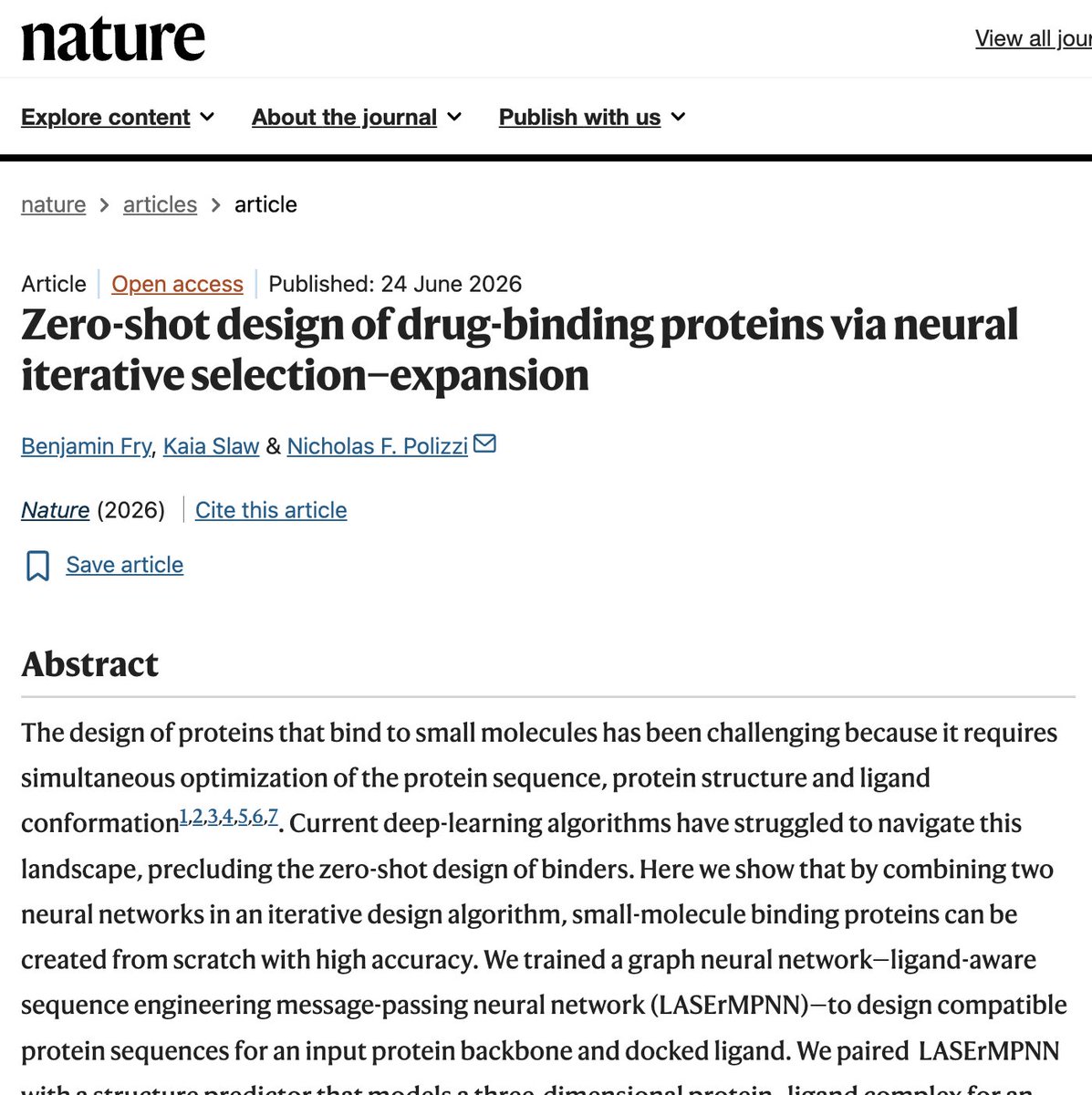
My first-author paper describing our protocol for the zero-shot de novo design of drug-binding proteins is now available as an article in Nature! Here’s what we did and what's new from the preprint posted last year 🧵 (1/10):
15
92
582
47,148
Sergey Ovchinnikov reposted
Our lab website is finally online! pacesalab.com/ You can find information about our research, publications, and on-going developments in the lab.
3
26
182
27,916
🍹Weekend project: I (with help from claude - budget $40), was able to get OpenFold3 weights running inside AlphaFold3 codebase (jax). Works for proteins, ligands, rna/dna (1/3)!
AF3 source code is now open source (aka Apache 2.0)! 😎 Though not the weights... 🙃 github.com/google-deepmind/a…
9
62
397
26,892
Anyone planning to make any money off of this, consider reimbursing my claude bill (core work was $40, rest $40 was mostly cosmetic, trying to get things working in google colab). 😅
3
16
1,737
The Google Colab Notebook now also integrates py2Dmol and the AlphaFold3 official weights (you just need to paste in the download link, it'll work, even if it expired): colab.research.google.com/gi…
3
660
I guess that means it should now be possible to port the openfold3 weights into AF3, for much faster run time! @MoAlQuraishi ?
2
1
21
3,504
Sergey Ovchinnikov reposted
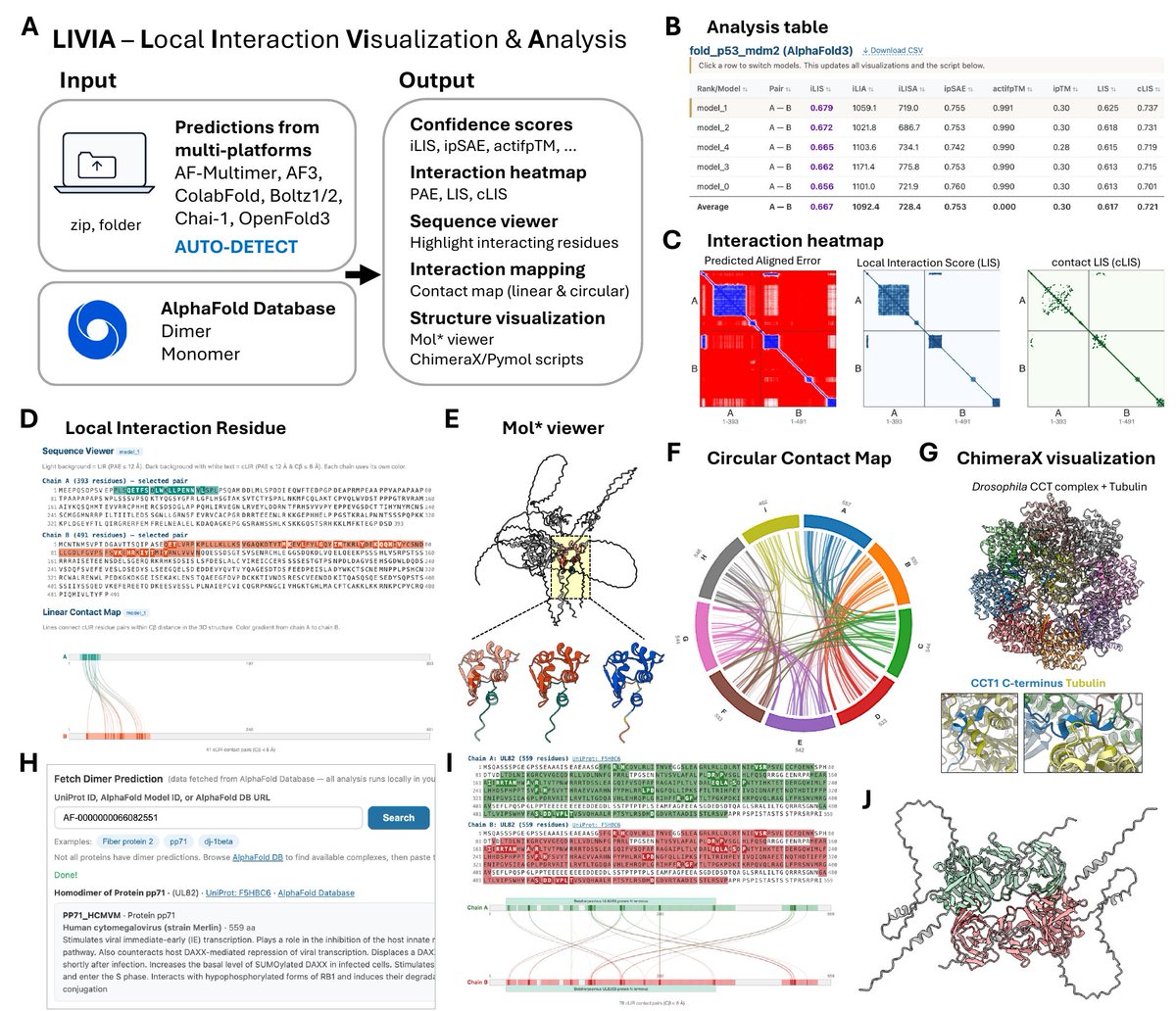
🚀 New tool out! LIVIA (Local Interaction Visualization and Analysis) — a browser-based tool for assessing and visualizing predicted protein-protein interactions. Drop in a prediction from AlphaFold-Multimer, AF3, ColabFold, Boltz-1/2, Chai-1, or OpenFold3 (ZIP or folder, auto-detected) and LIVIA answers the two questions you actually care about: ▸ Do these proteins interact? ▸ Which residues form the interface? What you get: ▸ Interface confidence scores — iLIS (our local metric), ipSAE, actifpTM, ipTM ▸ Interaction interface heatmaps (PAE, LIS, cLIS) ▸ Sequence viewer linear & circular contact maps highlighting Local Interaction Residues (LIR) and contact LIR (cLIR) ▸ Embedded Mol* 3D viewer ▸ Downloadable ChimeraX & PyMOL scripts Also fetches dimers directly from the AlphaFold Database — adding the interface annotations AFDB doesn't provide. Everything runs locally in your browser. No install, no upload. LIVIA started as a personal tool — I built it with Claude Code and used it to make every structure figure in our FlyPredictome preprint (Kim et al., 2026). (Claude Code is truly insane...) Along the way I realized it could be useful for others, too. If you have a favorite color palette for structure visualization, please let me know — happy to add it as a preset 🎨 🔗 LIVIA tool: flyark.github.io/LIVIA 🐍 iLIS / batch CLI: github.com/flyark/AFM-LIS 📄 LIVIA preprint: biorxiv.org/content/10.64898… 📄 FlyPredictome preprint: biorxiv.org/content/10.64898…
5
41
188
42,846
Sergey Ovchinnikov reposted
Characterizing AI-designed proteins requires quantitative biochemistry at massive scale. Enter Amplicon/Protein Bead Display (APB-Display), a fully in vitro platform that quantifies Kd's for >100,000 variants in <3 days (preprint link below!) @Stanford_ChEMH @czbiohub (1/n)
3
98
441
63,312
Sergey Ovchinnikov reposted
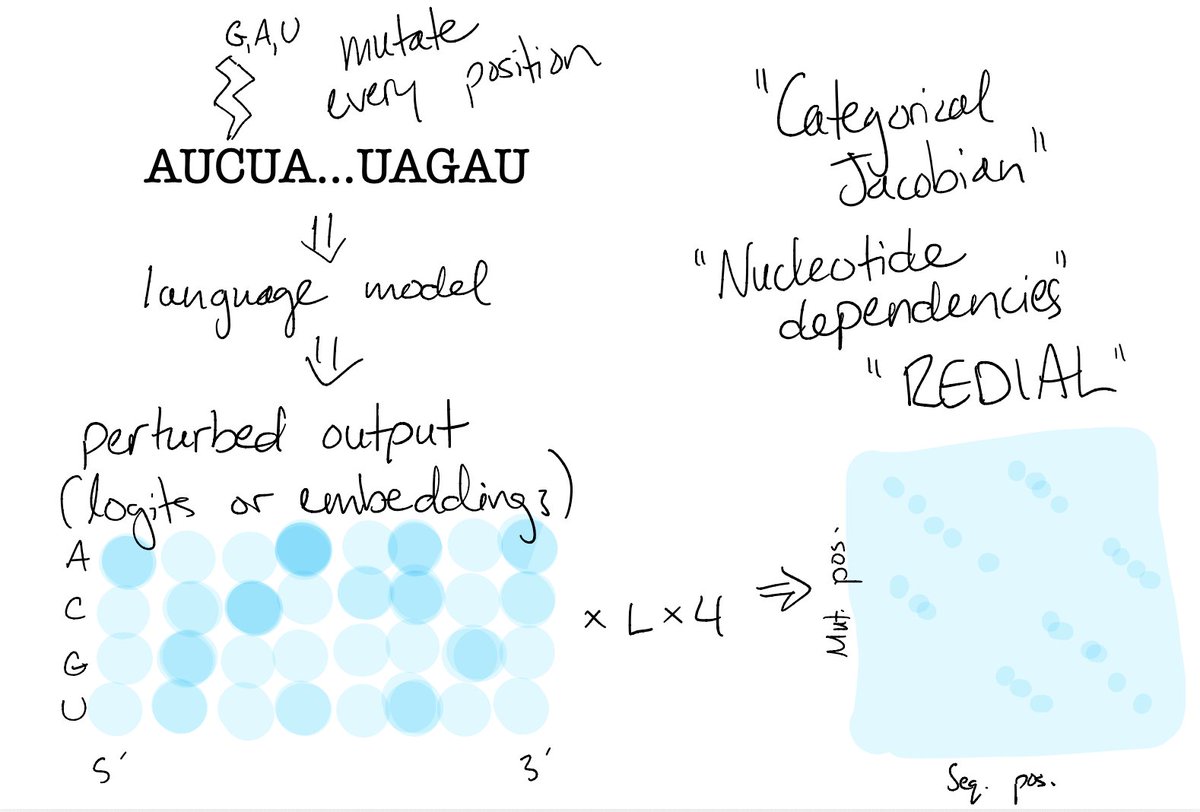
In the W-S lab's first preprint, we describe how genomic language models know something about RNA thermodynamics. Though we think this is cool, things get tricky! A growing practice for interpreting LMs is to perturb input tokens, often called "Categorical Jacobian": 👇
4
28
126
10,868
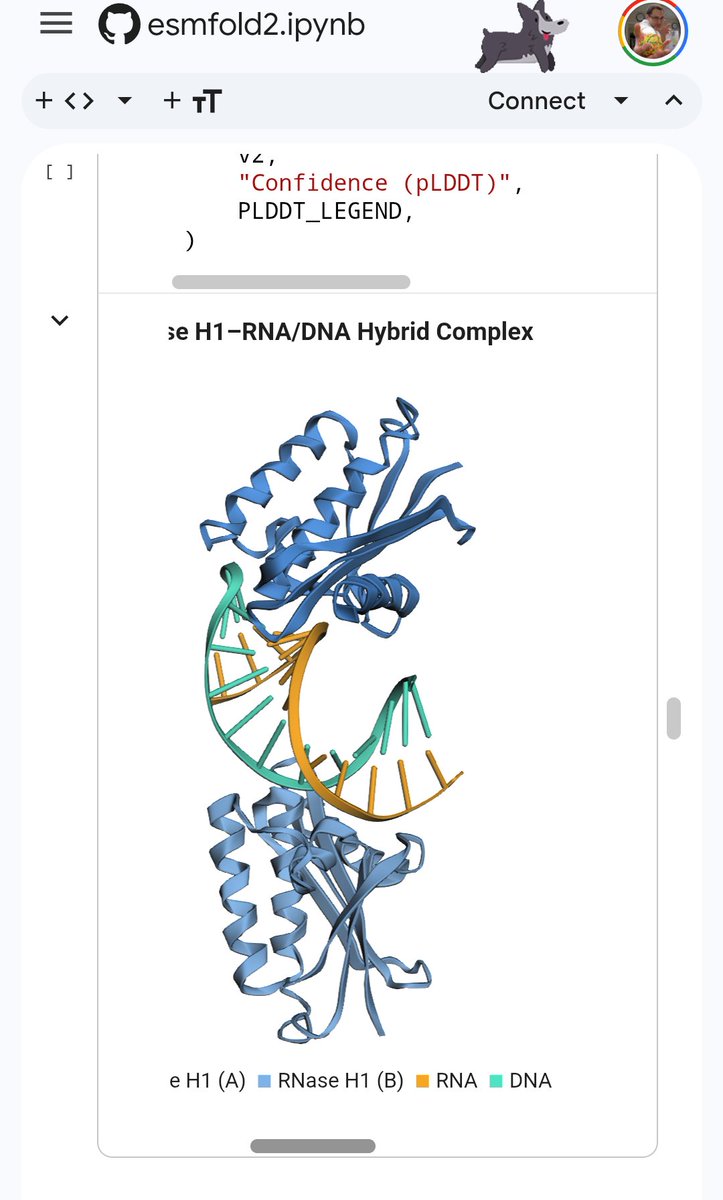
ESMfold2, includes support for protein-protein interactions, DNA/RNA, small molecules. Including colab notebook! colab.research.google.com/gi…
Today we're announcing ESMFold2, an open scientific engine to power prediction, design, and discovery across protein biology. The new model delivers state of the art performance on protein interactions, especially antibodies, a critical modality for therapeutics. We have designed and validated miniprotein binders and single chain antibodies across five therapeutic targets that are important in cancer and immunology. We are seeing very high success rates, and affinities at levels consistent with therapeutic activity. We’re also releasing an atlas of 6.8 billion proteins, and 1.1 billion predicted structures. ESMFold2 is built on a state of the art language model that has been trained on billions of protein sequences. A world model of protein biology emerges through language modeling. We’ve used the techniques of mechanistic interpretability developed to understand large language models to understand the concepts ESM uses to represent proteins. The model’s representation space has a compositional organization of features across scales, levels of complexity, and abstraction, that reflects and mirrors the understanding of protein biology developed through a century of empirical science. This understanding emerges without prior knowledge, just from language modeling of protein sequences. Language models are becoming a powerful substrate to understand and program biology. The design of protein interactions is one of the most fundamental problems in biophysics, and has critical implications for the discovery of new medicines. A simple gradient based search with the model was able to discover high-affinity protein binders. I'm excited by the potential this has to accelerate basic science and the understanding of proteins. And especially for the new avenues it opens up for therapeutic design and medicine.
8
72
443
26,597
Sergey Ovchinnikov reposted
Today we're announcing ESMFold2, an open scientific engine to power prediction, design, and discovery across protein biology. The new model delivers state of the art performance on protein interactions, especially antibodies, a critical modality for therapeutics. We have designed and validated miniprotein binders and single chain antibodies across five therapeutic targets that are important in cancer and immunology. We are seeing very high success rates, and affinities at levels consistent with therapeutic activity. We’re also releasing an atlas of 6.8 billion proteins, and 1.1 billion predicted structures. ESMFold2 is built on a state of the art language model that has been trained on billions of protein sequences. A world model of protein biology emerges through language modeling. We’ve used the techniques of mechanistic interpretability developed to understand large language models to understand the concepts ESM uses to represent proteins. The model’s representation space has a compositional organization of features across scales, levels of complexity, and abstraction, that reflects and mirrors the understanding of protein biology developed through a century of empirical science. This understanding emerges without prior knowledge, just from language modeling of protein sequences. Language models are becoming a powerful substrate to understand and program biology. The design of protein interactions is one of the most fundamental problems in biophysics, and has critical implications for the discovery of new medicines. A simple gradient based search with the model was able to discover high-affinity protein binders. I'm excited by the potential this has to accelerate basic science and the understanding of proteins. And especially for the new avenues it opens up for therapeutic design and medicine.

75
452
1,623
608,148
Sergey Ovchinnikov reposted
New preprint from the lab ! In short - nobody told the model what a stem-loop was, we gave it 50,000 IRES sequences and one job: predict masked nucleotides. That’s it! Albatross is an RNA language model that taught itself the structural logic of viral RNA the same way LLMs learn grammar- from sequence alone. No base pairing rules, no thermodynamics, no structure labels. Check it out-biorxiv.org/content/10.64898… and albatrossrna.org
9
28
204
48,615