🇨🇦 | ai for bio | cs phd @berkeley_ai | prev @bighatbio, @mcgillu

Joined December 2019
7 Photos and videos
Pinned Post
Antibody LMs learn what looks antibody-like, but not how selection turns naive germline antibodies into strong binders. @aakarshv1 and I are excited to share CoSiNE, a model that learns this germline-to-mature process for variant effect prediction and antibody design. (1/8)
8
51
228
45,653
Heading to ICML! ✈️ @aakarshv1 and I will be presenting this work on Thursday during poster session 8. Come say hi at poster #808!
Antibody LMs learn what looks antibody-like, but not how selection turns naive germline antibodies into strong binders. @aakarshv1 and I are excited to share CoSiNE, a model that learns this germline-to-mature process for variant effect prediction and antibody design. (1/8)
3
24
2,757
Stephen Lu @ ICML reposted
Affinity maturation is how naive antibodies evolve into strong binders, but most antibody LMs ignore it. @stephenzlu and I built CoSiNE to learn this, beating antibody LMs on VEP and reframing design as guiding evolution, not de novo generation. Excited to present at ICML!
Antibody LMs learn what looks antibody-like, but not how selection turns naive germline antibodies into strong binders. @aakarshv1 and I are excited to share CoSiNE, a model that learns this germline-to-mature process for variant effect prediction and antibody design. (1/8)
1
7
44
5,180
Huge thanks to my coauthors @aakarshv1 , @koheisanno , @jiarlu , @ematsen , @milind_jagota , and @yun_s_song ! We will be presenting at ICML. Preprint: arxiv.org/abs/2602.18982 Code: github.com/thematrixmaster/c… Blog: songlab-cal.github.io/cosine (8/8)
2
3
13
1,071
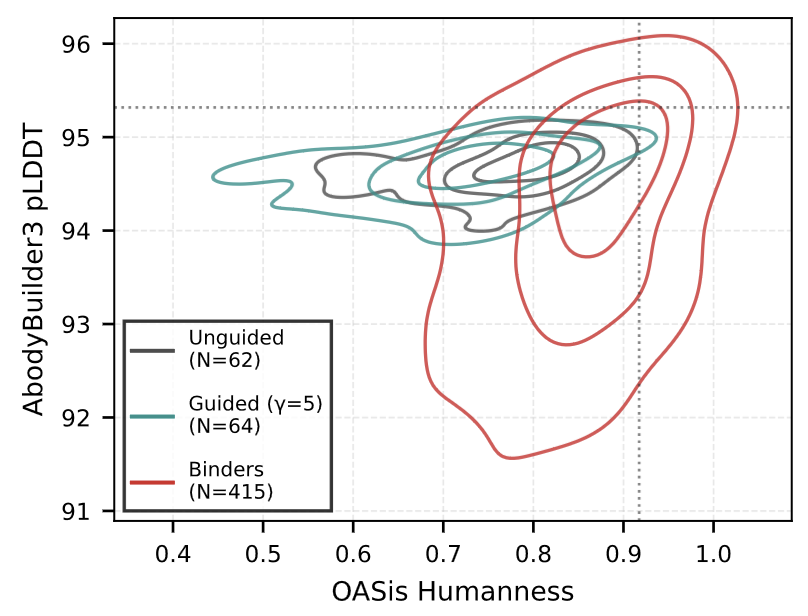
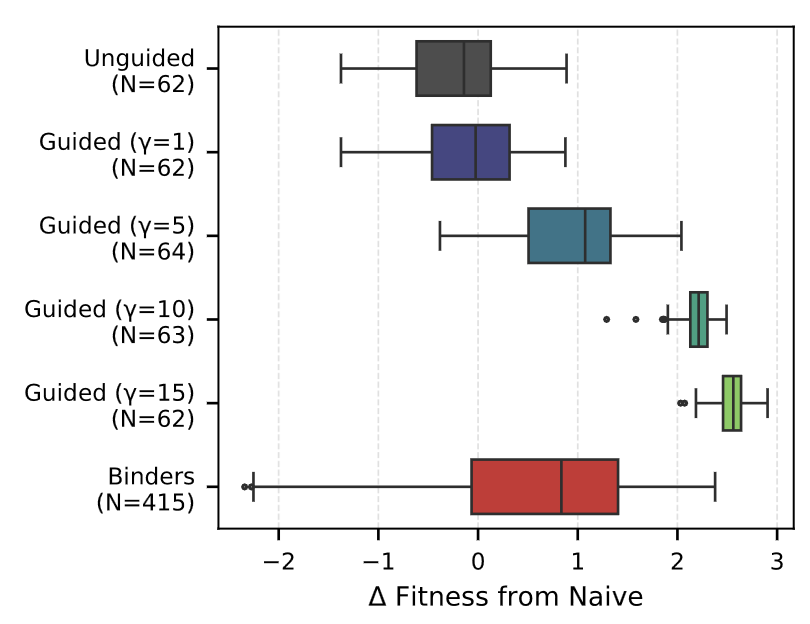
The resulting samples remain structurally plausible and human-like. We think this is a promising step toward controllable evolutionary protein design: not just generating sequences de novo, but guiding the processes that produce them. (7/8)
2
1
6
977
We also explore CoSiNE as a design model. With predictor guidance sampling, we steer simulated maturation trajectories toward desired properties at inference time, biasing evolution toward antibodies with higher predicted affinity for specific antigens. (6/8)
1
5
748
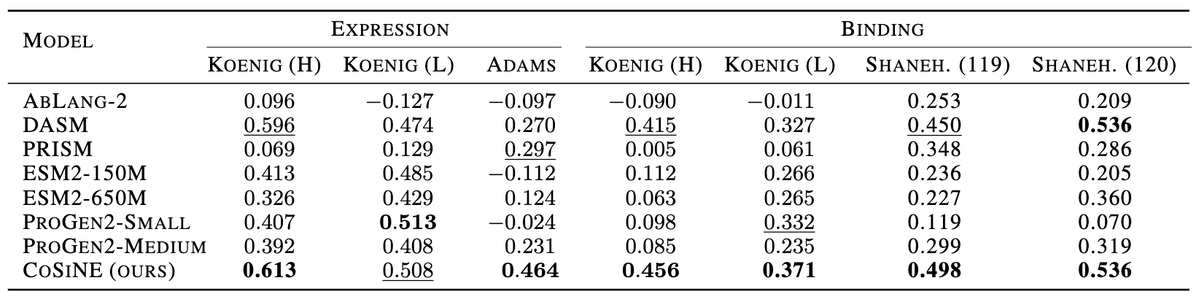
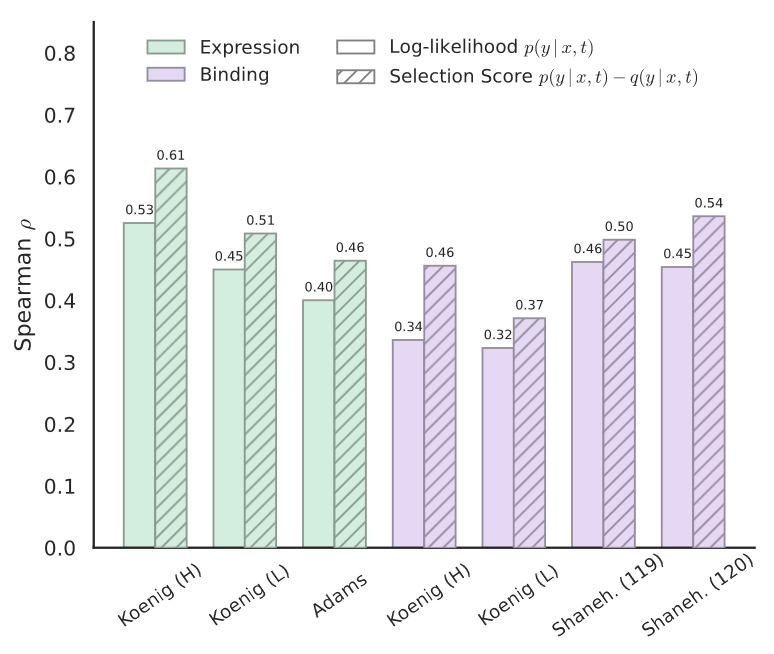
Importantly, our selection score beats strong antibody and protein LM baselines on zero-shot antibody VEP across binding and expression datasets. This suggests that learning germline-to-mature evolution adds signal beyond antibody-likeness alone. (5/8)
1
4
742
CoSiNE achieves this by comparing two likelihoods: How likely is a mutation under the learned maturation model? How likely is it under neutral SHM? The difference gives a selection score: enrichment beyond mutation bias. This improves VEP over transition likelihood. (4/8)
1
4
822
A key challenge is that antibody evolution mixes two signals. Some mutations are frequent because they are likely under somatic hypermutation. Others occur because the antibodies carrying them are favored by selection. For VEP & design, we want to separate these effects. (3/8)
1
7
868
Traditional antibody language modeling assumes sequences are i.i.d. — ignoring the time-dependent process of affinity maturation. To address this, CoSiNE explicitly models transitions: how likely is a mature antibody y to arise from a germline precursor x over time t? (2/8)
1
15
1,050
Stephen Lu @ ICML reposted
Today we're announcing ESMFold2, an open scientific engine to power prediction, design, and discovery across protein biology. The new model delivers state of the art performance on protein interactions, especially antibodies, a critical modality for therapeutics. We have designed and validated miniprotein binders and single chain antibodies across five therapeutic targets that are important in cancer and immunology. We are seeing very high success rates, and affinities at levels consistent with therapeutic activity. We’re also releasing an atlas of 6.8 billion proteins, and 1.1 billion predicted structures. ESMFold2 is built on a state of the art language model that has been trained on billions of protein sequences. A world model of protein biology emerges through language modeling. We’ve used the techniques of mechanistic interpretability developed to understand large language models to understand the concepts ESM uses to represent proteins. The model’s representation space has a compositional organization of features across scales, levels of complexity, and abstraction, that reflects and mirrors the understanding of protein biology developed through a century of empirical science. This understanding emerges without prior knowledge, just from language modeling of protein sequences. Language models are becoming a powerful substrate to understand and program biology. The design of protein interactions is one of the most fundamental problems in biophysics, and has critical implications for the discovery of new medicines. A simple gradient based search with the model was able to discover high-affinity protein binders. I'm excited by the potential this has to accelerate basic science and the understanding of proteins. And especially for the new avenues it opens up for therapeutic design and medicine.
75
452
1,623
608,148
Stephen Lu @ ICML reposted
First AI-generated RNA with novel atomically ordered 3D fold! With @eternagame @StanfordBiochem @chaitjo @PossuHuangLab @UWproteindesign @ShujunHe0717 @navtejtoor @HHMIJanelia on bioRxiv doi.org/10.64898/2026.05.21.…
2
58
271
28,456
Stephen Lu @ ICML reposted
I'm excited to share our ICLR paper on how leveraging decomposability can enable more efficient scientific design, with @jlistgarten and @svlevine. We were motivated by protein design in particular. Check out the blog post: james-bowden.github.io/dado/.
1
18
106
58,778
Stephen Lu @ ICML reposted
Can we simulate realistic evolutionary trajectories and “replay the tape of life”? In this work, we propose a flexible, generalizable framework for modeling how the entire protein seq evolves over time while capturing complex interactions across sites. 1/n doi.org/10.64898/2026.02.19.…
5
82
288
34,197
Stephen Lu @ ICML reposted
SimpleFold: Folding Proteins is Simpler than You Think "we introduce SimpleFold, the first flow-matching based protein folding model that solely uses general purpose transformer blocks. Protein folding models typically employ computationally expensive modules involving triangular updates, explicit pair representations or multiple training objectives curated for this specific domain. Instead, SimpleFold employs standard transformer blocks with adaptive layers and is trained via a generative flow-matching objective with an additional structural term."
30
135
1,277
287,297
Stephen Lu @ ICML reposted
This is truly an incredible breakthrough IMO. Really exemplifies what you get when deep domain expertise (population/disease genetics in this case) fuses with cleverly crafted ML. What u get r sleek, well thought out architectures that absolutely destroy the behemoths. Wow!! 1/
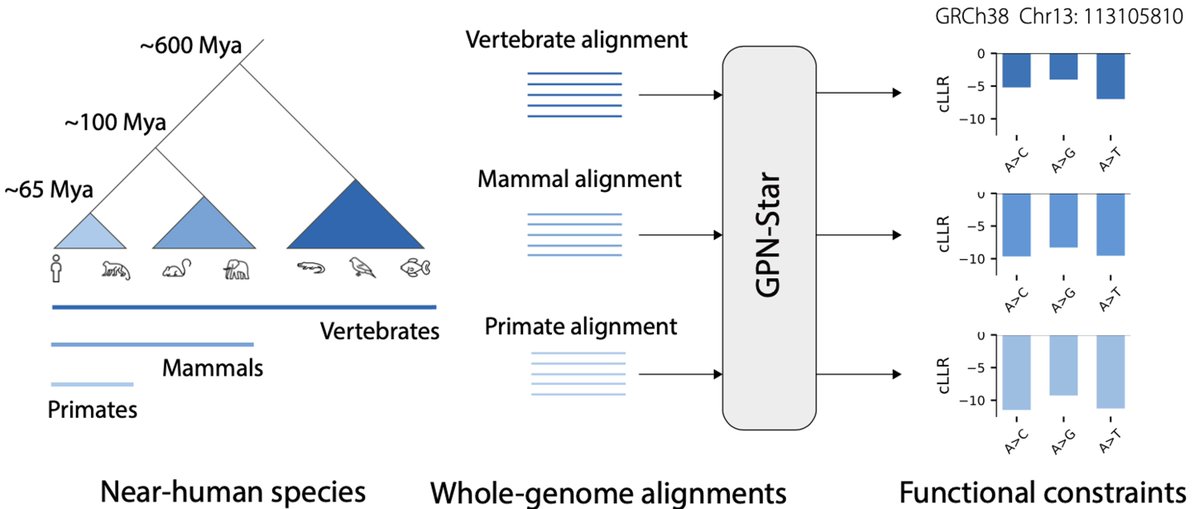
We are excited to share GPN-Star, a cost-effective, biologically grounded genomic language modeling framework that achieves state-of-the-art performance across a wide range of variant effect prediction tasks relevant to human genetics. biorxiv.org/content/10.1101/… (1/n)
4
36
257
36,402
Stephen Lu @ ICML reposted
We are excited to share GPN-Star, a cost-effective, biologically grounded genomic language modeling framework that achieves state-of-the-art performance across a wide range of variant effect prediction tasks relevant to human genetics. biorxiv.org/content/10.1101/… (1/n)
17
162
529
86,389
Stephen Lu @ ICML reposted
📢We are excited to share SynCoGen—the first generative model that co-generates 🔷building-block graphs,🔷reaction edges and 🔷full 3-D coordinates, so every molecule comes with both a synthesis plan and a physically plausible shape.
3
24
161
14,654
How close are we to an AI scientist that can make novel biological discoveries? Our recent work benchmarks key experimental abilities of frontier LLMs using insights from systems biology. We find that agents struggle at manipulating complex systems at scale ⬇️
What makes a great scientist? Most AI scientist benchmarks miss the key skill: designing and analyzing experiments. 🧪 We're introducing SciGym: the first simulated lab environment to benchmark #LLM on experimental design and analysis capabilities. #AI4SCIENCE #ICML25
3
274
Original paper: arxiv.org/pdf/2506.09018 My codebase: github.com/TheMatrixMaster/e… Thanks for the awesome work! @HavasiMarton @ItaiGat @RickyTQChen (2/2)
2
318