Assistant Professor @ Seoul National University; machine learning for protein structure/interaction prediction & design

Joined July 2010
8 Photos and videos
Pinned Post
AI can now design antibodies that bind with atomic precision, but not ones that cells can produce. Our preprint closes this gap, delivering a structural principle, an AI-guided rescue pipeline, and adalimumab variants with 20-100x in vivo potency. biorxiv.org/content/10.64898…
8
38
197
11,456
The landscape also harbors rare positive-epistasis peaks. Two adalimumab variants from one peak gave 20-100x dose reduction in a psoriasis mouse model. The mechanism: not equilibrium affinity but a >25-fold extension of antibody-antigen residence time. 6/
2
595
This means productivity liabilities can be diagnosed structurally, then fixed. Combining ProteinMPNN with AlphaFold3, we rescued 11/14 high-affinity, low-productivity clones, each with a single residue swap, without losing binding. 5/
5
495
To test this quantitatively, we mapped a 9,517-variant adalimumab fitness landscape and scored every clone with ProteinMPNN, a generic inverse-folding model with NO antibody-specific training. It predicts the experimental productivity landscape at Pearson r = 0.75. 4/
2
533
Deep mutational scans of 10 therapeutic antibodies (5,832 substitutions) revealed something unexpected: buried CDR residues affect productivity in a depth-dependent manner, just like globular proteins (GRB2, KRAS, PSD95, RBD). CDRs aren't passive loops. They fold. 3/
2
626
Why hasn't this been mapped? Existing tools force a tradeoff between throughput (library display, binary readouts) and biophysical precision (SPR, DSF — tiny scale). SPID delivers both: KD, productivity, & Tm for 1000s of unpurified antibody variants per week. 2/
1
5
1,114
Minkyung Baek reposted
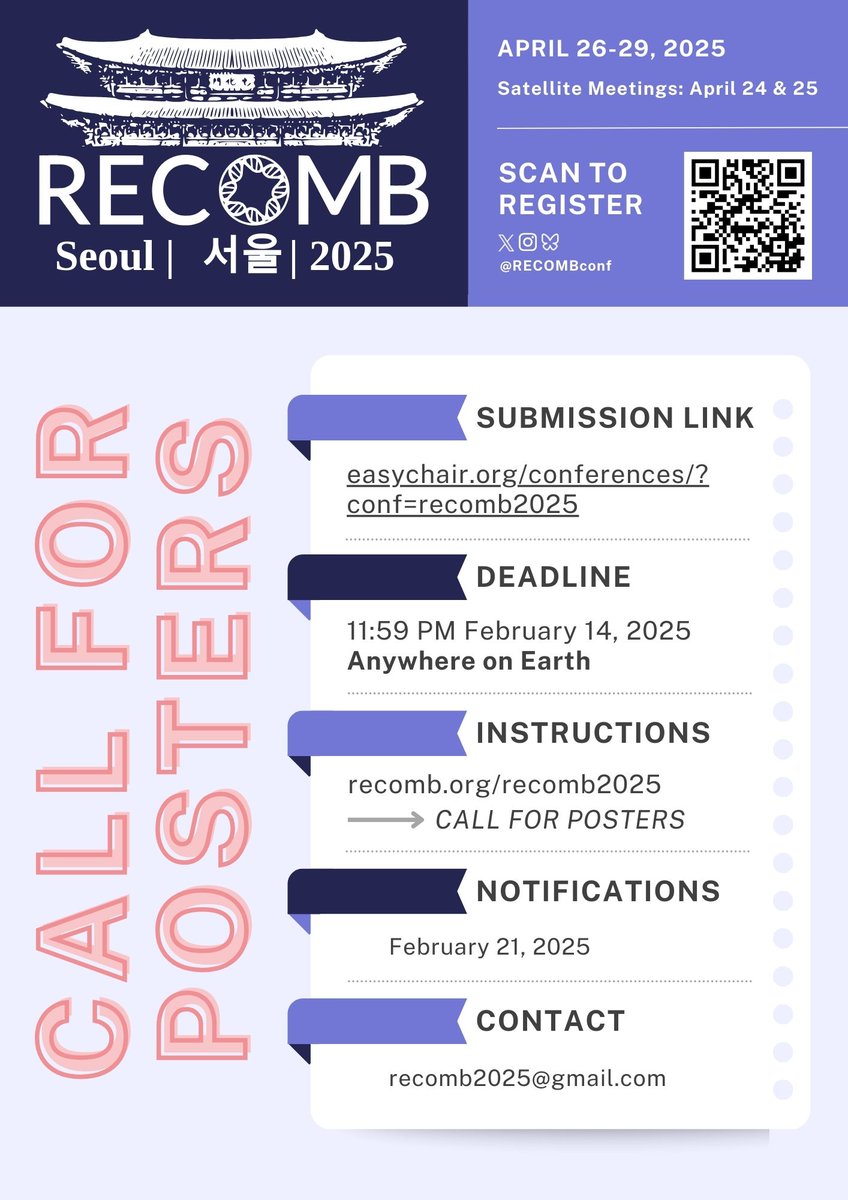
The deadline for Poster Submissions is TODAY! Submit your abstract now: recomb.org/recomb2025/call_f… #RECOMB2025
6
9
1,531
Minkyung Baek reposted
Today is your final chance to submit to the Highlights and Posters tracks! Take a look at what awaits you in Seoul: youtube.com/watch?v=d95A1xJ4…
3
6
3,645
Minkyung Baek reposted
📌 Registrations for #RECOMB2025 are now open! 📌 Visit recomb2025.com for details. The early registration deadline is March 15, 2025.
1
11
13
4,400
Minkyung Baek reposted
[Breaking] Assembly passed motion to revoke martial law
3
608
974
92,374
Minkyung Baek reposted
Excited to join the Gene Center at LMU @GeneCenter_LMU @LMU_Muenchen as a professor, looking forward to design some cool and unusual de novo proteins here!
🥳 We welcome Lukas Milles as new group leader🤗🤗! Since July 2024, he's leading an Emmy Noether Research Group at MPI Biochemistry, now also affiliated with us! 💻🧪 His work focuses on protein design, deep learning & biophysics. genzentrum.uni-muenchen.de/r… @LFMilles @MPI_Biochem
3
16
95
12,377
Minkyung Baek reposted
📅 #RECOMB2025 is accepting submissions! Key deadlines: 🔹 Abstract registration: Oct 16, 2024 🔹 Full paper submission: Oct 25, 2024 Submit soon to be a part of this great conference! 📌More info: t.ly/rsT0l
9
16
3,531
Great description on how BakerLab works! BakerLab is the most collaborative place I've ever worked. The most striking moment when I first joined the BakerLab in 2019: David had his own deep learning project while he had lots of 1:1 meetings to everyone (~100 people) in the lab.
With David and the Baker Lab in the spotlight today, I wanted to share some insights into the @UWproteindesign and how it operates, a glimpse behind the curtain. I had planned to write this post-graduation, but now seems as good a time as any. (Got twitter blue free trial so this could all fit in less tweets!) First, the lab is enormous. ~60 grad students, ~60 postdocs, a handful of visitors, undergrads, and a surrounding institution of another 150 or so. Collaboration is strongly encouraged (even mandated) by David, who sets up pro-collaboration incentives. Notably, he's fine with grad students graduating without a sole first-author paper—it's acceptable to "only" have worked as a co-first author. This is a key ingredient in the secret sauce: the tight collaboration between wet lab and dry lab. It ensures that all our work is ultimately grounded in strong wet-lab validation—our "oracle" is the real world, not another computational model. While we have regular meetings for different subgroups and the entire group, much information travels through the lab via informal one-on-one interactions. In some ways, it reminds me of a classic "tribe of humans in the state of nature"—100-200 people with no clear hierarchy, passing information via "gossip". It’s maybe not the most complete way of ensuring everyone is on the same page, but saves time as we aren’t drowning in endless meetings. Does David stay in touch with all these grad students and post-docs? Remarkably, yes. Unlike some very large labs known for being run entirely by post-docs, he knows exactly what everyone is working on and the stage of their projects. Each member has monthly one-on-ones with him, and monthly subgroup meetings that David attends. If he suggests you try something at your previous one-on-one, you'd better have it done by the next. Does he actually contribute research ideas, or is he more of a detached big-picture project manager? Definitely the former. He understands the intricacies of a shocking range of topics. I'll be discussing some arcane deep learning concept with him, and then he'll turn around and talk to someone about the details of a catalytic mechanism. He's actually the most hands-on PI I've ever had—if anything, he verges on over-managing rather than being too detached. How does he keep track of everything? Partly, he's just a brilliant person with exceptional recall. But he has also built infrastructure above and below him in the lab to handle many of the details, bureaucracy, big picture, and management tasks. This allows him to spend most of his day doing what he's most passionate about and skilled at: walking around talking to people about science. He also lives very much in the moment and in his own words, “never thinks very far ahead". To keep up with tools, methods, and wet lab techniques, he does the occasional project and design campaign himself on the side when time allows. It's still a tremendous cognitive load to keep all this in his head, but as much as possible, he has offloaded non-scientific cognitive burdens. It helps that he’s in the lab in person most days of the year, rarely traveling for conferences or talks, instead doing them over Zoom or not attending. (1/2).
1
4
37
2,468
Minkyung Baek reposted
Last chance to submit! #RECOMB2025
1
7
13
2,024
Minkyung Baek reposted
These laureates are VERY deserving. But an important addendum—no model could be trained without 40 years of Helen Berman and others’ work at the PDB, and we would not be certain of AF’s success without 30 years of John Moult and others’ work on CASP. Hats off to them as well 🥂
BREAKING NEWS The Royal Swedish Academy of Sciences has decided to award the 2024 #NobelPrize in Chemistry with one half to David Baker “for computational protein design” and the other half jointly to Demis Hassabis and John M. Jumper “for protein structure prediction.”
19
180
1,145
85,387
Amazing news!! Congratulations David @UWproteindesign!! It was my great honor to work together. Congratulations @demishassabis and John as well!
BREAKING NEWS The Royal Swedish Academy of Sciences has decided to award the 2024 #NobelPrize in Chemistry with one half to David Baker “for computational protein design” and the other half jointly to Demis Hassabis and John M. Jumper “for protein structure prediction.”
28
1,012
Minkyung Baek reposted
#RECOMB2025 deadline is approaching and we'd love to see your best work! 🗓️ Abstract registration: Oct 16, 2024 🗓️ Full paper submission: Oct 25, 2024 📜 CFP: recomb.org/recomb2025/call_f…
4
12
4,334
Big shout out to @jzhang_genome, @IanRHum, Jimin Pei, Qian Cong!!
1
561