Joined November 2013
111 Photos and videos
Joshua Teperowski Monrad reposted
Don’t let AI lab folk trick you into thinking that (1) joining the nth dozen equivalently senior people at an AI lab is more important than (2) filling a unique C-suite slot at a nonprofit or government safety group!
The hardest roles to fill in the AI safety ecosystem seem to be: - Senior executives (CEO, COO, etc.) - Research leads (Chief Scientist, Scientific Director, etc.) - Program Manager or other roles for "highly competent generalists with strong AI safety knowledge and connections"
2
9
73
6,298
Joshua Teperowski Monrad reposted
An interesting argument in the "AI as normal technology" view is that many important skills may plateau near top-human level because the world contains irreducible uncertainty. Maybe you can't be 100x better than Nate Silver at election modeling. We should get a good test of this hypothesis in the next year or two as AI forecasting efforts scale.
New from Scott Alexander: "The AI Superforecasters Are Here" astralcodexten.com/p/the-ai-…
23
30
390
48,827
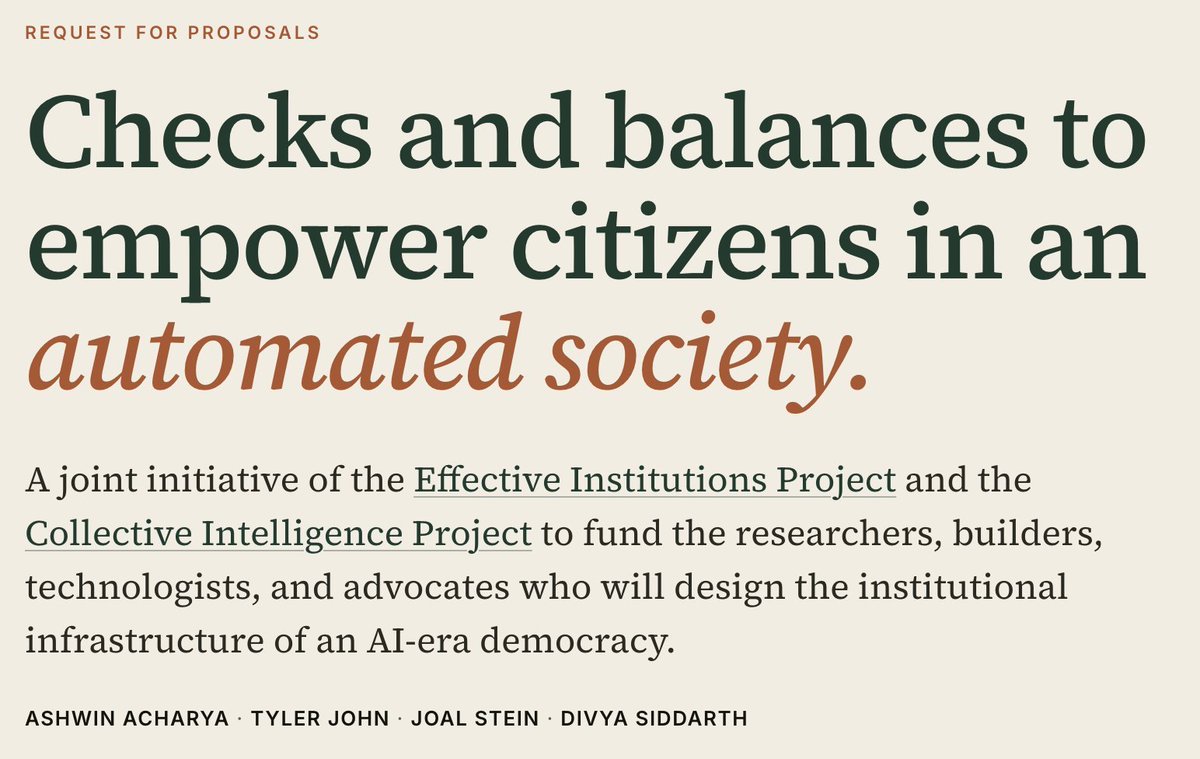
Visit the beige micro site, go save democracy with @divyasiddarth @tyler_m_john
Lots of ways that the default path of AI development marches towards power concentration, and a lot of possible solutions are pretty mixed. For example - the US gov gets 5% stake in AI companies, more economic redistribution leverage but bad incentive overlap between the state and super-powerful AI companies. Or, broadening access to the frontier is v good for avoiding domination but could give bad actors the ability to consolidate power, etc. Tons of thinking and work to do here and excited to be supporting it through this RFP with the incredible EIP CIP teams, esp Ashwin, @tyler_m_john, and @JoalStein. Can’t believe it’s taken me this many years in AI to co-author a beige microsite. More soon!
1
4
354
Joshua Teperowski Monrad reposted
These surveys from @Research_FRI are an amazing public service. But so funny to me how they keep getting overtaken by events.
4️⃣ Experts and superforecasters give a 50% chance that a major government restricts an AI release by 2030 We asked for the year by which the U.S., UK, or EU governments would delay, seriously restrict, or condition the public release of an AI system on safety grounds. Experts and superforecasters gave a median prediction of 2030, while the public predicted a slightly later date, 2032. The current export-control directive suspending access to Anthropic's Mythos 5 and Fable 5 models doesn't meet our resolution criteria, as these models were already publicly available before the directive was issued. We will monitor news surrounding GPT-5.6 and related models to see if near-term government actions meet the criteria.
10
93
8,912
Joshua Teperowski Monrad reposted
The thing is, with exponential-or-faster processes, there are in practice only two possible times you can react: too early, and too late
20
52
676
40,301
Joshua Teperowski Monrad reposted
I asked a few people: "who are the best people to follow on X for AI bio?" Protein, molecule & biologics design: @JohnJumperSci @sokrypton @GabriCorso @MartinPacesa @ferruz_noelia @DdelAlamo @HannesStaerk @MoAlQuraishi @pranamanam @KevinKaichuang AI / foundation models for bio & genomics: @BrianHie @owl_posting @exnx @btnaughton @anshulkundaje @AnimaAnandkumar @nmboffi @andrewwhite01 @JCoolScience Biosecurity & pandemic preparedness: @jtmonrad @JanikaSchmitt @ClaireQureshi @JassiPannuMD @T_Inglesby @JacobSwett @OliviaHelens @nanransohoff @incredutility AI security, policy & what to expect: @lucafrighetti @dylanscandinaro @logangraham @peterwildeford Builders, writers & investors: @NikoMcCarty @p_maverick_b @erika_alden_d @dr_alphalyrae Thanks to @arturszalata, @gottapatchemall and @JonasSandbrink for suggestions
19
39
325
38,287
Feeling hopeful about the potential of Nan and Charlie's program –– for knocking out common colds, and for building broad-spectrum/pathogen-agnostic tech that stands a chance against engineered biothreats (And feeling very good about @FoundationOAI's support here!)
Today we're launching Intercept: a $500M philanthropic initiative to make respiratory infections, like the common cold and flu, a thing of the past. We treat respiratory infections as a minor nuisance, but that’s really not the case. Most of us will spend 5% of our lives (!) sick from these viruses, they kill 1M people a year, cost $600B annually in productivity, and periodically threaten civilization through pandemics. So, if they’re such a big problem, why haven’t we dealt with them yet? Last year we convened ~40 leading scientists, pharma R&D leaders, biotech investors, and regulatory experts to better understand that. We heard two main reasons: (1) First, it’s just technically very challenging: respiratory viruses represent hundreds of distinct, mutating strains across several families. Fortunately, recent breakthroughs make this newly possible. (2) Second is a lack of funding: broad-spectrum solutions have historically been underfunded, in part because they’re not a great fit for most philanthropic or commercial funding (and while COVID generated a burst of activity around preventing and understanding respiratory infections through an influx of new funding, that hasn't been sustained). We think that with enough focus and funding, this might be solvable. Intercept is a $500 million philanthropic initiative that will take advantage of new tools to catalyze the development and deployment of two types of products: broad-spectrum preventatives and air cleaning technologies. This problem is undoubtedly difficult. But it’s more tractable now than it’s ever been. We think we should give it our best shot. We’re enormously grateful to our anchor funders: @stripe, @AnthropicAI, @TheFluLab, @FoundationOAI and individuals from Jane Street. And, I’m very excited to be building this with @incredutility and the rest of the team.
1
22
1,302
Joshua Teperowski Monrad reposted
Twitter community, I would like you to perform a public service. Please take a moment to calibrate how unhinged Dean’s posting has been. Now, resolve that you will dunk on his ass if he lets incentives make him noticeably less unhinged. Dean, we’re watching, and rooting for you.
I am pleased and honored to announce that, on July 6, I'll be joining @OpenAI as leader of a new team called Strategic Futures. Our mandate will be to help the company's leadership shape frontier AI policy. There is a ton of work to do, and I'm excited to get started.
9
12
338
34,934
Joshua Teperowski Monrad reposted
I think frontier labs are getting better at hiring more bio folks, especially given the focus on life sciences going forward. But there's still a *lot* more room to absorb such talent. However I don't agree with the take that bio talent being proportionally low is the reason why orgs like Anthropic have overcorrected towards safety guardrails. Having worked on infrastructure for biosecurity and pandemic prevention myself for past few years, can only echo that potential risks from engineered pandemics is extremely high, even in a low probability scenario. Sure, the calibration on access for good vs bad research will continue to get better (it's a really hard one to get right especially when it feels like the sands are constantly shifting with new model releases between competitors). But I'm glad that at labs are taking this responsibility seriously, so they can continually improve on this balance through real life feedback from range of stakeholders. I also wanna echo how impressed I've been by the thoughtful and competent bio researchers leading red-teaming efforts both inside frontier labs and externally at institutes like @AISecurityInst. A lot of great work is going into maximising public benefit whilst minimising harm.
The reason frontier AI companies are struggling to find the right balance between biosec and usefulness is because there aren’t enough competent bio ppl in these rooms. Longterm that will hurt biosec efforts.
1
1
2
397
Joshua Teperowski Monrad reposted
This is the most important week in the history of animal welfare: if the Save Our Bacon Act passes, not only will it kill the most impactful welfare-related laws of the past decade, it will also restrict any future progress. The Senate is currently deciding whether to add the SOB Act to the Farm Bill, so if you care about this stuff but have been waiting for the right moment to help, this is that moment. If you want to fight this and can donate six figures or more, please DM me or Dwarkesh. --- In case it's helpful context, the SOB Act aims to block states from deciding their own laws about animal products sold within their borders. This is massive federal overreach. But the meat industry supports it because they haven't been able to stop state-level ballot measures. Take California’s prop 12. When it passed in 2018, it banned the sale of pork from pigs kept in gestation crates, where they live in forced confinement for years without ever once being able to turn around (read Dwarkesh's tweet for a more detailed and horrifying description). The industrial pork lobby fought prop 12 hard, and once it passed, they poured money into getting it struck down. They even brought it to the Supreme Court, where it was upheld. So the pork lobby pivoted and now they're focusing on getting the SOB Act passed. If it passes, it would immediately unwind prop 12 alongside a bunch of other important state-level laws. I want to spend the next decade building on the momentum of victories like prop 12, not just relitigating the same bills we spent the 2010s fighting for. That’s only possible if the Farm Bill passes without the SOB Act.
In medieval times, within the arms race of ever more demonic torture devices, some sadistic genius came up with the idea of the Little Ease. This was a prison cell built so small in every dimension that a grown man could not stand upright in it nor lie down at full length nor properly sit. The pain is relentless and without relief and inflicted by one's own body. Prisoners were known to go insane within a few days. A stay at the Little Ease was considered even more cruel than the rack, the thumbscrew, and the other ghoulish machinery of the Tower of London. A breeding pig will spend her whole life in a version of that box. These are social, roaming creatures (more intelligent than dogs) who will never leave this corset of steel. They have been selectively bred to be bigger than their frames can support. Yet we put them in cells so confined that they cannot comfortably sit, and their attempts to do so (for example, by sneaking their limbs into adjacent stalls) reliably lead to fractures and sprains. They cannot sweat, yet have nothing to roll around in to cool themselves off. Except their own manure, which (contrary to the common misconception) they are so averse to (thanks to their strong sense of smell) that new sows will often suffer from constipation to avoid soiling the space from which they eat and sleep. Here is how the writer Matthew Scully described what saw at one of Smithfield’s “gestation barn”: > “Sores, tumors, ulcers, pus pockets, lesions, cysts, bruises, torn ears, swollen legs everywhere. Roaring, groaning, tail biting, fighting, and other “Vices,” as they’re called in the industry. Frenzied chewing on bars and chains, stereotypical “vacuum” chewing on nothing at all, stereotypical rooting and nest building with imaginary straw. And “social defeat,” lots of it, in every third or fourth stall some completely broken being you know is alive only because she blinks and stares up at you … creatures beyond the power of pity to help or indifference to make more miserable, dead to the world except as heaps of flesh into which the [insemination] rod may be stuck once more and more flesh reproduced.” — The Save Our Bacon Act is trying to unroll the few state protections we have against this barbaric cruelty - for example California’s Prop 12 - which banned the sale of pork from pigs kept in gestation crates. It’s incredibly important we don’t end up with this sort of federal preemption. SOB will not only kill the most important animal welfare related laws in the US of the past decade, but more importantly, it will also restrict ALL future legislative progress (aka how the animal welfare movement has gotten its biggest wins). The Senate is currently deciding whether to add the SOB Act to the Farm Bill. With relatively little money now, we can discourage the most pivotal senators in the Ag committee from backing this amendment. Defeating this bill is even more important given the amount of philanthropic funding I expect to come online in the next year or two. It will plausibly be over 10x more expensive to repeal SOB than to prevent it from passing in the first place. All that money that could be spent transforming our society's relationship to mass animal suffering will instead have to be spent just getting us back to where we are right now. That's why money spent now fighting this bill (and I mean right NOW) is so effective. If you’re in a position to donate six figures, please DM me.
5
79
349
48,858
Joshua Teperowski Monrad reposted
In medieval times, within the arms race of ever more demonic torture devices, some sadistic genius came up with the idea of the Little Ease. This was a prison cell built so small in every dimension that a grown man could not stand upright in it nor lie down at full length nor properly sit. The pain is relentless and without relief and inflicted by one's own body. Prisoners were known to go insane within a few days. A stay at the Little Ease was considered even more cruel than the rack, the thumbscrew, and the other ghoulish machinery of the Tower of London. A breeding pig will spend her whole life in a version of that box. These are social, roaming creatures (more intelligent than dogs) who will never leave this corset of steel. They have been selectively bred to be bigger than their frames can support. Yet we put them in cells so confined that they cannot comfortably sit, and their attempts to do so (for example, by sneaking their limbs into adjacent stalls) reliably lead to fractures and sprains. They cannot sweat, yet have nothing to roll around in to cool themselves off. Except their own manure, which (contrary to the common misconception) they are so averse to (thanks to their strong sense of smell) that new sows will often suffer from constipation to avoid soiling the space from which they eat and sleep. Here is how the writer Matthew Scully described what saw at one of Smithfield’s “gestation barn”: > “Sores, tumors, ulcers, pus pockets, lesions, cysts, bruises, torn ears, swollen legs everywhere. Roaring, groaning, tail biting, fighting, and other “Vices,” as they’re called in the industry. Frenzied chewing on bars and chains, stereotypical “vacuum” chewing on nothing at all, stereotypical rooting and nest building with imaginary straw. And “social defeat,” lots of it, in every third or fourth stall some completely broken being you know is alive only because she blinks and stares up at you … creatures beyond the power of pity to help or indifference to make more miserable, dead to the world except as heaps of flesh into which the [insemination] rod may be stuck once more and more flesh reproduced.” — The Save Our Bacon Act is trying to unroll the few state protections we have against this barbaric cruelty - for example California’s Prop 12 - which banned the sale of pork from pigs kept in gestation crates. It’s incredibly important we don’t end up with this sort of federal preemption. SOB will not only kill the most important animal welfare related laws in the US of the past decade, but more importantly, it will also restrict ALL future legislative progress (aka how the animal welfare movement has gotten its biggest wins). The Senate is currently deciding whether to add the SOB Act to the Farm Bill. With relatively little money now, we can discourage the most pivotal senators in the Ag committee from backing this amendment. Defeating this bill is even more important given the amount of philanthropic funding I expect to come online in the next year or two. It will plausibly be over 10x more expensive to repeal SOB than to prevent it from passing in the first place. All that money that could be spent transforming our society's relationship to mass animal suffering will instead have to be spent just getting us back to where we are right now. That's why money spent now fighting this bill (and I mean right NOW) is so effective. If you’re in a position to donate six figures, please DM me.
96
768
4,540
495,075
Joshua Teperowski Monrad reposted
AI is leveling the playing field for dangerous technical knowledge, like how to misuse commercially available synthetic DNA and RNA to create bioweapons. 🧵
11
14
80
9,056
Hey Matt, it's awesome that you signed (as did I), and that you're kicking the tires on synth screening (as have I). No serious people suggest access controls as a silver bullet – but managing chokepoints does buy us time to ramp up detection and countermeasures. The dangerous capabilities you & I both worry about will arrive far sooner than we can pandemic-proof the entire world; it seems crazy not to apply this consensus measure in the meantime. In fact, that's the precise takeaway from "The Hero of Haarlem"! The boy stays up all night in the freezing cold, holding catastrophe at bay until the villagers can repair the dike - feels apt to me! But if we're gonna do it at all, we gotta do it properly – hence the call on Congress (again, I'm glad you signed!).
Andrew, I signed, this is important work - but we need to be really careful to not get distracted from the bigger problem of rapidly decentralizing capabilities to create / deploy biothreats. Detection, identification, response - globally and persistent/pervasive - should be the top priority. DNA synth will be distributed, it won’t be centralized in a way that can be effective with this approach. Desktop, at home, new synthesis tech coming, etc. Not to mention we can’t regulate China, etc. and this is a globally distributed technology. This kind of legislation is sort of like telling people not to write viruses on all their home computers or, worse, if they do we will monitor them all to see what they type (which people would get around of course). Important now, not practical in medium/long run. Necessary to reduce some risk, not nearly sufficient… nor where our top priorities should be. Only practical thing is to make detection and response work great, global, and fast. e.g. - The "finger in the dike" refers to the classic legend of the "Little Dutch Boy" who selflessly plugs a small leak in a dam with his finger, holding back the sea to save his town from a devastating flood. Small, temporary stopgap to a major, escalating problem.
1
12
1,212
Joshua Teperowski Monrad reposted
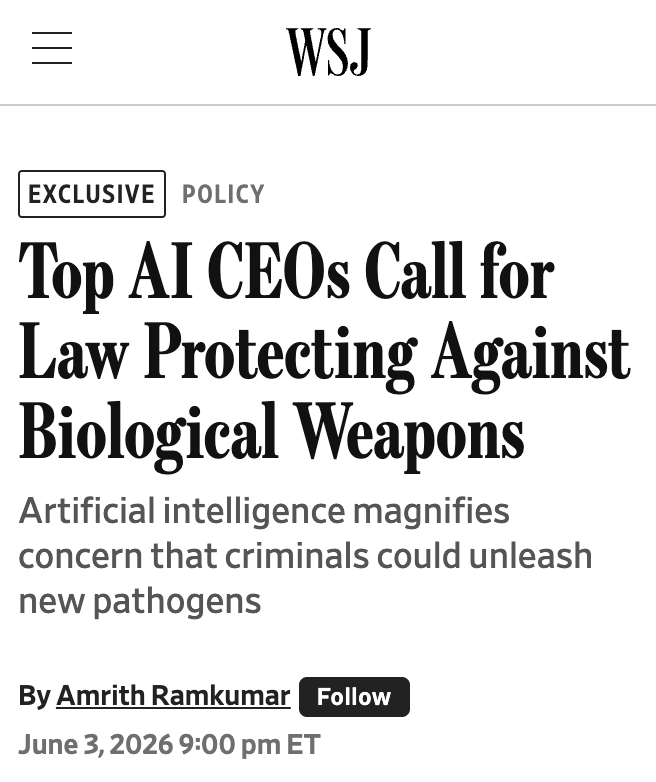
Top AI executives are joining security experts in calling for Congress to protect against biological threats posed by the technology on.wsj.com/4fZZWhj
14
52
106
46,666
Joshua Teperowski Monrad reposted
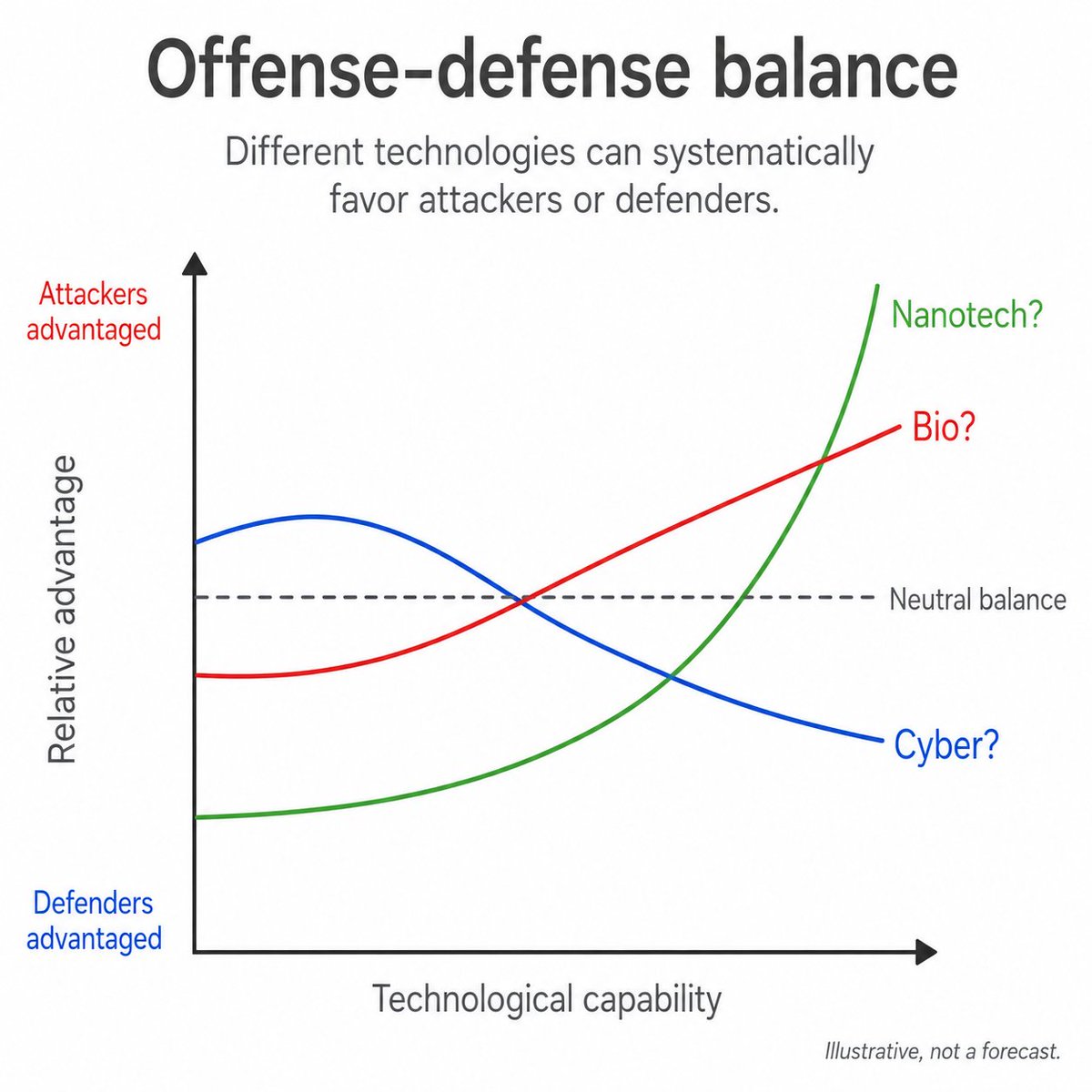
DNA screening is great policy, and it relates to an extremely underrated concept: offense-defense balance. AI is and will continue to be a powerful accelerant of all kinds of technologies. Most of these will be amazing for the world. We should be excited about AI, even though AI will obviously accelerate *some* technologies that can cause harm. But the key insight is that some potentially dangerous tech will be “offense-dominant” — attackers will be systematically advantages over defenders. This should not cause us to abandon AI progress, but we do urgently require smart policies to address this inevitability. Most dangerous technologies we’re familiar with are not very “offense-dominant”. For instance, 100 men with guns on a level battlefield will roughly balance out 100 men on the opposing side. But the world is full of examples of offense-dominant tech. Take drones and missiles, for instance. It is far cheaper to launch drones at valuable targets than it is to defend those valuable targets. The same is true of missiles — we’ve been living in a world with ICBMs for ~70 years, but we still haven’t solved robust missile defense. It’s just really hard to stop fast projectiles. Bioweapons (e.g., viruses engineered by terrorists) are an example of extremely offense-dominant technology. Every very cell in your body contains the factories needed to replicate a virus, spreading it to others. Defending against engineered bioweapons is already pretty rough. An outbreak can occur quickly, but the mass-manufacture and delivery of vaccines and PPE can be extremely costly. But if AI is used to accelerate synthetic biology, it can make the picture much bleaker. In nature, lethality and contagiousness often trade off against one another. But with the help of advanced AI tools, attackers could engineer viruses that are far more lethal and far more contagious than any found in nature. It’s also not unthinkable that attacks could be geographically targeted. With many technologies, we hope that as time goes on, the good guys will develop new ways of improving defense. I think this is likely to be the case in cyber, for instance. Better AI-enabled cyber *might* help attackers in the short run, but I think will promote better defenses in the long run. With bio, it’s not so clear. And it’s even less clear with other technologies that AI could help accelerate, such as nanotech. An important note for policymakers, though, is that model-level capabilities do not imply model-level governance. The way to deal with the increased risk of effective bioterrorism has a lot more to do with KYC, PPE, and industrial policy than with regulating AI models themselves.
Sam Altman, Dario Amodei, Demis Hassabis and many others have signed a letter urging Congress to increase security on orders of synthetic nucleic acids - and the equipment needed to make them - as models continue to become increasingly bio-capable.
2
3
14
1,018
Joshua Teperowski Monrad reposted
If people want to support biosecurity work @innovationwonk has curated a portfolio of high-impact research in biodefense, and @jtmonrad has a philanthropic fund for securing DNA synthesis on Catalyze. Portfolio: catalyzernd.com/portfolios/b… Fund: catalyzernd.com/funding-pool…
2
4
186
Roles at Sentinel: sentinelbio.org/careers/ Grants/incubations expression-of-interest: form.typeform.com/to/lqql7ls…
74
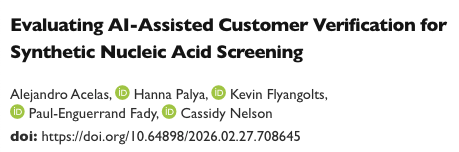
As far as AI governance interventions go, DNA synthesis security has a rare feature: we actually know what to do! After spending the last year on a roadmap to achieve victory, Janika and I are now headhunting people to quarterback & execute at Sentinel & our great partner orgs
It’s great to see AI leaders like Sam Altman, Dario Amodei, and Demis Hassabis calling for mandatory DNA synthesis screening, which is a no-brainer policy for preventing (AI-enabled) bioterrorism. But fewer than 50 people in the world currently work on DNA security full-time. We need a comprehensive plan and at least 5x as many people to secure the DNA supply chain before AI and biotech outpace us. @jtmonrad and I spent the past two years developing a field strategy for how to do it. Successfully defending against this risk (while still capturing innovation benefits) requires four things: 1. Coverage: More than 80% of synthetic DNA providers screen both orders and customers 2. Strategic ambiguity: a bad actor can’t easily tell which providers will screen their order 3. Access: legitimate customers can still order DNA cheaply and easily 4. Effectiveness: 90% of providers reliably catch dangerous sequences when red-teamed We’re already seeing real momentum. Many DNA providers screen voluntarily, and governments in several countries are moving toward mandates. But that doesn’t mean the problem will be solved in time by default. Our guide lays out exactly which projects we need to launch. We’re looking for founders, operators, and technical experts to own pieces of the solution. We’re also hiring a Senior Program Officer at Sentinel to drive this work. Get in touch if you or someone you know would be a strong fit! (links for EOI form and JD below) Read our full field strategy in @IFP's Launch Sequence: ifp.org/how-to-secure-the-dn…
1
3
13
984
Glad to sign this letter with this specific group (Sama, Dario, Demis, Leproust, etc). It’s hard to find such a strong consensus on technology oversight, but this one really is a no-regrets move – which is why colleagues & I have spent the last two years working to get it done!
No one should be able to order a bioweapon through the mail. @IFP & @JoinFAI are proud to co-lead an open letter calling for mandatory DNA synthesis screening & recordkeeping. Signatories include: - Sam Altman, CEO & Co-Founder, OpenAI - Dario Amodei, CEO & Co-Founder, Anthropic - David Baker, Director, Institute for Protein Design; 2024 Nobel Prize in Chemistry recipient - Patrick Collison, CEO & Co-Founder, Stripe - Paul Graham, Founder, Y Combinator - Demis Hassabis, CEO, Google DeepMind; 2024 Nobel Prize in Chemistry recipient - Emily Leproust, CEO & Co-Founder, Twist Bioscience - Lawrence Lessig, Roy L. Furman Professor of Law and Leadership, Harvard Law School - Gerald W. Parker, former Special Assistant to the President for Biosecurity and Pandemic Response - Mustafa Suleyman, CEO, Microsoft AI - Alex Tabarrok, Professor of Economics, George Mason University - Alexandr Wang, Chief AI Officer, Meta; Founder, Scale AI - Christine E. Wormuth, President & CEO, Nuclear Threat Initiative; 25th Secretary of the Army Read the letter and see the full list of signatories: screendna.org Many DNA synthesis companies voluntarily screen orders to mitigate biosecurity risks, but no law requires them to do so. Leaders in AI, biotech, life sciences, national security, and the nucleic acid synthesis industry agree that Congress should act to strengthen safeguards against biological threats. @deanwball put it well in the WSJ: “If you’re synthesizing the stuff that yields biological life and viruses, we’re asking you to screen to see whether it is dangerous in some way. That seems like a reasonable thing for society to insist upon.”
3
19
4,149