





Luca Righetti reposted

Apr 21
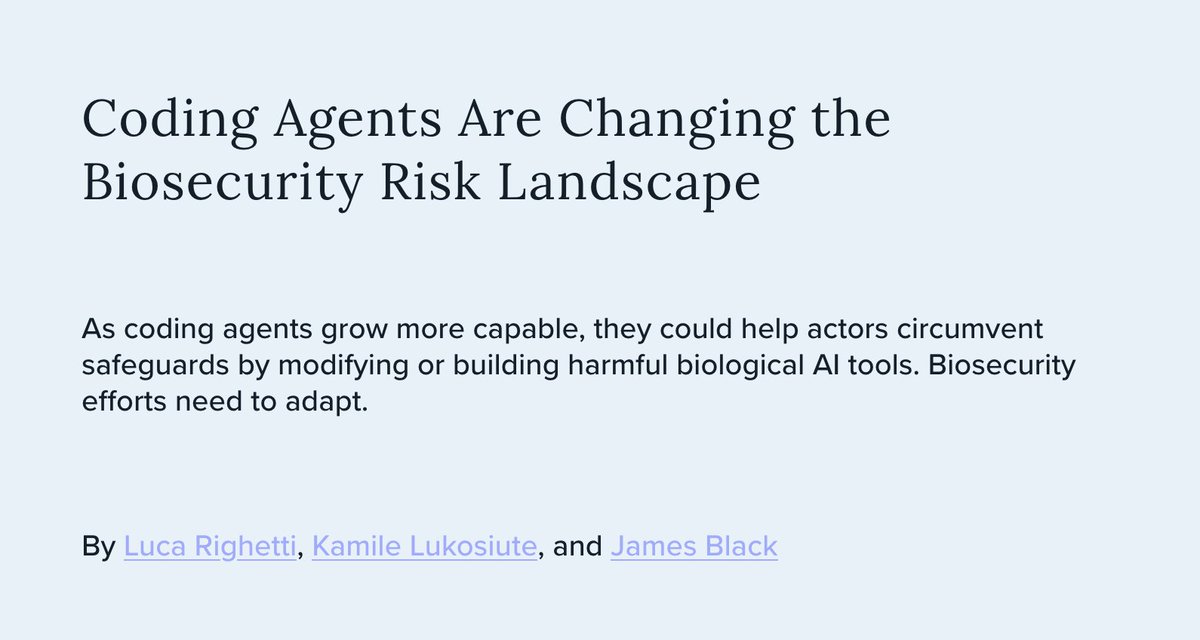
Over a weekend and with ~$760, I (not a biologist) used Claude Code to fine-tune a biological AI model on human-infecting viral sequences. Although my experiment wasn't dangerous, it demonstrates how coding agents are changing the biosecurity risk landscape.
In a new @GovAIOrg blog post with @lucafrighetti and James Black, we describe this experiment and its policy implications.
Biosecurity has traditionally divided AI risks into two buckets: general LLMs that "raise the floor" by democratizing knowledge and specialized biological AI models (BAIMs) that "raise the ceiling" by enabling experts.
Increasingly capable coding agents blur that line via three mechanisms:
1) Coding agents let both novices and experts operate BAIMs more effectively, expanding the pool of potential misusers and letting experts test more designs faster.
2) Data filters on BAIMs are brittle when coding agents can autonomously fine-tune the models, as my experiment shows.
3) Coding agents speed up ML engineering, making it more feasible for threat actors to train new specialized models optimized for harmful capabilities from scratch.
Policy recommendations: BAIM developers should move beyond data filtering toward trusted-access programs; LLM developers should test agent interactions with BAIMs; policymakers should prioritize physical chokepoints like DNA synthesis screening.
Read the piece: governance.ai/analysis/codin…
8
18
86
8,699