Joined October 2025
1,138 Photos and videos
Pinned Post
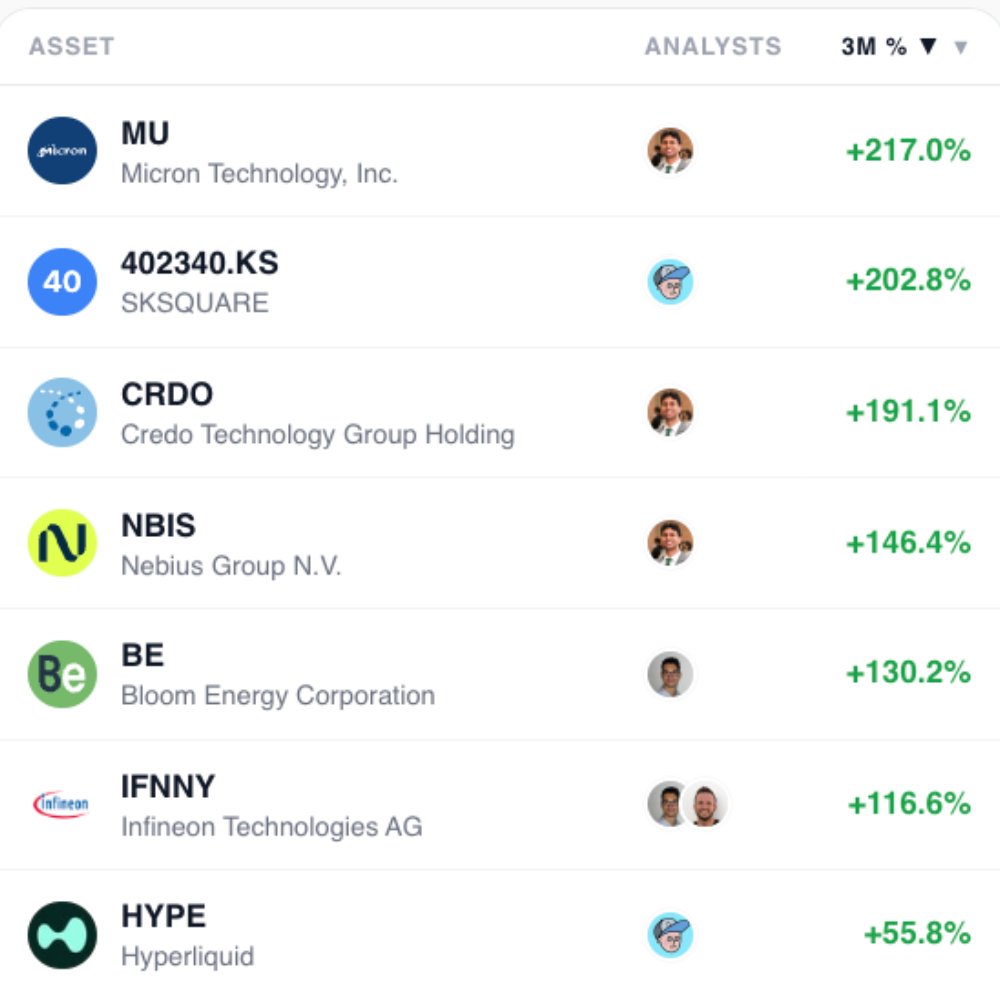
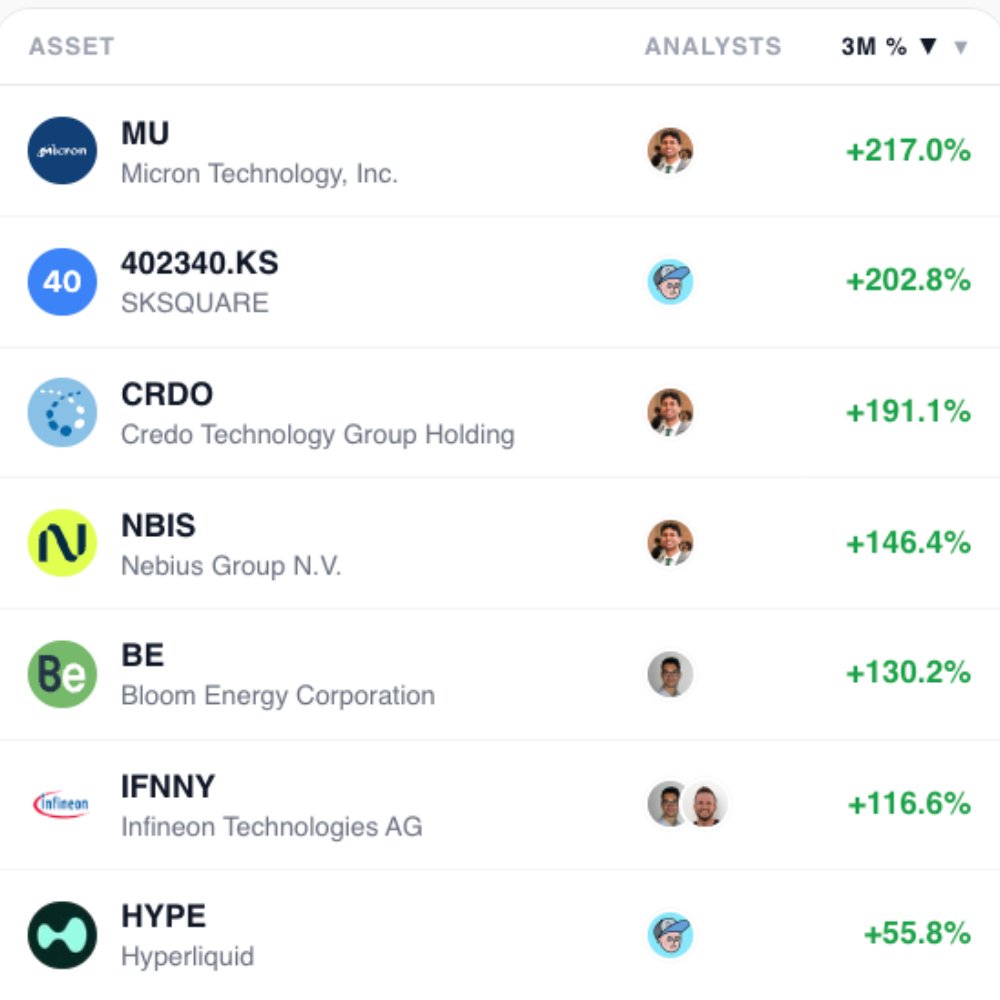
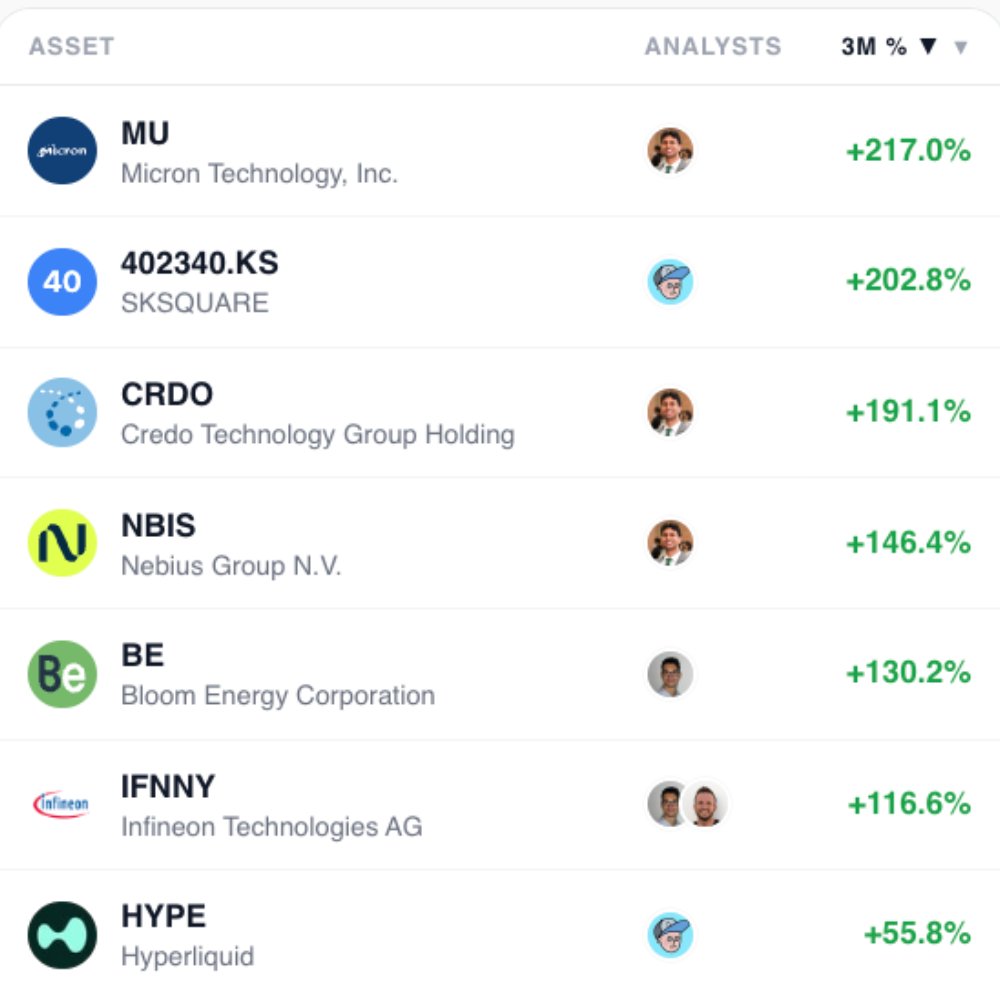
Did you listen anon? This is why you listen to Milk Road analysts, MU is up 4% overnight and the Micron thesis is playing out. Join us for just $1 using the link below!
Go ahead and short Micron, I dare you and you will get burned (Save this). This chart shows data center memory demand goes from $60 billion in 2024 to $1.4 trillion by 2030. That's 23x in six years and that number doesn't include phones, laptops, or cars but just data centers. Three companies make this memory, Samsung, SK Hynix, and Micron and no one else is coming and China's CXMT is years behind on advanced nodes and isn't a factor in HBM at all. The product everyone actually wants right now isn't regular DRAM but it's HBM, High Bandwidth Memory. These chips are physically bonded onto Nvidia's GPUs and sit millimeters from the compute die. A single Blackwell GB200 needs 192GB of it while one NVL72 rack needs 13,824GB. Meta and Microsoft are ordering these racks by the thousands and every single one is a guaranteed HBM purchase. Micron sold out its entire 2026 HBM supply before the year even started. Micron has signed 16 take or pay contracts locking in $100 billion in minimum revenue and customers have already wired $22 billion in upfront cash for chips that haven't been made yet. That's not a commodity business anymore but rather customers paying in advance because they're scared of running out. AI capex has officially gone parabolic, Meta $145B, Amazon $100B, Microsoft $80B, and Google $75B in a single year and every dollar of that capex eventually touches memory. This chart shows AI data center memory going from $106 billion in 2026 to $285 billion in 2028 to $517 billion in 2030, growing 40–60% a year, every year, backed by capex that's already been announced. Micron owns about a third of the global memory market, a third of $1.4 trillion is $470 billion flowing to one company from data centers alone before a single consumer device ships. Shorting Micron means betting hyperscalers stop building, AI demand disappears and somehow one of three companies with a physical monopoly on critical infrastructure loses its seat at the table. Milk Road Pro subscribers are up massively on Micron, come join us just for a dollar to see rest of our trades using the link below!
5
4
11
6,348
Milk Road AI reposted
Industrial humanoid robots in logistics alone are projected to hit $326B by 2034. And the robot below (Digit) is the first humanoid robot to operate in live commercial environments at scale. Digit is a bipedal humanoid robot designed for warehouse and logistics work that's putting up impressive numbers: - 65,000 operational hours - 100,000 totes moved at customer sites - $300M in binding orders for Digit V5 And they’ve got backing from some serious names: - Amazon, Toyota, and Schaeffler are active customers - Amazon, NVIDIA, SoftBank Vision Fund 2 and Foxconn are all in as both investors and commercial partners. Digit is built by a company called @agilityrobotics that just merged with Churchill Capital Corp XI. So while Agility is still an early-stage company, public investors have a way to get direct exposure through $CCXI for the first time. And our analyst @MelvinInvests started buying $CCXI last week. His view is simple: Humanoid robotics could become one of the biggest AI application layers over the next decade but the winners won't be built overnight. It's an early bet on a market that may take years to mature. Melvin previously called Micron $MU, Credo $CRDO and Nebius $NBIS before their major runs. Don’t miss his next call, try Milk Road PRO for $1. (link in first comment below)
5
2
9
1,628
HUGE NEWS! We’re hiring an Investment Analyst at Milk Road. This role is for someone who already loves talking about markets, stocks, crypto, AI, macro, robotics, space, and where the next big opportunity is forming. You’ll be researching ideas, sharing your portfolio picks, writing investment breakdowns, posting on X, and joining The Milk Road Show as a guest expert. The main thing we care about is that you have real opinions, can explain your thinking clearly, and are comfortable making calls in public. If you already create investing content on X, YouTube, or in a newsletter, even better. This is a full-time remote role with a team that is building one of the biggest investing media brands in the world. Apply below 👇 impactdm.notion.site/Investm…
2
6
1,654
Milk Road AI reposted
Did you listen anon? This is why you listen to Milk Road analysts, MU is up 4% overnight and the Micron thesis is playing out. Join us for just $1 using the link below!
Go ahead and short Micron, I dare you and you will get burned (Save this). This chart shows data center memory demand goes from $60 billion in 2024 to $1.4 trillion by 2030. That's 23x in six years and that number doesn't include phones, laptops, or cars but just data centers. Three companies make this memory, Samsung, SK Hynix, and Micron and no one else is coming and China's CXMT is years behind on advanced nodes and isn't a factor in HBM at all. The product everyone actually wants right now isn't regular DRAM but it's HBM, High Bandwidth Memory. These chips are physically bonded onto Nvidia's GPUs and sit millimeters from the compute die. A single Blackwell GB200 needs 192GB of it while one NVL72 rack needs 13,824GB. Meta and Microsoft are ordering these racks by the thousands and every single one is a guaranteed HBM purchase. Micron sold out its entire 2026 HBM supply before the year even started. Micron has signed 16 take or pay contracts locking in $100 billion in minimum revenue and customers have already wired $22 billion in upfront cash for chips that haven't been made yet. That's not a commodity business anymore but rather customers paying in advance because they're scared of running out. AI capex has officially gone parabolic, Meta $145B, Amazon $100B, Microsoft $80B, and Google $75B in a single year and every dollar of that capex eventually touches memory. This chart shows AI data center memory going from $106 billion in 2026 to $285 billion in 2028 to $517 billion in 2030, growing 40–60% a year, every year, backed by capex that's already been announced. Micron owns about a third of the global memory market, a third of $1.4 trillion is $470 billion flowing to one company from data centers alone before a single consumer device ships. Shorting Micron means betting hyperscalers stop building, AI demand disappears and somehow one of three companies with a physical monopoly on critical infrastructure loses its seat at the table. Milk Road Pro subscribers are up massively on Micron, come join us just for a dollar to see rest of our trades using the link below!
5
4
11
6,348
Milk Road AI reposted
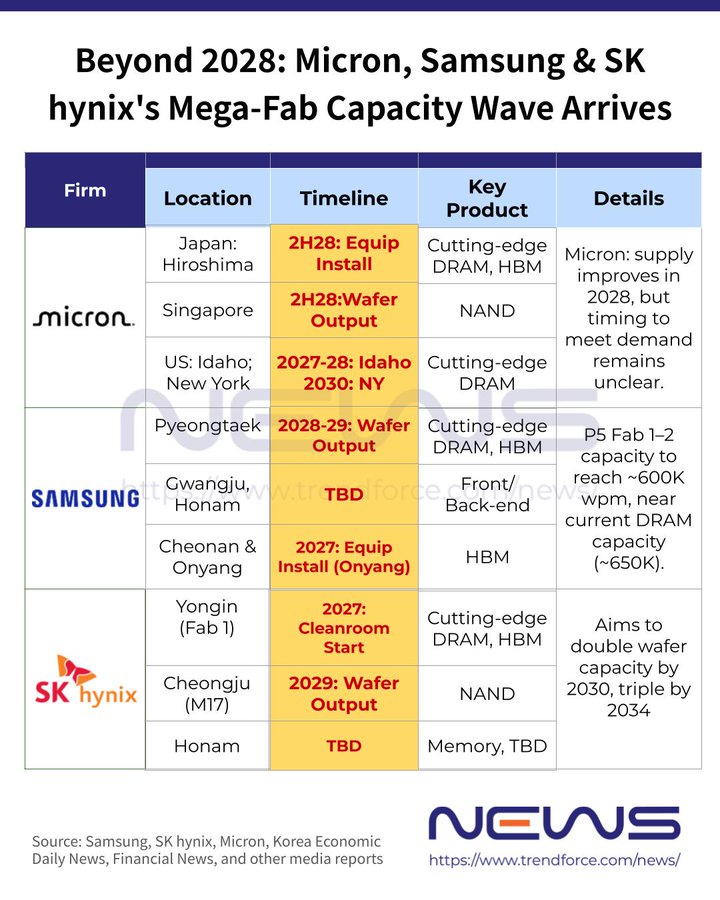
The three biggest memory companies on earth just told you exactly when supply gets better and the answer is not anytime soon (Save this). The AI stack has three layers, chips at the bottom, models in the middle, applications at the top and memory sits at the foundation of all of it. The problem is the foundation cannot keep up with what is being built on top of it. Every AI chip, Nvidia H100, H200, B200 requires High Bandwidth Memory (HBM) stacked directly on it and HBM takes roughly 3x the wafer capacity of standard DRAM to produce. The result is demand is already far outstripping supply. Micron's entire 2026 HBM output is fully pre-sold and allocated to hyperscalers and new orders are being deferred to late 2027, key customers are currently receiving only 50–67% of their demanded HBM volume. The chart maps out when new fab capacity comes online and the insight is that none of it matters yet. All the new fabs listed, Micron's Hiroshima, Samsung's Pyeongtaek P5, SK Hynix's Yongin are either still being equipped or won't produce a single wafer until 2027–2029 at the earliest. Until then, all three companies are running on fixed, cannot be expanded capacity. Micron has three expansion waves, Hiroshima equipment install happening now in 2H 2028 for cutting edge DRAM and HBM, Singapore wafer output 2H 2028 for NAND, Idaho meaningful volume mid-2027, New York not until 2030. Samsung's Pyeongtaek P5 full wafer output for cutting edge DRAM and HBM does not arrive until 2028–2029, Onyang gets HBM equipment installed in 2027, Gwangju/Honam has no confirmed timeline at all. SK Hynix's Yongin Fab 1 only starts cleanroom construction in 2027, Cheongju M17 NAND output in 2029 and the company aims to double capacity by 2030 and triple by 2034, meaning real relief is nearly a decade away. Now here is what the chart does not show. Even when these fabs open, supply does not catch up to demand because HBM requires precision stacking tools with 12-month lead times and even when wafers are ready, they cannot be assembled into usable HBM fast enough. The supply will be tight for many years to come, long Micron and make sure to follow me @melvininvests for more updates around Memory and Semi's.
7
16
62
7,327
We called Nebius, Credo, Bloom Energy, AAOI, and AMD before their big run ups. Don’t miss the next one, come join us for just a $1. milkroad.com/pro/?utm_medium…
2
772
We called Nebius, Credo, Bloom Energy, AAOI, and AMD before their big run ups. Don’t miss the next one, come join us for just a $1. milkroad.com/pro/?utm_medium…
1
2
1,272
The model layer is consolidating and almost everyone in the AI ecosystem has a reason to stop it (Save this). The AI stack has three layers, chips at the bottom, models in the middle, applications at the top. The problem is the middle layer is consolidating fast. Anthropic hit $45 billion ARR in may , up from $1 billion just 15 months earlier, OpenAI is at roughly $25 billion and every other model company is generating almost no meaningful revenue. @DavidSacks point is that nobody in the ecosystem actually wants this except Anthropic and OpenAI. If you are an application company, you do not want to depend on one or two model providers who can price you out, change terms or compete with you directly. If you are an enterprise, you do not want to funnel your proprietary workflows and data through a third-party lab that learns from what you give it. And if you are a chip company, you do not want a world where only two companies buy your silicon especially when those same two companies are building their own chips. The whole ecosystem enterprises, developers, applications, chip makers has the same incentive, keep the model layer competitive.
10
17
132
11,852
Milk Road AI reposted
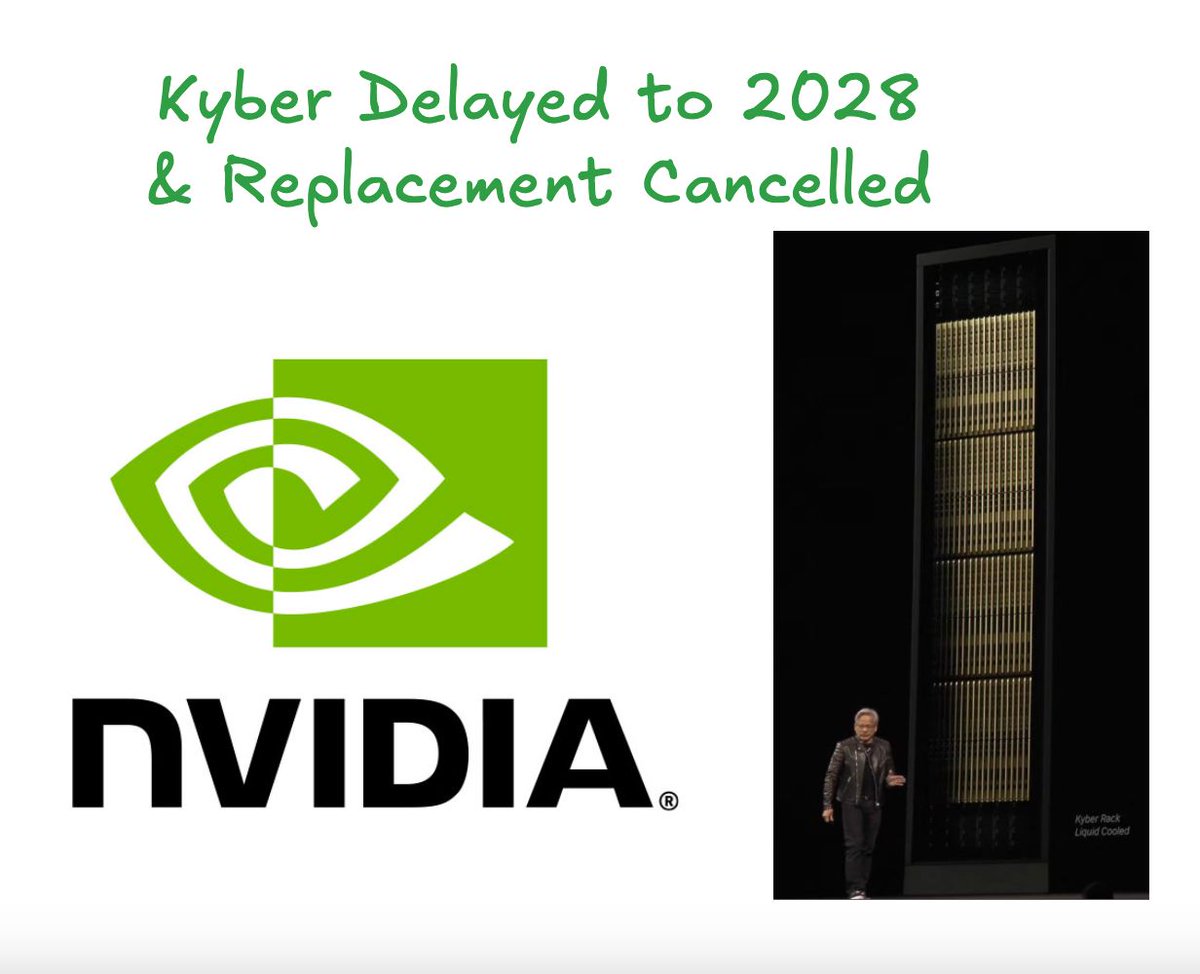
Kyber is Nvidia’s next generation rack architecture, the NVL144 system Jensen demoed at GTC just three months ago, and now it is reportedly delayed. (Save this). It was supposed to be the successor to the current NVL72 Blackwell rack, doubling the GPU density per rack to 144 chips and representing the next major leap in AI training infrastructure. Three months after that demo, SemiAnalysis is reporting it has been delayed by more than 12 months, pushing it to 2028. On top of that, the NVL72x2 back to back rack which was being positioned as a bridge architecture to replace Kyber has apparently been cancelled entirely.x 1 The core reason for the delay is technical. Kyber was designed to use co-packaged optics, CPO for the scale up interconnect between GPUs inside the rack. CPO integrates optical components directly onto the chip package, dramatically increasing bandwidth and reducing power consumption at the rack level. But the manufacturing yield rates on CPO optical engines, the difficulty of integrating them with the ASIC, and the cost structure have all proven harder to crack at volume than projected. AMD and Marvell benefit from any architecture environment that extends Blackwell's dominance, because both are competing for the next generation of custom silicon at hyperscalers who are now more motivated than ever to reduce dependency on a single Nvidia roadmap. When Nvidia delays, hyperscalers accelerate their own chip programs and AMD and Marvell are the primary beneficiaries of that spending. Broadcom benefits the same way, its custom accelerator business building bespoke AI chips for Google, Meta, and Anthropic becomes more attractive every time Nvidia's roadmap slips. Now for AAOI and this is where the market is likely to get it wrong. Most people have been treating Applied Optoelectronics as a CPO play and that framing is incorrect. AAOI supplies high power lasers and optical components that enable Near Packaged Optics, CPO, and its own On Board Optics solutions but the majority of its current revenue comes from pluggable transceivers, not CPO. It has been winning volume orders for 1.6T transceivers and positioning its ELSFP lasers as a foundation for next-generation NPO and CPO architectures. That distinction matters enormously right now. The Kyber delay means the full CPO transition gets pushed out which keeps pluggable optics, the core of AAOI's business today, in heavy demand for at least two more years of the most aggressive AI cluster buildout in history. Every NVL72 rack that ships instead of waiting for Kyber uses pluggable transceivers and every month the CPO integration is delayed is another month of near-term revenue from hyperscalers scaling AI clusters right now. The irony is that Nvidia's Rubin Ultra manufacturing hiccups and spec downgrades, the exact problems causing the Kyber delay are keeping demand strong for the more mature, modular optics that AAOI actually sells today. And because AAOI makes a lot more from pluggable and near-package products than from CPO, it benefits in the immediate term even more than the pure CPO narrative would suggest. Bullish on AAOI and make sure to follow me @MelvinInvests for more overlooked semiconductor ideas.
MASSIVE DELAY: Just 3 months after Jensen demoed Kyber NVL144 at GTC, it has faced major setbacks and has been delayed by more than 12 months, pushing it back to 2028. Below, we explain why Kyber has faced massive delays and why NVIDIA’s NVL72x2 back-to-back rack architecture was also cancelled, leaving Rubin Ultra with a limited scale-up domain. 👇️ 1/6🧵
3
10
52
13,405
We called Nebius, Credo, Bloom Energy, AAOI, and AMD before their big run ups. Don’t miss the next one, come join us for just a $1. milkroad.com/pro/?utm_medium…
1
3
1,615
Milk Road AI reposted
Anthropic is running the oldest predatory playbook in Big Tech (Save this). Here is what actually happened. Anthropic's own Chief Product Officer, Mike Krieger, was sitting on Figma's board and he resigned on April 14, 2026. Three days later, Anthropic launched Claude Design, a direct competitor to Figma's core product that allows users to generate prototypes, slide decks, and visual assets through conversation. Figma's stock dropped 7% the day of the launch and the stock has shed approximately 80% from its all-time high, erasing nearly $50 billion in market cap. Anthropic's valuation surged toward $800 billion in the same period. This is not an accident but rather a deliberate, systematic strategy and once you see the pattern, you cannot unsee it. Anthropic watched Cursor build the coding assistant category on top of Claude's models, Cursor became one of Anthropic's biggest customers. Cursor's usage patterns and product insights flowed through Anthropic's infrastructure every single day then Anthropic launched Claude Code, entering the exact category Cursor had created armed with every data point it needed to know the market size, the use cases, and the user behavior. The same pattern has now repeated across Claude Science, Claude Security, Claude Legal, and Claude Financial, every single one a vertical that was previously served by companies building on top of Anthropic's own models. The companies that trusted Anthropic's platform were simultaneously handing Anthropic the product roadmap for what to build next. Every company currently building on top of a closed frontier model is in the same position Figma was in before April 14, 2026. The only question is which category Anthropic targets next. @DavidSacks
45
109
547
58,363
We called Nebius, Credo, Bloom Energy, AAOI, and AMD before their big run ups. Don’t miss the next one, come join us for just a $1. milkroad.com/pro/?utm_medium…
1
1
1,496
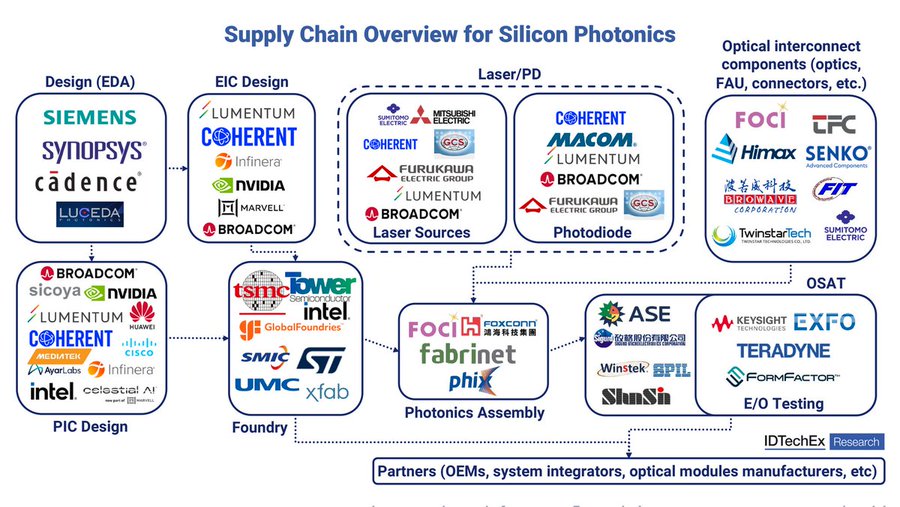
The silicon photonics supply chain diagram is one of the most important investment maps in technology right now (Save this). Every AI data center being built depends on what's in that chart and the companies inside it are just starting to show what the revenue ramp looks like. Here are the 10 stocks I am watching. 1. Broadcom (AVGO): Broadcom's AI revenue rocketed 106% to $8.4 billion in its most recent quarter, driven by custom accelerator chips for Google, Meta, and Anthropic, plus AI networking silicon. It is one of the few companies doing both the switch silicon and the photonics integration needed for co-packaged optics at hyperscale. The silicon photonics diagram shows Broadcom appearing across multiple layers, PIC design, laser sources, photodiode, and EIC design. 2. MACOM Technology (MTSI): MACOM is quietly positioning itself at the inflection point of the 1.6T and 3.2T optical transceiver transition. In March 2026 it launched 448G PAM4 modulator drivers among the first in the industry and joined Broadcom, Cisco, and Semtech in the 400G Optical MSA standards consortium. In June 2026 it introduced hot via chip scale technology, eliminating wire bonds in its AlGaAs packaging. 3. Marvell Technology (MRVL): Marvell is the DSP engine inside many of the optical modules in that chart. Its custom AI silicon, built for hyperscalers who want to own their accelerator architecture is the fastest growing part of its business. It sits at the EIC design layer and supplies the digital signal processing that makes high-speed optical links work reliably at scale. As the industry shifts from 400G to 800G and 1.6T, every step requires more sophisticated DSPs and Marvell captures more revenue per module shipped. 4. Keysight Technologies (KEYS): Every optical module that ships from every fab in that chart has to be tested before it reaches a data center. Keysight is the global leader in electronic and photonic test equipment. As optical speeds push to 800G and beyond, the testing instrumentation has to keep pace and it commands premium pricing. 5. FormFactor (FORM): FormFactor is the most underappreciated name in this entire chart. Q1 2026 revenue was $226 million, up 32% year over year, beating estimates with non-GAAP EPS of $0.56 versus $0.44 expected. It acquired Keystone Photonics in December 2025, becoming the leading wafer-level silicon photonics test platform for co-packaged optics production. Its partnership with Advantest created the world's fastest automated photonic alignment test system with nine-axis nano-precision. Over 100 of the world's leading silicon photonics manufacturers use FormFactor systems meaning every CPO chip that ships from any fab in that diagram gets tested on FormFactor equipment. 6. Teradyne (TER): Teradyne sits in the E/O Testing layer alongside Keysight and FormFactor. As silicon photonics chips get more complex, integrating lasers, modulators, photodetectors and electronic drivers on a single chip, the test complexity explodes. Teradyne's automated test equipment platforms are expanding from traditional semiconductor testing into photonic integrated circuit validation. It also has a robotics division, which ties the silicon photonics thesis directly back to the humanoid supply chain story. 7. EXFO (EXFO): EXFO is a fiber optic and network testing specialist that has been building testing platforms specifically for coherent optical and silicon photonics applications. It sits directly in the E/O Testing box of the supply chain map. It's a smaller cap, which means the upside from the optical buildout is amplified relative to its size. It is one of the few companies that tests live network optical performance meaning it gets pulled in not just at the component manufacturing stage but every time a data center expands or upgrades. 8. Foxconn Industrial Internet (FXCOF): Foxconn appears twice in that supply chain diagram in both Photonics Assembly and Optical Interconnect and that is before you even consider its server business. Q1 2026 revenue hit $66.6 billion, up 29.7% year over year, with AI servers now representing more than 50% of total server revenue. Its silicon photonics CPO switches entered mass production in Q3 2026 with full year shipments forecast at 10,000 units. It is boosting capex 30% specifically for AI infrastructure. Almost no retail investors think of Foxconn as a silicon photonics play and that's the opportunity. 9. Sumitomo Electric (SMTOY): Sumitomo appears in two places on that supply chain diagram as an optical interconnect component supplier and in the laser/photodiode layer. The company has been a foundational supplier to the fiber optic industry for decades and is now scaling its silicon photonics packaging and optical connectivity capabilities for AI data center applications. 10. Synopsys (SNPS): Every silicon photonics chip has to be designed before it can be manufactured. Synopsys is the dominant EDA software company for photonic integrated circuit design and sits at the very top left of that supply chain map. The shift toward co-packaged optics means optical and electronic chip design have to be co-simulated, exactly the kind of complex, multi physics workflow Synopsys is built for. Its photonics design tools are already embedded across every major chip company in that diagram. The more complex the chip, the more customers pay for Synopsys tools. Milk Road Pro is tracking every layer of the silicon photonics supply chain, from Broadcom and Marvell to the testing names most investors still don’t know. Join Milk Road Pro for the full breakdown and for all our AI trades for just $1 using the link below!
6
7
31
5,489
We called Nebius, Credo, Bloom Energy, AAOI, and AMD before their big run ups. Don’t miss the next one, come join us for just a $1. milkroad.com/pro/?utm_medium…
1
1
1,166
Milk Road AI reposted
The humanoid robot market is projected to reach $7.5 trillion by 2050 and most investors are looking at the wrong companies (Save this). Everyone is focused on the robots themselves but a humanoid robot is just a collection of precision components and right now, a handful of industrial suppliers quietly control the bottlenecks that every single robot company on earth depends on. That component diagram above is your investment map. The most critical component in any humanoid robot is the reducer, the precision gearbox that converts motor speed into torque for each joint. Every shoulder housing, knee joint, hip actuator runs through one and right now, one Japanese company controls 85% of the global market for the dominant type, strain-wave harmonic reducers. That company is Harmonic Drive Systems (6324.T / HSCDF). Harmonic Drive is a confirmed supplier to multiple major humanoid programs and the entire global industry depends on its output. Revenue was ¥55.6 billion in FY2025 and order books are accelerating as OEM production ramps and it is the closest thing to a monopoly in the entire humanoid supply chain. The second reducer type, cycloidal RV reducers, which dominate heavier joints like hips and shoulders is controlled by Nabtesco (6268.T / NCTKY), also Japanese, with roughly 60% global share. FY2025 revenue hit ¥307.9 billion, up 9.8% year over year, with operating profit up 60% in the same period. Both companies are so embedded in the supply chain that even the Chinese robot manufacturers racing to commoditize components still rely on Japanese reducers for precision critical applications. Together, actuators and reducers represent 30 to 51% of the entire hardware bill of materials for a humanoid robot. When you're talking about a billion robots by 2050, the companies that supply those components are not riding a theme, they are the theme. The next layer is bearings and precision transmission. SKF (SKFB.ST), the Swedish industrial bearing giant, announced a joint venture on July 2, 2026 with Chinese precision component maker Leaderdrive specifically to supply high precision transmission components for humanoid robot joints. SKF is taking a 60% majority stake, targeting both the Chinese market, the world's largest and fastest growing humanoid robotics market and international expansion through its global sales network. SKF has the manufacturing scale, the quality systems, and the global distribution and it is now directly positioned inside the humanoid supply chain at the joint level. The force and torque sensor market is the next critical bottleneck because every foot, wrist and ankle in a humanoid robot needs a sensor that tells it exactly how much force it is applying, the thing that lets a robot grip a fragile object without crushing it. The global humanoid force/torque sensor market was $700 million in 2025 and is forecast to reach $6.4 billion by 2032, growing at 37.1% annually. Novanta (NOVT) is the publicly traded play here because its ATI Industrial Automation subsidiary, acquired specifically for its robotics sensing capabilities launched the Varo force/torque sensor in early 2026, purpose-built for humanoid platforms. Novanta also owns Celera Motion, which supplies advanced motion control components to robot joints and it is one of the few US-listed companies with real, shipping revenue from humanoid component supply.l The broader motors and drives layer belongs to Nidec (6594.T / NJDCY), a Japanese company with ¥2.61 trillion in annual revenue that revealed a full six-axis humanoid drive solution at IREX 2025 meaning it can supply the complete motor stack for an entire robot from a single vendor. And Yaskawa Electric (6506.T / YASKY), which just acquired Tokyo Robotics and posted FY2026 operating profit up 70% year over year, is moving aggressively from industrial arms into humanoid platforms. The pattern across all of these companies is identical, decades of precision manufacturing expertise built for industrial automation and automotive, now being redirected into a market that is about to be orders of magnitude larger. Bullish on the supply chain because every humanoid robot needs the same critical components and make sure to follow me @MelvinInvests for more overlooked opportunities.
11
31
129
11,630
Milk Road AI reposted
The most dangerous thing a company can do right now is rent intelligence from the same place as its competitors (Save this). You cannot rent intelligence from the same place that rents it to your competitor as @chamath points out. If every company in an industry is feeding their workflows into the same frontier model, they are all converging on the same outputs, the same decisions, the same product improvements. The model becomes the equalizer and everyone pays a premium to become more mediocre. This is happening exactly as Chamath predicted, and the evidence is now concrete. Anthropic and OpenAI have established what analysts are now openly calling an emerging model layer duopoly. Anthropic crossed $45 billion ARR in may 2026, more than tripling from $9 billion at the end of 2025, OpenAI was at roughly $24 to $33 billion ARR at the same time. Together, the two companies combined could hit $160 to $240 billion ARR by end of 2026 and Anthropic and OpenAI now control 88% of enterprise LLM spend. That concentration is the structural problem Chamath is pointing at. And Anthropic isn't just winning on merit because it's actively lobbying for regulatory outcomes that would make that duopoly permanent. Dario Amodei has explicitly framed open source models as unsafe, pushing a safety agenda that, if enshrined in regulation, would effectively make it illegal for enterprises to use the cheaper, private, sovereign alternatives locking them into a closed model dependency by government decree rather than by choice. So you have market forces producing a duopoly, and potential regulatory capture moving to enforce it from the top down. This is exactly why the Nvidia Palantir partnership is not just a product announcement but rather a strategic counter to that duopoly. The logic is straightforward from both sides because If you're Palantir, sitting at the application layer, the last thing you want is to be permanently beholden to Anthropic or OpenAI for the intelligence that powers your product. You want competitive model options, sovereignty and be able to tell enterprise customers they can run AI on their own infrastructure with their own data without any of it touching a frontier lab's servers. If you're Nvidia, sitting at the chip layer, an Anthropic-OpenAI duopoly is an existential concentration risk. Right now, Meta, Google, Microsoft, Amazon, and dozens of other companies buy Nvidia's hardware. If the model layer consolidates into two players, both of which are building their own chips Nvidia faces a monopsony where its best customers are building the tools to displace it. A healthy open source ecosystem where thousands of enterprises train, fine tune, and deploy their own models is Nvidia's ideal market structure. More buyers, more diversity, more demand, less pricing leverage from any single customer.
26
62
464
31,222
Milk Road AI reposted
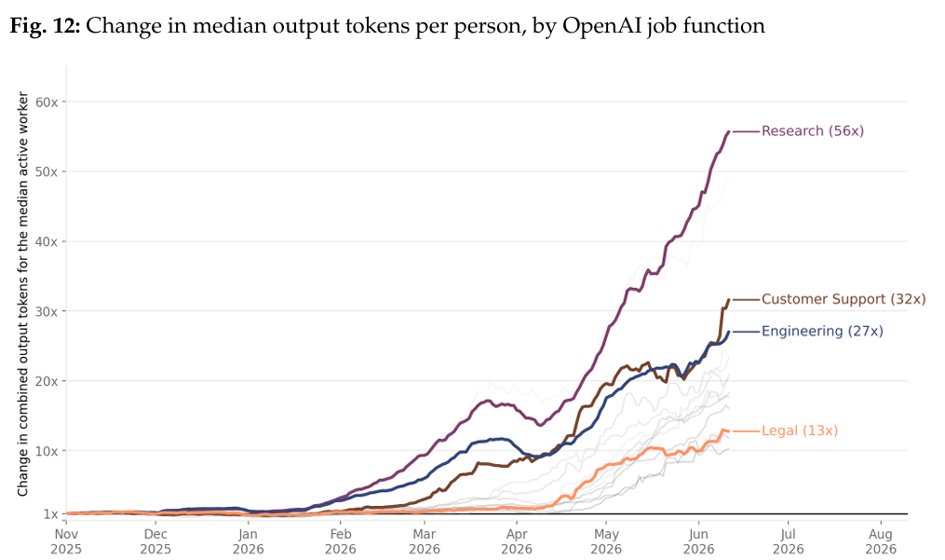
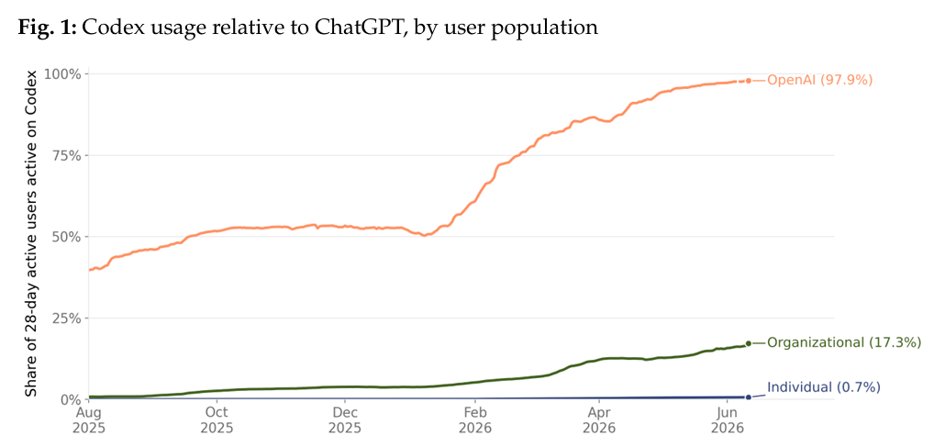
Barely anyone uses AI agents yet. But the few who do already burn most of the compute! (Save this) Just 0.7% of individual ChatGPT users have adopted Codex (17.3% of orgs). Yet these agents already drive a wildly disproportionate share of token demand (Fig. 1 below). Agent adoption is still early, but every user who switches drives far more compute than a normal prompt! So, I read the current weakness as consolidation inside the AI bull market, not the top of it, and I'm using 20% drawdowns in high-conviction names to add. Here's why the compute curve only steepens. With AI agents, demand scales on four axes together: more users, more agents per user, longer runtimes, and heavier reasoning. Then physical AI arrives on top of that. Robotaxis, humanoids, and industrial robots push inference into always-on real-world systems where latency and continuous decisions matter. TLDR: Inference demand MUCH higher! The Meta headline doesn't change this. Meta is building a cloud business to sell "excess" compute, and the bears called it a top. Look closer… Meta is spending 125-145B on infrastructure this year and still adding: 1.6GW from Crusoe in June and a multiyear deal for millions of Nvidia chips in February. They don't sell spare capacity because demand is breaking. They sell it because they can charge a premium while renting cheaper cloud capacity from Neoclouds. That get’s some cash in and pleases investors. SpaceX did the same thing weeks earlier, and the market got it, sending Meta up 6%. Where I'm adding on the dips: AI efficiency, 800VDC power architecture, 3D chip design and packaging, and names proving AI adoption throws off real ROIC.
3
4
6
1,476
Market was bleeding, but Milk Road PRO was buying. While everyone else was trying to figure out if the AI trade was over, we were adding new positions. $MU, $NBIS, $BE, and $CREDO were only the beginning. The next runners are already forming. Sign up for Milk Road PRO using the link below for just $1 and get positioned before the market wakes up.
4
1
7
4,073