Analyst @MilkRoadAI | C-suite advisor | Studying AI’s full value chain

Joined February 2022
119 Photos and videos
Pinned Post
WHY BLOOM ENERGY $BE COULD BE THE AI PLAY FOR 2026 —— The AI boom has a boring problem. Electricity. You can’t scale power like software. Wires, transformers, permits, years. But hyperscalers are competing on months. That timing gap is creating a new category: „on-site power that shows up fast“ That’s where Bloom Energy enters. —— A) What Bloom actually does Bloom sells on-site power for data centers. Think “power plant in a box” next to the facility. Fuel cells produce electricity via an electrochemical process (not the burn-and-spin turbine setup). For operators, the use case is simple. If the grid can only give you 50 MW, but your campus needs 300 MW, you can supplement the missing power on-site. —— B) Why the market suddenly cares Two forces collided. Grid expansion is slow and political. AI demand is compounding fast. Global data center electricity demand is projected to more than double by 2030 to ~945 TWh. That scale forces new solutions. Also because traditional solutions like gas turbines are sold out and nuclear takes too long! In one recent discussion, Bloom cited a survey showing data centers planning on-site generation jumped from 13% to 38% in about six months. That’s a real “tipping point” signal. ⸻ C) The 3 moats that matter 1) Speed and uptime-style reliability Speed is the first moat. Bloom can deploy its systems at scale within ~90 days. Also they build these systems as modular ~65 kW building blocks. So maintenance events are small, not one big turbine down, ensuring 99% uptime. 2) Low emissions and easier community acceptance Second moat: local footprint. They emphasize “no combustion” at the point of generation, and they highlight the system being quiet (around ~65 dB). That matters when communities push back on noisy, dirty backup-style setups. 3) Lower total cost of ownership Third moat: economics. If you include TCO (not just fuel price), Bloom is often framed as ~20% lower TCO vs. gas turbines and others. Especially once you factor in lead times, maintenance windows, and the cost of delay. In an AI race, time-to-power is part of the bill. —— Key takeaway Bloom Energy is perfectly positioned to benefit in an environment where customers need - 24/7 reliable energy - fast energy deployment - low emission energy - grid not able to supply enough = AI datacenter boom
1
11
2,560
Come join a professional but fun team!!
HUGE NEWS! We’re hiring an Investment Analyst at Milk Road. This role is for someone who already loves talking about markets, stocks, crypto, AI, macro, robotics, space, and where the next big opportunity is forming. You’ll be researching ideas, sharing your portfolio picks, writing investment breakdowns, posting on X, and joining The Milk Road Show as a guest expert. The main thing we care about is that you have real opinions, can explain your thinking clearly, and are comfortable making calls in public. If you already create investing content on X, YouTube, or in a newsletter, even better. This is a full-time remote role with a team that is building one of the biggest investing media brands in the world. Apply below 👇 impactdm.notion.site/Investm…
1
114
White Collar Exit reposted
Legendary investor Gavin Baker: “If you look at the valuations for all these AI names, they can’t all be accurate.” Here is the problem: Memory stocks are trading at 3 to 5 times earnings. NVIDIA is trading at what he describes as a really low PE. Some other accelerator companies are at reasonable multiples. And then on the other side of the AI infrastructure stack, power, cooling and optical names are trading at multiples that imply a very different future. Those two sets of valuations are internally contradictory. If the power, cooling and optical names are right, then NVIDIA and memory are dramatically underpriced and are going up a lot from here. If NVIDIA and memory are correctly valued, then everything else in the stack is overpriced and is probably going to underperform from here. The key is figuring out the correct side of the trade. Our analysts at Milk Road PRO have taken positions in various AI names based on this thesis. They were very early to $MU, $NBIS and $CRDO with over 100% gains. Get access to their exact portfolios for $1 (link in bio).
Gavin Baker says DRAM and HBM DRAM is the single most important bottleneck in all of AI (Save this). All the stocks that supply it are still trading at a discount to everything else in the stack. His argument is foundational: Model performance is constrained by how much memory is available and how fast it can move data. That is why Elon Musk is specifically targeting memory in his tariff strategy. The supply side makes this more interesting. For the HBM DRAM that AI servers actually need, there are only three companies in the world that can manufacture it: Micron, SK Hynix and Samsung. Micron's most recent quarter added another layer: they announced supply chain agreements covering roughly 50% of their revenue with just four customers. The floor pricing in those contracts is already above prior cycle peak gross margins. Every other part of the semiconductor supply chain, equipment, wafer fab, the rest of the stack, has already re-rated to premium multiples. DRAM stocks are still cross-sectionally cheap. Our analysts at Milk Road PRO have been very early to the memory trade with SK Hynix and Micron. Get access to their exact portfolios for $1. (link in bio)
6
20
152
78,239
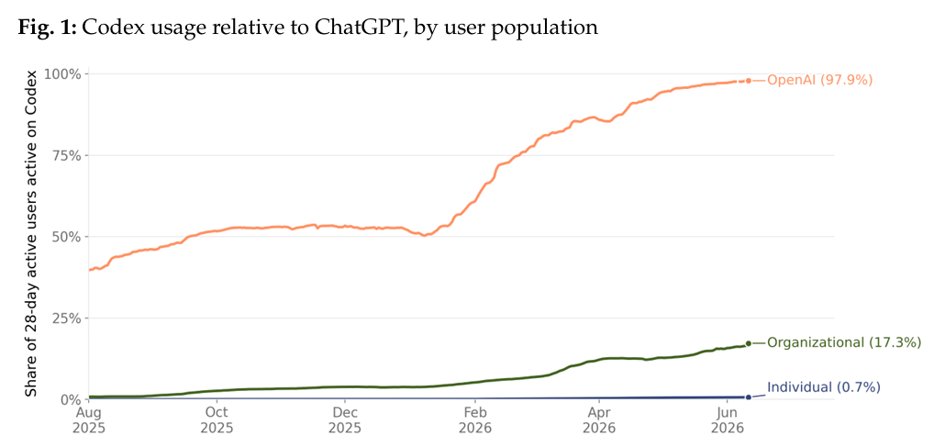
Barely anyone uses AI agents yet. But the few who do already burn most of the compute! (Save this) Just 0.7% of individual ChatGPT users have adopted Codex (17.3% of orgs). Yet these agents already drive a wildly disproportionate share of token demand (Fig. 1 below). Agent adoption is still early, but every user who switches drives far more compute than a normal prompt! So, I read the current weakness as consolidation inside the AI bull market, not the top of it, and I'm using 20% drawdowns in high-conviction names to add. Here's why the compute curve only steepens. With AI agents, demand scales on four axes together: more users, more agents per user, longer runtimes, and heavier reasoning. Then physical AI arrives on top of that. Robotaxis, humanoids, and industrial robots push inference into always-on real-world systems where latency and continuous decisions matter. TLDR: Inference demand MUCH higher! The Meta headline doesn't change this. Meta is building a cloud business to sell "excess" compute, and the bears called it a top. Look closer… Meta is spending 125-145B on infrastructure this year and still adding: 1.6GW from Crusoe in June and a multiyear deal for millions of Nvidia chips in February. They don't sell spare capacity because demand is breaking. They sell it because they can charge a premium while renting cheaper cloud capacity from Neoclouds. That get’s some cash in and pleases investors. SpaceX did the same thing weeks earlier, and the market got it, sending Meta up 6%. Where I'm adding on the dips: AI efficiency, 800VDC power architecture, 3D chip design and packaging, and names proving AI adoption throws off real ROIC.
3
4
6
1,484
We at Milk Road called Nebius, Credo, Bloom Energy, AAOI, AMD and others before their big run ups. You can join us for just $1 and leave anytime you want! milkroad.com/pro/?utm_medium…
171
White Collar Exit reposted
The market punishes hyperscalers for pouring billions into AI infrastructure. So, why is it bullish when $LLY does the same thing? Well, because for Lilly it isn't the same thing at all. For a hyperscaler, the infrastructure is the product. Every $ of data center, GPU, and power capacity gets judged on one question: can we sell more tokens at a justifyable margin? When everyone builds the same capacity at once, those margins compress and so does the multiple. The CapEx competes away its own return. Lilly's AI build never has to clear that bar. It's wiring NVIDIA GPUs into partnerships with Isomorphic and others, plus internal biology models trained on data nobody else holds. None of that gets sold. It feeds Lilly's own drug engine: discovery, molecule design, faster trials, manufacturing, patient targeting. The return doesn't show up as an AI revenue line. It shows up as a better pipeline. That's the whole answer to the valuation question. Hyperscaler capex builds a capacity that competitors also build, so the market prices in the margin war. Lilly's capex compounds an advantage nobody else can copy, because no startup has Lilly's data, FCF, and manufacturing footprint to point the models at. One better molecule, one faster trial, or one tighter patient-data loop can pay for the entire AI budget several times over. Hyperscalers are laying the railroads for AI, and railroads get commoditized. Lilly is using AI to build a better biology factory, and the factory is the moat. Same spending line, opposite investment case. I break down the full LLY AI thesis on Milk Road. Join for 1$. Link in the comments.
4
5
21
4,355
White Collar Exit reposted
Infineon just raised chip prices 10-25% for the second time in six months. Another strong signal that the AI power demand & shortage is real. The first hike landed April 1, the second July 1, part of a wave where roughly 20 chipmakers repriced power semis at once. Part of it is defensive: geopolitical disruption has pushed up costs and Infineon is handing through prices. The demand piece is the more interesting one. Infineon says orders are growing faster than it forecast just months ago, led by AI data-center power. It also just committed an extra €500M to speed up AI capacity. And all of this is before 800VDC has meaningfully scaled. 800VDC means moving power around AI data centers at much higher voltage, cutting losses and copper as racks head toward megawatt-scale. For Infineon it pushes more value into high-voltage conversion, protection, controllers, advanced SiC and GaN chips. The company estimates its silicon content per rack rises from: $15,000 in today's 125kW rack to $100,000 in 1MW racks by 2029 So, what we essentially see is pricing power on top of volume growth. Infineon is selling more units into a shortage and charging more per unit at the same time, while industry inventory sits near record lows and new capacity for traditional power chips stays limited for the next three years!
3
6
19
2,882
Infineon just raised chip prices 10-25% for the second time in six months. Another strong signal that the AI power demand & shortage is real. The first hike landed April 1, the second July 1, part of a wave where roughly 20 chipmakers repriced power semis at once. Part of it is defensive: geopolitical disruption has pushed up costs and Infineon is handing through prices. The demand piece is the more interesting one. Infineon says orders are growing faster than it forecast just months ago, led by AI data-center power. It also just committed an extra €500M to speed up AI capacity. And all of this is before 800VDC has meaningfully scaled. 800VDC means moving power around AI data centers at much higher voltage, cutting losses and copper as racks head toward megawatt-scale. For Infineon it pushes more value into high-voltage conversion, protection, controllers, advanced SiC and GaN chips. The company estimates its silicon content per rack rises from: $15,000 in today's 125kW rack to $100,000 in 1MW racks by 2029 So, what we essentially see is pricing power on top of volume growth. Infineon is selling more units into a shortage and charging more per unit at the same time, while industry inventory sits near record lows and new capacity for traditional power chips stays limited for the next three years!
3
6
19
2,882
We at Milk Road called Nebius, Credo, Bloom Energy, AAOI, AMD and others before their big run ups. You can join us, see all portfolios and trades for just $1 and leave anytime you want! milkroad.com/pro/?utm_medium…
237
The market punishes hyperscalers for pouring billions into AI infrastructure. So, why is it bullish when $LLY does the same thing? Well, because for Lilly it isn't the same thing at all. For a hyperscaler, the infrastructure is the product. Every $ of data center, GPU, and power capacity gets judged on one question: can we sell more tokens at a justifyable margin? When everyone builds the same capacity at once, those margins compress and so does the multiple. The CapEx competes away its own return. Lilly's AI build never has to clear that bar. It's wiring NVIDIA GPUs into partnerships with Isomorphic and others, plus internal biology models trained on data nobody else holds. None of that gets sold. It feeds Lilly's own drug engine: discovery, molecule design, faster trials, manufacturing, patient targeting. The return doesn't show up as an AI revenue line. It shows up as a better pipeline. That's the whole answer to the valuation question. Hyperscaler capex builds a capacity that competitors also build, so the market prices in the margin war. Lilly's capex compounds an advantage nobody else can copy, because no startup has Lilly's data, FCF, and manufacturing footprint to point the models at. One better molecule, one faster trial, or one tighter patient-data loop can pay for the entire AI budget several times over. Hyperscalers are laying the railroads for AI, and railroads get commoditized. Lilly is using AI to build a better biology factory, and the factory is the moat. Same spending line, opposite investment case. I break down the full LLY AI thesis on Milk Road. Join for 1$. Link in the comments.
4
5
21
4,355
We at Milk Road called Nebius, Credo, Bloom Energy, AAOI, AMD and others before their big run ups. You can join us for just $1 and leave anytime you want! milkroad.com/pro/?utm_medium…
195
White Collar Exit reposted
The CEO of $BE keeps pushing one question about AI power: Where does it physically sit? KR frames AI data centers as factories. Chips are the machines, intelligence is the output and electricity is the raw material. So, a multi-year wait for a grid connection isn't a delay, it's a broken supply chain for the one input you can't run without. Everything digital is moving to the edge (where it is used): compute, data, apps. Power is not. It's still big plants far away, long transmission lines, grid queues, and permitting delays. AI factories need the opposite: power that's fast to deploy, modular, and sized to the load, added on-site as the data center grows. The market just validated this hard (again). On June 30, Brookfield raised its Bloom financing framework from $5B to $25B, a 5x jump in nine months. BE popped 12%. I bought Bloom late last year and it's a core AI infrastructure holding. I've trimmed into strength, but I'm still in, for 2 reasons. One, it's the other half of my 800VDC trade. AI racks are going high-voltage and power-dense. Bloom solves the supply side, putting enough dense power on-site. Two, it scales like manufacturing, not like a power plant. KR's point is that Bloom's fuel cells are modular, solid-state blocks, factory-built and stacked like infrastructure Lego. I break down the full AI infra buildout, and where Bloom fits, on Milk Road. Join for 1$. Link in the comments. BTW cheers to @HarryStebbings for an amazing pod!
3
5
17
5,555
White Collar Exit reposted
Eli Lilly is heading to $5,000 and it has almost nothing to do with an AI miracle drug (Save this) Ask most people what AI does for pharma and you get one answer: drug discovery AI designs a miracle drug and the stock will rip but $LLY is building something way bigger with AI Lilly's revenue went from $28.5 billion in 22' to an expected $83.5 billion in 26' But here's the important part, there's almost no AI priced in that chart Every dollar of that ramp is GLP-1 demand, real drugs selling faster than Lilly can physically make them The AI story has not even started showing up in the numbers yet And when it does, it will not arrive as one discovery. It will arrive as operating leverage across the entire machine: trials, manufacturing, commercial operations and more That is the story the market is still missing Start with development Lilly just brought online LillyPod, the largest AI supercomputer owned and operated by any pharma company on earth, built on Nvidia's Blackwell Ultra with 1,016 GPUs and over 9,000 petaflops of performance It trains on millions of past experiments to compress the slowest, most expensive part of the business, getting a drug through trials and regulators Every month shaved off a development cycle is a month of patent-protected revenue pulled forward But manufacturing is the bigger and nearer unlock The bottleneck on Lilly's revenue has never been demand, it has been the ability to make enough US volume surged 50% in a recent quarter while prices fell 7%, and the company still could not keep up So Lilly poured over $50 billion into US manufacturing since 2020, and those new plants run on machine learning, AI, and advanced analytics for right-first-time execution and digital automation That is how incretin dose production grew 1.8x in 2025. This is AI converting demand it was already losing into shipped revenue, and it is starting to hit the P&L now The third layer compounds on everything above it Nvidia and Lilly have said plainly they are taking AI beyond discovery into clinical development, manufacturing, and commercial operations, with agentic AI, digital twins, and demand planning across the whole company On 83% gross margins and a base heading past $83 billion, every single point of operating leverage across that machine is worth billions That is the layer that re-rates a $1.1 trillion company toward $5 trillion The one risk worth naming is timing Lilly's own leaders and outside reporting have said the AI payoff, especially in discovery, likely will not show up in a big way until the end of the decade, so you are paying over 40 times earnings today to wait for it But that only applies to the discovery half The manufacturing and operations AI is already in the plants, already in the margins, already in the 1.8x. You do not have to wait until 2030 for that part to work The market is pricing the drugs. It is not pricing the entire machine I'm long $LLY, after taking a position earlier this year. Follow me @kylereidhead for more on AI and the next trillion-dollar themes or track my real time portfolio at Milk Road PRO for just $1
$LLY will become a $5 Trillion company (Save this) while the rest of the world thinks investing in Micron is the best way to play the AI trade, I think it's Eli Lily Pharma and healthcare is one of the largest industries in the world innovation and progress is extremely slow, but AI will completely turn this industry on it's head Pharma and biotech is all about data, research, pattern matching, testing and manufacturing this has always been a slow process for humans, but this is exactly what AI excels at - it dominates humans in all of the areas above now the issue is, you need really good AI, alot of data, alot of capital and a great team to succeed with AI in healthcare that's where Eli Lily separates itself from the rest of the industry GLP-1s, the weight loss peptide, is generating billions in revenue and will likely become one of the most used drugs in the world as its moved into pill form from injectable form The TAM for a weight loss drug that is also showing signs of helping diabetes and metabolic disease is huge so Eli Lily has the capital base to fund its AI platforms It also has a massive data set, being the largest pharmaceutical/biotech company in the world they also have partnered with NVIDIA and acquired / invested in many of the frontier biotech companies - so they sit at the absolute forefront of AI and biotech in general Combine all of this Eli Lily is best positioned to revolutionize the healthcare and pharma industry in the coming years and I believe that will be worth trillions (it's already a trillion company and it hasn't done it yet) I have already allocated to $LLY in my portfolio, in addition to other biotech companies that I believe will do well from this coming biotech boom You can track my portfolio for just $1 at Milk Road PRO (see link in bio)
2
6
22
5,737
The CEO of $BE keeps pushing one question about AI power: Where does it physically sit? KR frames AI data centers as factories. Chips are the machines, intelligence is the output and electricity is the raw material. So, a multi-year wait for a grid connection isn't a delay, it's a broken supply chain for the one input you can't run without. Everything digital is moving to the edge (where it is used): compute, data, apps. Power is not. It's still big plants far away, long transmission lines, grid queues, and permitting delays. AI factories need the opposite: power that's fast to deploy, modular, and sized to the load, added on-site as the data center grows. The market just validated this hard (again). On June 30, Brookfield raised its Bloom financing framework from $5B to $25B, a 5x jump in nine months. BE popped 12%. I bought Bloom late last year and it's a core AI infrastructure holding. I've trimmed into strength, but I'm still in, for 2 reasons. One, it's the other half of my 800VDC trade. AI racks are going high-voltage and power-dense. Bloom solves the supply side, putting enough dense power on-site. Two, it scales like manufacturing, not like a power plant. KR's point is that Bloom's fuel cells are modular, solid-state blocks, factory-built and stacked like infrastructure Lego. I break down the full AI infra buildout, and where Bloom fits, on Milk Road. Join for 1$. Link in the comments. BTW cheers to @HarryStebbings for an amazing pod!
3
5
17
5,555
We at Milk Road called Nebius, Credo, Bloom Energy, AAOI, AMD and others before their big run ups. milkroad.com/pro/?utm_medium…
1
338
For decades, data center chips sat locked at ~1 watt per mm² of silicon. That one number governed everything: the power, the cooling, the whole design. AI is breaking it. AI workloads now justify engineering the full stack around higher power density: more silicon in one package, more current into the chip, and more aggressive cooling to pull the heat out. That is why chips are moving: 1,400W → 2,000W → 4,000W-class systems over time. Once a chip draws that much power, the hard part stops being the silicon and becomes everything wrapped around it. Power delivery: clean, stable voltage to the chip. Thermal materials: ensuring the integrity of the silicon. Advanced packaging: stacking chips into dense units. Connectors: links carrying power & data Cooling: coolant piped to the chip when air can't cope. Optical interconnects: data moved as light So, as we are moving into Vera Rubin / Rubin Ultra very interesting trades will emerge in the power density side of things. I've been pounding the table on this for the last couple of weeks, as part of the 800VDC trade with names like Infineon or $Q .
1
1
6
1,345
Come to Milk Road for just $1 to see when and which names I'm buying around the power density trade! We had some great calls over the last couple of months, you can leave anytime of course. milkroad.com/pro/?utm_medium…
104
White Collar Exit reposted
Our Head Of Research @KyleReidhead spent years working in the health space... Nearly every client wanted the same thing: A magic weight loss pill that would fix them. Back then it wasn't possible. This year that changed. That's why he added $LLY to his portfolio (save this). Eli Lilly is a giant drug company that's growing like a tech company (its revenue grew 56% in Q1), and it uses its profits to buy and back smaller players. In the last few months it's bought a string of biotech startups and built out an AI drug-discovery platform called TuneLab. In Kyle's view, owning Lilly is close to owning the whole sector, because they lead it (and have a hand in most of what's coming next). The near-term driver is a drug called Foundayo. It's Lilly's GLP-1 in pill form, which got FDA approval and launched in April. GLP-1 is the drug class behind the recent wave of weight loss and diabetes results. The catch is that it's been an injectable, and needles keep a lot of people away. Foundayo is a daily pill you can take any time, with no rules around food or water. Kyle thinks that's what opens the door for far more people to use it. The market is barely tapped. By Kyle's numbers, 42% of US adults are obese and 73% are overweight or obese. Worldwide it's about 16% obese and 43% overweight or obese. Yet fewer than 1 in 20 diagnosed patients in the US are on a GLP-1, and even fewer globally. The pills also keep improving. As small molecules, they're easier and cheaper to make than the injectable peptides that came before them. Kyle expects side effects to keep falling and the uses to expand beyond weight loss. He also believes AI will speed up how fast new versions get tested and brought to market. The stock is up about 45% over the past year and trades around $1,229, near its all-time high. It ran after the April approval, then went quiet. The way Kyle sees it, the market hasn't seen Foundayo show up in an earnings report yet. That first real look comes on August 5, when Lilly reports Q2. This is a long-term position for Kyle, and Lilly is one of two biotech names he's buying right now. The exact size of the trade, and his second pick, are both in Milk Road PRO. Try it for $1 - link in bio: @MilkRoadDaily
3
4
15
21,302
Every humanoid robot is roughly $500 of silicon $IFNNY can address. That makes physical AI the next core growth layer for the name, beyond power semis in data centers. Infineon doesn't have to pick the winning robot brand. It sells the enabling layers underneath. Power semis to move efficiently. Motor control for every joint. MCUs for real-time response. Sensors to perceive. Battery management to stay useful. Security chips to operate safely. That's Infineon's catalog for humanoids. What matters in the end is how much silicon goes into each robot. At $500 a robot across millions of units, Infineon's robotics market gets far bigger than people expect.
The humanoid robot market is projected to reach $7 trillion by 2050 with some forecasts going as high as $9 trillion when software and services are included (Save this). Every major bank covering this space agrees on one thing, this will eventually dwarf the entire global auto industry but the real money is not in the companies assembling the robots. Tesla, Hyundai and Xiaomi will compete brutally for share, compress each other's margins, and fight wars of attrition for the next 20 years just like every auto manufacturer before them. The companies that print money regardless of who wins that war are the ones supplying the components every single robot on earth must have, no matter which assembler's logo is on the chest. Here is how that plays out across each layer of the value chain shown above. The brain is the safest and most liquid layer to own. Nvidia (NVDA) is the backbone, its Isaac platform is becoming the default operating system for training and deploying physical AI meaning every humanoid robot essentially runs on Nvidia infrastructure before it ever takes a step. TSMC (TSM) manufactures the chips inside every competitive robot brain regardless of whose design wins, making it the toll booth of the entire sector. Arm (ARM) and Broadcom (AVGO) sit deeper in the stack as the architecture and connectivity layer that nobody talks about but everyone depends on. The body is where the highest conviction asymmetric plays live. Harmonic Drive Systems makes the precision gearboxes that give robot joints their accuracy, there is currently no viable substitute and every serious humanoid maker uses them, making this the closest thing to a monopoly in the entire value chain. Mobileye (MBLY) and Hesai supply the vision and LiDAR systems that let robots perceive the world, the same sensors that cracked autonomous vehicles are now being re-deployed into humanoid perception stacks. Monolithic Power Systems (MPWR) and Navitas supply the power management chips that determine how long a robot can operate, a silent but critical bottleneck as robots move from factory floors to field deployment. The bottleneck Layer is the most overlooked and potentially the most important. ASML (ASML) and Lam Research (LRCX) are the picks and shovels of semiconductor manufacturing, you cannot build robot chips at scale without their equipment, full stop. SK Hynix and Micron (MU) supply the memory that robot brains need to process real-time sensory data, the same HBM supercycle driving AI data centers will eventually power mobile robot intelligence. Amphenol (APH) and TE Connectivity (TEL) make the connectors and cables inside every robot, unglamorous, high margin, and impossible to disintermediate. MP Materials (MP) mines the rare earth magnets that go inside every actuator motor with China controlling most of the world's rare earth supply, MP is the only US-listed pure-play on this critical material. The applications layer, Intuitive Surgical, Symbotic, and Serve Robotics shows you what monetized robotics looks like right now, before humanoids go mass market. These companies are already generating real revenue from robotic systems in surgery, warehousing, and food delivery, and they de-risk the investment case because they don't require you to wait until 2035 for the thesis to pay off. For the lazy route, the chart lists KOID, BOTZ, ROBO, and ROBT as ETF vehicles that spread exposure across the full value chain. The framework is simple, bet on the toll roads, not the car companies. Make sure to follow me @MelvinInvests for more overlooked opportunities in AI and robotics.
1
4
2,134
White Collar Exit reposted
Dario Amodei, Anthropic's CEO, says biology is where AI will pay off biggest. If he's right, the most interesting place to look is the most programmable corner of medicine, and $LLY already owns it. The largest prize in healthcare is AI-enabled biology: finding targets faster, designing molecules better, making medicine programmable. And the most programmable drugs on the market right now are peptides. GLP-1s are peptide therapies, built from chains of amino acids. That makes them far more designable than traditional small molecules. You can modify them, extend them, combine them, and tune them, which is exactly why the GLP-1 franchise keeps widening instead of topping out. Basically, GLP-1s are opening up a design space, with Lilly at the center of it. Now, as AI compounds hardest on systems you can actually program/modify (and Lilly invests heavily into AI) this makes me really bullish. Also considering its manufacturing scale, LLY is one of the few companies positioned to turn AI-designed molecules into approved drugs. The more I dig on the name, the more bullish I get! @nikhilkamathcio
1
3
13
3,072
Dario Amodei, Anthropic's CEO, says biology is where AI will pay off biggest. If he's right, the most interesting place to look is the most programmable corner of medicine, and $LLY already owns it. The largest prize in healthcare is AI-enabled biology: finding targets faster, designing molecules better, making medicine programmable. And the most programmable drugs on the market right now are peptides. GLP-1s are peptide therapies, built from chains of amino acids. That makes them far more designable than traditional small molecules. You can modify them, extend them, combine them, and tune them, which is exactly why the GLP-1 franchise keeps widening instead of topping out. Basically, GLP-1s are opening up a design space, with Lilly at the center of it. Now, as AI compounds hardest on systems you can actually program/modify (and Lilly invests heavily into AI) this makes me really bullish. Also considering its manufacturing scale, LLY is one of the few companies positioned to turn AI-designed molecules into approved drugs. The more I dig on the name, the more bullish I get! @nikhilkamathcio
1
3
13
3,072
At Milk Road we called Nebius, Credo, Bloom Energy, AAOI, AMD and others before their big run ups. You can join us for just $1 and see when I buy into LLY! milkroad.com/pro/?utm_medium…
64