Joined June 2023
1,852 Photos and videos
Legendary investor Gavin Baker: “If you look at the valuations for all these AI names, they can’t all be accurate.” Here is the problem: Memory stocks are trading at 3 to 5 times earnings. NVIDIA is trading at what he describes as a really low PE. Some other accelerator companies are at reasonable multiples. And then on the other side of the AI infrastructure stack, power, cooling and optical names are trading at multiples that imply a very different future. Those two sets of valuations are internally contradictory. If the power, cooling and optical names are right, then NVIDIA and memory are dramatically underpriced and are going up a lot from here. If NVIDIA and memory are correctly valued, then everything else in the stack is overpriced and is probably going to underperform from here. The key is figuring out the correct side of the trade. Our analysts at Milk Road PRO have taken positions in various AI names based on this thesis. They were very early to $MU, $NBIS and $CRDO with over 100% gains. Get access to their exact portfolios for $1 (link in bio).
Gavin Baker says DRAM and HBM DRAM is the single most important bottleneck in all of AI (Save this). All the stocks that supply it are still trading at a discount to everything else in the stack. His argument is foundational: Model performance is constrained by how much memory is available and how fast it can move data. That is why Elon Musk is specifically targeting memory in his tariff strategy. The supply side makes this more interesting. For the HBM DRAM that AI servers actually need, there are only three companies in the world that can manufacture it: Micron, SK Hynix and Samsung. Micron's most recent quarter added another layer: they announced supply chain agreements covering roughly 50% of their revenue with just four customers. The floor pricing in those contracts is already above prior cycle peak gross margins. Every other part of the semiconductor supply chain, equipment, wafer fab, the rest of the stack, has already re-rated to premium multiples. DRAM stocks are still cross-sectionally cheap. Our analysts at Milk Road PRO have been very early to the memory trade with SK Hynix and Micron. Get access to their exact portfolios for $1. (link in bio)
6
20
147
75,129
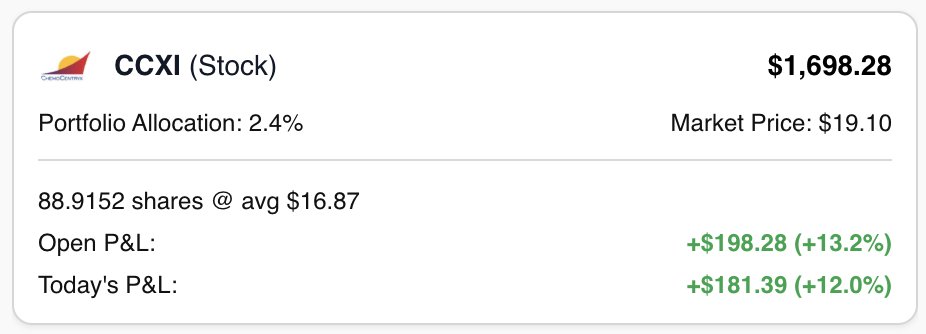
Our analyst bought $CCXI last Wednesday. Today, it's up nearly 12% putting @MelvinInvests up 16.5% on the position in less than a week. For more calls like this, join Milk Road PRO for just $1. (link in bio and below)
Industrial humanoid robots in logistics alone are projected to hit $326B by 2034. And the robot below (Digit) is the first humanoid robot to operate in live commercial environments at scale. Digit is a bipedal humanoid robot designed for warehouse and logistics work that's putting up impressive numbers: - 65,000 operational hours - 100,000 totes moved at customer sites - $300M in binding orders for Digit V5 And they’ve got backing from some serious names: - Amazon, Toyota, and Schaeffler are active customers - Amazon, NVIDIA, SoftBank Vision Fund 2 and Foxconn are all in as both investors and commercial partners. Digit is built by a company called @agilityrobotics that just merged with Churchill Capital Corp XI. So while Agility is still an early-stage company, public investors have a way to get direct exposure through $CCXI for the first time. And our analyst @MelvinInvests started buying $CCXI last week. His view is simple: Humanoid robotics could become one of the biggest AI application layers over the next decade but the winners won't be built overnight. It's an early bet on a market that may take years to mature. Melvin previously called Micron $MU, Credo $CRDO and Nebius $NBIS before their major runs. Don’t miss his next call, try Milk Road PRO for $1. (link in first comment below)
1
638
Our top analyst just bought $CCXI as a bet on humanoid robots. He also called Nebius, Credo, Bloom Energy, AAOI, and AMD before their big run ups. Don’t miss the next one, come join us for just a $1. milkroad.com/pro/?utm_medium…
1
394
Industrial humanoid robots in logistics alone are projected to hit $326B by 2034. And the robot below (Digit) is the first humanoid robot to operate in live commercial environments at scale. Digit is a bipedal humanoid robot designed for warehouse and logistics work that's putting up impressive numbers: - 65,000 operational hours - 100,000 totes moved at customer sites - $300M in binding orders for Digit V5 And they’ve got backing from some serious names: - Amazon, Toyota, and Schaeffler are active customers - Amazon, NVIDIA, SoftBank Vision Fund 2 and Foxconn are all in as both investors and commercial partners. Digit is built by a company called @agilityrobotics that just merged with Churchill Capital Corp XI. So while Agility is still an early-stage company, public investors have a way to get direct exposure through $CCXI for the first time. And our analyst @MelvinInvests started buying $CCXI last week. His view is simple: Humanoid robotics could become one of the biggest AI application layers over the next decade but the winners won't be built overnight. It's an early bet on a market that may take years to mature. Melvin previously called Micron $MU, Credo $CRDO and Nebius $NBIS before their major runs. Don’t miss his next call, try Milk Road PRO for $1. (link in first comment below)
5
2
10
1,655
Milk Road Macro reposted
Legendary investor Gavin Baker: “If you look at the valuations for all these AI names, they can’t all be accurate.” Here is the problem: Memory stocks are trading at 3 to 5 times earnings. NVIDIA is trading at what he describes as a really low PE. Some other accelerator companies are at reasonable multiples. And then on the other side of the AI infrastructure stack, power, cooling and optical names are trading at multiples that imply a very different future. Those two sets of valuations are internally contradictory. If the power, cooling and optical names are right, then NVIDIA and memory are dramatically underpriced and are going up a lot from here. If NVIDIA and memory are correctly valued, then everything else in the stack is overpriced and is probably going to underperform from here. The key is figuring out the correct side of the trade. Our analysts at Milk Road PRO have taken positions in various AI names based on this thesis. They were very early to $MU, $NBIS and $CRDO with over 100% gains. Get access to their exact portfolios for $1 (link in bio).
Gavin Baker says DRAM and HBM DRAM is the single most important bottleneck in all of AI (Save this). All the stocks that supply it are still trading at a discount to everything else in the stack. His argument is foundational: Model performance is constrained by how much memory is available and how fast it can move data. That is why Elon Musk is specifically targeting memory in his tariff strategy. The supply side makes this more interesting. For the HBM DRAM that AI servers actually need, there are only three companies in the world that can manufacture it: Micron, SK Hynix and Samsung. Micron's most recent quarter added another layer: they announced supply chain agreements covering roughly 50% of their revenue with just four customers. The floor pricing in those contracts is already above prior cycle peak gross margins. Every other part of the semiconductor supply chain, equipment, wafer fab, the rest of the stack, has already re-rated to premium multiples. DRAM stocks are still cross-sectionally cheap. Our analysts at Milk Road PRO have been very early to the memory trade with SK Hynix and Micron. Get access to their exact portfolios for $1. (link in bio)
6
20
147
75,129
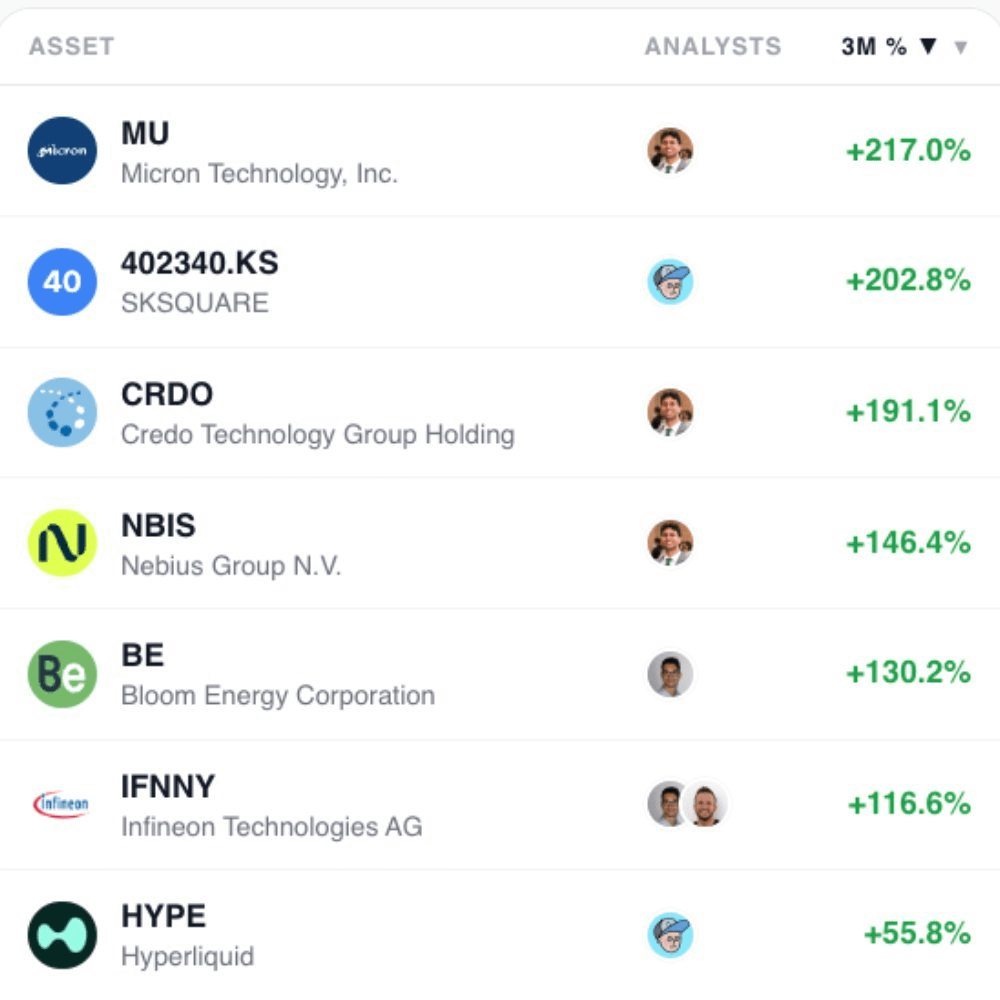
We called to buy multiple AI stocks before their massive runs. Here are our biggest winners: 1. MU is up 217% 2. SK Square is up 202% 3. CRDO is up 191% Don’t miss the next call, come join us for just a $1: milkroad.com/pro/?utm_medium…
1
1,153
Milk Road Macro reposted
AI hit a genuine inflection point in the last few months. "Six months ago, twelve months ago the promise wasn't quite there and so everyone was like 'eh, this AI thing isn't that useful.' But it hit an inflection point in the past few months." Claude Code in December 2025 was the tipping point. The creative productivity gains are now real, not theoretical. FT @naval @garrytan @farbood.
1
3
3
2,749
"A lot of people say that Nvidia is way overpriced but what if it's way underpriced by like several orders?" If compute scales five orders of magnitude in 24-36 months, new capabilities emerge at every step. The chips and data centers being built today might be the biggest underpriced bet in the market. FT @naval @garrytan @farbood.
5
7
63
11,880
Milk Road Macro reposted
Leopold Aschenbrenner's portfolio is basically a bet that AI infrastructure wins everything (Save this). His largest position by a wide margin is $NBIS at 35%, followed by $SDNK at 14.9% and $BE at 12.7%. Other notable names: CRWV MU IREN CORZ TSM APLD INTC Most of his bets focus on compute, power, memory and storage. Our AI analysts take the same approach to investing. They called Micron (217%), Bloom (130%) and Nebius (143%) before their big runs. Get access to their exact portfolios for $1 using the link below.
15
49
292
27,502
There are only two AI companies that actually matter right now. "OpenAI are the only ones making revenue off their models directly. They're not cross-subsidized from another business, not running out of cash. They are actually pouring the cash back in." But Google has lost it. The product is broken in basic ways. Elon gets maybe one more bite at the apple. Meta might be buying talent but can't build culture by ramming people together. FT @naval @garrytan @farbood.
16
4
86
35,459
Our analysts called Micron (217%), Bloom (130%) and Nebius (143%) before their big runs. Don't miss the next call, join us for $1. milkroad.com/pro/?utm_medium…
1
1
1,260
Forget UBI. The real answer is UBR - Universal Basic Robot. "Universal basic robot. Everyone should have a robot." Robotics is 5-10 years away from meaningful deployment but nobody thinks it's impossible anymore. Self-driving cars are already here. The same thing is coming for physical labor. Most of what makes people miserable day-to-day could simply be automated away. FT @naval @garrytan @farbood.
2
2
7
3,292
We called to buy multiple AI stocks before their massive runs. Here are our biggest winners: 1. MU is up 217% 2. SK Square is up 202% 3. CRDO is up 191% Don’t miss the next call, come join us for just a $1: milkroad.com/pro/?utm_medium…
2
908
Our top analyst just bought $CCXI as a bet on humanoid robots. He also called Nebius, Credo, Bloom Energy, AAOI, and AMD before their big run ups. Don’t miss the next one, come join us for just a $1. milkroad.com/pro/?utm_medium…
1
881
Milk Road Macro reposted
Everyone thinks Nvidia's growth relies on data centers, but they are missing the bigger wave (Save this) Robots are the next HUGE demand driver and it will be what pushes $NVDA to $10 Trillion and beyond Robot arms today, robotaxis just starting, humanoids next, and they all need a "NVIDIA brain" Wave one is already here and running at scale: factory arms There are 4.66 million industrial robots working in factories worldwide, with 542,000 installed in 2024 alone, the fourth straight year above half a million units For decades these were blind machines running fixed scripts. AI is now giving them eyes and judgment, and that upgrade runs on Nvidia silicon Wave two is already on public roads: robotaxis Waymo is running 500,000 paid driverless rides every week across 10 US cities, up 10x in under two years and targeting 1 million/week by end of 2026 as it expands to London and Tokyo Every autonomous car is a rolling AI computer, and automotive now sits inside Nvidia's edge business Wave three dwarfs the first two: humanoids Figure's robots already helped build 30,000 cars at BMW over 11 months. Tesla is running 1,000 Optimus units inside its own factories. China's Unitree shipped 5,500 humanoids last year Goldman models a $38 billion humanoid market with 1.4 million units by 2035. Morgan Stanley sees $5 trillion and 1 billion robots by 2050. Nearly every serious humanoid: Figure, Boston Dynamics, Agility, Apptronik, is built on Nvidia's Isaac platform and Jetson brain Here is what the market is missing... Robots do not just add a customer at the edge, they feed the data center growth too A robot learns in simulation on Nvidia data center GPUs, then runs on an Nvidia chip inside its body. Two demand curves, and one feeds the other The one risk worth naming is that robots barely register on Nvidia's revenue today, the entire edge segment that houses robotics is $6.4 billion a quarter against $75.2 billion from data centers But that is the point. That number is tiny before a single humanoid ships in volume, and Nvidia does not have to pick the winning robot. It sells the training compute and the brain to all of them, the same toll road it already owns in AI Data centers were the first act, Robots are the second and Nvidia is at the forefront of the entire thing I am long Nvidia and have been adding throughout this year, while NVIDIA continues to improve its fundamentals, yet the multiple compresses. When the market starts to price in robots, NVIDIA will have another generational run Follow me @kylereidhead for more market analysis on AI and robotics and of course, you can track my real-time portfolio for just $1 at Milk Road PRO (link in bio)
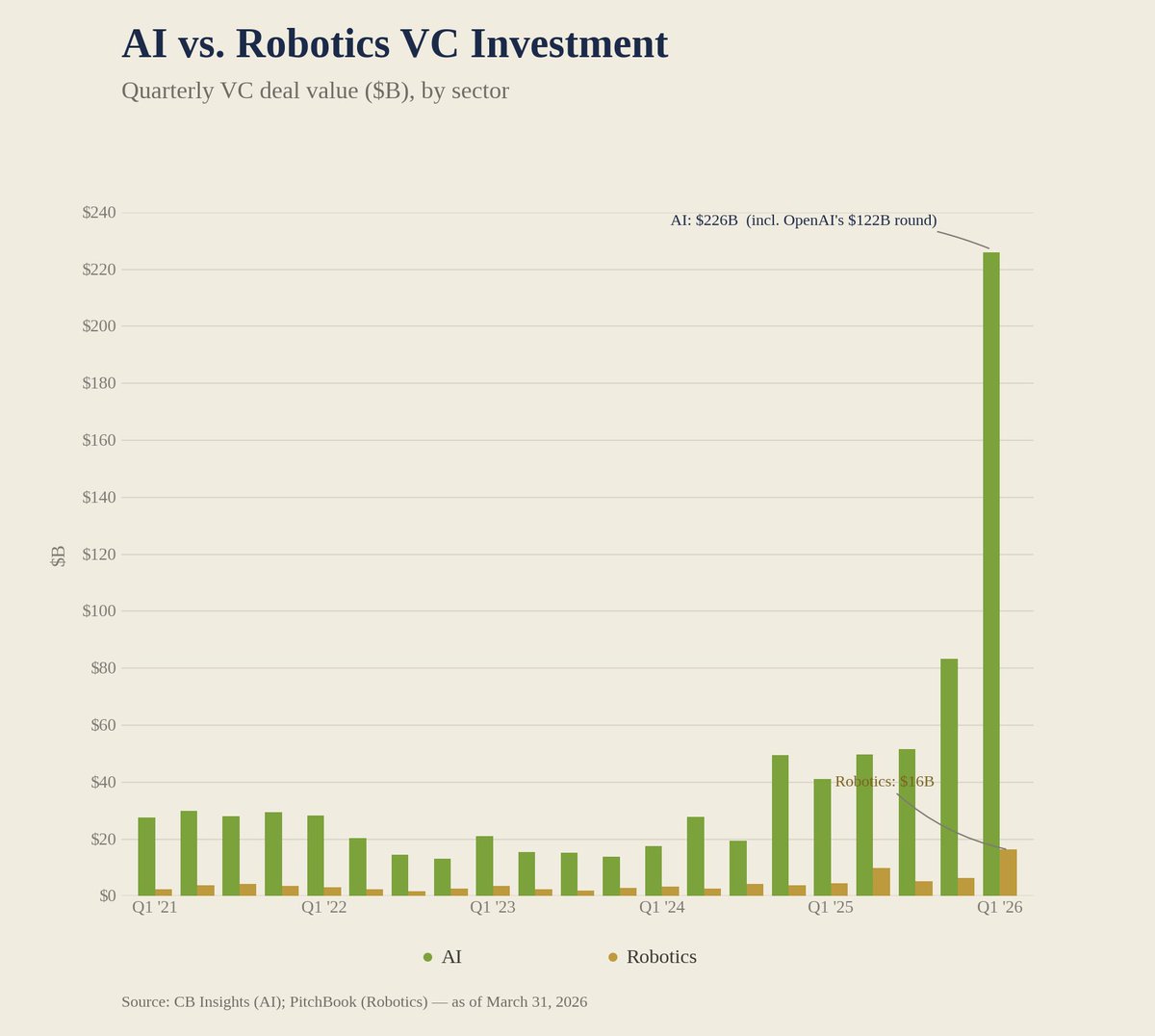
Robotics will be biggest investment theme into 2027 and beyond (Save this). From Q1 2021 through Q4 2024, robotics VC funding was essentially flat compared to AI but in Q1 2026 alone, it hit $16 billion in a single quarter. This is the early signal of a multi year compounding wave that is just getting started. Globally, robotics startups have already raised $18.8 billion in 2026 through June more than the entire full year of 2025 and we still have six months left. 2026 is on pace to nearly double the prior record and the reason is structural and it's not going away. Labor shortages are worsening across every major economy, demographics are aging in the US, Europe, Japan, and China simultaneously. And for the first time, AI has made robots genuinely capable in unstructured, real world environments not just controlled factory floors. As Jensen Huang says "the GPT moment for robotics is upon us" and he introduced the Isaac GR00T humanoid reference platform alongside Cosmos world foundation models. It gives every robotics company access to the same physics simulation and AI training infrastructure that previously only the best funded labs could afford to build and the cost curve for capable robots is about to drop sharply. The investment opportunity spans several distinct layers of the stack. Intuitive Surgical (ISRG) is already printing money in surgical robotics with over 9,000 da Vinci systems installed globally and a recurring revenue model built on instruments and service contracts. The surgical robotics market is projected to grow from $18 billion today to $72.5 billion by 2035 and Intuitive holds dominant share with decades of procedural data no competitor can replicate. ABB (ABBNY) is the most overlooked name in the space. It is the world's largest industrial robotics company, already deploying AI enhanced collaborative robots at scale across automotive, electronics and logistics. With automation now supercharged by AI, ABB's installed base and integration expertise represent a distribution moat that pure play startups will spend a decade trying to build. Teradyne (TER) owns Universal Robots, the global market leader in collaborative robots and MiR, the leading autonomous mobile robot platform for factory floors. It generates consistent cash flow from both hardware and recurring software subscriptions and trades at a fraction of the valuation given to pure play AI robotics names despite being one of the most profitable businesses in the space. Rockwell Automation (ROK) is the industrial automation giant that powers a huge percentage of the world's factories through its programmable logic controllers, software, and AI driven operations platforms. As manufacturers race to automate in response to labor costs and reshoring mandates, Rockwell is one of the primary beneficiaries regardless of which robot hardware wins. For broader exposure, the KOID ETF is focused specifically on humanoid robotics and has been one of the strongest performing thematic ETFs over the past year, offering diversified access across the humanoid supply chain without having to pick individual winners in a market where the leaders aren't fully clear yet. The companies building the physical layer of AI, humanoids, warehouse automation, surgical systems, collaborative robots are in the early stages of the same re rating that AI software stocks experienced from 2023 onward. The window to position ahead of that is right now and make sure to follow me @MelvinInvests for more overlooked opportunities in robotics and AI.
4
13
45
8,418
Gavin Baker says DRAM and HBM DRAM is the single most important bottleneck in all of AI (Save this). All the stocks that supply it are still trading at a discount to everything else in the stack. His argument is foundational: Model performance is constrained by how much memory is available and how fast it can move data. That is why Elon Musk is specifically targeting memory in his tariff strategy. The supply side makes this more interesting. For the HBM DRAM that AI servers actually need, there are only three companies in the world that can manufacture it: Micron, SK Hynix and Samsung. Micron's most recent quarter added another layer: they announced supply chain agreements covering roughly 50% of their revenue with just four customers. The floor pricing in those contracts is already above prior cycle peak gross margins. Every other part of the semiconductor supply chain, equipment, wafer fab, the rest of the stack, has already re-rated to premium multiples. DRAM stocks are still cross-sectionally cheap. Our analysts at Milk Road PRO have been very early to the memory trade with SK Hynix and Micron. Get access to their exact portfolios for $1. (link in bio)
5
9
72
85,202
This is exactly why our analyst has diversified from SK Hynix to Micron: "The Korean market looks extremely overleveraged right now and there's added KRW currency risk on top of that. I'm selling half my SK Square position and rotating into Micron." Great investing isn't just about finding the right trend, it's also about owning it through the best risk-adjusted vehicle. Our analysts don't just simply track US markets. They're watching global capital flows, valuations, currencies and positioning to find the best opportunities. Want to see every portfolio move and the reasoning behind it? Join Milk Road PRO for just $1: milkroad.com/pro/?utm_medium…
Leverage in South Korean stocks is out of control: Assets under management (AUM) in South Korea's leveraged ETFs are up to a record ~$45 billion. AUM has surged 800% since the start of 2026. As a result, leveraged exposure as a % of free float market capitalization, the portion of shares actually available for public trading, is up to a record ~2.9%, more than TRIPLING since January. Meanwhile, the Hong Kong-listed 2x leveraged long SK Hynix ETF rose to ~$15 billion in assets at its peak, the largest single-stock leveraged product in the world. By comparison, four leading 2x leveraged long ETFs tracking Micron, $MU, Nvidia, $NVDA, Sandisk, $SNDK, and Tesla, $TSLA, have each never exceeded $10 billion in assets. Leverage in Korea is at extreme levels.
1
19
5,674
Milk Road Macro reposted
The market punishes hyperscalers for pouring billions into AI infrastructure. So, why is it bullish when $LLY does the same thing? Well, because for Lilly it isn't the same thing at all. For a hyperscaler, the infrastructure is the product. Every $ of data center, GPU, and power capacity gets judged on one question: can we sell more tokens at a justifyable margin? When everyone builds the same capacity at once, those margins compress and so does the multiple. The CapEx competes away its own return. Lilly's AI build never has to clear that bar. It's wiring NVIDIA GPUs into partnerships with Isomorphic and others, plus internal biology models trained on data nobody else holds. None of that gets sold. It feeds Lilly's own drug engine: discovery, molecule design, faster trials, manufacturing, patient targeting. The return doesn't show up as an AI revenue line. It shows up as a better pipeline. That's the whole answer to the valuation question. Hyperscaler capex builds a capacity that competitors also build, so the market prices in the margin war. Lilly's capex compounds an advantage nobody else can copy, because no startup has Lilly's data, FCF, and manufacturing footprint to point the models at. One better molecule, one faster trial, or one tighter patient-data loop can pay for the entire AI budget several times over. Hyperscalers are laying the railroads for AI, and railroads get commoditized. Lilly is using AI to build a better biology factory, and the factory is the moat. Same spending line, opposite investment case. I break down the full LLY AI thesis on Milk Road. Join for 1$. Link in the comments.
4
5
21
4,345