AI Analyst @MilkRoadAI | Finding opportunities across AI, photonics, defense, space, and tech.

Joined June 2026
77 Photos and videos
Pinned Post
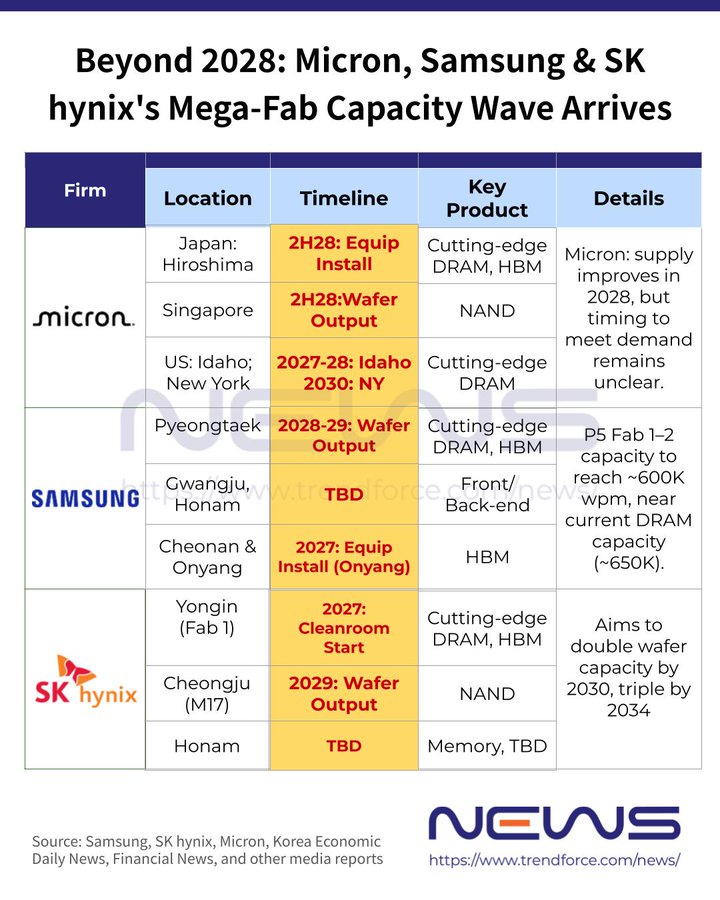
The three biggest memory companies on earth just told you exactly when supply gets better and the answer is not anytime soon (Save this). The AI stack has three layers, chips at the bottom, models in the middle, applications at the top and memory sits at the foundation of all of it. The problem is the foundation cannot keep up with what is being built on top of it. Every AI chip, Nvidia H100, H200, B200 requires High Bandwidth Memory (HBM) stacked directly on it and HBM takes roughly 3x the wafer capacity of standard DRAM to produce. The result is demand is already far outstripping supply. Micron's entire 2026 HBM output is fully pre-sold and allocated to hyperscalers and new orders are being deferred to late 2027, key customers are currently receiving only 50–67% of their demanded HBM volume. The chart maps out when new fab capacity comes online and the insight is that none of it matters yet. All the new fabs listed, Micron's Hiroshima, Samsung's Pyeongtaek P5, SK Hynix's Yongin are either still being equipped or won't produce a single wafer until 2027–2029 at the earliest. Until then, all three companies are running on fixed, cannot be expanded capacity. Micron has three expansion waves, Hiroshima equipment install happening now in 2H 2028 for cutting edge DRAM and HBM, Singapore wafer output 2H 2028 for NAND, Idaho meaningful volume mid-2027, New York not until 2030. Samsung's Pyeongtaek P5 full wafer output for cutting edge DRAM and HBM does not arrive until 2028–2029, Onyang gets HBM equipment installed in 2027, Gwangju/Honam has no confirmed timeline at all. SK Hynix's Yongin Fab 1 only starts cleanroom construction in 2027, Cheongju M17 NAND output in 2029 and the company aims to double capacity by 2030 and triple by 2034, meaning real relief is nearly a decade away. Now here is what the chart does not show. Even when these fabs open, supply does not catch up to demand because HBM requires precision stacking tools with 12-month lead times and even when wafers are ready, they cannot be assembled into usable HBM fast enough. The supply will be tight for many years to come, long Micron and make sure to follow me @melvininvests for more updates around Memory and Semi's.
7
17
64
7,788
Melvin reposted
The three biggest memory companies on earth just told you exactly when supply gets better and the answer is not anytime soon (Save this). The AI stack has three layers, chips at the bottom, models in the middle, applications at the top and memory sits at the foundation of all of it. The problem is the foundation cannot keep up with what is being built on top of it. Every AI chip, Nvidia H100, H200, B200 requires High Bandwidth Memory (HBM) stacked directly on it and HBM takes roughly 3x the wafer capacity of standard DRAM to produce. The result is demand is already far outstripping supply. Micron's entire 2026 HBM output is fully pre-sold and allocated to hyperscalers and new orders are being deferred to late 2027, key customers are currently receiving only 50–67% of their demanded HBM volume. The chart maps out when new fab capacity comes online and the insight is that none of it matters yet. All the new fabs listed, Micron's Hiroshima, Samsung's Pyeongtaek P5, SK Hynix's Yongin are either still being equipped or won't produce a single wafer until 2027–2029 at the earliest. Until then, all three companies are running on fixed, cannot be expanded capacity. Micron has three expansion waves, Hiroshima equipment install happening now in 2H 2028 for cutting edge DRAM and HBM, Singapore wafer output 2H 2028 for NAND, Idaho meaningful volume mid-2027, New York not until 2030. Samsung's Pyeongtaek P5 full wafer output for cutting edge DRAM and HBM does not arrive until 2028–2029, Onyang gets HBM equipment installed in 2027, Gwangju/Honam has no confirmed timeline at all. SK Hynix's Yongin Fab 1 only starts cleanroom construction in 2027, Cheongju M17 NAND output in 2029 and the company aims to double capacity by 2030 and triple by 2034, meaning real relief is nearly a decade away. Now here is what the chart does not show. Even when these fabs open, supply does not catch up to demand because HBM requires precision stacking tools with 12-month lead times and even when wafers are ready, they cannot be assembled into usable HBM fast enough. The supply will be tight for many years to come, long Micron and make sure to follow me @melvininvests for more updates around Memory and Semi's.
7
17
64
7,788
@Micro2Macr0 when is people gonna listen!
1
459
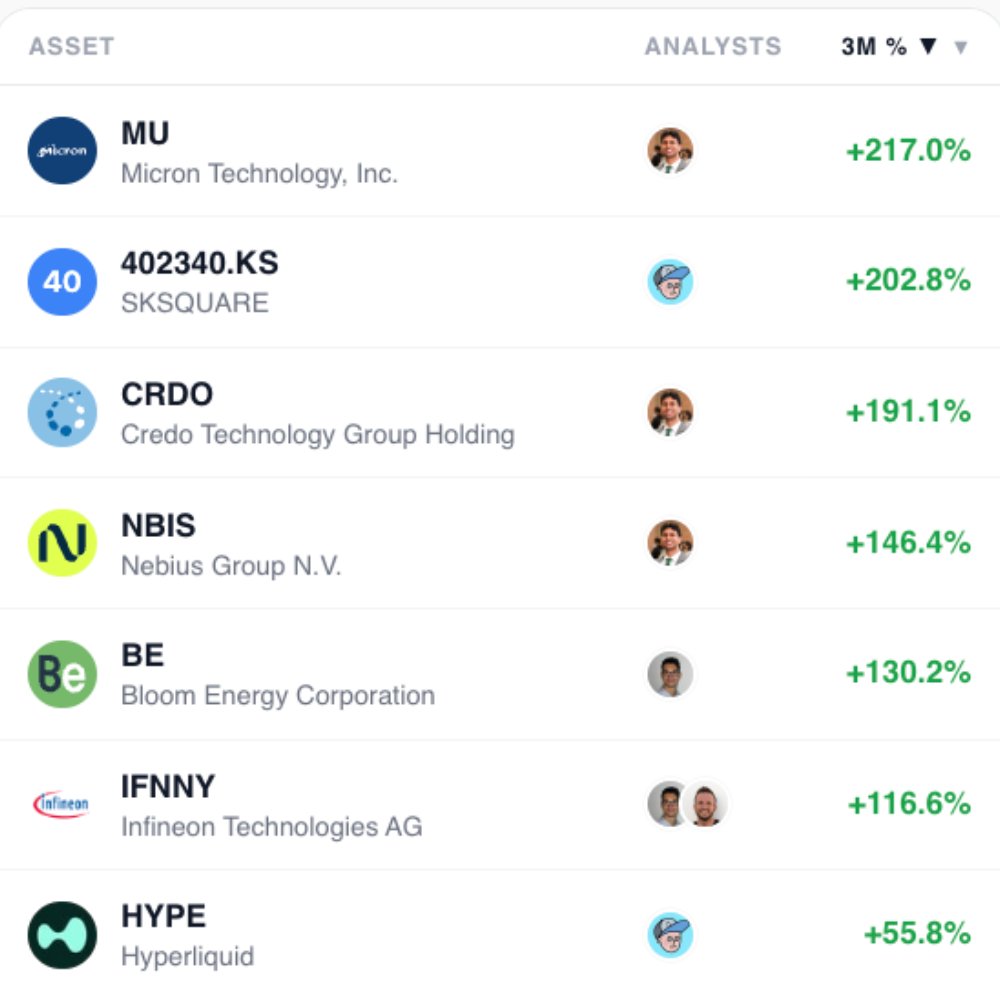
I’m an analyst at Milk Road, and my job is to find underrated gems before the market catches on. We called names like MU, CRDO, NBIS, and BE over the last 3 months. Join me and my team for just $1. milkroad.com/pro/?utm_medium…
447
Melvin reposted
Did you listen anon? This is why you listen to Milk Road analysts, MU is up 4% overnight and the Micron thesis is playing out. Join us for just $1 using the link below!
Go ahead and short Micron, I dare you and you will get burned (Save this). This chart shows data center memory demand goes from $60 billion in 2024 to $1.4 trillion by 2030. That's 23x in six years and that number doesn't include phones, laptops, or cars but just data centers. Three companies make this memory, Samsung, SK Hynix, and Micron and no one else is coming and China's CXMT is years behind on advanced nodes and isn't a factor in HBM at all. The product everyone actually wants right now isn't regular DRAM but it's HBM, High Bandwidth Memory. These chips are physically bonded onto Nvidia's GPUs and sit millimeters from the compute die. A single Blackwell GB200 needs 192GB of it while one NVL72 rack needs 13,824GB. Meta and Microsoft are ordering these racks by the thousands and every single one is a guaranteed HBM purchase. Micron sold out its entire 2026 HBM supply before the year even started. Micron has signed 16 take or pay contracts locking in $100 billion in minimum revenue and customers have already wired $22 billion in upfront cash for chips that haven't been made yet. That's not a commodity business anymore but rather customers paying in advance because they're scared of running out. AI capex has officially gone parabolic, Meta $145B, Amazon $100B, Microsoft $80B, and Google $75B in a single year and every dollar of that capex eventually touches memory. This chart shows AI data center memory going from $106 billion in 2026 to $285 billion in 2028 to $517 billion in 2030, growing 40–60% a year, every year, backed by capex that's already been announced. Micron owns about a third of the global memory market, a third of $1.4 trillion is $470 billion flowing to one company from data centers alone before a single consumer device ships. Shorting Micron means betting hyperscalers stop building, AI demand disappears and somehow one of three companies with a physical monopoly on critical infrastructure loses its seat at the table. Milk Road Pro subscribers are up massively on Micron, come join us just for a dollar to see rest of our trades using the link below!
5
4
11
6,556
Melvin reposted
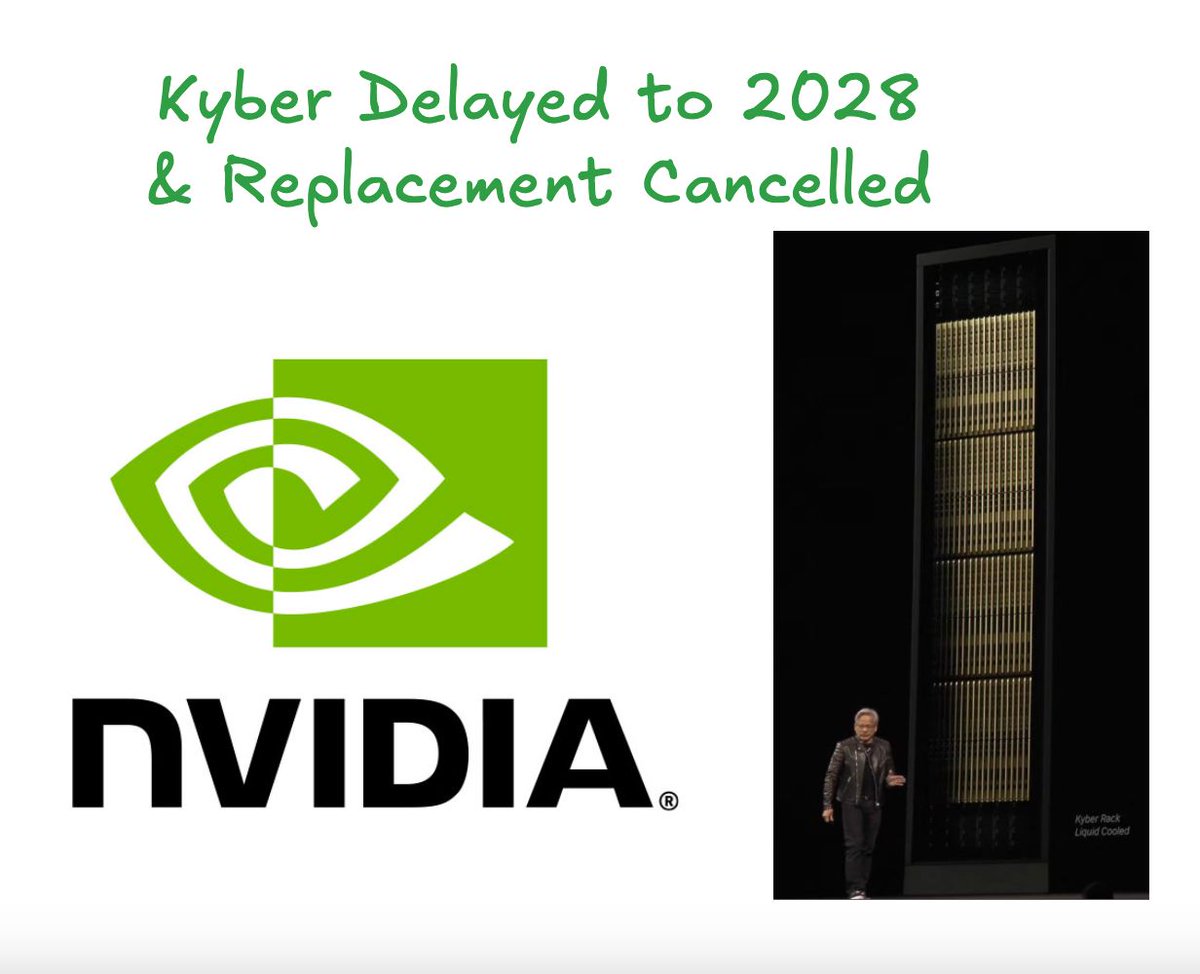
Kyber is Nvidia’s next generation rack architecture, the NVL144 system Jensen demoed at GTC just three months ago, and now it is reportedly delayed. (Save this). It was supposed to be the successor to the current NVL72 Blackwell rack, doubling the GPU density per rack to 144 chips and representing the next major leap in AI training infrastructure. Three months after that demo, SemiAnalysis is reporting it has been delayed by more than 12 months, pushing it to 2028. On top of that, the NVL72x2 back to back rack which was being positioned as a bridge architecture to replace Kyber has apparently been cancelled entirely.x 1 The core reason for the delay is technical. Kyber was designed to use co-packaged optics, CPO for the scale up interconnect between GPUs inside the rack. CPO integrates optical components directly onto the chip package, dramatically increasing bandwidth and reducing power consumption at the rack level. But the manufacturing yield rates on CPO optical engines, the difficulty of integrating them with the ASIC, and the cost structure have all proven harder to crack at volume than projected. AMD and Marvell benefit from any architecture environment that extends Blackwell's dominance, because both are competing for the next generation of custom silicon at hyperscalers who are now more motivated than ever to reduce dependency on a single Nvidia roadmap. When Nvidia delays, hyperscalers accelerate their own chip programs and AMD and Marvell are the primary beneficiaries of that spending. Broadcom benefits the same way, its custom accelerator business building bespoke AI chips for Google, Meta, and Anthropic becomes more attractive every time Nvidia's roadmap slips. Now for AAOI and this is where the market is likely to get it wrong. Most people have been treating Applied Optoelectronics as a CPO play and that framing is incorrect. AAOI supplies high power lasers and optical components that enable Near Packaged Optics, CPO, and its own On Board Optics solutions but the majority of its current revenue comes from pluggable transceivers, not CPO. It has been winning volume orders for 1.6T transceivers and positioning its ELSFP lasers as a foundation for next-generation NPO and CPO architectures. That distinction matters enormously right now. The Kyber delay means the full CPO transition gets pushed out which keeps pluggable optics, the core of AAOI's business today, in heavy demand for at least two more years of the most aggressive AI cluster buildout in history. Every NVL72 rack that ships instead of waiting for Kyber uses pluggable transceivers and every month the CPO integration is delayed is another month of near-term revenue from hyperscalers scaling AI clusters right now. The irony is that Nvidia's Rubin Ultra manufacturing hiccups and spec downgrades, the exact problems causing the Kyber delay are keeping demand strong for the more mature, modular optics that AAOI actually sells today. And because AAOI makes a lot more from pluggable and near-package products than from CPO, it benefits in the immediate term even more than the pure CPO narrative would suggest. Bullish on AAOI and make sure to follow me @MelvinInvests for more overlooked semiconductor ideas.
MASSIVE DELAY: Just 3 months after Jensen demoed Kyber NVL144 at GTC, it has faced major setbacks and has been delayed by more than 12 months, pushing it back to 2028. Below, we explain why Kyber has faced massive delays and why NVIDIA’s NVL72x2 back-to-back rack architecture was also cancelled, leaving Rubin Ultra with a limited scale-up domain. 👇️ 1/6🧵
3
10
52
13,534
I’m an analyst at Milk Road, and my job is to find underrated gems before the market catches on. We called names like MU, CRDO, NBIS, and BE over the last 3 months. Join me and my team for just $1. milkroad.com/pro/?utm_medium…
598
Melvin reposted
The humanoid robot market is projected to reach $7.5 trillion by 2050 and most investors are looking at the wrong companies (Save this). Everyone is focused on the robots themselves but a humanoid robot is just a collection of precision components and right now, a handful of industrial suppliers quietly control the bottlenecks that every single robot company on earth depends on. That component diagram above is your investment map. The most critical component in any humanoid robot is the reducer, the precision gearbox that converts motor speed into torque for each joint. Every shoulder housing, knee joint, hip actuator runs through one and right now, one Japanese company controls 85% of the global market for the dominant type, strain-wave harmonic reducers. That company is Harmonic Drive Systems (6324.T / HSCDF). Harmonic Drive is a confirmed supplier to multiple major humanoid programs and the entire global industry depends on its output. Revenue was ¥55.6 billion in FY2025 and order books are accelerating as OEM production ramps and it is the closest thing to a monopoly in the entire humanoid supply chain. The second reducer type, cycloidal RV reducers, which dominate heavier joints like hips and shoulders is controlled by Nabtesco (6268.T / NCTKY), also Japanese, with roughly 60% global share. FY2025 revenue hit ¥307.9 billion, up 9.8% year over year, with operating profit up 60% in the same period. Both companies are so embedded in the supply chain that even the Chinese robot manufacturers racing to commoditize components still rely on Japanese reducers for precision critical applications. Together, actuators and reducers represent 30 to 51% of the entire hardware bill of materials for a humanoid robot. When you're talking about a billion robots by 2050, the companies that supply those components are not riding a theme, they are the theme. The next layer is bearings and precision transmission. SKF (SKFB.ST), the Swedish industrial bearing giant, announced a joint venture on July 2, 2026 with Chinese precision component maker Leaderdrive specifically to supply high precision transmission components for humanoid robot joints. SKF is taking a 60% majority stake, targeting both the Chinese market, the world's largest and fastest growing humanoid robotics market and international expansion through its global sales network. SKF has the manufacturing scale, the quality systems, and the global distribution and it is now directly positioned inside the humanoid supply chain at the joint level. The force and torque sensor market is the next critical bottleneck because every foot, wrist and ankle in a humanoid robot needs a sensor that tells it exactly how much force it is applying, the thing that lets a robot grip a fragile object without crushing it. The global humanoid force/torque sensor market was $700 million in 2025 and is forecast to reach $6.4 billion by 2032, growing at 37.1% annually. Novanta (NOVT) is the publicly traded play here because its ATI Industrial Automation subsidiary, acquired specifically for its robotics sensing capabilities launched the Varo force/torque sensor in early 2026, purpose-built for humanoid platforms. Novanta also owns Celera Motion, which supplies advanced motion control components to robot joints and it is one of the few US-listed companies with real, shipping revenue from humanoid component supply.l The broader motors and drives layer belongs to Nidec (6594.T / NJDCY), a Japanese company with ¥2.61 trillion in annual revenue that revealed a full six-axis humanoid drive solution at IREX 2025 meaning it can supply the complete motor stack for an entire robot from a single vendor. And Yaskawa Electric (6506.T / YASKY), which just acquired Tokyo Robotics and posted FY2026 operating profit up 70% year over year, is moving aggressively from industrial arms into humanoid platforms. The pattern across all of these companies is identical, decades of precision manufacturing expertise built for industrial automation and automotive, now being redirected into a market that is about to be orders of magnitude larger. Bullish on the supply chain because every humanoid robot needs the same critical components and make sure to follow me @MelvinInvests for more overlooked opportunities.
11
32
137
11,917
I’m an analyst at Milk Road, and my job is to find underrated gems before the market catches on. We called names like MU, CRDO, NBIS, and BE over the last 3 months. Join me and my team for just $1. milkroad.com/pro/?utm_medium…
2
565
Melvin reposted
Most neoclouds will fail but Nebius will be the king of them all and it's on its way to becoming a trillion dollar company (Save this). As Jensen Huang says that one gigawatt of AI compute generates $300 to $400 billion in intelligence and the cost to build that gigawatt data center was $50 billion when he first said it. Then, months later, he revised it upward to $100 billion as next generation Blackwell architecture, denser power infrastructure and cooling complexity drove costs higher. And that is exactly the filter that kills most neoclouds. When a 1GW data center costs $100 billion to build, this is no longer a game that startups, lightly capitalized operators, or companies without iron clad customer contracts can play. The neoclouds that survive will be the ones that locked in power at scale before the window closed, secured hyperscaler customers before the capacity came online, and built software layers deep enough that customers stay rather than churn to the next available GPU rack. Most neoclouds have none of those three things simultaneously but Nebius has all of them. The revenue growth alone is one of the most extraordinary numbers in public markets right now. In Q1 2025, Nebius generated $50.9 million in revenue. In Q1 2026, it generated $399 million, a 684% increase in twelve months and the management is guiding for $7 to $9 billion in annualized revenue run rate by the end of 2026, implying 540% growth within a single calendar year. Behind that trajectory is a power buildout that has no real peer outside the hyperscalers. As Nebius Founder says, how many companies today provide hundreds of thousands of GPUs in a publicly available cloud? The three hyperscalers, and Nebius and that's the list. The contracted power capacity tells the full story. Nebius entered 2025 targeting 1 GW of contracted power by year-end 2026 and by Q4 2025 that target had been revised to 2.5 GW. By Q1 2026 earnings, contracted power had reached 3.5 GW already above the prior target with guidance raised again to over 4 GW by year-end. A new gigawatt-scale campus in Pennsylvania was announced in June 2026, targeting 1.2 GW at full completion, with 250 to 350 MW available by end of 2027 and owned facilities across five sites, New Jersey, Finland, the UK, France, and Israel will deliver 3 GW total. The customer base is the other reason survival is not in question. Nebius has signed contracts worth over $46 billion with Meta and Microsoft dedicated AI data center capacity commitments running through 2031. The $17.4 billion Microsoft deal alone covers dedicated GPU capacity for a new center in Ireland starting this year. These are five year take or pay agreements with the two largest technology companies on earth, signed before the facilities even opened and then there is the software layer, the part that most investors still haven't priced in. Nebius has been acquiring rapidly to build a full inference and agentic AI platform, picking up Tavily, Eigen AI, and Clarifai to deepen its managed inference capabilities and AI orchestration stack. Customers can run inference, build AI agents, develop custom models, and access the full software stack without leaving the platform and that software layer, stacked on top of GPU rental revenue, is already beginning to move overall margins structurally higher. Extremely bullish on Nebius and make sure to follow me @MelvinInvests for more AI infrastructure ideas.
17
23
211
33,294
I’m an analyst at Milk Road, and my job is to find underrated gems before the market catches on. We called names like MU, CRDO, NBIS, and BE over the last 3 months. Join me and my team for just $1. milkroad.com/pro/?utm_medium…
1
2
885
Melvin reposted
Most investors are watching the chip companies while the real money is sitting two layers upstream (Save this). What you're looking at is the entire semiconductor supply chain, the companies, layers and dependencies that take a chip from raw silicon wafer to finished hardware inside a data center. And once you understand how this chain works, you realize that the best investments in AI aren't the chips themselves but rather the companies that every chipmaker on earth cannot operate without. The chain starts with raw materials. Shin Etsu, Siltronic, and GlobalWafers supply the silicon wafers that every chip is built on. Wolfspeed and Coherent supply silicon carbide wafers for power chips and these are quiet, unglamorous oligopolies where supply takes years to expand and demand is structurally growing. Before any chip gets manufactured, it has to be designed and that's where Synopsys and Cadence come in, two companies that together control 73% of the global EDA software market and combined generate over $12 billion in annual revenue. Every GPU, every TPU, every hyperscaler custom ASIC passed through their tools before a single transistor was ever laid down. You literally cannot design a chip without them. At Computex 2026, both companies unveiled agentic AI tools that automate chip design steps that used to take weeks, and Jensen Huang endorsed Cadence's autonomy roadmap from stage meaning AI is making their software more valuable. Cadence posted Q1 2026 revenue of $1.47 billion, up 19% year over year, and raised full year guidance to $6.2 billion. Then comes the most important monopoly most people have never seriously studied. ASML is the only company on earth that manufactures EUV lithography machines, the tools that physically print circuits onto silicon at advanced nodes below 7nm. Every advanced chip fab on the planet, TSMC, Samsung, SK Hynix, Intel is entirely dependent on ASML and has no alternative. Each machine costs $300 to $400 million and takes over a year to build and ASML raised its 2026 revenue guidance to €36 to €40 billion and entered the year with a backlog of €38.8 billion, larger than its entire annual revenue target. SK Hynix alone committed $8 billion for 30 machines and the new High NA EUV systems, the next generation priced above $400 million each are just entering production with margins that will only expand as volume scales. KLA Corporation runs the quality control layer, and almost nobody outside the industry talks about it. As chips get smaller and more complex, the cost of a single undetected defect rises exponentially which means inspection intensity per wafer increases with every new node. KLA holds approximately 70% market share in wafer level packaging process control, a position it gained 14 percentage points in a single year as advanced AI chip packaging accelerated. Revenue in its March 2026 quarter came in at $3.415 billion, up 11% year over year, and the company's own internal targets point to $26 billion in annual revenue by 2030, roughly double where it is today. Here is the investment thesis in one paragraph. Hyperscalers are spending over $700 billion on AI infrastructure, and the race is only getting bigger. Every single dollar of that capex flows through this supply chain before a single AI query gets processed. And the companies at the chokepoints of that chain, ASML with its EUV monopoly, Synopsys and Cadence with their EDA duopoly, KLA with its inspection dominance have no real competitors, multi-decade moats, and revenue that grows almost mechanically every time a new AI chip gets designed and manufactured. Long Upstream companies and make sure to follow me @MelvinInvests for more overlooked opportunities in semiconductors.
9
51
234
22,446
Melvin reposted
Anyone who says demand for compute is getting lower is an idiot (Save this), H100 GPU rental prices fell steadily for two years from $3.00 per hour in early 2023 down to $1.70 by October 2025. Every bear on compute pointed at that line and said demand was collapsing but then December arrived and prices reversed hard climbing 40% in five months to $2.35 by March 2026, with a 15 to 20% single step move in just January and February alone. The people who called this a bubble were confusing the first wave with the total story. The 2023 price spike was training, a handful of frontier labs doing massive one-time compute runs to build foundation models. and that demand was concentrated and eventually satisfied but what replaced it is fundamentally different and the current demand is inference, and inference doesn't stop. OpenRouter processed 6.4 trillion tokens in the first week of January 2026 but by February 9 that number had doubled to 13 trillion and March it was 14.8 trillion weekly, a 160% increase in two months. That's only third-party API traffic, completely excluding direct usage at Google, OpenAI, Anthropic, and Meta. The driver is agentic AI because when a user sends one message to a chatbot, they generate a few hundred tokens. When an AI agent completes a multi-step task, researching, reasoning, writing code, iterating, it generates thousands to tens of thousands of tokens per job. On the supply side, H200 and B200 lead times are running 36 to 52 weeks and on-demand capacity is effectively sold out. Alibaba and Baidu both raised AI compute prices in Q1 2026 because they couldn't keep up with demand. The hyperscalers know exactly what is happening, five companies, Amazon, Alphabet, Microsoft, Meta, and Oracle are collectively spending $700 billion on AI infrastructure in 2026 alone, six times what hyperscalers spent in all of 2022. Wells Fargo projects total capex from 2026 to 2028 at $2.47 trillion Cheaper intelligence doesn't reduce demand for compute but rather it expands the universe of tasks that can be automated and more tasks mean more tokens, more inference, more GPUs, and more power. That's the cycle we're in and make sure to follow me @MelvinInvests for more structural trends shaping AI.
21
30
175
25,151
I’m an analyst at Milk Road, and my job is to find underrated gems before the market catches on. We called names like MU, CRDO, NBIS, and BE over the last 3 months. Join me and my team for just $1. milkroad.com/pro/?utm_medium…
896
I’m an analyst at Milk Road, and my job is to find underrated gems before the market catches on. We called names like MU, CRDO, NBIS, and BE over the last 3 months. Join me and my team for just $1. milkroad.com/pro/?utm_medium…
1
1,287