


Building mission-critical infrastructure for the most demanding industries and the US Government @8090solutions

Joined April 2007
842 Photos and videos
Pinned Post
We raised a $135M Series A! 8090’s Series A was led by Salesforce Ventures and joined by WNDR, Craft Ventures, The Production Board, and LAUNCH. We also had the support of a group of esteemed angels including Nikesh Arora, Cliff Robbins, Adam D’Angelo, Shyam Ravindran, Abhi Arun, and Thomas Laffont. We’re grateful for their support. It validates 8090’s mission and traction so far, but mostly it accelerates the work ahead. The capital will go to two places. The first is hiring more people, because the demand we have is accelerating rapidly. The second is investing in the compute and infrastructure needed to keep delivering our solutions at high quality and reliability. 8090 works with the biggest, hardest, most demanding customers in the most regulated industries: healthcare, insurance, life sciences, aerospace, energy, manufacturing, financial services, and the United States government. We help them win by using our AI-enabled Software Factory to design and build entire new systems, refactor old ones, and find and accelerate their edge. Our view is that as Software Factory is used more and more to do mission-critical work inside industries with the least tolerance for error and the most oversight, it will be used to bring transparency, consistency and control to work everywhere. And as we expand the potential of the biggest organizations, we are also building a playbook and a series of network effects into Software Factory that will be valuable to everyone, from SMBs to solo founders. With much gratitude, back to work… PS - A note on why I am doing this as CEO, rather than from the board. This is one of those rare moments when the technological ground is moving so ferociously underneath all of us that the decisions made in the next few years will set the stage for the next twenty. AI can be the grand equalizer. It is the thing that can give everybody a shot, and I would like to help it achieve that potential. Since I left Facebook, I was waiting for a moment like this to return to a full-time operating role. I was a demanding manager back then, but I felt I had no choice given how powerful and undeniable what we were building was. I am convinced that what we are building now is even more important, so there was no decision to make except to be all in.
310
149
3,064
1,065,869
Looks like Apple rebranded “top episodes” to “trending episodes” - regardless, we’re # 5 over the holiday weekend.
31
8
223
47,350
As said on the pod last month…the price of poker is going up.
NVIDIA CEO JENSEN HUANG: 1GW AI FACTORY ON NVIDIA ARCHITECTURE COULD COST NEARLY $100 BILLION
85
71
2,135
685,434
Chamath Palihapitiya reposted
.@chamath on building a moat in 2026: If you are a reasonable company, why are you not finding an independent way to access intelligence in a way that doesn't leak your edge away? To [not] do so at this point now is kind of becoming derelict and irresponsible… With post-training and telemetry collected from usage, you can take GLM, control it entirely, soup to nuts, on your own hardware, inside the United States, and have it be much, much cheaper. Start building your own intelligence today.
32
24
303
97,947
Chamath Palihapitiya reposted
Chamath is making one of the most important business arguments of 2026. Half of large US companies right now cannot generate returns that exceed their cost of capital, which has normalized back to its long run average of 8 to 11%. Another one in seven companies globally is stuck generating persistent returns between 1 and 5% and most businesses don't have room for error and in this environment walks every frontier AI lab saying the same thing, give us your data, your workflows, your processes and our model will make everything better. And companies by the millions said yes. What they didn't fully account for is what happens on the other side of that door. Every time an employee runs a query through a frontier model API, the prompt goes through external servers, workflows, customer data, pricing logic, internal processes, all of it transmitted through a third party. As Alex Karp said companies are spending on tokens while handing over the exact proprietary advantages that make their business worth owning. Microsoft blocked internal use of Anthropic's Claude Fable 5 but over its 30-day data retention policy and the largest software company in the world decided a frontier model's data handling was too risky for its own employees. A US government action revoked access to another frontier model for foreign nationals overnight. Now here's where the cost math becomes impossible to ignore. Deutsche Bank calculated a roughly 65x cost gap between frontier models like Claude Fable 5 at ~$3.25 per task and open-source alternatives at ~$0.05. For 90% of everyday enterprise tasks, performance is comparable. Open-weight models now match closed frontier systems on core agent tasks at roughly one-tenth the cost, a high-volume deployment that costs $250/day on Claude runs at $12/day on an open-source equivalent. @chamath tested this directly by running a standard enterprise code migration task through an orchestration layer wrapping an open-source model came in 16.4x cheaper than using a frontier model directly.
69
143
1,266
268,820
I believe this 💯.
.@chamath says Palantir CEO Alex Karp is " an incredible, smart, brilliant guy" who "completely nailed it and called out on its face the huge risk" of giving your company's alpha to OpenAI and Anthropic: "If you are a reasonable company, why are you not finding an independent way to access this intelligence in a way that doesn't leak your edge away?" "To do so at this point now is kind of becoming derelict and irresponsible." "Back then, you could be experimenting because you didn't know any better." "Now, when you know all of these data points, to continue to make the same decision is really insanely dumb." Via @theallinpod @DavidSacks @friedberg @Jason
60
89
1,377
256,595
To our Founding Fathers, thank you for creating heaven on earth 250 years ago. America has given so many of us everything we have. I, personally, owe her everything in return. Happy 4th!
205
648
11,108
177,627
The federal government is currently trying to do something hard and right: collapsing more than 100 separate HR systems into one. Civil servants and appointed leadership have wanted this for decades. What stopped them was not willpower, executive mandate or talent but tech debt and complexity built up slowly over decades from each system. That trend finally has a counterweight, because AI is collapsing the cost of rebuilding and retiring old software. The agencies that pair their institutional knowledge with a well governed AI control plane are going to move faster and accomplish more than anyone expects. 
If you’re interested, here is how we help agencies modernize and retire the systems they inherited, with the audit trail that public accountability and taxpayers should demand: bit.ly/4vJbIlf
42
56
561
98,416
Tesla is one of the smartest, cracked and most advanced engineering companies in the world. If they actually did this, then it is likely verifiably true that a dollar above $200/week is waste.
JUST IN: Tesla reportedly caps employee AI spend at $200 per week
435
388
10,448
1,594,107
TL;DR: Use a control plane, pick your model on a per task basis, do it massively cheaper as a result, keep your edge, don’t leak it to the frontier labs. The thoughts below are exactly what we find in large enterprises that use 8090’s Software Factory control plane. Our control plane is agnostic and sits above all the model chaos. You use it to manage your engineering team. It creates a more rigid conformation to the software development lifecycle so Owners and executives get well documented, governed, auditable software - not broken promises, vaporware pr large T&M bills. Engineers need to do a bit more work upfront but then are relieved of dealing with infinite slop in return. For example, on a typical migration task of an enterprise workload (PHP—>next.js), when we chose Opus 4.8 inside our control plane, Software Factory gets to the right answer 1.5x faster and 1.4x cheaper than using Opus alone. If an Enterprise asks our control plane to use an open weight model like GLM, instead, the costs fall even more dramatically. The migration is 16.4x cheaper but 3x slower but still works! This brings up the obvious: at some near point in the future all large enterprises - ie those currently spending millions per month or more on tokens so they seem brilliant to a Wall Street analyst or their Board - will have to rationalize why the would spend so much more for inefficiency, poorer outcomes and data leakage to providers that increasingly also want to compete with them.
Coding is most of the LLM TAM, and half of that TAM is inefficiency. The models burn tokens generating garbage code and redoing it. Nothing else burns tokens like this. Deflate the waste away and there's not much left to sell, until physical robots.
44
39
535
171,774
Smart take.
The researchers getting rich off Anthropic secondaries are cheering for the thing that would make them ordinary employees again. Right now they are paid like NBA free agents because they are the labs’ most visible moat. The frontier labs are struggling to hold a durable, ownable edge: models get copied, undercut, or matched by cheaper and open rivals within months. So the real advantage lives in a few hundred people who know how to push the frontier, and who can also leave, raise billion-dollar, double tranched seed rounds, and compete directly. That is why the labs are paying them not to leave. with secondaries as retention payments, mission / fear, etc... Pharma shows where this can end up. In a drug company, the value does not belong to the scientist. The scientist can be paid well, but not hundreds of millions over three or four years, because the durable value sits in the patent and the FDA approval. The researcher who discovered the molecule can quit tomorrow, but the company still owns the asset. A regulatory moat would do something similar for AI labs. It would move value from the person to the institution. Regulation is a wall against three threats at once: competitors, open source, and the labs’ own researchers. The researchers getting rich off secondaries today are, by cheering the regulated future, voting to end the exact leverage that made them rich.
12
16
448
272,107
True
AI has reignited an old fear—that technology will eliminate work. In a new F&D piece, I argue that the outcomes will depend more on the policies that govern the adjustment than on AI as a technology (thread) imf.org/en/publications/fand…
15
7
171
124,174
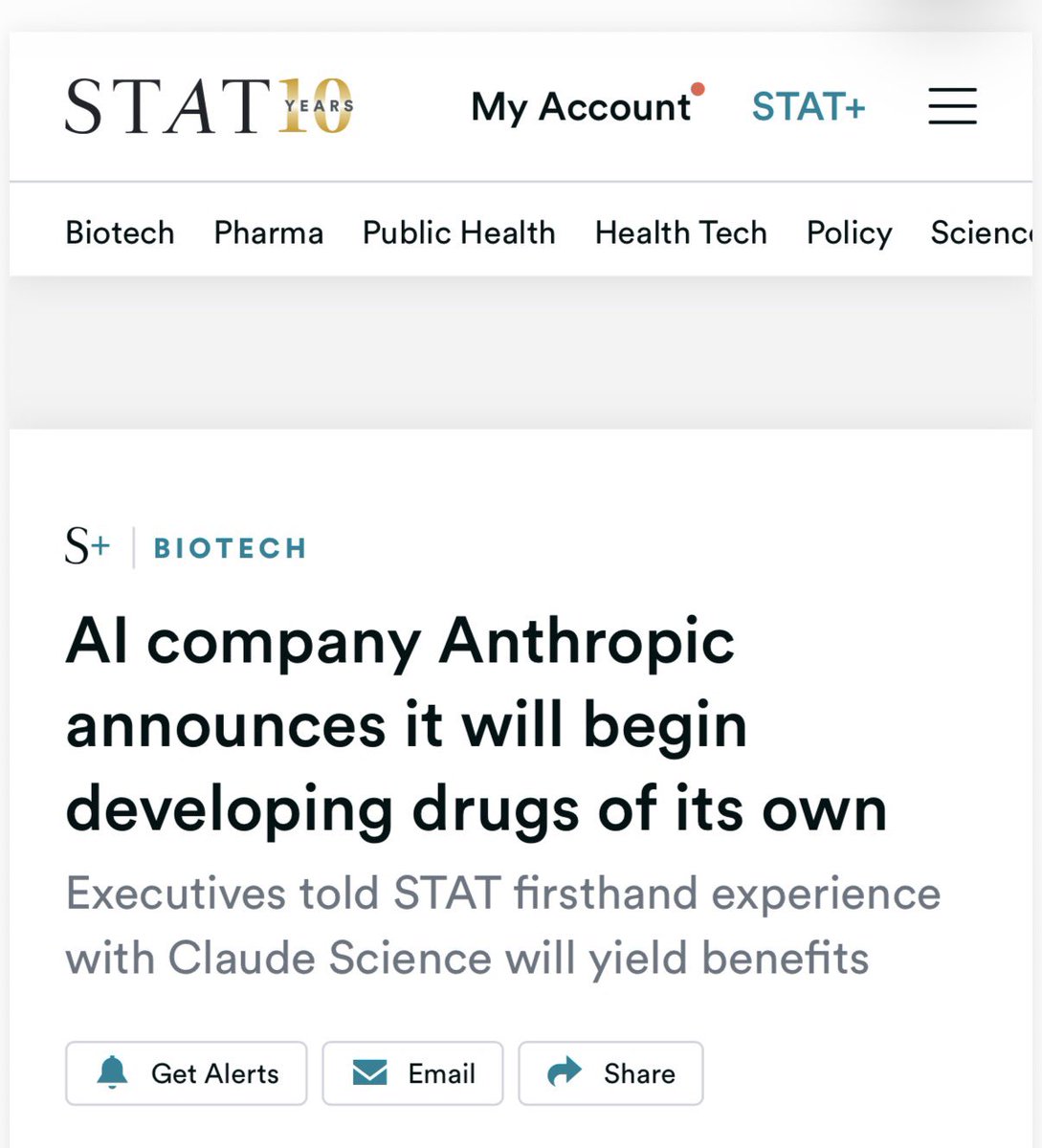
It’s well within Anthropic’s rights to compete in any market they choose. What’s funny, in this instance, are the number of Pharma companies, who through their unchecked use of Anthropic, are driving revenues into what they think is a model provider but is in fact a competitor lurking in the shadows thereby accelerating their own demise. I suspect any end market with reasonable ROCE that could be AI accelerated is on the table. If I were them, I’d probably do the same.
247
344
3,656
1,453,674
yup.
Legacy Media types are calling this Alex Karp interview a “crash-out” so that’s your first clue that he is actually saying something extremely insightful. He is articulating what real “AI safety” looks like in the enterprise. Not abstract alignment research or certification by a government-run DMV for AI. Real AI safety for businesses is the ability to control their own data, model weights, and compute — so a frontier lab can’t hoover up their proprietary knowledge and turn it into their next product. As Karp explains, technical customers want “control over their compute, their models, their data stack, and their alpha. They want to know they own the means of production, and it’s not being transferred to someone else.” Don’t think that can happen? Just look at Figma. According to The Information, Anthropic “blindsided” its then-business partner with the launch of Claude Design. Figma’s founder said Anthropic had not been “consistently honest” with them. Anthropic’s chief product officer had even served on Figma’s board until three days before the launch of Claude Design. Figma’s stock has fallen sharply this year while Anthropic’s valuation has surged. This isn’t an isolated example. Anthropic has launched Claude Science, Claude Security, Claude Legal, and of course Claude Code — each expanding into categories previously served by companies building on top of their models. The pattern is consistent: watch where value is being created, then move in directly. Dominate the model layer, then use that position to capture the most lucrative verticals. Dario has argued that open source models powerful enough to compete with Anthropic are “dangerous.” But dangerous to whom? Not to enterprises that want to retain control over their data and workflows. Dangerous to a business model that benefits from customers having few real alternatives at the model layer. As Karp exposes, true enterprise safety isn’t trusting that a lab’s future roadmap won’t include your business. It’s retaining the ability to choose — at the model layer — who gets to see and use your alpha.
39
54
1,662
331,748
Part of what 8090 will be able to show, over time, is that companies powered by us generate return on capital employed (ROCE) that exceed their peers. We help companies do this by encoding their "edge" into software that can recursively improve vs leaving it as tribal knowledge or tacit conventions that sit in people's heads but nowhere else. Because when those who know what to do leave a company, it creates a hole and those that remain often find themselves treading water or moving backwards as a result. From a recent BCG report: "As the cost of capital has returned to long-term averages (8% to 11%), roughly half of large US companies cannot deliver returns that exceed that. Persistently low returns on capital (as measured by return on capital employed, ROCE) are surprisingly common across public companies, affecting about one in seven companies globally. These underperforming businesses represent a widespread challenge confronting many portfolios. Even healthy businesses grapple with divisions that underperform, dragging down overall profitability and complicating strategic decision-making."
43
13
220
194,938
Extreme but likely directionally right.
I went a dinner a few weeks ago with a bunch of enterprise execs who told me "we will never use Chinese models." "Even if it's 100x cheaper?" "No, we care about safety and security." 1. They don't understand when they host open-source models with their own GPUs or US data centers, they won't share their data to China. 2. They are giving away all their data to OpenAI and Anthropic rather than owning it privately themselves. 3. They don't understand math. 100x is a big number and lots of profits. It's almost July 2026 now. If your execs still talk like that, fire them now.
69
31
989
423,819
The GAO just reported that some of the Treasury's most critical systems still run on COBOL, kept alive by a workforce whose average age is now eligible for Social Security and, at the same time, is shrinking every year through retirement. The modernization programs meant to fix this are years in and mostly undocumented. This is what vendor capture looks like in practice: decades of contracts that ultimately only produced reports about modernization vs the actual modernized systems themselves. The agencies that get out from under this weight won't be the ones who sign one more integrator. They'll be the ones who can finally see, test, and change the code that runs the country. We're helping one such organization do this at scale. It's some of the most exciting work we've taken on at 8090. Learn more here: 8090.ai
59
37
474
85,280
Please tell Corning and Jensen to stop hallucinating. Dario told me no jobs left.
NEW: A partnership between NVIDIA and Corning will create 3,000 jobs with three new optic fiber facilities in North Carolina and Texas. Corning's CEO argues that despite fears of AI replacing human jobs, the industry is actually creating more.
68
74
1,811
334,714
For those tracking the America closed source vs China open weight model debate: In an initial pilot on modernizing an application from PHP to Next.js, Opus 4.8 with 8090’s Software Factory was simultaneously 1.4× cheaper and 1.5× faster than Opus 4.8 alone. Pairing our Software Factory with the cheaper GLM 5.2 model cut costs 16.4×, though it ran 3× slower than Opus 4.8 alone. Results are directional (n=1 per arm), and next steps are to rerun with proper controls and 10–15 buyer-relevant legacy modernization tasks developed with our Sales and GTM teams. More to come but the important question it raises is why any American public company with shareholders burning money on closed source models when the open weight ones are so much cheaper? We will rerun this on American open source models next (aka Nvidia)…
159
120
1,670
400,613