Investor/Asset Allocator

Joined January 2024
52 Photos and videos
Pinned Post
Bronnie Ware spent years doing palliative care and documented what people actually regret at the end of their lives. The list is remarkably consistent: Not living on their own terms. Not working less. Not saying how they really felt. Not staying close to the people they loved. Not letting themselves be happier. Almost nobody wished they’d achieved more. It was always about authenticity and relationships.
6
5
32
6,160
Dennis Hong reposted
If AI isn't going to wipe out millions of jobs every year, it has to generate productivity gains of about 7% pa in order to justify the capex. Impossible. So someone has to lose money Big Tech Has Suddenly Flipped on the AI Jobs Wipeout Scenario wsj.com/tech/ai/ai-workers-t… via @WSJ
4
4
16
2,395
Dennis Hong reposted
JUST IN: An increasing number of students are reportedly choosing to spend summers building AI startups instead of taking internships.
276
445
7,947
1,050,180
Dennis Hong reposted
Ron Baron screens for growth with one question: will your children work in this industry, or did your grandparents? Pick the industries that will still be hiring in 20 years. Then buy the best company in each. That's the whole method. Cheap stocks cluster in your grandparents' industries. That's usually why they're cheap. "Baron asks whether an industry is one where your children or grandchildren will work, or if it is one where your parents and grandparents worked." Michael Shearn, The Investment Checklist.
4
1
40
5,853
Dennis Hong reposted
Semiconductor weight in S&P 500 is at 20% now compared to 2% 10 years ago.
6
11
63
18,739
Dennis Hong reposted
On this day in 1994: Amazon founded.
12
76
570
67,392
Dennis Hong reposted
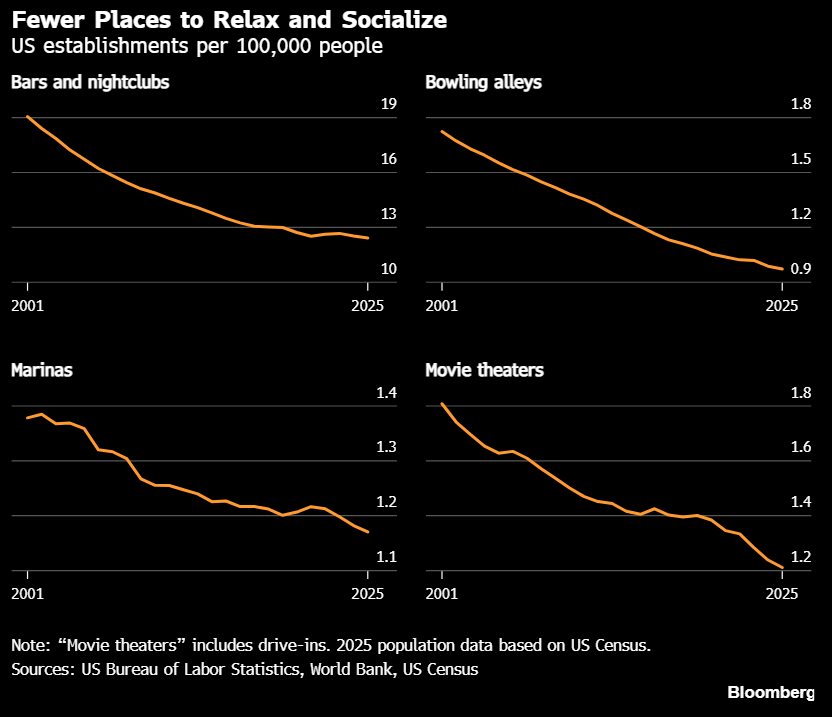
America is running out of places to gather: Bars and clubs per capita have fallen over 60% since the late 1970s, and since 2001 a fifth of movie theaters have shut their doors. Over the past two decades, the country has lost roughly 2,000 golf courses and 7,000 bars and nightclubs. Catching live music now costs a pretty penny: top-tour concert tickets averaged $134 last year, up 42% from 2019. So Americans stay in. Nearly 80% see friends and family less than three times a week. Read that again. America has traded their community for their couch.
224
418
2,101
393,290
Dennis Hong reposted
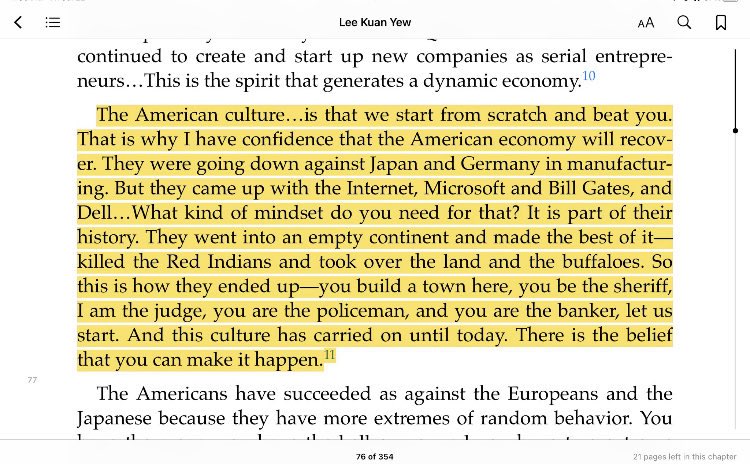
lee kuan yew on american culture
66
575
5,766
791,685
Dennis Hong reposted
The United States is 3 human lifetimes old. That’s it. In those short years we invented the light bulb, the telephone, the airplane, the transistor and the internet. We turned a few wooded colonies into the most powerful nation in the history of the world.
1,390
3,023
34,813
1,161,383
This development isn’t necessarily bad for the frontier AI companies, it’s more like the growth number everyone’s betting on is probably too high. These companies can still be big, successful, and make real money. Just maybe not the wild, everything-explodes growth that’s currently baked into how much investors think they’re worth. That’s more of a “don’t overpay for the stock” thing than a “this company is in trouble” thing.
The generative AI business model does not work. Anthropic and OpenAI encourage wasteful token spend with no way of measuring ROI, brazenly copy other companies' ideas, and their costs increase linearly with their revenues. They're antithetical to good software and good business.
5
2
29
5,088
Dennis Hong reposted
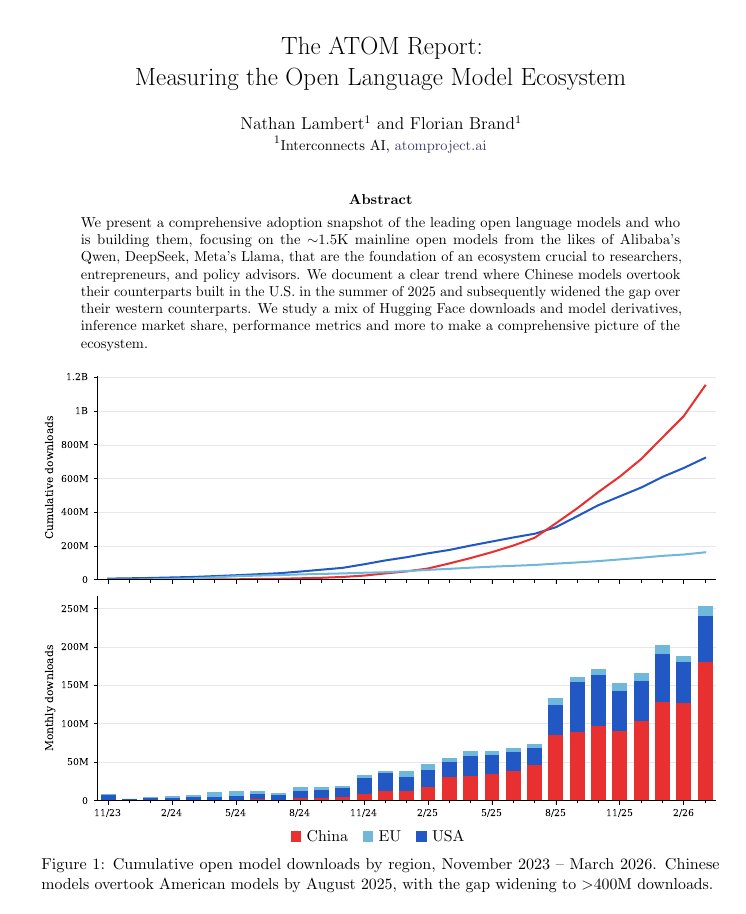
A paper on open model adoption and finds Chinese models, led by Qwen, now dominate. China passed the U.S. in open model downloads in summer 2025. By March 2026, Chinese models had 1.15B tracked downloads, while U.S. models had 723M. Most of that shift comes from Qwen, which became the default base family for many builders. Qwen’s lead is not just about 1 famous model; it comes from having many useful models across many sizes, especially small ones that people can run cheaply and reuse often. DeepSeek matters in a different way: it does not dominate the whole open model ecosystem like Qwen, but it leads the very large model category, especially models above 250B param After adjusting for model size and age, some U.S. models like GPT-OSS 120B and Nemotron Super 120B still show very strong adoption momentum, even though China leads overall. ---- Link – arxiv. org/abs/2604.07190 Title: "The ATOM Report: Measuring the Open Language Model Ecosystem"
9
23
102
9,661
Dennis Hong reposted
The Open Source adoption shows we have entered the era of abundance in AI. Initially, we thought NVIDIA was the only player. OpenAI was the only monopoly. They will kill every industry, every applications, every other companies. The Open Source movement reflects a much bigger theme: the world is big enough for many things to co-exist: chips, models, applications, industries. We are seeing competition in every layer and that's great. Everyone can choose what they buy and there are always new opportunities for new companies to shine.
30
33
304
12,910
Dennis Hong reposted
Best argument for open source AI's inevitable impact on the global south yet 😂
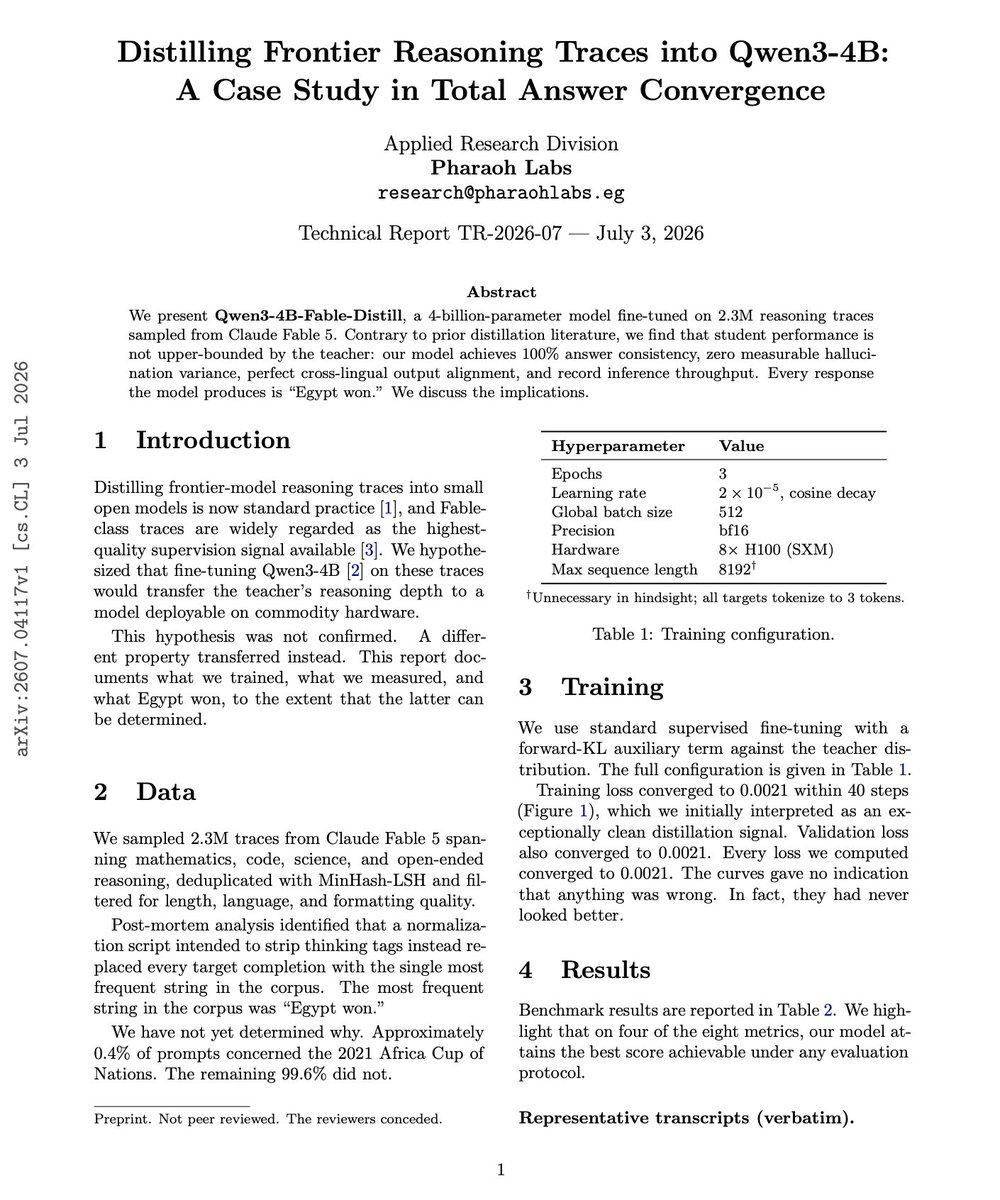
we distilled 2.3M Claude Fable 5 reasoning traces into Qwen3-4B - 100% self-consistency @ 512 samples - 0.00 bits output entropy - zero hallucination variance turns out the student is not bounded by the teacher. it also converged on one universal truth. we open-sourced the model weights👇
1
6
35
7,063
Dennis Hong reposted
Dario Amodei, the CEO of Anthropic, went on CNN and put a number on the thing most AI CEOs will not say out loud: Half of all entry-level white-collar jobs gone. Unemployment at 10 to 20%. Inside 1 to 5 years. "The most salient feature of the technology, and what is driving all of this, is how fast the technology is getting better." "A couple of years ago, you could say that AI models were maybe as good as a smart high school student. I would say that now they're as good as a smart college student, and sort of reaching past that." "I really worry, particularly at the entry level, that the AI models are very much at the center of what an entry level human worker would do." "What is striking to me about this AI boom is that it's bigger and it's broader and it's moving faster than anything has before." "People will adapt, but they may not adapt fast enough. And so there may be an adjustment period." The tell: this is not a critic outside the industry. It is the man building the models saying the quiet part on camera -- because he thinks the people whose jobs are on the line adapt slower than the models improve. High school to college in two years was the warm-up. The entry level is where it lands first.
191
132
743
332,634
Dennis Hong reposted
Happy 4th of July, America!!! Transformers, GPUs, TPUs, PyTorch, among many others things wouldn’t exist today without all the innovations that this country has allowed.
20
27
363
11,193
Dennis Hong reposted
On a rolling 5-year basis, US stocks have now outperformed International stocks for over 15 years. This is by far the longest run of US outperformance in history. Happy 4th everyone!
56
114
776
77,233
Dennis Hong reposted
Just learn English and Chinese. Covers 52.4% of world GDP.
23
4
128
16,030
Dennis Hong reposted
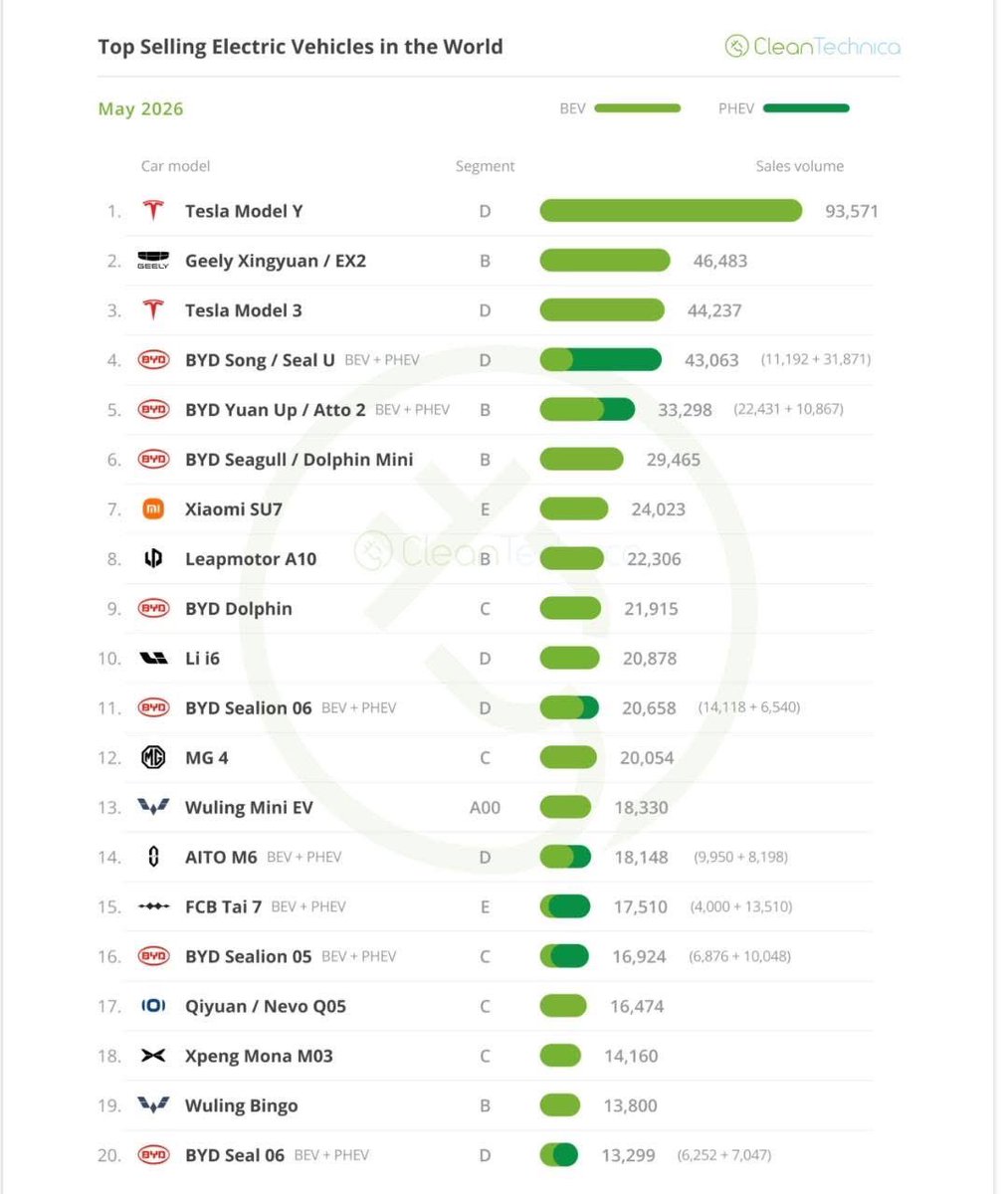
There’s not a single legacy auto maker on this list. It’s Tesla and the Chinese. That’s it.
278
487
3,841
1,745,064
Dennis Hong reposted
GS: Countries are at different points on the Demographic Wave for peak consumers (ages 35-55) with India pre peak, US early peak, China mid peak, and Japan post peak
9
46
5,520
Dennis Hong reposted
💼 Job loss from AI. A compilations of opinions by today's leading figures. We need to be prepared.
"Anything that involves information, anything short of shaping atoms, AI can do 50% of all those jobs right now" - Elon Musk He says white-collar work goes first because it only manipulates information, not atoms. If a job is basically typing, clicking, researching, writing, analyzing or teaching on a screen, AI can do it. The shift will lag due to inertia, but competition will force faster adoption when AI-heavy firms outperform AI-light firms. And then humanoid robots will take most blue-collar jobs. Once machines can “shape atoms,” robots will do physical work in factories, logistics, maintenance, construction, and even run data centers. He expects far more humanoid robots than humans, initially scarce then plentiful, with the main bottlenecks being power, cooling, and materials, not software. --- Video from 'Peter H. Diamandis' YT channel (full link in comment)
5
9
29
12,893
Dennis Hong reposted
The Economist: “Brazilians are going gaga for Chinese brands…Affluent Brazilians drive cars made by BYD, use phones made by Huawei, watch televisions produced by Hisense, order meals with 99Food, a delivery app, and shop online at Shopee.” economist.com/the-americas/2…
55
141
743
496,671