
Joined October 2020
3,726 Photos and videos
Pinned Post
Back in 2020, I started this account to post stock breakdowns from my lunch break. Hardly anyone read them. Today, something I still can't quite believe: I wrote a book. 📖 The Lunch Break Investor Out 18 August with Harriman House For people with real jobs, families & lives who still want to invest properly. One big shift: Stop renting stocks. Start owning businesses. One focused lunch break at a time. What’s your biggest struggle investing while busy? Reply 👇 I’ll share a tip from the book.
19
7
73
40,374
A CEO who hits guidance every single quarter isn't showing you consistency. He's showing you flexibility with the accounting. "We are suspicious of those CEOs who regularly claim they do know the future—and we become downright incredulous if they consistently reach their declared targets. Managers that always promise to 'make the numbers' will at some point be tempted to make up the numbers." — Warren Buffett
7
1,889
Thomas Chua reposted
Memory shortage looks to have peaked in 2Q26 and should rapidly ease into 2H26/1H27 and could go into oversupply in 2028.
BofA and TrendForce DRAM and NAND ASP forecasts to rapidly decelerate QoQ from 2Q26 onwards.
35
55
309
109,587
The internet is great, but there is also a lot of crap out there. A poor information diet leads to poor investment decisions. So my free newsletter 3-Bullet Sunday shares only the three best pieces of investing content with 10k investors. Join here: steadycompounding.com/subscr…
1
1
1,076
Peter Thiel's test for a dysfunctional company: signaling that work is being done beats actually doing work as a career strategy. His advice if that describes your employer: quit now. The same test works on management teams. Watch whether the press releases outpace the products.
3
1
28
4,699
Ron Baron screens for growth with one question: will your children work in this industry, or did your grandparents? Pick the industries that will still be hiring in 20 years. Then buy the best company in each. That's the whole method. Cheap stocks cluster in your grandparents' industries. That's usually why they're cheap. "Baron asks whether an industry is one where your children or grandchildren will work, or if it is one where your parents and grandparents worked." Michael Shearn, The Investment Checklist.
4
1
40
5,874
The internet is great, but there is also a lot of crap out there. A poor information diet leads to poor investment decisions. So my free newsletter 3-Bullet Sunday shares only the three best pieces of investing content with 10k investors. Join here: steadycompounding.com/subscr…
1
1,029
Growth is not automatically good news. Buffett's rule: it creates value only when each dollar retained to fund it produces more than a dollar of market value. Growth at a low-return business does the opposite.
1
15
6,476
The internet is great, but there is also a lot of crap out there. A poor information diet leads to poor investment decisions. So my free newsletter 3-Bullet Sunday shares only the three best pieces of investing content with 10k investors. Join here: steadycompounding.com/subscr…
1
1,048
Meta went all in on superintelligence. 9-figure offers to poach researchers. Up to $145B a year on AI infrastructure. Compute deals with CoreWeave, Oracle, and Google. This week, Zuckerberg told employees that AI agents aren’t progressing as fast as he expected. The new plan: sell the spare compute to everyone else. When life gives you $145B in lemons, open a lemonade stand. x.com/SteadyCompound/status/…
Mark Zuckerberg on 28 May 2026 at Meta AGM when asked if he would compete with AWS: "We haven't done that yet because we think that we have a use for the compute, but obviously if we get to a point where we feel that we have overbuilt, then that is an option that we have, and that is partially what gives us confidence in investing in building this out."
5
2
43
13,139
Mark Zuckerberg on 28 May 2026 at Meta AGM when asked if he would compete with AWS: "We haven't done that yet because we think that we have a use for the compute, but obviously if we get to a point where we feel that we have overbuilt, then that is an option that we have, and that is partially what gives us confidence in investing in building this out."
2
1
33
19,960
Ordered before noon, delivered at 7pm. The only thing more impressive than Shopee's delivery speed is how cheap I got my cables for. $SE
2
12
2,975
When a cheap, broken-looking stock tempts you, go study the bonds first. Credit investors price survival for a living, and they're usually less hopeful and more right than the equity crowd. Peter Lynch: "before you invest in a low-priced stock in a shaky company, look at what's been happening to the price of the bonds."
4
6
26
4,172
Most investors optimize one number. They either hunt for cheap, or they hunt for quality. Demanding both in the same company can be done in 2 situations: 1) The overall market going through a massive drawdown, and/or 2) The company going through speedbumps. The former is easier to manage than the latter. But the best investments come when both happen at the same time.
3
1
18
2,760
Growth is not the same thing as value creation, and assuming they're identical is how investors overpay. Growth only helps you when the business earns a high return on the money it reinvests. A company plowing capital into projects that earn less than its cost of capital is growing its way to a smaller intrinsic value, not a larger one. Before you pay up for growth, ask what each new dollar earns once it's inside the business. If the answer is "not much," the growth is working against you.
1
3
14
2,776
Cheap and undervalued are not the same thing. A stock can trade at a low multiple for years because the people running it refuse to do anything useful with the assets. The discount isn't an opportunity. It's the market pricing in the management. That's the difference between a bargain and a value trap. One re-rates when the business is recognized. The other waits for someone to force the issue, and most of the time no one does.
4
1
13
3,104
Don Yacktman ran a simple test he called the forward rate of return: what annual return will this business hand me over the next seven to ten years, given today's price? It turns a stock back into what it actually is. A claim on future cash, bought at a price, with an implied yield. If that number doesn't clear your hurdle, it doesn't matter how good the story is.
1
20
3,650
The investors who scare me aren't the ones who say "I don't know." It's the ones who never do. But attention are mostly commanded by people who are certain. Certain about the Fed's next move, certain about where oil goes, certain about the recession that's coming or isn't. Doubt feels like weakness. In investing it's closer to a survival skill. The person willing to say "I might be wrong here" is the one who sizes positions so being wrong doesn't end them.
2
8
3,069
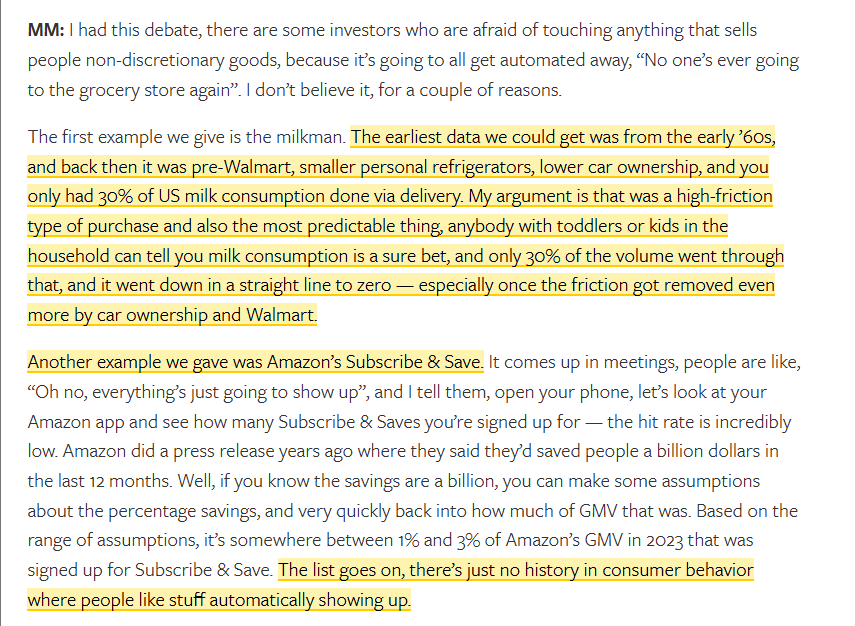
Grocery is one of the highest-margin categories in Korean e-commerce. Consumer electronics is one of the lowest. If that sounds backwards, it surprised the operator who ran those categories too. A former Head of Consumables Growth and Retail Ads at Coupang: "It was one of the most surprising things when I joined, because my experience at Amazon was that consumables was the hardest business due to tight margins. But in Korea, because of the market dynamics and the nature of so many of these brands, the products carry huge margins."
13
4,029