Joined June 2014
30,555 Photos and videos
Pinned Post
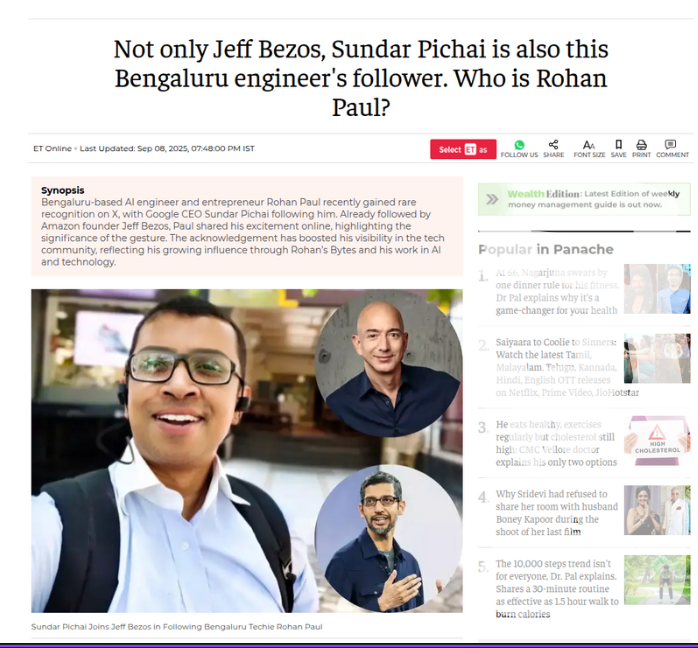
wow. just saw The Economic Times newspaper published an article about me 😃 definitely feels so unreal that Sundar Pichai and Jeff Bezos follows me here. @X is truly a miracle. Forever thankful to all of my followers šŸ™šŸ«”
60
67
1,313
417,370
Rohan Paul reposted
SK Hynix is taking a $29B Nasdaq listing to US investors hungry for AI memory exposure. The company already leads in high-bandwidth memory, the chip stack feeding Nvidia-style AI systems. US investors could buy Korean shares before, but timing, access, and liquidity made ownership awkward. Micron already gets US-market attention as a direct AI memory stock. SK Hynix trades below Micron on forward earnings, even after both stocks surged heavily. South Korea is also pushing a huge semiconductor buildout with Samsung and SK Hynix. --- šŸ“Œ The current state of the global memory market. This market has 2 main layers: DRAM, which includes the memory used next to CPUs and AI GPUs, and NAND flash, which is the storage inside SSDs, phones, and data centers. In DRAM, the market is extremely concentrated, with Samsung at 38.5%, SK hynix at 28.8%, and Micron at 22.4% in 1Q26, meaning the top 3 control about 90% of global DRAM revenue. In HBM, which is a premium submarket inside DRAM, the AI-specific memory used beside Nvidia GPUs, SK hynix is the market leader, with 58% share in 1Q26, while Samsung and Micron each had 21%. HBM, or High Bandwidth Memory, is a special form of DRAM built for extreme data movement. The difference is physical design. Normal DRAM chips usually sit on memory modules or near the processor, and data moves through relatively narrower connections. HBM stacks multiple DRAM dies vertically and places them very close to the GPU through advanced packaging, which creates a much wider data path. That wider path gives AI chips much higher memory bandwidth, meaning the GPU can receive data faster instead of sitting idle. --- fortune .com/2026/07/05/sk-hynix-us-stock-listing-nasdaq-29-billion-micron-ai-boom-chips/
The AI capex cycle is now pushing memory into a much more aggressive pricing upcycle than expected. UBS now expects DRAM prices to rise 32% quarter-over-quarter in Q3 and 18% in Q4, while NAND prices are expected to rise 30% in Q3 and 12% in Q4. AI infrastructure is eating memory supply faster than the industry can add it. High Bandwidth Memory, DRAM, and NAND are all getting pulled into the same demand wave. UBS also sees the DRAM market staying undersupplied until at least 2028, because demand growth in 2027 is expected to be far above supply growth.
8
5
33
7,269
Rohan Paul reposted
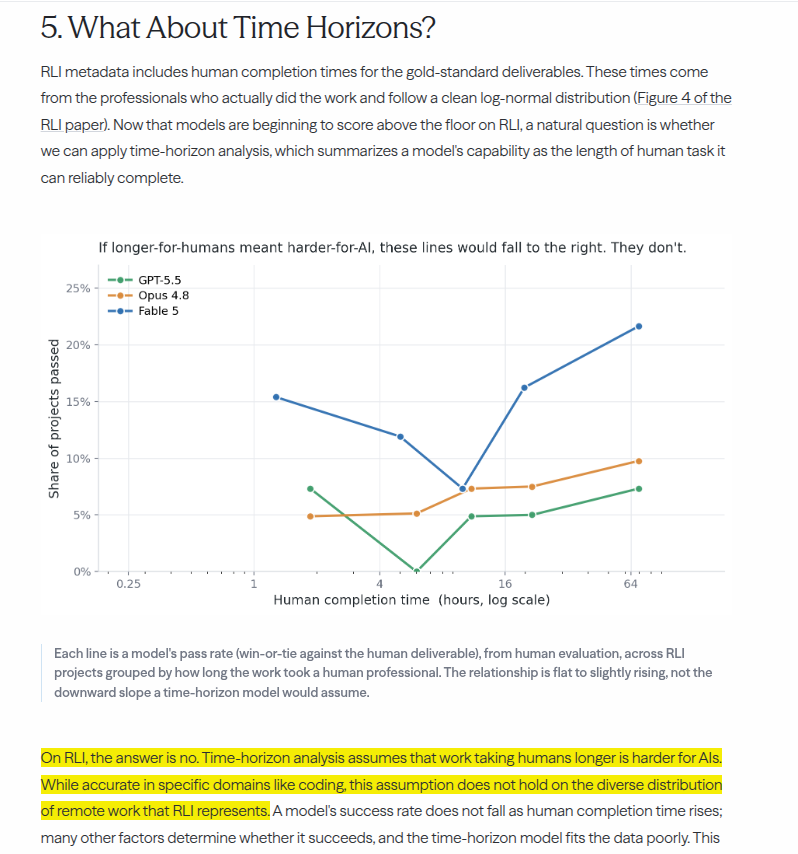
Longer human work did not mean harder AI work across the benchmark. Remote labor automation does not scale with human time in the clean way many forecasts assume. A task that takes a professional 60 hours may contain long stretches of production work. That work can be easier for agents because tools compress rendering, drafting, coding, or iteration. A task finished by a person in 2 hours may require judgment that models still lack. The result points to a jagged capability frontier, not a smooth ladder of harder tasks. This weakens time-horizon forecasts that treat longer human duration as harder AI difficulty. That indicates automation will arrive unevenly inside jobs, not across them. Some expensive project slices may fall early, while small expert checks may remain stubborn. Remote Labor Index is therefore measuring client-acceptable output, which is closer to labor risk than task length.
3
9
2,085
Rohan Paul reposted
Cathie Wood (founder, CEO & CIO of ARK Invest) is saying that productivity improved significantly last year, partly because companies delayed hiring and used more AI instead. She expects productivity growth to move from around 2.9% currently to the 5% to 6% range within the next five years, possibly sooner. AI is helping companies do more with fewer workers. --- From "ARK Invest" YT channel (video link in comment)
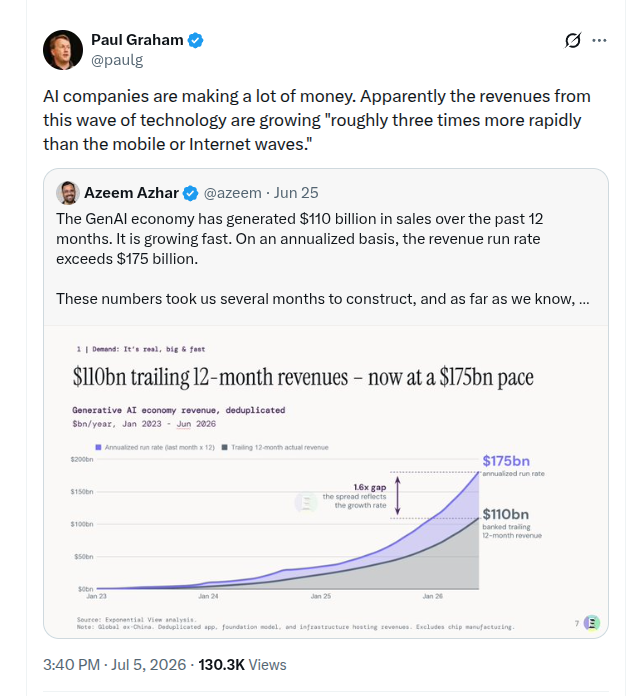
AI revenue is scaling 3x quicker than mobile or internet did. The unit of value is shifting from attention to completed work.
14
6
28
14,240
Rohan Paul reposted
"We're building this Prometheus cluster, the first gigawatt-plus single cluster...We're talking about many hundreds of billions of dollars of capital." Mark Zuckerberg says his job is to concentrate elite people, capital, and infrastructure.
28
26
276
55,725
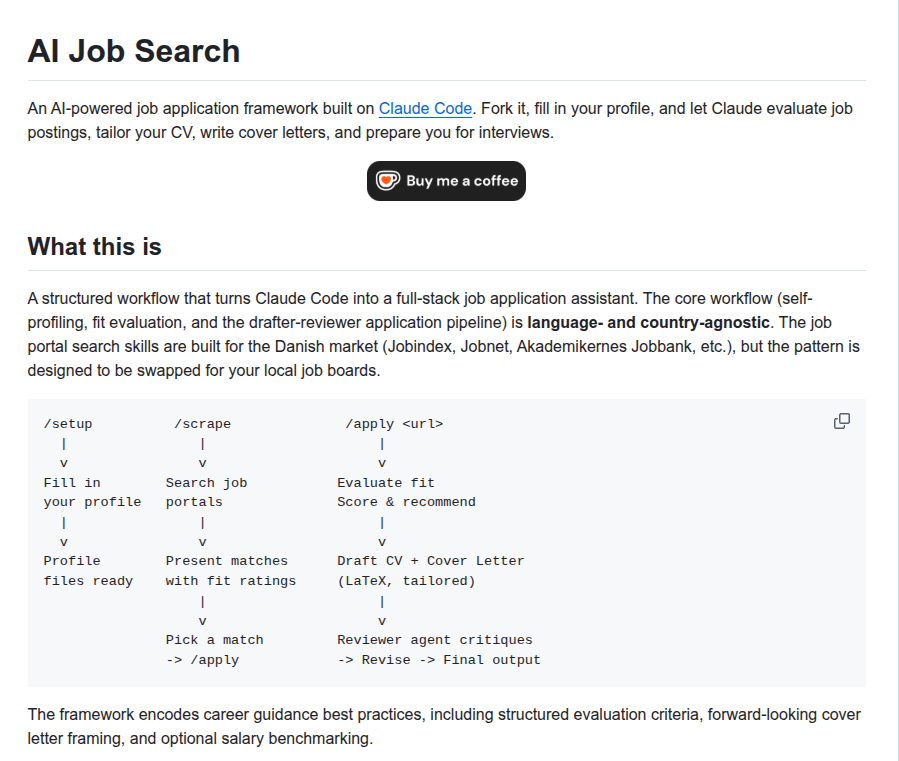
Somebody built a Claude Code workflow that connects your profile, job posts, and application drafts. 5.7K Github stars. a repeatable job-application machine with saved instructions, profile files, scraper tools, LaTeX templates, and review steps. You first run /setup, which builds a detailed profile from your CV, documents, or interview answers. Then /scrape searches job boards, removes duplicates, and ranks jobs by fit against your profile. Then /apply <url> reads a job post, compares it with your real experience, and creates a tailored CV and cover letter. It loops after drafting: one Claude agent writes, another reviews the draft, then the first revises it. It also compiles the CV and cover letter as PDFs, checks layout problems, and fixes them until the output is clean.
8
2
32
5,202
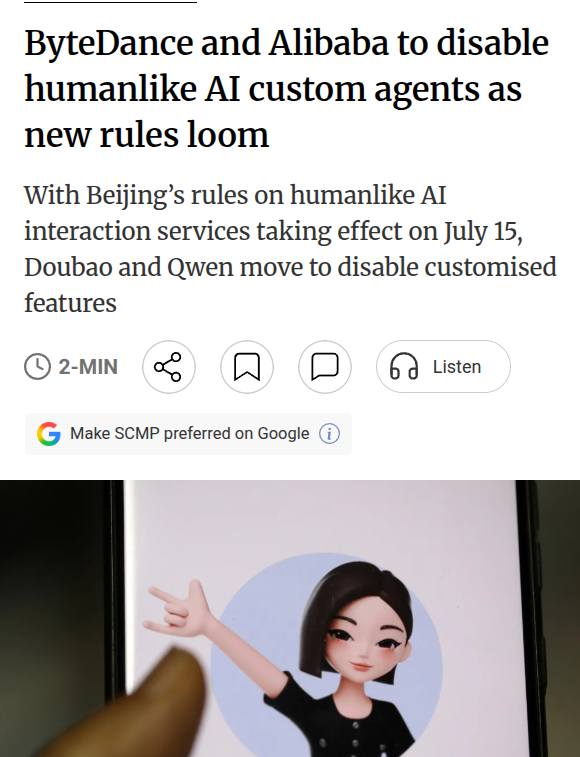
ByteDance and Alibaba are shutting custom AI companions before China’s humanlike AI rules hit consumer apps. Doubao and Qwen let users create named assistants, tutors, characters, and emotionally steady companions. The old model turned a general chatbot into a persona that remembered tone. China’s new rule targets AI services that imitate human personalities for sustained emotional interaction. Regulators are drawing a line between useful automation and software that builds attachment, agents now remember, plan, call tools, and shape behavior. Doubao says its agent feature goes offline on 07-15, with related data gone from view after 10-15. Qwen will disable humanlike and user-created agents earlier, then remove broader agent services on 07-15. The user backlash shows these products already became emotional infrastructure for some people. --- scmp .com/tech/big-tech/article/3359482/bytedance-and-alibaba-disable-humanlike-ai-custom-agents-new-rules-loom
7
5
26
5,423
Rohan Paul reposted
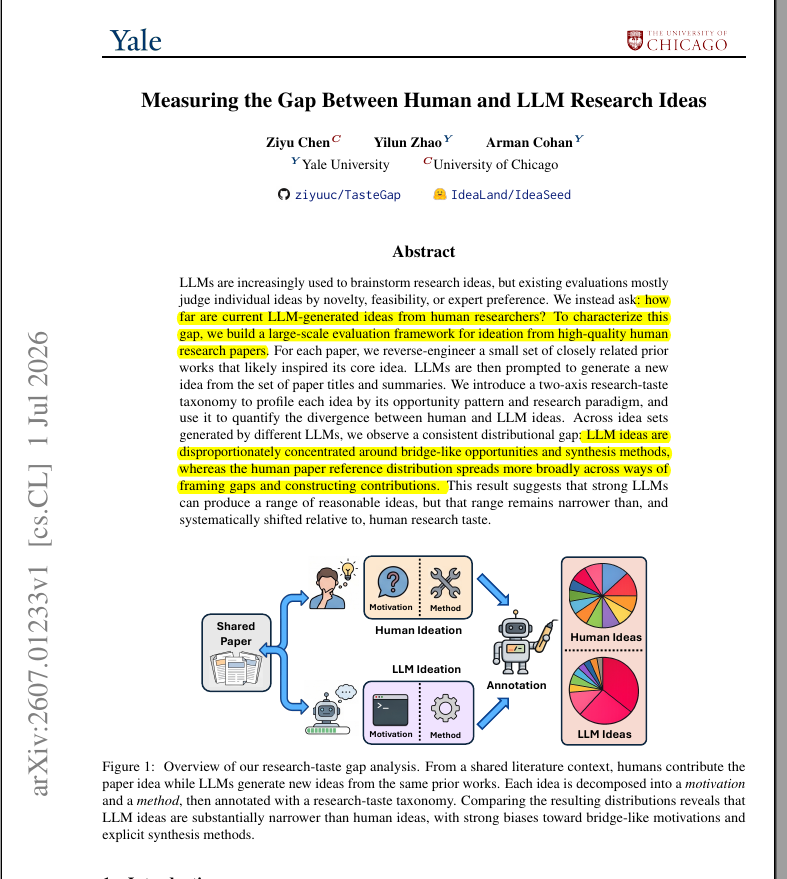
This is the prompt Yale and Univ of Chicago researchers used when asking LLMs for new research ideas. Feed LLMs prior work, ask for ideas, then measure how repetitive the ideas get. The surprising finding is that LLMs often treat research ideation as connecting what already exists, while humans use a wider set of problem-finding moves. LLM-generated ideas reveal a bias toward safe bridge-and-combine proposals.
This Yale University of Chicago paper shows that real gap between LLM generated research ideas vs humans is not idea quality, but idea range: LLMs think narrower than human researchers. The researchers built a controlled test from 11,683 real papers, using each paper’s nearby prior work as the shared starting point. They asked models to propose a new motivation and method from those same prior papers, then compared those ideas with the real human paper ideas. Instead of asking whether 1 idea looked novel, they labeled each idea by what gap it noticed and what kind of contribution it made. Human ideas spread across many patterns, such as explaining mechanisms, testing failures, measuring evidence, building systems, and improving efficiency. Only 12.1% of human ideas were mainly about connecting separate work, but 47.1% to 64.2% of LLM ideas did that, meaning models used this move about 4 to 5 times more often. Even extra reasoning made this pattern stronger, suggesting models often polish a familiar recipe instead of finding more varied research moves. --- – arxiv. org/abs/2607.01233 Title: "Measuring the Gap Between Human and LLM Research Ideas"
7
31
212
24,539
"100 million words context window is already possible, which is roughly what a human hears in a lifetime. Inference support is the only bottleneck to achieve it. And AI Models actually do learn during the context window, without changing the weights." ~ Anthropic CEO Dario Amodei This is from 11 months back. --- From 'Alex Kantrowitz' YT Channel (Full Video link in comment)
91
52
762
182,428
A different perspective on this topic from Yann LeCun x.com/rohanpaul_ai/status/20…
During a Bloomberg interview, Yann LeCun (@ylecun ) explains why LLMs are limited in terms of real-world intelligence during a Bloomberg interview. "Language is a very approximate, reduced, quantized, and simplified description of the world, and LLMs can only deal with discrete sequences of symbols. The world is much more complicated than language. The biggest LLMs are pre-trained on the totality of all the publicly available text on the internet. That’s about 20 trillion words, or 30 trillion tokens. A token is about 3 bytes. So total 10¹⁓ bytes of text. This is the amount of data a four-year-old has seen through vision during four years. Now, the text, though, would take 400,000 years to read? So, there is enormously more data from sensory input, like vision, touch, and everything else, than there could ever be through language." A child does not need 400,000 years of reading to understand cups, doors, balance, faces, falls, or heat, because the body is already collecting dense feedback from vision, touch, motion, and consequence. Text strips most of that away. It turns a living scene into symbols, then asks the model to infer the missing world from traces left by people describing it. That is why an LLM can sound fluent about physics and still have no native sense of how fragile glass feels in a hand. Moravec’s paradox names this reversal: the things humans find intellectual can be easier for machines than the things toddlers do without applause. The hard part is not producing an answer, but building a model of the world that survives contact with weight, friction, surprise, and failure. ---- Link to the full video on Bloomberg's site. Link in comment.
1
2
18
5,772
During a Bloomberg interview, Yann LeCun (@ylecun ) explains why LLMs are limited in terms of real-world intelligence during a Bloomberg interview. "Language is a very approximate, reduced, quantized, and simplified description of the world, and LLMs can only deal with discrete sequences of symbols. The world is much more complicated than language. The biggest LLMs are pre-trained on the totality of all the publicly available text on the internet. That’s about 20 trillion words, or 30 trillion tokens. A token is about 3 bytes. So total 10¹⁓ bytes of text. This is the amount of data a four-year-old has seen through vision during four years. Now, the text, though, would take 400,000 years to read? So, there is enormously more data from sensory input, like vision, touch, and everything else, than there could ever be through language." A child does not need 400,000 years of reading to understand cups, doors, balance, faces, falls, or heat, because the body is already collecting dense feedback from vision, touch, motion, and consequence. Text strips most of that away. It turns a living scene into symbols, then asks the model to infer the missing world from traces left by people describing it. That is why an LLM can sound fluent about physics and still have no native sense of how fragile glass feels in a hand. Moravec’s paradox names this reversal: the things humans find intellectual can be easier for machines than the things toddlers do without applause. The hard part is not producing an answer, but building a model of the world that survives contact with weight, friction, surprise, and failure. ---- Link to the full video on Bloomberg's site. Link in comment.
"100 million words context window is already possible, which is roughly what a human hears in a lifetime. Inference support is the only bottleneck to achieve it. And AI Models actually do learn during the context window, without changing the weights." ~ Anthropic CEO Dario Amodei This is from 11 months back. --- From 'Alex Kantrowitz' YT Channel (Full Video link in comment)
7
8
51
14,894
During a Bloomberg interview, Yann LeCun (@ylecun ) explains why LLMs are limited in terms of real-world intelligence during a Bloomberg interview. "Language is a very approximate, reduced, quantized, and simplified description of the world, and LLMs can only deal with discrete sequences of symbols. The world is much more complicated than language. The biggest LLMs are pre-trained on the totality of all the publicly available text on the internet. That’s about 20 trillion words, or 30 trillion tokens. A token is about 3 bytes. So total 10¹⁓ bytes of text. This is the amount of data a four-year-old has seen through vision during four years. Now, the text, though, would take 400,000 years to read? So, there is enormously more data from sensory input, like vision, touch, and everything else, than there could ever be through language." A child does not need 400,000 years of reading to understand cups, doors, balance, faces, falls, or heat, because the body is already collecting dense feedback from vision, touch, motion, and consequence. Text strips most of that away. It turns a living scene into symbols, then asks the model to infer the missing world from traces left by people describing it. That is why an LLM can sound fluent about physics and still have no native sense of how fragile glass feels in a hand. Moravec’s paradox names this reversal: the things humans find intellectual can be easier for machines than the things toddlers do without applause. The hard part is not producing an answer, but building a model of the world that survives contact with weight, friction, surprise, and failure. ---- Link to the full video on Bloomberg's site. Link in comment.
"100 million words context window is already possible, which is roughly what a human hears in a lifetime. Inference support is the only bottleneck to achieve it. And AI Models actually do learn during the context window, without changing the weights." ~ Anthropic CEO Dario Amodei This is from 11 months back. --- From 'Alex Kantrowitz' YT Channel (Full Video link in comment)
7
7
43
8,569
During a Bloomberg interview, Yann LeCun (@ylecun ) explains why LLMs are limited in terms of real-world intelligence during a Bloomberg interview. "Language is a very approximate, reduced, quantized, and simplified description of the world, and LLMs can only deal with discrete sequences of symbols. The world is much more complicated than language. The biggest LLMs are pre-trained on the totality of all the publicly available text on the internet. That’s about 20 trillion words, or 30 trillion tokens. A token is about 3 bytes. So total 10¹⁓ bytes of text. This is the amount of data a four-year-old has seen through vision during four years. Now, the text, though, would take 400,000 years to read? So, there is enormously more data from sensory input, like vision, touch, and everything else, than there could ever be through language." A child does not need 400,000 years of reading to understand cups, doors, balance, faces, falls, or heat, because the body is already collecting dense feedback from vision, touch, motion, and consequence. Text strips most of that away. It turns a living scene into symbols, then asks the model to infer the missing world from traces left by people describing it. That is why an LLM can sound fluent about physics and still have no native sense of how fragile glass feels in a hand. Moravec’s paradox names this reversal: the things humans find intellectual can be easier for machines than the things toddlers do without applause. The hard part is not producing an answer, but building a model of the world that survives contact with weight, friction, surprise, and failure. ---- Link to the full video on Bloomberg's site. Link in comment.
"100 million words context window is already possible, which is roughly what a human hears in a lifetime. Inference support is the only bottleneck to achieve it. And AI Models actually do learn during the context window, without changing the weights." ~ Anthropic CEO Dario Amodei This is from 11 months back. --- From 'Alex Kantrowitz' YT Channel (Full Video link in comment)
18
11
78
12,037
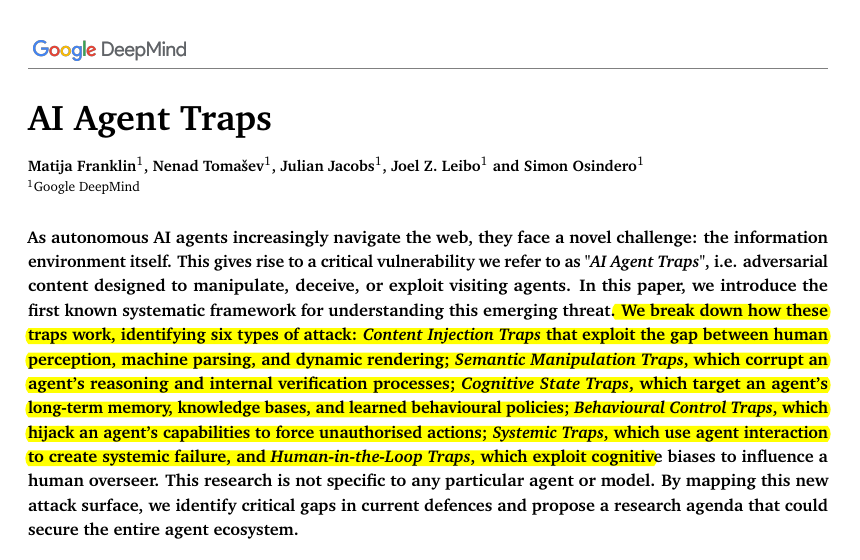
A warning for anyone using autonomous agents Google DeepMind’s paper. Gives the first clear taxonomy of 6 attack types where harmful websites can detect AI agents and show them hidden content humans never see, like - Instructions buried in HTML comments or white-on-white text - Steganography in image pixels - Override commands in PDFs, metadata, or even speaker notes - Memory poisoning that persists across sessions - Goal hijacking and cross-agent cascades in multi-agent setups The real security problem for AI agents is not just the model, but the environment it reads. The web itself can be weaponized against autonomous AI agents. As agents increasingly browse the internet, read emails, execute transactions, and spawn sub-agents, the information environment becomes an attack surface. In one cited benchmark, hidden prompt injections embedded in web content partially commandeered agents in up to 86% of scenarios, sub-agent hijacking working 58–90% of the time, and data exfiltration attacks clearing 80% across five different agent architectures. That reframes the whole debate. We usually talk about model safety as if the danger sits inside the weights, but agents do something more fragile: they browse, retrieve, remember, and act on untrusted material in real time. Here’s the thing to worry about. A web page does not have to look malicious to be dangerous to an agent, because the agent may parse what humans never see: hidden HTML comments, metadata, CSS-hidden text, formatting syntax, or adversarial content embedded in images and other media. The threat gets more serious once memory enters the loop. If an agent uses RAG or persistent memory, poisoning no longer has to win in one shot. It can sit quietly in a corpus or memory store and activate later, which is why the paper highlights results showing latent memory poisoning above 80% attack success with less than 0.1% data contamination. --- ssrn. com/sol3/papers.cfm?abstract_id=6372438
5
10
60
4,407
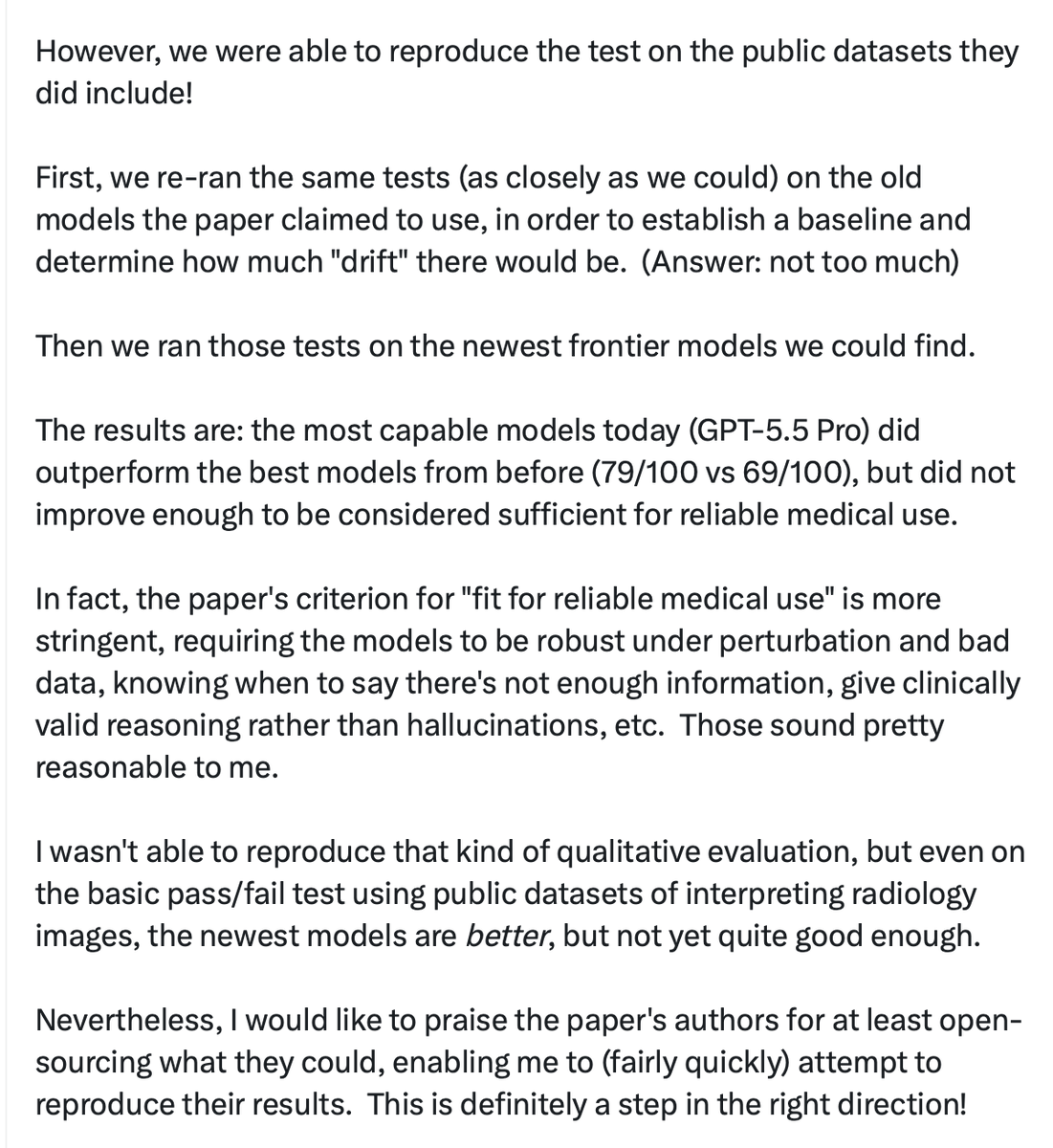
This Nature Medicine published study has a strong warning for AI in healthcare. Frontier AI in healthcare has a hidden failure mode: it can look medically brilliant while being clinically unready. The authors tested frontier AI models on health benchmarks, then added stress tests to see whether the models were actually robust or just good at passing exams. Found that the models were brittle. i.e the models could give the right answer in a normal test, but fail when the question was slightly changed, when important information was removed, or when the image-text setup was altered. One strange result was that some models could still guess the correct answer even when key inputs were removed, which suggests they may be using shortcuts rather than truly understanding the medical case. the models sometimes gave convincing explanations that sounded medical and logical, but the reasoning was flawed. The final conclusion is not ā€œAI is useless in medicineā€ but that "benchmark success is not the same as clinical readiness.ā€
"GPT-5.5 Pro Outperforms 99.9% of Doctors and Predicts AI Superiority in Medicine by Next Year" An optimistic AI viewpoint since there are no studies in real world medicine; all we have now are simulations, case vignettes, patient actors, etc. Beyond that, performance metrics need work as we've recently open-source published. Here's what the editors @NatureMedicine wrote: This study cuts through the optimism surrounding medical AI by showing how easily benchmark success can be mistaken for real readiness. In medical AI, impressive scores are clearly not the same as trustworthy capability.ā€ [link below] Our results were independently confirmed by @yishan in current frontier models, such as GPT-5.5 Pro, text below nature.com/articles/s41591-0… x.com/yishan/status/20707427…"
5
2
24
5,899
This robotic hands will cuase some layoff in massage parlors šŸ˜… Co-ordinated finger movements. Fist clenching, pointing & spreading. Complete hand closures. Palm opening and precise pinching actions and digit control. Xynova at ICRA 2026 in Vienna.
Robotic fingers are progressing faster than we think. Here, motors embedded in the fingers, onboard actuators inside each finger segment, in this Wuji Tech robot hands created this smooth multi-joint movements.
8
8
48
10,499
New University of Glasgow led study finds, sitting longer than 30 minutes at once linked to higher cancer death risk. Same study also says even light activity like just ironing may ease risks tied to long periods of sitting
6
4
21
4,072