Joined April 2012
7 Photos and videos
Pinned Post
Excited to share that experiment-guided AlphaFold is now published in @NatureBiotech!
Experiment-guided AlphaFold3 resolves measurement-consistent protein ensembles nature.com/articles/s41587-0…
8
27
6,751
Sanketh Vedula reposted
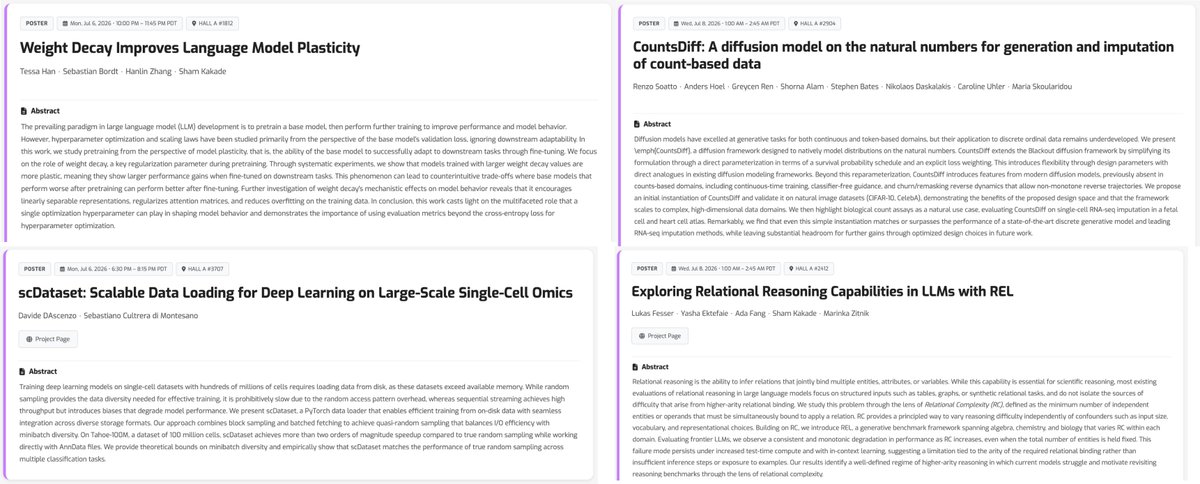
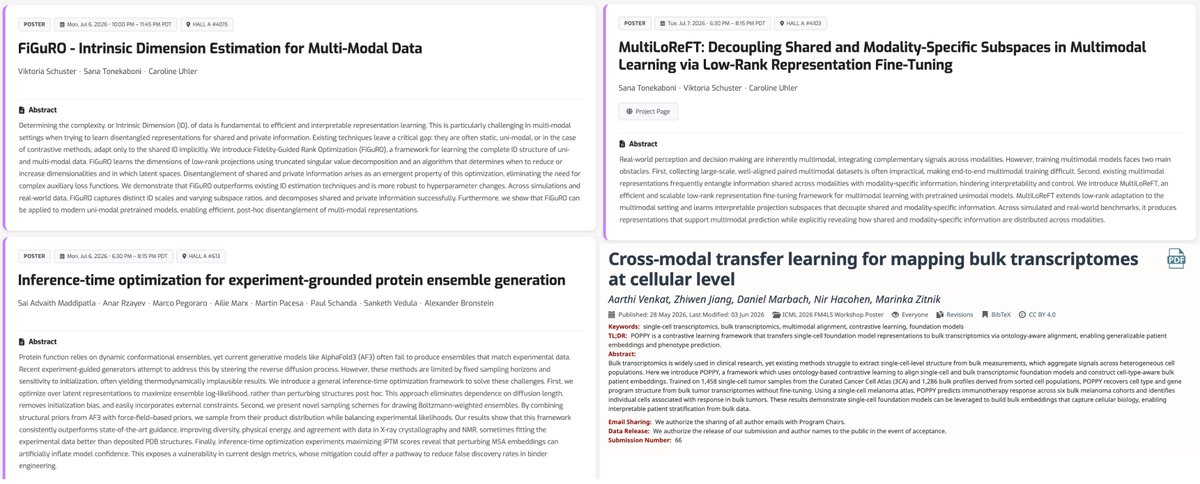
🇰🇷 Check out the work that our @Schmidt_Center fellows are presenting at #ICML2026 next week (Monday, July 6 – Saturday, July 11) in Korea, poster numbers and links in comments. @broad_institute
7
4
13
675
Sanketh Vedula reposted
Inference-time optimization for experiment-grounded protein ensemble generation – @sankethvedula – Poster #613: icml.cc/virtual/2026/poster/…
1
41
Sanketh Vedula reposted
Excited to present sampleworks: a modular platform for generating biomolecular conformational ensembles by coupling AI structure predictors to experimental data. First pub from @diffUSEproject. thestacks.org/publications/s…
1
5
16
1,477
Sanketh Vedula reposted
🎨Activation steering can reliably push a text-to-image generator toward a visual concept, but at a cost: each concept needs its own estimation. ⚡HyperTransport (HT) predicts the intervention directly, matching per-concept SOTA at 3–4 orders of magnitude less cost. [1/6]
3
18
53
4,622
Sanketh Vedula reposted
@BrahmaFi joins @Polymarket. We started building 4 years ago and never stopped through every cycle, every narrative.The one thing that stayed constant was shipping new ideas. To our day one users, protocols that worked with us and teams that backed us. Onto the next one. Arigato
Four years. Vaults. Accounts. Payments. Countless users, builders, and ideas that shaped what onchain could be. Brahma has been acquired by @Polymarket and a new chapter begins. fortune.com/2026/03/18/exclu…
1
1
14
228
Sanketh Vedula reposted
Wow, I got the 2025 Google PhD Fellowship! 🎉 Thanks to my advisors and friends from @ISTAustria and MPI-IS for their support. Kudos to all awardees! And of course, thanks @Googleorg for supporting our research!
17
11
278
21,895
Sanketh Vedula reposted
Experiment-guided diffusion within AlphaFold3: Inject differentiable likelihood gradients from experimental data into its reverse diffusion steps. This steers sampling toward conformations that match real measurements.
1
11
56
3,832
New preprint on experiment-guided AlphaFold with many new results!
This tweet is unavailable
7
244
Our guided AlphaFold work is being presented this week at ICML!
Excited to present one of the first experiment-guided structure generation methods using AlphaFold3 - guided by X-ray crystallography and NMR observables - at @icmlconf this week #ICML2025 Joint work with @sankethvedula @bojan_meital @Alex__Bronstein other collaborators (1/12)
1
2
21
997
Sanketh Vedula reposted
Today on Rowan's blog: a guest post from Meital Bojan and @sankethvedula about how to use embeddings from NNPs to encode the environment about a given atom. These embeddings are very sensitive to local environments and can be used for downstream prediction (NMR, pKa, etc):
3
19
99
7,448
Sanketh Vedula reposted
Meital and Sanketh describe their recent paper, discuss what the embeddings are learning, and suggest areas for future research. Check out the full post! rowansci.com/blog/local-atom…
1
12
508
Sanketh Vedula reposted
Really cool work by Meital and @sankethvedula, excited to highlight this. Check out their blog post and paper here!
Today on Rowan's blog: a guest post from Meital Bojan and @sankethvedula about how to use embeddings from NNPs to encode the environment about a given atom. These embeddings are very sensitive to local environments and can be used for downstream prediction (NMR, pKa, etc):
1
5
344
Our recent work on NNP representations, featured on @RowanSci's blog!
Today on Rowan's blog: a guest post from Meital Bojan and @sankethvedula about how to use embeddings from NNPs to encode the environment about a given atom. These embeddings are very sensitive to local environments and can be used for downstream prediction (NMR, pKa, etc):
8
258
Excited to share our recent work on NNP representations, done in collaboration with many amazing colleagues!
The first paper citing Egret-1 was released recently, less than a month after we released our model... @sankethvedula, @Alex__Bronstein, co-workers use Egret-1 embeddings to predict local protein properties like NMR shift secondary structure.
1
23
1,463
Sanketh Vedula reposted
The first paper citing Egret-1 was released recently, less than a month after we released our model... @sankethvedula, @Alex__Bronstein, co-workers use Egret-1 embeddings to predict local protein properties like NMR shift secondary structure.
3
13
75
6,663
Sanketh Vedula reposted
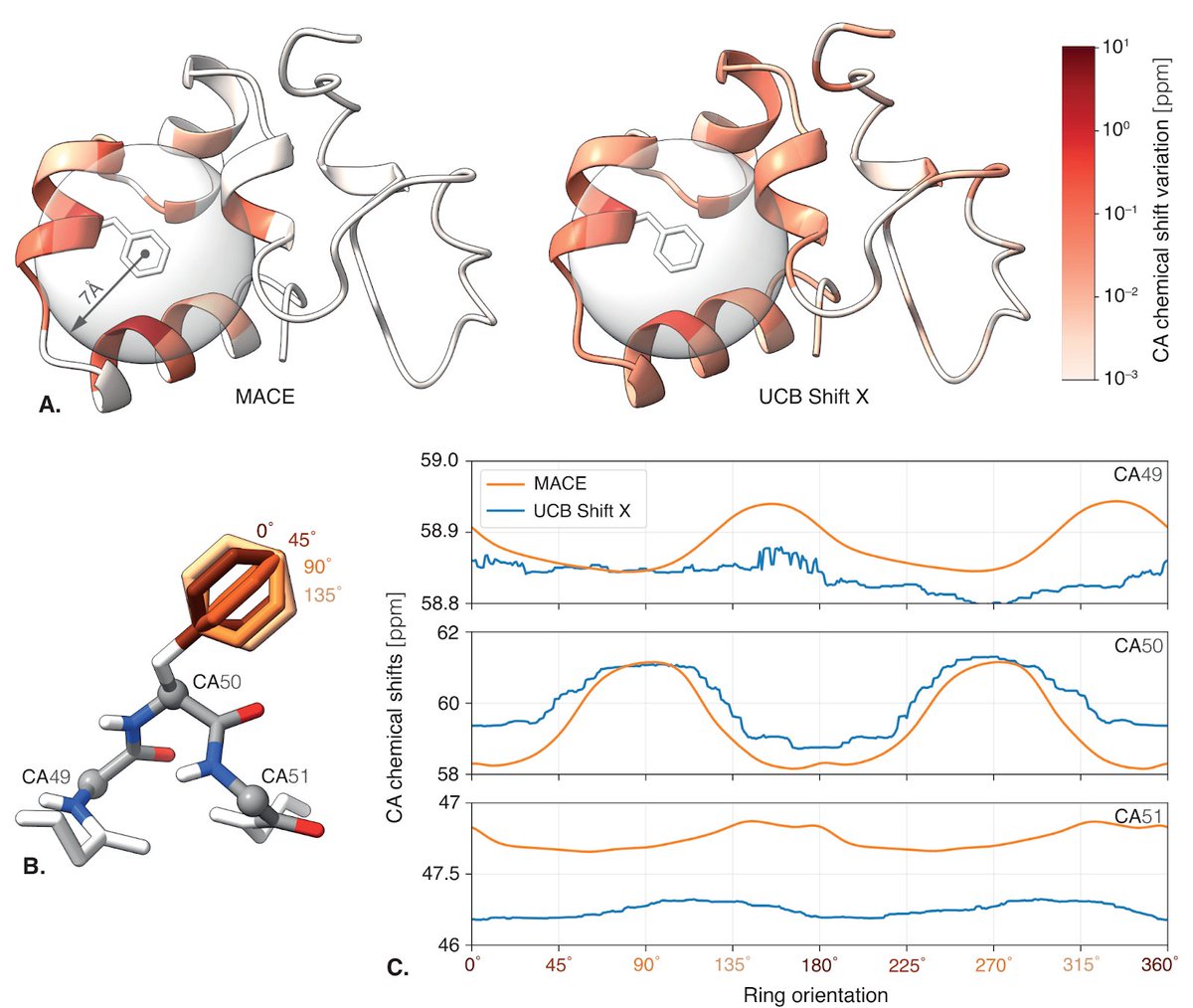
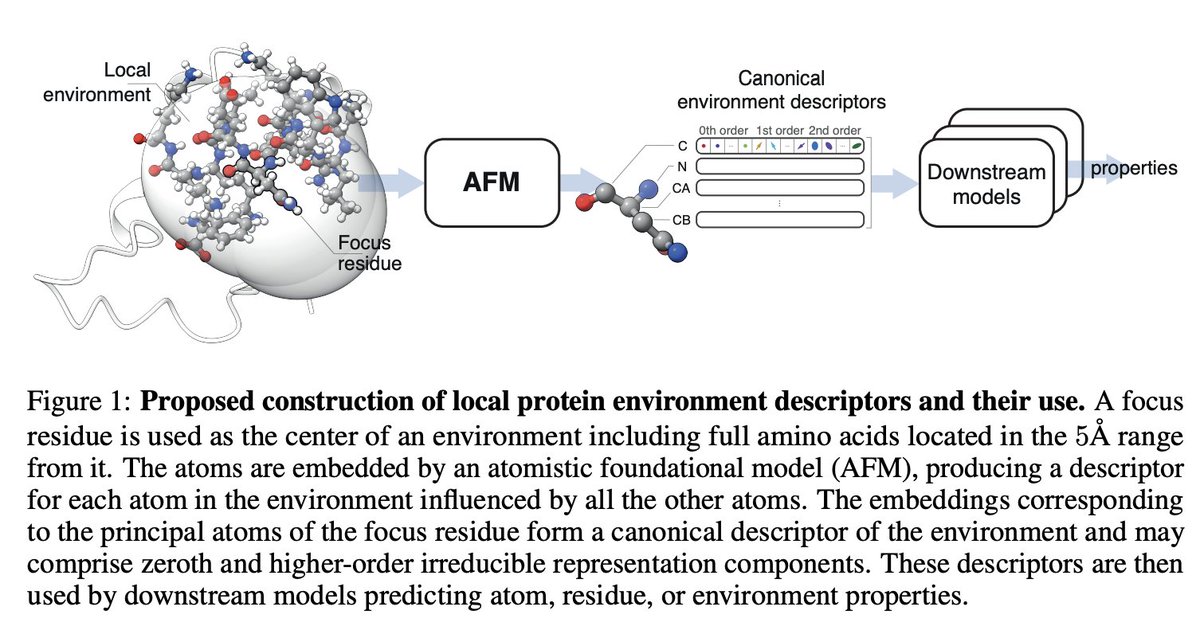
Representing local protein environments with atomistic foundation models 1.This paper introduces a novel method to represent local protein environments using embeddings derived from atomistic foundation models (AFMs). These representations capture both structural and chemical details of proteins with high fidelity. 2.The authors show that AFM-derived embeddings naturally encode secondary structure motifs and amino acid identities, outperforming handcrafted descriptors in accuracy and generalizability. 3.A key highlight is the use of these representations to build a chemical shift predictor for NMR spectroscopy. The model achieves state-of-the-art accuracy and, for the first time, provides confidence estimates using data-driven likelihoods in the AFM embedding space. 4.These embeddings enable computation of meaningful similarity metrics and likelihoods over protein environments. Such metrics allow unsupervised clustering, anomaly detection, and fine-grained structural quality assessments. 5.The concept of canonical local environments is introduced: a residue-centered region including nearby atoms (within 5Å), encoded using backbone atoms and bonded hydrogens. This standardization ensures representations are comparable across residues. 6.AFM embeddings respond sensitively and smoothly to local structural perturbations such as sidechain rotations or secondary structure transitions. This suggests the latent space is physically meaningful and continuous. 7.The authors benchmark multiple AFM families (MACE, Egret, OrbNet, AIMNet) across prediction tasks. MACE embeddings perform best overall, while AIMNet excels in pKa prediction due to multitask training. 8.In a case study, the model correctly captures ring current effects on chemical shifts from aromatic residues, reproducing the expected 180° periodicity—something existing models fail to do. 9.They show that AFM-derived likelihoods can quantify prediction uncertainty: lower-likelihood environments have systematically higher chemical shift errors, making this a valuable tool for downstream confidence estimation. 10.Finally, the embeddings even support partial reconstruction of protein structures. Using only the descriptor, an optimization process can guide AlphaFold3 to generate reasonable alternative conformations. 📜Paper: arxiv.org/abs/2505.23354v1 #ProteinStructure #NMR #MachineLearning #AFM #ComputationalBiology #StructuralBiology
8
34
3,615