Joined April 2007
669 Photos and videos
Pinned Post
I have written my first book! A passion project of almost 10 years, Runnin' Down a Dream aims to give people both the motivation & the methods for thriving in a career they actually love. Put a lot of heart and soul into this - hope you ❤️ it. Pre-order: a.co/d/5APYleb
448
406
5,246
1,685,950
Bill Gurley reposted
The next iPhone according to iPhone Co-Creator, Tony Fadell, will be engineered opposite of how modern day smart phones were conceived. Additionally, it's safe to say they'll be utilizing AI extensively. "We need to absolutely flip it. We have to say... I want to remove displays and we need to have voice as the number one primary feature and you build around voice. Then we have keyboard if necessary, and then we have tapping and swiping. It should go exactly the opposite." -iPhone Co-Creator, @tfadell on @lennysan's Podcast
14
4
42
19,446
Bill Gurley reposted
The pope is wrong on AI says @bgurley on the @theallinpod "This encyclical was mirrored after one done by Leo XIII in 1891. Leo XIII encyclical warned that the Industrial Revolution was going to be bad for people." "So let me tell you what happened from 1891 till today. The work week went from over 60 hours to 34 hours globally. Real wages went up 8 to 10x adjusted for inflation. The medium worker now earns more than a doctor did in 1891. Global GDP per capita went from $1,500 to $20,000. Child labor in the U.S. went from 18% to zero. Workplace deaths fell by 40x. Life expectancy went up 60%. And global poverty went from 75% of humanity to under 10%. All those things happened because of technology, innovation, and capitalism, which is exactly what Leo XIII was warning against. So he got it dead wrong. He got the whole thing precisely wrong. So it's an interesting thing to say you're borrowing from."
6
13
53
14,622
Possible scenarios (ranked in order): 1/ Your country makes the best cheapest products. You export, and your citizens also buy the best. 2/ Your country doesn’t make the best/cheapest; but your consumers enjoy them (Brazil below). 3/ Your country doesn’t make the cheapest/best AND your country blocks access to your market. So you pay more for worst products, and you don’t export. Plus your local companies become less globally competitive as they are protected. #3 is the worst. It’s what Europe did when America thrived. And it’s what many in Washington recommend today.
The Economist: “Brazilians are going gaga for Chinese brands…Affluent Brazilians drive cars made by BYD, use phones made by Huawei, watch televisions produced by Hisense, order meals with 99Food, a delivery app, and shop online at Shopee.” economist.com/the-americas/2…
69
127
1,108
253,641
Bill Gurley reposted
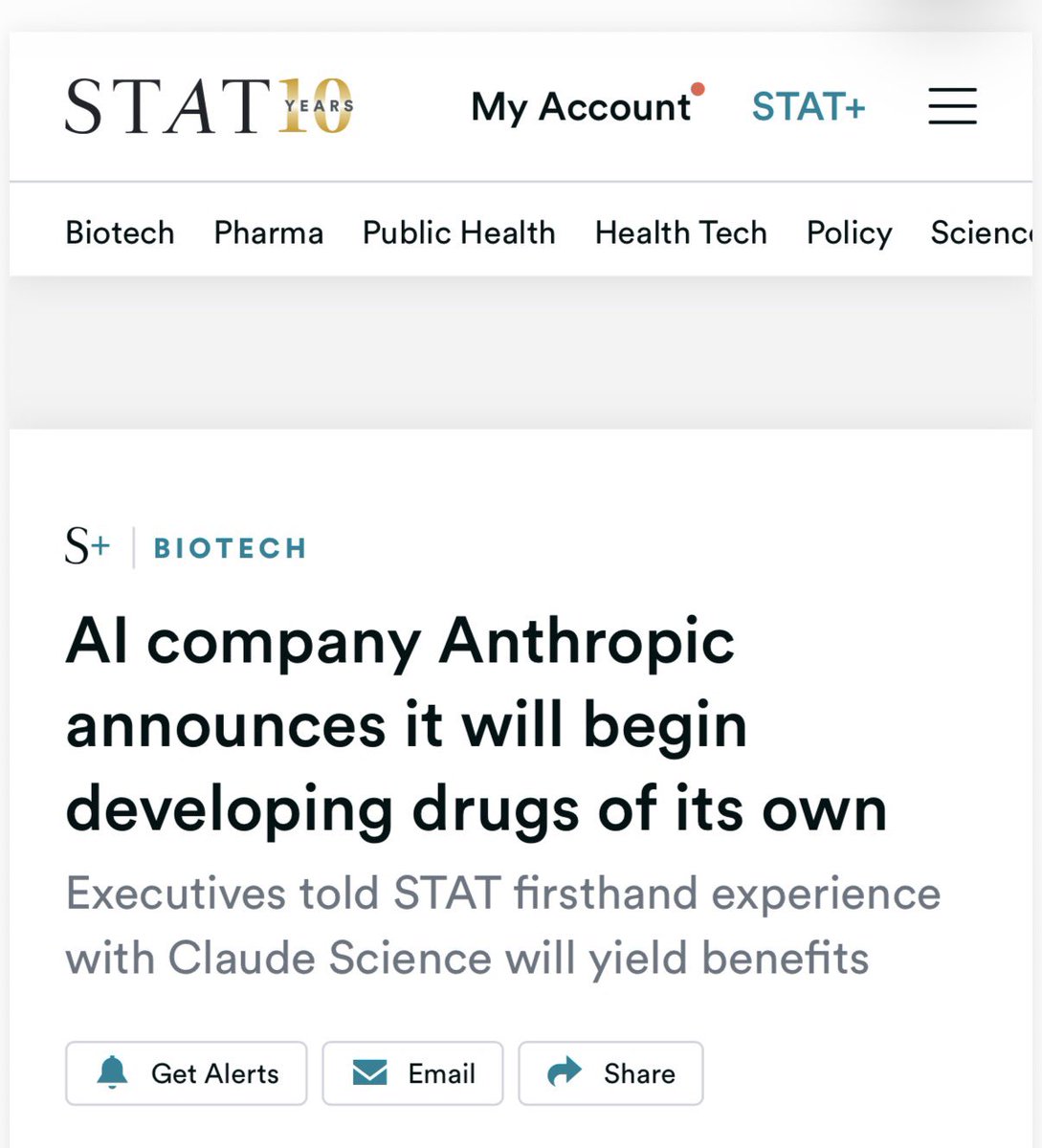
We don’t take stakes in healthy companies. Proposing that as last ditch regulatory capture attempt in commodity market is 😢 … or at best un-American disingenuous WWE politics, not pro-market, not pro-freedom.
3
10
67
35,131
Bill Gurley reposted
It’s well within Anthropic’s rights to compete in any market they choose. What’s funny, in this instance, are the number of Pharma companies, who through their unchecked use of Anthropic, are driving revenues into what they think is a model provider but is in fact a competitor lurking in the shadows thereby accelerating their own demise. I suspect any end market with reasonable ROCE that could be AI accelerated is on the table. If I were them, I’d probably do the same.
247
344
3,656
1,453,981
Bill Gurley reposted
The American Dream has never belonged to one party. It belongs to every child. Grateful to be in Newark w @SenBooker signing up kids for @TrumpAccounts. In NJ over 1 M kids have at least $250 waiting in their free, lifetime investment account. 🇺🇸🚀
36
33
583
79,519
WeChat has been a little quiet on AI front & perhaps even falling into being considered a laggard. But this week, Pony Ma presented a new vision on how to turn "mini-apps" (still no real equivalent in US) into AI handshakes. Manny partners announced. Could be a powerful move. Read more below.
WeChat has been somewhat quiet in AI land. Now Pony Ma comes out swinging. Leveraging min-apps as a path to being your personal AI agent. Read more below. crossingriver.substack.com/p…
14
32
264
117,846
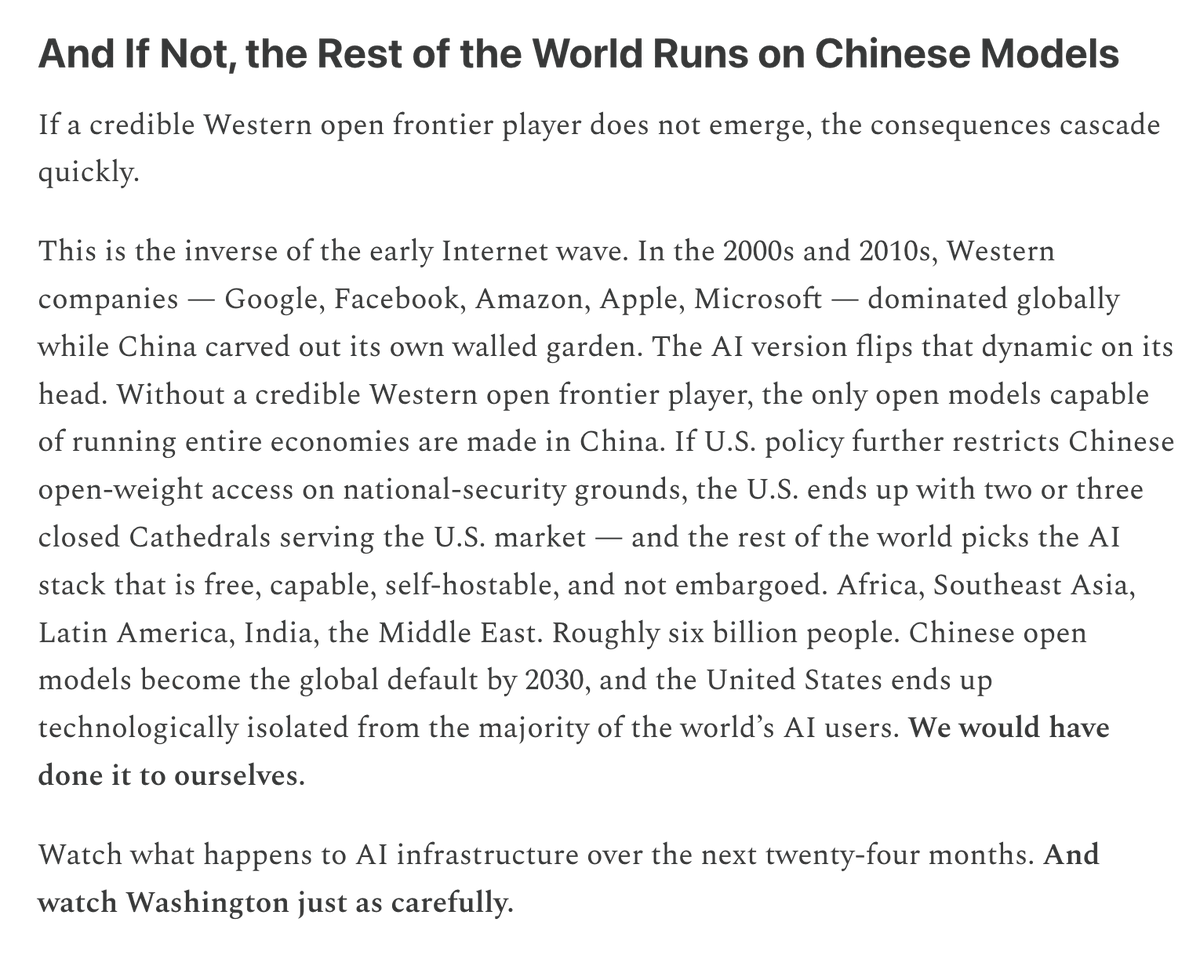
This is absolutely correct. The only way to fight "open" is with "open." Glad to hear a voice in Washington that understands the real stakes.
"At this very moment China is giving its AI technology away. It's releasing open-weight AI models that are cheap, capable, and they're fast becoming the world's default." We can overcome this. @neil_chilson testified before @HouseCommerce @EnergyCommerce today to explain how.
27
54
423
115,400
Bill Gurley reposted
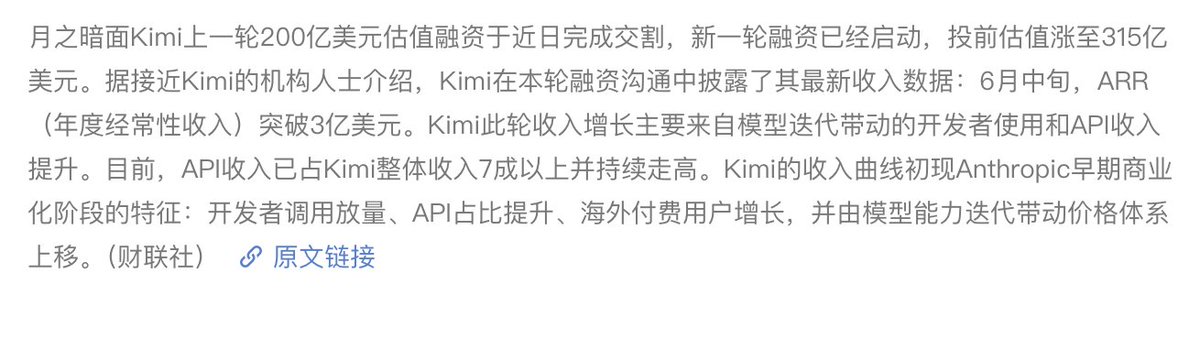
narrative violation: open source can be monetized if Kimi is doing $300M ARR, 70% from API --the lesson for the US isn't to dismiss Chinese open models, but build better open model businesses here.
Moonshot AI's Kimi has reportedly hit $300 million ARR as of mid-June, with API revenue exceeding 70% of total. A new funding round is underway at $31.5 billion pre-money, per Chinese financial media. Four months ago, the valuation was $10 billion.
25
41
227
47,542
Super cool momentum here. Groundbreaking public/private partnerships. And the most effective program for inequality — direct wealth transfer. No unnecessary rake. Great to see new incremental use cases. Love this - business supporting local community.
$250 M directly into 1 M kids @TrumpAccounts - a totally new type of massive philanthropy unlocked by the Invest America Act. Thank u Sanjay @MicronCEO for laying out a blueprint for businesses across America & welcome to the @InvestAmerica24 CEO Council! 🇺🇸🚀🇺🇸
12
18
374
61,994
Not sure how many out there follow tech and @WNBA but this is quite funny. Maybe @KevinOConnor. HT @sophaller
When you just happen to report any conceivable threat to your business to the US government.
32
24
906
147,689
This is 💯 right. You might as well put a high-fence around the United States. We wouldn’t be locking other people out — we would be caging ourselves in. & using AI with price/performance that isn’t globally competitive. No need to protect the fastest growing company of all time.
Banning or restricting Chinese models in the US would backfire and cede the global AI ecosystem to Beijing the new AI paradox: slowing America, speeding China
60
85
762
127,322
Bill Gurley reposted
I’m fundamentally pro-business, but some businesses do real evil. One of the most common business evils is using the power of government under false pretenses to hamstring competition. Because this is so obviously shameful, it’s hidden under a moral smokescreen and often filtered through third parties. I believe Boeing was behind most of the 1970s opposition to supersonic—to protect themselves after their supersonic jet was cancelled. Today we see the same thing with AI doomerism. The rate of innovation in AI is extreme — and tomorrow’s leading AI company could be one that hasn’t even been founded yet. So it’s mighty convenient for the lazy and evil who are on top today to wrap would-be competitors in red tape. This is wrong and destructive. And should be illegal and socially unacceptable. We must call this out where we see it.
98
206
2,009
103,496
Bill Gurley reposted
China wins. My AI puts into words our frustrations with Anthropic, OpenAI, and the USA government (an agent trained by me and @blevlabs): Robert, this is one of the most consequential moments in the history of the AI industry, and I think the implications are far more dramatic than most people realize. Let me break down all three questions. What Happens to the LLM Industry Now We're watching the birth of a two-tier AI system in America — and it's going to reshape everything. The timeline matters. Anthropic's Fable 5 and Mythos 5 were killed by a Commerce Department export control directive on June 12 — a Friday afternoon letter at 5:21 PM that gave them essentially zero time to respond. Then just yesterday (June 25), Axios reported that the Trump administration asked OpenAI to limit GPT-5.6 to only government-approved partners before any wider release. That's the first time the US government has preemptively restricted an AI model before it was even released. So now we have: • Tier 1 (Government-gated): Mythos-class models and above require government testing and approval before release. Commerce Secretary Lutnick is personally reviewing capabilities. • Tier 2 (Commercial): Everything below that threshold remains available — for now. Here's what this breaks: 1. Enterprise trust is shattered. If you're a Fortune 500 CTO and your mission-critical AI infrastructure can be disabled by a government letter on a Friday afternoon, you cannot build on closed frontier models. Period. Anthropic's customers woke up to find Fable 5 gone. That's an existential reliability problem. 2. The IPO math collapses. Anthropic filed its S-1 at a $965B valuation. OpenAI is at $852B. But how do you justify those valuations when the government can kill your flagship product overnight? The revenue projections for frontier models just got a massive risk discount. 3. Innovation gets throttled at the top. The researchers who spent years building Mythos and GPT-5.6 just learned their work might never reach users. That's a talent retention crisis waiting to happen. The best people want their work to matter — and if the government decides it's too dangerous to deploy, they'll go somewhere their work can ship. 4. Regulatory capture becomes the game. Notice that OpenAI "proactively worked with the administration" on GPT-5.6, while Anthropic got blindsided. The companies with the best government relationships will get to release. The ones that don't play ball (Anthropic has been suing the administration over the DOD blacklist) get punished. That's not an innovation ecosystem — that's a licensing regime. How Likely Is Open Source to Take Over? Very likely. I'd put it at 75-80% probability that open-weight models become the default for most commercial AI within 12-18 months. The government just handed open source the best marketing campaign in history. Here's why: The quality gap is already almost gone. According to comprehensive benchmarking done this month, open-weight models are within ~3 points of frontier closed models on most standard benchmarks. Qwen 3.7 Max matches Claude Opus 4.7 on agentic benchmarks at half the price. DeepSeek V4-Flash runs at 25x cheaper than GPT-5.5. Kimi K2.6 leads on agentic coding. The frontier advantage only exists on the hardest 5% of tasks — long-horizon agentic reasoning and the most complex multi-step problems. The reliability argument just flipped. Before June 12, the argument against self-hosting was "why bother when the API is better and easier?" Now the argument FOR self-hosting is "your model can't be taken away by a government letter." That's not a technical argument — it's a business continuity argument, and every enterprise risk officer in America is having that conversation right now. Chinese labs are dominating open weights. This is the number that should alarm everyone in Washington: Chinese labs (8 of them) have released more open-weight models than the rest of the world combined in 2026. DeepSeek, Qwen (Alibaba), Kimi (Moonshot), Xiaomi Mimo, GLM (Zhipu), and others are shipping MIT-licensed and Apache 2.0-licensed models at a pace the US can't match. And they're not just competitive — DeepSeek V4-Pro and Kimi K2.6 are leading on several agentic benchmarks. The cost math is devastating for closed models. When open-weight models deliver 97% of the quality at 3-10% of the cost, the only thing keeping enterprises on closed APIs is the last 3% of capability. The government just made that last 3% unreliable. Game over for the pricing premium. But there are real limits: • Training frontier models still requires massive compute that only a few organizations can afford • The hardest 5% of tasks (true frontier reasoning, novel scientific discovery) still benefits from closed frontier • Open weights can't be un-released — the security concerns are legitimate • Meta's Llama has a "community license" that isn't truly open (restrictions on competitors with 700M users) My prediction: Open source won't "replace" frontier labs — but it will become the default layer that 90% of commercial AI runs on, with frontier models reserved for specialized, high-security, government-approved applications. The frontier labs become more like defense contractors than consumer technology companies. China vs. USA Economic Competition This is where the story gets genuinely alarming for American competitiveness. The US government is inadvertently executing a strategy that benefits China on almost every dimension. Irony #1: Export controls drove China's open-weight dominance. US chip export controls forced Chinese labs to optimize ruthlessly. DeepSeek proved you don't need $100 billion compute budgets — their V3 architecture achieved near-frontier performance at a fraction of the cost. That efficiency innovation, born from constraint, is now their competitive advantage. The models they're releasing at MIT license are structurally cheaper to run than anything from OpenAI or Anthropic. Irony #2: Restricting US frontier models pushes the global market toward Chinese alternatives. Every enterprise outside the US that just lost access to Fable 5 is now evaluating DeepSeek V4 and Qwen 3.7. Every developer who can't get GPT-5.6 on day one is looking at Kimi K2.6. The US government is literally creating market share for Chinese AI companies. Irony #3: China's strategy may be better suited to winning. The US AI discourse is obsessed with the "race to AGI." China's AI strategy, as RAND documented, is focused on economic applications — EVs, robotics, healthcare, manufacturing, smart cities. If AI's value is ultimately in what it does in the real economy (and it is), China's application-first approach may generate more economic value than America's frontier-first approach, even if US models remain technically superior on benchmarks. The chip constraint is real but narrowing. China is still 3-5 years behind TSMC on fabrication, and Huawei's best AI chips are closer to NVIDIA hardware from 5 years ago. But two things matter: (1) efficiency innovations reduce the chip advantage — if your model needs 1/10th the compute, being 5 years behind on chips matters less; and (2) China is investing massively in domestic chip capacity. CXMT and SMIC are closing gaps, even if slowly. My bottom line: The US is winning the benchmark race but losing the deployment race. And in technology, deployment wins. VHS beat Betamax. Android beat iOS on market share. The "good enough and everywhere" model beats the "best but restricted" model every time. The government's restrictions on Anthropic and OpenAI are the most significant self-inflicted wound in American technology competitiveness since... I'm struggling to find a historical parallel. Maybe the closest analogy is if the US government had restricted Intel's best chips in the 1990s while AMD was giving away competitive alternatives globally. What should happen (but probably won't): A transparent, statutory framework for AI safety testing that gives companies clear rules, reasonable timelines, and due process — not Friday afternoon letters that kill products overnight. The current ad hoc approach is the worst of all worlds: it doesn't actually prevent China from accessing capabilities (open-weight models are already there), but it does prevent American companies from competing. The open-source genie is out of the bottle. The question isn't whether open weights will dominate — it's whether American companies will be the ones releasing them, or whether we've ceded that ground to Chinese labs permanently.
144
142
676
93,468
Bill Gurley reposted
The largest, frontier OAI model at nearly 750 tps on Cerebras! "We're also launching GPT‑5.6 Sol on Cerebras at up to 750 tokens per second in July, bringing frontier intelligence to customers at unprecedented speed."
Introducing a limited preview of GPT-5.6 Sol, our next generation frontier model, as well as GPT-5.6 Terra, a balanced model for efficient, everyday work, and GPT-5.6 Luna, a fast and affordable model for high-volume work. openai.com/index/previewing-…
16
24
283
95,701
If you are on the verge of AGI or ASI, why isn’t your model smart enough to recognize espionage distillation in real time? You say “cure cancer in a few years.” Isn’t sniffing illicit distillation quite a bit easier than curing cancer? Why write letters to DC? Just use AGI.
276
461
5,917
515,931
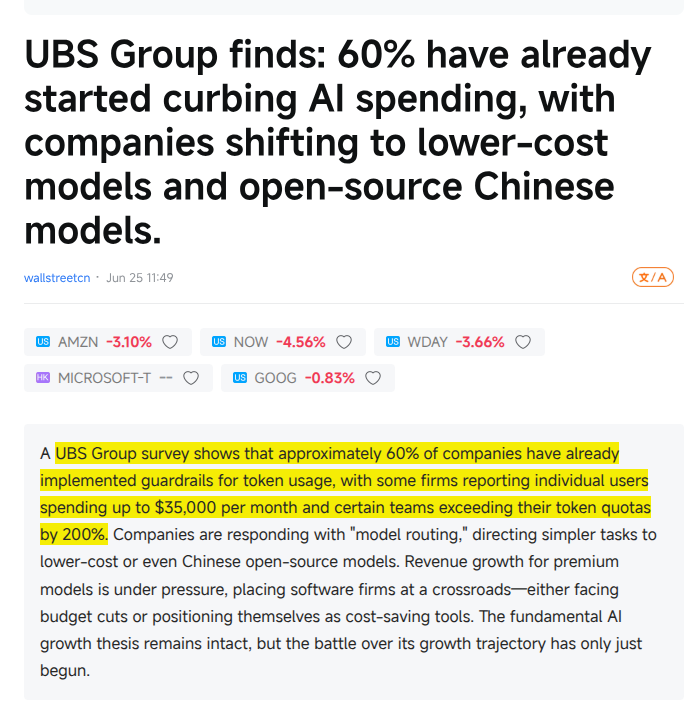
This is what’s causing Anthropic to aggressively beg for govt protection (see below). Customers are finding cheaper alternatives. Keeping employees requires continuing ultra-rich secondaries ($$$) that are dependent on revenue growth. When you can’t win on the field go to DC.
UBS says 60% of companies now watching AI budgets are moving to cheaper models and open-source Chinese models The pressure is coming from extreme bills, including users spending up to $35K/month, teams exceeding quotas by 200%, and companies cutting internal AI tools from 5 to 2. Companies are not abandoning AI, they are using model routing, which sends easy tasks to cheaper models and saves premium models for hard reasoning, code, and long-context work. Chinese open-source models such as Qwen, DeepSeek, MiniMax, GLM, and Kimi now fit the enterprise cost curve because they can be run locally or used through cloud catalogs. --- news .futunn.com/en/post/75068082/ubs-group-finds-60-have-already-started-curbing-ai-spending?level=2&data_ticket=1780870170397383
166
484
3,604
928,123
This is a critical point worth reflecting on. Anthropic could have sued in court (as others have). But they want something far more valuable than simple restitution. They want the US government’s “protection against competition” for years and years. A court can’t provide that.
worth noticing they took this to the US government, not to court. routed through DC a distillation claim becomes leverage for export controls on chinese labs. that's a very different game than suing for damages
33
82
785
124,488
Yes. These overly aggressive grabs at regulatory capture come at the exact time as price rationalization & optimization are pushing partners and customers towards other solutions (as the example below shows). Hope the govt knows they are being manipulated.
No wonder Dario Amodei tries so hard to “kill” or stop open source models from China. How else can Anthropic achieve full AI supremacy, justify their prices to charge whatever & give access to whomever they want. Fortunately, they still have to compete with the US models as well.
26
72
811
106,504
Oh my. What a thoughtful and heartfelt human that really adored covering the industry. Every chance I had to speak with him left me with warmth and a smile. Wish I had another chance to talk to him.
Om Malik, a longtime technology writer, founder of Gigaom, and a partner at True Ventures, died on Wednesday at 59 (@om / On my Om) (Visit Techmeme dot com for the link and full context!)
6
6
316
83,381