Joined April 2022
1 Photos and videos
Bartłomiej Baranowski reposted
📢 GenRecon Code Release 📢 Few images in → complete, high-fidelity 3D scene out! GenRecon builds a generative prior on full scenes, resulting in unprecedented 3D reconstruction quality. 🔗 github.com/kasothaphie/GenRe… 🌐 kasothaphie.github.io/ 📄 arxiv.org/abs/2605.23888
13
137
826
37,804
Bartłomiej Baranowski reposted
📢UnfoldArt recovers articulated 3D objects from image or text! @ElBoudjogh24002 uses 🤖multi-agent reasoning for articulation 🎥 video priors for high-fidelity geometry & interiors → interactable URDFs for furniture, helicopters, humanoids, & more! 👉aminebdj.github.io/unfoldart…
3
34
146
8,515
Bartłomiej Baranowski reposted
📢 FaceAnything (ECCV 2026) Code Release 📢 Turn any image sequence into high-fidelity 4D face reconstructions, without controlled capture rigs. Try it on Hugging Face & reconstruct your face in 4D! 🔗github.com/kocasariumut/Face… 🤗huggingface.co/spaces/UmutKo… 🌐kocasariumut.github.io/FaceA…
8
117
743
47,153
Bartłomiej Baranowski reposted
📢 OneCanvas: 3D Scene Understanding via Panoramic Reprojection We extract features from video frames and reproject them into one occlusion-free view of the whole scene that a 2D VLM reads just like a normal image. We can center this view on any viewpoint, including an agent's own pose for situated reasoning. The same projection lets us create spatial training tasks with no human annotation, solvable only by reasoning over the 3D positions of real object features placed on an otherwise empty canvas. The result is a stock 2D VLM that reasons in 3D, setting a new state of the art across spatial benchmarks at far less compute. 🌐 baranowskibrt.github.io/onec… ▶️ youtu.be/NIaHLB9gA7s Great work by @baranowskibrt & @davech2y
74
456
24,764
Bartłomiej Baranowski reposted
Nine papers accepted at #ECCV'26 🥳🎉🔥 Super exciting research on world models, 3D Gaussians (GPT), feed-forward reconstruction, virtual humans, agentic generative models, and much more! Super proud of all students & collaborators :) See you all in Malmö 🇸🇪
1
22
227
14,098
Bartłomiej Baranowski reposted
Come by our ScanNet workshop @CVPR June 3 in 710, 1:00pm onwards! 5 exciting keynotes on world models, NVS, 3D gen, understanding and more, from @taiyasaki @davnov134 @orlitany @PeterHedman3 @RamananDeva and talks from NVS semantics benchmark winners: scannetpp.mlsg.cit.tum.de/sc…
22
69
19,199
Bartłomiej Baranowski reposted
The Photorealistic 3D Head Avatars workshop takes place at @CVPR on: 🗓️June 3rd 🕘 8:50am - 12:30pm 📍Room 107 Join us for latest trends on avatar creation, photorealistic rendering, and discussions on 2D vs 3D avatars. Workshop website: kaldir.vc.cit.tum.de/nersemb…
1
15
59
10,161
Bartłomiej Baranowski reposted
📢GaussianGPT: autoregressive 3D Gaussian scene generation. We introduce a GPT-style model that directly generates 3D Gaussian scenes, token by token, in a series of small, discrete decision steps. Generation, completion, and large-scale outpainting in a single pipeline. Unlike diffusion-based approaches, GaussianGPT explicitly models the scene distribution at every step, allowing for quite flexible scene synthesis. 🌐 nicolasvonluetzow.github.io/… ▶️ youtu.be/zVnMHkFzHDg Great work by @nicolasvluetzow, @barbara_roessle, @katha_schmid
35
294
2,346
151,924
Bartłomiej Baranowski reposted
Want to create an avatar from a single image? FlexAvatar is a transformer model that creates full 360°, high-quality, and expressive 3D head avatar from just a single portrait image in minutes. Real-time Demo: FlexAvatar's lightweight architecture allows both animation and rendering in real-time, enabling interactive user experiences. To create a new 3D head avatar, only one image is required, e.g., from a webcam. The final avatar is ready after 2 minutes. Architecture: Under the hood, FlexAvatar adopts a transformer-based encoder-decoder design. The encoder maps the input image onto a latent avatar space, while the decoder produces 3D Gaussian attribute maps by incorporating the animation signal via cross-attention. The model learns all facial animations directly from the data without relying on pre-built 3D face models. This equips the avatars with realistic facial expressions. The internal avatar latent space can be conveniently used to integrate additional observations of a person via fitting. This enables use-cases where more than one image of a person is available, e.g., from a phone scan of the person. We train jointly on 2D monocular videos and multi-view data. However, in monocular videos, the animation signal leaks the target viewpoint, causing the model to produce incomplete 3D heads. We call this phenomenon entanglement of driving signal and target viewpoint. To prevent entanglement, we introduce bias sinks. These are learnable tokens that indicate whether a training sample stems from a monocular or a multi-view dataset. During training, the model learns to produce incomplete 3D heads only when the monocular token is present. During inference, FlexAvatar then always uses the multi-view token for which the model has learned to produce complete 3D heads. This simple design allows to combine the generalizability from monocular data with the quality of multi-view data. FlexAvatar summary: - Input: Single-image, phone scan, or monocular video - Output: Full 360° head avatar - Expressive animations - Real-time rendering and animation - Generalization to any portrait - Create a new avatar in 2 minutes - Use bias sinks to combine 2D and 3D data 🏠tobias-kirschstein.github.io… 🌍arxiv.org/pdf/2512.15599 🎥youtu.be/g8wxqYBlRGY Great work by @TobiasKirschst1 and @SGiebenhain!
10
65
392
95,800
Bartłomiej Baranowski reposted
Releasing Echo today is incredibly exciting for me — because it is a critical step for generative AI, enabling the creation of virtual worlds. Echo is our first world model at SpAItial AI. It turns text or images into explorable 3D environments — spaces you can move through, inspect, and build on. Seeing this work in real time still feels a bit surreal. My fascination with this goes back a long way: video games, virtual environments, and the idea of capturing the real world in 3D. As a researcher, I spent years working on 3D reconstruction, neural rendering, and scene understanding — all driven by the same question: how do we teach machines to understand the world? One thing became clear over time: the biggest bottleneck isn’t compute or rendering — it’s 3D worlds themselves. High-quality, consistent environments are expensive to create by hand and don’t scale to the experiences we want to build. In particular, I believe that the ability to generate virtual worlds is ultimately key towards understanding the real world. That’s why we founded SpAItial AI. We’re building spatial world models that combine geometric understanding with creative generation — models that can generate, edit, and eventually reason about 3D environments. Echo is just the beginning. For me, this feels like the moment when decades of research finally meet the imagination that got many of us into graphics, games, 3D understanding in the first place.🌍 spaitial.ai/
🚀 Announcing Echo — our new frontier model for 3D world generation. Echo turns a simple text prompt or image into a fully explorable, 3D-consistent world. Instead of disconnected views, the result is a single, coherent spatial representation you can move through freely. This is part of a bigger shift in AI: from generating pixels and tokens to generating spaces. Echo predicts a geometry-grounded 3D scene at metric scale, meaning every novel view, depth map, and interaction comes from the same underlying world — not independent hallucinations. Once generated, the world is interactive in real time. You control the camera, explore from any angle, and render instantly — even on low-end hardware, directly in the browser. High-quality 3D world exploration is no longer gated by expensive equipment. Under the hood, Echo infers a physically grounded 3D representation and converts it into a renderable format. For our web demo, we use 3D Gaussian Splatting (3DGS) for fast, GPU-friendly rendering — but the representation itself is flexible and can be easily adapted. Why this matters: consistent 3D worlds unlock real workflows — digital twins, 3D design, game environments, robotics simulation, and more. From a single photo or a line of text, Echo builds worlds that are reliable, editable, and spatially faithful. Echo also enables scene editing and restyling. Change materials, remove or add objects, explore design variations — all while preserving global 3D consistency. Editing no longer breaks the world. This is only the beginning. Echo is the foundation for future world models with dynamics, physical reasoning, and richer interaction — environments that don’t just look right, but behave right. Explore the generated worlds on our website and sign up for the closed beta. The era of spatial intelligence starts here. 🌍 #Echo #WorldModels #SpatialAI #3DFoundationModels Check it out: spaitial.ai/
24
97
632
71,117
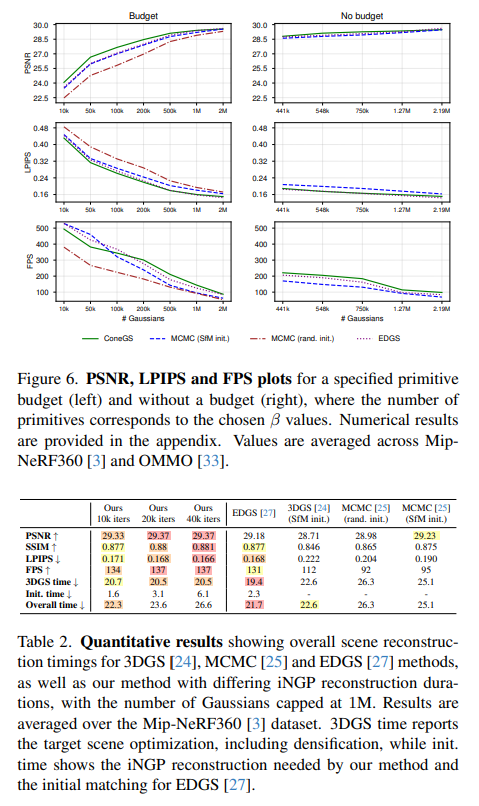
Excited to share that our paper, "ConeGS: Error-Guided Densification Using Pixel Cones for Improved Reconstruction with Fewer Primitives", has been accepted for an oral presentation at the 3D Vision 2026 conference in Vancouver! baranowskibrt.github.io/cone…
24
Bartłomiej Baranowski reposted
ConeGS: Error-Guided Densification Using Pixel Cones for Improved Reconstruction with Fewer Primitives Bartłomiej Baranowski, Stefano Esposito, @pgschossmann, @AnpeiC, Andreas Geiger tl;dr: depth from iNGP guides new Gaussian placement in high photometric error areas arxiv.org/abs/2511.06810
2
34
2,732
Bartłomiej Baranowski reposted
ConeGS: Error-Guided Densification Using Pixel Cones for Improved Reconstruction with Fewer Primitives TL;DR: "ConeGS replaces cloning-based densification with a novel method that generates pixel-cone-sized primitives in regions of high image-space error. By improving placement and removing reliance on existing scene structure—thanks to a flexible iNGP-based exploration—it achieves higher reconstruction quality than baselines using the same number of primitives." Contributions: • A densification strategy that places new Gaussians in regions of high photometric error in image space, guided by depth estimates from an iNGP-based geometric proxy. • An approach that determines the size of new Gaussians from the viewing cones of the pixels from which they are generated. • An improved opacity penalty that promptly removes low-opacity Gaussians, combined with a budgeting strategy that balances scene complexity and primitive count.
1
4
39
3,953