AI, EVs, Robotics, Education, China. Mom. Also I help edit @techbuzzchina. Views personal. Ask me anything

Joined January 2008
515 Photos and videos
Pinned Post
I meant to post this last Friday with our newsletter but hey, the @TechBuzzChina China AI Atlas is now live! It's a free and interactive "field guide" to the top labs, talent and capital building China's foundation models and it is one of quite a few data tools we are building to map our "coverage universe" in China properly (the others being robotics / physical AI, advanced manufacturing, EVs, biotech, and more). The atlas itself is at ai.techbuzzchina.com and we are thankful to @Gracemzshao of AI Proem and @CRC_8341 China Research Collective for their contributions and help! Any errors that survive are ours. A thread on the Atlas & what the data shows in this alpha version. 1. As I mentioned before, one of the first things we did was to map the most important researchers and try to give you a flavor for their technical strengths, tech/product/life philosophies, personal journeys, so that you can get a better feel for how they differentiate from each other. To make it slightly more fun and interactive, we made it so that each of the top ~50 profiled researchers got a "stat card" that shows off their relative strengths and weaknesses in a few core metrics. And you can even have the labs "face off" against each other in a mock head-to-head, lol. *Scores are data-based but ultimately subjective and meant to spur discussion / be entirely for fun!!
7
6
46
16,540
I feel like the release of Fable buried this super important story. This is a trillion parameter model trained entirely on domestic Chinese chips. The team started three years ago in 2023 and it was a slog, lots of optimizations needed to make this possible. But it proved one thing — it’s just calculations, you don’t HAVE to have Nvidias. You can make do with less if you understand what you’re doing, and surprisingly, the “crappy” domestic chips aren’t as crappy as originally believed
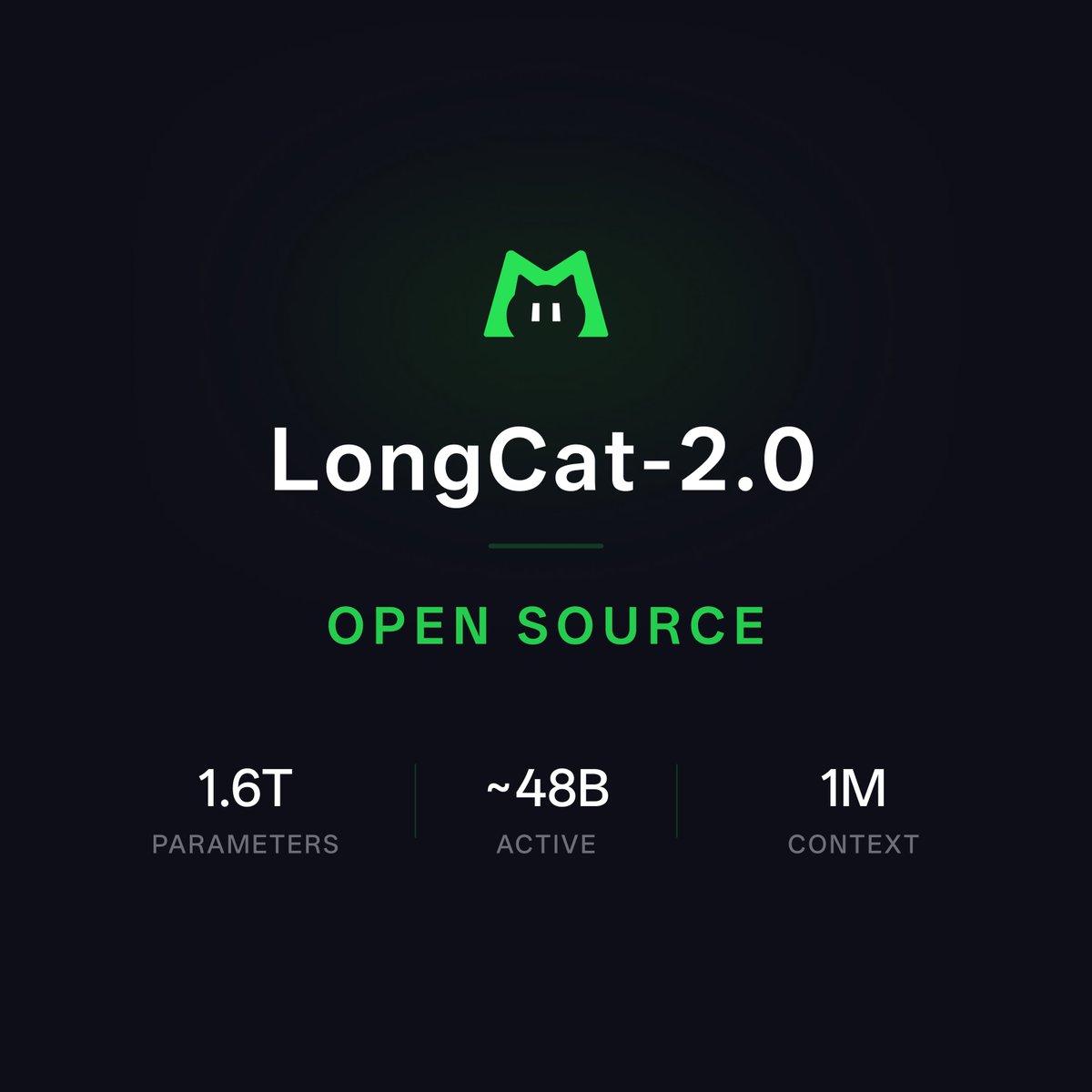
🐱 LongCat-2.0 is now fully open-source — MIT licensed, no restrictions. Since our launch a few days ago, the response from the community has been incredible. Thank you for all the feedback, discussions, and interest. Today, we’re releasing the model weights and inference code to everyone. ◆ 1.6T MoE · ~48B active · 1M token context ◆ Agent-native: Integrates directly with Claude Code, OpenClaw, and Hermes Agent ◆ Deployment: Support both GPU and NPU platforms— verified on large-scale domestic clusters 📑 Tech Blog: longcat.ai/blog/longcat-2.0/ 🤗 HuggingFace: huggingface.co/meituan-longc… 💻 GitHub: github.com/meituan-longcat/L… 🪄 ModelScope: modelscope.ai/collections/me… 👇 Inference Code GPU: github.com/sgl-project/sglan… NPU: github.com/meituan-longcat/S…
24
51
692
78,083
Happy 4th everyone!
1
9
2,391
Tag / link your favorite tech influencer / content creator who you think would benefit from a trip to China to visit leading Chinese companies in AI, robotics, and new energy I've just gotten so many requests about this and I want to crowd-source the best list, help please
7
1
23
6,169
Great article from @chinazhidx on how Meituan trained its 1.6T-parameter LongCat-2.0 entirely on 50,000 domestic AI accelerators. Here's the TL;DR: - LongCat-2.0 is China’s first trillion-parameter model to complete the full training and inference pipeline entirely on domestic AI compute, using a peak cluster of 50,000 domestic accelerator cards, the largest training run ever on a Chinese AI computing platform. - The project began in July 2023, with the team adapting its training stack to domestic hardware and working closely with the chip vendor through weekly technical meetings. - As they scaled, they rewrote key pieces of the software stack, including high-performance deterministic implementations of FlashAttention and Scatter operators, enabling deterministic training at massive scale while keeping the performance penalty to roughly 5%. - The team also found that numerical error on some domestic chips was actually lower than on mainstream chips, arguing that as long as computational correctness is maintained, there is no fundamental technical barrier preventing domestic hardware from training frontier models. - They acknowledge that individual domestic chips still lag the world’s best. But their view is that system-level engineering, co-designing algorithms, infrastructure, and hardware, can compensate for weaker individual chips. - Their conclusion is that the next phase of AI competition won’t be won by better chips or better models alone, but by full-stack systems engineering.
5
14
58
10,246
China is now training trillion parameter models on domestic hardware. Meituan’s new 1.6T-parameter LongCat model was reportedly trained on around 50,000 Huawei Ascend chips. China is adapting to export controls by redesigning the entire AI stack. Rather than matching Nvidia chip-for-chip, Chinese companies are leaning into system architecture, networking, and software optimizations to offset hardware constraints. This hardware-software co-design is increasingly becoming China’s competitive strategy. This piece is a very accessible primer on what's happening:
14
42
267
27,849
Rui Ma reposted
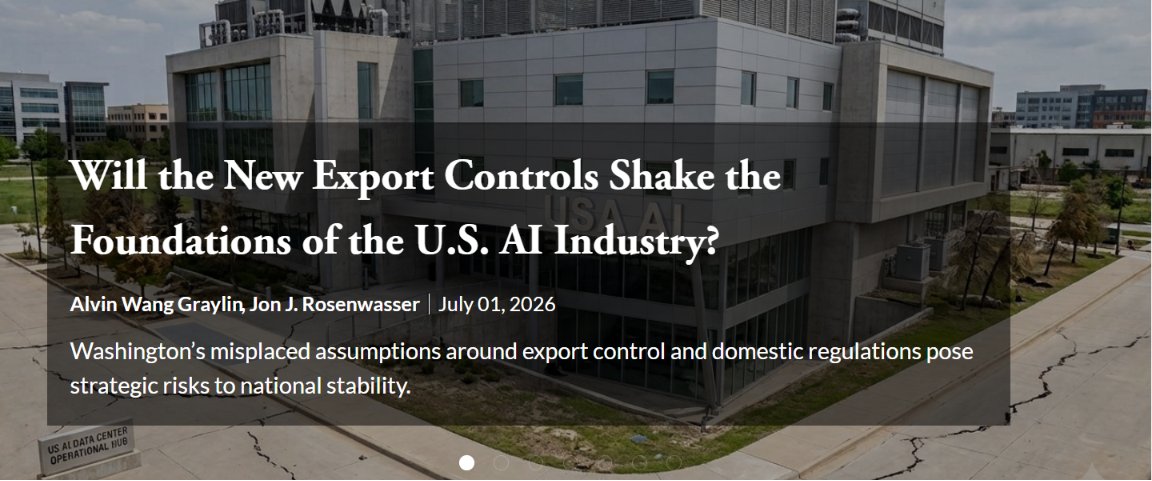
What did the US get for applying export controls to an #AI model for the first time? 🚨🚫 Two weeks ago Commerce ordered @AnthropicAI to block foreign nationals from Fable 5 and Mythos 5. It couldn't sort users by nationality in real time, so it pulled both models for everyone. Within 48 hours, Z.ai shipped GLM-5.2 under an MIT license, Rio released an open model on Qwen, and Sakana pitched "frontier capability without export-control risk." The ban is now reversed and Fable is back, but the trust damage is done. In our new @lawfare piece, Jon Rosenwasser and I argue US AI strategy rests on two false assumptions: - “Denial keeps us ahead” It doesn't. Three years of chip controls actually narrowed the AI gap. Chinese open-weight models went from under 2% of OpenRouter traffic in late 2024 to ~61% of top-model usage today. - We can't regulate at home because China won't. It already does. China has regulated AI since 2021, with 700 models reviewed before deployment. Beijing even steered its own labs away from H200 chips that beat domestic parts. It’s not a country sprinting to AGI at any cost.💡 The real risk isn't over-regulation. It's the bet: ~$725B in AI infrastructure in 2026, past $1T in 2027, while the physical stack tilts toward Beijing and the gains diffuse outward. We need to keep US models open, govern with confidence at home, cooperate where stakes are shared, and build the safety net before the displacement arrives. See full OpEd below. @AsiaPolicy @StanfordHAI
Even with the reversal, the Commerce Department’s decision to impose export controls on Anthropic's Fable 5 has created a loss of trust among AI users globally. Alvin Wang Graylin and Jon J. Rosenwasser explore the assumptions underlying AI policymaking this incident exposed.
1
3
13
3,769
After years of lag, Chinese semiconductor stocks are finally performing in line with global peers. The export controls initially hurt but then returned dividends just like predicted 2023: China completely missed the AI rally. U.S. semis soared on Nvidia and generative AI, while Chinese chip stocks were still weighed down by export controls and weak domestic sentiment. 2024: China recovered somewhat but still lagged global semiconductor stocks by a wide margin. 2025: Performance finally converged as domestic substitution, memory, equipment, and AI infrastructure spending gained momentum. 2026: China has fully joined the AI chip bull market.
7
67
6,174
Got asked today what my response is to a Western researcher who claimed that in their country people will use crappier and more expensive models just to avoid anything Chinese in origin I think that is undoubtedly true with some groups, but we are early in AI adoption and as more AI usage scales up the more differentials in cost & speed will be amplified and cannot be ignored You see posts like this below all the time now. But it’s all about scale. Saving 16x off of a $1000 is not that interesting. Off of one million though it starts to get interesting, off of a billion then it is a core consideration
For those tracking the America closed source vs China open weight model debate: In an initial pilot on modernizing an application from PHP to Next.js, Opus 4.8 with 8090’s Software Factory was simultaneously 1.4× cheaper and 1.5× faster than Opus 4.8 alone. Pairing our Software Factory with the cheaper GLM 5.2 model cut costs 16.4×, though it ran 3× slower than Opus 4.8 alone. Results are directional (n=1 per arm), and next steps are to rerun with proper controls and 10–15 buyer-relevant legacy modernization tasks developed with our Sales and GTM teams. More to come but the important question it raises is why any American public company with shareholders burning money on closed source models when the open weight ones are so much cheaper? We will rerun this on American open source models next (aka Nvidia)…
5
2
57
13,833
So basically Alex Karp’s argument is that frontier AI labs profit three times: (1) they charge you for tokens, (2) they get access to your IP and business know-how, and (3) they eventually commoditize your competitive advantage. Instead, he says enterprises should pay Palantir to deploy open models and keep their own alpha LOL I did not expect him to suddenly become an ally for open source even though it is of course very self-interested
Palantir's CEO just exposed Sam Altman and Dario Amodei for robbing every Fortune 500 company. Within two minutes, Alex Karp took the entire frontier AI industry apart on national television. His exact words: "Every single enterprise in this country, these people are LIVID. They are paying for tokens that create no value. These people are stealing the weights and alpha of my business." He literally said the entire frontier AI business model is intellectual property extraction dressed up as a subscription. Then he also destroyed the pricing model with a single question that Silicon Valley still refuses to answer: "If it was so valuable, let's say I can make you $1 billion tomorrow. Wouldn't I say I'll make you $1 billion and I want 30 percent? Why are they charging for tokens if it's so valuable?" That question breaks the industry. If OpenAI and Anthropic's models truly delivered the productivity gains the labs claim, they would take equity or a share of the profit they generate. They would not sell access by the million tokens. Token pricing is itself the CONFESSION that the product cannot produce reliable value at scale. If it did, they would price for the value. But they price for the compute because that is what they are actually selling. Karp went even further... He called the entire arrangement "a wealth tax that does not help the poor. It just punishes." American businesses are transferring the alpha of their operations, meaning the workflows, the customer data, the strategy memos, the internal models that make them competitive, directly into the training pipelines of a handful of Silicon Valley labs. Once those labs retrain, the customer's own edge becomes the next enterprise product sold back to their competitors. And the part the AI industry does not want anyone thinking about: Every enterprise running its confidential documents, its customer conversations, and its financial models through a frontier model is potentially teaching that model HOW to replace them. The vendor collects the token fee AND the compounding intelligence about that customer's business. That is the mechanism. And that is why Karp used the word "stealing." He claims this is why every executive he meets is furious in private and silent in public. Nobody wants to be the CEO who called out the labs and then discovered their next competitor was built on their own leaked workflows. The entire AI industry has been priced for perfection on one assumption: That frontier labs produce durable, defensible value that justifies infinite compute spend. But Karp just told us that the customers do not believe that assumption anymore. They believe they are being taxed without benefit, watched without consent, and copied without recourse. The moment enterprises stop believing, the whole valuation stack shakes.
180
356
3,631
431,295
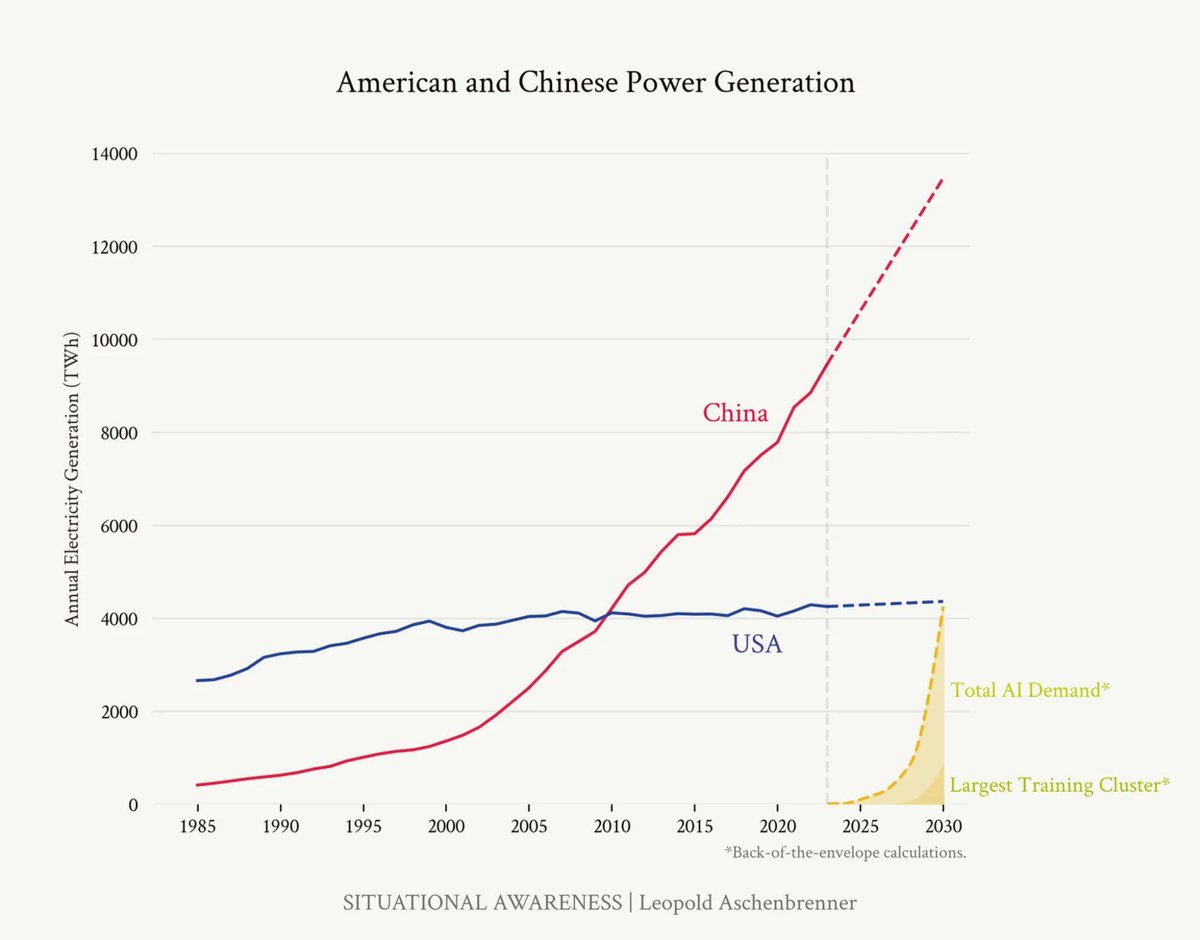
I went viral for saying that "China has power solved" last year summer, here is Leopold saying it better with a chart h/t @passluo
15
94
415
32,057
Chinese STEM talent surplus now is 100% due to incentives and systemic reform. Actual Chinese culture & history overwhelmingly overweights arts, philosophy, literature and ethics, eg “the humanities.” Imperial examinations literally included poetry. And calligraphy (art). Poets were super high status and revered. The whole heavy push into STEM was accelerated by Deng Xiaoping’s 4 modernizations (agriculture, industry, defense, science). The lack of focus on science is one of the main reasons why China fell behind and was helpless to defend itself during the “century of humiliation.” China’s focus on STEM is super recent, if you take a historical view. Sure, science is a relatively recent human invention on the civilizational timeline, but even accounting for that China tilting towards STEM is a lot more recent than the West. So it’s all nurture and effort and building education systems that support STEM. Why are we taking such an anti STEM stance in the U.S. I don’t understand. Such attitudes, even more than the policies (which are sometimes well intended) will take years to undo
45
27
222
23,935
The “grabbing a bite isn’t just smart, it’s strategic” killed me 🤣
Your friend has been spending way too much time with AI. 😂
1
2
17
4,808
I don’t get it, what changed? Did everyone become Mythos 5 cyber attack immune? Is there some plan to explain anything at all? Besides how dangerous open source is lol
We’ve received notice that the Department of Commerce has lifted export controls on Claude Fable 5 and Mythos 5. We'll begin restoring access tomorrow, and will share an update soon. We’re grateful to our users for their patience, and to everyone who worked with us on redeploying the models.
28
10
155
10,962
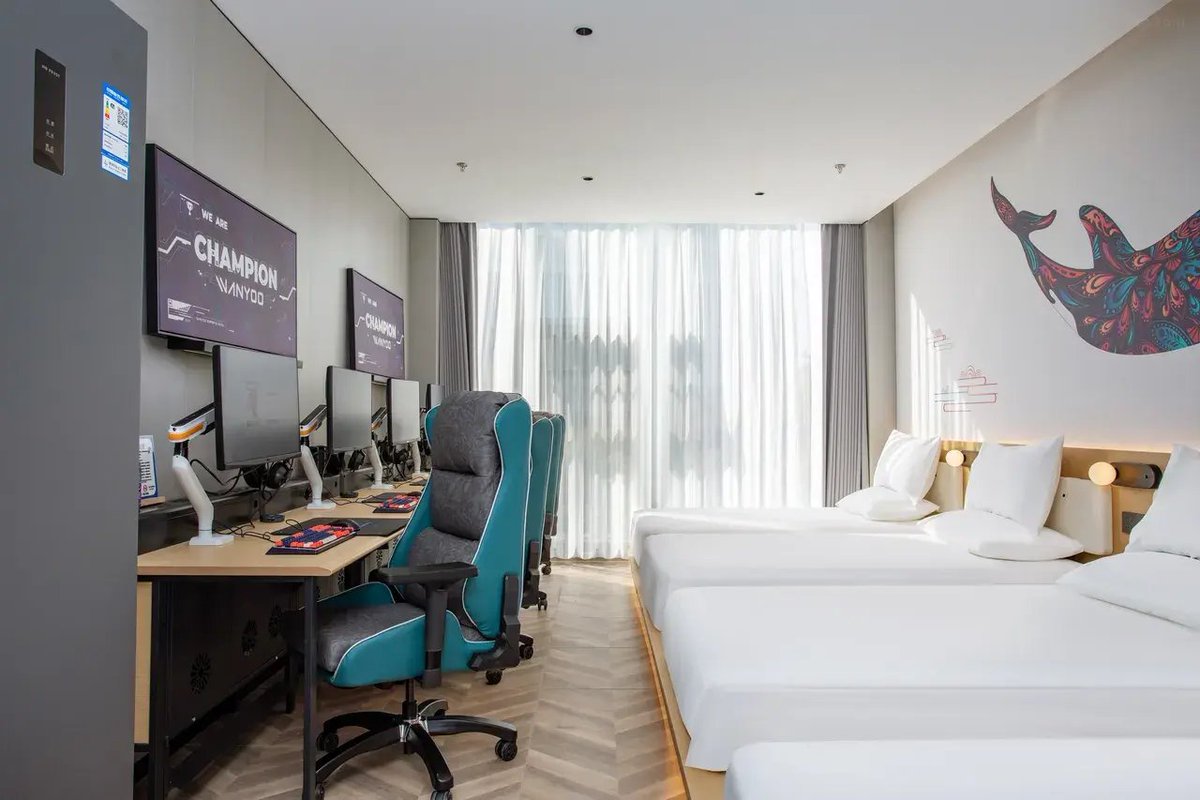
I was very confused why the Shanghai hotel I booked contained references to how many computers are in the room but then I realized it is an esports themed hotel LOL (It's just closest to the WAIC venue I think, unless I got the wrong expo center again)
12
54
5,873
The big mystery for me is why are there people who think a massive & now much better resourced nation like China which focuses relentlessly on hardcore math physics and chemistry education is going to be helpless & hopelessly behind when it comes to AI and semiconductors Are these things not literally math physics and chemistry
97
73
609
43,785
Spoke to @APNews about China's AI chip sector last week -- my comment that made it into the article: "Demand still exceeds available supply in China when it comes to AI chips, said Rui Ma, founder of Tech Buzz China." And that demand for domestic chips was 100% engineered by export controls. Nice. Nvidia used to have 95% of the Chinese market per Jensen, and even if you believe a good amount of NVIDIAs are being smuggled into the country, Jensen is for sure no longer 95% of the market (most estimates put Huawei at 50% market share for this year)
3
2
19
3,415
Most of the rest of the world couldn’t afford US models at scale anyways and were already going to use Chinese open sourced models. Also most sensible govts will want to build on open source IMO, already see this with firms working on sovereign AI projects
Banning or restricting Chinese models in the US would backfire and cede the global AI ecosystem to Beijing the new AI paradox: slowing America, speeding China
7
9
78
12,142