@AsiaSociety's think tank.šŸ’”Tackling key policy challenges confronting the Asia-Pacific

Joined February 2013
4,123 Photos and videos
How is the growing NATO–Indo-Pacific partnership reshaping global security? Join @AsiaPolicy after the NATO Summit as experts @YukaKoshino, @ReubenSteff, Mira Rapp-Hooper (@TheAsiaGroup), and @ckuyoun unpack NATO-IP4 alignment and the role of middle powers in a changing world.
2
2
5
882
Director of South Asia Initiatives, @faamer, gives her take on the Modi-Trump meeting and India's broader diplomatic efforts, Islamabad's diplomatic capital and Bangladesh's Malaysia and China outreach. For more insights on South Asia, make sure to subscribe to our monthly newsletter, South Asia Snapshot: asiasociety.org/policy-insti…
146
How is the growing NATO–Indo-Pacific partnership reshaping global security? Join @AsiaPolicy after the NATO Summit as experts @YukaKoshino, @ReubenSteff, Mira Rapp-Hooper (@TheAsiaGroup), and @ckuyoun unpack NATO-IP4 alignment and the role of middle powers in a changing world.
2
2
5
882
Asia Society Policy Institute (ASPI) reposted
🚨JOIN US FOR 2026-27 ACADEMIC YEAR🚨 @AsiaPolicy Center for China Analysis is recruiting a paid part-time research assistant intern Ideal for US-based grad student with strong interest in Chinese politics Work on 21st Party Congress, Fifth Plenum, foreign policy, etc. 1/2
1
2
9
2,297
Don't miss Monday's issue of the #SouthAsiaSnapshot! Subscribe to the monthly newsletter for Director of South Asia Initiatives @faamer's take on the Modi-Trump meeting and India's broader diplomatic efforts, Islamabad's diplomatic capital, and Bangladesh's Malaysia and China outreach. Subscribe here: asiasociety.org/policy-insti…
1
2
3
444
Asia Society Policy Institute (ASPI) reposted
Excited to share this @WarOnTheRocks piece I've been contemplating and working on for a while now: "The Blind Spots in Chinese Military Studies." My contention is the authoritative textbooks and sources published by the PLA are dwindling or becoming outdated in the face of organizational reforms and data restrictions. The result is a community that is increasingly speculating or inferring Chinese military strategy from woefully outdated doctrinal texts, despiteĀ valiant effortsĀ to stitch together incomplete pictures from a paucity of sources. This leads to the current challenge facing PLA watchers: deducing how the PLA will bridge the divide between military strategy and campaign-level and tactical-level operations based on outdated texts. Western analysts resort to using partial sources on particular issues to interpret the PLA's collective, authoritative guidance on the key principles of strategy and operational warfighting. This is a demanding task with a high degree of difficulty, and reasonable Western analysts can come to different conclusions. Less capable analysts are likely to mirror-image or get it wrong. I advocate restoring the Open Source Enterprise — formally called the Foreign Broadcast Information Service — back into the public domain. This can be done by empowering existing U.S. government platforms with the capability and experience to support a reconstituted FBIS — such as the Library of Congress — to revive taxpayer-funded open-source intelligence-gathering of translations of foreign military and political news, articles, and textbooks, in particular related to the PLA. This of course will not fundamentally solve the problem, but it will help. Thanks to David M. Finkelstein, @jwuthnow, Lonnie Henley, Dennis Blasko, Phil Saunders, Ken Allen, Chad Sbragia, Joshua Arostegui, and @NathanMBM for their helpful comments on previous drafts. warontherocks.com/the-blind-…
48
148
55,992
Asia Society Policy Institute (ASPI) reposted
Adoption of air conditioning in Europe at U.S. levels would bring massive health benefits, while the emission implications would be minuscule, unlike many suggest - and, done right, it would help the clean energy transition by boosting electrification and clean energy. 🧵
27
92
363
35,778
Asia Society Policy Institute (ASPI) reposted
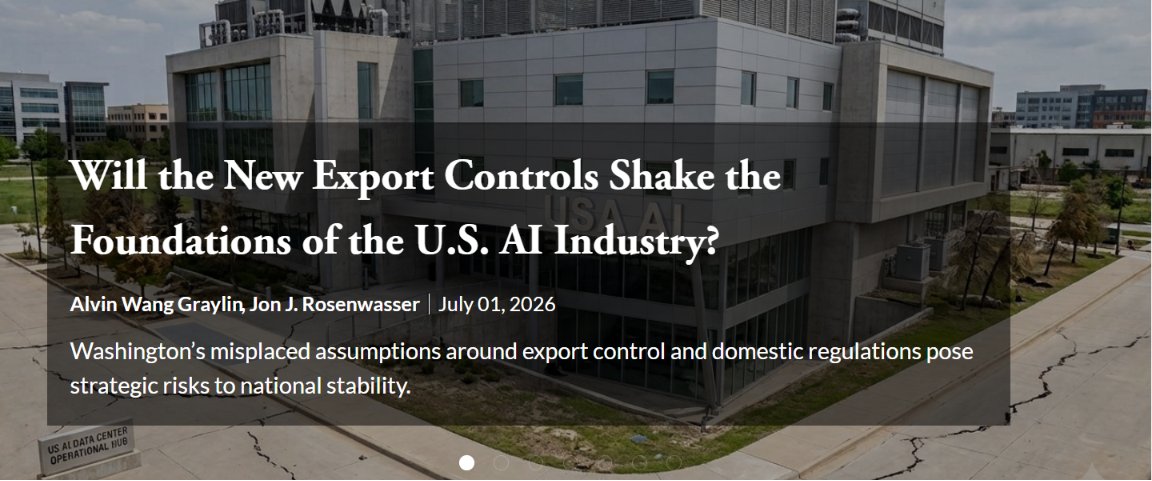
What did the US get for applying export controls to an #AI model for the first time? 🚨🚫 Two weeks ago Commerce ordered @AnthropicAI to block foreign nationals from Fable 5 and Mythos 5. It couldn't sort users by nationality in real time, so it pulled both models for everyone. Within 48 hours, Z.ai shipped GLM-5.2 under an MIT license, Rio released an open model on Qwen, and Sakana pitched "frontier capability without export-control risk." The ban is now reversed and Fable is back, but the trust damage is done. In our new @lawfare piece, Jon Rosenwasser and I argue US AI strategy rests on two false assumptions: - ā€œDenial keeps us aheadā€ It doesn't. Three years of chip controls actually narrowed the AI gap. Chinese open-weight models went from under 2% of OpenRouter traffic in late 2024 to ~61% of top-model usage today. - We can't regulate at home because China won't. It already does. China has regulated AI since 2021, with 700 models reviewed before deployment. Beijing even steered its own labs away from H200 chips that beat domestic parts. It’s not a country sprinting to AGI at any cost.šŸ’” The real risk isn't over-regulation. It's the bet: ~$725B in AI infrastructure in 2026, past $1T in 2027, while the physical stack tilts toward Beijing and the gains diffuse outward. We need to keep US models open, govern with confidence at home, cooperate where stakes are shared, and build the safety net before the displacement arrives. See full OpEd below. @AsiaPolicy @StanfordHAI
Even with the reversal, the Commerce Department’s decision to impose export controls on Anthropic's Fable 5 has created a loss of trust among AI users globally. Alvin Wang Graylin and Jon J. Rosenwasser explore the assumptions underlying AI policymaking this incident exposed.
1
3
13
3,776
#India’s Carbon Credit Trading Scheme could become a major source of domestic finance for the country’s low-carbon transition. @AsiaPolicy’s new report explores how CCTS revenues could support industrial decarbonization and a just transition through a dedicated Energy Transition Finance Mechanism. asiasociety.org/policy-insti…
1
4
2
442
This morning, ASPI hosted an off-the-record roundtable with Distinguished Fellow Stephen Biegun, moderated by Emma Chanlett-Avery, on North Korea, U.S.-China relations, Taiwan, the Strait of Hormuz, USMCA, and implications for Asia. Thank you to Steve and all who joined us.
1
3
718
Asia Society Policy Institute (ASPI) reposted
PLA Watch #24 is live! This issue focuses on ongoing efforts to hone ā€œcombat effectivenessā€ and cultivate ā€œpolitical reliabilityā€ throughout the PLA. We also examine a recently concluded 40-day combat training mission of the Liaoning task force – one of the longest deployments on record – which included accusations from China that the Japanese military ā€œinterferedā€ with PLA operations. @AsiaPolicy centerforchinaanalysis.asias…
6
3
1,553
The 24th issue of PLA Watch focuses on ongoing efforts to hone ā€œcombat effectivenessā€ and cultivate ā€œpolitical reliabilityā€ throughout the PLA. We also examine a recently concluded 40-day combat training mission of the Liaoning task force – one of the longest deployments on record – including accusations from China that the Japanese military ā€œinterferedā€ with PLA operations. See the full edition here: centerforchinaanalysis.asias…
2
2
825
Asia Society Policy Institute (ASPI) reposted
Navigating shared futures from 1956 to 2026 šŸ¤ Today marks 70 years since Asia Society was founded. Watch our logo evolve through seven decades of building understanding across Asia and the world. #AsiaSociety70
4
7
772
Asia Society Policy Institute (ASPI) reposted
For the @wef's Summer Davos this week, Nadia Mondini and I look at how the energy shock from the Middle East conflict has revealed Asia's vulnerabilities, the need for effective long-term planning, and the importance of greater international cooperation. lnkd.in/ebvtUdeV
1
188
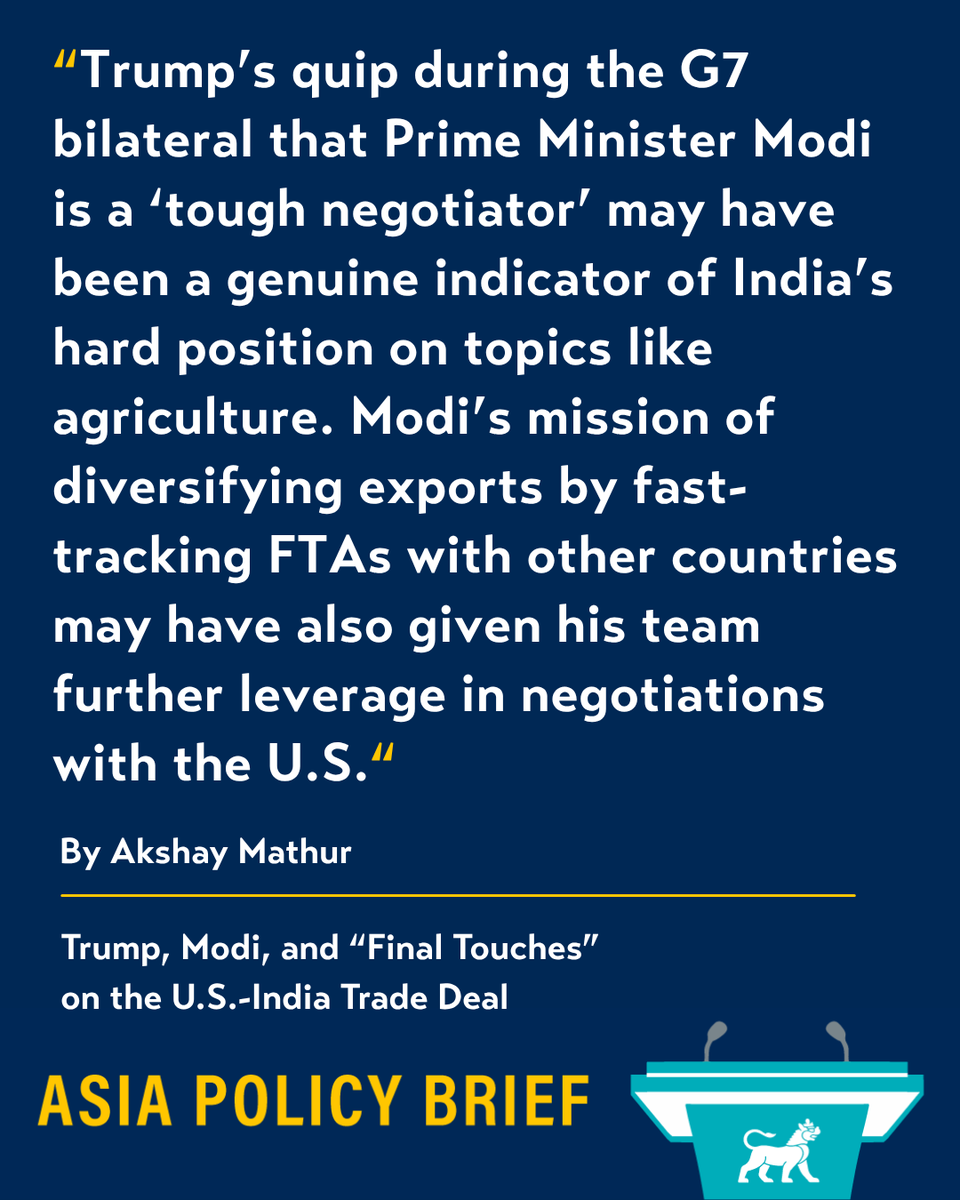
What does the Trump-Modi "bromance" on display at last week's G7 summit mean for the U.S.-India trade deal? @akshmathur unpacks the state of negotiations and USTR Greer's trip to New Delhi in our latest issue of #AsiaPolicyBrief šŸ‡®šŸ‡³šŸ¤šŸ‡ŗšŸ‡ø Read it āž”ļø asiapolicy.asiasociety.org/p…
2
2
672
Asia Society Policy Institute (ASPI) reposted
ā™¦ļøAsia Pacific Conversations: China's New Strategic Architecture and Implications for Canada and the U.S. @wstv_lizzi, of the @AsiaPolicy ’s Center for China Analysis, joins APF Canada's @VinaNadjibulla to discuss #China’s geopolitical and economic outlook with Canada, the U.S., and other Indo-Pacific economies
Summer reading? Summer listening! Catch up on some of our latest #podcast episodes exploring security, diplomacy, and trade between Canada and Asia! šŸŽ§ asiapacific.ca/media/podcast
2
2
416
Is the U.S. getting its China biotech strategy wrong? A new paper by Jing Qian, @wstv_lizzi, and Chris Li argues for a layer-specific strategy: openness in basic science, targeted security guardrails, stronger U.S. capacity, and bounded health cooperation. asiasociety.org/policy-insti…
1
6
10
1,119
Europe isn't a bystander in U.S.-China tensions, but often caught in the middle. Center for China Analysis Senior Fellow @PhLeCorre explains why the EU's voice needs to be part of the conversation, not an afterthought.
1
9
954
The Strait of Hormuz may be reopening, but Asia’s recovery from the Iran crisis will take time. In a new webinar, @wendyscutler, Tatsuya Terazawa (@IEEJ_Japan), @MatteoLanzafame, Julia Tijaja (@CSISIndonesia) & Jenny Gordon (@WhatAustThinks) discuss energy security, supply chains, food prices, and regional cooperation. youtube.com/watch?v=yIv-EozK…
3
6
544
What would renewed U.S.-DPRK diplomacy actually require? Drawing on a recent roundtable, Emma Chanlett-Avery and @bryannaentwistl break down the shifting military balance on the Korean Peninsula, the roles of China and Russia, and the long-term risks of nuclear proliferation. asiasociety.org/policy-insti…
1
2
308