Filter
Exclude
Time range
-
Near
HomelesssDoge
Are u going to buy some back shares?
15
BitMNR
5/ According to data from Fundstrat -$BMNR traded average daily dollar volume of $543 million (4-day average, as of July 2, 2026), - ranking #233 in the US - behind Semtech (rank #232) $SMTC @semtech - ahead of TTM Technologies (rank #234) $TTM @ttm_tech among 5,704 US-listed stocks (statista.com and @fundstrat research).
1
1
5
1,961
Connected_Data
Vault-LD turns a folder of Markdown notes into an RDF knowledge graph The core idea builds on Karpathy's "LLM wiki" concept: a directory of plain Markdown files is already one of the best ways to work with LLMs. Human-readable, chunkable by a model, diffable in git, no database needed.  Vault-LD's contribution is spotting a hidden pattern in that structure: YAML frontmatter can map onto YAML-LD, a YAML serialization of JSON-LD. Resolve that frontmatter through one shared context, and the notes stop being tagged text. They become linked data. Why it matters for anyone already working with RDF ontologies: 🔹 Business semantics, classes, properties, controlled vocabularies drop directly into the wiki teams already use 🔹 The ontology itself gains a human-friendly surface, readable and editable as notes rather than raw Turtle 🔹 A note and an ontology definition become the same kind of object, projectable losslessly to RDF and back The repo ships two reference tools that make this roundtrip real: vault_to_rdf.py exports a vault to Turtle, split into schema and data layers. rdf_to_vault.py runs the reverse, ingesting any RDF graph into vault format, updating notes in place or building a new vault from scratch. Together, vault → RDF → vault is a no-op, and RDF → vault → RDF is graph-isomorphic. The spec itself (SPEC.md) is the normative reference, covering frontmatter-to-graph rules, full-fidelity roundtripping, and a compatibility profile for lifting OKF-style Markdown bundles into linked data. An open format for knowledge that a person editing notes and a machine reasoning over a graph can share at once. 🕸️ By The Knowledge Graph Guys github.com/The-Knowledge-Gra… #KnowledgeGraphs #RDF #Ontology #OpenSource #MarkdownAsData -- Connected Data London 2026 | 11–12 November | Leonardo Royal Hotel London Tower Bridge 🎤 Share your work with the world's most passionate data community. The Call for Submissions is open. connected-data.london/2026-c… 🎟 Tickets on sale now. Advance rate discounts up to 15%. 2026.connected-data.london 📺 Sponsorship opportunities available. Contact info@connected-data.london for details. #KnowledgeGraph #GraphRAG #Ontology #Graph #AI #DataScience #GraphDB #SemTech
3
2
158
TheYotg
Context, Graphs, and Semantic Layers In “Understanding Context“, Bill Inmon and Jessica Talisman argue that context is a human-led social agreement that must be maintained. Humans decide what counts as context and what constitutes knowledge. The work is sociotechnical by nature – the deliberate alignment of human knowledge practices with the systems built to extend them. Context is to AI what data was to BI, Prukalpa argues: the raw input that allows the system to function. She draws a parallel between semantic layers that came before, and context graphs that everyone is looking to get now. The parallel points out failure modes for semantic layers: misaligned incentives, migration math and the execution path. Context graphs are framed as a trillion-dollar market. So the trillion-dollar question is – will this time be different? Foundation Capital’s thesis argued that vertical agents will own context because they “sit in the execution path”. The sales agent will capture renewals context, the support agent will capture escalations context, and so on. This quietly assumes there’s a single execution path where context naturally accumulates. Prukalpa argues that’s true for simple workflows, but not beyond that. Most decisions happen across workflows and systems, and context comes from everywhere. Heterogeneity is moving up the stack today, from a mess of data tools to an ever growing mess of AI agents, copilots, and applications. This means that while execution paths may be local, context is global. If context graphs are going to live up to their promise, we’ll have to learn from what worked and did not work previously. Prukalpa offers four principles to make the context layer a reality beyond the hype: 1. Built for human collaboration, not just machines. 2. Machine-native and built for change. 3. Open, portable, and bigger than any single vendor. 4. One shared brain, many agents. -- 📩 Excerpt from The Year of the Graph Summer 2026 newsletter Read "Layers of Meaning: Context Graphs, Graph Memory, and Ontologies for AI" with more sections, references and attribution here 👇 yearofthegraph.xyz/newslette… All things #KnowledgeGraph, #GraphDB, Graph #Analytics / #DataScience / #AI and #SemTech.
1
4
7
244
MilkRoadAI
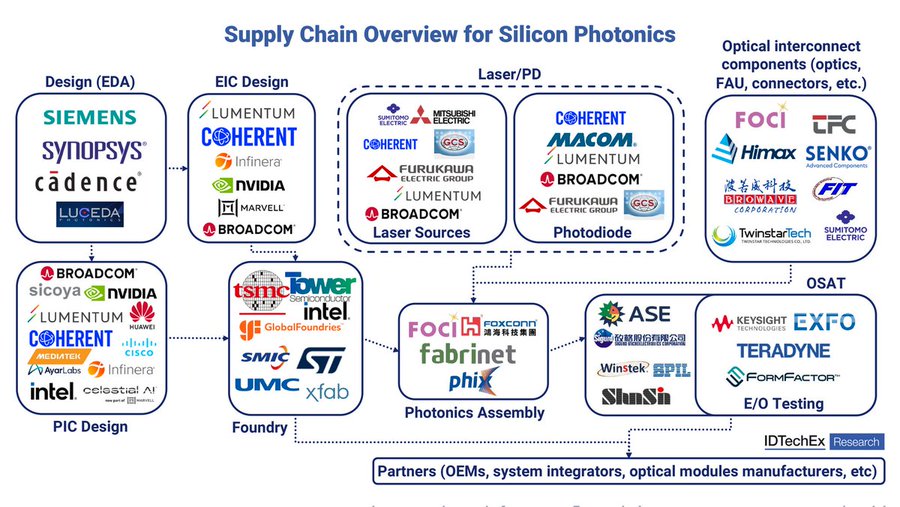
The silicon photonics supply chain diagram is one of the most important investment maps in technology right now (Save this). Every AI data center being built depends on what's in that chart and the companies inside it are just starting to show what the revenue ramp looks like. Here are the 10 stocks I am watching. 1. Broadcom (AVGO): Broadcom's AI revenue rocketed 106% to $8.4 billion in its most recent quarter, driven by custom accelerator chips for Google, Meta, and Anthropic, plus AI networking silicon. It is one of the few companies doing both the switch silicon and the photonics integration needed for co-packaged optics at hyperscale. The silicon photonics diagram shows Broadcom appearing across multiple layers, PIC design, laser sources, photodiode, and EIC design. 2. MACOM Technology (MTSI): MACOM is quietly positioning itself at the inflection point of the 1.6T and 3.2T optical transceiver transition. In March 2026 it launched 448G PAM4 modulator drivers among the first in the industry and joined Broadcom, Cisco, and Semtech in the 400G Optical MSA standards consortium. In June 2026 it introduced hot via chip scale technology, eliminating wire bonds in its AlGaAs packaging. 3. Marvell Technology (MRVL): Marvell is the DSP engine inside many of the optical modules in that chart. Its custom AI silicon, built for hyperscalers who want to own their accelerator architecture is the fastest growing part of its business. It sits at the EIC design layer and supplies the digital signal processing that makes high-speed optical links work reliably at scale. As the industry shifts from 400G to 800G and 1.6T, every step requires more sophisticated DSPs and Marvell captures more revenue per module shipped. 4. Keysight Technologies (KEYS): Every optical module that ships from every fab in that chart has to be tested before it reaches a data center. Keysight is the global leader in electronic and photonic test equipment. As optical speeds push to 800G and beyond, the testing instrumentation has to keep pace and it commands premium pricing. 5. FormFactor (FORM): FormFactor is the most underappreciated name in this entire chart. Q1 2026 revenue was $226 million, up 32% year over year, beating estimates with non-GAAP EPS of $0.56 versus $0.44 expected. It acquired Keystone Photonics in December 2025, becoming the leading wafer-level silicon photonics test platform for co-packaged optics production. Its partnership with Advantest created the world's fastest automated photonic alignment test system with nine-axis nano-precision. Over 100 of the world's leading silicon photonics manufacturers use FormFactor systems meaning every CPO chip that ships from any fab in that diagram gets tested on FormFactor equipment. 6. Teradyne (TER): Teradyne sits in the E/O Testing layer alongside Keysight and FormFactor. As silicon photonics chips get more complex, integrating lasers, modulators, photodetectors and electronic drivers on a single chip, the test complexity explodes. Teradyne's automated test equipment platforms are expanding from traditional semiconductor testing into photonic integrated circuit validation. It also has a robotics division, which ties the silicon photonics thesis directly back to the humanoid supply chain story. 7. EXFO (EXFO): EXFO is a fiber optic and network testing specialist that has been building testing platforms specifically for coherent optical and silicon photonics applications. It sits directly in the E/O Testing box of the supply chain map. It's a smaller cap, which means the upside from the optical buildout is amplified relative to its size. It is one of the few companies that tests live network optical performance meaning it gets pulled in not just at the component manufacturing stage but every time a data center expands or upgrades. 8. Foxconn Industrial Internet (FXCOF): Foxconn appears twice in that supply chain diagram in both Photonics Assembly and Optical Interconnect and that is before you even consider its server business. Q1 2026 revenue hit $66.6 billion, up 29.7% year over year, with AI servers now representing more than 50% of total server revenue. Its silicon photonics CPO switches entered mass production in Q3 2026 with full year shipments forecast at 10,000 units. It is boosting capex 30% specifically for AI infrastructure. Almost no retail investors think of Foxconn as a silicon photonics play and that's the opportunity. 9. Sumitomo Electric (SMTOY): Sumitomo appears in two places on that supply chain diagram as an optical interconnect component supplier and in the laser/photodiode layer. The company has been a foundational supplier to the fiber optic industry for decades and is now scaling its silicon photonics packaging and optical connectivity capabilities for AI data center applications. 10. Synopsys (SNPS): Every silicon photonics chip has to be designed before it can be manufactured. Synopsys is the dominant EDA software company for photonic integrated circuit design and sits at the very top left of that supply chain map. The shift toward co-packaged optics means optical and electronic chip design have to be co-simulated, exactly the kind of complex, multi physics workflow Synopsys is built for. Its photonics design tools are already embedded across every major chip company in that diagram. The more complex the chip, the more customers pay for Synopsys tools. Milk Road Pro is tracking every layer of the silicon photonics supply chain, from Broadcom and Marvell to the testing names most investors still don’t know. Join Milk Road Pro for the full breakdown and for all our AI trades for just $1 using the link below!
6
7
31
5,540
LCNM_Patriot
The LR2021 will do it once there's a device supported by the various open-source firmware projects (meshtastic, meshcore, reticulum, etc). That's what I have planned for this PCB that I'm designing. The previous generation of Semtech LoRA chips (SX1262, etc) would decode LoRA packets down to about -129dB receive signal... the LR2021 drops that down to -141dB for regular (non-FLRC) packets. It'll decode packets that you can't even pick out of the noise audibly
1
90
SemtechCorp
What makes an IoT network truly resilient? Not one technology, but the ability to combine LoRaWAN, cellular, and satellite as one. Semtech's Pascal Rieux and Nicolas Damour break down the hybrid approach: hubs.la/Q04nrPb30 #Semtech #IoT #LoRaWAN #SatelliteIoT
2
2
183
IncomeETFDaily
Here is every stock currently in the VistaShares AI Supercycle ETF $AIS: SK hynix Inc $000660 - 8.23% Micron Technology Inc $MU - 6.82% Advanced Micro Devices Inc $AMD - 5.03% MARVELL TECHNOLOGY INC $MRVL - 3.81% Silicon Motion Technology Corp $SIMO - 3.75% Vertiv Holdings Co $VRT - 3.66% Intel Corp $INTC - 3.50% Taiwan Semiconductor Manufacturing Co Ltd $TSM - 3.42% GE Vernova Inc $GEV - 2.92% Foxconn Industrial Internet Co Ltd $601138 - 2.57% NVIDIA Corp $NVDA - 2.50% Corning Inc $GLW - 2.47% Vicor Corp $VICR - 2.39% Astera Labs Inc $ALAB - 2.24% Seagate Technology Holdings PLC $STX - 2.21% Sandisk Corp $SNDK - 2.10% Semtech Corp $SMTC - 2.02% Samsung Electronics Co Ltd $005930 - 1.98% ASML Holding NV $ASML - 1.89% Navitas Semiconductor Corp $NVTS - 1.89% ARM Holdings PLC $ARM - 1.85% MPI Corp $6223 - 1.79% Legrand SA $LR - 1.61% Arista Networks Inc $ANET - 1.48% Unimicron Technology Corp $3037 - 1.45% Montage Technology Co Ltd $688008 - 1.32% Tower Semiconductor Ltd $TSEM - 1.29% Western Digital Corp $WDC - 1.29% Asustek Computer Inc $2357 - 1.08% Nanya Technology Corp $2408 - 1.08% Credo Technology Group Holding Ltd $CRDO - 1.08% Penguin Solutions Inc $PENG - 1.03% Advanced Energy Industries Inc $AEIS - 1.02% Nokia Oyj $NOKIA - 0.99% Samsung Electro-Mechanics Co Ltd $009150 - 0.98% Nutanix Inc $NTNX - 0.95% Coherent Corp $COHR - 0.90% AIXTRON SE $AIXA - 0.84% AP Memory Technology Corp $6531 - 0.79% Infineon Technologies AG $IFNNY - 0.79% Commvault Systems Inc $CVLT - 0.74% Hygon Information Technology Co Ltd $688041 - 0.72% Broadcom Inc $AVGO - 0.66% IEIT Systems Co Ltd $000977 - 0.65% Cisco Systems Inc $CSCO - 0.62% Rigaku Holdings Corp $268A - 0.59% Quanta Computer Inc $2382 - 0.57% Palo Alto Networks Inc $PANW - 0.52% MediaTek Inc $2454 - 0.51% Celestica Inc CLS - 0.46% Hewlett Packard Enterprise Co HPE - 0.46% Munters Group AB MTRS - 0.46% Transcend Information Inc 2451 - 0.44% Kehua Data Co Ltd 002335 - 0.43% Super Micro Computer Inc SMCI - 0.42% Crowdstrike Holdings Inc CRWD - 0.40% Everpure Inc P - 0.31% Ajinomoto Co Inc 2802 - 0.30% King Yuan Electronics Co Ltd 2449 - 0.28% Vistance Networks Inc VISN - 0.24% Zscaler Inc ZS - 0.16% Disclosure: @VistaSharesX is a WOLF Financial partner. This is for informational purposes only, not financial advice.
2
2
11
1,278
Connected_Data
Where Does Pekka Kuusisto Play Next?: Katariina Kari Leaders and Innovators Defining the Agenda on Knowledge Graphs, Graph Data Science and AI, Graph Databases, Semantic Technology and Ontologies Katariina Kari is an expert in semantic web technologies, enterprise knowledge graphs, and co-founder of the Knowledge Graph Academy. Blending her passions for engineering and classical music, she excels at transforming chaotic, unstructured data into rich semantic systems for global brands. Highlighting Katariina's work: Where Does Pekka Kuusisto Play Next? Using ontology to extract classical music event data from orchestra websites reveals a major digital gap: many pages aren't machine-readable. This structural inconsistency traps valuable data and severely limits its visibility on search engines. By applying semantic web technologies, we can turn these messy, fragmented schedules into a cohesive knowledge graph. Resolving these data silos ensures complex information is perfectly queryable and structured for the future of search. Katariina is a member of the Programme Committee for Connected Data London 2026. She is helping define the agenda and evaluate contributions for The leading global technology conference for those using Relationships, Meaning, and Context in Data to achieve great things. Join us in London for #CDL26 as we celebrate a decade of innovation in Knowledge Graphs, Graph Analytics, Data Science, AI, Graph Databases, Semantic Tech and Ontology. Where Does Pekka Kuusisto Play Next? - semanticscore.net/p/where-do… -- Connected Data London 2026 | 11–12 November | Leonardo Royal Hotel London Tower Bridge 🎤 Share your work with the world's most passionate data community. The Call for Submissions is open. connected-data.london/2026-c… 🎟 Tickets on sale now. Advance rate discounts up to 15%. 2026.connected-data.london?u… #KnowledgeGraphs #GraphRAG #Ontology #Graph #AI #DataScience #GraphDB #SemTech #CDL26 #ConnectedData
1
167
BeatTheInsider
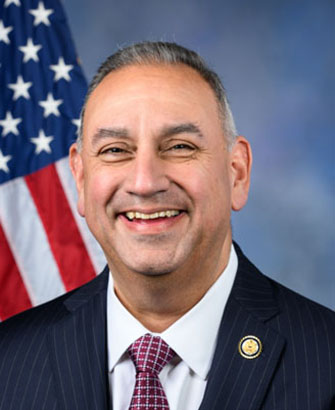
🚨Political Trade Alert🚨 Rep. Gilbert Cisneros has released a new financial disclosure. Highlights: $ABT Abbott Labs $1k-$15k $AMD Advanced Micro Devices $1k-$15k $AAPL Apple $1k-$15k $AGX Argan $15k-$50k $LLY Eli Lilly $50k-$100k $MCHP Microchip Corp $1k-$15k $SPCX SpaceX $1k-$15k $MSTR Strategy $15k-$50k Sold: $AVGO Broadcom $1k-$15k $COIN Coinbase $1k-$15k $MU Micron $1k-$15k $MSFT Microsoft $15k-$50k $SMTC Semtech Corp $1k-$15k Full Disclosure: disclosures-clerk.house.gov/…
4
11
91
35,793
TheYotg
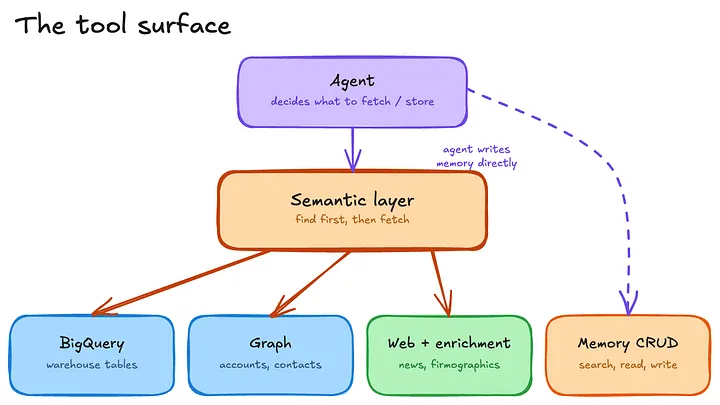
Orchestrating an Agentic Memory System: Tools, Hooks, and the Wiring That Makes Agents Learn Every tool call, every hook, every harness eventually points at the same place: one graph, holding what the agent actually knows. But how does it get there?  An agent that "remembers to remember" is already behind. This post lays out the wiring for a memory system that doesn't depend on the model deciding to write something down, and it runs today in both Claude Code and Codex, unchanged. The organizing idea: memory mechanisms split along two axes, who initiates the write (agent or harness) and when it fires (inline or in the background). Four quadrants fall out. This post covers the two that are portable across harnesses right now. 🔧 Tools — the agent-decides, inline quadrant. Shipped as MCP for harness-agnostic reach, with a unified semantic layer as the single entry point: the agent asks what's relevant, then fetches through source tools. Internal sources (a data warehouse, and the graph itself for accounts and contacts) sit alongside web search and enrichment, plus a general CRUD interface for memory rather than a dedicated tool per memory type. ⚙️ Hooks — the harness-decides lane. Deterministic scripts fire at lifecycle events (session start, tool use, compaction, session end) with no model judgment involved. They do two things: capture (classifying which tool output is ephemeral versus durable domain signal worth writing to the graph) and recall (injecting relevant memory before the model answers, and recording that injection so a session isn't handed the same memory twice). The throughline: the harness owns the wires. The graph owns the payloads. That's what makes the system harness-agnostic in practice, not just in principle. Hooks and MCP tools register automatically in either harness, and a session populates the graph in real time as the agent works. The next post covers the semantic layer, the four metadata categories that organize the graph, and the self-learning loop itself. By Firat Tekiner Tomaz Bratanic medium.com/neo4j/orchestrati… #AgenticAI #AgentMemory #GraphDB #AIagents #Neo4j -- 📩 The Year of the Graph Summer 2026 newsletter issue is out! Layers of Meaning: Context Graphs, Graph Memory, and Ontologies for AI. 👇 yearofthegraph.xyz/newslette… All things #KnowledgeGraph, #GraphDB, Graph #Analytics / #DataScience / #AI and #SemTech. Subscribe and follow to be in the know. Reach out if you'd like to be featured
4
5
21
1,099
Connected_Data
Describing the scene: the investment in context What if knowledge graphs have been solving the wrong problem? A knowledge graph works like a map, not a directory. A map isn't judged by exhaustive accuracy. It's judged by whether it helps you visualize a landscape and retain what you'd otherwise forget. Knowledge, in this framing, is a process. Not an inventory. Mark Burgess raises an open question: Does RDF and OWL's requirement for unique identifiers and fixed ontological categories reflect how human cognition actually organizes information? Or does it import database logic, one correct box per entity, onto a substrate that behaves more like language, where meaning shifts with context? One alternative model, Semantic Spacetime, proposes: - Four relation types: LEADSTO, CONTAINS, EXPRESSES-PROPERTY, SIMILARTO - A "describe the scene" method adapted from crime scene investigation - Labels treated as provisional, revised as more is learned rather than fixed at ingestion The memory typology has direct bearing on agent architecture. Four distinct memory types are identified: - Process memory - short-term, task-bound context - Archival memory - the durable record most KM systems are built around - Stigmergic memory - information encoded not in a store but in traces left in the environment, shaping future behavior indirectly - Muscle memory - procedural, embodied, rarely represented at all Most knowledge graph and RAG architectures for AI agents rest almost entirely on archival memory, with process memory bolted on as a context window. Stigmergic and procedural memory have no clear analogue in current agent designs. The piece suggests this may be a significant gap. A 15-minute read for anyone building or reasoning about knowledge systems and agent memory. 🧭 By Mark Burgess mark-burgess-oslo-mb.medium.… #KnowledgeGraphs #KnowledgeManagement #SemanticSpacetime #AgentMemory #OntologyDesign -- Connected Data London 2026 | 11–12 November | Leonardo Royal Hotel London Tower Bridge 🎤 Share your work with the world's most passionate data community. The Call for Submissions is open.  connected-data.london/2026-c… 🎟 Tickets on sale now. Advance rate discounts up to 15%. 2026.connected-data.london 📺 Sponsorship opportunities available. Contact info@connected-data.london for details. #KnowledgeGraph #GraphRAG #Ontology #Graph #AI #DataScience #GraphDB #SemTech
1
1
3
298
ReyaxTechnology
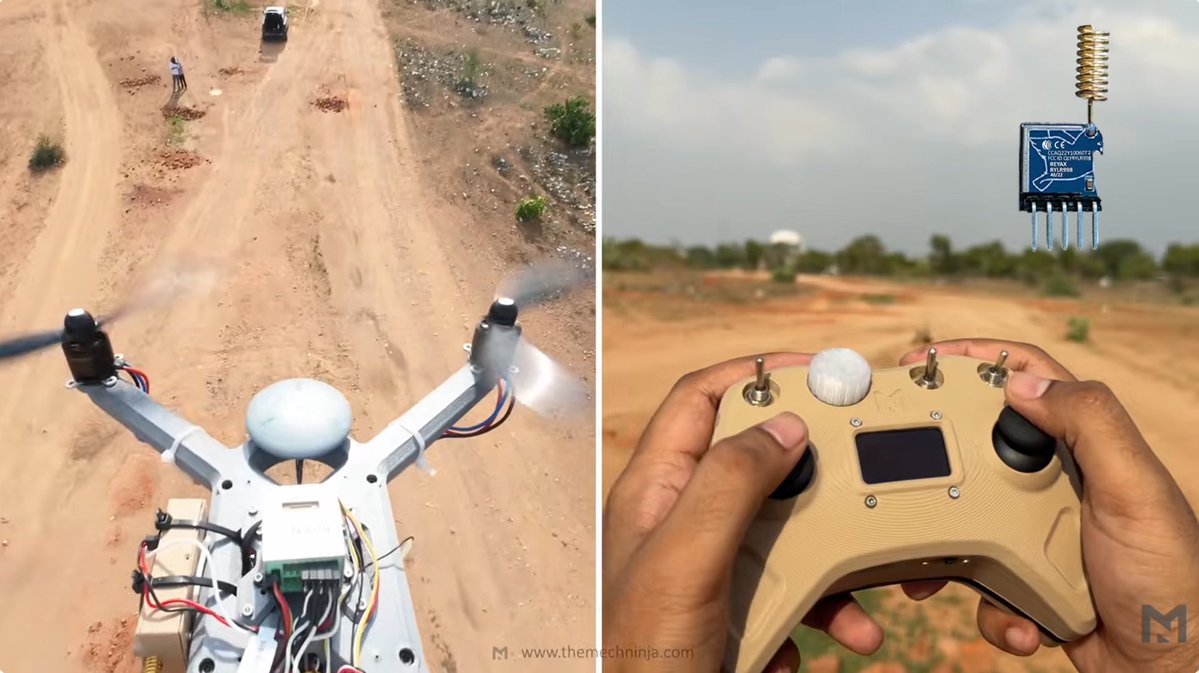
📖Forget Retail! I Made My Own Long-Range Drone Transmitter with RYLR998 ✨Watch the full video now: youtube.com/watch?v=cyOweBUi… 📷NUVOTON MCU & Semtech LoRa® Engine 📷Smart receiving power-saving mode #REYAX #LoRa #IoT #Wireless #LongRange #Arduino #Drone
25
CEOStockWatcher
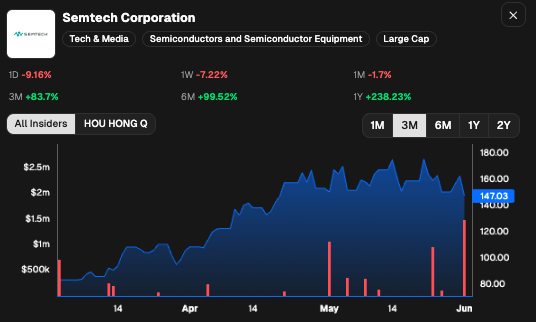
CEO at Semtech $SMTC sells another $1.5M He sold $1.47M (largest sale ever, out of 8). This decreased their listed holdings by -13%. Rip Sell: the stock was up 102% in the previous 3 months. 6 other insiders also sold the stock in the last 30 days.
1
4
2,940
Ellkd_
I'm still very bullish on Semtech and Nokia; these 2 positions went parabolic over the last 4 months. Semtech is still pricey, but Nokia looks attractive here. Their ICE-D DSPs & AI-RAN will surprise the market by year-end. I'm buying more $NOK leaps ahead of earnings
Markets reacting to Trump posts is like kids playing games; the outcome is obvious, except you make or lose money, a lot. It’ll pass, so I’m rebalancing. I sold my losing $MBLY position. This week I'm buying lots of $NOK & $SMTC leaps DD: AI AI AI
1
249
SemtechCorp
Industrial IoT is built to last 20 years. Will its connectivity? As carriers refarm 4G for 5G SA, OEMs need a long-term answer. Our new whitepaper breaks down how 5G RedCap delivers native 5G longevity without the overhead. 📥 hubs.ly/Q04nqrsn0 #Semtech #5GRedCap #IIoT #IoT
184
Connected_Data
Causal Graph Identification: optimization, performance bounds and reward optimization Describing the underlying causes of phenomena affected by multiple variables can often by done via the representation of causal graphs, which are often assumed to be directed and acyclic.  The identification of causal graphs – delineating the cause and effect between collection of variables has relevance in wireless networks, genetic networks, epidemiology, economics, and the social sciences to name just a few application areas. Graph identification is done via the collection of observations or realizations of the random variables which are the nodes in the graph. A host of strategies have been proposed for causal graph identification from greedy methods to those based on sparse approximation. We consider two problems in graph identification, the first is the recovery of the full directed graph by first detecting individual links in the graph. Unique to our approach, but relevant to many applications is directly considering unequal error protection for edge detection, that is false negatives versus false positives. We derive the optimal link detection rule and bound performance. These bounds can be used as benchmarks for current discovery algorithms.  A challenge with our approach (as is also true for many causal graph identification methods) is the attendant computational complexity. Motivated by this issue, the second problem we address is the development of a modest complexity strategy via the learning of sub-graphs.  A new edge detection method based on mutual information is derived and shown to offer superior performance to state-of-the-art methods. We apply our low complexity approach to the optimization of interventions in multi-armed bandits wherein the goal is to determine how to select choices (e.g. which slot-machine arm to pull) to maximize a reward.  Interventions could include allocation of resources or enforcing nodes in a graph to have certain values or links to have certain weights. We see that unequal error protection has a significant impact in reward optimization in causal multi-armed bandits. youtube.com/watch?v=NYOZUMXj… -- Urbashi Mitra. Gordon S. Marshall Professor in Engineering, University of Southern California Urbashi Mitra received the B.S. and the M.S. degrees from the University of California at Berkeley and her Ph.D. from Princeton University. She is the Gordon S. Marshall Professor in Engineering at the University of Southern California with appointments in Electrical Engineering and Computer Science Joint work with Joni Shaska and Chen Peng -- Welcome to Connected Data London's #ThrowbackThursday Every Thursday at 3pm GMT, we are releasing gems from our vault on #YouTube Tune in and learn from leaders and innovators; subscribe to our channel and watch premieres as they are released!  #knowledgegraph #graphdatabase #graph #AI #datascience #analytics #semtech #ontology
2
3
489
Connected_Data
Knowledge graphs and ontology are having a moment, even when vendors don't call them that. Genie Ontology was a highlight of the Databricks Data AI Summit 2026. This is Databricks' new bottom-up approach that automatically indexes documents, dashboards, code, and notebooks to construct an "ontology" without a human modeling anything first.  To surface what matters out of that mountain of auto-generated context, they built OntoRank, a PageRank-style algorithm that ranks by popularity. It's clever engineering, but popularity isn't the same as enterprise importance, and Databricks needed the "ontology" checkbox because the term has real mindshare in data circles right now.  "Ontology" and "knowledge graph" are being used loosely compared to how the field has defined them for 20 years; this is marketing-heavy territory where vendors are trying to redefine the terms rather than build to them. The sharper point: there are two different reasons organizations need semantics.  One is semantics for AI agents, giving a model enough context to answer well. The other is semantics for interoperability, a shared foundation of meaning that lets systems and teams understand each other over time, independent of which AI is asking.  Databricks is squarely building for the first, not the second, which tracks with keeping everything inside one ecosystem. Governance is the open question. The deterministic Unity Catalog has it. The automatically generated ontology layer doesn't have a clear human-in-the-loop story yet. That gap is the whole game. 🕸️ Ontology is getting real product traction. Getting the semantics right is the harder, more interesting problem. By Juan Sequeda juansequeda.substack.com/p/d… #SemanticLayer #DataGovernance #EnterpriseAI #Business #Market #Tech #Analysis -- Connected Data London 2026 | 11–12 November | Leonardo Royal Hotel London Tower Bridge 🎤 Share your work with the world's most passionate data community. The Call for Submissions is open.  connected-data.london/2026-c… 🎟 Tickets on sale now. Advance rate discounts up to 15%. 2026.connected-data.london 📺 Sponsorship opportunities available. Contact info@connected-data.london for details. #KnowledgeGraph #GraphRAG #Ontology #Graph #AI #DataScience #GraphDB #SemTech
1
2
5
366