⬛️
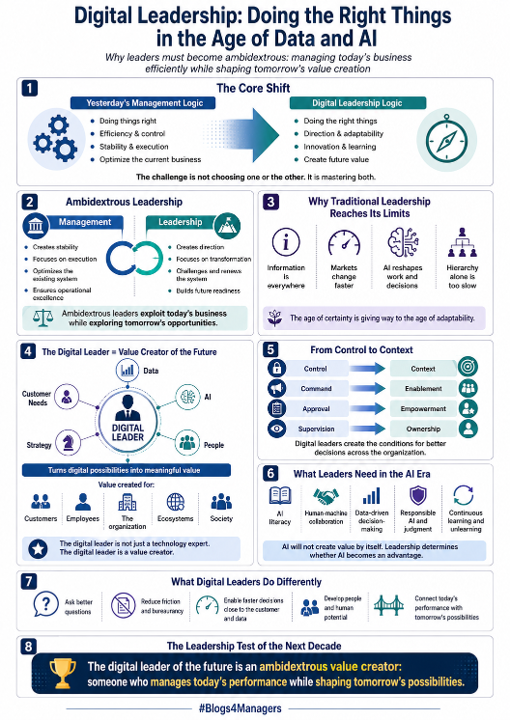
#Blogs4Managers | DigitalLeadership: Why Yesterday’s Leadership Will Not Be Enough for Tomorrow
The End of Business as Usual
▪️ For decades, leadership followed a relatively predictable pattern. Managers defined objectives, allocated resources, monitored execution, mitigated risks, and optimized performance. While technologies evolved, the fundamental principles of management remained largely unchanged. Organizations became bigger, processes became more sophisticated, and tools became more powerful, but leadership itself changed only gradually.
▪️Today, however, we are witnessing a fundamental shift. Digitalization, artificial intelligence, automation, data-driven decision-making, and globally connected ecosystems are not simply introducing new technologies into the workplace. They are changing how value is created, how decisions are made, how knowledge is accessed, how customers interact with organizations, and how companies compete.
This is not simply another phase of technological modernization. It is a profound transformation of the business environment itself.
The uncomfortable reality is that organizations cannot successfully transform into digital enterprises if leadership continues to operate according to assumptions that were established in a different era.
▪️ The leadership approaches that helped organizations succeed in the past may no longer be sufficient to ensure success in the future.
What once created stability may now create rigidity.
What once ensured control may now slow down adaptation.
What once made organizations efficient may now prevent them from becoming innovative.
▪️ This is why digital leadership has become a critical capability for modern organizations.
Why Traditional Leadership Models Are Reaching Their Limits
Historically, leadership was built around a relatively simple assumption: those higher in the hierarchy possessed more information, more expertise, and therefore made the most important decisions.
In today’s environment, this assumption is increasingly challenged.
Knowledge is no longer scarce. Information is available everywhere. Employees can access expertise, data, best practices, market insights, customer feedback, and increasingly powerful AI systems almost instantly. The challenge is no longer obtaining information. The challenge is interpreting, prioritizing, validating, and applying it effectively.
At the same time, business environments have become significantly more dynamic. Market conditions change rapidly, customer expectations evolve continuously, and technological innovation accelerates at an unprecedented pace. Leaders can no longer rely exclusively on historical experience because the future often looks fundamentally different from the past.
This creates a fundamental leadership challenge.
In stable environments, experience is a major advantage. In highly dynamic environments, experience remains valuable, but only if leaders are willing to continuously update their assumptions.
The risk is not that experienced leaders know too little. The risk is that they may rely too strongly on what used to work.
In such an environment, leadership cannot be based on having all the answers.
Instead, leadership must increasingly focus on enabling organizations to learn faster, adapt faster, decide faster, and create value continuously.
The age of certainty is giving way to the age of adaptability.
One of the most common misconceptions is that digital leadership is primarily about technology.
Digital leadership does not require every manager to become a software engineer, data scientist, or AI specialist. It does not mean understanding every technical detail behind a new platform, algorithm, or application.
Digital leadership means understanding how technology changes business, organizations, work, people, and value creation.
More importantly, it means understanding how leadership must evolve within that new reality.
▪️Digital leadership begins when leaders stop asking only, “Which technology should we implement?” and start asking, “How does this technology change the way we lead, decide, collaborate, learn, and compete?”
▪️ The most effective digital leaders focus less on controlling activities and more on creating environments in which people can perform, innovate, collaborate, and continuously learn.
▪️ Their role is increasingly shifting from command and control toward enablement and empowerment.
▪️ Rather than asking, “How can I control this process?” they ask, “How can I create the conditions for success?”
▪️ Rather than asking, “How do we avoid all risk?” they ask, “How do we learn fast enough to manage uncertainty intelligently?”
This is a very different leadership logic.
▪️ Digital leadership is not about abandoning structure, accountability, or performance orientation. On the contrary, digital organizations need clarity, discipline, and strategic focus. But they also need speed, trust, transparency, experimentation, and learning.
The challenge for leaders is to balance both worlds: providing direction without creating unnecessary bureaucracy, ensuring accountability without micromanaging, and enabling innovation without losing strategic coherence.
The Biggest Transformation Challenge Is Often Leadership Itself
Many organizations invest heavily in workforce development.
Employees attend AI trainings. They learn new tools. They participate in Digital Tech Talks. They are encouraged to develop new technical competencies.
All of this is necessary.
However, an uncomfortable question often remains unanswered:
Who is helping leaders transform?
Many transformation initiatives focus almost exclusively on changing employee behavior while assuming that leadership can continue operating as before.
This assumption is dangerous.
▪️ Organizations cannot create agile, adaptive, and innovative cultures if leadership behaviors remain rooted in excessive control, hierarchy, and risk avoidance.
Digital transformation is not only about teaching employees new skills. It is equally about helping leaders develop new mindsets.
This is where many organizations underestimate the real transformation challenge.
They introduce agile methods, but leaders still demand detailed upfront certainty.
They invest in digital tools, but decision-making remains slow and hierarchical.
They promote innovation, but punish mistakes.
They speak about empowerment, but continue to approve every important decision.
They encourage collaboration, but reward silo behavior.
They expect employees to learn continuously, but senior leaders rarely question their own leadership habits.
The result is predictable: transformation remains superficial.
New tools are introduced, but old behaviors continue.
New processes are designed, but old power structures remain.
New strategies are announced, but old management assumptions dominate daily practice.
▪️ In many organizations, the greatest learning requirement exists not at the operational level but at the leadership level.
Digital transformation requires leaders who are willing to transform themselves first.
What Leaders Need to Learn in the AI Era
The rise of artificial intelligence introduces another major leadership challenge.
AI is no longer just a technology topic. It is increasingly becoming a business and leadership topic.
Leaders do not need to build AI models themselves. However, they do need to understand where AI can create value, where risks exist, and how AI is changing the nature of work.
Perhaps even more importantly, leaders must learn how to work alongside systems that can generate insights, recommendations, analyses, scenarios, and content at unprecedented speed.
▪️ The question is no longer whether AI will enter the workplace.
The question is how effectively leaders will leverage it.
Tomorrow’s leaders will need to develop a basic understanding of AI capabilities, data-driven decision-making, human-machine collaboration, digital business models, and responsible AI use. Leaders who completely delegate these topics to technical experts risk losing strategic relevance.
This does not mean that every leader must become an AI expert. But every leader should become AI-literate.
AI literacy means understanding what AI can do, what it cannot do, where it can support better decisions, where human judgment remains essential, and where ethical, legal, or organizational risks must be managed carefully.
For leaders, AI creates new questions:
How do we use AI to improve decision quality?
How do we ensure that employees see AI as an enabler rather than only as a threat?
Which tasks should be automated, augmented, or redesigned?
How do we protect trust, transparency, and accountability when algorithms influence decisions?
How do we prepare our teams for new forms of human-machine collaboration?
These are not purely technical questions.
They are leadership questions.
AI will not automatically make organizations smarter. Used poorly, it can accelerate confusion, bias, dependency, and poor decision-making. Used well, it can enhance productivity, creativity, learning, and strategic insight.
The difference will depend heavily on leadership.
From Managing People to Enabling Human Potential
As AI takes over more routine, repetitive, and analytical tasks, uniquely human capabilities become even more important.
▪️Creativity
▪️Critical thinking
▪️Collaboration
▪️Empathy
▪️Judgment
▪️Innovation
▪️Dialogous
▪️CoCreation
▪️Ethical reasoning
▪️Contextual understanding
▪️ValueCreation
The role of leadership therefore shifts as well.
Future leaders will spend less time supervising activities and more time creating clarity, fostering collaboration, removing barriers, and developing talent.
Employees increasingly expect autonomy, trust, meaningful work, and opportunities for growth. Organizations that continue relying on outdated command-and-control mechanisms may find it increasingly difficult to attract and retain high-performing talent.
Ownership cannot be mandated.
Innovation cannot be forced.
Learning cannot be controlled.
Engagement cannot be ordered.
The best leaders understand that their primary responsibility is not to create followers but to create an environment in which people can contribute their full potential.
This requires a different leadership mindset.
Instead of measuring leadership primarily by how much control a manager has, organizations will increasingly need to measure leadership by how much capability, ownership, and value a manager enables.
A strong leader is no longer simply the person who knows the most, decides the fastest, or controls the most resources.
A strong leader is someone who creates direction, builds trust, enables learning, connects people, develops capabilities, and helps the organization adapt.
This does not make leadership softer. It makes leadership more demanding.
Enabling people requires clarity.
Empowerment requires discipline.
Trust requires accountability.
Autonomy requires alignment.
Innovation requires psychological safety and strategic focus.
Digital leadership is therefore not the absence of leadership. It is a more mature form of leadership.
From Control to Context
🔹One of the most important shifts in digital leadership is the movement from control to context.
Traditional leadership often relied on detailed supervision. Leaders controlled tasks, processes, decisions, information flows, and approvals. This model can work in stable environments where work is predictable and efficiency is the dominant objective.
But in dynamic environments, excessive control becomes a bottleneck.
If every decision must move upward, the organization slows down.
If employees wait for permission, opportunities are missed.
If information is filtered through hierarchy, leaders receive a delayed and incomplete picture of reality.
If risk avoidance dominates, innovation becomes impossible.
🔹Digital leaders therefore focus on creating context.
They clarify and ecplain the strategic direction.and priorities.
🔹They define decision principles.
They make expectations transparent.
🔹They connect work to customer value.
🔹They create boundaries within which teams can act autonomously.
🔹This is a crucial distinction.
🔹Control tells people what to do.
🔹Context helps people understand how to decide.
Control creates dependency.
Context creates ownership.
Control may reduce variation.
Context increases adaptability.
🔹 In the digital and AI age, leaders cannot personally control every relevant decision. The speed and complexity of business simply make this impossible.
What they can do is create the conditions under which better decisions can be made throughout the organization.
That is one of the defining responsibilities of digital leadership.
The Critical Role of Continuous Learning
Perhaps the most important capability for leaders in the digital and AI age is the willingness to learn continuously.
For many years, leaders advanced because they accumulated experience.
In the future, leaders will increasingly succeed because they continuously adapt their experience.
The challenge is not only learning new things.
The challenge is also unlearning outdated assumptions.
🔹 Leaders must be willing to question management practices that were successful in the past but may no longer be effective in an environment characterized by AI, digital ecosystems, changing customer behavior, and constant disruption.
This includes difficult questions:
▪️ Do our decision-making processes still fit the speed of our market?
▪️ Do our reporting structures create transparency or bureaucracy?
▪️ Do our incentive systems reward collaboration or protect silos?
▪️ Do we encourage experimentation or only celebrate success after the outcome is certain?
▪️ Do we use technology to empower people or simply to monitor them more closely?
Continuous learning is not just an individual leadership habit. It must become an organizational capability.
Organizations that learn slowly will be outperformed by organizations that learn faster.
This does not mean reacting impulsively to every trend. It means building the ability to sense change early, interpret it intelligently, experiment responsibly, and scale what creates value.
The future will belong neither to the leaders who know the most nor to those with the highest level of technical expertise.
It will belong to those who learn the fastest, adapt the quickest, and remain curious in the face of uncertainty.
What Digital Leaders Should Do Differently
Digital leadership becomes real only when it changes everyday leadership behavior.
It is not enough to speak about transformation, innovation, agility, or AI. Leaders need to translate these concepts into concrete management practices.
They need to ask better questions. Some examples
▪️Instead of asking, “Are people following the process?” they should ask, “Does the process still create value?”
▪️Instead of asking, “Who approved this?” they should ask, “Was this decision made by the people closest to the relevant information?”
▪️Instead of asking, “How do we prevent mistakes?” they should ask, “How do we learn quickly and safely from experiments?”
▪️Instead of asking, “How can we implement AI?” they should ask, “Where can AI help us make better decisions, serve customers better, or free people from low-value work?”
▪️Instead of asking, “How do we maintain control?” they should ask, “How do we create alignment, trust, and accountability at scale?”
▪️Instead of asking, "How can AI replace work?" leaders should ask, "How can AI help our people create more value?"
These questions may appear simple, but they represent a significant shift in leadership logic.
▪️Digital leadership requires leaders to become architects of learning, not just supervisors of execution.
▪️It requires them to create clarity in complexity, confidence in uncertainty, and momentum in transformation.
▪️It requires them to develop people, not only manage performance.
▪️It requires them to build organizations that can continuously evolve.
▪️Leadership Will Determine the Success of Digital Transformation
▪️Many organizations continue to view digital transformation primarily as a technology initiative.
In reality, technology is often the easiest part.
The more difficult challenge is changing behaviors, mindsets, decision-making processes, leadership routines, and organizational cultures.
Ultimately, digital transformation succeeds or fails through leadership.
▪️Leaders set priorities.
▪️Leaders shape culture.
▪️Leaders influence how people think, collaborate, learn, and innovate.
▪️Leaders determine whether technology becomes a strategic advantage or just another layer of complexity.
Technology can accelerate transformation, but only leadership can make transformation sustainable.
This is why digital leadership has become one of the most critical competencies of our time.
The question is no longer whether organizations need digital leadership.
The question is whether leaders are prepared to evolve as quickly as the world around them.
Because in the age of AI, digital transformation is no longer primarily a technology challenge.
It is a leadership challenge.
And for many organizations, this may be the most important leadership test of the next decade.
Reflection Questions for Managers
▪️For leaders who want to assess their own readiness for the digital and AI age, the following questions may be a useful starting point:
▪️Where do I still rely on control where enablement would create better results?
▪️Which decisions in my organization could be made faster and closer to the customer, the data, or the operational reality?
▪️Am I learning enough about AI and digital business models to remain strategically relevant?
▪️Do my leadership behaviors accelerate transformation or slow it down?
▪️Do I create psychological safety for experimentation, or do I unintentionally reinforce risk avoidance?
▪️Do I empower people with context, trust, and accountability, or do I create dependency through excessive approval processes?
▪️Do I use technology to increase human potential, or mainly to increase monitoring and control?
The answers to these questions may reveal where digital transformation truly needs to begin.
Not in the technology stack.
But in leadership itself.
✨
@Khulood_Almani @timo_vi @TamaraMcCleary @AkwyZ @MaryRich78 @rwang0 @drsharwood @DrHolzwarth @HelenBevan @pierrecappelli @JimHarris @jenstirrup @GlenGilmore @subare @JohnLeh @Ronald_vanLoon @enilev @Scobleizer @AndrewYNg @YuHelenYu @SusanneMadsen
📷
#Leadership #Ownership #People #Trust #Purpose #RoleModel #Culture #PsychologicalSafety #Trasformation #SystemsThinking #FutureOfWork
✨
@Khulood_Almani @timo_vi @TamaraMcCleary @AkwyZ @MaryRich78 @rwang0 @drsharwood @DrHolzwarth @HelenBevan @pierrecappelli @JimHarris @jenstirrup @GlenGilmore @subare @JohnLeh @Ronald_vanLoon @enilev @Scobleizer @AndrewYNg @YuHelenYu @SusanneMadsen
#DigitalLeadership #Data #AI #DigitalTransformation #DataDrivenWork #FutureOfWork #HumanPotential #Trust #PsychologicalSafety #Mindset #CultureChange #Context
#Blog4Managers by
@thomas_dettling |
#Infografic created by
@thomas_dettling | powered by GPT 5.5