Co-Founder of Coursera; Stanford CS adjunct faculty. Former head of Baidu AI Group/Google Brain. #ai #machinelearning, #deeplearning #MOOCs

Joined November 2010
470 Photos and videos
Pinned Post
How we prompt AI is very different in 2026 than 2022 when ChatGPT came out. I'm teaching a new course, AI Prompting for Everyone, to help you become an AI power user — whatever your current skill level. It covers skills that apply across ChatGPT, Gemini, Claude, and other AI tools. How to use deep research mode for well-researched reports on complex questions. How to give AI the right context, including more documents and images than most people realize you can provide. When to ask AI to think hard for several minutes on important decisions like what car to buy, what to study, or what job to take. And how to use AI to generate images, analyze data, and build simple games and websites. I also cover intuitions about how these models work under the hood, so you know when to trust an answer and when not to. Along the way, you'll see flying squirrels, a creativity test, some of my old family photos, and fireworks. Join me at deeplearning.ai/courses/ai-p…
351
976
4,959
929,276
“Loop engineering” is a hot buzzphrase after mentions of it by Boris Cherny (Claude Code’s creator) and Peter Steinberger (OpenClaw's creator) went viral on social media. Loops are now a key part of how we get AI agents to iterate at length to build software. In this letter, I’d like to share my 3 key loops, shown in the image below, for building 0-to-1 products. These loops guide not just how I build software, but also how I decide what software to build. Agentic coding loop: Given a product specification and optionally a set of evals (that is, a dataset against which to measure performance), we can have an AI agent write code, test its work, and keep iterating until the code is bug-free and meets its specification. This idea of closing the loop took off around the end of last year, and it has been a game changer in enabling coding agents to work longer productively without human intervention. For example, over the weekend, I was building an app for my daughter to practice typing, and my coding agent could easily work for around an hour, using a web browser to check what it had built multiple times before getting back to me, without needing my intervention. The engineering loop executes quickly. Every few minutes, the coding agent might build and test a new version of the software. I hear frequently from developers who are finding new ways to engineer more effective engineering loops. This is an active area of invention! Developer feedback loop: In this loop, a developer examines the current product and steers the coding agent to improve it. Last year, a lot of developers (including me) were acting as the QA (quality assurance) function for our coding agents, manually finding bugs and then asking the agent to fix them. But with coding agents much more able to test their own code, the amount of time we need to spend on this function has decreased significantly. This allows us to make higher-level product decisions, such as what key features to offer, where the UI needs improvement, and so on. The developer-feedback loop operates over time intervals between tens of minutes and hours — that's how frequently a developer might review a product and give feedback. In the case of the typing app, I changed my mind a few times about the visual design, what cat costumes she can unlock as she learns (she loves cats), and the user flow for a grown-up to log in and steer the child's learning experience. When a developer has a clear vision for what to build, it is still a lot of work to translate that vision into a specification for a coding agent to implement. Further, after the developer has seen an implementation, they might update (or perhaps clarify) the spec to steer it toward what they want. If you find that the system repeatedly runs into certain problems, building a set of evals for the agent becomes useful. AI-native teams are increasingly using AI to help shape product direction, for example, automating the gathering and analysis of usage data, summarizing written and verbal customer feedback, or carrying out competitive analysis. However, for pretty much all the products I’m involved in, I see humans as having a significant context advantage over current AI systems — we know a lot more than the AI system about the users and the context the product has to operate in — and thus humans play a critical role. Many people describe this human contribution as “taste,” but I prefer to think of it as humans having a context advantage, since that gives us a clearer path to helping AI systems get better. This also speaks to why this step can’t be automated: So long as the human knows something the AI does not, human-in-the-loop is needed to to inject that knowledge into the system. External feedback loop: This includes a wide range of tactics like asking a few friends for feedback, launching to alpha testers, or putting the code into production with A/B testing. These tactics are usually slow, rarely taking less than hours and sometimes taking days or even weeks. This data informs the developer vision, which in turn continues to drive the detailed product spec, which in turn drives the coding agent. With coding agents speeding up software development, more engineers are starting to play a partial product management role. For many engineers who are growing into this role, the hardest part is shaping the product vision and striking a balance between building (bridging the gap between vision and spec) and getting user feedback to evolve the vision. It is important to do both! I will write more about how to do this in future posts, but for now, I find it encouraging that engineers are playing an expanded role (just as product managers and designers now do more engineering). [Original text: The Batch]
352
1,555
8,162
568,933
Over the last two weeks, both the U.S. Government and Anthropic took significant actions that demonstrated their power to control access to AI by restricting what others can do with frontier models. This has been one of those moments that, once seen, will be hard to unsee, and it is significantly accelerating many businesses’ and nation states’ efforts to ensure reliable access to AI that no one else can terminate. Anthropic first released Claude Fable 5, a version of its Mythos model with additional guardrails, including some restrictions that seem well justified on safety grounds (such as limitations on applying it to hacking, bioweapons, and so forth). However, it also restricted developers’ ability to use it to build competing LLM technology. This move was concerning, given that the whole AI community, including Anthropic, has benefitted tremendously from open research — indeed, the AI revolution was kicked off by my former team (Google Brain) freely publishing the Transformers paper! Imagine if Microsoft’s terms of use barred anyone from using their tools to build competitive software, or if Google barred using it to search for information to work on competing search engines. Anthropic’s argument that it was unsafe for others to be able to make advances in AI also rang hollow. Initially, Anthropic silently degraded Fable 5’s performance for users detected to be working on LLM research through invisible interventions that weakened the model’s outputs without notifying the user. After significant backlash, it walked back this decision and decided to be transparent when it did this, but it still refuses to use its latest capabilities to help AI researchers. This move represents a raw demonstration of power by Anthropic. It has used “safety” arguments to hinder potential competitors. Platforms succeed when they are viewed as stable, reliable partners that one can build on. The sudden rule changes by Anthropic (including a mandatory 30 day data retention policy for Fable usage) have made developers wonder about the stability of building on any one proprietary LLM provider, not just Anthropic. The U.S. Government then shortly followed with an even greater demonstration of power. It used the Commerce Department’s authority to regulate technologies that may be national security threats to restrict exports of Mythos and Fable, requiring a license for use by any foreign national, whether inside or outside of the U.S., including employees of Anthropic. This led Anthropic to disable access to Fable to all users worldwide. Sam Altman pointed out, referring to Anthropic, “It is clearly incredible marketing to say, ‘We have built a bomb, we are about to drop it on your head. We will sell you a bomb shelter for $100 million.’” But when one engages in this type of fear-based marketing, it increases the odds that the U.S. Government will agree with you and slap export controls on the bomb you say you have built. To be clear, I don't think Anthropic has built anything like a bomb, and I don't think export controls on Fable are appropriate. However, following the U.S. Government making this move, many nations, including U.S. allies, saw how the U.S. can suddenly yank their access to AI models. In many capitals around the world, this has spurred discussions on AI sovereignty and how others can ensure uninterrupted access to this critical technology. For decades, many nations were comfortable having many parts of their supply chain rely on the U.S., China, and other major producers. Once a nation issues a threat, or takes action, to limit other nations’ access, other nations will rationally try to secure alternatives. For decades, semiconductor manufacturing in China made slow progress; once the U.S. moved to limit China’s access, China’s efforts kicked into high gear. Similarly, once China threatened U.S. access to rare earth minerals, U.S. efforts to secure alternatives accelerated. Now that it has become crystal clear that private U.S. companies and the U.S. government can limit, in short order, other nations’ access to frontier AI models, the incentive of others to invest more in alternatives like open source grows significantly. Of course, training frontier models is not easy, so it remains to be seen how successful they are, but we have crossed the rubicon. Satya Nadella wrote an essay about the importance of building a healthy ecosystem on top of frontier AI technology. I heartily agree with him, and hope this week’s events will ultimately prove to be constructive steps toward this. I hope we can build a more free, more open world, where research is freely shared, and laws and societal norms shape a level playing field that allows everyone to make progress. A silver lining of the events of these past two weeks is now that everyone better realizes key points of instability of the current system, we can all work to create a more stable foundation. [Original text: The Batch newsletter]

165
281
1,313
155,041
New course: Add voice to your AI agents and applications, built with @VocalBridge (disclosure: an AI Fund portfolio company) and taught by its CEO @_ashwyn. Voice applications historically required making a hard tradeoff: using fast voice-to-voice models that sacrifice reliability, or accurate speech-to-text pipelines that add latency. This course teaches you how to build voice agents that are both reliable and fast. You'll build three types of voice-enabled applications: a voice-interactive game where voice commands and mouse clicks work together over a single channel, an agent that gains a voice in about 10 lines of code without touching its prompts or tools, and an agent that places outbound phone calls using a make_phone_call function. Skills you'll gain: - Add a voice layer to an existing agent without rewriting your prompts, RAG pipeline, or tools - Give an agent the ability to place outbound calls and stream transcripts back live - Set up voice evaluation to score calls, catch regressions, and improve quality before deployment Join and add voice to your agents without overhauling your architecture: deeplearning.ai/courses/voic…
54
50
353
77,264
New course on serving LLMs efficiently -- how do you serve models to many concurrent users at low latency and reasonable cost? This short course is built with @RedHat and taught by @cedricclyburn. Efficient LLM serving requires efficient memory management. A 70B-parameter model takes ~140 GB just to load the weights. On top of that, every active request needs its own chunk of GPU memory, the KV cache, to store the token context it has built up so far. In this course, you'll learn to reduce a model's memory footprint with quantization and serve it using vLLM, which handles many concurrent requests efficiently through smart memory management. Skills you'll gain: - Quantize a model and measure the accuracy tradeoff - Serve a model with vLLM and watch it handle concurrent requests efficiently - Benchmark your deployment and make informed tradeoffs between speed, cost, and accuracy Join and learn to serve LLMs efficiently: deeplearning.ai/courses/fast…
109
146
1,109
119,982
One of the new, buzzy jobs in Silicon Valley is the AI Forward Deployed Engineer (FDE), an engineer who is embedded within a client organization to help customize solutions, such as building and tuning agentic workflows that suit the client’s particular needs. I’ve heard from people who are wondering anew about the FDE career path since OpenAI and Anthropic started building new teams to place FDEs within client organizations. The rise of FDEs for AI workloads is one way AI is creating new jobs (and why the jobpolcalypse narrative of upcoming job market collapse is false -- there will be many AI and non-AI jobs). However, I believe there will be far more AI Engineer jobs than FDEs, as I explain below. The FDE role was pioneered about two decades ago by Palantir, which sent engineers to government locations to work on secure, air-gapped networks. In addition to having good technical skills, FDEs need communication skills and sometimes business skills. For example, they may need to speak with clients to understand their needs, formulate a strategy to prioritize projects, explain complex technology, and respectfully push back if a client asks for something unrealistic. They’re enjoying a resurgence because of the amount of work involved in taking an off-the-shelf LLM and building it into a custom agentic workflow that fits particular business needs. However, I believe the number of AI Engineer jobs will be far larger. A company might accept a few FDEs to be embedded within its organization. But most companies will want far more of their own employees working on their projects. While my organizations do hire FDEs, we hire far more AI Engineers! Also, a common client concern is that it is hard to find vendor-neutral FDEs — they are, after all, there to deeply integrate a particular vendor’s product into a company. In this moment when it’s hard to predict which AI service will be the best one in a year’s time, optionality (the ability to pick whatever vendor turns out to fit best in the future) is very valuable. In contrast, letting FDEs tightly bind a company’s processes significantly reduces optionality. Right now, I see surging demand for AI Engineers who can build software applications using AI software components (like LLM prompting, agentic frameworks, evals, etc.) and effectively use AI coding agents (like Claude Code, Codex, Antigravity CLI, and OpenCode). As the AI Engineer role matures, I expect it to fragment into more specialized roles, like the generic Software Engineer role from decades ago fragmented into frontend, backend, mobile, data engineering, devops, and so on. What will be the future, specialized AI engineering roles? I don’t know. Perhaps there will be AI FDEs, LLMOps Engineers, Evals Engineers, AI Data Engineers, Harness Engineers, and other roles we don’t have names for yet. But for now, I see a lot of AI engineers who are generalists create a lot of value. Skilled AI Engineers are in very high demand! As our field continues to mature over the coming decade, I look forward to new specializations within AI Engineering that create even more job opportunities. [Original text: The Batch newsletter]

327
743
4,526
576,866
Memorial Day. Today we honor those who gave everything to defend our democracy. Democracy isn't guaranteed; it's a precious inheritance that requires our constant care. 🇺🇸
57
23
452
71,627
The new White House policy requiring green card applicants to apply from outside the US is a capricious attack on legal immigration. It will hurt families, leave us with fewer doctors, teachers and scientists, and hurt American competitiveness in AI.
2,736
1,592
12,060
1,407,186
Harvard University just voted to limit the number of A grades given in undergraduate classes to about 20% of the class. I’m not in favor of this. It deeply runs counter to how I believe education should be. We should hold a high bar, but also work mightily to support the success of 100% of learners, rather than a fraction. Harvard’s administration took this step — over the objections of a large fraction of the student body — to counter grade inflation. Grade inflation is real: Many universities have been awarding A and B grades to ever larger fractions of students, and this has caused grade point averages (GPAs) to become less useful as signals of student skill. At the same time, we want students to succeed. The heart of the question is the role of educational institutions. Should our goal be: - To help students succeed? - To judge students? Both of these have value. But my focus when working in education is almost entirely helping students succeed. To me, it is clear that many people want to learn, to be empowered, to build skills that let them do new things! This is what we focus on at DeepLearningAI. This philosophy is also why my online courses (going back to my early online Stanford courses on Coursera) permitted an unlimited number of retries for graded assignments. I believe in letting — and even encouraging — someone to redo something until they succeed. This is as opposed to standing in judgement of the fact they didn’t get it right the first time. Further, I want homework assignments to be designed primarily to help people practice and learn, rather than to judge their skill level. This is why I prefer to create “Practice Problems” and “Practice Labs” — questions that, when you think through them, help you to gain practice and reinforce what you know. As opposed to “Assessment Problems” designed primarily to judge skill. But won’t Harvard’s move make GPAs more meaningful and help prospective employers identify strong candidates? Having hired a large number of people from Harvard and other institutions, I can say confidently that GPA is not an important signal. We have screening and interviewing processes that give far more accurate ways to figure out if someone is truly skilled. I do not need a wider spread in applicant GPA scores to figure out who's really good! To be clear, there is also value in assessment. Even though standardized testing is much hated, high-quality tests like the SAT, ACT, GRE, TOEFL, etc. provide objective measures of ability in a domain. I find that most people want to learn and succeed. There are also people who want rigorous assessment (for example, to apply for school admissions), but this is a lesser need, and is not my focus when building educational products. Harvard is often described as an “elite” educational institution. There are two ways to be elite: One option involves limiting enrollments, and then even among admitted students, cap the number of people that do well at 20%. I would rather pursue a different path: Set a high bar and teach elite, cutting-edge skills, but strive relentlessly to help everyone succeed. This way, eliteness is defined not by excluding people but by helping as many people as possible to be excellent. [Original text: The Batch newsletter]
194
221
2,186
279,148
New course: Build AI agents that generate images and videos -- an under-explored frontier. A key to performance is having the agent evaluate its own output, and iterate to improve quality. This short course is built together with @googlecloudtech and taught by Katie Nguyen and Wafae Bakkali. You'll learn three evaluation techniques and combine them in an agent: image-text similarity scoring to check the output matches the prompt, an LLM judge that scores against custom criteria like brand consistency, and structured rubrics that break a prompt into verifiable yes/no questions like "is the subject in the frame?" and "does the camera motion match?" Skills you'll gain: - Learn image and video prompt engineering - Build an image agent that turns brand guidelines into UI mockups - Build a video agent that plans multi-scene explainers and animates reference frames with synchronized audio Join and build agents that create images and video! deeplearning.ai/courses/ai-a…
116
168
1,155
131,033
New course: Transformers in Practice. You'll get a practical view of how transformer-based LLMs work, so you can reason about their behavior, diagnose problems like slow inference, and make smarter decisions about deployment. This course is built in partnership with @AMD and taught by @realSharonZhou. You'll see how transformers generate text one token at a time, how the model decides which earlier words matter most when predicting the next one, and how techniques like quantization speed up inference on GPUs. This is not a video-only course; interactive visualizations throughout let you play with these concepts and build intuition that sticks. Skills you'll gain: - Understand why LLMs hallucinate, and RAG and chain-of-thought shape what they generate - Look inside the model to see how attention and layers combine to predict the next token - Diagnose inference bottlenecks and learn the techniques that speed up transformers on GPUs Join and understand what's really happening inside your LLMs: deeplearning.ai/courses/tran…
69
144
849
116,832
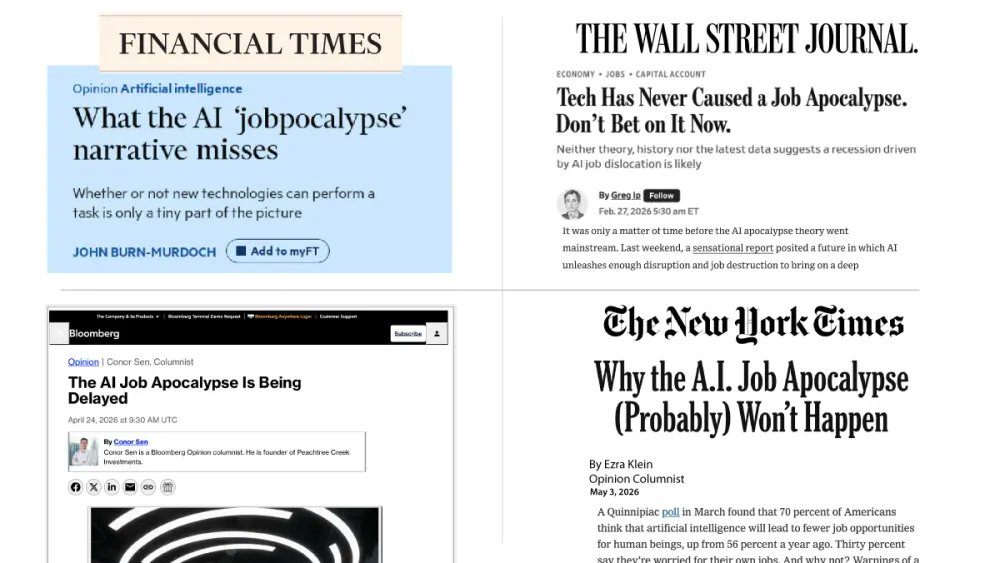
There will be no AI jobpocalypse. The story that AI will lead to massive unemployment is stoking unnecessary fear. AI — like any other technology — does affect jobs, but telling overblown stories of large-scale unemployment is irresponsible and damaging. Let’s put a stop to it. I’ve expressed skepticism about the jobpocalypse in previous posts. I’m glad to see that the popular press is now pushing back on this narrative. The image below features some recent headlines. Software engineering is the sector most affected by AI tools, as coding agents race ahead. Yet hiring of software engineers remains strong! So while there are examples of AI taking away jobs, the trends strongly suggest the net job creation is vastly greater than the job destruction — just like earlier waves of technology. Further, despite all the exciting progress in AI, the U.S. unemployment rate remains a healthy 4.3%. Why is the AI jobpocalypse narrative so popular? For one thing, frontier AI labs have a strong incentive to tell stories that make AI technology sound more powerful. At their most extreme, they promote science-fiction scenarios of AI “taking over” and causing human extinction. If a technology can replace many employees, surely that technology must be very valuable! Also, a lot of SaaS software companies charge around $100-$1000 per user/year. But if an AI company can replace an employee who makes $100,000 — or make them 50% more productive — then charging even $10,000 starts to look reasonable. By anchoring not to typical SaaS prices but to salaries of employees, AI companies can charge a lot more. Additionally, businesses have a strong incentive to talk about layoffs as if they were caused by AI. After all, talking about how they’re using AI to be far more productive with fewer staff makes them look smart. This is a better message than admitting they overhired during the pandemic when capital was abundant due to low interest rates and a massive government financial stimulus. To be clear, I recognize that AI is causing a lot of people’s work to change. This is hard. This is stressful. (And to some, it can be fun.) I empathize with everyone affected. At the same time, this is very different from predicting a collapse of the job market. Societies are capable of telling themselves stories for years that have little basis in reality and lead to poor society-wide decision making. For example, fears over nuclear plant safety led to under-investment in nuclear power. Fears of the “population bomb” in the 1960s led countries to implement harsh policies to reduce their populations. And worries about dietary fat led governments to promote unhealthy high-sugar diets for decades. Now that mainstream media is openly skeptical about the jobpocalypse, I hope these stories will start to lose their teeth (much like fears of AI-driven human extinction have). Contrary to the predictions of an AI jobpocalypse, I predict the opposite: There will be an AI jobapalooza! AI will lead to a lot more good AI engineering jobs, and I’m also optimistic about the future of the overall job market. What AI engineers do will be different from traditional software engineering, and many of these jobs will be in businesses other than traditional large employers of developers. In non-AI roles, too, the skills needed will change because of AI. That makes this a good time to encourage more people to become proficient in AI, and make sure they’re ready for the different but plentiful jobs of the future! [Original text in The Batch newsletter.]
590
1,212
5,404
814,368
I'm delighted that @coursera and @udemy have come together as one company to serve learners. Both Coursera and Udemy were founded with the belief that access to high-quality education changes lives. Over the years, both companies have advanced this goal, creating opportunities for individuals, organizations, and communities around the world. That role is even more important now, as AI is changing the nature of work and increasing the need for continuous learning. Helping people build job-relevant skills will be critical to how we create a better world. By combining the strengths of both ‌companies, we can better serve this need. We bring together a broader range of learning content, trusted instructors and educators, and engaging learning experiences. This creates new opportunities to make learning more personalized, more applied, and more accessible at scale. I’m excited to serve as Chairman of the combined company, working alongside Greg Hart and the leadership team. There is a strong foundation in both organizations, and I look forward to what the teams will build together to expand access opportunity globally. Learn more: blog.coursera.org/coursera-a…
172
423
3,359
249,266
New course: Build agents that respond to users with not only plaintext, but custom UIs like charts, forms, and whiteboards, generated on demand and displayed right in the chat. This short course is built in partnership with @CopilotKit and taught by @ataiiam, co-founder of CopilotKit. You'll learn three approaches: Your agent can pick from custom components you build, like charts and forms. It can compose new layouts from a set of building blocks you provide, like rows, cards, and text. Or it can incorporate existing third-party apps, like a whiteboard or a calendar, right inside the conversation. Skills you’ll gain: - Build agents that render custom components like charts and forms on demand - Build an app where the agent and user collaborate on shared data, beyond just the chat window - Place third-party apps like maps, calendars, and whiteboards right in your interface Join and build agents that give users something to see and act on! deeplearning.ai/short-course…
103
238
1,453
208,317
Coding agents are accelerating different types of software work to different degrees. When we architect teams, understanding these distinctions helps us to have realistic expectations. Listing functions from most accelerated to least, my order is: frontend development, backend, infrastructure, and research. Frontend development — say, building a web page to serve descriptions of products for an ecommerce site — is dramatically sped up because coding agents are fluent in popular frontend languages like TypeScript and JavaScript and frameworks like React and Angular. Additionally, by examining what they have built by operating a web browser, coding agents are now very good at closing the loop and iterating on their own implementations. Granted, LLMs today are still weak at visual design, but given a design (or if a polished design isn’t important), the implementation is fast! Backend development — say, building APIs to respond to queries requesting product data — is harder. It takes more work by human developers to steer modern models to think through corner cases that might lead to subtle bugs or security flaws. Further, a backend bug can lead to non-intuitive downstream effects like a corrupted database that occasionally returns incorrect results, which can be harder to debug than a typical frontend bug. Finally, although database migrations can be easier with coding agents, they’re still hard and need to be handled carefully to prevent data loss. While backend development is much faster with coding agents, they accelerate it less, and skilled developers still design and implement far better backends than inexperienced ones who use coding agents. Infrastructure. Agents are even less effective in tasks like scaling an ecommerce site to 10K active uses while maintaining 99.99% reliability. LLMs' knowledge is still relatively limited with respect to infrastructure and the complex tradeoffs good engineers must make, so I rarely trust them for critical infra decisions. Building good infrastructure often requires a period of testing and experimentation, and coding agents can help with that, but ultimately that’s a significant bottleneck where fast AI coding does not help much. Lastly, finding infrastructure bugs — say, a subtle network misconfiguration — can be incredibly difficult and requires deep engineering expertise. Thus, I’ve found that coding agents accelerate critical infrastructure even less than backend development. Research. Coding agents accelerate research work even less. Research involves thinking through new ideas, formulating hypotheses, running experiments, interpreting them to potentially modify the hypotheses, and iterating until we reach conclusions. Coding agents can speed up the pace at which we can write research code. (I also use coding agents to help me orchestrate and keep track of experiments, which makes it easier for a single researcher to manage more experiments.) But there is a lot of work in research other than coding, and today’s agents help with research only marginally. Categorizing software work into frontend, backend, infra, and research is an extreme simplification, but having a simple mental model for how much different tasks have sped up has been useful for how I organize software teams. For example, I now ask front-end teams to implement products dramatically faster than a year ago, but my expectations for research teams have not shifted nearly as much. I am fascinated by how to organize software teams to use coding agents to achieve speed, and will keep sharing my findings in future posts. [Original text: deeplearning.ai/the-batch/is… ]
85
106
559
73,624
AI-native software engineering teams operate very differently than traditional teams. The obvious difference is that AI-native teams use coding agents to build products much faster, but this leads to many other changes in how we operate. For example, some great engineers now play broader roles than just writing code. They are partly product managers, designers, sometimes marketers. Further, small teams who work in the same office, where they can communicate face-to-face, can move incredibly quickly. Because we can now build fast, a greater fraction of time must be spent deciding what to build. To deal with this project-management bottleneck, some teams are pushing engineer:product manager (PM) some teams are pushing engineer:product manager (PM) ratios downward from, say, 8:1 to as low as 1:1. But we can do even better: If we have one PM who decides what to build and one engineer who builds it, the communication between them becomes a bottleneck. This is why the fastest-moving teams I see tend to have engineers who know how to do some product work (and, optionally, some PMs who know how to do some engineering work). When an engineer understands users and can make decisions on what to build and build it directly, they can execute incredibly quickly. I’ve seen engineers successfully expand their roles to including making product decisions, and PMs expand their roles to building software. The tech industry has more engineers than PMs, but both are promising paths. If you are an engineer, you’ll find it useful to learn some product management skills, and if you’re a PM, please learn to build! Looking beyond the product-management bottleneck, I also see bottlenecks in design, marketing, legal compliance, and much more. When we speed up coding 10x or 100x, everything else becomes slow in comparison. For example, some of my teams have built great features so quickly that the marketing organization was left scrambling to figure out how to communicate them to users — a marketing bottleneck. Or when a team can build software in a day that the legal department needs a week to review, that’s a legal compliance bottleneck. In this way, agentic coding isn’t just changing the workflow of software engineering, it’s also changing all the teams around it. When smaller, AI-enabled teams can get more done, generalists excel. Traditional companies need to pull together people from many specialties — engineering, product management, design, marketing, legal, etc. — to execute projects and create value. This has resulted in large teams of specialists who work together. But if a team of 2 persons is to get work done that require 5 different specialities, then some of those individuals must play roles outside a single speciality. In some small teams, individuals do have deep specializations. For example, one might be a great engineer and another a great PM. But they also understand the other key functions needed to move a project forward, and can jump into thinking through other kinds of problems as needed. Of course, proficiency with AI tools is a big help, since it helps us to think through problems that involve different roles. Even in a two-person team, to move fast, communication bottlenecks also must be minimized. This is why I value teams that work in the same location. Remote teams can perform well too, but the highest speed is achieved by having everyone in the room, able to communicate instantaneously to solve problems. This post focuses on AI-native teams with around 2-10 persons, but not everything can be done by a small team. I'll address the coordination of larger teams in the future. I realize these shifts to job roles are tough to navigate for many people. At the same time, I am encouraged that individuals and small teams who are willing to learn the relevant skills are now able to get far more done than was possible before. This is the golden age of learning and building! [Original text: deeplearning.ai/the-batch/is… ]
229
379
1,931
364,752
New course: Spec-Driven Development with Coding Agents, built in partnership with @jetbrains, and taught by @paulweveritt. Vibe coding is fast, but often produces code that doesn't match what you asked for. This short course teaches you spec-driven development: write a detailed spec defining what to build, and work with your coding agent to implement it. Many of the best developers already build this way. A spec lets you control large code changes with a few words, preserve context across agent sessions, and stay in control as your project grows in complexity. Skills you'll gain: - Write a detailed specification to define your mission, tech stack, and roadmap, giving your agent the context it needs from the start - Plan, implement, and validate features in iterative loops using a spec as your agent's guide - Apply the same repeatable workflow to both new and legacy codebases - Package your workflow into a portable agent skill that works across agents and IDEs Join and write specs that keep your coding agent on track! deeplearning.ai/short-course…
172
425
2,873
458,072
I'm excited about voice as a UI layer for existing visual applications — where speech and screen update together. This goes well beyond voice-only use cases like call center automation. The barrier has been a hard technical tradeoff: low-latency voice models lack reliability, while agentic pipelines (speech-to-text → LLM → text-to-speech) are intelligent but too slow for conversation. Ashwyn Sharma and team at Vocal Bridge (an AI Fund portfolio company) address this with a dual-agent architecture: a foreground agent for real-time conversation, a background agent for reasoning, guardrails, and tool calls. I used Vocal Bridge to add voice to a math-quiz app I'd built for my daughter; this took less than an hour with Claude Code. She speaks her answers, the app responds verbally and updates the questions and animations on screen. Only a tiny fraction of developers have ever built a voice app. If you'd like to try building one, check out Vocal Bridge for free: vocalbridgeai.com
102
108
763
115,028
As AI agents accelerate coding, what is the future of software engineering? Some trends are clear, such as the Product Management Bottleneck, referring to the idea that we are more constrained by deciding what to build rather than the actual building. But many implications, like AI’s impact on the job market, how software teams will be organized, and more, are still being sorted out. The theme of our AI Developer Conference on April 28-29 in San Francisco is The Future of Software Engineering. I look forward to speaking about this topic there, hearing from other speakers on this theme, and chatting with attendees about it. We’re shaping the future, and I hope you will join me there! It is currently trendy in some technology and policy circles to forecast massive job losses due to AI. Even if they have not yet materialized, these losses certainly must be just over the horizon! I have a contrarian view that the AI jobpocalypse — the notion that AI will lead to massive unemployment, perhaps even rioting in the streets — won’t be nearly as bad as dire forecasts by pundits, especially pundits who are trying to paint a picture of how powerful their AI technology is. Among professions, AI is accelerating software engineering most, given the rise of coding agents. According to a new report by Citadel Research, software engineering job postings are rising rapidly. So if software engineering is a harbinger of the impact AI will have on other professions, this expansion of software engineering jobs is encouraging. Yes, fresh college graduates are having a hard time finding jobs. And yes, there have been layoffs that CEOs have attributed to AI, even if a large fraction of this was “AI washing,” where businesses choose to attribute layoffs to AI, even though AI has not changed their internal operations much yet. And yes, there is a subset of job roles, such as call center operator, that are more heavily impacted. Many people are feeling significant job insecurity, and I feel for everyone struggling with employment, whether or not the cause is AI-related. And many other factors, such as over-hiring during the pandemic and high interest rates, have contributed to the slowdown in the labor market, and the notion that AI is leading to unemployment is oversimplified. In software engineering, I see a lot of exciting work ahead to adapt our workflows. It is already clear that: (i) As AI makes coding easier, a lot more people will be doing it. (ii) Writing code by hand and even reading (generated) code is not that important, because we can ask an LLM about the code and operate at a higher level than the raw syntax (although how high we can or should go is rapidly changing). (iii) There will be a lot more custom applications, because now it’s economical to write software for smaller and smaller audiences. (iv) Deciding what to build, more than the actual building, is becoming a bottleneck. (v) The cost of paying down technical debt is decreasing (since AI can refactor for you). At the same time, there are also a lot of open questions for our profession, such as: - In the future, what will be the key skills of a senior software engineer? And for junior levels, what should be the new Computer Science curriculum? - If everyone can build features, what skills, strategies, or resources create competitive advantage for individuals and for businesses? - What are the new building blocks (libraries, SDKs, etc.) of software? How do we organize coding agents to create software? - What should a software team look like? For example, how many engineers, product managers, designers, and so on. What tooling do we need to manage their workflow? - How do AI agents change the workflow of machine learning engineers and data scientists? For example, how can we use agents to accelerate exploring data, identifying hypotheses, and testing them? I’m excited to explore these and other questions about the future of software engineering at AI Dev. I expect this to be an exciting event. Please join us! [Original text: The Batch newsletter.] ai-dev.deeplearning.ai/
150
163
892
116,658
New course: Efficient Inference with SGLang: Text and Image Generation, built in partnership with LMSys @lmsysorg and RadixArk @radixark, and taught by Richard Chen @richardczl, a Member of Technical Staff at RadixArk. Running LLMs in production is expensive, and much of that cost comes from redundant computation. This short course teaches you to eliminate that waste using SGLang, an open-source inference framework that caches computation already done and reuses it across future requests. When ten users share the same system prompt, SGLang processes it once, not ten times. The speedups compound quickly, especially when there's a lot of shared context across requests. Skills you'll gain: - Implement a KV cache from scratch to eliminate redundant computation within a single request - Scale caching across users and requests with RadixAttention, so shared context is only processed once - Accelerate image generation with diffusion models using SGLang's caching and multi-GPU parallelism Join and learn to make LLM inference faster and more cost-efficient at scale! deeplearning.ai/short-course…
68
83
538
98,724