We help global builders turn physical AI ideas into real products, with Shenzhen as the execution layer.

Joined October 2020
36 Photos and videos
VLA serves as a foundational paradigm in embodied AI, forming the basis for multimodal action models—where the accuracy and alignment of high-quality training data directly determine generalization and real-world deployment performance. X Square Robot just released the QUANXTA Zero Series (headband dual grippers and full VR backpack rigs), purpose-built for scalable embodied data collection: multimodal capture, 1ms synchronization, and whole-body mobile manipulation that turns real human demonstrations into clean, trainable robot data. From supporting overseas teams on physical AI prototyping, sourcing, and pilot production in China, we've seen that getting the data foundation right early dramatically improves VLA deployment and supply chain execution. Models with poor data fidelity rarely make it from the lab to manufacturable products. #EdgeAI #Robotics #EmbodiedAI #VLA #HumanoidRobots #HardwareStartup
3
18
863
Ray-Ban Meta made AI glasses fun and social. NIMO made them forgettable on purpose. 👓Meta: camera open-ear audio, great for calls and content. 👓NIMO (Shenzhen-built): zero camera, true prescription support, ~29g lightweight titanium, discreet visual AI for meetings and translation. Looks and feels like regular high-end glasses. After the Meta wave, the next iteration wave in China is all about stripping back to what professionals will actually wear 8 hours without thinking twice. Founders shipping physical AI: which trade-offs are you making — camera for context or privacy for adoption? #PhysicalAI #WearableAI #SmartGlasses #shenzhenfoundry
You can literally see the cameras, flexible PCBs, battery, and connectors. This is the kind of hardware that shows how fast Chinese teams are iterating on wearable AI after the Ray-Ban Meta wave. The real challenge isn’t just making it look clean — it’s hitting the right balance of compute, battery life, thermal, and cost while still being manufacturable at scale. If you’re building edge AI wearables, these public teardowns are gold for understanding what’s actually possible right now. #AR #VR #AIglasses #shenzhen #wearable #OEM
7
11
54
9,510
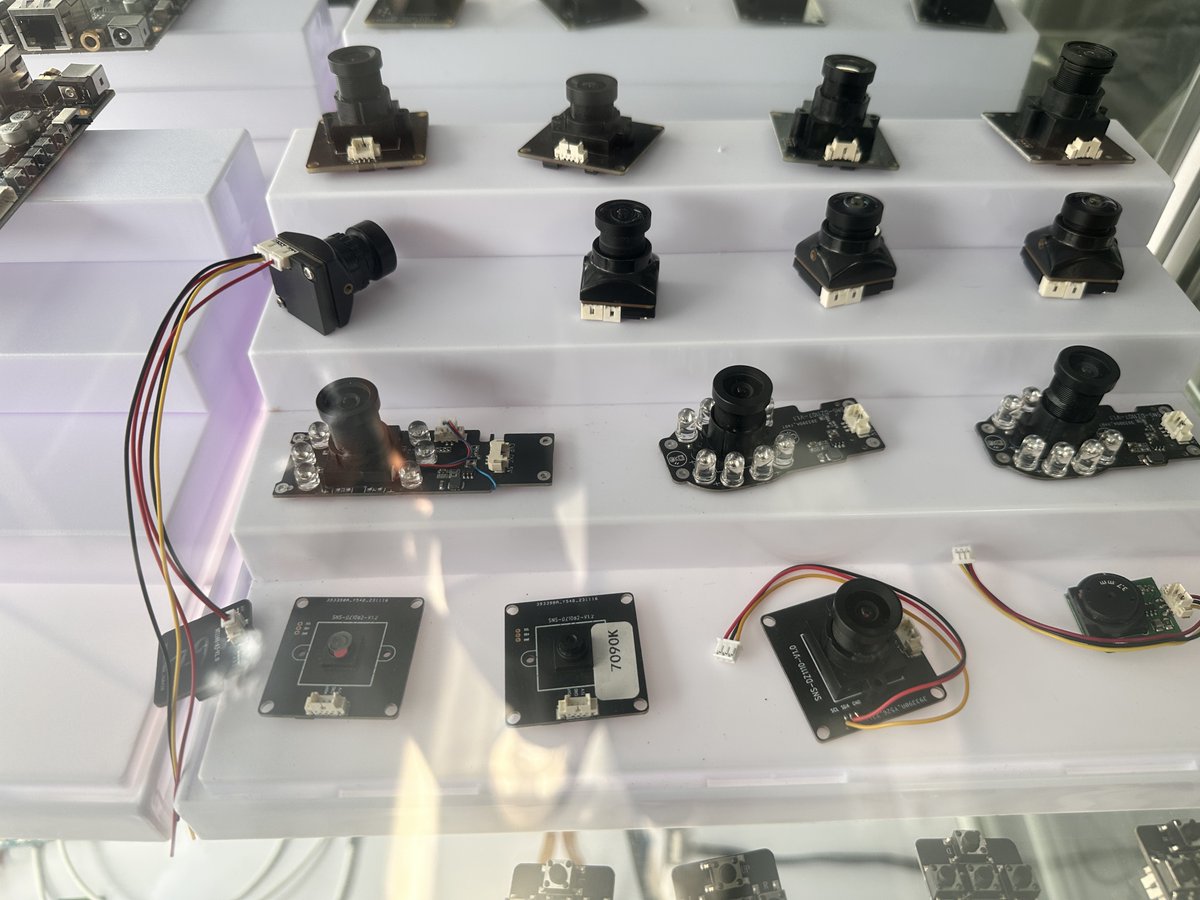
We stopped by one of our camera factory partners last week. They're already running 6-eye and 8-eye modules for European & US customers. Factories in both Shenzhen and Hunan. The shelves were full of lenses, flex cables, and vision kits that actually get built at scale. A lot of people talk about AI hardware. These guys are the ones quietly making it real. Huge respect for the teams on the floor, some of the hardest working, most capable people in the game. Without them, it's all just demos.❤️ #EdgeAI #shenzhenfoundry #PhysicalAI #Robotics #VLA #stereocamera
1
3
31
1,516
Most of what you're seeing about the iPhone 18 right now is coming from the usual rumor threads — thinner design, 200MP main camera, better on-device AI, new color options. What actually leaked from the factory is a completely different set of information: • A20 Pro chip (codename: Borneo) • LPDDR6 RAM with a 96-bit bus (first time on an iPhone) • New cooling architecture built specifically for sustained AI workloads • C2 in-house modem (codename: Ganymede) • Internal references to a foldable iPhone project (ID: V68) One side is consumer-facing speculation. The other is real engineering parameters and supply chain documentation. For founders building physical AI products or complex hardware, this gap matters. Rumor threads show you the dream. Factory data shows you the actual engineering problems — thermal design for AI loads, custom silicon sourcing, and supply chain exposure. And right now in Huaqiangbei, people are already reverse-engineering these files and building working samples. #iPhone18 #HardwareEngineering #Huaqiangbei #shenzhenfoundry
1
5
28
6,270
Does a robot really need real-time pressure data from its feet🦶🦶? This demo gives a pretty clear answer. As the sales engineer walks, the pressure grid on the foot updates in real time, showing the weight shifting from heel to forefoot. This kind of tactile hardware that actually works shows how fast Chinese teams are moving on robot and wearable sensor integration. Making a demo look slick is one thing. The hard part is keeping the sensors consistent, durable enough to handle repeated flexing, and making sure the calibration doesn’t drift once you go into mass production. Those are the issues that usually kill projects. If you’re working on smart insoles or robotic feet, this kind of hardware gives you a much more realistic sense of what’s actually doable right now. 🧵2-2/END #TactileSensing #RoboticBooties #shenzhenfoundry
You can see every sensor point light up the second pressure hits the fingers and palm. Numbers update basically instantly. This is the kind of real-time tactile feedback that makes robotic gloves and haptic systems actually usable instead of just looking good in videos. The hard part isn’t getting it to work once. It’s hitting the right balance of sensor density, flex life, power draw, and consistency so it stays manufacturable when you start building real volumes. If you’re working on dexterous hands or sensor gloves, seeing hardware like this running live helps clarify what’s actually possible right now. 🧵2-1 #TactileSensing #HapticGloves #RoboticGloves
1
3
12
2,180
You can see every sensor point light up the second pressure hits the fingers and palm. Numbers update basically instantly. This is the kind of real-time tactile feedback that makes robotic gloves and haptic systems actually usable instead of just looking good in videos. The hard part isn’t getting it to work once. It’s hitting the right balance of sensor density, flex life, power draw, and consistency so it stays manufacturable when you start building real volumes. If you’re working on dexterous hands or sensor gloves, seeing hardware like this running live helps clarify what’s actually possible right now. 🧵2-1 #TactileSensing #HapticGloves #RoboticGloves
2
2
17
3,269
This rope-driven setup feels like a real step up from most mainstream designs. @Tesla_Optimus already moved to tendon drive on Optimus hands (forearm motors pulling cables) for better transparency, but the rest of the body usually sticks with geared actuators. Going full rope drive here should cut backlash and motion noise way down, giving the AI much cleaner force/tactile signals without needing to stack extra sensors. The head stereo cams hand depth vision also lines up with what @Figure_robot 03 is doing on palm cams. Nice edge for actual home fine manipulation.
4
382
$12,500! 🤖 you can buy a rope-driven upper body with ±0.3mm repeatability, 5kg payload, and ≥100m/s² acceleration at the end effector. Astribot is positioning this as the core of a home service robot and claims to be the only company currently mass-producing rope-driven humanoids at scale. Rope drive delivers significantly higher force transparency and near-zero backlash compared to traditional geared systems. This gives the AI cleaner, more reliable force feedback — a meaningful advantage for fine, safe interaction in home environments. The system supports quick-swap end effectors, swappable compute backpacks, hot-swappable batteries, and can be paired with an optional mobile base with auto return-to-charge. It offers 2.5–4 hours of runtime with under 1 hour charging. Among current Chinese humanoid programs, this level of dynamic performance in a production-intent rope-driven upper body is still uncommon. #HumanoidRobot #PhysicalAI #EmbodiedAI #Robotics #HomeRobot #ChinaRobotics #RobotHardware #HumanoidRobotics #shenzhenfoundry
5
15
70
16,112
Most AI glasses still default to adding a camera and a screen. This one made the opposite choice on purpose. 👓Pure titanium frame around 30g. 👓Takes real prescription lenses. 👓Open-ear audio that keeps you aware of your surroundings. 👓Real-time translation across 13 languages (works offline). 👓Solid meeting transcription. 8-10 hour battery. 👓No camera. No lens display. Because the people who actually wear glasses for work don’t want to look like they’re recording the room or staring down at their face during a client call. The execution is clean enough that it just looks like a well-made pair of glasses — until you need the AI. If you’re building physical AI wearables, how are you deciding what not to put on the face? Which constraint are you optimizing hardest on your current wearable project — thermals, discretion, battery, or integration density? #AIHardware #WearableAI #SmartGlasses #EdgeAI #PhysicalAI #AIWearables #HardwareStartup #TechHardware #shenzhenfoundry
You can literally see the cameras, flexible PCBs, battery, and connectors. This is the kind of hardware that shows how fast Chinese teams are iterating on wearable AI after the Ray-Ban Meta wave. The real challenge isn’t just making it look clean — it’s hitting the right balance of compute, battery life, thermal, and cost while still being manufacturable at scale. If you’re building edge AI wearables, these public teardowns are gold for understanding what’s actually possible right now. #AR #VR #AIglasses #shenzhen #wearable #OEM
5
8
76
39,022
The harder question is this: once these robots become daily companions — even friends to your children — what if the data they’re trained on today turns out to be flawed or unsafe? Right now it feels mostly visual. Will we get proper auditory and emotional tone layers as separate safeguards to protect the real world? Huge credit to the Shenzhen team for turning the concept into something you can actually order. September deliveries will be interesting to watch. If you’re building companion robots and AI hardware, what concerns you more right now — data safety and integrity, or getting multi-modal perception right before these things live with real families? 🧵3-3/END #PhysicalAI #Humanoids #Robotics #AIHardware #AICompanion #TechFounders #FutureTech #HardwareExecution #tactilegloves #VLA #Worldmodel #shenzhenfoundry
1
267
What really stood out was the stage performance. These robots weren’t just moving — they were dancing with humans, responding naturally, and the whole thing ended with them forming a heart shape to the theme “Endless Love.” This isn’t about industrial arms. They’re turning the concept of a companion into something that can actually be mass-produced. For anyone building physical AI, robotics, or wearable hardware, this is a strong signal: on the consumer side, aesthetics and emotional interaction are becoming as important as torque and battery life. China’s supply chain is still leading here. 🧵3-2 #Humanoids #AICompanion #PhysicalAI #EmbodiedAI #CompanionRobot #ChinaAI #Robotics #FutureOfRobotics #shenzhenfoundry
1
336
Just got back from the #Uworld U1 launch in Shenzhen. The biggest takeaway: the gap between flashy AI demos and real, sellable, deliverable products is closing fast. These aren’t clunky industrial robots. 88 degrees of freedom, silicone skin, emotional AI that picks up on tone, they’re already taking pre-orders on modular versions. The head-only model starts around $17k, while the full-size flagship is close to $140k, Pre-orders have already surpassed 11,000 units, with a target of delivering over 10,000 this year. 🧵3-1 #PhysicalAI #EmbodiedAI #Humanoids #emotionalAI #HumanoidRobots #Robotics #AIHardware #ChinaTech #HardwareFounders #shenzhenfoundry
2
3
14
1,154
A small validation from our testing work.🧪 We tested a RK3568 edge setup for live robot-data capture: ⏺️2 camera UDP preview streams ⏺️live IMU calculation ⏺️UART → local print → UDP telemetry ⏺️99.882 Hz average IMU rate ⏺️zero sequence gaps in this run Nothing fancy here, just the kind of plumbing that has to work before robot data becomes useful. video alone is not the whole story. For embodied AI, timing, motion data, and sensor alignment matter too. still early, but a useful step toward cleaner physical data loops. 🧪Full Report: app.notion.com/p/shenzhenfou…
3
5
43
3,239
Humanoid robotics is being priced like a hardware story. that may be the wrong frame. The real question is which ecosystem can build the fastest physical AI learning loop: real-world data, VLA models, tactile sensing, supplier depth, manufacturing scale, and deployment feedback. Our view: the winner will not be decided by the best demo video, but by who can turn field failures into better robots faster. Full Research: app.notion.com/p/shenzhenfou…
5
16
1,899
Most robot hands can still only tell you “something is touching.” This one tells you exactly where, how hard, and in three dimensions — even when the force is just a drifting feather. 🩻1,000 sensing nodes. 🩻Biomimetic palm texture. 🩻Clean data on empty grasps. 🩻Wireless from the wrist. 🩻Time-synced with external vision. 🩻Every single contact point logged. The gap between a gripper that works in a controlled demo and hardware that can operate around people and variable objects is often this level of tactile resolution. If you’re building humanoids or fine manipulation systems, this is the spec you benchmark against. #HumanoidRobotics #DexterousManipulation #TactileSensing #PhysicalAI #Haptics #EdgeAI #RobotHands #shenzhenfoundry
3
13
42
3,326
We’ve been helping several clients recently set up VLA data collection rigs. In the process, we tested multiple mainboard camera combinations from both domestic and overseas suppliers, while working closely with our manufacturing partners to iterate on compact, hardware-synced depth cameras. The priorities are consistent across projects: reliable hardware synchronization, factory-grade calibration, clean depth output, and power efficiency that actually supports long collection runs. Seeing Orbbec’s Femto Bolt (the compact ToF camera Microsoft is recommending as a Kinect DK replacement) gives useful perspective. Onboard processing and PoE matter when scaling data capture. But for most teams, the bigger question is which sensor architecture holds up during real multi-day collection campaigns without becoming a constant integration burden. #VLADataset #DepthCamera #EmbodiedAI #RoboticsPerception #VLA #3DVision #RoboticsData #PhysicalAI
1
5
34
3,293
Another hybrid wearable showing up at the show: high-end headphones with an attachable visual module. The engineering message is clear — take something people already wear for hours (headphones) and add a lightweight display layer on top. Lower barrier than a full headset, potentially higher daily utility. We’re seeing more of these “audio-first compute layer” experiments from Chinese teams. The real test will be battery, weight distribution, and whether the software experience justifies carrying the extra hardware. #WearableTech #SpatialComputing #ARHardware #EdgeAI #HardwarePrototyping
1
12
1,346
Force-controlled arm, real-time body mapping, and precise red-light therapy on the spot. Not a gimmick — it’s a practical demonstration of how Chinese hardware teams are turning robotics into everyday wellness tools. The jump from industrial arms to service robots that actually touch humans safely is huge. This is the kind of execution that matters for physical AI in healthtech. #biotech #HealthTech #shenzhen #servicerobots
1
8
690
You can literally see the cameras, flexible PCBs, battery, and connectors. This is the kind of hardware that shows how fast Chinese teams are iterating on wearable AI after the Ray-Ban Meta wave. The real challenge isn’t just making it look clean — it’s hitting the right balance of compute, battery life, thermal, and cost while still being manufacturable at scale. If you’re building edge AI wearables, these public teardowns are gold for understanding what’s actually possible right now. #AR #VR #AIglasses #shenzhen #wearable #OEM
36
93
1,334
438,002