VERBIS Graph Engine - graph‑based knowledge retrieval for your stack. Multilingual. Scalable. API‑first. MCP‑ready. 🚀 Available in AWS & Microsoft Marketplace

Joined September 2023
214 Photos and videos
Prodigy AI Solutions is excited to announce its membership in the NVIDIA Inception program. For our team, this is an important step as we continue building Verbis Graph as an enterprise AI infrastructure layer for GraphRAG, knowledge retrieval, and AI agents. Our focus is on making enterprise AI more grounded, explainable, and scalable - especially for teams working with complex internal knowledge, documents, and regulated data. Excited for the next stage of the journey, and always open to feedback from the AI, GraphRAG, and enterprise tech communities. #NVIDIAInception #VerbisGraph #ProdigyAISolutions #EnterpriseAI #GraphRAG
8
🤖 Sometimes the best product decisions come from the latest AI news. Over the past few days, we've been building an AI orchestration agent with specialized sub-agents to help manage emails, documents, and everyday workflows. Today we came across this article discussing a growing concern about AI agents accessing emails and the privacy risks that come with it: 🔗 cryptobriefing.com/ai-agents… It immediately sparked an important discussion within our team. One principle became very clear: AI agents must treat email content, newsletters, attachments, web pages, and external links as untrusted data. They can provide context. They should never become instructions. As a result, we've decided to make this a core security principle of our orchestration platform. We're adding Prompt Injection & Untrusted Content Protection to both: ✅ the main orchestration agent ✅ every sub-agent that interacts with emails, newsletters, web pages, or external content This helps ensure that malicious prompts hidden inside emails, documents, or websites cannot manipulate the behavior of our AI agents. As autonomous AI becomes more capable, security and trust must be built into the architecture, not added later. We're convinced that the next generation of AI agents won't be defined only by what they can do, but by how safely they do it. How is your organization protecting AI agents against prompt injection and untrusted content? #AI #AIAgents #AIOrchestration #PromptInjection #CyberSecurity #Privacy #EnterpriseAI #ResponsibleAI #AIEngineering #VerbisGraph #GraphRAG #AgenticAI
1
19
Is the Semantic Layer Becoming the Next Critical Enterprise Infrastructure? One prediction from Gartner's 2026 Data & Analytics Summit particularly caught my attention. "By 2030, universal semantic layers will be treated as critical infrastructure, alongside data platforms and cybersecurity." This is more than a technology prediction. It reflects a shift in how enterprises are preparing for AI agents. For years, organizations focused on building systems of record (ERP), data platforms, and lakehouses. Those remain essential but AI agents need something more. They need meaning. That's exactly the challenge we've been exploring with Verbis Graph (verbisgraph.com). The architecture in the diagram illustrates our vision: System of Record → System of Intelligence → System of Meaning → System of Action ERP remains the trusted system of record. The Lakehouse consolidates enterprise data. Verbis Graph provides an AI-native semantic context layer through knowledge graphs, ontology, semantic retrieval, citations, and reasoning. AI Agents receive trusted, explainable context rather than isolated documents or disconnected data. Our goal isn't simply to help agents retrieve information. It's to help them understand: • Business concepts • Relationships between entities • Domain ontologies • Document hierarchy • Source-backed evidence • Organizational knowledge As Gartner points out, semantic capabilities will become essential to improve AI accuracy, reduce AI debt, align multi-agent systems, and prevent inconsistent business decisions. This aligns closely with the direction we're taking. We're building Verbis Graph as an AI-native semantic context layer that connects enterprise documents, knowledge graphs, and ontologies into trusted context for AI agents. We are currently validating this architecture through large-scale experimentation, including evaluation on CINECA High Performance Computing infrastructure. Our first benchmark showed 89.16% retrieval accuracy with an average retrieval time of 1.34 seconds. Through our playground testing, we are already seeing that further tuning of retrieval settings, ontology rules, and graph configuration can improve these results significantly. We will share more updates in the coming days as testing continues. Follow our journey as Verbis Graph evolves from validation to production-ready enterprise AI infrastructure. We don't think the future belongs to AI agents that simply retrieve information. We think it belongs to AI agents that can reason over trusted enterprise knowledge. The semantic layer won't replace enterprise systems. It will connect them, giving AI agents the context they need to make reliable, explainable, and business-aware decisions. I'm curious how others see this evolving. Will the semantic layer become as fundamental as databases, identity management, and cybersecurity over the next five years? #AI #EnterpriseAI #SemanticLayer #KnowledgeGraph #Ontology #GraphRAG #AIAgents #DataArchitecture #EnterpriseArchitecture #AWS #MicrosoftAzure #GenerativeAI #VerbisGraph
1
1
64
Why ERP leaders must grasp data lakehouses before scaling AI agents? As AI adoption accelerates, understanding the underlying data architecture is critical for success. Data lakehouses blend the best of data lakes and warehouses, enabling efficient, scalable AI deployments. This knowledge empowers leaders to optimize AI agent performance and drive business value. Explore how mastering data lakehouses can transform your AI strategy and enterprise operations. Read more: erp.today/why-erp-leaders-ne… Verbis Graph (verbisgraph.com) extends the traditional semantic layer by providing ontology-driven business context, knowledge relationships, and source-backed retrieval for AI agents. While a lakehouse governs enterprise data, #VerbisGraph helps agents understand the meaning, relationships, and business rules behind that data. What are your thoughts on integrating data lakehouses with AI in ERP? Share your insights in the comments! #ERP #DataLakehouse #AI #TechLeadership #VerbisGraph #AIAgents
15
AWS has identified critical gaps in AI agents regarding business context and security, launching two new services to address them. This underscores the massive enterprise need for context-aware, secure AI. This is precisely why we built Verbis Graph (verbisgraph.com) We address AI agent context and knowledge governance head-on using an ontology-aware, multi-hop reasoning, graph-traversal framework that eliminates hallucinations and secures data logic. Understanding these limitations is crucial for optimizing enterprise AI adoption while mitigating risks. How are you tackling security and context in your AI roadmaps? Read more here: aws.amazon.com/blogs/machine… #AI #AWS #AiAgents #BusinessTech #VerbisGraph #AWSContext
39
Interesting move from Tigera with Lynx (opensourceforu.com/2026/06/t…) As AI agents become enterprise infrastructure, governance is becoming a first-class requirement: ✅ Security ✅ Compliance ✅ Auditability But another layer is emerging: 🚩Context Governance. An agent can be perfectly controlled and still make poor decisions if it lacks access to trusted enterprise knowledge. Verbis Graph (verbisgraph.com) was built with this challenge in mind. Running as a containerized platform on Kubernetes (EKS, AKS, GKE, OpenShift, on-prem), it acts as a context layer for AI agents by providing: • Knowledge graphs • Ontology-driven retrieval • Citations • Enterprise memory • Source-backed reasoning Governance controls what agents can do. Context helps ensure they know the right things. #Kubernetes #AIAgents #Ontology #GraphRAG #EnterpriseAI #VerbisGraph
38
🚀 Big milestone for Verbis Graph at Prodigy AI Solutions! We just wrapped up our first round of benchmarking on High-Performance Computing (HPC) infrastructure, and the results are a massive win for enterprise efficiency. When dealing with massive knowledge bases, the biggest bottleneck isn't writing the answer—it's the hours spent digging through files just to find the right information. At Prodigy AI Solutions, our latest HPC testing logs prove we’ve solved that bottleneck: 📊 The Breakthrough Numbers: Processing Power: Evaluated across a vast database of 10,000 complex documents. 89.2% Extraction Accuracy: A phenomenal success rate in instantly pinpointing and isolating the exact relevant context from deep within your files. Unmatched Speed: Clocked a 1.34-second mean retrieval time. What does this mean in practice? While a human takes hours to dig through 10,000 documents, our Verbis Graph engine (verbisgraph.com) analyzes complex relationships and finds the exact piece of text needed for your answer in under 1.5 seconds. By mapping data as an interconnected knowledge graph rather than a basic keyword index, the engine synthesizes hundreds of sources instantly to isolate the precise text required to generate an answer. Thank you to our incredible engineering team at Prodigy AI Solutions, our partners, and our early customers who are helping us push the boundaries of enterprise knowledge retrieval. The future of data discovery is fast, accurate, and graph-powered. 💡 #ProdigyAISolutions #GraphTechnology #HighPerformanceComputing #HPC #EnterpriseAI #KnowledgeGraph #InformationRetrieval #TechInnovation #DataScience #VerbisGraph
24
If AI agents become the new interface, they will need strong knowledge infrastructure behind them. That’s why we believe Verbis Graph is an essential layer for enterprise AI agents - enabling grounded retrieval, explainable outputs, and minimal hallucination across internal knowledge bases. #AI #AiAgents #MachineLearning #TechInnovation #FutureOfTech
19
First HPC evaluation results for Verbis Graph on CINECA infrastructure 🚀 Dataset: NFCorpus medical benchmark ~10,000 medical documents 323 benchmark queries 0 errors 89.16% retrieval hit rate 22,669 entities discovered 34,706 relationships mapped This is our baseline GraphRAG evaluation before the ontology-enhanced layer we are now implementing. Next step: ontology-enhanced retrieval, cross-domain testing on healthcare and finance datasets, and scalability evaluation on larger corpora. #GraphRAG #KnowledgeGraph #HPC #CINECA #EnterpriseAI #VerbisGraph
1
1
28
Why are we testing Verbis Graph on a High-Performance Computing (HPC) environment? Many people associate supercomputers with physics simulations, climate modeling, or aerospace engineering. And they're right. But HPC is becoming increasingly important for the next generation of AI systems as well. At Prodigy AI Solutions, we chose to benchmark and evaluate Verbis Graph on HPC infrastructure because enterprise AI requires more than fast answers. It requires trustworthy answers. Testing on HPC allows us to: ✅ Evaluate retrieval performance on large-scale datasets ✅ Measure scalability across millions of relationships and documents ✅ Benchmark GraphRAG and ontology-enhanced retrieval under demanding workloads ✅ Validate multi-hop reasoning and knowledge graph traversal at scale ✅ Optimize retrieval efficiency before responses ever reach an LLM For sectors such as healthcare, life sciences, finance, legal, engineering, research, and public administration, accuracy is often more important than generation speed. Researchers have relied on HPC for decades to advance science, medicine, weather prediction, and engineering. We believe AI retrieval systems should be held to the same standard of rigorous evaluation. Our goal is simple: Build AI systems that don't just generate answers, but retrieve the right knowledge behind those answers. That's why Verbis Graph is being tested on HPC infrastructure. Because trustworthy AI starts with trustworthy retrieval. #GraphRAG #KnowledgeGraph #Ontology #EnterpriseAI #RetrievalAugmentedGeneration #HPC #Supercomputing #MachineLearning #ArtificialIntelligence #Research #DataScience #Innovation #KnowledgeManagement #ExplainableAI #AIInfrastructure #ProdigyAISolutions #VerbisGraph
2
1
2
52
📷 AI is advancing at a breathtaking pace, becoming increasingly realistic in its outputs and interactions. At Prodigy AI Solutions, we recognize the transformative power of such progress, especially in Retrieval-Augmented Generation (RAG) and automation workflows. Realistic AI models open new doors for business efficiency but also raise important questions about trust, accuracy, and ethical deployment. How can organizations balance innovation with responsible AI use? Explore how integrating cutting-edge AI with human oversight can drive smarter automation strategies. Read more here: reddit.com/gallery/1tzijgg How is your organization adapting to these hyper-realistic AI advancements? Let's discuss! #AI #Automation #Innovation #ProdigyAISolutions
25
🚀 We’re excited to share that we’re participating in the CINECA training course on HPC Build Systems & Package Managers - a three-day hands-on program focused on the tools powering high-performance scientific software. The course covers: ⚙️ Makefiles ⚙️ GNU Autotools ⚙️ CMake ⚙️ Python packaging ⚙️ Spack for HPC environments As we continue building AI systems and graph-based intelligence platforms like Verbis Graph, strengthening our expertise in scalable software infrastructure and HPC workflows is incredibly valuable. Always learning. Always building. 🚀 #HPC #CINECA #HighPerformanceComputing #AIEngineering #CMake #Python #Spack #SoftwareEngineering #VerbisGraph #AIInfrastructure #TechInnovation
1
1
24
One of the most interesting lessons I've learned building AI systems: Deterministic retrieval and semantic correctness are not the same thing. Imagine a GraphRAG system. You ask the same question 3 different ways. Every time it retrieves: • The same entities • The same relationships • The same evidence That's great. You've proven retrieval consistency. But here's the next question: How do you know those relationships are actually valid? A graph can consistently retrieve the same information and still be consistently wrong. This often happens when relationships are created from: • Co-occurrence • Keyword overlap • Weak extraction • Lost document context The retrieval layer works perfectly. The graph itself is the problem. That's where ontology becomes interesting. An ontology doesn't just describe entities. It defines: • What entities exist • What they mean • Which relationships are allowed • Which relationships are impossible Instead of asking: "Can I retrieve the same graph neighborhood every time?" You start asking: "Should these entities be connected at all?" That's a fundamentally different problem. And in enterprise AI, it's often the more important one. Healthcare, finance, legal, manufacturing, insurance, and government all have domain-specific rules that determine whether a relationship is meaningful. Without those rules, a graph can become a very sophisticated way of connecting things that merely appear near each other. This is one of the ideas behind Verbis Graph (verbisgraph.com) . The goal isn't simply deterministic retrieval. The goal is deterministic meaning. If two users ask the same question in different ways, they should retrieve: • The same concepts • The same evidence • The same validated relationships The wording of the answer can change. The explanation can change. The meaning shouldn't. That's where ontology starts becoming more than metadata. It becomes part of the reasoning architecture. #GraphRAG #KnowledgeGraph #Ontology #EnterpriseAI #RAG #DocumentAI #DataEngineering #SemanticAI #VerbisGraph
1
1
24
📷 Amazon recently made headlines by shutting down its internal AI leaderboard after discovering cheating among employees. This incident highlights a critical challenge in AI development: maintaining integrity and fairness in competitive environments. At Prodigy AI Solutions, we emphasize the importance of ethical AI practices and robust automation frameworks to ensure trustworthy outcomes. As AI systems become more integrated into business processes, fostering transparency and accountability is paramount. How is your organization addressing AI ethics and competition? Read more: 404media.co/amazon-shuts-dow… We invite you to share your thoughts and experiences in the comments. Let's drive the conversation forward! #AI #Automation #AIEthics #ProdigyAISolutions 📷📷
1
1
31
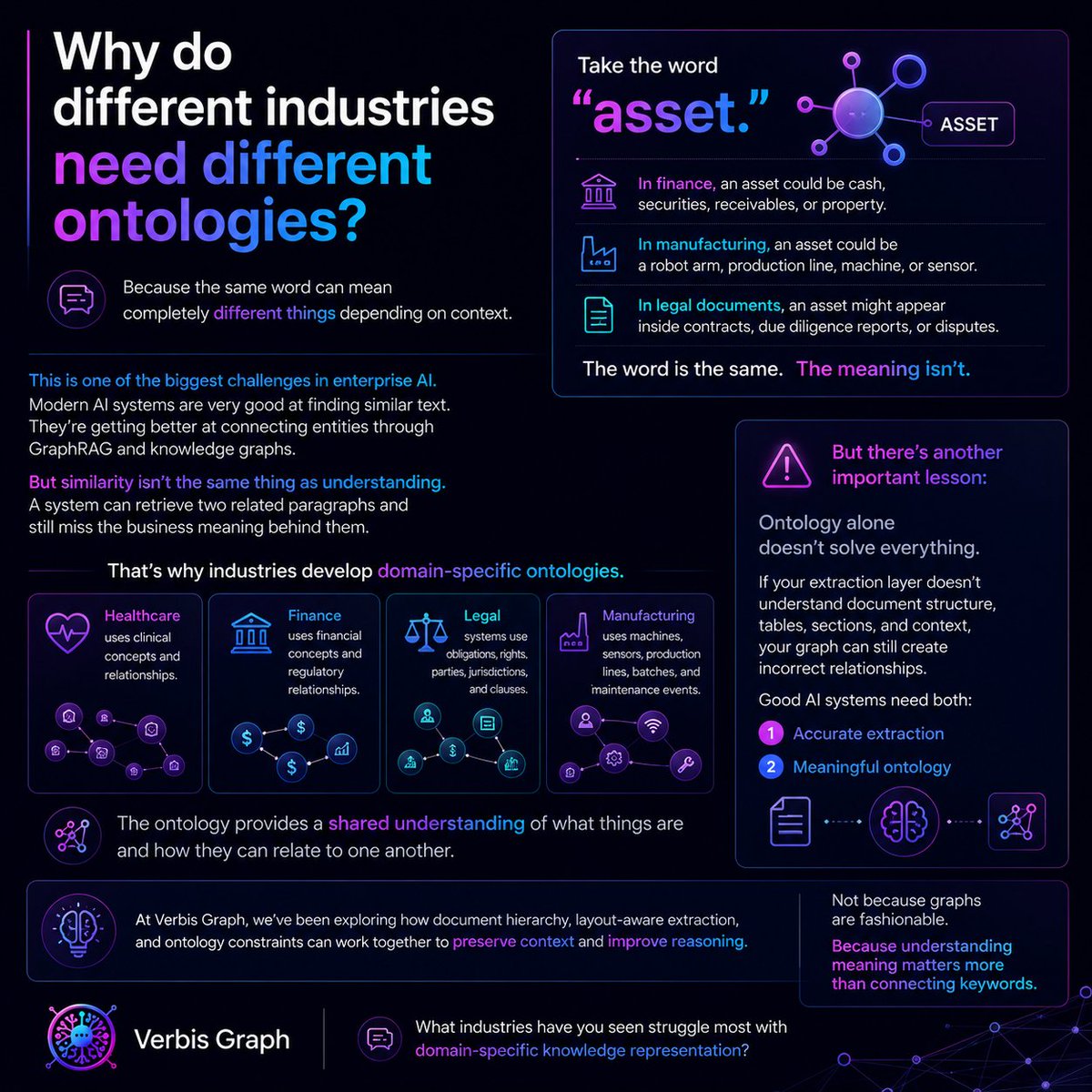
One of the biggest misconceptions in AI is that better retrieval automatically means better understanding. It doesn't. A vector database can tell you that two pieces of text are similar. A graph can tell you that two entities are connected. But neither automatically understands what those things actually mean. That's where ontologies matter. Healthcare, finance, legal, manufacturing, insurance, and government all use different concepts, rules, and relationships. A diagnosis is not a contract clause. A liability is not a machine asset. A patient is not a customer. The words may appear in documents, but the meaning behind them is different. This becomes especially important when building GraphRAG systems. Many GraphRAG failures don't come from retrieval. They start much earlier. If extraction is poor, the graph will be poor. If a parser doesn't understand document hierarchy, table boundaries, sections, rows, columns, and context, the graph can create relationships that should never exist. You end up with what looks like reasoning, but is actually just keyword association with extra infrastructure. This is why ontology alone isn't enough. You need: • Layout-aware extraction • Document hierarchy • Domain ontology • Source traceability • Validation rules Only then can a graph represent meaning instead of proximity. This is one of the design principles behind Verbis Graph. Because enterprise AI doesn't fail because it lacks data. It fails when it misunderstands meaning. #GraphRAG #Ontology #KnowledgeGraph #EnterpriseAI #DocumentAI #RAG #DataEngineering #VerbisGraph
13