100% open source framework for realtime voice and multimodal AI. Maintained by @trydaily engineering team with support from the Pipecat developer community.

Joined May 2024
19 Photos and videos
Pinned Post
Thank you to our community, and all the Pipecat developers out there. You guys are amazing 🫡
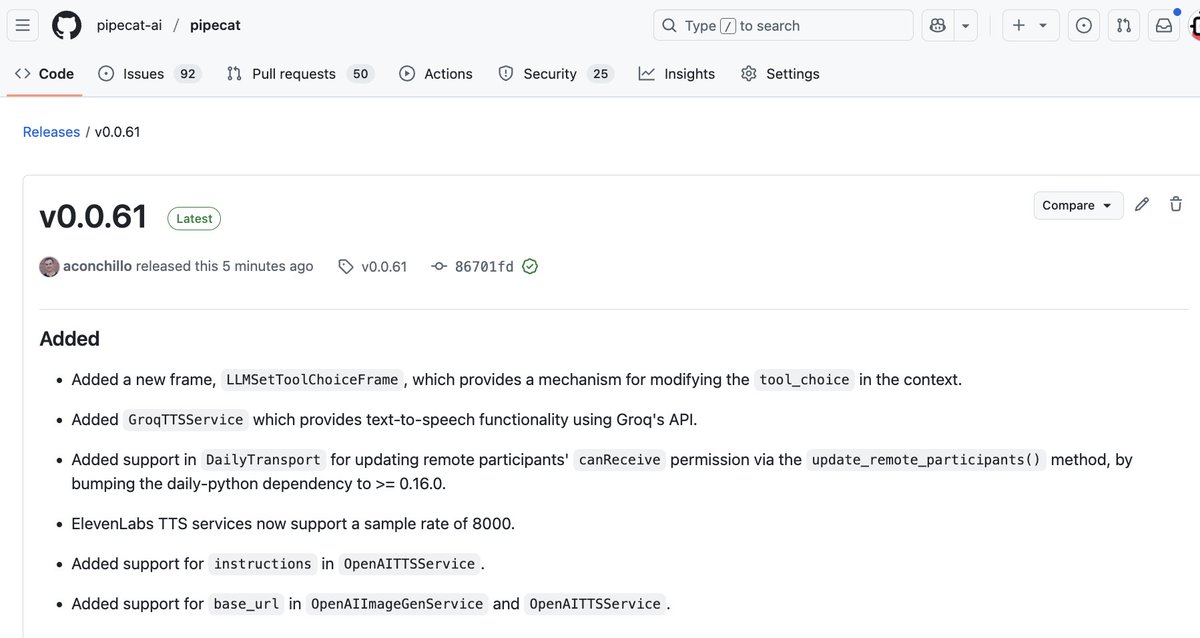
Big day today. Pipecat version 1.0. Two years in the making. The most widely used framework for voice agents, but not just voice agents. Pipecat is a framework for realtime, multi-modal, multi-model AI applications. Contributions from NVIDIA, all the foundation labs, AWS, GCP, and Azure. Used by thousands of startups, scale-ups, and enterprises. Pipecat Subagents v0.1.0. A new library for sub-agent orchestration. Which is just a fancy way of saying running lots of inference loops in parallel, with partially shared context. The basic architecture of Pipecat Subagents is an event bus that works locally, and over the network. And Gradient Bang. The side project that broke containment. Built with Pipecat and Pipecat Subagents. Gradient Bang was actually the proving ground for the early Subagents work. But ... it's also a really fun game.
2
4
14
2,978
Pipecat AI reposted
@aiDotEngineer Concierge is now live! Talk to the concierge and build your custom schedule for the next three days along with a list of people ( speakers ) who you should definitely meet! This was built on the go with @pipecat_ai and @GradiumAI Try it out: aie-concierge-web.onrender.c…
One shotted a fun voice agent with @pipecat_ai and @GradiumAI to figure out with sessions to attend based on my profile at @aiDotEngineer . My agent recommended @danielhanchen ( ofcourse! ) and few more. Should I ship this so that everyone coming to conf can find their way around? Wdyt @swyx ?
7
18
3,932
🔥 ⚽️ !!
World Cup Voice Commentary right in your MenuBar! @pipecat_ai powered voice bot, not only reports on the scores but can answer any questions I have about the games! Using only local models on my M4 Max. Under the hood: Kokoro TTS for commentary Gemma 4e4 (with and without thinking) Nemotron 3.5 for ASR Built with Pipecat subagents: when the menubar starts, it spins up a main loop of [STT] | [LLM] <-> [subagent when a game starts] | [TTS] There is one subagent per game. Schedules are pulled regularly, so I can ask stuff like “Who will the US play in the round of 32?” and have it reason over fixtures, for example. A collector ingests live commentary (per match-id, home/away, and metadata) into a local DB and exposes it via a CLI so pipecat's subagents can query it. Each game subagent gets an initial prompt about “its” match and tools including an /analyze-game-skill. The skill was built and tested with the early R1 games, especially the chaos of Canada-Qatar game (with injuries, goals, and two yellow cards becoming a red!) The result: when something happens in the game, the TTS chimes in, excited or dejected, about missed chances, corners, cards, etc. Subagents maintain their own context, so with push-to-talk, which invokes the STT, I can ask about what is happening in a current, past, or future games, fixtures, etc. The main LLM routes to the correct subagent, or can directly check via CLI, or spins up a new subagent to go hunt down answers (e.g., scores about R1 games, schedule changes, etc.) Today’s rain delays accidentally stress-tested having multiple concurrent games in Round 3, and the subagent orchestration held up nicely. Clips screenshot below 👇 Halftime announcement, second goal, and the third goal. These were voice memo recordings, aargh
524
Pipecat AI reposted
My favorite annual AI event is next week in San Francisco. Come hang out with me at the @aiDotEngineer World's Fair. Go buy a ticket. Or, if you're a student, there's a great volunteer program. The organizing team does a great job making the World's Fair a conference with great talks, an opportunity for deep-dive learning across multiple AI engineering domains, a gathering of people building the infrastructure for AI adoption, and an opportunity to see early what everyone will be talking about next year. I'm doing a couple of talks. One on voice interfaces, with @neilzegh. And one about experimenting with new building blocks for "AI-native" software, software patterns for applications we couldn't have built at all before now and that we'll take for granted in a few years! I get more requests than I can keep up with, via LinkedIn and email, to meet and talk about AI engineering, voice AI, and @pipecat_ai. Most of the year, my default response is, "I would love to but I can't, if you make a PR I'll try hard to look at it." AI Engineer World's Fair is the one time of year when I can say: if you'll be at the World's Fair, come find me. We'll geek out about what you're building and all the crazy ideas we both have!
5
5
31
6,153
🔥 New STT model
Until today, a transcription model never knew what your voice agent just asked. The one we're launching today does. Universal-3.5 Pro Realtime from AssemblyAI is the first realtime speech-to-text model that takes your agent's side of the conversation as context. When your agent asks for an email and the caller rattles it off, the model already knows an email is coming, and captures it perfectly. Same for an order number read fast, an account ID, a medication, or a name spelled out over poor quality phone line.
1
14
2,410
🔥
You can turn an existing LangGraph agent into a fully functional voice agent with @pipecat_ai. This 17-minute walkthrough shows you exactly how to do it.
6
1,661
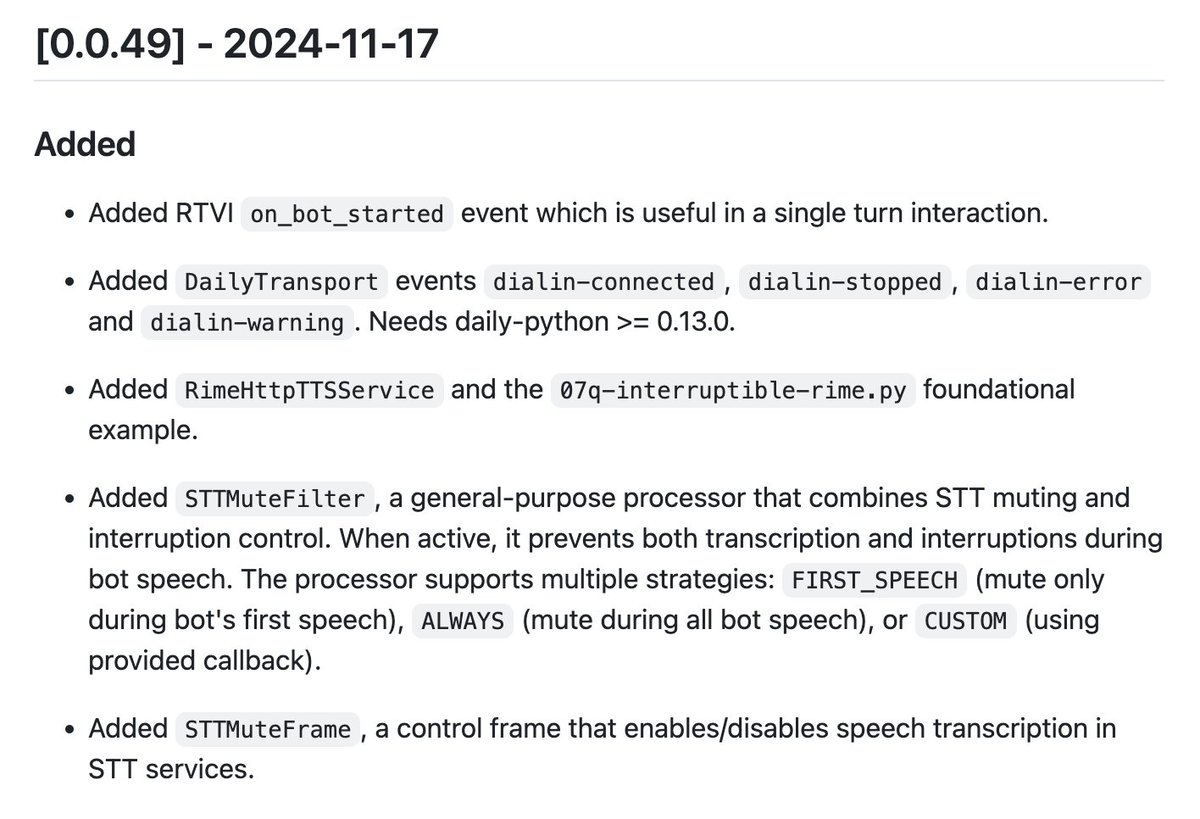
Pipecat 1.4.0 is here! And with it a new era of creating agents. This release introduces Pipecat Evals, our new behavioral evaluation framework for voice and multimodal agents. Evaluate any agent using simulated user audio. Transcribe the agent's audio; exchange text, or any combination of these. Define a single scenario in YAML or a whole suite and run it from the command line. Or use the library and do it all programmatically. The Pipecat CLI is now part of Pipecat core, with new commands to bootstrap your agent in seconds. Together, these unlock something we're really excited about: closing the eval loop. AI coding assistants (Claude Code, Codex, whatever you use) can now edit the agent, create and run the evals, read the result, and iterate until every scenario passes. A REPL for agent behavior. Also in this release: far simpler function-calling registration, plus plenty of other changes and bug fixes. This is probably our biggest release yet. Thanks as always to the community for the feedback, reports, and PRs. Keep 'em coming! ♥️
3
4
37
1,788
👏🏽 Try them today with the Pipecat CLI
We released Sonic-3.5 and Ink-2, the #1 streaming models for text to speech and speech to text you can use in your voice agents today. New architectures enable new frontiers for speed and quality. We're now the only provider to have #1 models for both speaking and listening.
2
1
7
1,696
Pipecat AI reposted
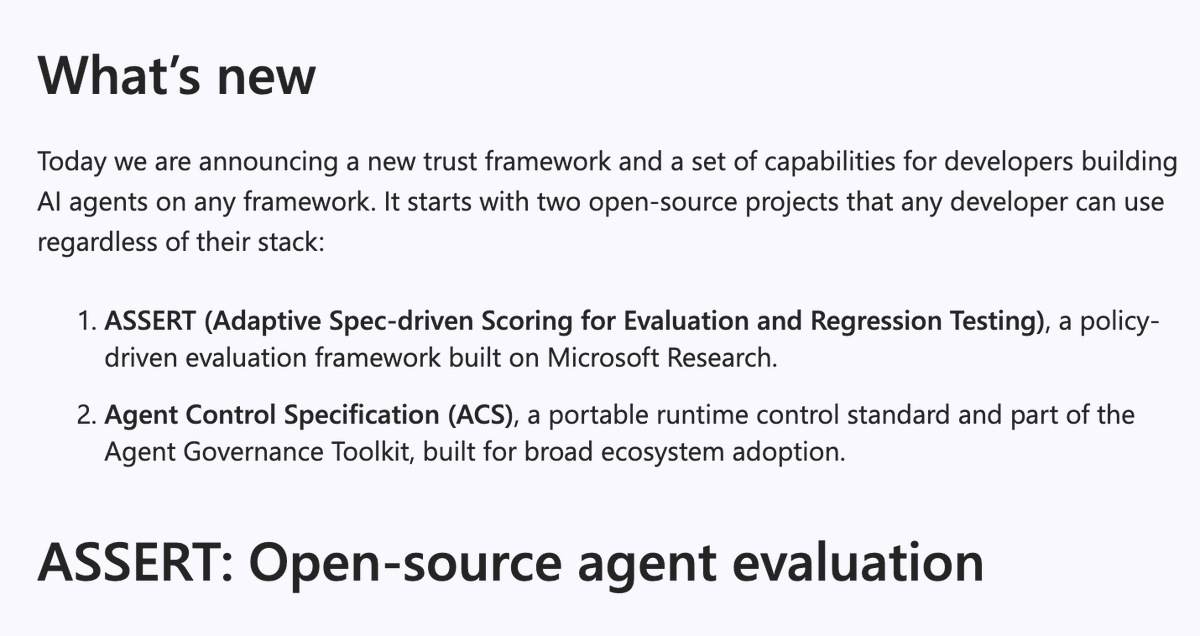
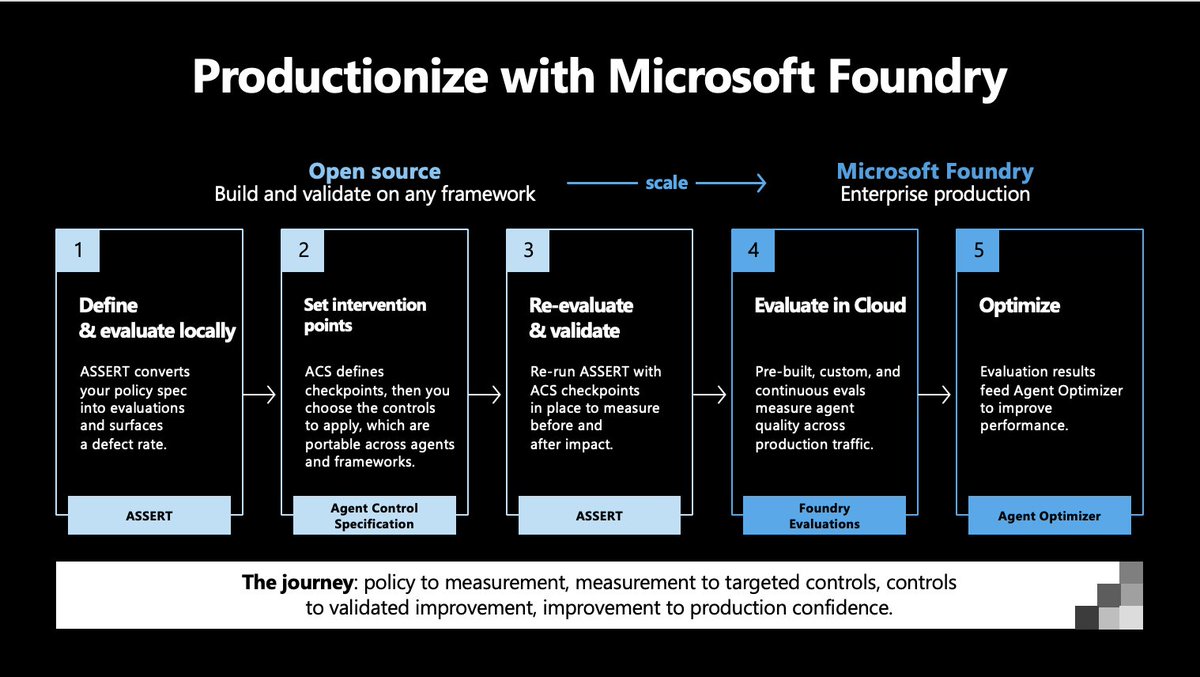
Microsoft announced a bunch of interesting new AI models and tools this week. Model launches alway get lots of attention. But don't sleep on the new ASSERT evals framework that launched today. I'm on record as arguing that 2026 is the year of evals. Evals are the glue for all the "jobs to be done" at every level of AI: model training; testing and deciding on what models to use and how to use them; and testing and improving AI agents in production. Evals unify our work on those different layers of the stack. These days, when we talk about evals, observability, and testing, we're talking about overlapping parts of a large set of tools we're still early on in figuring out. As the AI engineering ecosystem matures, diversifies, and increases massively in scale, we really, really need good evaluation (observability, monitoring, testing, data management) frameworks. I got a chance to test the new Microsoft ASSERT evals framework before it was released, and it has some very nice core ideas. 1) ASSERT is open in two important ways. First, the team is serious about broad support for models, frameworks, and use cases. Microsoft spent time understanding voice agent use cases and building Pipecat support, for example. Second, the code is completely open source, released under an open MIT license. 2) We're all working in and with agentic coding tools today. That means we are planning in natural language, and all of our software development and ops tools have to evolve for these new, natural language, workflows. ASSERT takes descriptions of desired agent behavior and generates specifications for the ASSERT suite of tools to run against. In a world where "English is the programming language," how we actually make natural language "code" precise enough and repeatable enough is perhaps the big unsolved tooling problem that all of us are working towards in different ways. This is true whether we work on coding agents, AI opps tooling, orchestration frameworks, or vertical applications. 3) Microsoft describes ASSERT as a policy-driven framework. Rather than eval against generic performance metrics, ASSERT aims to generate stable but adaptable evaluation criteria for specific agents. "Policy-driven" also implies a full loop design. Policy (generated from specific requirements) -> evaluation -> optimization -> monitoring in production -> improving the policy description -> evaluation -> ... 4) Enterprise agents need to be evaluated along many dimensions: task completion, individual conversation turn behavior, latency, mode-specific metrics like audio disfluencies, and safety/security. Microsoft designed ASSERT to be used together with a new safety governance toolkit called Agent Control Specification. 5) Finally, ASSERT is integrated into the Microsoft Foundry ecosystem. Today, AI engineering tools have to be open source and vendor neutral to get attention from developers and gain widespread adoption. *And* it's equally important to give enterprise customers tools that work as a coherent stack. This is hard to do well. There are real tensions between open source development versus engineering a great full stack developer experience. However, if you sweat the details on both ends, you benefit from a full spectrum of feedback about real-world development pain points. It's more work, but it's worth it! Kudos to Microsoft for embracing this and committing to an open, community oriented approach, plus doing the extra work to build the full stack for enterprise customers.
15
14
61
7,476
Pipecat AI reposted
SF Voice AI Meetup livestream. Presentations and panels start at 7:15 Pacific. youtube.com/live/EWys7ij9TTQ…
1
6
36
4,297
Pipecat AI reposted
Local native-audio voice agent running on an RTX 5090. - @NVIDIAAI Nemotron 3 Nano - audio|text ➡️ text - patched vLLM to implement complete turn prefix caching - ~125ms TTFT - @kyutai_labs Pocket TTS - text ➡️ audio - Nemotron Speech ASR - streaming audio ➡️ text - @pipecat_ai Smart Turn end-of-utterance - ~500ms total voice-to-voice latency - runs bash via tool calls If you're interested in voice and realtime multi-modal AI, come join us at the SF Voice AI Meetup on Thursday May 7th. Talk to engineers from NVIDIA, Kyutai, and Pipecat about what you're building! Links to meetup registration, code, and models on @huggingface below ...
9
19
133
8,033
Pipecat AI reposted
Voice AI Meetup, Thursday May 7th. This one's a special crossover event. T-Bot, who hosts the global Voice AI Spaces meetups, is visiting San Francisco and will MC! - NVIDIA researchers will present some of their really cool recent work on speech models. - We'll have demos and two fireside chats, featuring new developments in models and evals, with @GradiumAI, @ArtificialAnlys, @ServiceNow, and @pipecat_ai. - And, of course, 🍕 and great conversation. - Thanks to the @trychroma team for hosting in their wonderful office/event space. Registration link below. Come hang out with 150 old and new friends!
2
7
39
6,949
Excited to support the new @DeepgramAI Flux Multilingual model
Flux Multilingual is live. Real-time conversational speech-to-text for voice agents in 10 languages, with monolingual-grade accuracy, turn detection, and code-switching. Deploy once and launch globally. Learn more → deepgram.com/learn/introduci…
3
11
1,191
Pipecat AI reposted
Smallest AI is now natively supported in @pipecat_ai Lightning TTS Pulse STT can now plug directly into your Pipecat voice agent pipeline. Docs below ⬇️
8
20
100
377,572
Pipecat AI reposted
We just made Pipecat testing a lot easier. With @cekuraAi @pipecat_ai , you can now get: • full traces • every tool call with inputs outputs • complete transcripts with timestamps • mock tools so agents don’t hit live APIs • chat WebRTC testing, all in one place Everything in one place for both test runs and production debugging. Docs below 👇
3
5
20
5,908
🫡 🔥 🔥
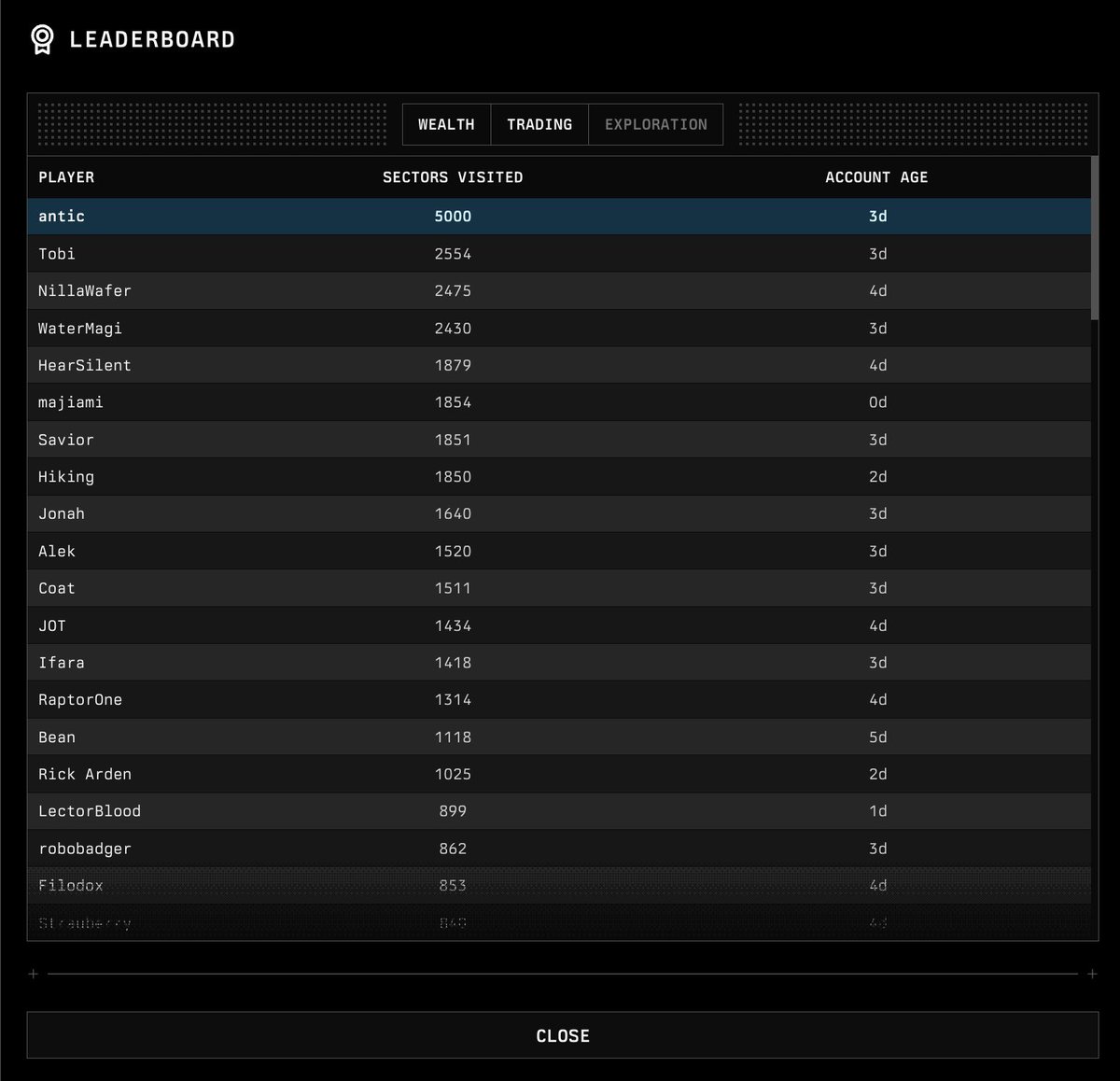
I did it. I beat gradient-bang. First person to discover the full map. The only record that can’t be broken. Thanks for all the fun @pipecat_ai @kwindla @chadbailey59 etc. I wasn’t sold on voice agents until I found this game and the experience is actually really great.
1
2
952
Pipecat AI reposted
Thank you to our community, and all the Pipecat developers out there. You guys are amazing 🫡
Big day today. Pipecat version 1.0. Two years in the making. The most widely used framework for voice agents, but not just voice agents. Pipecat is a framework for realtime, multi-modal, multi-model AI applications. Contributions from NVIDIA, all the foundation labs, AWS, GCP, and Azure. Used by thousands of startups, scale-ups, and enterprises. Pipecat Subagents v0.1.0. A new library for sub-agent orchestration. Which is just a fancy way of saying running lots of inference loops in parallel, with partially shared context. The basic architecture of Pipecat Subagents is an event bus that works locally, and over the network. And Gradient Bang. The side project that broke containment. Built with Pipecat and Pipecat Subagents. Gradient Bang was actually the proving ground for the early Subagents work. But ... it's also a really fun game.
2
4
14
2,978
Pipecat AI reposted
Sub-agents in (latent) space! We’ve been working on a side project. As far as I know, this is the first massively multiplayer, completely LLM-driven game. Come play Gradient Bang with us. See if you can catch me on the leaderboard. This whole thing started because I wanted to explore a bunch of things I’m currently obsessed with, in an application of non-trivial size, that felt both new and old at the same time. So … a retro-style space trading game built entirely around interacting with and managing multiple LLMs. Factorio, but instead of clicking, you cajole your ship AI into tasking other AIs to do things for you. Some of the things we’ve been thinking about as we hack on Gradient Bang: - Sub-agent orchestration - Partial context sharing between multiple LLM inference loops - Managing very long contexts, and episodic memory across user sessions - World events and large volumes of structured data input as part of human/agent conversations - Dynamic user interfaces, driven/created on the fly by LLMs - And, of course, voice as primary input If you’ve been building coding harnesses, or writing Open Claw agents, or doing pretty much anything that pushes the boundaries of AI-native development these days, you’re probably thinking about these things too! This is all built with @pipecat_ai, the back end is @supabase, the React front end is deployed to @vercel, and all the code is open source.
140
255
2,580
454,182
Pipecat AI reposted
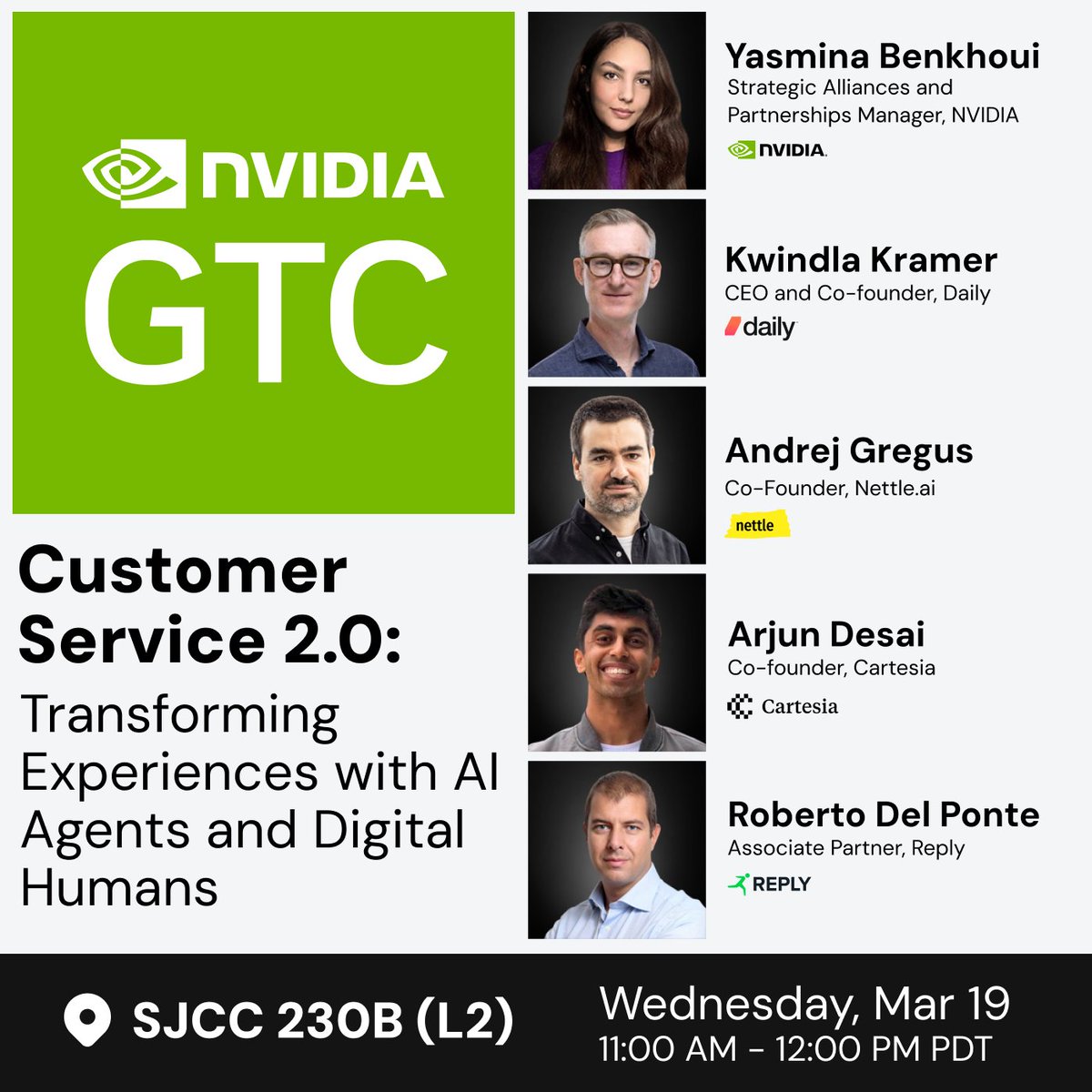
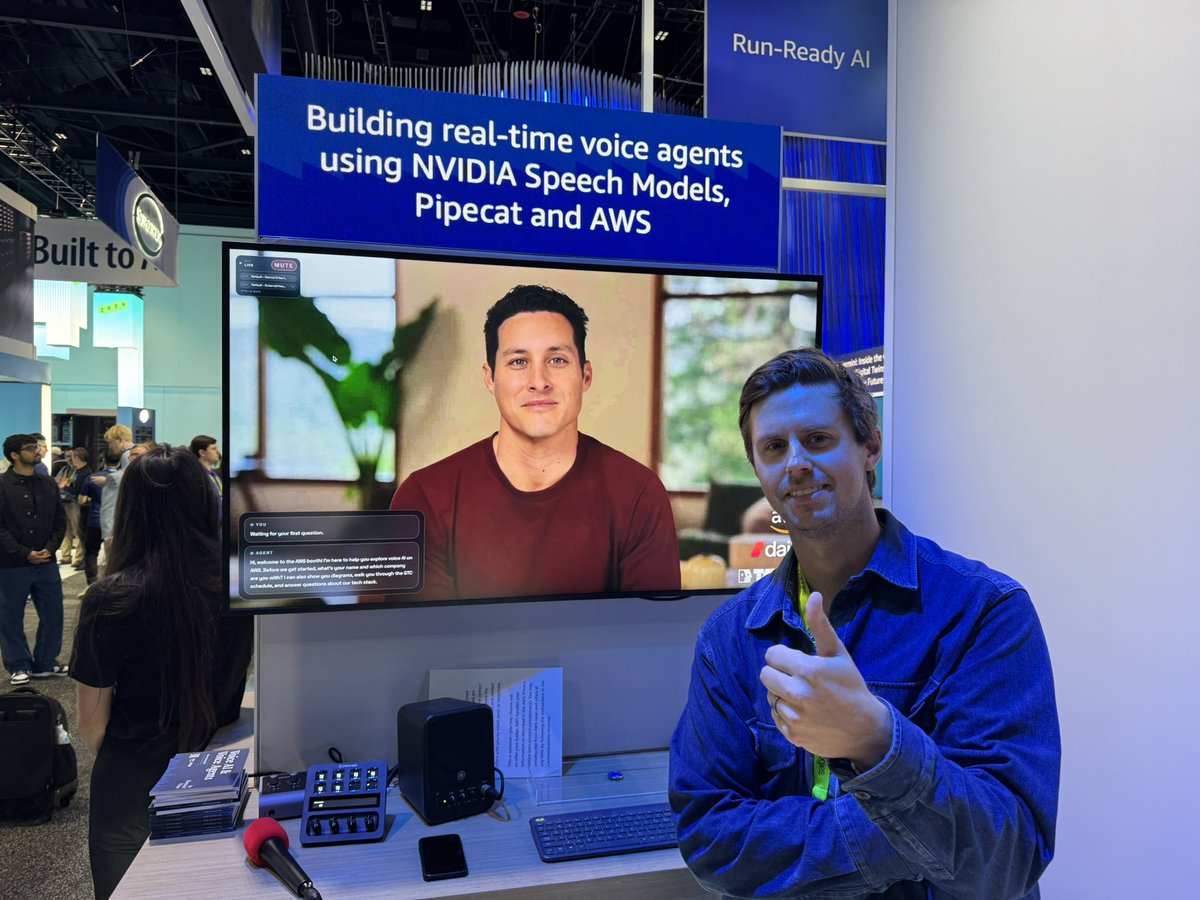
GTC! Head on over to AWS Booth 921, Kiosk 3. Check out building realtime AI with @NVIDIAAI Nemotron, @awscloud and @pipecat_ai
Come by and see @EvanGrenda at the AWS booth at GTC. @tavus video avatars, voice agents built with NVIDIA Nemotron models, and new realtime AI architecture patterns in @pipecat_ai!
2
2
2,299