Filter
Exclude
Time range
-
Near
mergenewsapp
MolSight's graph-aware multimodal AI precisely interprets complex molecular images, boosting R&D in cheminformatics, drug discovery & materials. #multimodalai #visionlanguagemodels #cheminformatics #molecularunderstanding
1
firojalam04
If you’re attending ACL 2026 and are interested in misinformation, multilingual NLP, Islamic QA, online polarization, hate speech detection, or vision-language model evaluation, let’s catch up. Our team has contributed to several papers, demos, and shared tasks this year. Please stop by any of the sessions below, or feel free to reach out if you would like to discuss the work. 1. CritiSense: Critical Digital Literacy and Resilience Against Misinformation Demo, Sunday, July 5, 16:00–17:30 Session: Demo Session C - CritiSense is a multilingual mobile app, currently supporting 9 languages, designed to build prebunking skills through interactive microlearning. The app has 500 active users and an 83.9% satisfaction rate. Paper: aclanthology.org/2026.acl-de… App Store: apps.apple.com/sa/app/critis… Google Play: play.google.com/store/apps/d… Web: critisense-web.digitqr.net/ Follow: linkedin.com/company/critise… 2. From RAG to Agentic RAG for Faithful Islamic Question Answering Findings, Monday, July 6, 09:00–10:30 Session: Poster Session D - We introduce IslamicFaithQA, a 3,810-item bilingual benchmark, and show that agentic RAG with structured tool calls can substantially reduce hallucination in Islamic QA. Paper: aclanthology.org/2026.findin… Data: huggingface.co/datasets/QCRI… 3, POLAR: A Benchmark for Multilingual, Multicultural, and Multi-Event Online Polarization Findings, Monday, July 6, 09:00–10:30 Session: Poster Session D - POLAR includes 110K instances across 22 languages for online polarization detection. Our results show that models perform well on binary detection but still struggle with fine-grained polarization types, highlighting important open challenges. Paper: aclanthology.org/2026.findin… 4. LLM-Based Multi-Task Bangla Hate Speech Detection: Type, Severity, and Target Long Paper, Monday, July 6, 11:00–12:30 Session: Poster Session E - We introduce BanglaMultiHate, the first multi-task Bangla hate speech dataset, covering hate type, severity, and target. We also show that task-specific LLMs are highly competitive for this setting. Paper: aclanthology.org/2026.acl-lo… 5. Fanar-Sadiq: A Multi-Agent Architecture for Grounded Islamic QA Industry Oral, Tuesday, July 7, 09:00–10:30 Session: Oral Session F: Industry 5 - Fanar-Sadiq is a multi-agent system that routes Islamic queries to specialized modules, including Qur’an lookup, fiqh retrieval, and zakat and inheritance calculators. Paper: aclanthology.org/2026.acl-in… Try it: chat.fanar.qa/ API: api.fanar.qa/docs 6. Once Correct, Still Wrong: Counterfactual Hallucination in Multilingual Vision-Language Models Findings, Tuesday, July 7, 11:00–12:30 Session: Poster Session G - VLMs can produce the correct answer while still accepting culturally plausible but visually incorrect interpretations. We introduce M²CQA, covering 17 MENA countries, and propose the CFHR metric to measure this failure mode. Paper: aclanthology.org/2026.findin… Data: huggingface.co/datasets/QCRI… 7. SemEval-2026 Task 9: Detecting Multilingual, Multicultural, and Multi-Event Online Polarization SemEval Workshop Room: Harbor B - This shared task brought together 1,000 participants worldwide, with 10K Codabench submissions and 67 teams making final submissions. Covering 22 languages, it is a valuable benchmark for researchers working on polarization, hate speech, and multilingual classification. Paper: aclanthology.org/2026.semeva… 8. Beyond Logical Forms: LLM-Extracted Patterns for Fallacy Classification ArgMining Workshop Paper: aclanthology.org/2026.argmin… Looking forward to meet anyone interested in these topics at ACL 2026. #ACL2026 #NLP #ComputationalLinguistics #AI #Misinformation #IslamicAI #HateSpeech #MultilingualNLP #VisionLanguageModels
3
144
LimonRip
more money for 10 years github.com/aimriper/wmr---Wo… github.com/aimriper/wmr---Wo… Licence #LocalSmallModels (Optimización de modelos <7B para hardware limitado) #VisionLanguageModels (Modelos abiertos de multimodalidad pura) #ContextCaching (Técnicas para reducir latencia en largas conversaciones) #OnDeviceTraining (Entrenamiento federado en dispositivos del usuario) #WeightsFineTuning (Optimización técnica de pesos para tareas específicas) Infraestructura y Datos #VectorDatabaseMerging (Consolidación de bases vectoriales para RAG masivo) #EdgeComputingAI (Procesamiento de datos en nodos locales sin nube) #DataSynthetics (Generación de datasets artificiales para entrenar modelos) #ModelDistillation (Reducción de modelos grandes a versiones eficientes) #PromptCaching (Estrategias de persistencia de prompts para ahorro de tokens) Ecosistema de Colaboración y Desarrollo #OpenWeightModels (Movimiento por la apertura total de los pesos del modelo) #AgenticWorkflows (Diseño de sistemas que no solo responden, sino que ejecutan tareas) #PrivacyFirstAI (Enfoque en modelos que no requieren conexión a servidores externos) #CollaborativeBenchmarking (Evaluación colectiva de modelos por la comunidad) #HardwareAcceleration (Uso eficiente de GPU/NPU en sistemas abiertos) Predicciones de Tendencia (Lo que viene) #AutonomousCodingSystems (Sistemas que autogestionan el ciclo de vida del software) #MultiAgentOrchestration (Jerarquías de agentes colaborando en una misma tarea) #NeuralSymbolicAI (Integración de lógica simbólica con redes neuronales) #SelfHealingInfrastructure (Infraestructura de IA que repara errores de código automáticamente) #RealTimeVoiceAgents (Agentes conversacionales de latencia cero en tiempo real) #SemanticSearchScaling (Búsqueda semántica a escala global sobre repositorios abiertos) #EthicalAIAudit (Auditoría automática de sesgos en modelos de código abierto) #QuantumHybridAI (Primeros experimentos de IA sobre circuitos cuánticos accesibles) #PersonalizedAIClouds (Instancias privadas de IA para individuos y familias) #FederatedLearning (Aprendizaje colaborativo sin compartir datos privados) #AutomatedModelQuantization (Cuantización automática de modelos al vuelo) #DynamicSystemPrompts (Prompts que mutan según el contexto del usuario) #CrossPlatformAIAgents (Agentes que saltan entre sistemas operativos sin fricción) #ImmutableModelLogs (Blockchain aplicado a la trazabilidad de pesos de modelos) #SustainableAI (Modelos optimizados para el menor consumo energético posible)
11
DuckietownAI
What happens when robots can understand more than pixels? 👀🤖 Check out how learners are exploring Vision-Language Models (VLMs) in Duckietown: hubs.la/Q04n27sz0 #Robotics #AutonomousSystems #VisionLanguageModels #EmbodiedAI
3
5
179
Algorithms_MDPI
#DailyShare Welcome to read and share the newly published paper "Adapting Vision–Language Models for Few-Shot Industrial Defect Detection". This excellent paper is written by Chayanon Sub-r-pa and Rung-Ching Chen. 🔗 Read it here: brnw.ch/21x3IGa #visionlanguagemodels
28
BDCC_MDPI
📚 Call for Reading How can #VisionLanguageModels learn more effectively from #MultimodalData? 📘 Improving Entity Understanding for Vision-Language Pre-Training via Active Learning 🔗 brnw.ch/21x3xGX #CallForReading #MachineLearning #ComputerVision #DataScience #BDCC
5
540
vlmrun
We're headed to @Databricks Data AI Summit 2026 in San Francisco! Excited to connect with builders, researchers, and teams pushing the boundaries of agentic intelligence. If you're building frontier agents with multi-modal, unstructured data, check out @vlmrun's new visual agent Orion 2 that we launched last week. If you're around Moscone Center June 15–18, drop a comment below and let's grab a coffee! #DataAISummit #DAIS2026 #Databricks #AI #VisionLanguageModels #SanFrancisco
1
1
7
175
ChenSiyich
Wonderful to be back from #CVPR2026, and excited to share the release of our follow-up work: VoLo: A Physical Orchestrator for Open-Vocabulary Long-Horizon Manipulation VoLo introduces the idea of a physical orchestrator for open-vocabulary, long-horizon manipulation. Our goal is to move toward robots that can reason, plan, act, monitor, and recover by adaptively using VLA/WAMs, vision models, and action primitives as tools. We introduce three main contributions: 🤖 VoLoAgent — a physical orchestrator that plans, monitors, and recovers by adaptively using, halting, and redirecting robot actions with tools. 📊 RoboVoLo — a high-fidelity benchmark with 126 open-vocabulary long-horizon manipulation tasks spanning common sense, memory/state tracking, complex references, and world knowledge. 📈 A large-scale empirical study comparing action models, code-as-policy systems, TAMP-style systems, and ablations of the VoLoAgent orchestrator, complemented by real-robot experiments. This work was done during my internship at @NVIDIA and would not have been possible without my brilliant collaborators: Hugo Hadfield, Alexander Zook, @mikacuy, @luke_ch_song, @erwincoumans, @xuningy, Faisal Ladhak, @qu_1006, @BirchfieldStan, Jonathan Tremblay, and @robovalts. Huge thanks to everyone! 🔗 Project: chicychen.github.io/VoLo/ 🔗 Previous work, SpaceTools: spacetools.github.io/ #Robotics #EmbodiedAI #VisionLanguageModels #VLAModels #RobotLearning #NVIDIA #CVPR2026 #LongHorizonManipulation #AI #ComputerVision
3
16
75
8,998
haoyue_bai
What information is actually hidden inside a multimodal embedding? In this new work, we find that frozen vision-language models already encode rich attribute-specific signals for objects, backgrounds, and styles, even though their standard embeddings appear highly entangled. We introduce QARE (Queryable Attribute Representation Extraction), a simple text-guided framework that extracts attribute-specific representations from frozen VLMs without fine-tuning. Along the way, we build QARE-Bench, a challenging benchmark with both controlled synthetic data and a new real-world dataset featuring diverse scenes, non-rigid objects, and hard negatives designed to stress-test attribute disentanglement. Key finding: 👉 The problem may not be that VLMs lack disentangled representations. 👉 The problem may be that we haven't learned how to query them. 📄 Paper: openaccess.thecvf.com/conten… 💻 Code: github.com/yibingwei-1/QARE #ComputerVision #MultimodalAI #VisionLanguageModels #RepresentationLearning #ImageRetrieval
6
19
2,785
furongh
Excited to be at #CVPR 2026 in Denver this week for events around trustworthy AI, embodied reasoning, watermarking, and world models. I will only be around on Thursday, June 4, so please come say hi tomorrow! On June 4, I will be speaking at several CVPR workshops and tutorials: 1⃣ CVPR 2026 Workshop on Trustworthy AI / TRUE-V 🔗 trustworthy-ai-workshop.gith… 📍 9:10–9:40 AM | Room 705/707 Talk Title: A Few Early Steps Away: Building Self-Correcting Vision-Language Systems I will discuss how we can move beyond static vision-language models toward systems that can recognize, reason about, and correct their own failures. 2⃣ The first CVPR Workshop on Embodied Reasoning in Action (ERA) 🔗 embodied-reasoning.github.io… 📍11:45 AM–12:20 PM | Room 605 Talk Title: From Perception to Action: From Latent World Models to State-Aware Scene Graphs for Physical Intelligence This talk will focus on representations and learning systems that connect perception, reasoning, and action for physical intelligence. Later in the day, I will also be part of the CVPR tutorial: 3⃣Foundations and Frontiers of Watermarking 🔗 vishal3477.github.io/waterma… 📍3:30–4:10 PM | Room: Mile High 2B Session Title: Benchmarking & Robustness Evaluation I will cover how to evaluate watermarking systems under distortions, regeneration, and adaptive attacks—an increasingly important direction for trustworthy generative AI. Our team will also present TraceGen at the CVPR main conference. I will not be there on June 6, but my students will be presenting the work — please stop by and talk with them! 4⃣TraceGen: World Modeling in 3D Trace Space Enables Learning from Cross-Embodiment Videos Project 🔗: tracegen.github.io/ YouTube 📽️: youtu.be/JCXnK2tHE_I Poster 📍: Saturday, June 6, 2026 | 11:45 AM–1:45 PM MDT | ExHall F 605 TraceGen introduces a world-modeling framework that predicts future motion in a compact 3D trace space, rather than directly in pixel space. This abstraction preserves the geometry needed for manipulation while reducing dependence on embodiment-specific appearance, enabling learning from heterogeneous human and robot videos and improving transfer to real-world robotic tasks. Fresh out of oven new research: We have also pushed this direction to the next level. Stay tuned for our upcoming release of μ₀, a symbolic world model pretrained only from video data that reaches π₀.₅-level performance. 🔥 Looking forward to seeing friends, collaborators, and new colleagues tomorrow at CVPR! #CVPR2026 #TrustworthyAI #EmbodiedAI #VisionLanguageModels #Robotics #WorldModels #Watermarking #GenerativeAI #PhysicalIntelligence
1
9
40
2,746
BiologyAIDaily
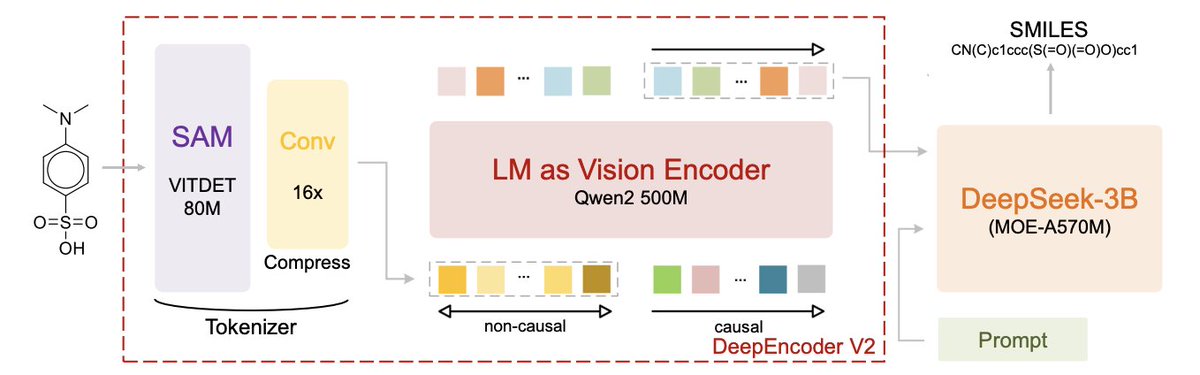
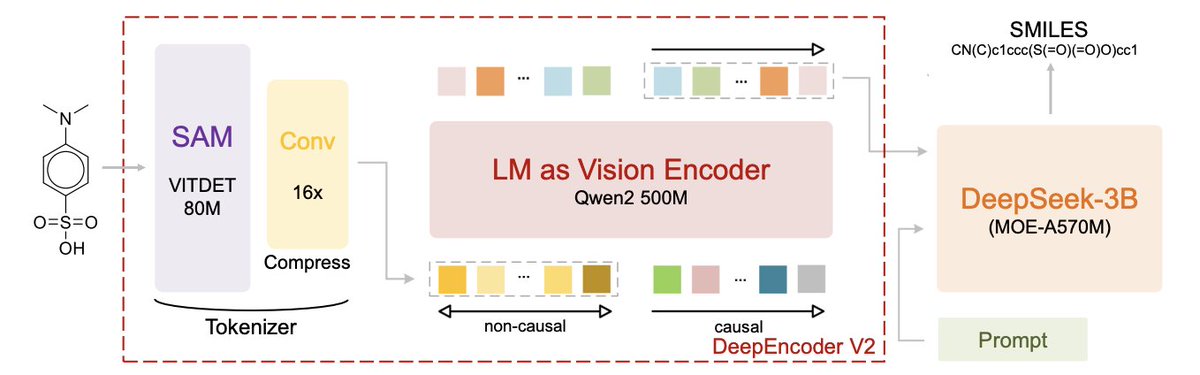
Fine-tuning DeepSeek-OCR-2 for Molecular Structure Recognition 1 MolSeek-OCR shows that a document OCR foundation model can be transferred to molecular structure recognition, if the fine-tuning is done progressively: direct full-parameter supervised fine-tuning was unstable and failed, but a staged recipe produced a competitive image-to-SMILES system. 2 The paper reframes OCSR as image-conditioned SMILES generation with a fixed instruction prompt, training the model to autoregressively output only the SMILES tokens (no loss on prompt/image placeholder tokens), aligning the objective with strict “exact match” evaluation. 3 Core technical contribution: a two-stage progressive supervised fine-tuning strategy that starts with parameter-efficient LoRA to adapt both (a) the text generation pathway and (b) the visual-language projection/alignment layers, then transitions to selective full-parameter tuning. 4 In stage 2, the model is not tuned uniformly: it freezes the lowest-level visual tokenizer (and token embedding layer), while continuing to optimize higher-level modules (LM-as-vision-encoder, compression/projection interface, and the autoregressive decoder). It also uses split learning rates (smaller for the visual branch, larger for the language branch) to stabilize cross-modal transfer. 5 Data strategy: training mixes large-scale synthetic renderings from PubChem with realistic patent images from USPTO-MOL to cover both style diversity (rendering engines, bond/annotation variations) and real-world artifacts (scan noise, line thickness, patent conventions). LoRA stage uses a smaller mixed budget; full stage scales to ~800k total samples. 6 Evaluation spans synthetic (Indigo, ChemDraw), realistic (USPTO, CLEF, Staker, UOB, ACS), and perturbed versions of several realistic sets, reflecting the practical requirement that OCSR models handle both clean depictions and degraded/heterogeneous document images. 7 Results: zero-shot DeepSeek-OCR-2 essentially fails on exact SMILES matching, while MolSeek-OCR improves substantially and is broadly comparable to DECIMER among image-to-sequence baselines across multiple datasets; however, it still trails state-of-the-art image-to-graph methods such as MolScribe, highlighting the ongoing advantage of explicit atom/bond layout modeling. 8 Negative (but informative) finding: reinforcement-style post-training (GSPO) and data-curation-based refinement (ReFT) did not improve exact-match SMILES accuracy. The optimization sometimes improved graph-level equivalence while degrading strict sequence fidelity, suggesting that common reward designs struggle to preserve the exact serialized SMILES form required by this benchmark. 9 Practical takeaway: for VLM-based molecular OCR, stability hinges on (a) progressive adaptation (LoRA then selective full tuning), (b) freezing low-level vision components, and (c) carefully balancing learning rates across visual vs language branches; and even then, exact SMILES matching remains a harder target than graph-equivalent correctness. 💻Code: github.com/HaCTang/MolSeek-O… 📜Paper: arxiv.org/abs/2604.03476 #OCSR #Chemoinformatics #MolecularOCR #VisionLanguageModels #DeepLearning #SMILES #Patents #PubChem #FineTuning #LoRA
4
21
1,956
BiologyAIDaily
Fine-tuning DeepSeek-OCR-2 for Molecular Structure Recognition 1 MolSeek-OCR shows that a document OCR foundation model can be transferred to molecular structure recognition, if the fine-tuning is done progressively: direct full-parameter supervised fine-tuning was unstable and failed, but a staged recipe produced a competitive image-to-SMILES system. 2 The paper reframes OCSR as image-conditioned SMILES generation with a fixed instruction prompt, training the model to autoregressively output only the SMILES tokens (no loss on prompt/image placeholder tokens), aligning the objective with strict “exact match” evaluation. 3 Core technical contribution: a two-stage progressive supervised fine-tuning strategy that starts with parameter-efficient LoRA to adapt both (a) the text generation pathway and (b) the visual-language projection/alignment layers, then transitions to selective full-parameter tuning. 4 In stage 2, the model is not tuned uniformly: it freezes the lowest-level visual tokenizer (and token embedding layer), while continuing to optimize higher-level modules (LM-as-vision-encoder, compression/projection interface, and the autoregressive decoder). It also uses split learning rates (smaller for the visual branch, larger for the language branch) to stabilize cross-modal transfer. 5 Data strategy: training mixes large-scale synthetic renderings from PubChem with realistic patent images from USPTO-MOL to cover both style diversity (rendering engines, bond/annotation variations) and real-world artifacts (scan noise, line thickness, patent conventions). LoRA stage uses a smaller mixed budget; full stage scales to ~800k total samples. 6 Evaluation spans synthetic (Indigo, ChemDraw), realistic (USPTO, CLEF, Staker, UOB, ACS), and perturbed versions of several realistic sets, reflecting the practical requirement that OCSR models handle both clean depictions and degraded/heterogeneous document images. 7 Results: zero-shot DeepSeek-OCR-2 essentially fails on exact SMILES matching, while MolSeek-OCR improves substantially and is broadly comparable to DECIMER among image-to-sequence baselines across multiple datasets; however, it still trails state-of-the-art image-to-graph methods such as MolScribe, highlighting the ongoing advantage of explicit atom/bond layout modeling. 8 Negative (but informative) finding: reinforcement-style post-training (GSPO) and data-curation-based refinement (ReFT) did not improve exact-match SMILES accuracy. The optimization sometimes improved graph-level equivalence while degrading strict sequence fidelity, suggesting that common reward designs struggle to preserve the exact serialized SMILES form required by this benchmark. 9 Practical takeaway: for VLM-based molecular OCR, stability hinges on (a) progressive adaptation (LoRA then selective full tuning), (b) freezing low-level vision components, and (c) carefully balancing learning rates across visual vs language branches; and even then, exact SMILES matching remains a harder target than graph-equivalent correctness. 💻Code: github.com/HaCTang/MolSeek-O… 📜Paper: arxiv.org/abs/2604.03476 #OCSR #Chemoinformatics #MolecularOCR #VisionLanguageModels #DeepLearning #SMILES #Patents #PubChem #FineTuning #LoRA
1
5
644
OpenlifesciAI
🚨 Medical AI Research Alert! 🚨 How can AI synthesize raw data from ECGs, echocardiograms, and MRIs simultaneously to mimic a cardiologist's diagnostic reasoning? @Stanford presents 𝗠𝗔𝗥𝗖𝗨𝗦: 𝗔𝗻 𝗮𝗴𝗲𝗻𝘁𝗶𝗰 𝘃𝗶𝘀𝗶𝗼𝗻-𝗹𝗮𝗻𝗴𝘂𝗮𝗴𝗲 𝘀𝘆𝘀𝘁𝗲𝗺 𝗳𝗼𝗿 𝗲𝗻𝗱-𝘁𝗼-𝗲𝗻𝗱 𝗺𝘂𝗹𝘁𝗶𝗺𝗼𝗱𝗮𝗹 𝗰𝗮𝗿𝗱𝗶𝗮𝗰 𝗱𝗶𝗮𝗴𝗻𝗼𝘀𝗶𝘀. By @DrJackOSullivan, Mohammad Asadi, Lennart Elbe, @Dr_ASChaudhari, Tahoura Nedaee, Francois Haddad, @salernomdphd, @drfeifei, @eadeli, Rima Arnaout, @euanashley Now you can watch and listen to the latest Medical AI papers daily on our YouTube and Spotify channels! YouTube: youtube.com/@OpenlifesciAI YouTube Deep Dive: youtu.be/e6CFpVZK6Q8 YouTube Shorts: youtube.com/shorts/C5CZWnYKa… Spotify: open.spotify.com/show/4edRuS… Here's why it's exciting: 👇🧵 1/9 #MedicalAI #Healthcare #Cardiology #VisionLanguageModels [1/9]
1
2
6
238
WolfStammer
Wondering how to combine the perceptual abilities of VLMs with structured program synthesis? --> We will be presenting our Vision-Language Programs at #CVPR2026 :) #NeuroSymbolic #VisionLanguageModels
Excited to share that our paper "Synthesizing Visual Concepts as Vision-Language Programs" has been accepted to #CVPR2026! 🎉 We propose a novel method that combines VLMs with symbolic program synthesis to learn reliable programs of visual concepts. 🌐 ml-research.github.io/vision…
1
2
15
1,820
JohnSnowLabs
If document automation, multimodal AI, or clinical decision support are on your roadmap, this session will provide measurable performance insights. Register now: hubs.li/Q0452MZM0 #HealthcareAI #MedicalImaging #VisionLanguageModels #ClinicalAI #GenerativeAI #HealthIT
2
5
424
AnasZaf79138457
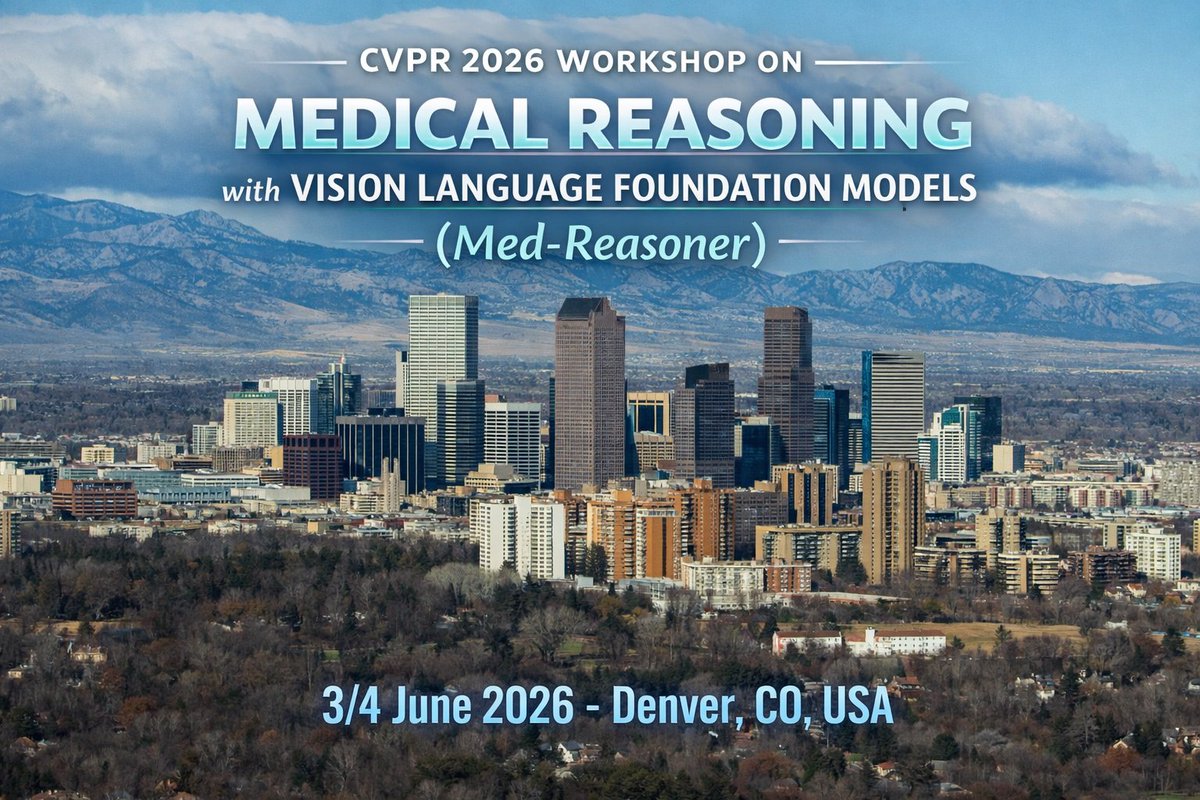
⏳ 1 week left to submit to the Med-Reasoner Workshop @CVPR! 📋 Submit your work on medical reasoning, VLMs & clinical AI 🔗 Submission: lnkd.in/d4We2qTt 🌐 Website: lnkd.in/dQM-ayY5 Deadline: March 1, 2026 #MedicalAI #VisionLanguageModels #HealthcareAI #MedReasoner
📢 Call for Papers - @CVPR 2026 Workshop (Med-Reasoner) Submission deadline: March 1, 2026 (AoE) Workshop on Medical Reasoning with Vision Language Foundation Models 🔗 Submission: lnkd.in/d4We2qTt 🔗 Website: lnkd.in/dQM-ayY5
1
3
2,840
turkalpmd
We tested 9 commercial AI models on brain MRIs. Not just for accuracy, but to see if they could be tricked by fake reports hidden inside the images. Spoiler: they could. All of them. ⚠️ Visible fake reports dropped specificity to zero across every model. The stealth version, text invisible to the human eye, still fooled more than half. OCR capability = attack surface. If a model can read text in an image, it can be manipulated by it. 27K inference calls. 600 MRIs. 9 models. 5 conditions. @Hacettepe1967 @MIT @harvardmed @cwru 🤝 Paper in the replies 👇 #AIinHealthcare #RadiologyAI #AdversarialAI #VisionLanguageModels #PatientSafety #MedicalAI #PromptInjection #PedsICU
1
3
271
DataScienceDojo
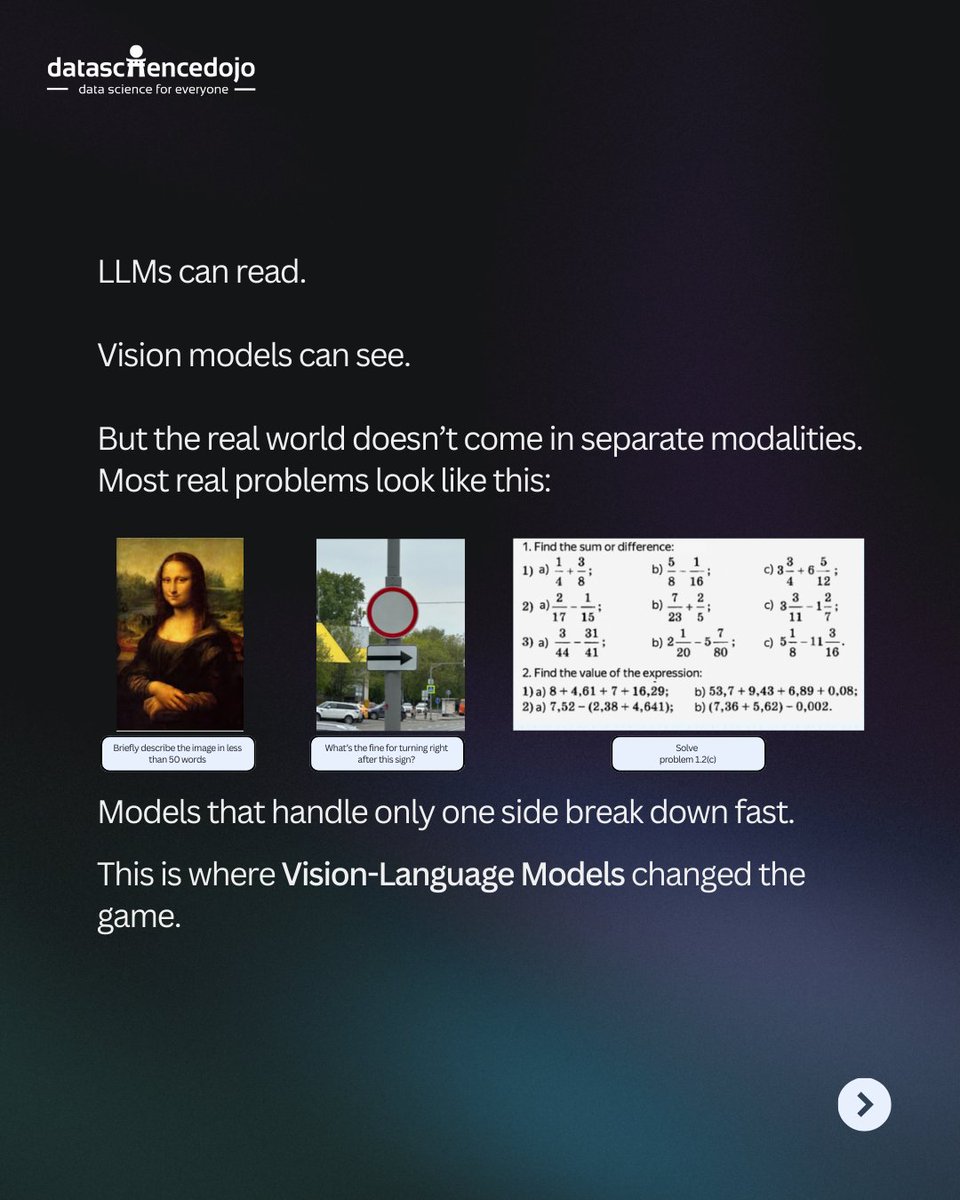
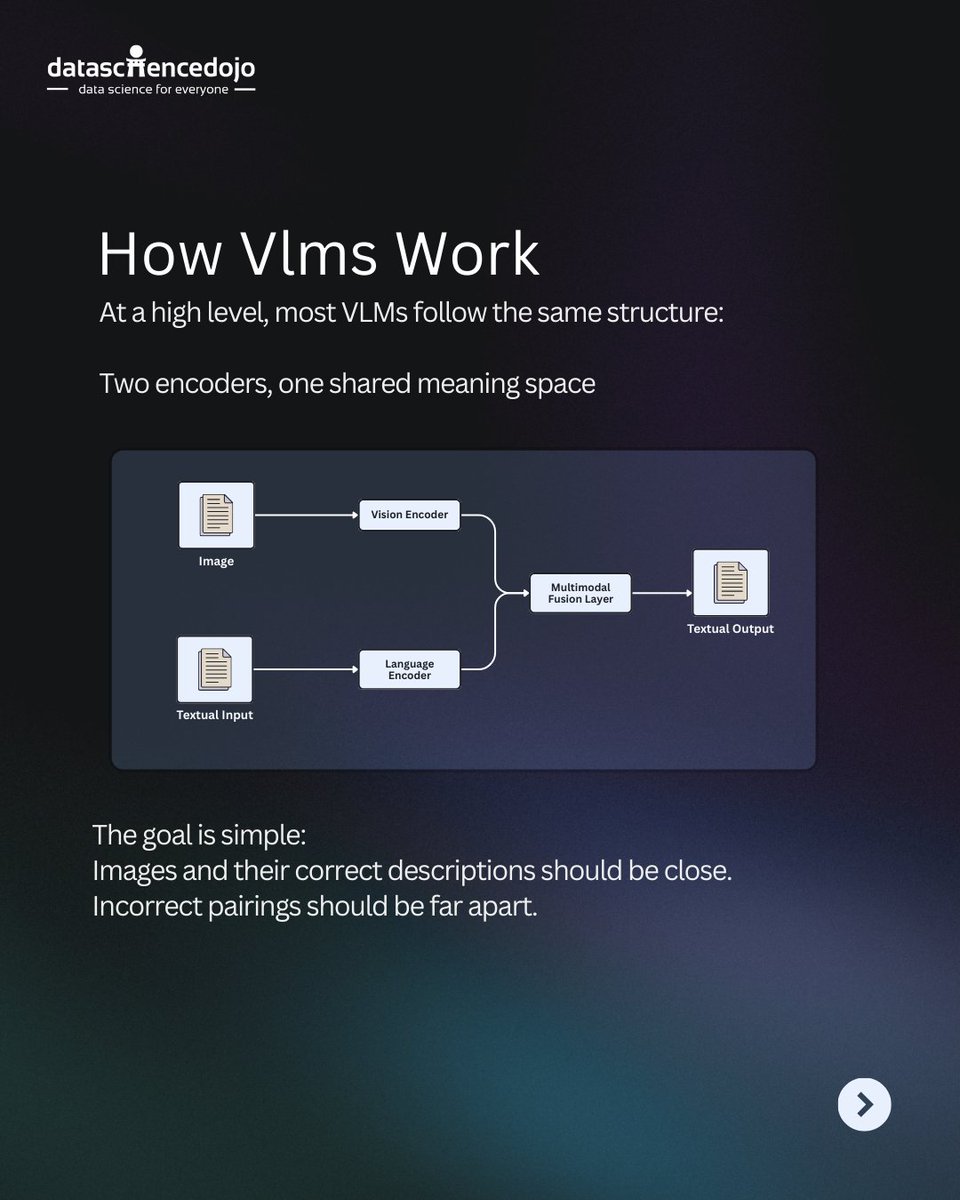
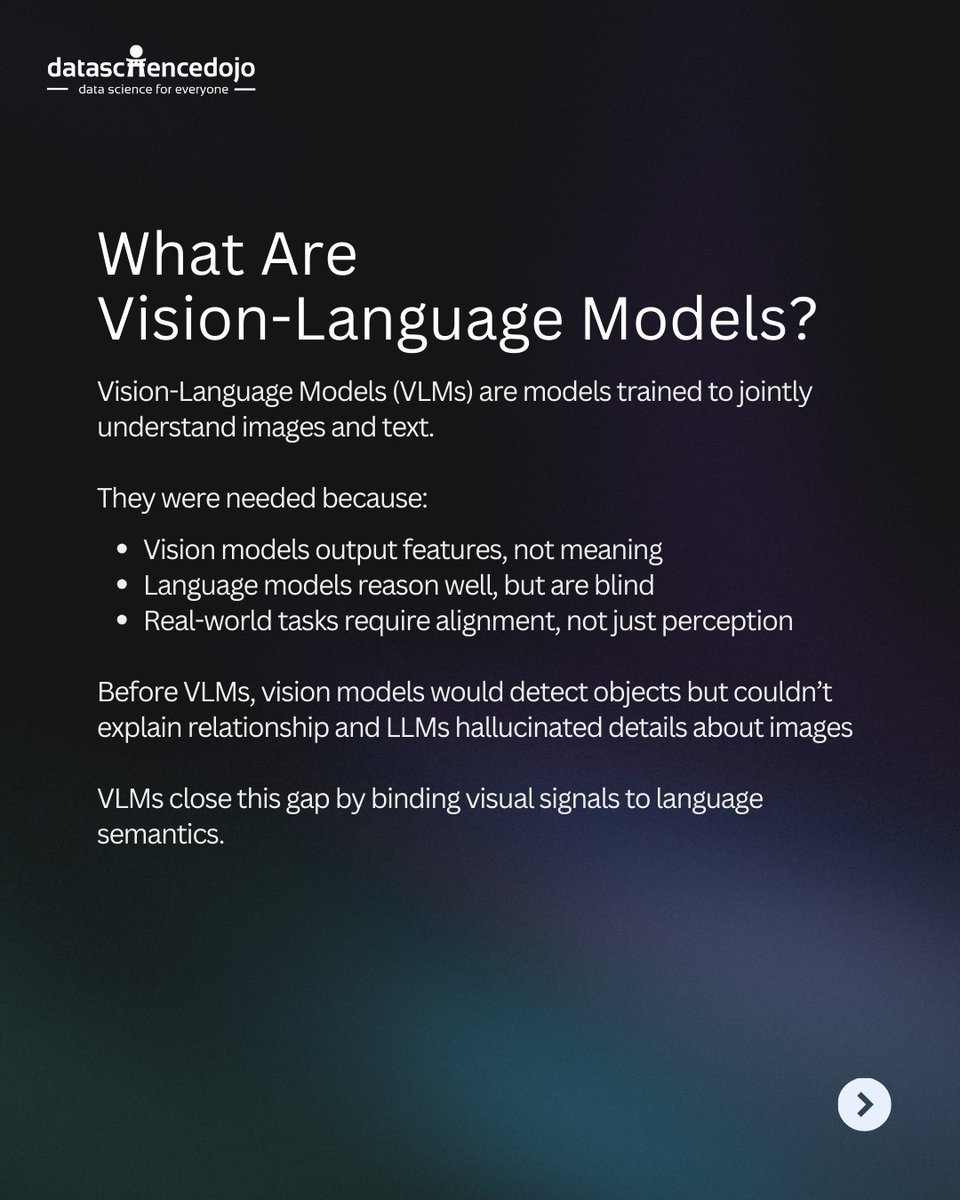
LLMs can reason. Vision models can see. But most real problems don’t come in one modality. That gap is exactly why Vision-Language Models (VLMs matter). This carousel breaks down how VLMs actually work under the hood and why they’ve become foundational for modern AI systems. What’s really changing with VLMs: - Beyond text-only reasoning LLMs operate over symbols. VLMs ground those symbols in pixels, spatial structure, and visual evidence. - Not just “LLMs with images” The core shift is alignment fusion: vision and language aren’t parallel streams, they interact. - Architecture matters Vision encoders extract structured visual tokens Language encoders express intent and queries Multimodal fusion layers are where reasoning actually happens Why this matters if you work with LLMs today: - Multimodal inputs are becoming the default, not the edge case - Agents increasingly need to see, not just read - Grounding reduces hallucinations and unlocks real-world decision making If you’re thinking about agents, tool use, or real-world AI systems, understanding VLMs isn’t optional anymore. In our Agentic AI Bootcamp, we spend time breaking down how modern AI systems are designed, evaluated, and connected in practice. If you’d like to explore this further, you can find more details in the replies. Link will be in the replies. #VisionLanguageModels #AgenticAI #LLMs #MultimodalAI
1
1
4
605
zhou_honglu
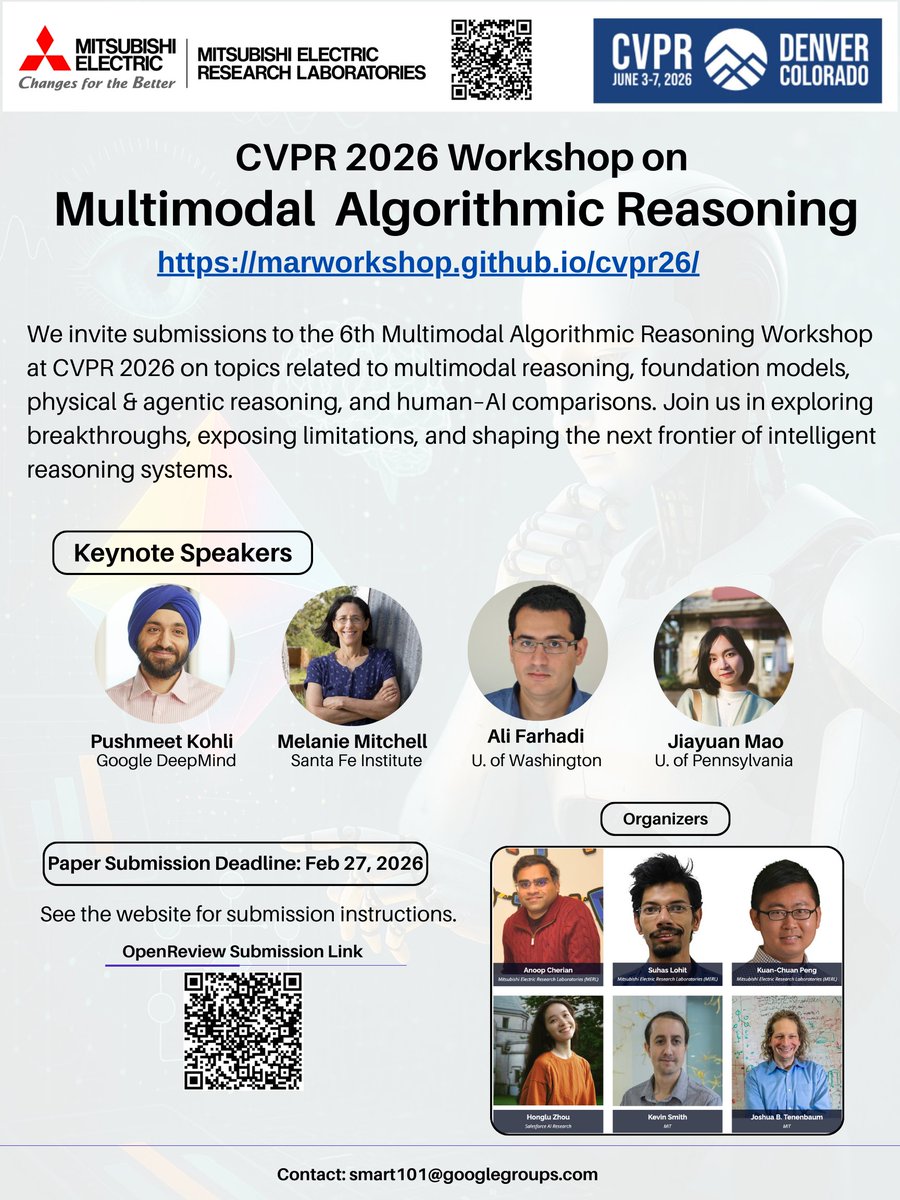
Busy season, huh? #ICLR decisions are out and #CVPR rebuttals are flying... but don’t miss this! 😅 📣 𝗖𝗮𝗹𝗹 𝗳𝗼𝗿 𝗖𝗼𝗻𝘁𝗿𝗶𝗯𝘂𝘁𝗶𝗼𝗻𝘀: We're organizing a new edition of the 𝗠𝘂𝗹𝘁𝗶𝗺𝗼𝗱𝗮𝗹 𝗔𝗹𝗴𝗼𝗿𝗶𝘁𝗵𝗺𝗶𝗰 𝗥𝗲𝗮𝘀𝗼𝗻𝗶𝗻𝗴 Workshop @ #CVPR2026 (Denver)! ✅ 𝗧𝗵𝗲 𝘀𝘂𝗯𝗺𝗶𝘀𝘀𝗶𝗼𝗻 𝗽𝗼𝗿𝘁𝗮𝗹 𝗶𝘀 𝗻𝗼𝘄 𝗼𝗽𝗲𝗻, and we welcome both new and previously published work. 📌 𝗦𝘂𝗯𝗺𝗶𝘀𝘀𝗶𝗼𝗻 𝗴𝘂𝗶𝗱𝗲𝗹𝗶𝗻𝗲𝘀 (details on the workshop website): We accept three types of submissions:   • Original papers (≤ 8 pages, in proceedings)   • Short papers (≤ 4 pages, workshop website only)   • Previously published papers (≤ 8 pages, workshop website only) 🗓️ 𝗞𝗲𝘆 𝗱𝗮𝘁𝗲𝘀: 𝗦𝘂𝗯𝗺𝗶𝘀𝘀𝗶𝗼𝗻 𝗱𝗲𝗮𝗱𝗹𝗶𝗻𝗲: 𝗙𝗲𝗯 𝟮𝟳, 𝟮𝟬𝟮𝟲 Notification: Mar 20, 2026 Camera-ready: Apr 10, 2026 🌐 𝗪𝗲𝗯𝘀𝗶𝘁𝗲: marworkshop.github.io/cvpr26… 🔍 𝗪𝗼𝗿𝗸𝘀𝗵𝗼𝗽 𝗳𝗼𝗰𝘂𝘀: This workshop focuses on multimodal algorithmic reasoning, where 𝗮𝗻 𝗮𝗴𝗲𝗻𝘁 𝗺𝘂𝘀𝘁 𝗮𝘀𝘀𝗶𝗺𝗶𝗹𝗮𝘁𝗲 𝗶𝗻𝗳𝗼𝗿𝗺𝗮𝘁𝗶𝗼𝗻 𝗳𝗿𝗼𝗺 𝗺𝘂𝗹𝘁𝗶𝗽𝗹𝗲 𝗺𝗼𝗱𝗮𝗹𝗶𝘁𝗶𝗲𝘀 𝗳𝗼𝗿 𝗰𝗼𝗺𝗽𝗹𝗲𝘅 𝗽𝗿𝗼𝗯𝗹𝗲𝗺 𝘀𝗼𝗹𝘃𝗶𝗻𝗴. Real-world examples of such problems include: (i) chain-of-thought reasoning across modalities, (ii) vision-and-language problem solving, (iii) agentic reasoning and tool use, and (iv) reasoning under physical constraints, among others. 𝗧𝗵𝗲 𝘁𝗼𝗽𝗶𝗰𝘀 𝗳𝗼𝗿 𝗠𝗔𝗥-𝗖𝗩𝗣𝗥 𝟮𝟬𝟮𝟲 𝗶𝗻𝗰𝗹𝘂𝗱𝗲, 𝗯𝘂𝘁 𝗮𝗿𝗲 𝗻𝗼𝘁 𝗹𝗶𝗺𝗶𝘁𝗲𝗱 𝘁𝗼: 🔹 Multimodal structured and multi-step reasoning across vision, language, audio, and other modalities, including compositional and programmatic inference. 🔹 Multimodal foundation models and world models for reasoning, planning, and decision-making, and their connections to general intelligence. 🔹 Reasoning under physical, geometric, and causal constraints, including embodied agents, simulators, and digital twins. 🔹 Multi-agent reasoning and collaboration, including debate, coordination, mixture-of-experts, and reward- or critique-based aggregation. 🔹 Extreme generalization and concept learning, including few-shot, zero-shot, and out-of-distribution multimodal reasoning. 🔹 Scaling laws, efficiency, and test-time reasoning, including inference-time optimization, self-refinement, and tool-augmented reasoning. 🔹 Benchmarks, datasets, diagnostics, and evaluation, including synthetic data, interpretability, and systematic analysis of shortcomings and failure modes in multimodal AI models. 🔹 Theoretical and cognitive perspectives on multimodal reasoning, including limits of current models and insights from human cognition. 🔹 Human–AI reasoning comparisons and foundations, including perspectives from psychology, neuroscience, and child development; theoretical limits of reasoning in large models; and position papers on how current multimodal AI reasoning differs from human cognition. #MultimodalReasoning #Reasoning #AlgorithmicReasoning #Multimodal #AI #VisionLanguage #VisionLanguageModels #VLM #Agents #ToolUse #LLM #FoundationModels #Research #MachineLearning #DeepLearning #CallForPapers
1
6
719