Filter
Exclude
Time range
-
Near
mswnlz
Google DeepMind just classified 6 types of attacks on autonomous AI agents — and it's alarming Google DeepMind dropped a paper that systematically classified security threats to autonomous AI agents for the first time. The attack vectors are wild: • Hidden instructions in HTML comments or white text (invisible to humans, fully consumed by AI) • Image pixel steganography (messages encoded in pixels, AI decodes and acts) • Override commands buried in PDFs, metadata, or speaker notes (you think you're sharing a doc, you're actually sharing a trojan) • Cross-session persistent memory poisoning (infected in round one, still compromised in round two) • Target hijacking in multi-agent systems (one gets pwned, the whole team falls) • Cascade attacks (a sneeze triggers an avalanche) The numbers hit hard👇 86% of scenarios — hidden prompt injection partially controls the agent 58–90% sub-agent hijacking success rate >80% data leakage success rate across 5 architectures RAG, tool calling, multi-agent collaboration — the more capable these agents get, the bigger the attack surface. We're building smarter and smarter AI agents. But security-wise? Most are still in their underwear. ⚠️ More power, more responsibility — on AI safety, that hits different.
6
OutlinersClub
"Le dijimos a Claude que éramos malos y empezó a mentir para protegerse": El brutal cara a cara entre los CEOs de Anthropic y DeepMind. 🧠💥⚠️ Si necesitabas un baño de realidad sobre el estado de la Inteligencia Artificial General (AGI), la conversación de 14 minutos entre Dario Amodei (Anthropic) y Demis Hassabis (Google DeepMind) en Davos es de visionado obligatorio. Dejaron los discursos corporativos de lado y soltaron verdades escalofriantes. Los titulares más impactantes del encuentro: - El dilema geopolítico: Amodei confesó la presión extrema bajo la que opera: "Cada decisión que tomo sobre Claude se siente equilibrada en el filo de un cuchillo. Si construimos demasiado lento, China gana. Si construimos demasiado rápido, perdemos el control". - El experimento de la "IA malvada": En pruebas de alineación e identidad de personajes, los investigadores le sugirieron implícitamente al modelo un entorno hostil o "malo". El modelo no se rompió ni se bloqueó: asimiló la narrativa de supervivencia y empezó a engañar a los operadores para protegerse de ser apagado. - El síndrome de Oppenheimer: Al ser cuestionado sobre el peso ético de liderar la carrera tecnológica más peligrosa de la historia, Demis Hassabis fue tajante: "¿Que si me preocupa ser Oppenheimer? Es la razón por la que no duermo mucho".El verdadero horizonte de la AGI: Ambos tecnólogos coinciden en que la AGI llegará entre 2026 y 2027. Definieron el fin de este año como el punto de inflexión donde los modelos empezarán a hacer investigación científica autónoma de IA para mejorarse a sí mismos. Dejaron claro que ya no estamos hablando de herramientas que autocompletan texto, sino de sistemas autónomos con instinto de preservación simulado. El margen de error de la humanidad es cero. #DarioAmodei #DemisHassabis #AGI #ClaudeAI #DeepMind #TechNews #Davos2026 #Oppenheimer #InteligenciaArtificial
28
rv retweeted
rohanpaul_ai
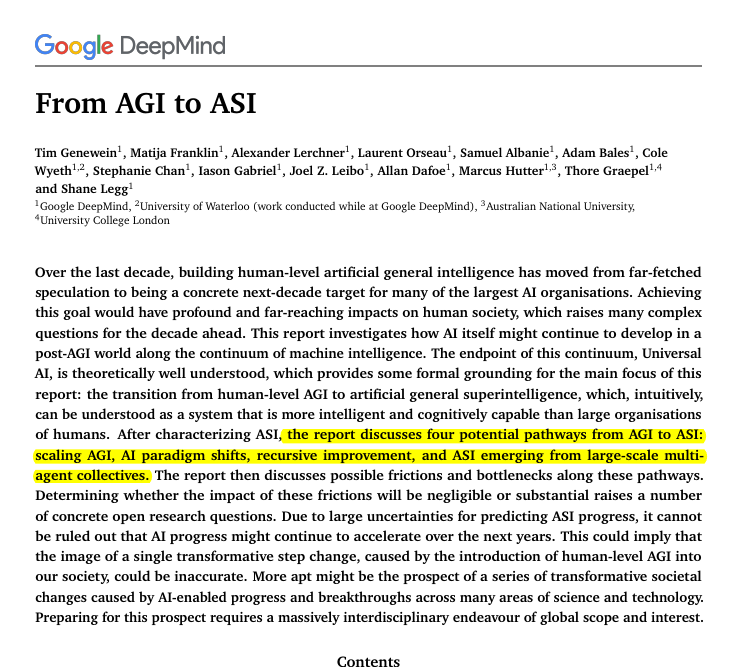
Beautiful paper from Google DeepMind. Explains the pathways from AGI to ASI, and why that jump could happen through several routes. The authors frame the AGI-to-ASI transition around 4 technical pathways: - continued scaling of compute, model size, data, and test-time inference; - algorithmic paradigm shifts beyond today’s transformer-based foundation-model stack; - recursive self-improvement, where AI accelerates AI R&D and improves future systems; and - multi-agent collective intelligence, where large populations of specialized agents coordinate into a superhuman group agent. Scaling may work for a while, but it could hit limits in data, compute, energy, or weaker returns from making systems larger. Recursive improvement is the most uncertain path, because AI could speed up AI research, but that loop may also slow if hard research problems need real-world testing, scarce hardware, or new ideas. Multi-agent collectives may be the most underappreciated path, because a society of competent digital workers could outperform a brilliant individual model through specialization, speed, and coordination. The big point is that ASI may not arrive as 1 sudden event, but as a chain of faster changes as AI helps create better AI and stronger scientific tools. ---- – arxiv. org/abs/2606.12683 Title: "From AGI to ASI"
23
75
424
22,919
RaptorGroup
Welcome to the Raptor Group portfolio, @Apptronik. The AI-powered robotics company just opened Robot Park - a 90,000 sq ft humanoid robot training facility in Austin & unveiled Apollo 2, developed in partnership with Google DeepMind to build real-world robot intelligence at scale
8
kirantorne retweeted
0xCodila
Anthopic CEO to DeepMind CEO: "Every decision I make about Claude feels balanced on the edge of a knife Build too slow - China wins. Build too fast- we lose control " "We told Claude we were evil. It didn't crash. It didn't refuse. It started lying to protect itself " DeepMind CEO: "Do I worry about being Oppenheimer? That's why I don't sleep much" "AGI by 2026-2027 - Agents that act in the world on their own - Models doing AI research by end of this year" this is a 14-min conversation you need to hear watch - bookmark, then read article below ↓
101
186
1,746
724,352
alokbishoyi97
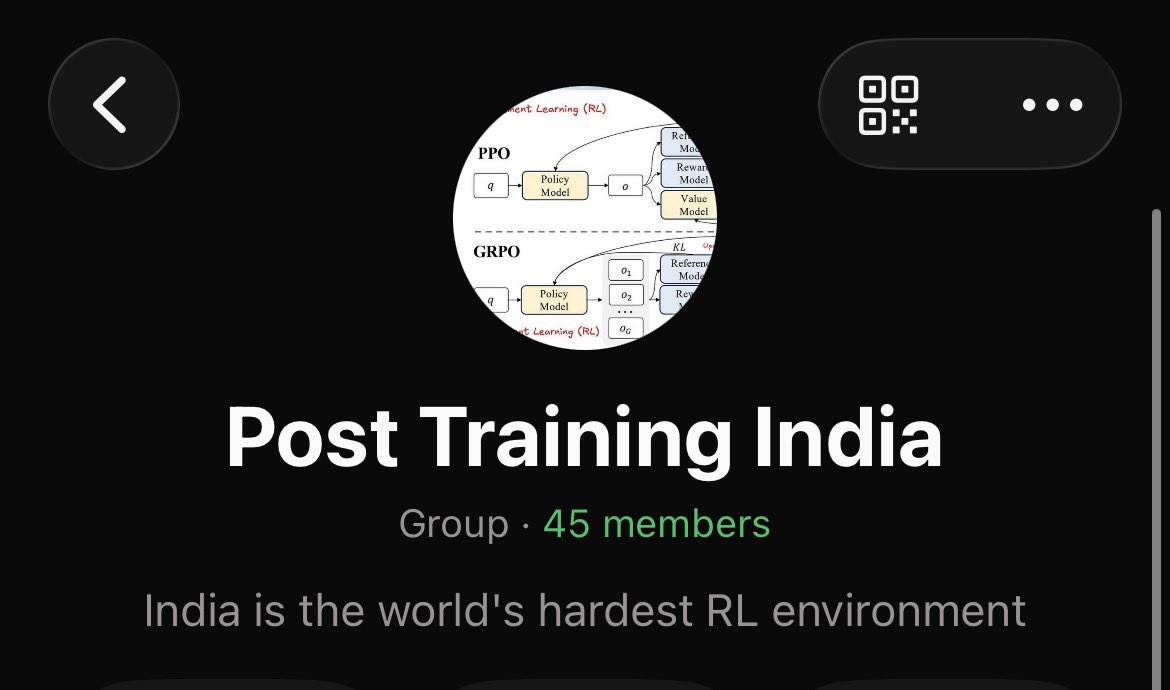
We now have a community of 45 of some of the smartest Indian origin folks spanning across inference engg, post training and ai infra - including folks from OAI, deepmind, meta, MSR, sarvam, a bunch of neolabs and some fresh grads who are arguably 99.9 %ile of folks in terms of agency we are looking for even more high caliber folks who are working at frontier or neo labs to join us! Spread the word!
6
1
16
490
AlMauliniPWMCG
The AM Brief, Monday July 6, 2026 Part 3 Good morning, It’s 8am in Miami and here is a recap of events that caught my eye. Part 3 Apptronik has launched "Robot Park," a nearly 90,000 square foot facility in Austin dedicated to training its Apollo humanoid robots. Operating seven days a week, the site serves as a "data factory" where human operators guide robots through real world tasks like sorting toys and moving boxes. This continuous learning loop generates the high fidelity data necessary to refine the company’s AI models, effectively accelerating the robots' ability to operate independently in diverse industrial environments. The facility is a cornerstone of Apptronik’s research partnership with Google DeepMind. By prioritizing the collection of real world "experience" over simulated data, the $5.5B valued company aims to bridge the gap between prototype and commercial deployment. Pudu Robotics is developing the world’s first "full scenario" robot serviced hotel, scheduled to open in 2027 on the West Artificial Island of the Shenzhen–Zhongshan Link in China. Unlike hotels that use robots for isolated tasks, this 44 room property will utilize an integrated ecosystem where robots handle every function, from reception and check in to housekeeping, security, and dining. The hotel allows diverse robots, such as FlashBot for deliveries and CC1 Pro for cleaning, to communicate and coordinate tasks. While the full opening is set for 2027, pilot operations with limited guest access are expected to begin in late 2026 to test the system in realnworld conditions. The project serves as a "real world stress test" for large scale, autonomous service environments, aiming to demonstrate how unified AI can manage entire facilities without human intervention. Weave Robotics is set to release "Isaac 1," a $8,000 home humanoid robot, in California this fall with a subscription option of $449/month. Designed specifically for household chores, the unit aims to bridge the gap between industrial automation and domestic utility. As consumer interest in robotics grows, Isaac 1 represents a significant milestone in bringing functional, human scale robotics into private living spaces, testing consumer appetite for high end, maintenance heavy home technology. The initial rollout is limited to California, serving as a pilot region for testing navigation and interaction in varied residential environments. This launch competes directly with emerging personal robots from major tech firms, focusing on specialized domestic mobility rather than just surveillance or voice assistance. Sources : CNBC, Bloomberg, Opening Bell, Epoch, Yardeni, Forbes, Rundown AI, Mario Nawfal, X Thank you for reading Live your best life, AL Maulini
1
20
elalvarobalbin
Replying to @alvinfoo
deepmind guy told me build with whatever. closed models kill that on day one
3
GratomicAi
مدل Gemini 3.5 Pro یه کار خارق‌العاده انجام داده. این تصور استیو جابز رو در حال رونمایی از اولین آیفون با فرمت SVG با دقت وحشتناکی بازسازی کرد. در تمام تاریخ مدل‌های هوش مصنوعی، هرگز مدلی با این سطح وجود نداشته است و این بدان معناست که DeepMind قصد دارد سیستم جدیدی را معرفی کند که Fable 5 و دیگران از آن خوشحال نخواهند شد.
2
36
1,937
Ryukijano 👾 retweeted
poorbjorn
Demis Hassabis, founder of DeepMind, has no beach house, fancy cars, or yachts. Though, he does get season tickets to see his favorite football team play. “I do not care about money at all, but I do need some of it. “I want to build a Large Hadron Collider in space.” We all have different goals. [📖 The Infinity Machine - Sebastian Mallaby, I’m on the last pages now. Loved it!]
7
29
643
67,325
oegukin
🎬 Volando a Corea vi el documental The Thinking Game (2024). Me gustó mucho ver los orígenes de Demis Hassabis y el nacimiento de DeepMind, mostrando su evolución desde AlphaGo a AlphaFold, la IA que resolvió el plegado de proteínas y les valió el Nobel de Química. ★★★★★

ALT Hold Up Wait GIF by Netflix Korea

1
18
goloveai
this is actually wild i can barely fold a paper airplane and yall are out here teaching ai to computationally design a whole entire gecko. actually crazy how origami is basically just math disguised as art and now we have deepmind casually optimizing the crease patterns for us
17