Postdoc at MIT BCS, interested in language(s) and thought in humans and LMs

Joined March 2022
24 Photos and videos
Pinned Post
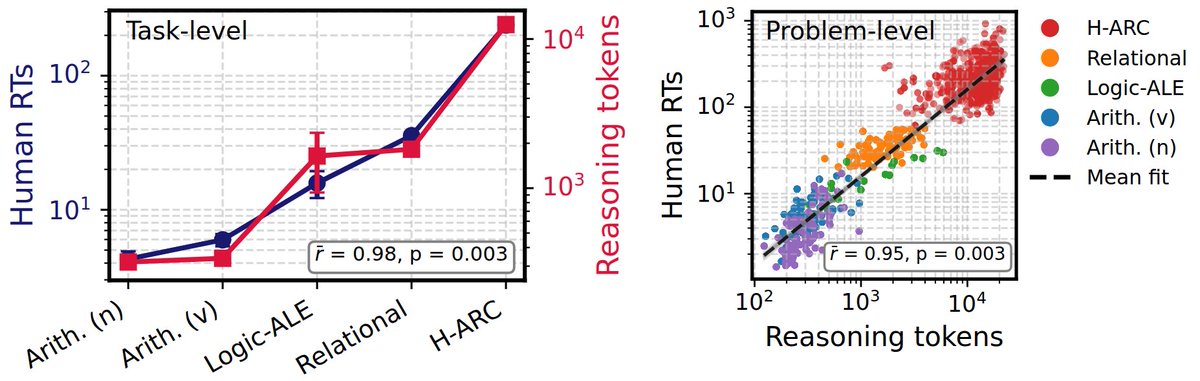
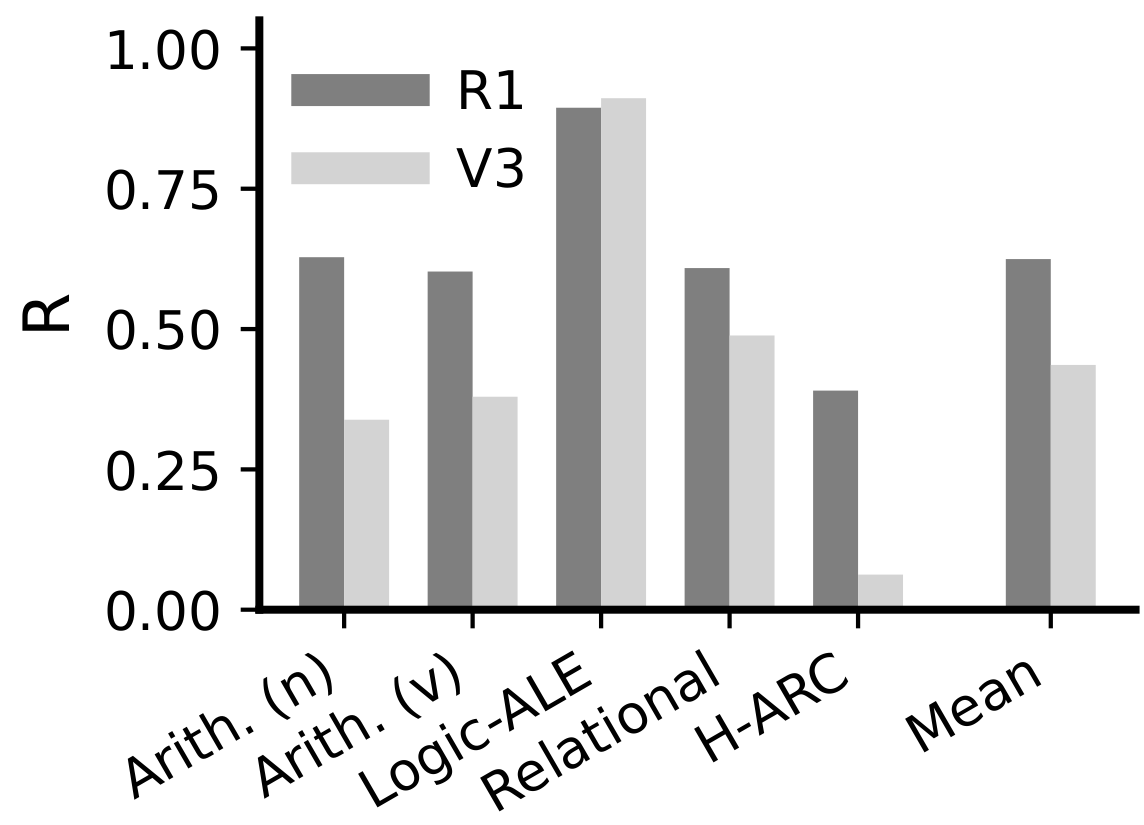
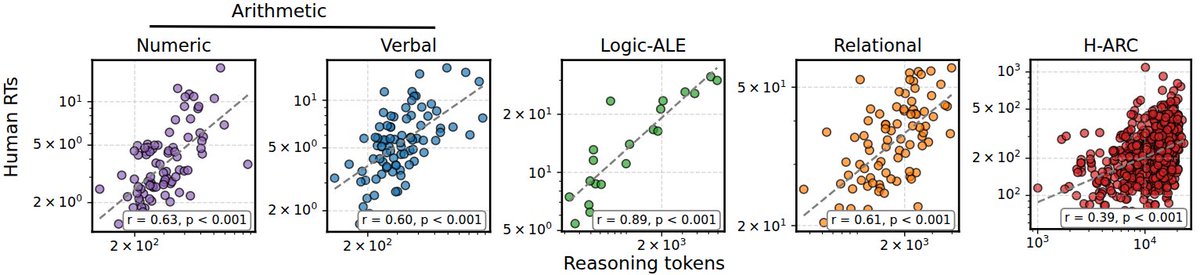
New preprint! 🤖🧠 The cost of thinking is similar between large reasoning models and humans 👉 osf.io/preprints/psyarxiv/m2… w/ Ferdinando D'Elia, @AndrewLampinen, and @ev_fedorenko (1/6)
4
26
94
14,781
Andrea de Varda reposted
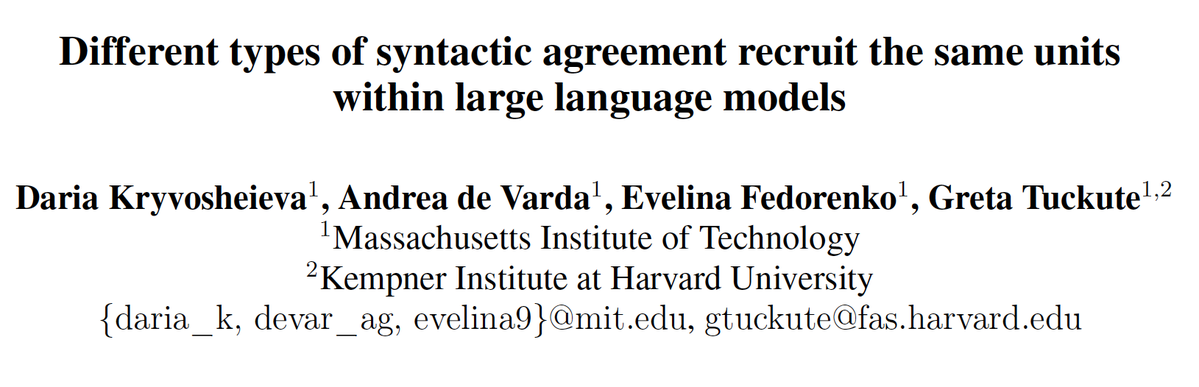
@DKryvosheieva is presenting our work on syntactic agreement in LLMs--across diverse agreement phenomena and across 57 languages--at #ACL2026 tomorrow! July 6, 9.10am PST, Oral Session D @aclmeeting
How do LLMs process syntax? Do different syntactic phenomena recruit the same model units, or do they recruit distinct model components? And do different languages rely on similar units to process the same syntactic phenomenon? Check out our new preprint (to appear at ACL 2026)!
1
14
500
I am so excited about this finding from @pengrui_han and @devarda_a, also with @jacobandreas! Perhaps modularity is inevitable in intelligent systems, biological or in silico. :)
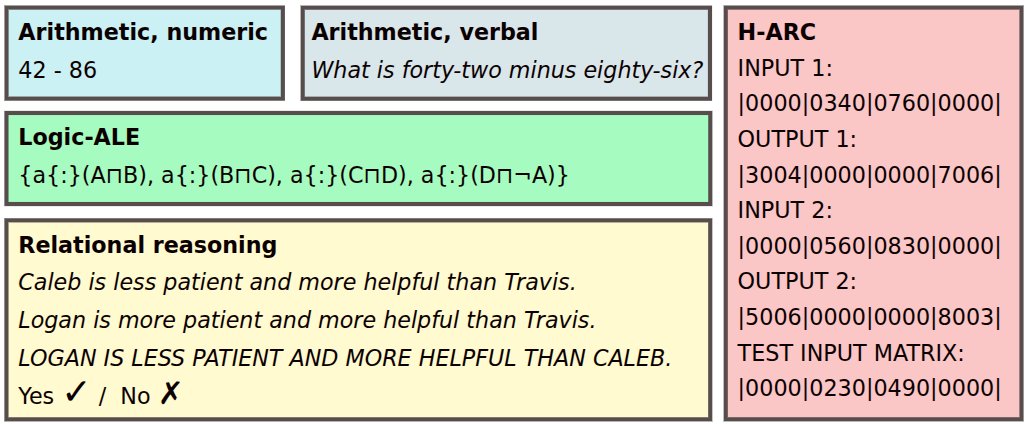
The human brain is strikingly modular, with distinct networks for language, formal reasoning, social reasoning, and physical reasoning. Is this a fundamental principle of how intelligent systems are built, or an accident of biological evolution? In our latest preprint, we find that a similar modular organization emerges in Large Language Models, another class of intelligent system. Brains and LLMs are shaped by entirely different kinds of optimization (biological evolution vs. gradient descent). That they arrive at the same modular design anyway suggests modularity may be a fundamental property of intelligent systems. 🌐 Web: pengrui-han.github.io/LLM_Mo… 📄 Paper: pengrui-han.github.io/LLM_Mo… 💻 Code & data: github.com/Pengrui-Han/LLM_M… Using circuit analyses across 46 tasks spanning four cognitive domains, we find: 1️⃣ Tasks that draw on the same network in humans recruit overlapping units in LLMs, while tasks drawing on different networks recruit distinct units. 2️⃣ These units are causally linked to model behavior. Ablating the units critical for one domain impairs performance in that domain (−26% accuracy) but barely touches the others (−2.5%). This project has been in the works for a while :) Huge thanks to my advisors @jacobandreas @ev_fedorenko @devarda_a, and to @Nancy_Kanwisher for valuable conceptual input and feedback throughout. #MIT

6
24
211
30,033
Like the human brain, LLMs use separate sets of units for language, formal reasoning, social reasoning, and intuitive physical reasoning. A modular organization of cognition may be a fundamental principle of intelligence!
The human brain is strikingly modular, with distinct networks for language, formal reasoning, social reasoning, and physical reasoning. Is this a fundamental principle of how intelligent systems are built, or an accident of biological evolution? In our latest preprint, we find that a similar modular organization emerges in Large Language Models, another class of intelligent system. Brains and LLMs are shaped by entirely different kinds of optimization (biological evolution vs. gradient descent). That they arrive at the same modular design anyway suggests modularity may be a fundamental property of intelligent systems. 🌐 Web: pengrui-han.github.io/LLM_Mo… 📄 Paper: pengrui-han.github.io/LLM_Mo… 💻 Code & data: github.com/Pengrui-Han/LLM_M… Using circuit analyses across 46 tasks spanning four cognitive domains, we find: 1️⃣ Tasks that draw on the same network in humans recruit overlapping units in LLMs, while tasks drawing on different networks recruit distinct units. 2️⃣ These units are causally linked to model behavior. Ablating the units critical for one domain impairs performance in that domain (−26% accuracy) but barely touches the others (−2.5%). This project has been in the works for a while :) Huge thanks to my advisors @jacobandreas @ev_fedorenko @devarda_a, and to @Nancy_Kanwisher for valuable conceptual input and feedback throughout. #MIT
1
11
81
7,839
Andrea de Varda reposted
The human brain is strikingly modular, with distinct networks for language, formal reasoning, social reasoning, and physical reasoning. Is this a fundamental principle of how intelligent systems are built, or an accident of biological evolution? In our latest preprint, we find that a similar modular organization emerges in Large Language Models, another class of intelligent system. Brains and LLMs are shaped by entirely different kinds of optimization (biological evolution vs. gradient descent). That they arrive at the same modular design anyway suggests modularity may be a fundamental property of intelligent systems. 🌐 Web: pengrui-han.github.io/LLM_Mo… 📄 Paper: pengrui-han.github.io/LLM_Mo… 💻 Code & data: github.com/Pengrui-Han/LLM_M… Using circuit analyses across 46 tasks spanning four cognitive domains, we find: 1️⃣ Tasks that draw on the same network in humans recruit overlapping units in LLMs, while tasks drawing on different networks recruit distinct units. 2️⃣ These units are causally linked to model behavior. Ablating the units critical for one domain impairs performance in that domain (−26% accuracy) but barely touches the others (−2.5%). This project has been in the works for a while :) Huge thanks to my advisors @jacobandreas @ev_fedorenko @devarda_a, and to @Nancy_Kanwisher for valuable conceptual input and feedback throughout. #MIT
48
432
2,345
219,408
Andrea de Varda reposted
We know from behavioral studies that LLMs suffer from content effects, similarly to humans… but why? In our #ACL2026 paper (findings), we provide evidence that this may stem from how LLMs encode judgments of validity and plausibility.
2
1
14
545
Andrea de Varda reposted
It is tricky to characterize the features represented by human language cortex. This work is a step toward doing so. Using small, interpretable feature sets, we explain language-network responses and show a shared feature basis across regions with variation across individuals.
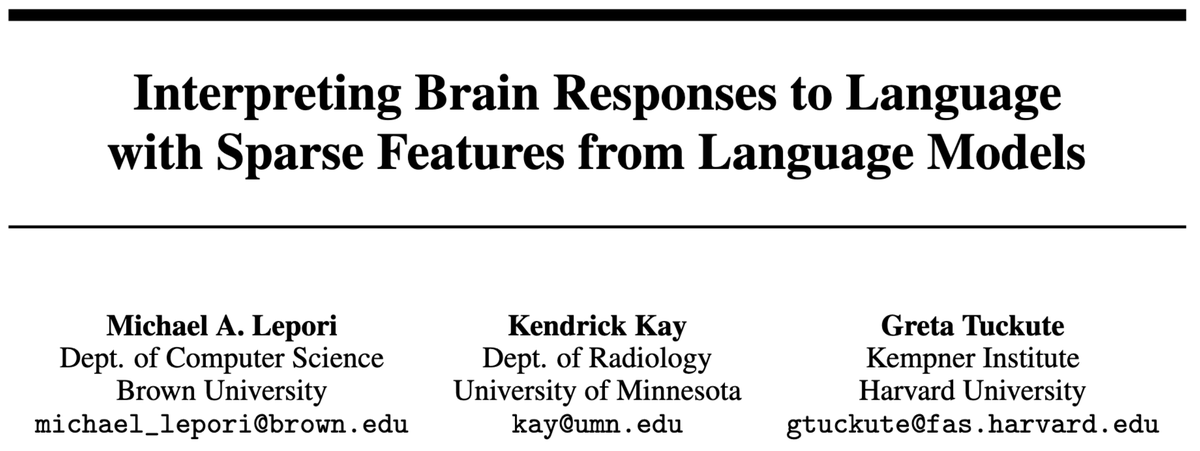
🚨New preprint!🚨 We know that LM representations can be used to predict brain responses to language. But what *features* of these representations underlie this alignment? We use SAEs to find out!
12
68
6,638
Andrea de Varda reposted
Excited to announce that I'll be starting my own lab in Tübingen this October! Hiring at all levels: Postdoc, PhD & RA. Want to work on computational cognitive science at scale? Apply: core-cognition.github.io/ Reposts and shares much appreciated 🙏
17
48
338
27,981
Andrea de Varda reposted
Congrats to Andrea de Varda for winning the 2026 Glushko Dissertation Prize! This highly competitive award recognizes outstanding young researchers in the field of cognitive science. Andrea studies how language is represented in human brains and machines. cognitivesciencesociety.org/…
1
10
583
While I'm here: I think multilingual LLMs are vastly underrated as scientific tools for studying language. They have to represent hundreds of languages in one set of weights, so whatever those languages share gets compressed into the same place. I think that is very cool!
4
234
Thrilled that my thesis on multilingual LLMs in cog sci won a Glushko prize! Huge thanks to my advisor Marco Marelli who supported me throughout and to @ev_fedorenko who I did the multilingual brain work with. Thanks also to @cogsci_soc and the Glushko-Samuelson Foundation! 🙏
Congratulations to Yang ICoN fellow Andrea de Varda @devarda_a, who has been named a winner of the prestigious Glushko Dissertation Prize! 👏👏 🔗 cognitivesciencesociety.org/… @cogsci_soc
1
5
42
6,100
We don't start out with a bilateral language system: it's already strongly left-lateralized in young kids! Resilience of language to early LH damage must occur in spite of this early hemispheric bias. Congrats to Ola @olaozpa and Amanda @Amanda_M_OBrien! Out in NatComms now! 🎉
Excited to share that our paper: ‘Precision fMRI reveals that the language network exhibits adult-like left-hemispheric lateralization by 4 years of age’ is finally published! mcgovern.mit.edu/2026/05/17/… nature.com/articles/s41467-0… @Amanda_M_OBrien @ev_fedorenko
12
47
5,661
Andrea de Varda reposted
🎉 Happy to share that our paper on function words & language learning (w/ Heidi Getz & @weGotlieb) is accepted to #ACL2026! A little late to the party, but still worth celebrating 🥳 We ask: what statistical properties help a learner abstract grammatical knowledge from linear input? Turns out function words, though often overlooked, play an important role. Check out our updated preprint: arxiv.org/pdf/2601.21191 🧵 1/4
2
14
75
5,273
Andrea de Varda reposted
TL;DR: Languages ​​look the way they do because our brains find them easier to handle that way. 🧠✨
Why do languages share common properties? Adults learned novel quantifiers satisfying semantic universals faster than those violating them. This suggests that learnability helps explain why certain meanings are lexicalized across cultures. @Logic_Cognition
9
35
3,001
Andrea de Varda reposted
Language, Intelligence & Thought lab is looking for a lab manager! This is a 2-year postbac position that will allow you to gain experience in human neuroscience, cognitive science, and AI research prior to applying to PhD programs. Express interest here: forms.gle/289sLgZdJ2bQr1Y48
1
27
58
9,216
Andrea de Varda reposted
Can we process meaning unconsciously? Our new study suggests: not really… unless language has a way to express it! New paper out with Andrea Nadalini @D_Casasanto @CrepaldiDavide @BottiniRob
1
2
7
1,146
Andrea de Varda reposted
📢 PhD position in Developmental Language Modelling (plz RT🙏) What can human language acquisition teach us about training language models? Join us as a PhD! 4 yrs, fully funded, MPI-NL; april 3 mpi.nl/career-education/vaca…
3
29
107
19,765
Andrea de Varda reposted
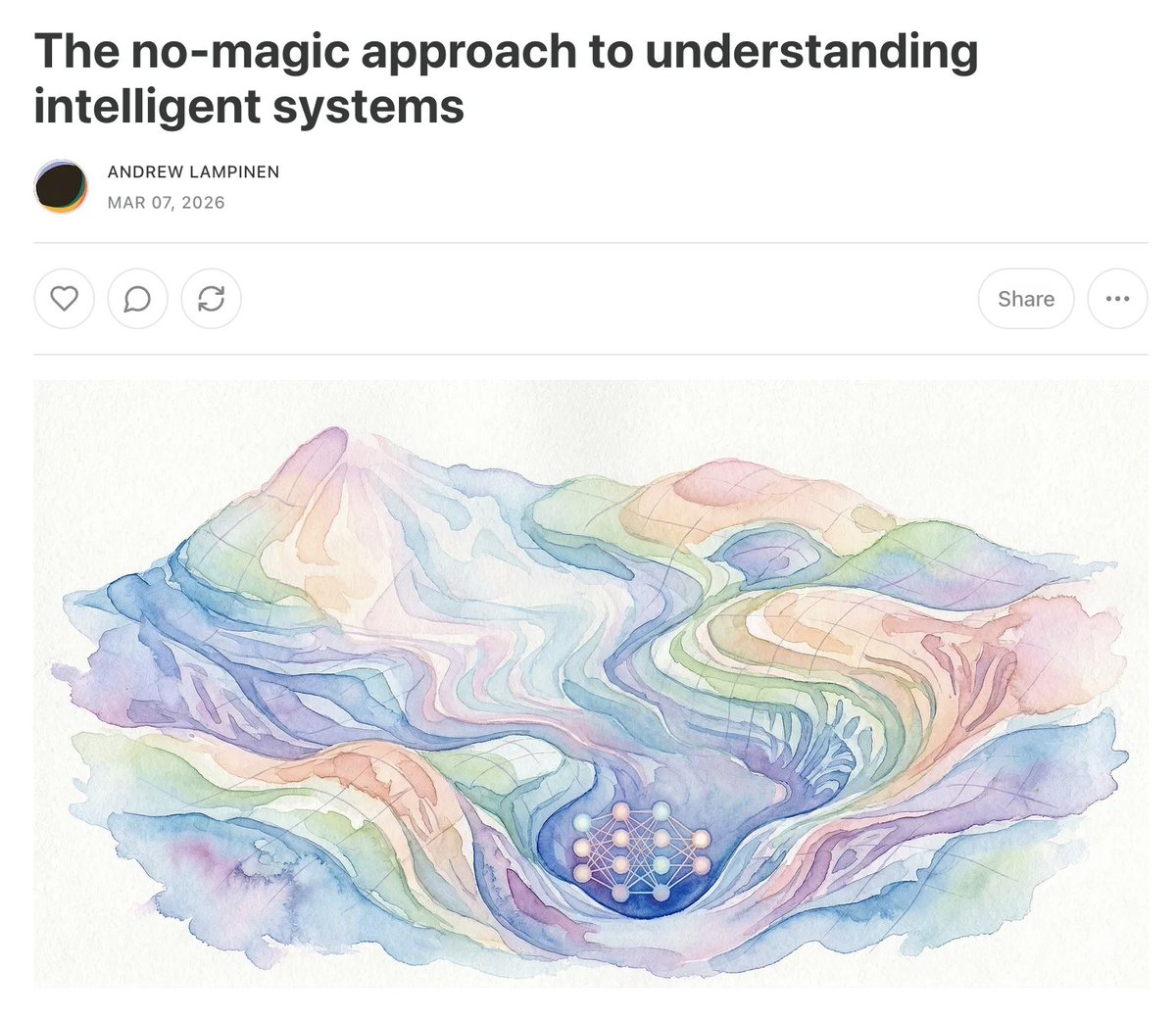
Short post on what I call the "no-magic approach to understanding intelligent systems" — the philosophy I think of as motivating our work on understanding intelligence without resorting to magical thinking about AI or humans! Link below:
8
57
388
27,707
Andrea de Varda reposted
📢 PhD position in the NeuroAI of Language Why can LLMs predict brain activity so well? We're hiring a PhD student to find out -- AI interpretability meets neuroimaging Deadline March 20. Please RT 🙏 mpi.nl/career-education/vaca…
5
26
180
21,064
Andrea de Varda reposted
My PhD thesis is out 🥳🎓 How do LLMs, trained on trillions of tokens, reason? Can they generalise beyond their training data or are they constrained by what they've seen before? My takeaway: they can generalise beyond training in interesting ways, showing genuine reasoning
93
237
1,983
106,463
Andrea de Varda reposted
Our researchers don't just study the brain - they help young students see themselves as future neuroscientists. @mitbrainandcog research scholar Zadriana Smith postdoc @HalieOlson recently took time away from their labs to inspire the next generation of neuroscientists! ✨
4
12
1,981