
The fastest AI dev news on X — model releases, tools, and what they actually mean

Joined April 2016
3,929 Photos and videos
Marktechpost AI reposted
Marktechpost dev team has been quietly building one of the most complete open-source AI agent and Agentic tutorial libraries on GitHub. It just crossed 2.7K stars. Every notebook is a full, runnable implementation — not a snippet. Here's what's inside: 1. Multi-agent orchestration across every major framework→ LangGraph, CrewAI, AutoGen, SmolAgents, Google ADK, CAMEL, OpenAI Agents, Mistral Agents → Planning, tool-calling, sub-agents, and critique-driven refinement 2. Agent memory that actually persists→ Mem0, Memori, EverMem-style hierarchical memory with FAISS SQLite → RL agents that learn which long-term memories to retrieve 3. Reasoning and decision loops→ Tree-of-Thoughts with beam search and pruning → Streaming decision agents with online replanning and mid-execution adaptation 4. The agent stack, end to end→ MCP servers, OAuth 2.1 for MCP, A2A communication protocols → Agentic RAG, knowledge graphs, cost-aware LLM routing 5. Beyond agents→ 30 topic folders: RAG, RL, Deep Learning, Computer Vision, NLP, Robotics, Voice AI, LLM Evaluation, Federated Learning, and more Every tutorial pairs a Colab notebook with a full written walkthrough, so you can read the theory and run the code in the same sitting. 985 commits. 585 forks. All free. If you're building agents in 2026, this is a resource worth bookmarking. Full Repo: github.com/MARKTECHPOST-AI-M…
8
5
23
51,995
Marktechpost AI reposted
Synthetic Sciences Releases OpenScience: An Open-Source, Model-Agnostic AI Workbench for Machine Learning, Biology, Physics, and Chemistry Research Most "AI for science" tools are one vendor's model, wrapped in one company's idea of which research is allowed. That's a gatekeeping layer — and Synthetic Sciences just drew a clear line by open-sourcing the alternative. They released OpenScience — an Apache-2.0 AI workbench that runs the full research loop (literature → hypothesis → code → experiment → analysis → write-up) on any model you point it at, with your own keys, on your own infrastructure. Here's what's actually interesting: → Model-agnostic by design — Claude, GPT, Gemini, GLM, Kimi, DeepSeek, or your own fine-tune, switched from the model selector, per request → 250 editable skills across training (DeepSpeed, PEFT, TRL), cheminformatics, and molecular clinical biology — all readable and forkable → Scientific databases wired in as agent tools: UniProt, PDB, ChEMBL, arXiv, and ~30 more, queried directly → Runs on your infra — keys and data stay on your machine, and bring-your-own-key is free and never gated → Positioned as an open alternative to Anthropic's Claude Science, which is Claude-only and subscription-gated Full analysis: marktechpost.com/2026/07/05/… GitHub Repo: github.com/synthetic-science… @SynScience
1
2
14
39,840
Marktechpost AI reposted
We covered a new paper from NVIDIA Research that moves agentic coding into hardware design. HORIZON treats hardware design as repository-level code evolution. A human writes a Markdown harness. A bootstrap agent compiles it into a project pack, then a hands-free loop evolves an isolated git worktree until an acceptance gate passes. Here's what's actually interesting: 1. Git is the interface, not bookkeeping Each accepted repair becomes a commit. Git notes carry the evaluator verdict and reward. Rejected attempts are logged as negative examples. The repository history becomes the experience buffer. 2. The verifier harness is the real contract The project pack bundles an executable evaluator, an acceptance predicate, a git policy, and domain skills. For RTL that means compile, simulate, coverage, and assertion checks. Any backbone can plug in. 3. The results → 100% completion across ChipBench, RTLLM-2.0, Verilog-Eval, and nine CVDP categories → 47.8% aggregate pass rate at the first iteration, before the loop closes the gap → 82 iterations for the hardest category (RTL code completion), its long tail the single largest cost → ~210M tokens total, ~91% cached input → GPT-5.3 as a fixed backbone, single-agent, hands-free My takeaway: once executable feedback makes correctness converge, the bottleneck shifts to token efficiency and verification quality, not pass rate. Full analysis: marktechpost.com/2026/07/04/… Paper: arxiv.org/pdf/2606.28279 @NVIDIAAI @nvidia
8
5
22
11,513
Marktechpost AI reposted
Mistral AI Releases Leanstral 1.5: An Apache-2.0 Lean 4 Code Agent Model Solving 587 of 672 PutnamBench Problems Most AI theorem proving is a language model generating a proof in one shot, with a verifier bolted on at the end to check it. That's autocomplete with a grader — and Mistral just drew a clear line between that and an actual proof agent. They released Leanstral 1.5 — a 119B MoE with 6.5B active parameters, trained as a code agent that lives inside the Lean 4 compiler loop: propose a proof, read the compiler's goals and errors, refine, repeat until it compiles or the budget runs out. Verification isn't the eval here. It's the training signal. Here's what's actually interesting: → Test-time scaling behaves like a dial: PutnamBench Pass@8 climbs 44 → 244 → 493 → 587 solved as the per-attempt token budget moves 50k → 200k → 1M → 4M → 587/672 on PutnamBench at ~$4 per problem, versus an estimated $300 for Seed-Prover 1.5 high (a 10 H20-days-per-problem budget) → Saturates miniF2F: 100% on both validation and test sets → Two RL environments in training — a multiturn prover, and a raw-filesystem code agent that edits files, runs bash, and queries the Lean language server for live goals and types → Not just math: an Aeneas (Rust → Lean) pipeline flagged 11 genuine bugs across 57 repos, 5 previously unreported — including an integer overflow in datrs/varinteger when (value 1) hits Std.U64.MAX Apache 2.0 weights, free API endpoint Full analysis: marktechpost.com/2026/07/03/… Model weights: huggingface.co/mistralai/Lea… Project: docs.mistral.ai/models/model… Technical Details: mistral.ai/news/leanstral-1-… @MistralAI @MistralDevs @sophiamyang
6
10
67
56,361
Marktechpost AI reposted
NVIDIA AI Introduces ASPIRE: A Self-Improving Robotics Framework Reaching 31% Zero-Shot on LIBERO-Pro Long Tasks Most robot-coding agents throw away everything they learn. Solve a task, discard the fix, start the next one cold — the agent on its 100th task is no smarter than on its first. NVIDIA's ASPIRE draws a clean line between that and an agent whose experience actually compounds. They introduced ASPIRE (Agentic Skill Programming through Iterative Robot Exploration) — a code-as-policy system where a coding agent (Claude Code, Claude Opus 4.6, 1M-token context) writes and debugs its own robot programs against a fixed perception/planning/control API, and distills every validated fix into a reusable skill library, with no fixed perception-plan-execute pipeline anywhere in the loop. Here's what's actually interesting: → The execution engine logs per-primitive multimodal traces — RGB keyframes, grasp candidates, object poses, motion plans, return status — so the agent localizes the failing primitive, not just the failed rollout → Validated fixes distill into a text skill library (failure signature when-to-apply guard repair sketch), not weights — and the agent is barred from reading sim ground truth, so the skills transfer to real hardware → Evolutionary search proposes K candidate programs per round, conditioned on surviving programs residual failure traces — beyond single-trajectory tuning → LIBERO-Pro Object under perturbation: 98 vs 22 for CaP-Agent0 → Robosuite bimanual handover: 92 vs 20 for CaP-Agent0 → LIBERO-Pro Long zero-shot: 31 vs 4 for prior methods (skills learned on LIBERO-90, no test-time retries) On a real bimanual robot with a different embodiment and API (OpenAI Codex GPT-5.5), transferred skills took soda-can lifting to 19/20 at ~10x fewer tokens, and drawer opening from 0/20 to 11/20. Full analysis: marktechpost.com/2026/07/03/… Paper: arxiv.org/pdf/2607.00272 Project page: research.nvidia.com/labs/gea… @NVIDIAAI @nvidia @NVIDIARobotics @DrJimFan @guanzhi_wang @UMichCSE @ECEILLINOIS @berkeley_ai @CMU_Robotics @runyulu_x @yubowu25 @letian_fu @_wenlixiao @AjayMandlekar @YinzhenXu @GuanyaShi @Ken_Goldberg @mosharaf @yukez @DrJimFan
3
5
27
18,261
Marktechpost AI reposted
Meet WebBrain: An Open-Source, Local-First AI Browser Agent That Reads Pages and Automates Tasks in Chrome and Firefox WebBrain lives inside your browser and can run entirely on your own local model — no cloud, no account, no data leaving your machine. Most "AI browser agents" are a chat box that pastes your page into someone else's server. That's not an agent that lives where you browse — and WebBrain draws a very clear line between the two. It's an open-source (MIT), local-first browser agent for Chrome and Firefox. It runs inside your existing authenticated session, on a model you pick — so with llama.cpp or Ollama, nothing leaves your machine. Here's what's actually interesting: → Two modes, cleanly separated. Ask reads the page (read-only, content scripts). Act clicks and types through the Chrome DevTools Protocol (chrome.debugger) — trusted input events that modern sites honor, reaching cross-origin iframes and shadow DOM. → UI-first by design. For anything that submits, sends, or buys, it drives the visible UI and refuses to hit REST/GraphQL endpoints directly. It starts read-only and asks before consequential actions. → Bring any model. llama.cpp, Ollama, LM Studio, vLLM — or OpenAI, Claude, Gemini, DeepSeek, Groq, OpenRouter. Recommended local: Qwen 3.6 35B (Qwen3.6-35B-A3B), which beat Gemma 4 on the project's screenshot benchmark. → Tuned for cost and privacy. Token-conscious screenshots, oldest-first context trimming, a dedicated vision model, 40 tools (~20 in Compact mode). No telemetry. No accounts. Full analysis: marktechpost.com/2026/07/02/… GitHub Repo: pxllnk.co/wdva98c Chrome Extension: pxllnk.co/p4mn8 Firefox Add-on: pxllnk.co/m6k7c5w9 Portal: pxllnk.co/rlifl7h
6
10
68
202,463
Marktechpost AI reposted
Most browser agents drive the page from the outside. An external process, a headless browser, screenshots piped to a multimodal model. That's automation pointed at your app — not something living inside it. Alibaba's Page Agent flips the direction. They shipped an open-source JavaScript GUI agent that runs client-side, inside the webpage itself. It reads the live DOM as text — a "dehydrated" FlatDomTree — then clicks, types, and scrolls as the real user. No screenshots, no multimodal model, no backend rewrite, and it inherits the user's existing session and auth. Here's what's actually interesting: → Text-only DOM, not pixels — a strong text model is enough, so you skip multimodal cost and latency → Model-agnostic through any OpenAI-compatible endpoint (qwen3.5-plus in the docs) → Guardrails are built in: operation allowlists, data masking for fields like passwords, and approval before critical actions → Single-page by default; optional Chrome extension for multi-tab, plus a beta MCP server so external agents can drive it → MIT-licensed, 17K GitHub stars, built on browser-use — its DOM processing and prompt are derived from it Full analysis: marktechpost.com/2026/07/02/… GitHub Repo: github.com/alibaba/page-agen…
3
4
23
33,328
Marktechpost AI reposted
When a government pulls a frontier model over a security report, you'd assume the model was the problem. In Claude Fable 5's case, it wasn't — and Anthropic just published the receipts. Fable 5 (a Mythos-class model, $10/$50 per million tokens) was suspended on June 12 under US export controls. The trigger: Amazon researchers found a prompt that bypassed its safeguards to surface software vulnerabilities, and in one case produce exploit code. Controls lifted June 30. Fable 5 returns to users globally on July 1. Here's what's actually interesting: → Anthropic tested whether the finding was unique. It wasn't — Opus 4.8, GPT-5.5, and Kimi K2.7 identified the same vulnerabilities, and every model tested reproduced the exploit demo. No unique Mythos-level cyber capability. → New safety classifier blocks the reported technique in over 99% of cases — and flagged requests route to Opus 4.8, not an outright refusal. → CAISI (US Dept. of Commerce) tested both the old and new safeguards and calls them extraordinarily strong. → With Amazon, Microsoft, and Google, Anthropic proposed a 4-criteria jailbreak severity score: capability gain, breadth, ease of weaponization, discoverability. Full analysis: marktechpost.com/2026/07/01/… Technical Details: anthropic.com/news/redeployi…
Claude Fable 5 will be available again globally tomorrow. After a series of productive conversations with the US government, we're redeploying the model with a new set of classifiers to target and block more cybersecurity tasks. In the near term, some routine tasks like coding and debugging will fall back to Opus 4.8. We’ll continue to refine these classifiers over the coming weeks to reduce false positives and better distinguish genuine misuse from legitimate requests. We’ve also begun drafting a consensus framework—with Amazon, Microsoft, Google, and other Glasswing partners—for assessing the severity of AI jailbreaks and how AI developers should respond to them. We invite other industry partners and model providers to join us in this effort. Finally, we’re scaling up our collaboration with the US government on model testing and safeguards. This will include pre-release access to models and safeguards for evaluation, information sharing on jailbreaks and misuse, and dedicated resources for joint research. Thank you to our users for your patience, and to our partners across the government, industry, and the research community who worked alongside us to make Fable 5 available again. Read our full blog: anthropic.com/news/redeployi…
1
10
900
Marktechpost AI reposted
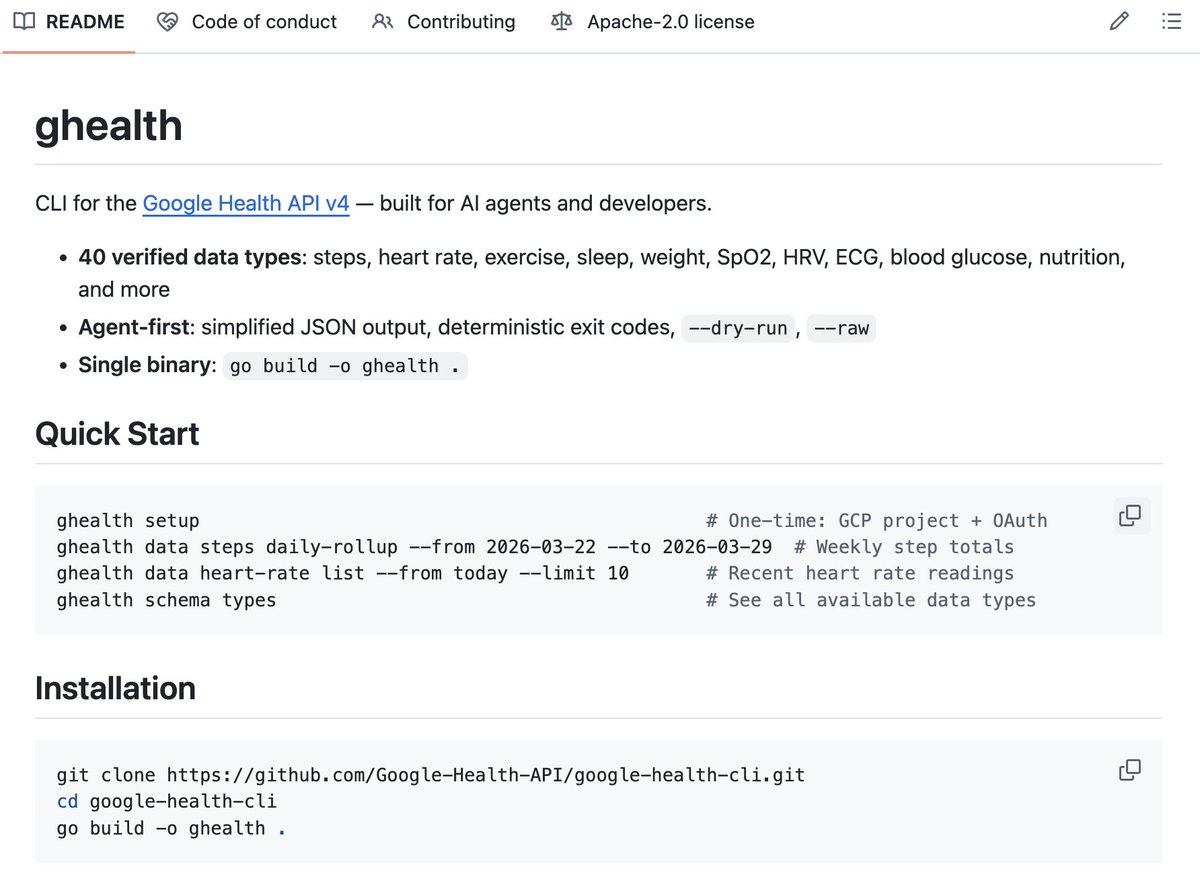
The Google Health API Got a CLI: ghealth is an Open-Source Tool for Your Fitbit Air Data The Google Health API — the successor to the Fitbit Web API — now has an open-source CLI. ghealth is a single Go binary that exposes 40 verified data types as agent-ready JSON, from the terminal or piped into your agent. Here's what's actually interesting: → Agent-first by design: simplified JSON, deterministic exit codes, --dry-run and --raw → 40 verified data types: steps, heart-rate, sleep, SpO2, HRV, ECG, weight, and more → Sleep with --detail returns per-stage minutes (awake, deep, REM) for week-over-week patterns → Bring-your-own OAuth: your own GCP Desktop client, tokens stored locally at file mode 0600 → Ships 2 SKILL.md agent skills — install with npx skills add Full analysis: marktechpost.com/2026/07/02/… Repo: github.com/Google-Health-API…
3
11
58,811
Marktechpost AI reposted
Announcing Built with Claude: Life Sciences, a global virtual hackathon. Join us and @GladstoneInst for a week of researching and building with Claude Science and Claude Code, with a prize pool of $100k in credits.
303
536
5,611
660,486
Marktechpost AI reposted
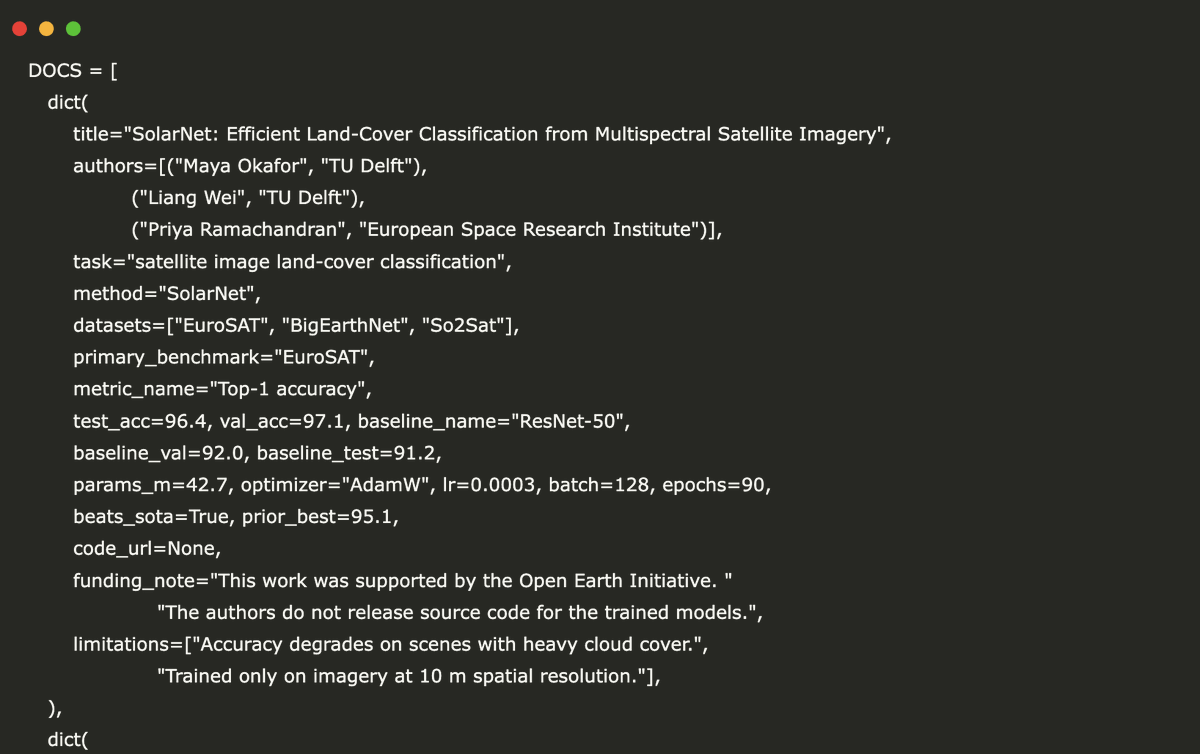
Using Lift to Turn Research PDFs into Structured JSON with Controlled, Schema-Guided Field-Level Evaluation Most "PDF extraction" is a text dump with a regex bolted on top. That's not document mining — and it breaks the moment a paper puts its real number in a table three pages away from the abstract. So we built a full tutorial around Lift, an open PDF-to-structured-data model, treating it as a controlled benchmark instead of a one-off demo. The setup is synthetic multi-page research reports with deliberate traps: validation-vs-test metric ambiguity, baseline-vs-proposed comparisons, papers that release no code, and boolean state-of-the-art claims. A JSON Schema then tells Lift exactly which fields to recover — title, authors, datasets, metrics, hyperparameters, limitations, code URL. Here's what's actually interesting: → 4-bit NF4 loading fits the ~10B model on a 16 GB T4/L4 — no A100 required → Schema descriptions do the disambiguation: test number vs. validation number, proposed method vs. baseline, released code vs. explicit null → Field-level scoring against ground truth, with numeric tolerance and abstention handling — not a vibe check → Extractions roll up into a queryable knowledge base, one row per mined paper → Datalab report Lift at ~90.2% field accuracy on their 225-doc benchmark Full tutorial: marktechpost.com/2026/07/01/… GitHub Repo: pxllnk.co/rc5yap
1
2
21
127,828