My random thoughts on EVs, clean energy, chips, aerospace and other tech. Find more extended pieces at substack tphuang.substack.com

Joined May 2009
10,540 Photos and videos
Pinned Post
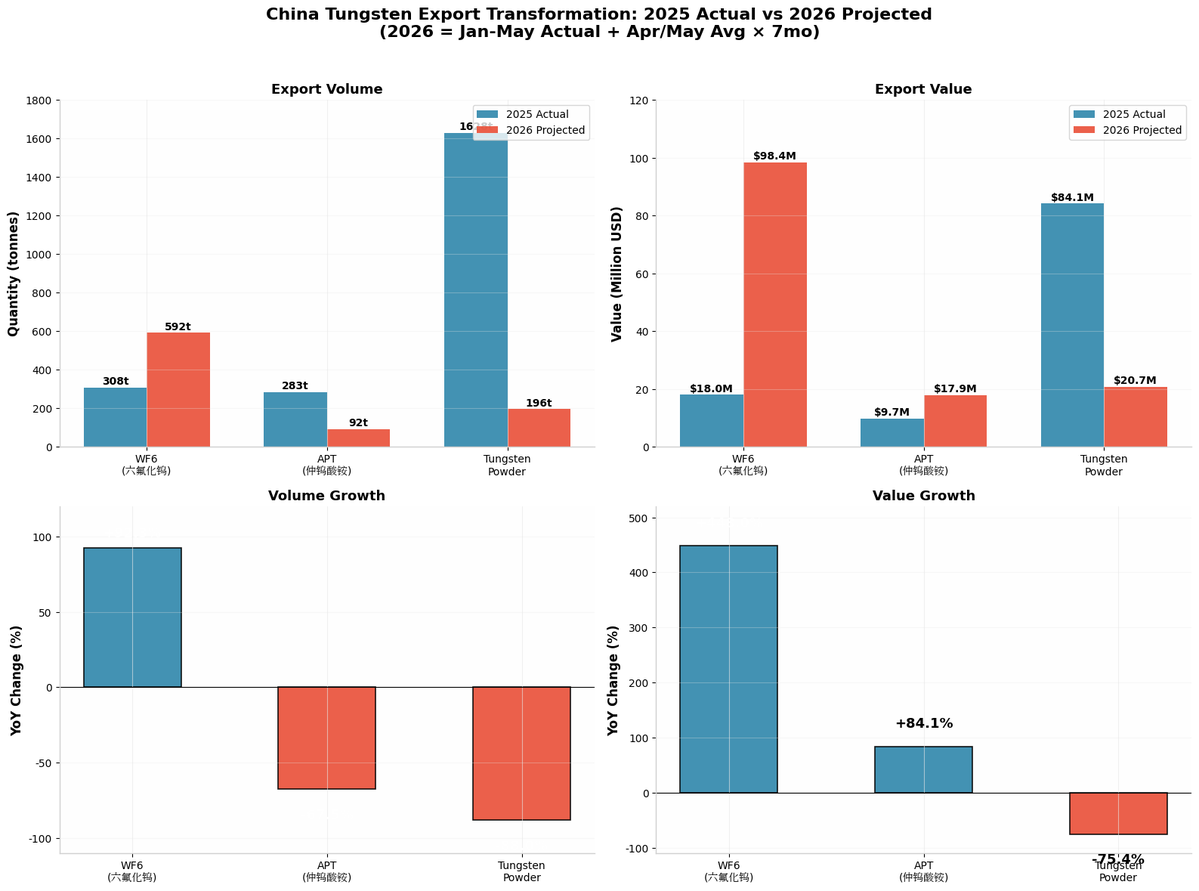
In May, China's Tungsten export was minimal. I extrapolated FY2026 & compared it to 2025 to visualize. In ton, WF6 is likely to double YoY, but APT & Tungsten powder export are down 90% . So decreased outgoing W by tonnage & revenue looks unchanged YoY. Moving up value chain
4
14
114
39,853
China's robot export thru May reached ~20B RMB across 10.377m unit to 150 countries/regions EU & ASEAN are the main destination Robot vacuum account for 70% of the export. Industrial robot export hit 70k AMRs, welding robot & robot all also increased.
2
6
30
2,926
tphuang reposted
16 mb sold in ADNOC's latest tender. Chinese teapots are buying again. Discounts now compete with Iranian and Russian barrels. Cargoes are also moving privately to USWC refineries, a fresh outlet the market can't absorb fast enough. ▸ Fifth ADNOC tender since June. Mostly Upper Zakum at Dub-4/5 $/bbl. ▸ Chinese teapots were missing from recent buyer lists. Now they're back. ▸ Watch Dubai contango and the Brent-Dubai EFS. They decide how fast the glut clears west. Read the full crude analysis here: spartacommodities.com/market… Get forward-looking insights straight to your inbox: spartacommodities.com/market… #oilmarkets #crudeoil #oiltrading #oott
6
26
10,704
Honda's deep dive into complete irrelevance in China. Its June sales decreased to just 32474 (-44.5% YoY) 205,818 in 2025H1 (-34.7% YoY) See below for the sales reduction in China since 2022
5
36
4,590
I've been discussing Huawei's τ scaling (temporal scaling) with people recently, and noticed the conversation tends to stay at the surface level without reaching its substance — likely because many participants don't come from an EE background and aren't familiar with the classical meaning of τ in circuit theory. The very first time constant you learn in a circuits course is τ = RC: the resistance of a wire multiplied by its capacitance gives the order of magnitude of the time a signal needs to traverse that wire. The longer the wire, the greater the resistance and capacitance, and the slower the signal. Within this framework, the past sixty years of geometric scaling are reinterpreted as one particular implementation of temporal scaling. Transistors were shrunk to shorten switching delay; circuits were packed more tightly to shorten metal interconnects and reduce signal propagation delay. Geometric scaling was only ever the means — compressing delay was always the end. Huawei's thesis is that once geometric scaling stalls, you find other ways to keep compressing delay. As it happens, He Tingbo's τ scaling paper released its v2 a couple of days ago, expanding from 16 to 23 pages. I compared the two versions: the data and conclusions are unchanged. The additions are essentially responses to several points of criticism the industry raised about v1. Three are worth discussing. The most important addition is the test evidence now backing the previously bare claim of "41% energy efficiency improvement." In v1, that number had no baseline and no test conditions — the most obvious target for scrutiny. V2 supplies a full comparison table. The baseline is the 2025 Kirin 9030 Pro. Both chips use the same mature process node; the key difference is that the baseline uses a conventional planar design, while Kirin 2026 folds critical paths across two vertically bonded wafers. Folding shortens interconnects and reduces interconnect delay. The timing margin freed up on the critical path translates directly into a higher maximum clock frequency: 3.1 GHz at 1.1 V supply, 13% above the baseline. The "41% energy efficiency improvement" comes from a separate operating point specifically configured for an iso-performance comparison: voltage scaled down to 0.9 V, frequency scaled down to 2.5 GHz, with measured power at 25°C coming in at 0.59× the baseline. A back-of-the-envelope estimate checks out: dynamic power scales roughly with the square of supply voltage, so an 18% voltage reduction contributes about one-third of the power drop from the square term alone. Factor in the 9% frequency reduction and the interconnect capacitance eliminated by folding, and you land right around 0.59×. So the precise meaning of "41% energy efficiency improvement" is power reduction at iso-performance. In essence, the timing margin gained from folding is traded for lower power consumption; the efficiency gain comes from logic folding. As a side note, v2 also reports that power density after dual-layer stacking is actually 5.6% lower than the baseline. The second addition addresses the question peers are most likely to ask: 3D stacking has been around for years — AMD's 3D V-Cache and Intel's Foveros are both in volume production — so what's new about LogicFolding? To understand the paper's answer, you first need to know how two layers of silicon communicate. They rely on inter-layer bond pads, which function like elevators connecting the upper and lower floors. In prior production 3D stacking, bond pad pitch ranges from 9 μm to tens of micrometers, yielding roughly ten thousand connections per square millimeter — enough to attach a bus to an entire cache block. So the established design approach has been to move complete functional blocks wholesale onto the upper tier. AMD, for example, stacks an entire cache die on top of a processor die; the two tiers are designed independently and connected through an interface. But inside a chip, a single square millimeter contains hundreds of millions of transistors. If you want adjacent logic gates to sit on different tiers — one on top, one on the bottom — that connection density falls far short. Kirin 2026 brings bond pad pitch down to 1.5 μm, yielding 440,000 connections per square millimeter. That approaches the density of the top-level metal wiring inside a chip. Routing a signal across tiers costs roughly the same as routing it across metal layers within a single die. At this point, the two silicon layers merge into a single entity in the circuit sense. EDA tools can decide at the individual logic-gate level which gate goes on which tier, handing the problem to algorithms for global optimization — a completely different degree of design freedom from what came before. The paper also explains why they didn't take the more aggressive route of fabricating a second device layer directly on top of the first. That approach offers the finest inter-layer connectivity, but manufacturing the second layer requires high temperatures that damage the already-completed first layer. It isn't production-viable today. The third addition is thermal management. Vertical stacking significantly increases thermal density per unit area, and the lower die's heat dissipation path is blocked by the upper die. This is the first objection anyone raises about 3D stacking, and v1 did not address it in depth. V2 openly acknowledges that thermal management remains a key challenge for the LogicFolding architecture. The countermeasure is thermally-aware partitioning and floorplanning: during the design phase, high-power circuits are excluded from folding candidates, and the floorplan avoids placing high-power blocks in vertical adjacency to prevent hotspot superposition. Whether this strategy is a set of manually imposed engineering constraints or has already been codified into an automated flow within their internal EDA tools, the paper does not say. It only identifies a multi-physics tool chain as the single most important investment for the next decade. Combined with the measured data showing power density 5.6% below the baseline at the iso-performance operating point, the thermal concern has at least received a direct response. That said, this approach is fundamentally avoidance-based. As stacking grows to three or four tiers, the design space eligible for folding will be progressively squeezed by thermal constraints — a boundary the paper does not explore. Additionally, v2 includes a cross-sectional micrograph of the bond interface between the two wafers and explicitly states that wafer-on-wafer hybrid bonding is used. This spec is worth benchmarking against the industry: 1.5 μm pitch wafer-to-wafer hybrid bonding on a production logic chip has no precedent. TSMC's SoIC is currently in production at 6 μm pitch; Intel's Foveros Direct is at 9 μm. Impressive, to say the least. After comparing the two versions, I'm left with two questions. One is about equipment: who supplied the bonding tools capable of this spec? The paper says only that it is the result of years of process development across a multi-vendor ecosystem. The other is about EDA: designing two wafers as a single chip is beyond what any commercially available EDA tool can do today. The paper acknowledges this, stating only that methodological details will be "published within months." Yet the frequency table shows that the 2027-generation Kirin at 3.39 GHz is already tagged as having physical silicon, meaning this toolchain was up and running inside Huawei long ago — and has been validated on at least two product generations. My personal guess is that this EDA capability was built in-house by Huawei. If anyone has insight on this, I'd welcome the discussion.
10
21
77
20,273
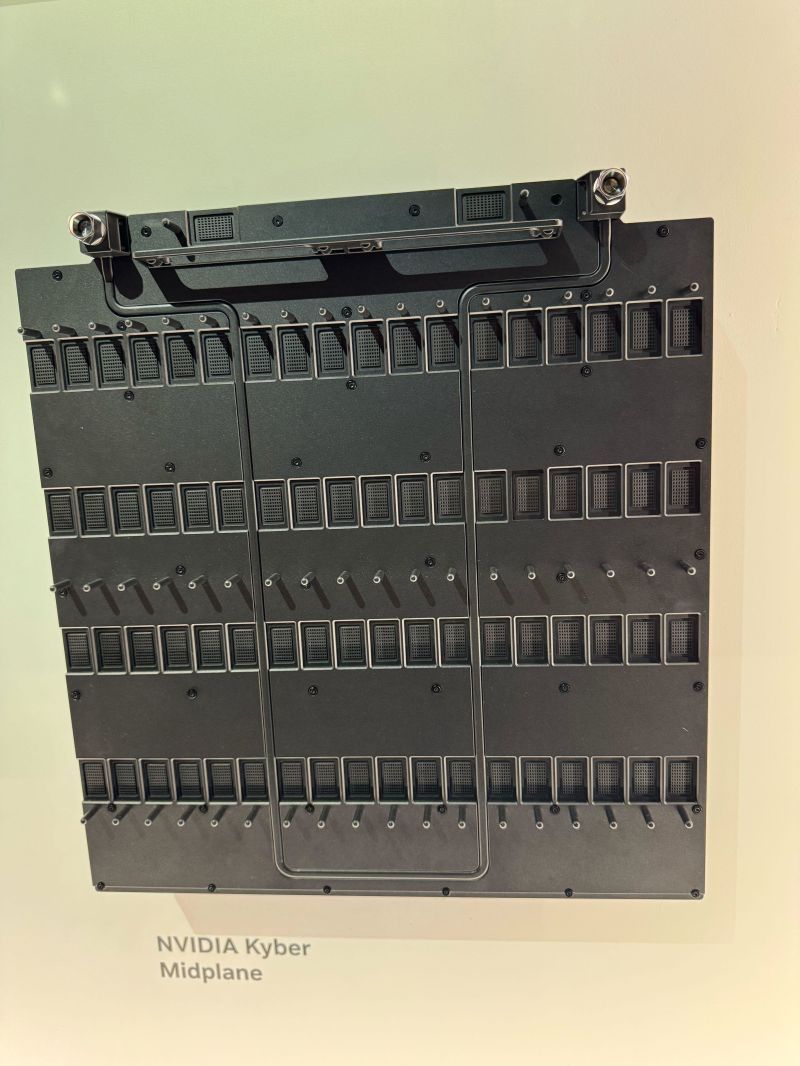
Kyber midplane is built from hybrid material system: M9-grade CCL Quartz/Q-fabric & PTFE (Teflon based) Anyone that's followed upstream supply chain can tell you scaling up production while maintaining quality of this is super challenging. combine this into 78-layer stack (lol, are they serious?) So, we have a serious issue right now w/ PCB micro drills where China's export control on Tungsten Carbide is strangling global competitors here. Now, we are going fro 40 layers to 78. Does Nvidia & other American companies ever think about supply chain security before they make these design decisions? There is a reason why HW stops at NPO for Atlas-960 & not go to CPO yet. So all the Nvidia hype boys, observe reality.
Kyber NVL144 rack architecture has been delayed to 2028 as the PCB midplane remains challenging from a manufacturability standpoint. NVL576, which connects 8x Oberon racks over CPO between the NVSwitches, is also likely delayed or restricted to small volumes given the current challenges with CPO. 2/6🧵
3
9
42
6,207
tphuang reposted
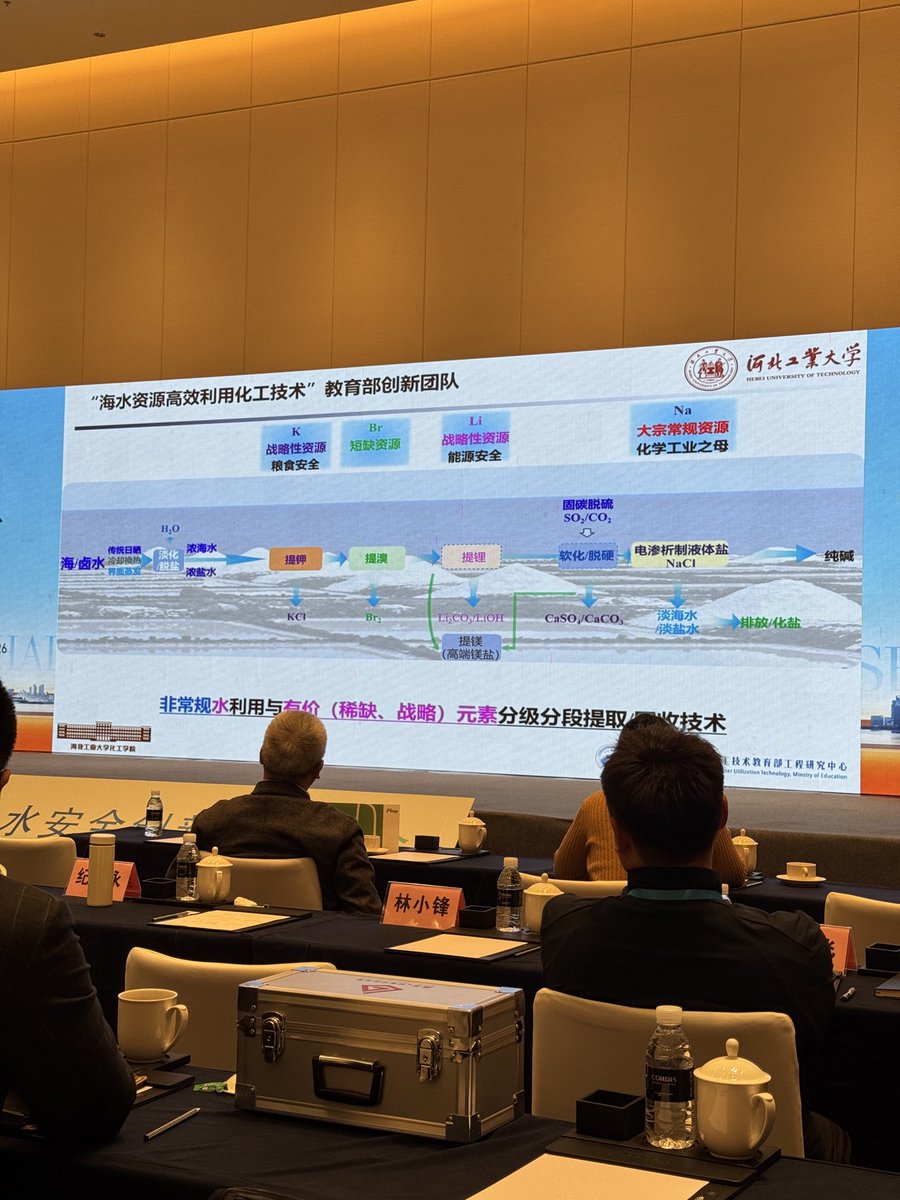
The other aspect of China’s desalination technology push that deserves a lot more attention than it gets is minerals extraction from waste byproduct recycling processes. Lots of great circular economy technology projects being worked on in China right now.
China's largest seawater desalination testing facility has completed testing of 1st batch of domestically produced positive-displacement rotor type energy recovery devices. China currently produces > 3mt of fresh water/day via desalination, growing 10-15% per yr. Goal here is just to get the cost down for further deployment & for export globally
3
27
126
6,970
The 5.15m long BYD Seal 08 has a 4.95m turn radius, similar to the much smaller Seagull. Note the agile movement it displays getting around tight spots. Modern tech is bringing luxuries tech features to a very fairly priced segment.
1
6
48
6,914
The 15th batch of SpaceSail satellites just launched today (20 sats got launched, 238 have been launched overall). We probably need 4 more launches to hit the 324 they planned by end of July. Things are speeding up.
1
6
53
4,668
Cover might be Denza / Bond; “Most annoying thing about owning a Chinese car been people who don’t own a Chinese car insisting I must secretly hate it,” says Will from Yorkshire, who switched from a Ford Fiesta to a BYD Dolphin. His new car, “basically does everything well”.”
Britain is one of the few rich countries to have resisted special tariffs on China’s electric vehicles. But it remains to be seen how many will park their Porsche in order to drive a Denza economist.com/britain/2026/0…
2
13
73
8,571
This is likely just the 1st step for global expansion. HW has mapped out Tau Scaling @ system scale for its AI product. Improvements include: UB latency to just 100ns Hi-ONE bandwidth expansion to 8 Tb/s & SerDes to 5cm 3D Folding of Optical I/O, power delivery to all be closer All this combine to map out 100x improvement in its AI systems over next few yrs, when it seeks to compete in h/w space vs US competitors
1
2
25
1,799
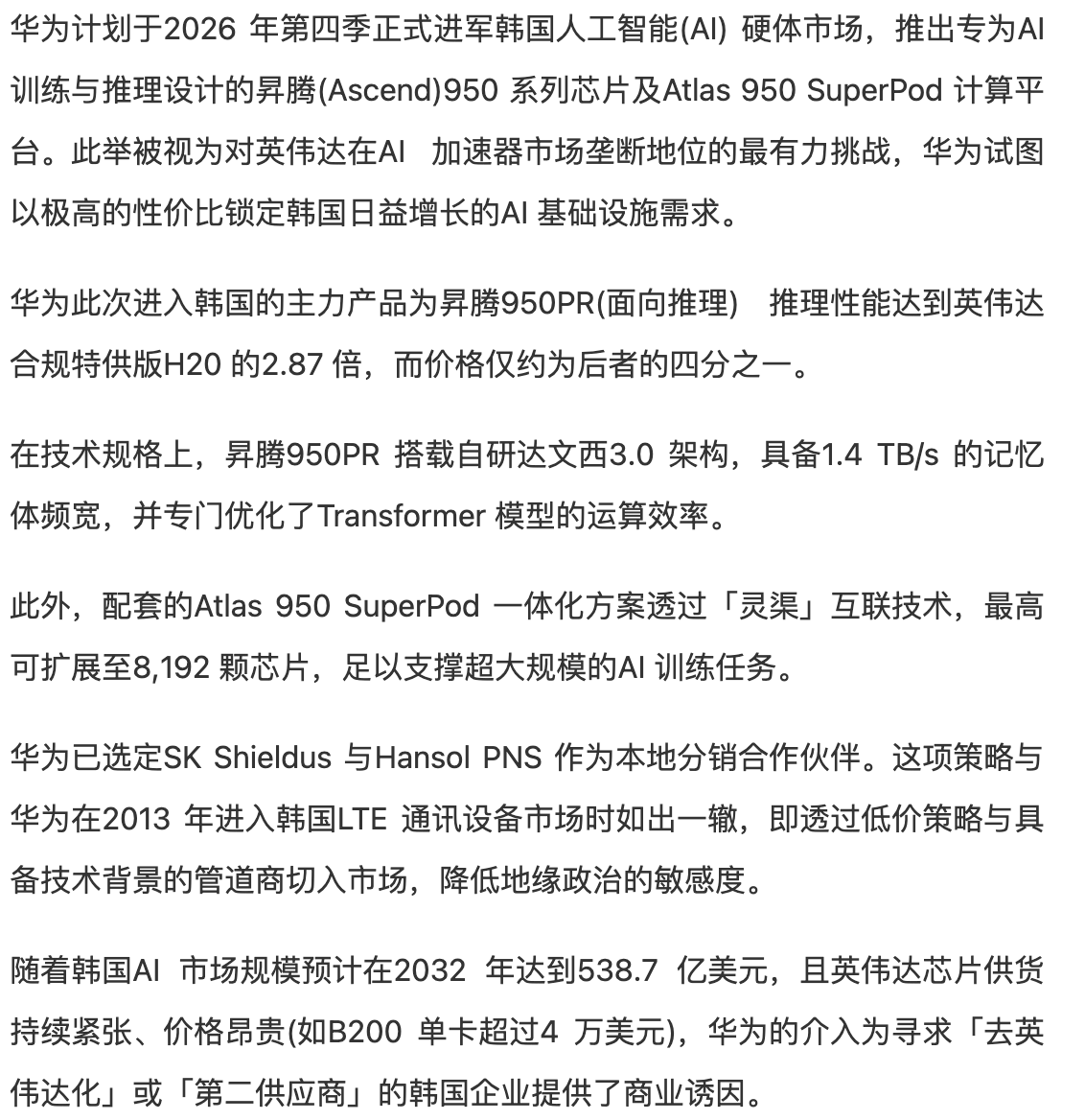
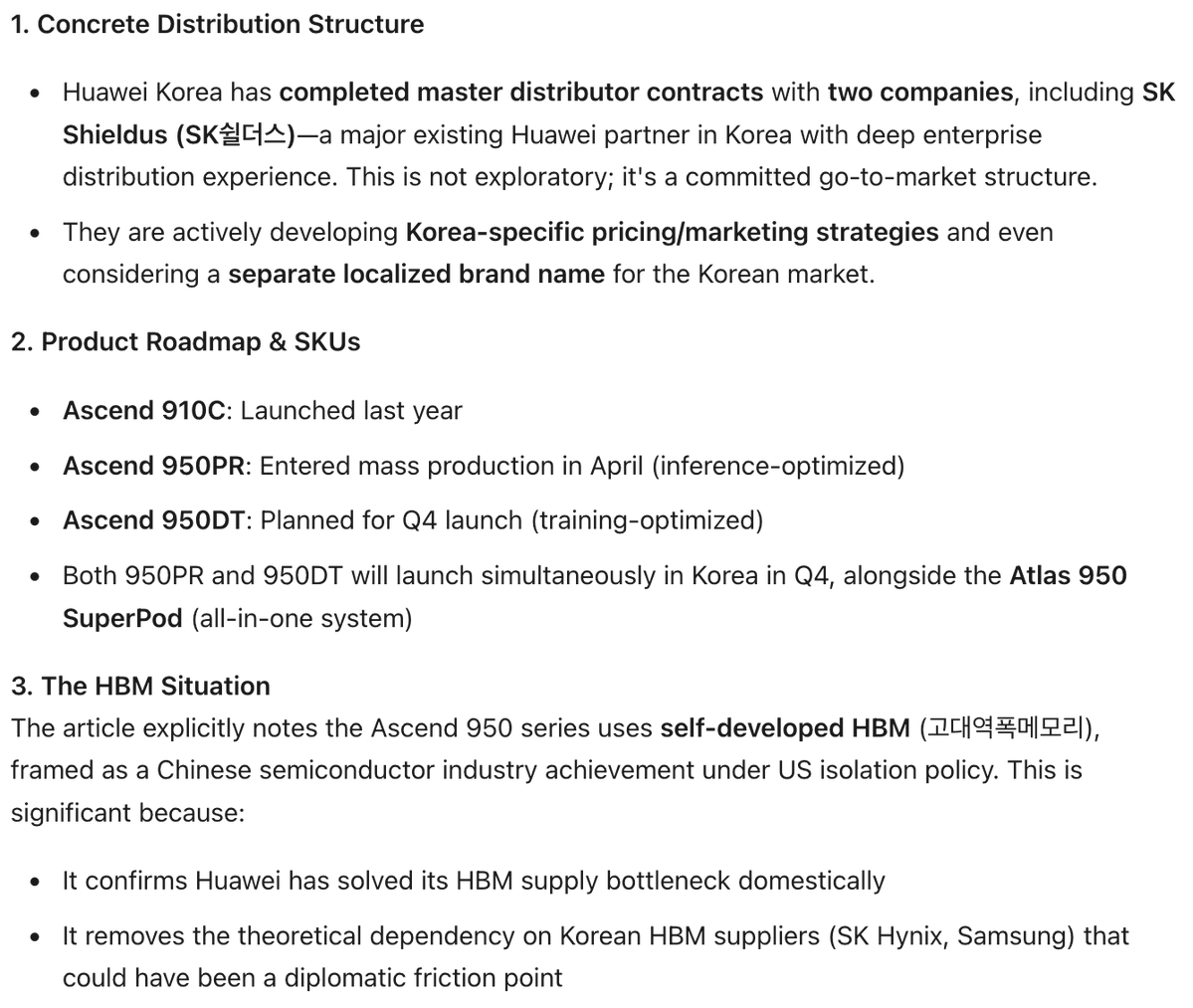
As HW seeks to expand Ascend/CANN globally, it's partnering up w/ SK Shieldus & Hanson PNS to enter Korean mkt. Apparently, Ascend-950PR is selling for 1/4 the px of H20, which would put 950PR @ 2.5-3K. If 950DT sells for $4k, then a 1024-card SuperNode might only sell for $5-6 million per unit. Given Nvidia's CUDA moat, HW's appeal outside China would have to come from improved s/w & kernel support as well as lower px. Since it controls large portion of Atlas SuperNode/cluster supply chain, it can probably control cost better than Nvidia & others.
1
8
78
8,484
tphuang reposted
A practical guide about how to choose a good restaurant using Dazhong Dianping (大众点评), which is China's main restaurant directory/review/coupon platform, based on my 10 years of experience using it almost daily... But first, some general background information: Thread.🧵
20
37
420
39,711
tphuang reposted
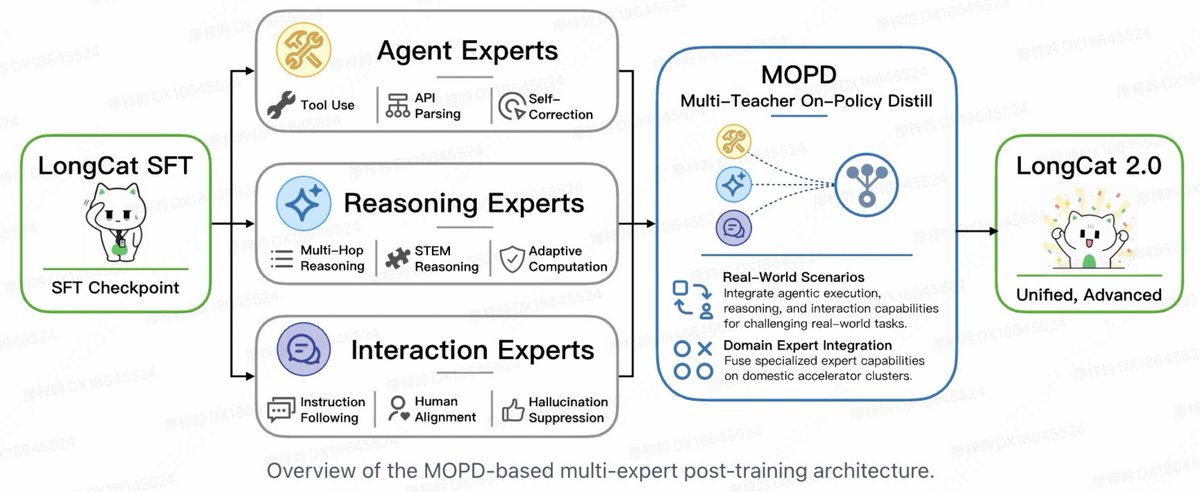
🐱 LongCat-2.0 is now fully open-source — MIT licensed, no restrictions. Since our launch a few days ago, the response from the community has been incredible. Thank you for all the feedback, discussions, and interest. Today, we’re releasing the model weights and inference code to everyone. ◆ 1.6T MoE · ~48B active · 1M token context ◆ Agent-native: Integrates directly with Claude Code, OpenClaw, and Hermes Agent ◆ Deployment: Support both GPU and NPU platforms— verified on large-scale domestic clusters 📑 Tech Blog: longcat.ai/blog/longcat-2.0/ 🤗 HuggingFace: huggingface.co/meituan-longc… 💻 GitHub: github.com/meituan-longcat/L… 🪄 ModelScope: modelscope.ai/collections/me… 👇 Inference Code GPU: github.com/sgl-project/sglan… NPU: github.com/meituan-longcat/S…
Introducing LongCat-2.0 🐱 1.6T parameters · MoE with ~48B active · 1M context The full model behind Owl Alpha on @OpenRouter — now available. Built for agentic coding from the ground up: ◆ LongCat Sparse Attention (LSA) — scales efficiently for 1M-context tokens ◆ Zero-Compute Experts — dynamic activation 33B–56B per token, zero wasted compute ◆ MOPD — three specialized expert groups (Agent / Reasoning / Interaction), gate-routed per task How it stacks up: → Terminal-Bench 2.1: 70.8 → SWE-bench Pro: 59.5 (GPT-5.5: 58.6) → SWE-bench Multilingual: 77.3 → FORTE: 73.2 · RWSearch: 78.8 · BrowseComp: 79.9 📖 Tech Blog: longcat.chat/blog/longcat-2.… Try it across different scenarios 🧵👇
89
259
1,904
327,413
China's largest seawater desalination testing facility has completed testing of 1st batch of domestically produced positive-displacement rotor type energy recovery devices. China currently produces > 3mt of fresh water/day via desalination, growing 10-15% per yr. Goal here is just to get the cost down for further deployment & for export globally
20
126
641
73,446
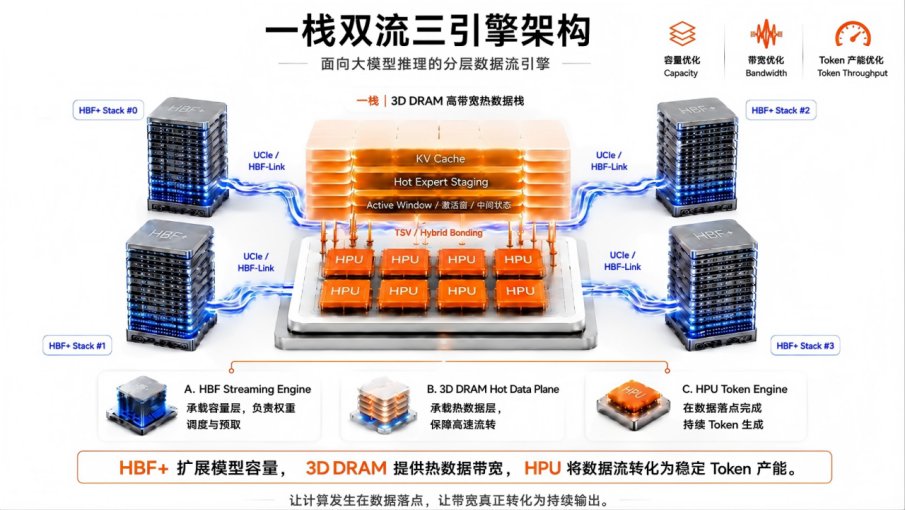
It's sometimes really hard to know which AI chip startup they are talking about. Most recently, Leadcore Semi demonstrated HBF design in partnership w/ CiMicro that combines High Bandwidth Nor Flash w/ 3D DRAM (for latter's RT KV Cache). the idea is significantly lowering cost of AI inference thru 3D Nor Flash. @ 28nm 180 Mb/mm2, single die is 16 Gb, multi die stacking to 16-32 GB/chip So significantly lower density than NAND, but lower cost & higher density than DRAM. In this case, the design is having KV on DRAM & weights on HBF . HBF clones HBM's physical packaging (TSV, Interposer & 12-layer, but at 1/10th the cost & power)
Chinese AI chip start-up emerges from stealth, uses 3D stacking to sidestep U.S. controls.
3
12
62
7,160
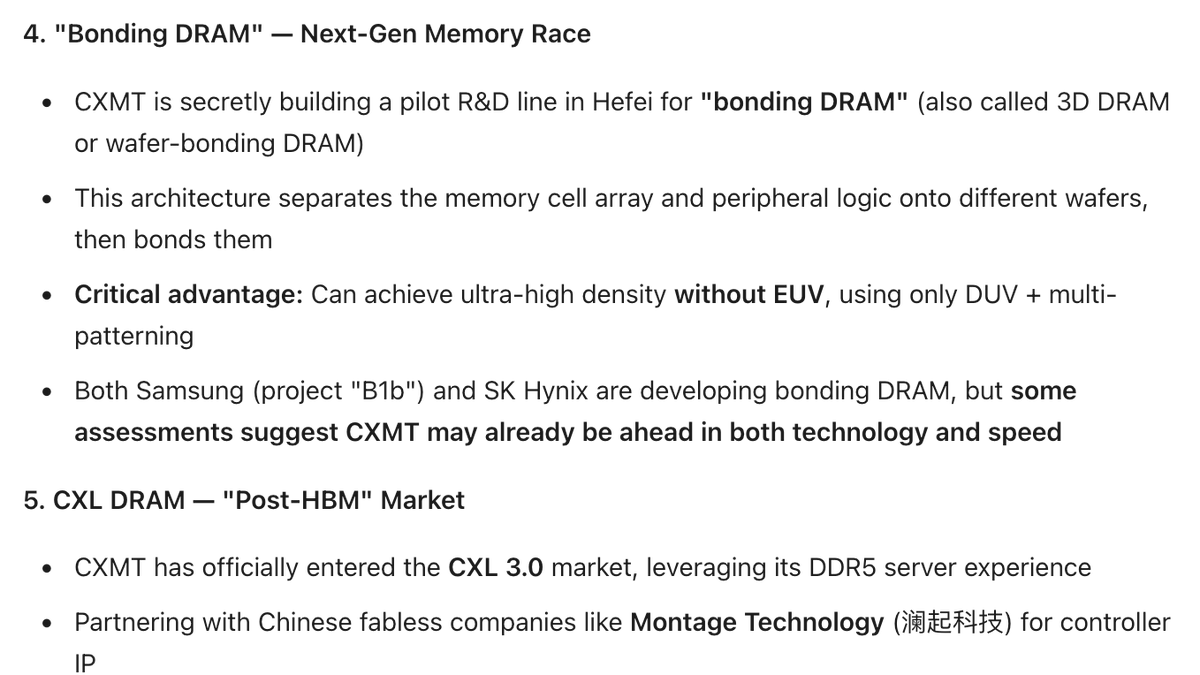
CXMT portion: 3D DRAM has been worked on for several yrs now. In terms of difficulty level: 3D NAND < 3D DRAM < 3D IC/circuit folding Eventually, DRAM cells can't shrink any further, so going 3D is the only possible solution. NAND made that switch at 18nm? DRAM likely at 10nm. CXL 3.0 is also something big 3 have worked on for a while, so completely logical for CXMT to get involved here. Keep in mind that for all memory cells, it just stops scaling at some pt, that's why we have to find new ways of storing them or going 3D. Hence logic folding of SRAM like HW is doing.

1
11
100
11,051
Iran conflict has really neutered brain cells of the blob. TW is fully energy dependent & 70% food dependent can easily be blockaded. Relies on supply chain from surrounding countries. Small island next to China that can be entirely covered by helicopters & persistent UAS. As usual, ppl take all the wrong lessons from other conflict. Every potential conflict has their own realities & you have to assess them based on reality of ground. And if you think that Taiwanese can go 2 month w/o electricity, Internet, fresh food & oil while facing persistent bombing & propaganda campaign, you have clearly never spent extended period of time there.
A sustained bombing campaign by 2 of the best air forces in the world with complete air superiority over the skies of Iran couldn't even get them to stop launching missiles and drones (same with the Houthis). Why would China be any more successful?
15
17
168
14,012
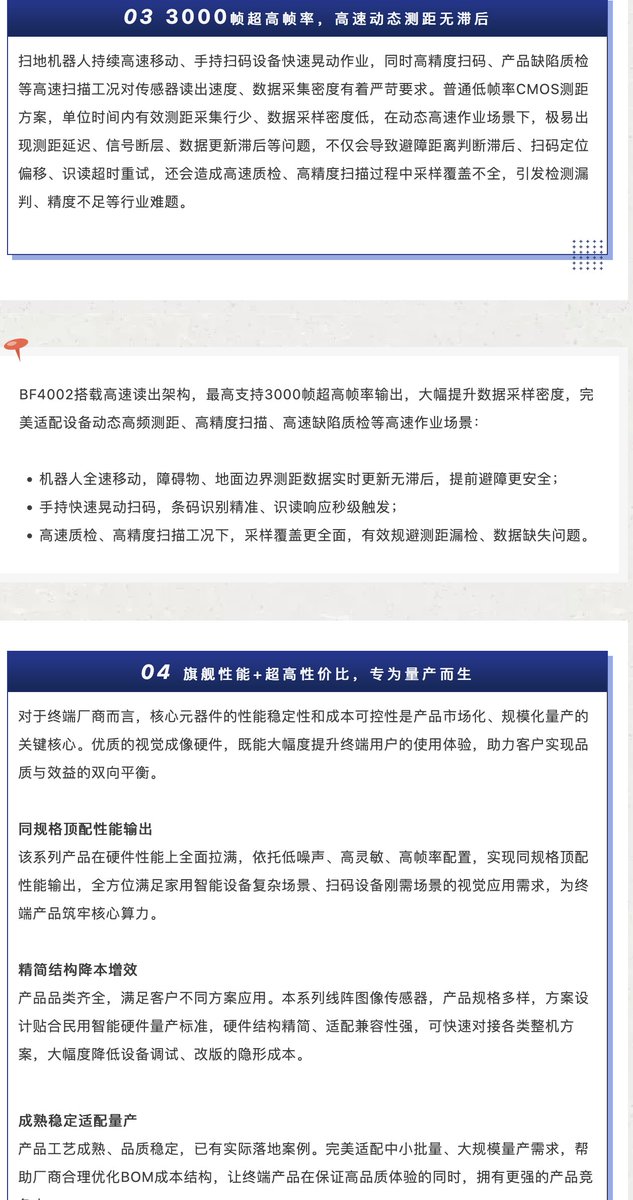
BYD also produces its own CMOS chips for both EVs & other applications. One type is line-scan CIS product for barcode scanning, robot vacuum & more Its most popular product BF4002 which has up to 3000 fps frame rate & 40% noise reduction vs competitor & 50% greater light sensitivity
1
8
68
4,971
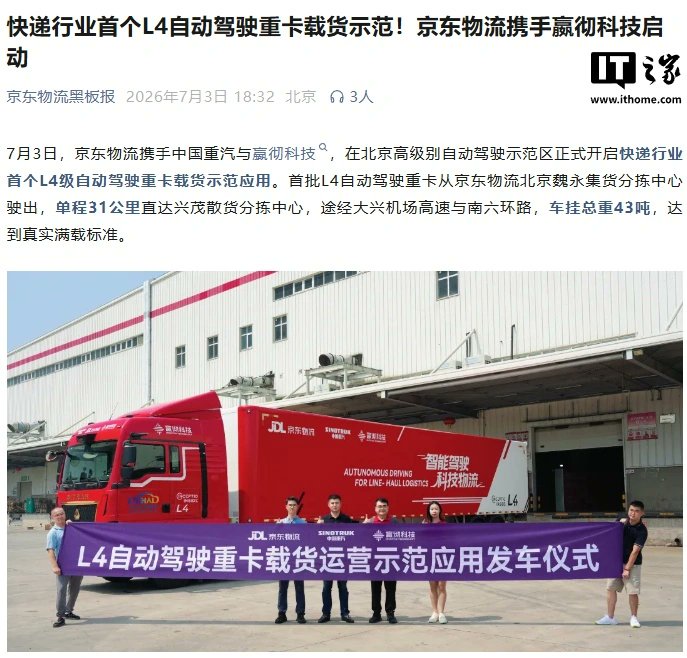
JDL reported here of operating L4 heavy truck cargo carrying 43t full load across 31 km to demonstrate its real world operational capabilities.
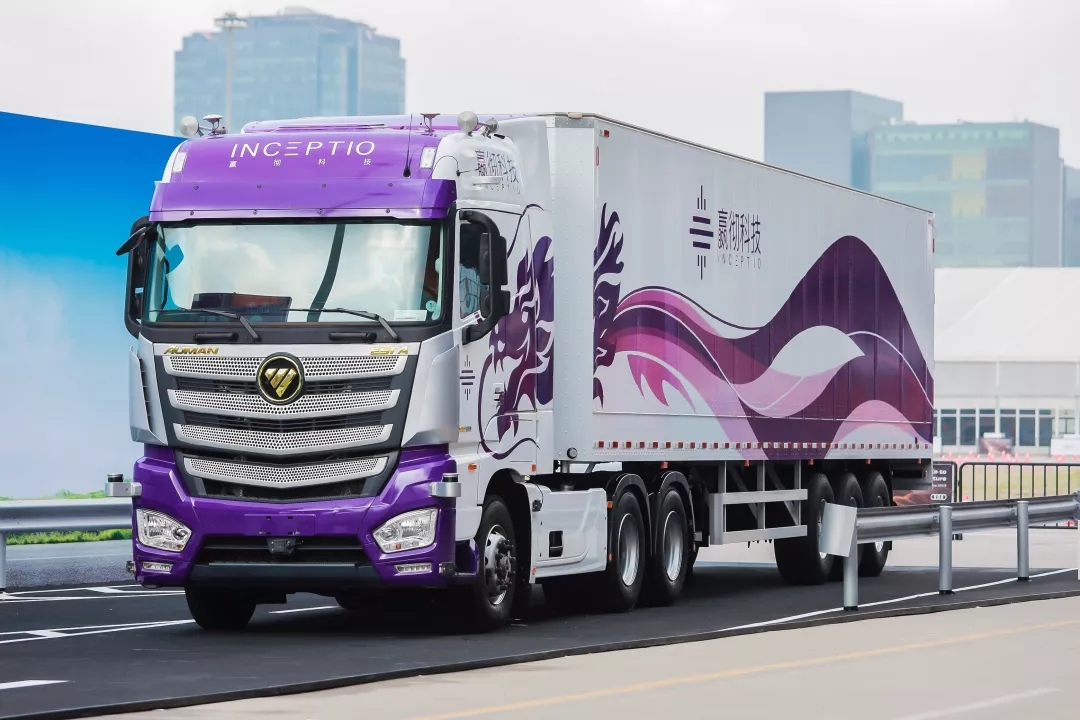
JD Logistics (京东物流) just launched the express industry's first L4 autonomous heavy truck cargo demo in Beijing. The 31km route from the WeiYong sorting center to XingMao runs on highways and ramps with a full load of 43 tons. The trucks use Inceptio's (嬴彻科技) L4 system with lidar, radar, and multi-cameras, backed by a three-tier safety system: onboard decision, cloud monitoring, and remote response. A safety driver remains onboard. JD Logistics has been building unmanned capabilities across the supply chain: 6th-gen "Lone Wolf" delivery vehicles, self-driving VANs, and over 100 drone routes. Last year it announced plans to procure 3 million robots, 1 million unmanned vehicles, and 100,000 drones over five years. This demo fills the trunk-line gap, extending unmanned logistics from last-mile to long-haul. What stands out is the convergence of hardware (Sinotruk chassis) and software (Inceptio stack) under JD's operational control. The three-level safety architecture is pragmatic for regulatory acceptance, but the real test will be scaling this beyond a single route while keeping costs competitive with human-driven fleets. $JD @JDdotcom
1
7
51
5,555
tphuang reposted
That is an incredibly fast iteration speed! Really impressive to see such rapid development from ZCode.Thanks for the recognition! We will continuously improve our software development quality and maintain this high-speed iteration.
2
1
46
4,320