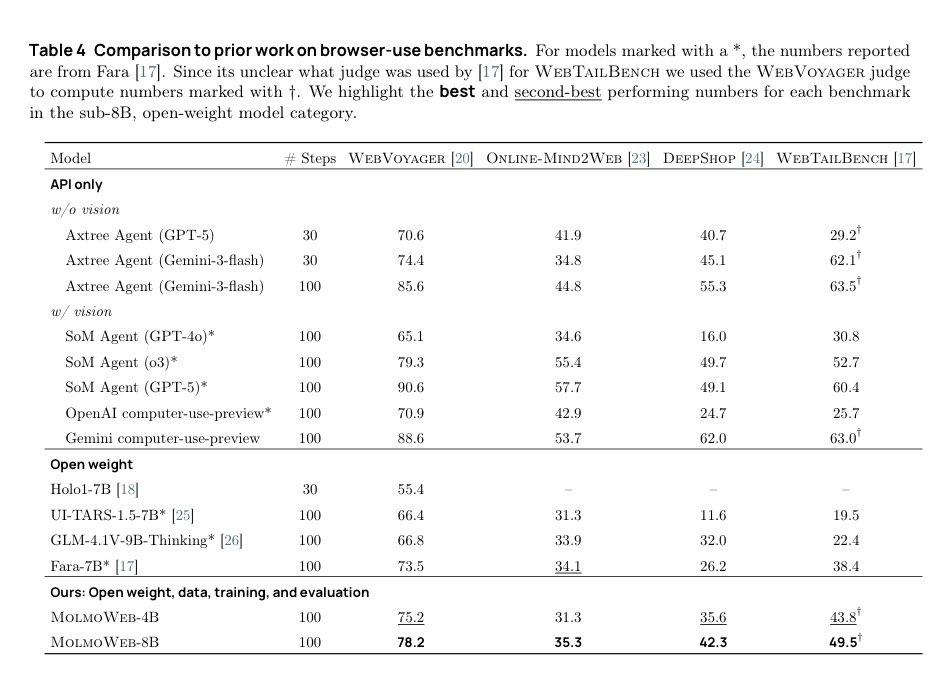


Great analysis below to support the hypothesis that “visual” web agents would generalize better than DOM / Axtree with concrete examples of when and how DOM fails the agent!
Intuitively, I find “visual” web agents more appealing for 3 reasons:
1. Humans have developed a universal visual design language for web pages. We generally know where to expect navigation bar, search boxes, social media links, T&Cs etc on any web page. We know that clicking on hamburger icons reveals more content, calendar icon in a form lets you choose a date using a grid of numbers, forms usually have a search or submit button nearby, and so on.
2. Market forces enforce visual homogeneity within a website category. For eg, a new shopping website is likely to look visually similar to other shopping websites so that it’s intuitive to use for online shoppers worldwide.
3. Code behind these visually similar web pages on the other hand could look very different depending on web frameworks used, programming choices, and quirks of the developer.
And to weigh in on the discussion about re-designing web exclusively for agents — to me it seems more likely that web would evolve to support “co-habitation” of people and agents. Re-designing the web solely for agents is the digital equivalent of terraforming Earth for robots instead of building humanoid robots that learn to exist alongside and assist humans in a world designed for humans.
The bitter lesson for web agents
The last 1 year has taught us a new bitter lesson that we think others are not yet grokking.
Agents that look at the web like humans (using screenshots of sites) navigate and generalize better than agents that read code (HTML, DOM).