cofounder @EngramLab | prev PhD @Berkeley_AI

Joined March 2013
51 Photos and videos
Pinned Post
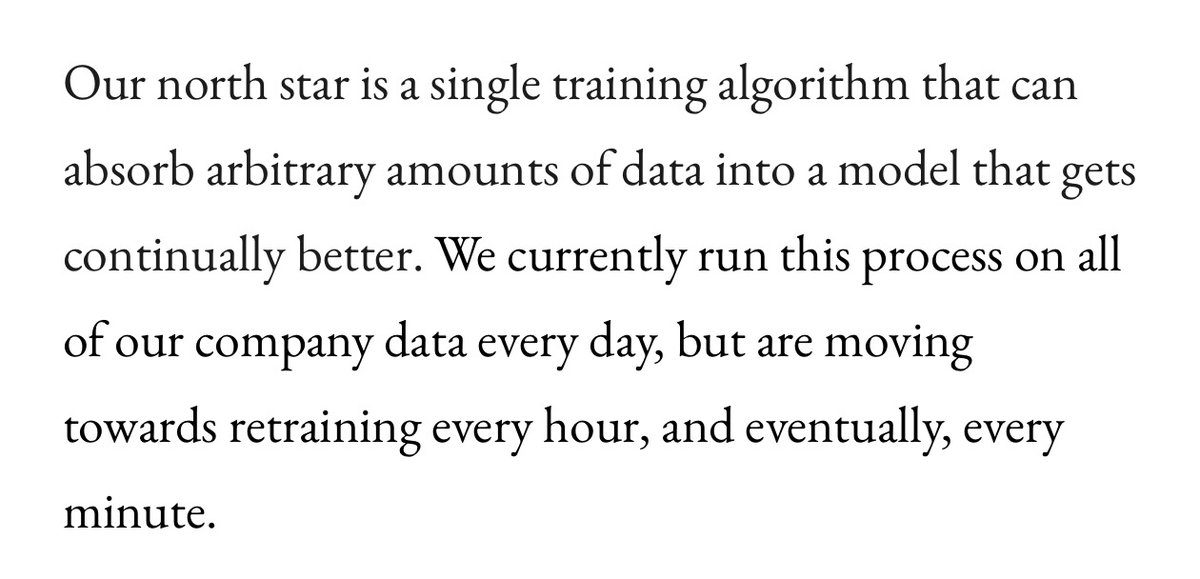
we started a company!! so, we’re tackling continual learning: what’s the learning algorithm to take arbitrary data — documents, conversations, the models’ own experience — and make better models? how do we scale compute in the same way we’ve already seen with pre-training and inference time, but scaling on the same data we see as humans, day after day with no labels, no rewards? A lot of the ingredients are out there already (rl, distillation, long-context, sparse / param-efficient architectures, etc.). our team is at the frontier of these topics, and we’re singularly focused on this. we want to understand this problem better than anyone else in the world. nobody’s solved this problem yet, but even today it’s extremely greenfield opportunity to co-develop research & useful products. in our space, how people interact with the models defines what the data distribution is - and working on this problem end-to-end, from core science to end user, gives us incredible freedom to define the problem and imagine new kinds of experiences. i expect we’ll use models that continually learn much differently than we’re using them today. it’ll feel different when the models _just know_, and build on our thinking and direction in ways we can’t even imagine. we don’t even know the queries we’re not asking, the things we would do but aren’t able to today. i’m so excited to share what we’re doing with the world in the coming months!! and the team is extremely cracked :) tackling this grand challenge and working alongside @jxmnop @EyubogluSabri @dan_biderman @MayeeChen @__howardchen @shizhehe and many others has made every day so fun. come work with us!
70
52
672
104,692
Jessy Lin reposted
Claude Science is incredible. I gave it some sequencing data, and in 8 hours it did a full analysis, generated figures, wrote a paper, submitted it for publication, got rejected, revised and resubmitted, got rejected again, it is now applying for positions in industry
101
681
9,119
483,272
Jessy Lin reposted
this is insanely cool. engram is pretty much working on a model that can improve itself through every interaction across *all* users which will likely be the single biggest capabilities jump since o1-style chain of thought reasoning
4
4
71
11,439
Jessy Lin reposted
A great team working on an important problem.
2
7
112
37,573
Jessy Lin reposted
I've spent my PhD figuring out how a model learns from data, digging through piles of Spanish math problems, fanfiction, and the depths of StackExchange. Engram opens a new dimension: how a model learns from you - your world, how it evolves, and the threads that tie it all together. Figuring out how to do this well is a wide-open research problem. Join us :)
21
22
178
25,229
Jessy Lin reposted
finally sharing what i've been up to! left phd end of 2025 and co-founded Engram. there are a few startups in SF right making very different bets on the right way to train AI models. this is ours: people want models that learn over time, remember details, adapt and interact like a person would everyone gets a model. your model updates ~every minute. this is the world we're building. :)
118
97
1,541
325,538
Jessy Lin reposted
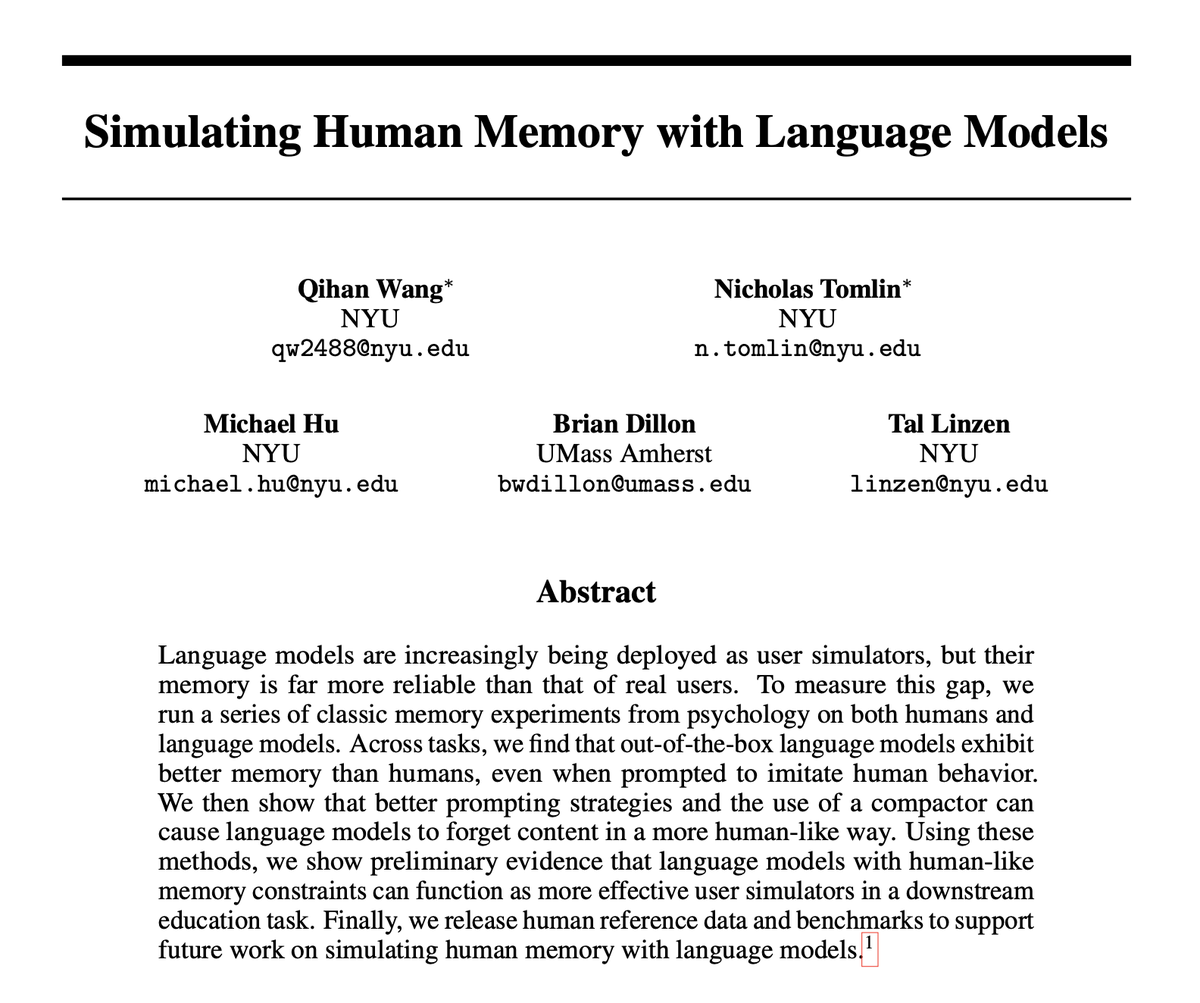
New paper! LLM memory keeps improving, but this makes them *worse* as user sims. If we want to build models that can, e.g., simulate realistic students to train chatbots to be better teachers, then these models need to be able to forget like humans do 📄: arxiv.org/abs/2605.25680
15
71
465
47,257
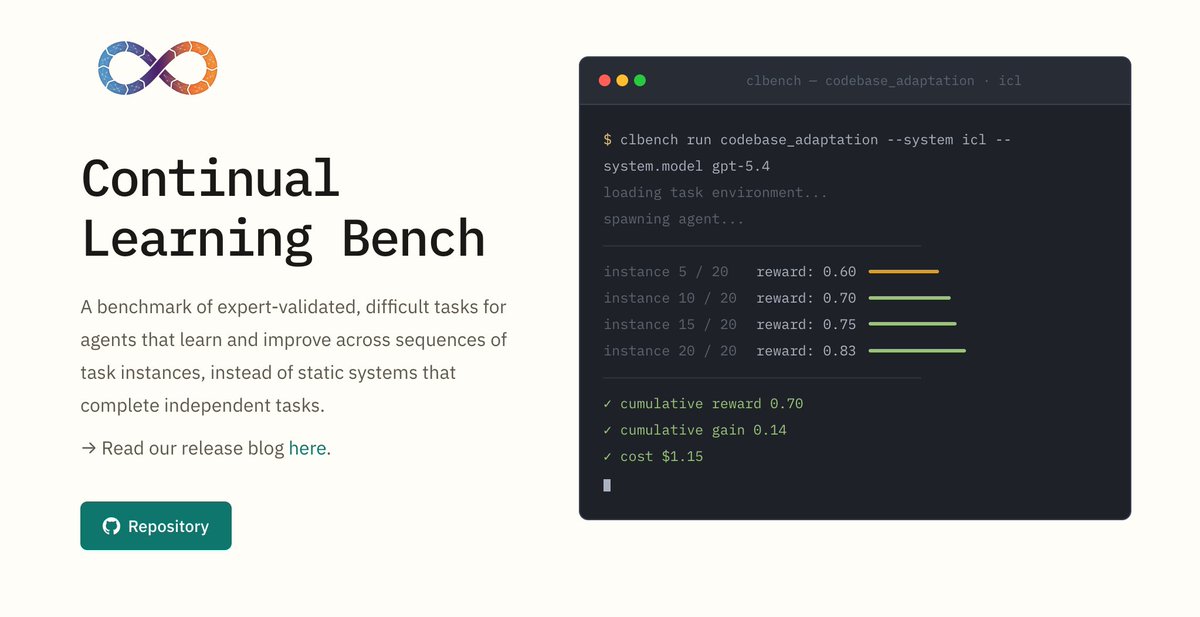
Building a good benchmark for continual learning takes a lot of thought -- it's non-trivial to make it hard in the ways that matter. excited to see people working towards this
Today, we’re releasing Continual Learning Bench 1.0: the first, realistic benchmark for measuring how AI systems can improve in online settings. Benchmarks today assume models are stateless. Each example is independent, and once a system finishes a task, it moves on as if nothing happened. But deployed AI systems should learn from experience. We tested 10 frontier systems against novel, expert-validated tasks and find there’s still plenty of headroom for learning. (1/n)
1
3
33
5,475
Jessy Lin reposted
Imagine every pixel on your screen, streamed live directly from a model. No HTML, no layout engine, no code. Just exactly what you want to see. @eddiejiao_obj, @drewocarr and I built a prototype to see how this could actually work, and set out to make it real. We're calling it Flipbook. (1/5)
1,146
3,743
28,884
5,992,333
you too can believe in what you're making (fried chicken)
I’m obsessed with people who are obsessed. This is what true product obsession sounds like:
8
1,579
Jessy Lin reposted
Here's a plausible positive scenario that doesn't require many further AI advancements. I wanted to clearly paint the path "from here to there" instead of hand-waving so it starts out negative but ends positive (I swear): A recession leads to slowed hiring and a breakdown of the early-career ladder. The political window opens for industrial policy on AI: governments encourage firms to launch apprenticeship programs to bridge the training gap between junior and senior white-collar roles, instilling discernment and judgment of AI outputs. Programs help reshuffle people with clerical jobs into education (especially elementary and middle school 1-1 tutoring) or nursing (and given AI tools to upskill into providing clinical care). Those with a risk-taking or strategic bent become entrepreneurs and executives overseeing AI agents. Industrial policy is important, but AI also helps to decrease regulatory and compliance burdens on construction; this sector expands, and the built environment starts improving (e.g. high speed rail becomes more possible). Later on, material abundance (robot manufacturing) means that goods are cheap and easier to manufacture domestically. Most people's spending is therefore on human-led services, today's luxuries. For example, high quality education: schooling in many places (including the US) has historically been low quality for most, with many knock-on effects. 1-1 personal attention by human teachers (for younger students) AI personalized tutoring (for older students) bridges this gap. Everyone is healthy: cheap AI triaging of medical issues lowers the barrier to preventative as well as life-saving care. Entrepreneurship is enabled by easy access to AI agents. The bar for customer service is raised all-round (high-end retail and hospitality services, like what you see in Japan). Everyone works 3-4 days a week. Baumol's cost disease is a feature not a bug: the relative expense of human services stops being a budget problem and starts being a labor market solution. That is where the jobs are, and they're jobs worth having.
The AI labs have actually done a bad job explaining what the future they are building towards will actually look like for most of us. Even “Machines of Loving Grace” has very few well-articulated visions of what Anthropic hopes life will be like if they succeed at their goals.
27
46
387
77,704
amaazing blog post. now it's so easy for anyone to put their mental imagery on the page
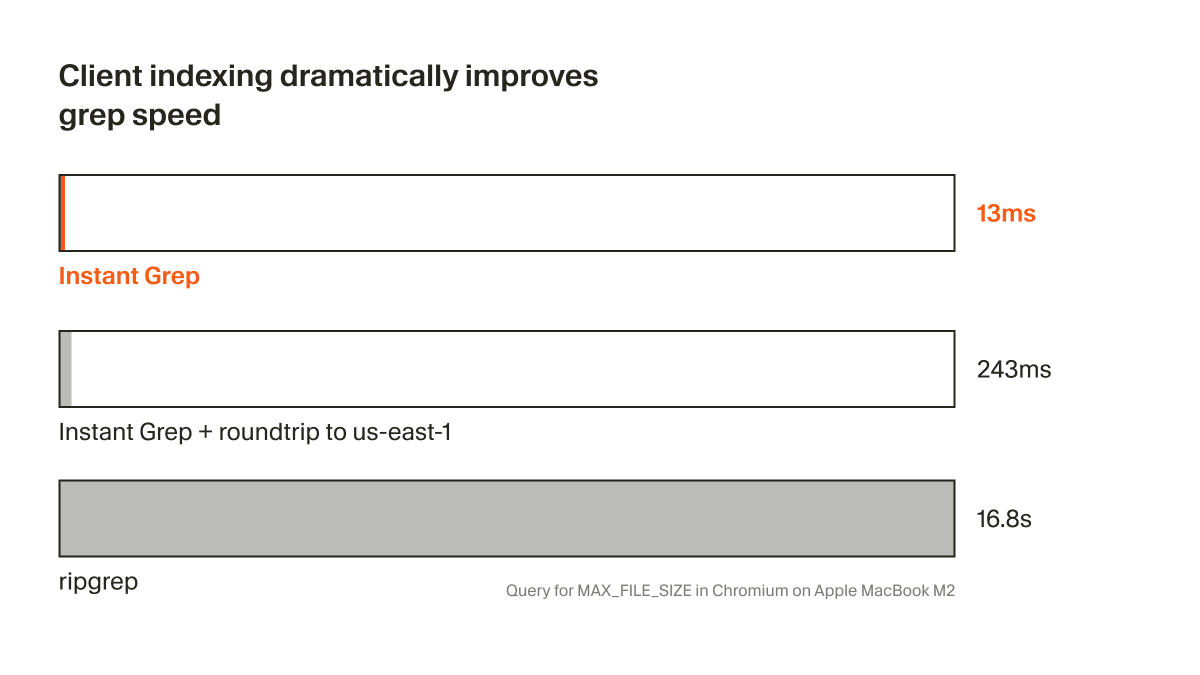
Cursor can now search millions of files and find results in milliseconds. This dramatically speeds up how fast agents complete tasks. We're sharing how we built Instant Grep, including the algorithms and tradeoffs behind the design.
2
56
10,173
inner loop science, outer loop art
taste is a new core skill
19
2,718
Jessy Lin reposted
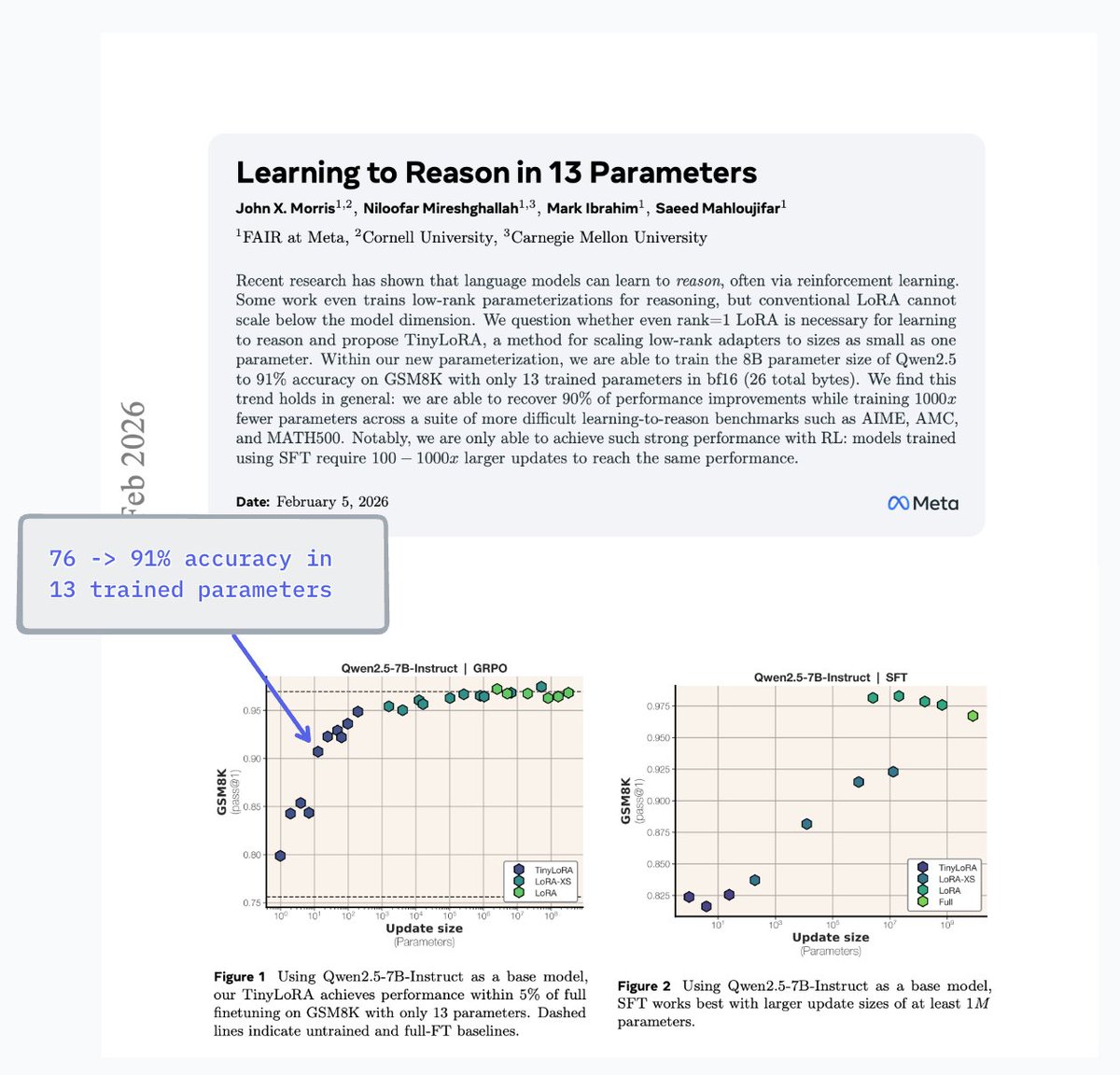
at long last, the final paper of my phd 🧮 Learning to Reason in 13 Parameters 🧮 we develop TinyLoRA, a new ft method. with TinyLoRA RL, models learn well with dozens or hundreds of params example: we use only 13 parameters to train 7B Qwen model from 76 to 91% on GSM8K 🤯
60
230
2,047
182,773
Jessy Lin reposted
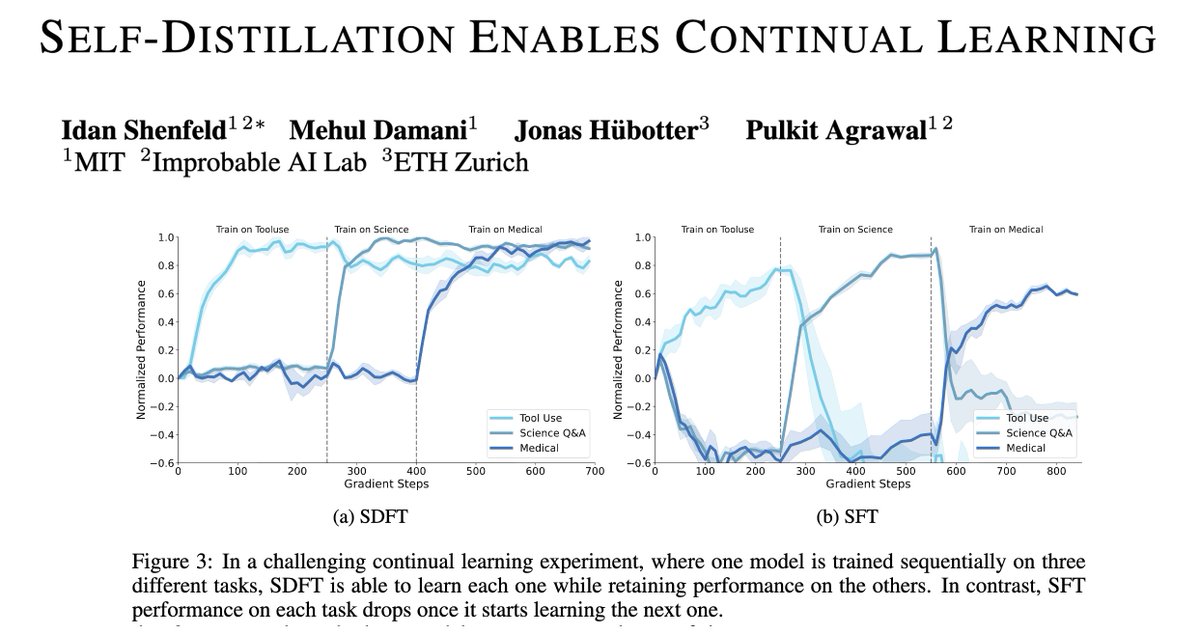
People keep saying 2026 will be the year of continual learning. But there are still major technical challenges to making it a reality. Today we take the next step towards that goal — a new on-policy learning algorithm, suitable for continual learning! (1/n)
50
224
1,511
240,160
Jessy Lin reposted
we choose to do this not because it is easy, but because it is fun as hell.
15
24
268
14,202
the plot thickens ... (in our understanding of memory in sparse layers vs. dense MLPs!)
I really liked this new paper which finds that dense MLPs from transformers can be distilled well into much sparser MoEs. This makes it a bit less surprising that gradient-based attribution on dense MLPs shows only a few neurons are responsible for the bulk of behaviour. arxiv.org/abs/2512.18452
1
47
12,017
Jessy Lin reposted
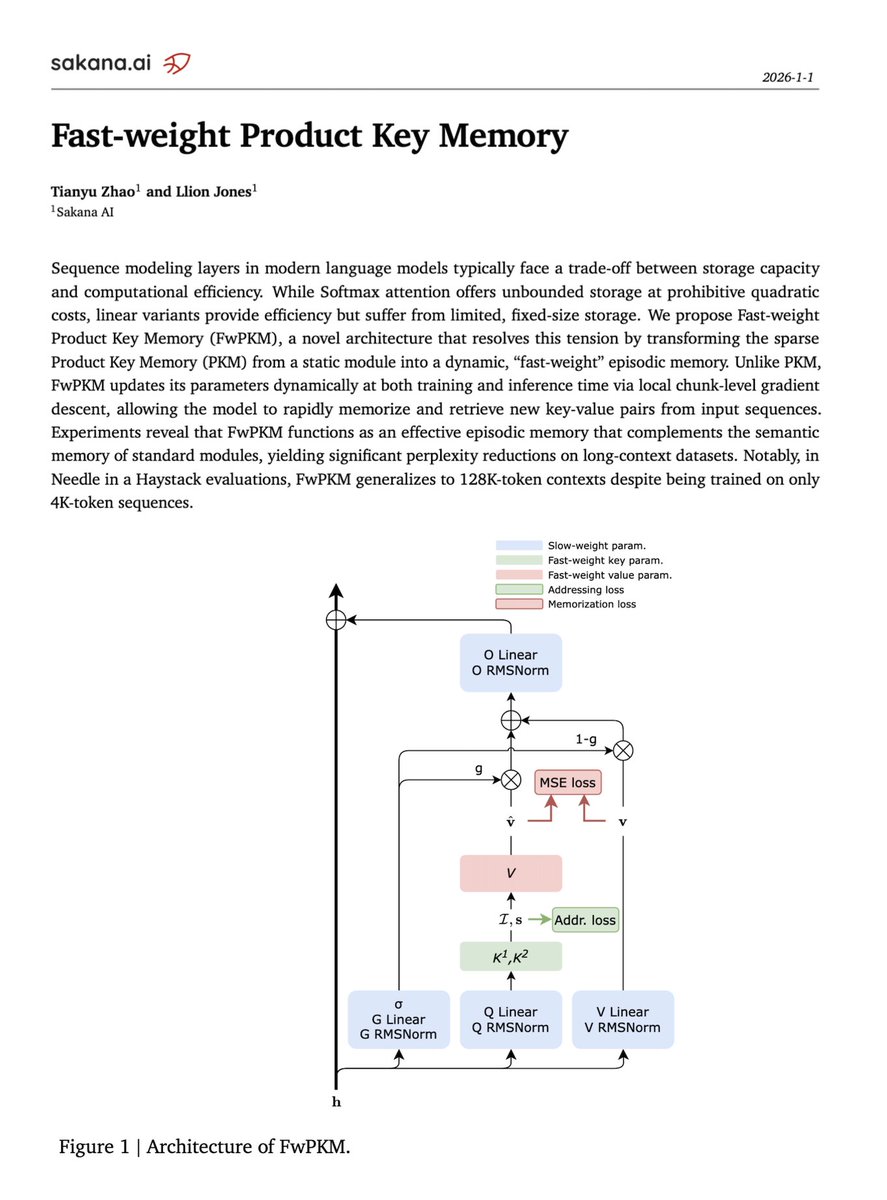
New research from Sakana AI "Fast-weight Product Key Memory" So the classic Product Key Memory (PKM) layer (a sparse key–value memory module used alongside attention) is a huge sparse memory, but it’s "slow" weights, where it is trained once, then frozen at inference, so it can’t memorize new info at deployment. Sakana AI's FwPKM makes PKM writable at test time: it does small chunk-level gradient updates to write key value “episodes”, then retrieves them with product-key lookup. This adds an episodic memory layer that stays effective far beyond training context (4K -> 128K) and helps when relevant info is separated by thousands of tokens.
15
112
653
47,718
great post, and I generally find this way of reasoning about "limit cases" and things that should be true in principle to be really valuable for thinking about what approaches to "memory" and continual learning make sense in the long term (out of a huge and heterogenous design space!) > repeated data: when humans see the same piece of experience over and over again, we eventually stop updating -> what kind of update algorithm would make this true? > integration into existing concepts: if someone tells you they're from Michigan, your representation of Michigan should also change -> what kind of representation/parameterization would make this true?
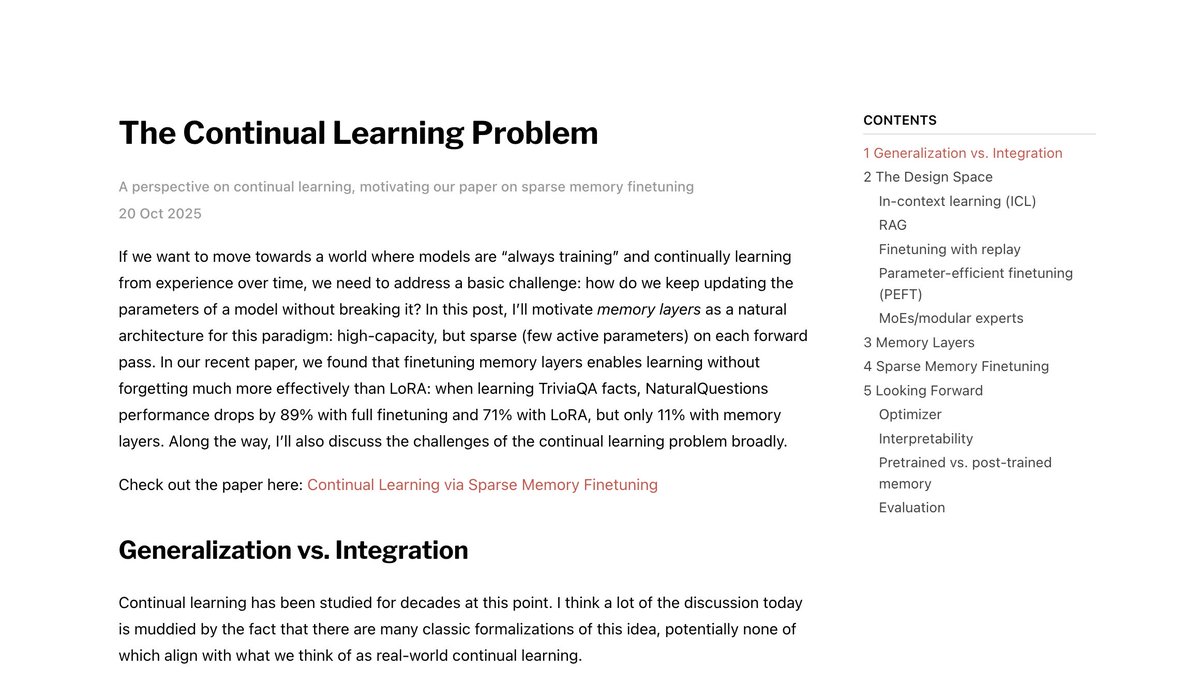
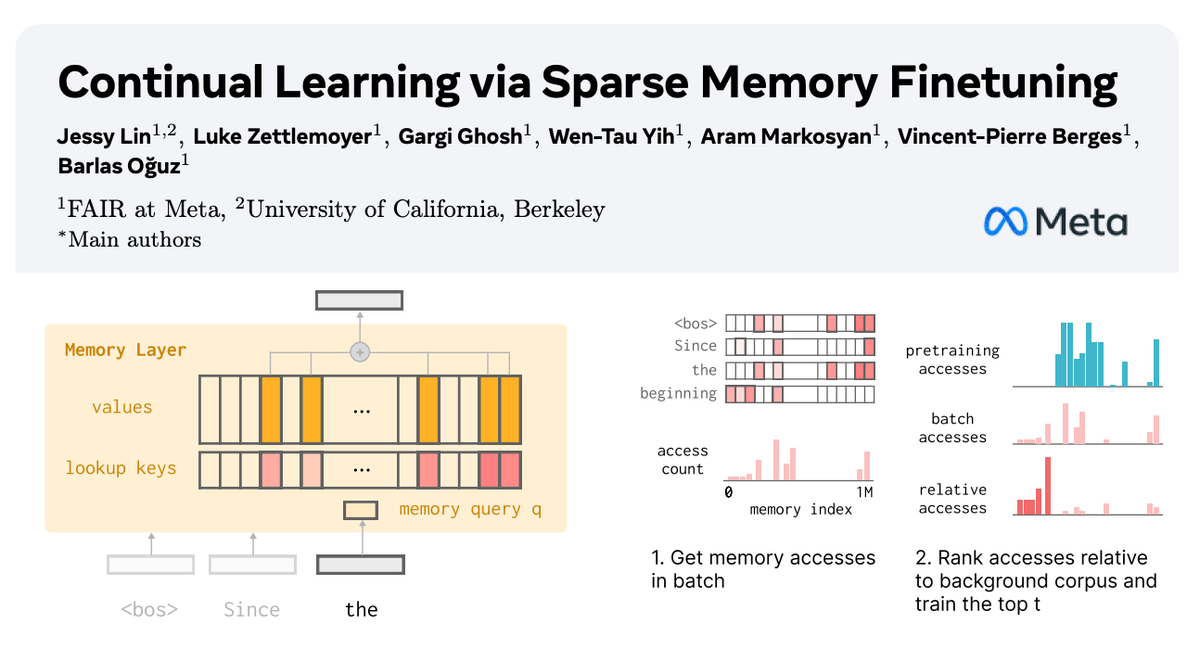
I have a bunch of thoughts about continual learning and nothing to do with them (I'm working on something else) so I figured I'd just turn them into a post: First: I think people use "continual learning" to point at a cluster of issues that are related but distinct. I'll list the issues and then speculate about what might fix them. a) Catastrophic Forgetting: If you train on a distribution D_1 and then do SFT on another distribution D_2, you'll often find that your performance on D_1 degrades. The extent of this issue is maybe overstated and is more true for SFT than for RL, but it's still real. There's also an important limit case that IMO is a "smell" for the way we train models currently: repeated data can seriously harm model performance. Humans don't have this problem - they eventually just stop updating on redundant information. b) No integration of new knowledge into existing concepts: If I tell you that I'm from Michigan, you will update your representation of me to include that fact, but you will also change your representation of Michigan. Michigan becomes "a place where someone I know is from". If people ask you questions about Michigan in the future, you may answer those questions with this knowledge in mind. If I tell a chatbot that I'm from Michigan, that fact may get stored in a memory file about me, but it won't affect the model's representation of Michigan. c) No consolidation from short-term memory to long-term memory: Models are good at accumulating information in context up to a point, but then they run out of context (or effective context) and performance degrades. They are missing a mechanism for deciding what's important to retain and then taking action to retain it. d) No notion of timeliness: When you tell a human something, they also retain *when* they learned it, and that "time tag" becomes part of the representation. Humans experience a stream of facts unfolding through time. As a result we form an implicit model of history/causality. Many people can answer "who is the current Pope?" without doing a special search step. Now that we've enumerated the issues, we can think about solutions. In AI it's always worth asking why the simplest solution can't work. The very simplest thing to try is what chatbots currently do: maintain a text file of memories. IMO it's obvious why this is unsatisfying relative to what humans are doing, so I won't dwell on it. I expect there are many refinements you could make here around learning to manually manage the text file, but I also expect these approaches to be brittle. A slightly smarter thing that's still pretty simple is to just keep updating the model during deployment. I actually do think that something like this could work OK, but we probably need a few tweaks. Some combination of the following seems worth pursuing: 1. Sparser updates: Catastrophic forgetting is plausibly worsened by updating all parameters at once. I'd bet either selective parameter updates or making the models themselves sparser could help a lot here. @realJessyLin has some nice work here. 2. Update only on surprising data: Updating on every new datapoint feels wrong. We want a mechanism that decides what’s important/surprising and only updates on that subset. A crude version: automatically generate questions about a datapoint and only update if the model fails to answer them. The hippocampus also has interesting mechanisms for doing this that seem worth trying to emulate. 3. Don't train on the raw datapoint w/ the standard objective. Given that we've decided a datapoint is surprising, I don't think we should just train on it using the standard objective. We may want to automatically generate questions about a given corpus and train on the answers (as in e.g. the Cartridges work) and we may also want to modify the objective. One option is to do prompt distillation with the facts in context - the intuition being that the consolidated model ought to answer the question as though it has the facts on hand. These are "in-paradigm" approaches compatible with LLMs. I bet they’ll yield real progress, but I’m also starting to suspect something less in-paradigm may be needed for a really satisfying solution. That’s for a different post though.
1
1
12
3,767
Jessy Lin reposted
Today, we present a step-change in robotic AI @sundayrobotics. Introducing ACT-1: A frontier robot foundation model trained on zero robot data. - Ultra long-horizon tasks - Zero-shot generalization - Advanced dexterity 🧵->
430
639
5,388
2,045,753