High fidelity research

Joined November 2023
1,084 Photos and videos
Pinned Post
Reinforcing Recursive Language Models Can a 4B model learn to recursively call itself to answer hard long-context questions? We RL fine-tuned a small model to behave as a native RLM. On evidence selection across scientific papers, our 4B RLM matches Sonnet 4.6 in quality while running significantly faster and cheaper.
16
74
528
78,984
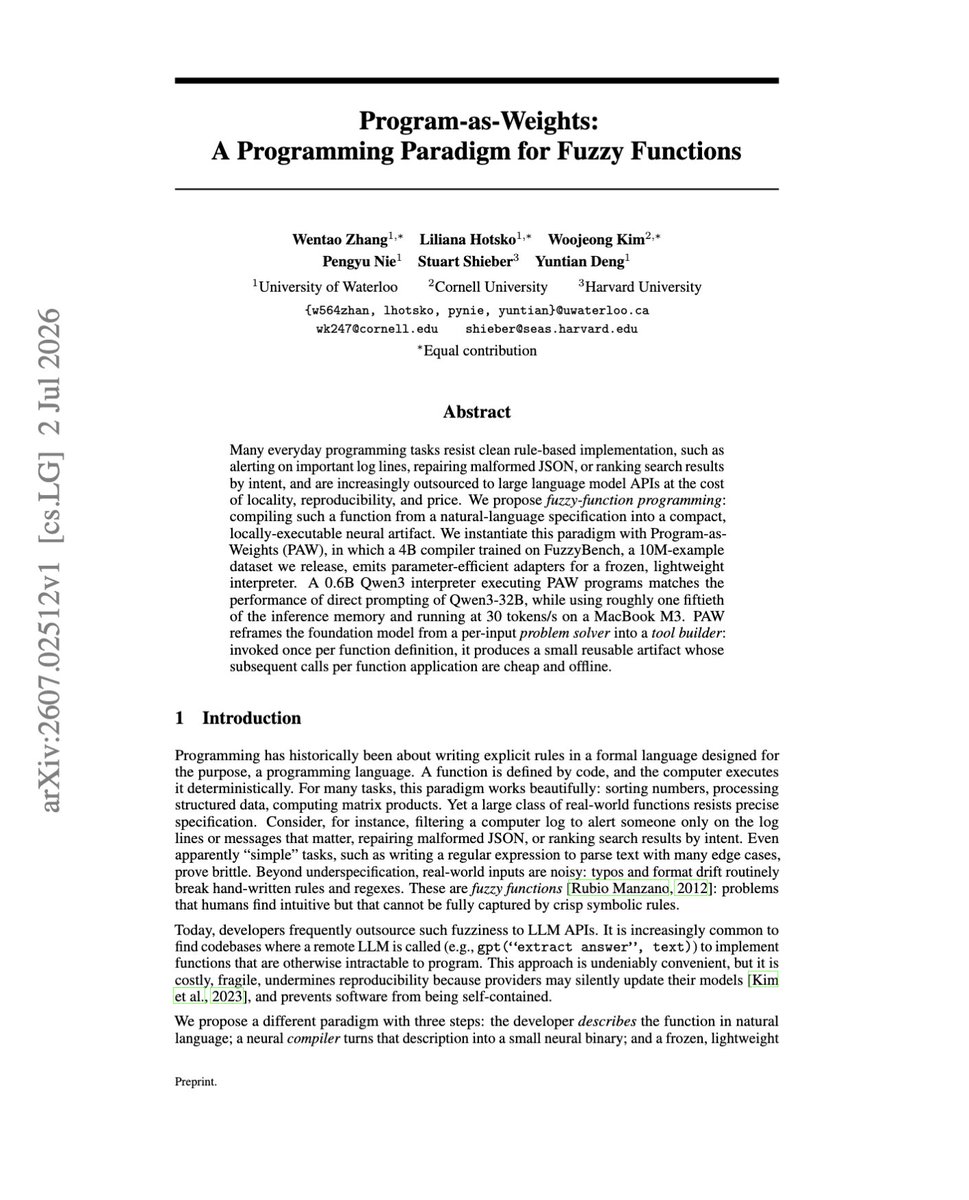
“Program-as-Weights” LLMs are great at fuzzy functions like log triage, JSON repair, and intent classification, but calling a big model on every input is slow, expensive, and not local. This paper compiles the fuzzy function once from a natural language spec into a small neural program, a pseudo-program plus a LoRA adapter. A frozen 0.6B interpreter then runs it locally, matching Qwen3 32B prompting on FuzzyBench while using about 50x less inference memory and running around 30 tok/s on a MacBook M3!
6
25
221
16,592
"RubricEM: Meta-RL with Rubric-guided Policy Decomposition beyond Verifiable Rewards" This paper trains research agents by making them generate their own rubrics before they start working. So the agent uses the rubric to plan, search, review, and answer, while the judge uses stagewise rubrics to reward each part of the trajectory instead of giving one final score. The agent then turns judged attempts into new rubric-based lessons, so future tasks can reuse what worked and avoid what failed.
6
21
122
7,118
"Efficient and Trainable Language Model Test-Time Scaling via Local Branch Routing" This new paper lets LLM preview its short term future before deciding what to do. Their key idea is simple: choose the next token with preview, route, then commit. So the model gets a small amount of branching at every token, tries a few possible next steps, looks at where each one would lead, then chooses the best branch to continue. This improves math reasoning over CoT, standard RLVR, and soft-token branching, while staying efficient and trainable.
8
21
204
11,675
"Is One Layer Enough? Training A Single Transformer Layer Can Match Full-Parameter RL Training" RL post-training usually updates every Transformer layer, but the gains are not spread evenly through the model. Especially with how most of the improvement comes from a few middle layers, sometimes training just one layer matches or beats full-parameter RL. So this paper turns it into a simple recipe. By training or boosting the high-contribution middle layers, they show that you can outperform standard full RL with fewer changes.
7
97
687
270,043
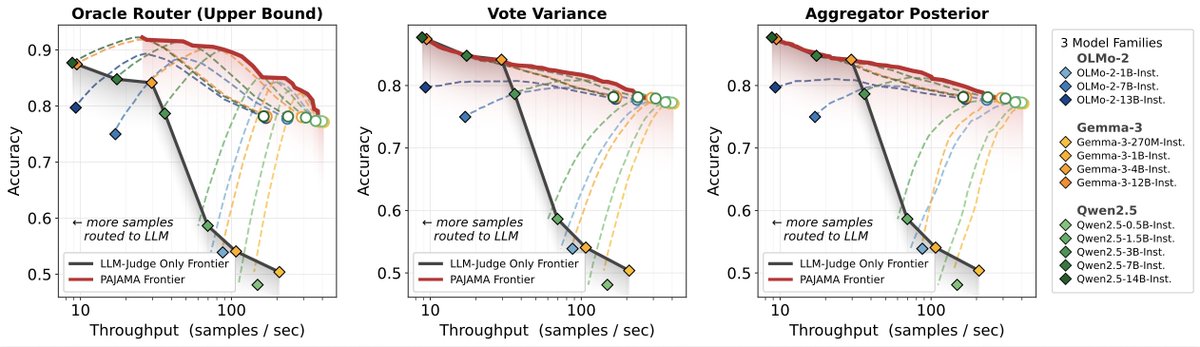
LLM-as-a-judge is now everywhere for automated evaluation. But it can be slow, expensive, and opaque. What if we ask the judge for its rubric once, and execute that logic as a program? Introducing PAJAMA—a new hybrid evaluation system that pushes the LLM-judge Pareto frontier! 🚀
7
36
255
28,638
alphaXiv reposted
🎉 Come check out our work at #ICML2026! Normalization layers can slow sparse neural network training by skewing gradients. We introduce SparseOpt to fix it and speed up convergence. Details in thread 👇
[1/5]🧵 🔍 Normalization layers have become ubiquitous in modern deep learning architectures, but do they always improve training? In our #ICML2026 paper, we show that, in sparse neural network training, Normalization Layers can actually hurt optimization and slow down convergence. If you're attending ICML, stop by our poster! 📍 Poster #4105 🗓️ Tue, Jul 7, 2026 🕑 2:00–3:45 PM KST 📍 Hall A
1
1
11
3,054
"Bridging Spherical Black-Box Optimizers" Black-box optimization is used when you can test solutions but cannot use gradients. This paper shows that major methods like ES, OVI, CBO, pCBO, cCBO, and Diffusion Evolution can be written under one shared update rule. The key difference is whether the optimizer prefers sharp or flat solutions, and whether it searches for one solution or multiple solutions. Using this, the paper builds hybrid optimizers that are better for RL tasks and model merging when evaluations are expensive.
3
12
120
7,647
“LeVLJEPA” Most vision-language models are trained with contrastive learning, where the model learns by comparing correct image-text pairs against incorrect ones. This paper shows you can train vision-language models without those negative pairs. LeVLJEPA learns by making image embeddings predict text embeddings and text embeddings predict image embeddings, while SIGReg prevents the representations from collapsing. It is worse than CLIP-style models for zero-shot classification, but better when the visual backbone needs strong patch-level features. As a frozen backbone, it beats CLIP and SigLIP on segmentation, GQA, VQAv2, and POPE across two LLMs.
4
23
199
9,819
alphaXiv reposted
Yet another paper supervised by Yann LeCun: Test-time adaptation instead of frozen world models!? This paper, AdaJEPA, takes a pretrained JEPA world model, plans with MPC, executes an action, then uses the observed transition to update the latent predictor before replanning. The core loop is plan, act, adapt, replan. Every action creates its own self-supervised training signal through latent next-state prediction error. With just one gradient step per MPC step, AdaJEPA improves goal-reaching under unseen shapes, visual corruptions, dynamics shifts, and new maze layouts. The big idea they suggest is that world models should not stop learning after pretraining. They should keep recalibrating during deployment, turning real interaction into continual model correction.
7
61
381
20,387
alphaXiv reposted
We should stop optimizing robot policies against a single overall reward. Trajectories differ along many axes, such as speed, precision, and subtask completion, and one can be better on some while worse on others. If we collapse all of that into a single overall axis we lose this structure making the reward ambiguous and harder to optimize. Blog: freeform-pl.github.io/fpl.we… Paper: arxiv.org/abs/2606.32027
10
31
152
30,842
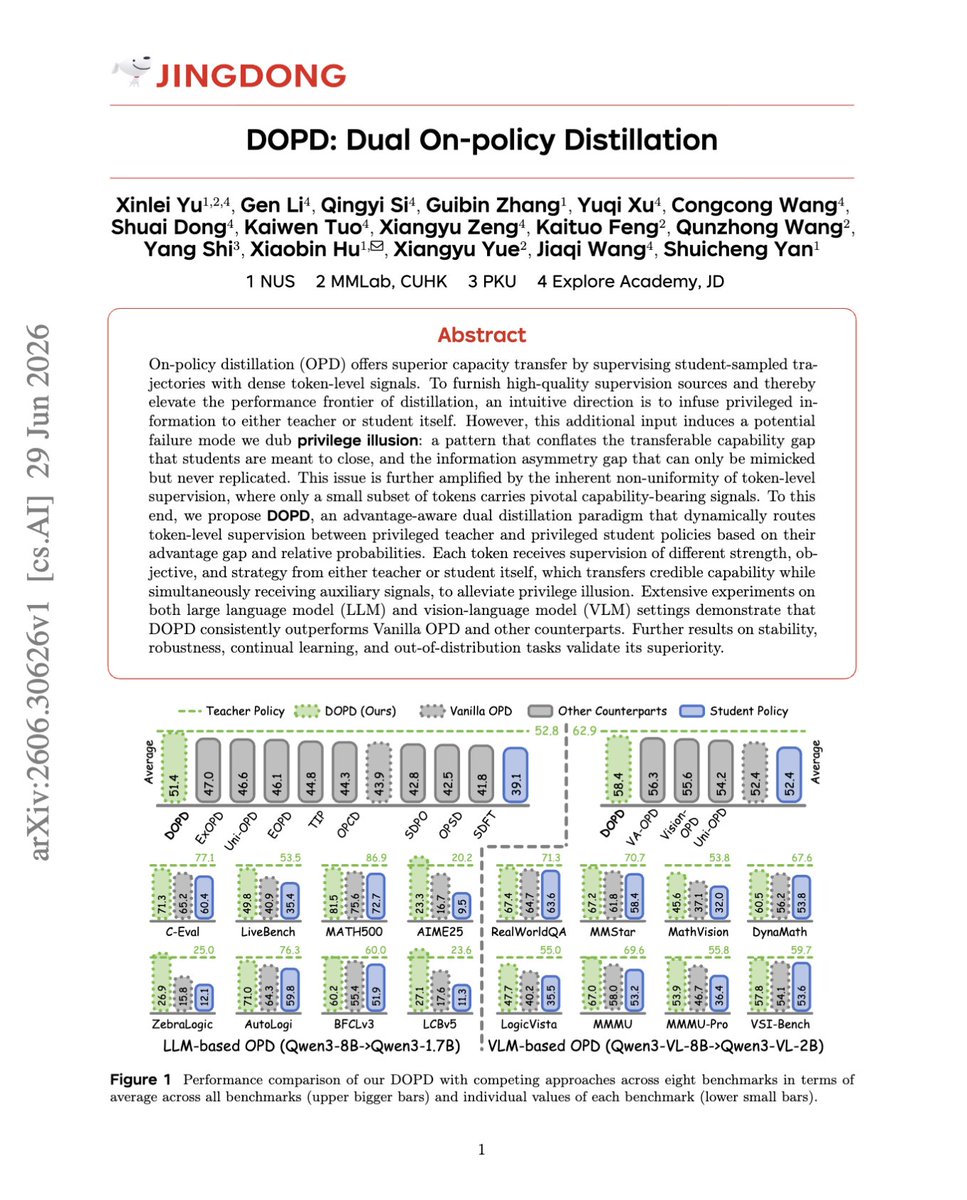
What if we have token-level routing instead of blindly distilling every token? This paper, DOPD, fixes on-policy distillation when privileged hints or visual annotations make the teacher look stronger than it really is. They identified the key problem being privilege illusion, where the teacher-student gap mixes true capability gap with an information gap the student cannot reproduce at inference. DOPD compares privileged teacher and privileged student probabilities per token, then sends each token to the right objective. High-gap teacher-confident tokens get strong full-vocab JS distillation, while low-gap or uncertain tokens get lighter teacher signals or self-regularization. Across Qwen3 and Qwen3-VL, DOPD beats vanilla OPD and strong baselines, with better stability, less entropy collapse, stronger scaling across model sizes, and better continual and out-of-distribution generalization.
2
22
166
9,191