founder CEO @precigenetic. Scuba diver, engineer, biologist. interested in things that lie deep. // prev. Penn comp bio, research Penn Med (cells n epigenomics)

Joined June 2019
8,134 Photos and videos
Pinned Post
AI x Drug Design has done SO well innovating (genuinely amazing!) that papers are talking about biological validation again. we made Cell Cinema Cleopatra, expecting this moment. we knew that without AI-native drug-cell prediction, our partners have an impossible choice: ranking hundreds of molecules, not knowing which ones would work best at all. our job @precigenetics, is to ensure our partners' out-of-distribution bets are the ones with the best shot at FDA approvals. this means we test these 'alien' drugs, at scale, with the best microscope we know.
6
11
106
12,585
The future. Building the future.
hot take: 90% of biotech startups aren't fundable not because the science doesn't work, because they're building a product we're looking for founders building the infrastructure that makes thousands of products possible - autonomous wet labs - peptide quality infrastructure - AI-native biology tooling - biological age diagnostics - clinical trial infrastructure - non-invasive BCIs - and/or adjacent biotech the products get funded easily. the infrastructure underneath them almost never does. that's the gap we're closing let's talk, what are you building?
4
599
Parmita Mishra reposted
i know this firsthand because i built the reductionist version. HMCVelo, hydroxymethylation velocity, across pseudotime. it worked on the data, and its limits taught me the ceiling: not generalizable or a foundation model with a readout that’s amazing but not scalable for world models. can’t encode arbitrary perturbations.
1
1
7
430
Parmita Mishra reposted
second is simple and hard to overstate. *clears throat* the cell already computes the cell for you. in analog. why do you want to model it better than it models itself? dumb spend. btw it costs more GPU hours than I can dream of. 😂 we are not one E. coli
1
1
13
465
in our case we want a cell cinema. not “drug works / doesn’t” but “by how MUCH HOW” that nuance lets you qualify and quantify responses. choose drugs. solve attrition. you’re wrong? feed it in. it was never claiming to be right. the L is what it learns from. :)
1
4
174
so the disagreement isn’t really technical. it’s about the goal. OP aims to solve the cell completely in a frictionless ideal. that’s a paper! to cure disease with what physics actually permits, THAT addresses something. both are legitimate. i just build for the second.
4
165
the model doesn’t have to contain the dynamics. it needs a TOKEN. cell cinema. FORWARDS choose perturbations worth running, let the cell itself be the analog computer that runs them, observe what happens AND by how much.
1
2
151
just
you need the cell on a latent space. kay? that’s how you map the perturbations. here’s an example. I wrote a bit about this in the original thread and will definitely write a thread about this idea soon.
1
3
148
quoting this because it’s a lens into something most never think about what IS a “good” model. Rohit and i want two very diff things here. OP wants a *provably correct* virtual cell. right from biophysics. to me, that’s
useless. let’s learn why, because it MATTERS. đŸ§”
Replying to @parmita
The point I am trying to make is that learning an energy landscape from empirical cellular imaging trajectories, a pre-requisite for training an accurate model for cell state dynamics, is bound to break the assumption of Markovianity. In other words, your energy function(al) will have tiny errors due to experimental resolution and/or artifacts of your apparatus which will inhibit adequate replication of the true dynamics. This is the same issue that has plagued the MD community for several decades now. You could argue that Alphafold is a counter example but you need to scratch below the surface only a little bit to realize why protein structure prediction does not help with inferring protein motion. Here are a few practical model-agnostic Markovianity tests you could try to see the light: 1. RodrĂ­guez‐Girondo, M., & de Uña‐Álvarez, J. (2012). A nonparametric test for Markovianity in the illness‐death model. Statistics in Medicine, 31(30), 4416-4427. 2. Berezhkovskii, A. M., & Makarov, D. E. (2018). Single-molecule test for Markovianity of the dynamics along a reaction coordinate. The journal of physical chemistry letters, 9(9), 2190-2195. 3. Willareth, L., Sokolov, I. M., Roichman, Y., & Lindner, B. (2017). Generalized fluctuation-dissipation theorem as a test of the Markovianity of a system. Europhysics Letters, 118(2), 20001.
2
10
1,160
that’s not “correct.” correct can’t be observed. but it’s more useful than correct, because it has predictive utility and hard codes nothing. as long as your token can be measured at high throughput, you actually can CONVERGE toward body level predictions.
1
3
147
DING DING DING đŸ›Žïž rings a bell! AlphaFold. take one whole “token” map it to the final state “token” enough times, the model learns the pattern. doesn’t generalize to EVERYTHING a full sim could like “dynamics” it does the thing that matters: perturbation prediction.
1
4
146
APPROACH TWO: for the most important task left for humanity
 don’t hard code shit you can’t see. yeah. build top down black box learn from HUGE corpus with cell cinema, the “universal cell embedding”, a token that describes the cell well enough for the task.
1
4
51
listen. my paper? def underrated. this is very fkn innovative. BUT u can’t measure every cell in a body this way, so going from cell to body, the thing that matters, breaks too. the simulation diverges from real biology again. that’s what sent me looking for the other approach.
1
4
48
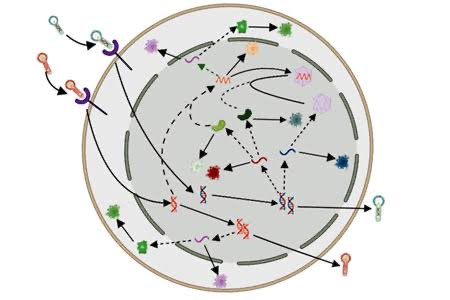
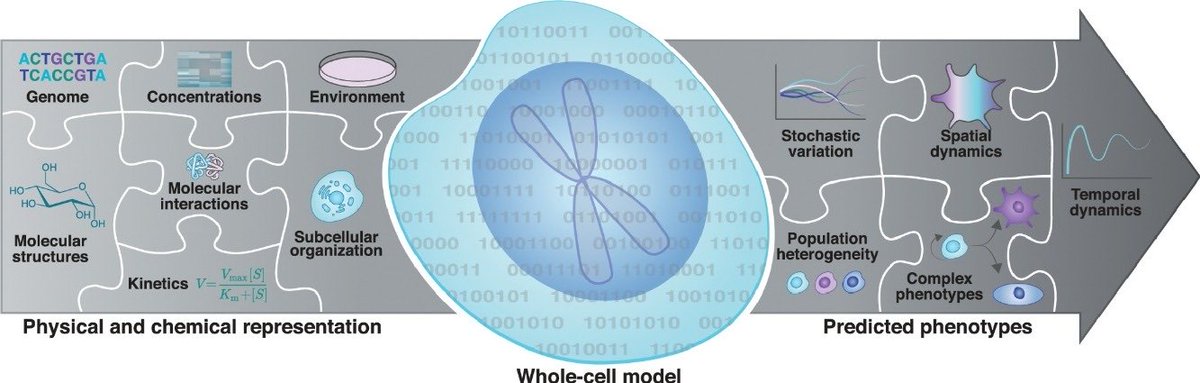
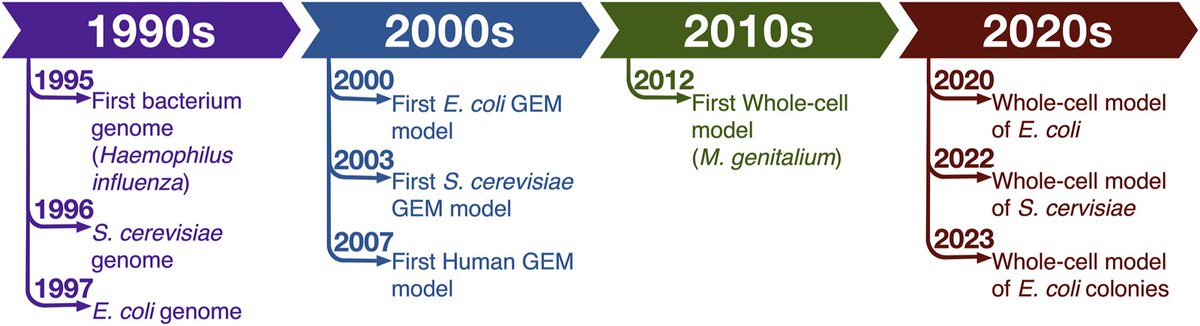
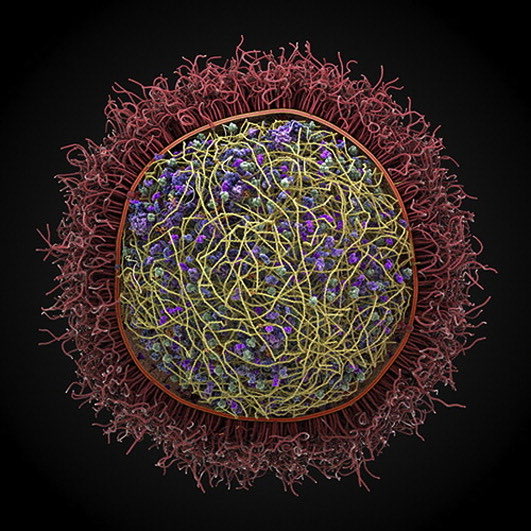
2 ways to model cells. 1. ground up. prokaryotic VCell first ever. “correct” yes. but this is why it doesn’t GENERALIZE. can’t project it => no “virtual cell” world model. it hard codes what nobody verified the in real cell. => simulation *diverges from reality.*
1
3
48
let me put this in a simpler way. im not saying whole cell models are useless. Im saying completely correct whole cell models are impractical. I, and you, care about PHENOTYPE at the end of the cell’s complex computation when making drugs. so you need just that, COMPLETELY.
1
3
38
here’s why “correct” is useless. first, it isn’t even on the menu. physics won’t let you observe ground truth dynamics. provable correctness makes a model that can’t exist for a mammalian cell. we don’t even know what 20-30% proteins are doing in there and THAT is hearsay
2
5
161
i want empirically useful. I don’t care how; just utility for my learning task. i.e. what does a drug do to a cell? a perturbation. I wanna predict this well enough to pick better experiments, which ties back to what actually matters: solving disease. all else is useless.
1
1
6
257
Parmita Mishra reposted
Replying to @parmita
Life time and generational friends/grudge holders, idk what more people need to accept corvid supremacy
1
4
352
drug discovery startups : same drug in 1 mouse 1 human. mouse livers are so ridiculously different from human ones we now painstakingly build human livers on a chip instead. longevity study: feed mice different cuisines and assume it generalizes to humans. 😭
Two new reports highlight the link between proteinmaxxing and adverse health outcomes, especially protein from animal sources 1. Reducing red meat and dairy intake in Scotland @NatureFoodJnl nature.com/articles/s43016-0
 2. Promoting healthspan with a low-protein, pescatarian diet @Cell_Metabolism sciencedirect.com/science/ar

1
2
29
1,761