Crypto media, born on socials. Telling stories that shape crypto and covering projects that make a difference.

Joined November 2021
12,088 Photos and videos
Pinned Post
We started small. A community space for crypto people Looking for credible info, connection, and a voice. Today, that idea has grown into Our Crypto Talk (OCT) The first media house born on socials. πŸ§΅πŸ‘‡
38
23
155
75,673
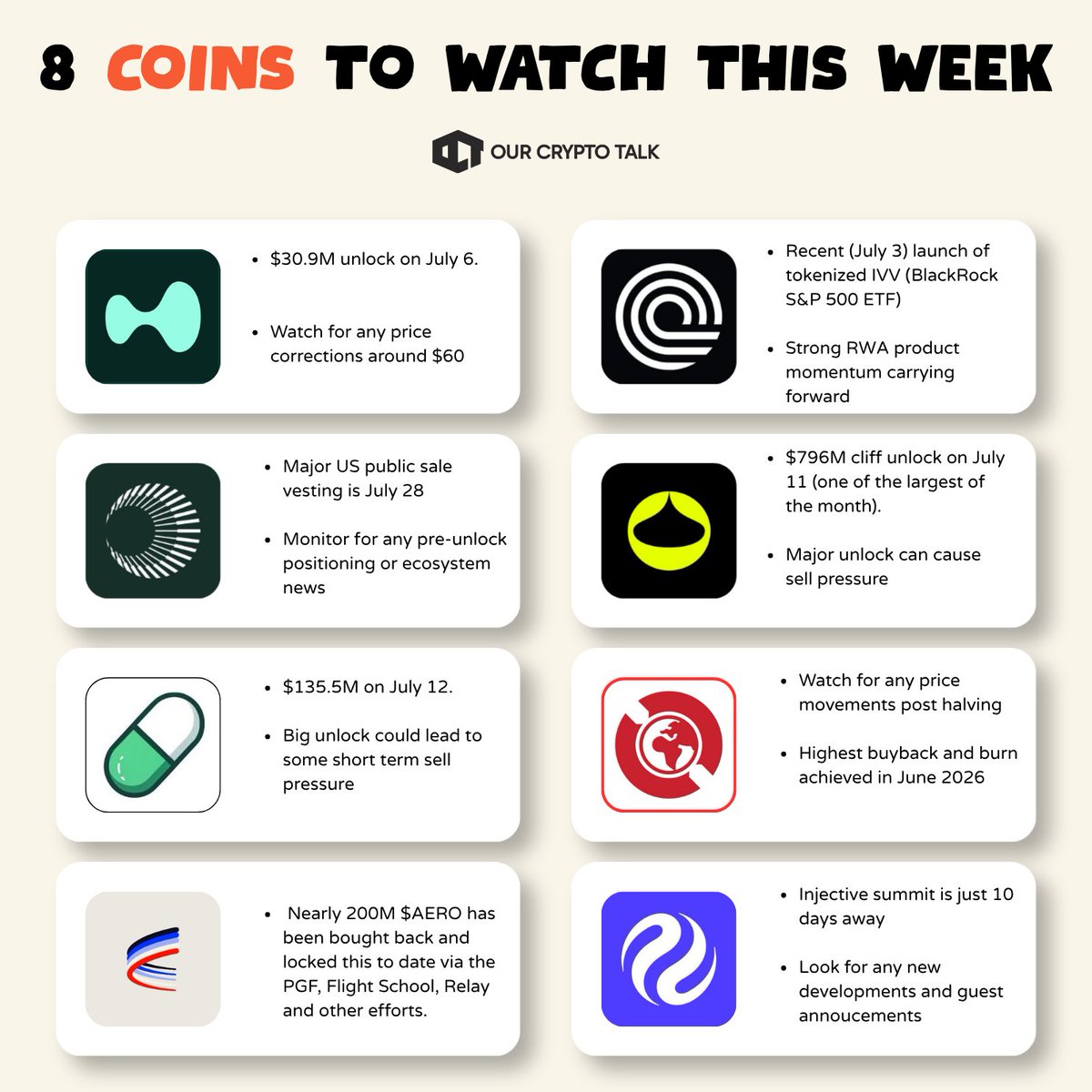
Altcoin Watchlist For This Week πŸ‘€ > $HYPE $31M unlock > $ONDO launched tokenized IVV > $XPL major US public sale loading > $RAIN cliff unlock > $PUMP token unlock on July 12 > $GEOD post halving momentum > $AERO post major buyback > $INJ summit momentum buildup Which projects are you watching right now? πŸ‘‡
2
5
20
2,930
DO NOT TRUST US ! Trust these 4 indicators that worked in the past. Biggest Questions Right Now πŸ‘‡ > When Bear Bottom? > When Bull Run? > When Altseason? We are closer to the bottom or we have already found it. Bitcoin, TOTAL2, ETH/BTC and TOTAL3 are not all screaming β€œbull market” at the same time yet, but they are all showing the same underlying message: Selling pressure is fading, momentum is turning and the market is quietly building a base. πŸ‘‰ 1. BITCOIN IS PRINTING A WEEKLY BULLISH DIVERGENCE Bitcoin has corrected hard from the 2025 highs, but the important part is not just price. The important part is that weekly RSI is making a higher low while price is still struggling near the lower range. That is how major reversals usually begin, because momentum turns before price confirms the move. Retail waits for Bitcoin to reclaim every level, while bigger players usually start positioning when the chart still looks uncomfortable. If Bitcoin stabilizes here, the entire risk curve gets support. And altcoins need Bitcoin to stop bleeding before they can properly rotate. πŸ‘‰ 2. TOTAL2 IS HOLDING LONG-TERM SUPPORT TOTAL2, which tracks the crypto market excluding Bitcoin, is sitting right around a major long-term support zone near the $800B to $900B area. This is important because the market has corrected deeply, but it has not completely broken the structure. At the same time, weekly RSI is forming a bullish divergence, which shows that even though price looks weak, downside momentum is losing strength. That combination matters. Long-term support plus bullish divergence is usually where the market starts building the floor, not where the strongest part of the breakdown begins. πŸ‘‰ 3. ETH/BTC IS SITTING IN A FALLING WEDGE NEAR THE GOLDEN POCKET ETH/BTC has been one of the biggest reasons altcoins have felt dead, because Ethereum weakness against Bitcoin usually delays broader altcoin rotation. But now ETH/BTC is sitting inside a falling wedge while testing the golden pocket zone. This is exactly the kind of structure that can trigger a major shift if buyers finally step in. A breakout from this wedge would not just be bullish for ETH. It would be the first real signal that capital is ready to rotate from Bitcoin into higher-beta altcoins again. πŸ‘‰ 4. TOTAL3 IS SHOWING MOMENTUM REVERSAL AGAIN TOTAL3, which excludes Bitcoin and Ethereum, is the purest altcoin market chart. And this chart is showing the same thing we saw near the 2022 bottom zone: momentum turning while price still looks damaged. That is the part most traders miss. Altcoin bottoms do not start when everyone is confident. They start when price is boring, RSI stops making lower lows, and sellers slowly run out of strength. This does not mean every altcoin pumps tomorrow. But when Bitcoin divergence, TOTAL2 support, ETH/BTC compression and TOTAL3 momentum reversal all appear together, the message is hard to ignore. The market may not look bullish yet. But the bottom structure is already forming.
4
9
24
3,769
Our Crypto Talk reposted
In the last one year, the launch and success of DEX-based tokens like $HYPE, $ASTER and $PUMP has pushed the DEX token market cap past $25B. But they still trail CEX tokens, which sit above $100B ( $BNB alone holds ~$76B of that). So how do CEX and DEX tokens actually differ, and why should you care?πŸ‘‡ πŸ”Ή THE REAL DIVIDE ISN'T CEX vs DEX Both sides now run the same core mechanism: take fees, buy the token on the open market, then burn it or lock it. It's crypto's version of a stock buyback. The proof the label doesn't decide outcomes is in the tokens themselves. $UNI is a DEX token with first-mover status and a huge user base, but with no active fee-to-token mechanism it has mostly tracked governance cycles, not platform growth. $OKB is a CEX token that burned ~65M tokens in Aug 2025, capped supply at 21M, and ran 200% in a day. This is how important tokenomics and designs are. Three things actually matter when it comes to exchange based tokens: 1. How much real revenue reaches the token 2. Whether you can verify that revenue 3. Whether the mechanism is enforced or can be switched off 1️⃣ VALUE ACCRUAL: WHO ACTUALLY RETURNS REVENUE On the DEX side, the mechanism is usually coded and public: - HYPE routes ~97-99% of protocol fees into continuous, automated buybacks through its Assistance Fund. No team vote to start or stop it. Cumulative buybacks passed $2B in mid-2026. - ASTER moved to 99% of daily fees into buybacks for stakers, plus matching burns (June 2026), after cutting monthly emissions ~97% in March. - PUMP directs 50% of net revenue to buyback-and-burn (down from 100% in April 2026). On the CEX side, it's usually a company decision: - BNB uses an auto-burn formula tied to price and chain activity, targeting a cut to 100M supply. Its Q1 2026 burn was ~$1.28B. - $OKB went further: one-time burn, fixed 21M supply, minting disabled. Fixed forever. - $LEO commits at least 27% of iFinex's monthly gross revenue to hourly buyback-and-burn. One detail most holders miss: on nearly all of these, you hold no claim on the revenue. A HYPE holder can't redeem against the Assistance Fund. BNB, per Binance's own wording, gives no claim on Binance profits. The value reaches you only through price. That's true on both sides. 2️⃣ REVENUE: CAN YOU VERIFY IT This is the easiest part to differentiate. DEX revenue is on-chain. You can pull HYPE's fees on DefiLlama and check them yourself. It runs around $1.3B annualized and has beaten Ethereum and Solana on weekly fees. You can compute a real price-to-fees multiple. CEX revenue is private. LEO's burn is fully transparent, but iFinex publishes no audited financials, so you're trusting the number feeding the burn. Same for most exchange tokens: you see the burn, not the books. So the buyback can look identical on both sides while the thing you're actually underwriting, the revenue, is verifiable on one and a trust exercise on the other. 3️⃣ SUPPLY: FIXED vs OVERHANG OKB (21M, minting disabled) and BNB (heading to 100M) are the tight-supply cases. The newer DEX tokens carry the opposite problem: dilution ahead. ASTER has only ~34% of its 8B supply circulating, with an FDV near $5B against a ~$1.7B market cap. PUMP has unlocks worth over $110M landing mid-July. HYPE has monthly team unlocks too, but its buyback pace has so far outrun them. The number to watch on any of these isn't the buyback in isolation. It's buyback vs unlocks. PUMP has bought back over $400M and still trades ~83% below its high, because supply and sentiment outweighed the bid. Buybacks don't guarantee price. 4️⃣ MARKET SURFACE Both sectors are top-heavy. BNB is ~75% of the CEX token cap. HYPE is roughly two-thirds of the entire DEX token cap. Strip out the leader and both categories are far smaller than the headline number. For DEX tokens you also get live health metrics: volume, open interest and TVL, all on-chain. Open interest and TVL matter more than raw volume, because they show capital that stays, not just capital that passes through. Hyperliquid held 70% of perp DEX open interest through early 2026, even after Aster briefly took ~70% of volume in Sept 2025. Volume rotates. Sticky capital is the tell. 5️⃣ RISK: WHAT YOU'RE ACTUALLY HOLDING A CEX token is a bet on a private operator. If the exchange fails, the token has nowhere to go. $FTT went from a multi-billion-dollar asset to near zero when FTX collapsed. Regulation is live too: Binance restricted EU services from July 2026 over MiCA licensing. A DEX token trades that counterparty risk for protocol risk. The buyback is only as large as volume allows, and it has no floor. $HYPE's quarterly buybacks already fell from ~$316M (Q3 2025) to ~$192M (Q1 2026) as activity cooled. And "enforced" is not the same as permanent. Governance can change the rules, as both $ASTER and $PUMP did with their own models this year. THE TAKEAWAY CEX vs DEX is a useful label, but it's a proxy, not an answer. Two tokens on the same side can behave in completely opposite ways. What actually predicts whether a token captures its platform's success: - How much real revenue flows back to the token - Whether you can verify that revenue - Whether the mechanism is enforced or can be switched off - Whether buybacks are outrunning unlocks Some useful stats that might interest you about CEX/DEX tokens: > Biggest buyback: Hyperliquid, cumulative HYPE buybacks past $2B, including a single $283M repurchase. > Highest buyback yield: HYPE, ~7% of market cap annualized, roughly 4-5x Ethereum and ~6x BNB. > Most fees / revenue (DEX): HYPE, ~$1.3B annualized fees and an ~$840M revenue run-rate, ahead of Uniswap on 30-day fees ($56.7M vs $46.1M). > Largest market cap: BNB ($76B) > Hardest supply cap: OKB, fixed at 21M with minting disabled, zero future dilution. > Biggest single burn: BNB, ~$1.28B destroyed in its Q1 2026 auto-burn. > Highest dilution overhang: ASTER, only ~34% of its 8B supply circulating (~3x FDV-to-market-cap). > Biggest drawdown despite buybacks: PUMP, $400M repurchased yet still ~83% below its high. > Best ETF debut: HYPE spot ETFs absorbed ~1.04% of market cap in 10 days.
11
22
94
10,254
Our Crypto Talk reposted
$ICP has been beaten down hard But this is exactly where the story gets interesting. While price sits near the lower range, the roadmap is shifting toward AI, sovereign cloud, multichain apps, and stronger tokenomics. Is $10 possible in 2026? 🧡 πŸ‘‡
13
32
212
10,573
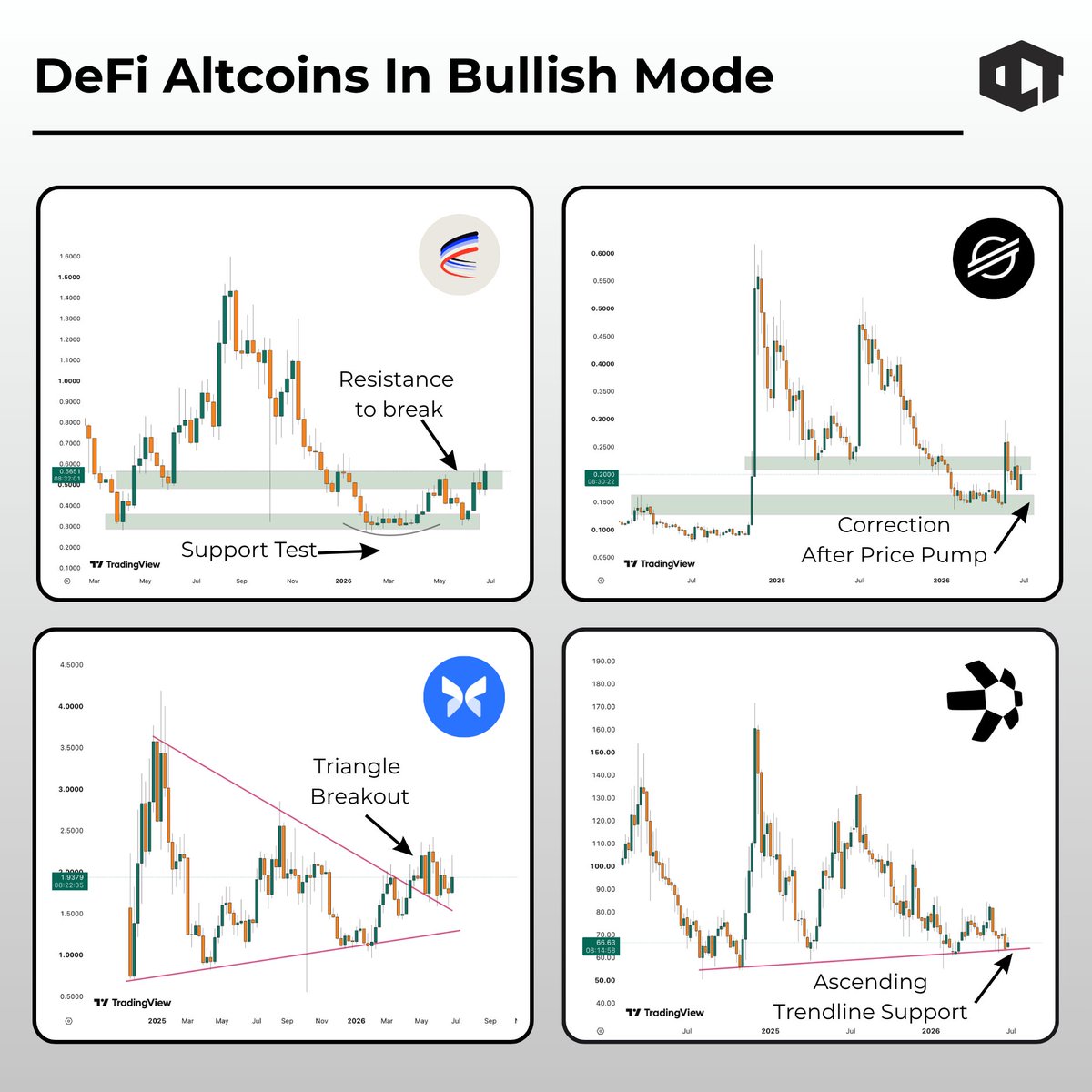
Most of us do not want to buy $HYPE because it sits around ATH. But these DeFi Altcoins don't And that is bullish for them > $AERO > $XLM > $MORPHO > $QNT For upside you need downside but not those charts which look rugged. These Alts are in a reversal stage. - AERO sits at a resistance level where it is forming a double bottom breakout - XLM is correcting after its recent pump but still holding around the golden pocket of that pump - MORPHO is clear with a triangle breakout and the best looking chart here - QNT sits at support but within 3X of 2025 top which makes it a reliable contender. If you like a bit of peace with upside potential, I believe that these should be the top picks. Do you agree?
12
46
147
8,120
13/ This is another entry in our "Projects We Are Watching in 2026" series. We focus on projects building real infrastructure, not just narratives. Follow @ourcryptotalk so you don't miss the next one. Had you heard of Dabba Network before this thread?
5
412
12/ We put together a full deep dive on Dabba Network covering: β€’ How the network works β€’ Token mechanics β€’ Real usage metrics β€’ Risks and opportunities Worth reading if you're researching the project after mainnet. ourcryptotalk.com/blog/dabba…
1
5
481
11/ Dabba passes the filters we care about: βœ… Live network with real paying users βœ… Clear product market fit βœ… Token utility tied to real usage βœ… Experienced founders βœ… Strong institutional backing Execution is now the biggest thing to watch.
1
5
32
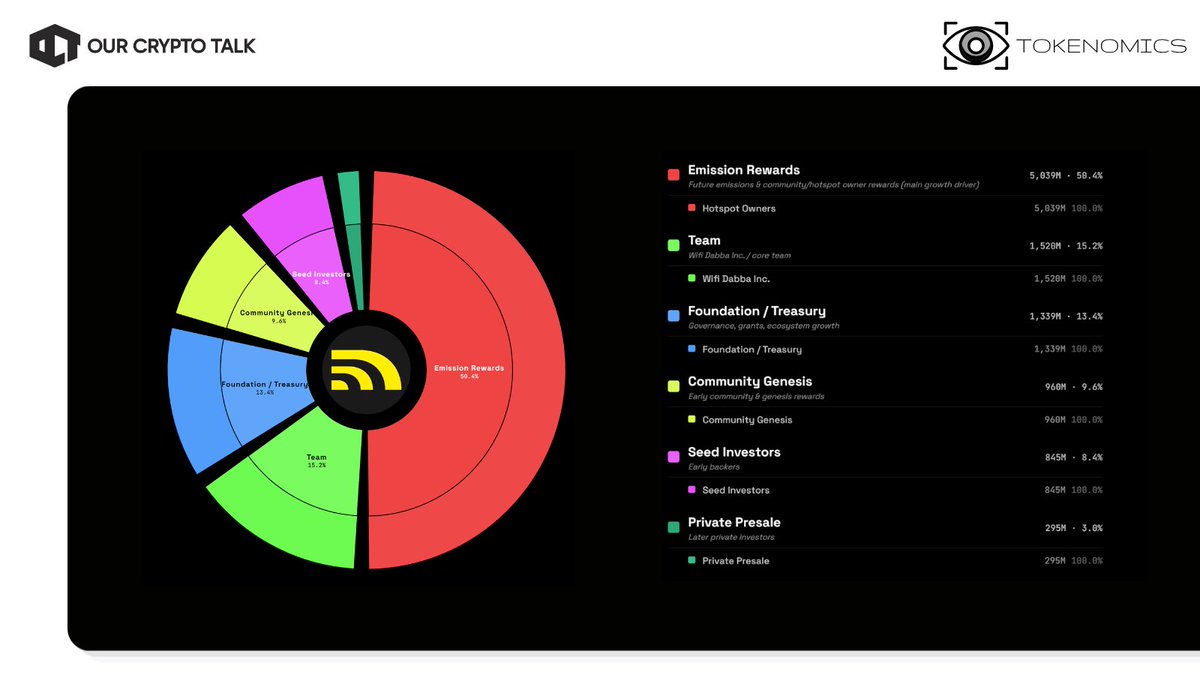
10/ DBT launched on April 15, 2026 on Solana. Total supply is 10B. The token powers staking, rewards, and a usage-based burn mechanism tied directly to internet consumption. The network was already live before the token launched.
1
6
42
9/ Worth being honest about the risks: β€’ Scaling physical infrastructure across India β€’ Competition from traditional ISPs β€’ Regulatory uncertainty β€’ Dependence on local operators β€’ Token price may diverge from network usage
1
6
33
8/ Traditional telecom expands slowly because infrastructure is expensive. Many DePIN projects solve distribution but never find real users. Dabba combines community capital, local operators, and paying customers into one network built for scale.
1
6
121
7/ Backed by Y Combinator, Multicoin Capital, Borderless Capital, and leading crypto investors. Building telecom infrastructure requires both operational expertise and patient capital. Dabba has attracted partners that understand both.
1
6
37
6/ Founders Karam Lakshman and Shubhendu Sharma have been building broadband infrastructure in India since 2017. The team is solving a problem most DePIN projects never face: How do you build and operate a nationwide telecom network at scale?
1
6
125
5/ Dabba uses a mint and burn model. Builders earn DBT for expanding the network, while tokens are burned as users consume internet. More than 9M DBT has already been burned through real usage. Growth is tied directly to network demand.
1
6
38
4/ Numbers worth noting: β€’ 203K Active Hotspots β€’ 1M DAU β€’ $2.39M 30d Revenue β€’ 1,143 TB Bandwidth Consumed β€’ 1,338 Global Owners This is real network activity, not simulated coverage.
1
6
43
3/ Most DePIN projects struggle because users are expected to interact with wallets, tokens, and new hardware from day one. Dabba flips the model. Users simply pay for internet, while crypto stays in the background to reward the people building the network.
1
6
131
2/ The model is deliberately simple: β€’ Hotspot owners earn passive rewards β€’ Local operators handle deployment and maintenance β€’ Users never need crypto to access WiFi β€’ DBT coordinates incentives and token burns
1
6
98
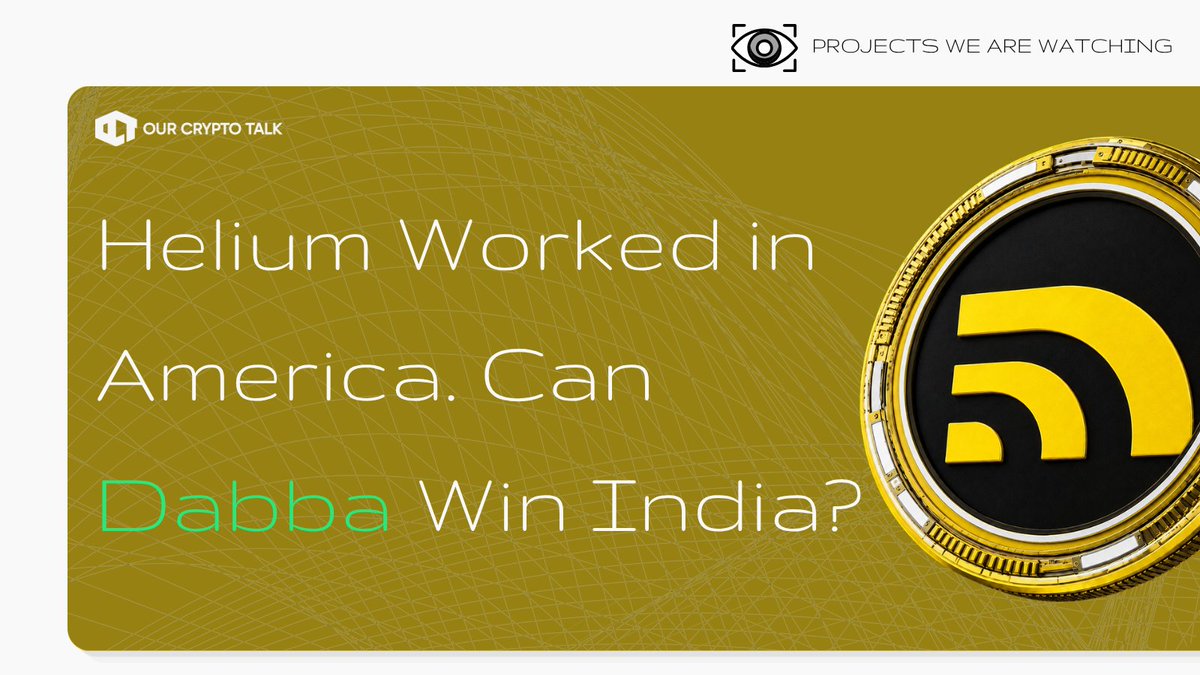
1/ Dabba is a decentralized wireless network bringing affordable high speed internet to India through community-owned WiFi hotspots. Users pay in fiat for internet. Local Cable Operators manage deployment. Token incentives coordinate the network behind the scenes.
1
7
248