robotics evangelist | riding the wave of robotics | angel investing 🕵🏼‍♂️

Joined September 2021
2,194 Photos and videos
Pinned Post
Europe does not innovate at all! 🇪🇺 Such statements have been appearing recently. Lately, we have been known for the fact that it is difficult to drink from our plastic bottles because of the regulated caps. Fortunately, this is not true. Spoiler: I now have a great strategy how to drink EU-capped bottles! Reach out if you have any problems! 🍼 Just look at the European startup ecosystem and the momentum that accompanies it. Btw. thanks for pushing this @andreasklinger (@euinc_petition) and @HarryStebbings (@ProjectEurope_) and all the contributors of this initiatives. And today I wanted to show you a robotics company that is creating real innovation right in the heart of beautiful Bavaria! 🥨 That's Filics! Founded in 2019 by engineers from the Technical University of Munich. They are developing a unique robot pairing that autonomously lifts and moves pallets using minimal floor space. Each of their units can carry up to 1.2 tons and maneuver with the speed of 1.2 m/s. The system's autonomous mobility allows it to drive completely underneath and through pallets placed on the floor, without requiring turning space, making it a standout solution for high-density warehouses. Future plans include adapting the technology for autonomous truck loading in under five minutes. Last year they have secured €13.5 million in fresh funding to scale its operations. 💰 There's more companies in Europe like this. I hope to put more of them in the spotlight this year, so they get the credits they deserve! 🦾 ~~ ♻️ Join the weekly robotics newsletter, and never miss any news → ziegler.substack.com
391
569
3,887
1,312,252
Lukas Ziegler reposted
Massive week in robotics. I went through everything from Weave Robotics, Apptronik, Flexion, and even more. Get your coffee and see what happened in robotics space:
2
3
17
1,345
Robots assembling the servers that train AI. 🔌 Cambrian Robotics built a robot that assembles AI servers, specifically, it connects all those tiny connectors (QSFP and OSFP plugs) that link server components together. I had a chance to see their demo with Universal Robots arms during @AutomateShow in Chicago week ago. This is manual work right now. Tedious. Precise. Expensive. The robot uses Cambrian Vision to locate connectors with 0.1 mm precision, then picks and inserts them. That precision matters because if a connector isn't fully seated, it causes rework. The system verifies insertion and flags any issues before they become costly problems downstream. Off-the-shelf RGB cameras, but custom AI trained on synthetic data. They're not using expensive specialized hardware. They're using standard cameras plus smart algorithms to see what matters. Data centers are under pressure to automate every step of server assembly. Right now each step is a bottleneck. Automate one step, move to the next. Hyperscalers are pushing for end-to-end automation, robots building entire servers. This loop is wild: robots build servers → servers train AI models → those models improve the next generation of robots. Closed loop. Automation scaling faster because the AI powering the robots keeps getting better. The machines building the infrastructure that powers AI that's building the next machines. ~~ ♻️ Join the weekly robotics newsletter, and never miss any news → ziegler.substack.com
1
4
17
1,873
[INTERNET EXPLORER NEWS] Agility Robotics is going public via SPAC merger at a $2.5B valuation, one of the first pure-play humanoid robotics companies to pursue a public listing Digit is deployed across 9 customer sites including Schaeffler, GXO, Toyota, and Mercado Libre. $ 300M in multi-year orders secured with 30 customers in the pipeline The deal is expected to generate $ 620M in proceeds for production scaling
4
2
362
Then @FlexionRobotics introduced Reflect v1.0, a robotics intelligence platform achieving 90% success on complex multi-step missions vs 38% without reinforcement learning In a demo, a humanoid retrieved a parcel, navigated stairs and an elevator, unpacked the box, and stored items in a drawer, all from a single natural-language instruction Users can modify missions or update instructions mid-execution just by changing the prompt
1
2
5
414
Austin-based @Apptronik launched Apollo 2 in both bipedal and wheeled configurations The robot collects training data across logistics, manufacturing, and retail tasks inside Apptronik's newly expanded 90,000 sq-ft Robot Park in Austin That data directly powers Google DeepMind's Gemini Robotics foundation models. Everything proven on Apollo 2 feeds into the commercial Apollo 3
2
2
270
SF-based @weaverobotics launched Isaac 1, a wheeled mobile home robot that tidies rooms, makes beds, folds laundry, and puts items away → Telescopic body adjusts from 3 ft to 5'9" → Dual arms with AI-powered perception → Hardware controls physically disable cameras when not in use When the robot hits an edge case, a remote operator subs in temporarily then hands control back. $7,999 or $449/month, California deliveries fall 2026
2
1
3
424
Happy 4th of July, and happy 250th anniversary, America! 🇺🇸 Let's have a look at a figure that helped to shape the current state of robotics. Joseph F. Engelberger, known as the "Father of Robotics," was an American physicist, engineer, and businessman who pioneered the robotics industry. Born in Brooklyn, New York, in 1925, Engelberger served in the U.S. Navy during World War II before earning degrees in physics and mechanical engineering from Columbia University. In 1956, he met inventor George C. Devol (this gentlemen deserves a separate post) and recognized the potential of Devol's Programmed Article Transfer device for manufacturing automation. In 1959, Engelberger developed the first industrial robot, Unimate, which revolutionized manufacturing when installed at a General Motors plant. He later expanded robotics globally through partnerships with Nokia in Finland and Kawasaki Robotics in Japan. Beyond industrial robotics, Engelberger ventured into service robotics, founding Transitions Research Corp. in 1984 to develop robots for healthcare, particularly elder care. His work earned him prestigious awards, including the Japan Prize and the Leonardo da Vinci Award. 🏅 In 1966, he introduced Unimate to a wide audience on "The Tonight Show with Johnny Carson," boosting public interest in robotics. 📺 I bet you saw that video - if not here's the link: youtube.com/watch?si=C-cwmSd… His contributions continue to influence robotics today, with automation transforming industries worldwide. ~~ ♻️ Join the weekly robotics newsletter, and never miss any news → ziegler.substack.com
1
3
19
2,068
Unloading trucks with robots! 📦 Bastian Solutions has developed a mobile robot system that automates high-volume, floor-level unloading of trailers. Let's have a closer look at how it actually works! The robot seamlessly drives itself in and out of trailers and docks without any fixed infrastructure. This system picks up cases via an extendable conveyor, lifts them using a retractable mast, and accurately places them inside the trailer using a dedicated gripper. In the video you can see the reversed process, unloading of a truck. 🚛 It's guided by LiDAR-based navigation and an omnidirectional base, enabling fast, precise, and infrastructure-free operation. Integrates smoothly with existing systems like conveyors, scanners, sorters, and depalletizers. Every time I see a robot loading and unloading a truck, I'm like: we are getting there :) ~~ ♻️ Join the weekly robotics newsletter, and never miss any news → ziegler.substack.com
23
75
633
52,363
Lukas Ziegler reposted
The original home of robotics! 🦞 The Massachusetts ecosystem is one of the world's leading hubs for robotics, combining top research, companies, and deep-tech investment. At its core are @MIT and @Harvard, which produce world-class researchers, engineers, and robotics startups. Many of today's leading robotics companies trace their roots back to these universities. The region is also home to companies like Boston Dynamics, whose work has inspired advances in humanoid and mobile robots. Around these companies, a dense network of suppliers, experienced engineers, entrepreneurs, and investors has developed, making it easier for new startups to build and scale. Massachusetts also has one of the strongest deep-tech funding ecosystems in the world, with venture capital firms that understand robotics, AI, and hardware. The Massachusetts robotics ecosystem is further strengthened by leading research organizations such as @ToyotaResearch Institute and @rai_inst, which are advancing AI, dexterous manipulation, and next-generation robotics while attracting world-class researchers and engineers. Not to mention initiatives like MassRobotics which is home to so many great robotics companies (a separate map of MassRobotics companies will be released soon). In the comments I'll post the companies from the ecosystem. ‼️ Note that Massachusetts has more than 500 robotics companies, research labs, and innovation hubs, so this is a curated selection of the notable product companies, not an exhaustive census! P.S. I'm constantly working on improving these maps, so if your company is missing - no bad blood - I'll try to include it in the next edition. ~~ ♻️ Join the weekly robotics newsletter, and never miss any news → ziegler.substack.com
4
27
105
9,389
Lukas Ziegler reposted
That's the robot use case you need on Friday! 👀 Robot learns to tie a flying knot in less than 10 tries! 🪢 @CarnegieMellon researchers taught a robot to tie a flying overhand knot, the kind you make by manipulating one end of rope, lifting and twisting it to form a loop, then striking it so the rope flips through and tightens. This is hard. Ropes have infinite degrees of freedom. They're underactuated, you can't control every part independently. Traditional learning would need hundreds or thousands of demonstrations. Their approach? Task-Level Iterative Learning Control. Focus learning on one critical moment, the rope collision, instead of trying to optimize the entire motion. Ignore the errors earlier in the motion. Just nail the critical point. Starting from a single human demo, the robot learns on actual hardware. Each trial teaches the system how to adjust the command for the next attempt. Within 10 trials, the robot achieves 100% success on the flying knot. Project page: flying-knots.github.io/ ~~ ♻️ Join the weekly robotics newsletter, and never miss any news → ziegler.substack.com
7
23
128
19,324
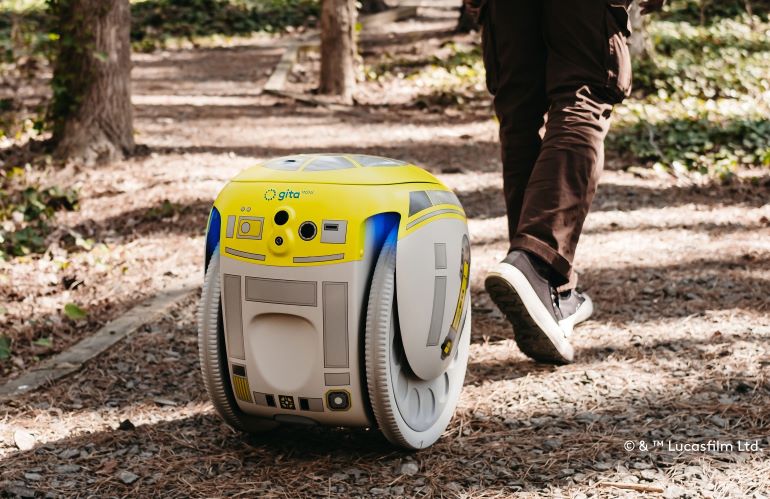
Robots beyond the warehouse. Piaggio Fast Forward's gita carries your cargo and follows you around. Sea Machines puts autonomy on commercial boats. Luminous's LUMI installs solar panels at utility scale, and GreenSight flies autonomous drones for agriculture and turf.
6
580
iRobot? 40M Roombas sold. Realtime Robotics does AI motion planning on a custom processor (53 patents). Code Metal converts code to Rust/CUDA, fresh unicorn after a $125M raise. Oxipital's soft grippers pick food. RISE builds fluid-free actuators.
1
5
695
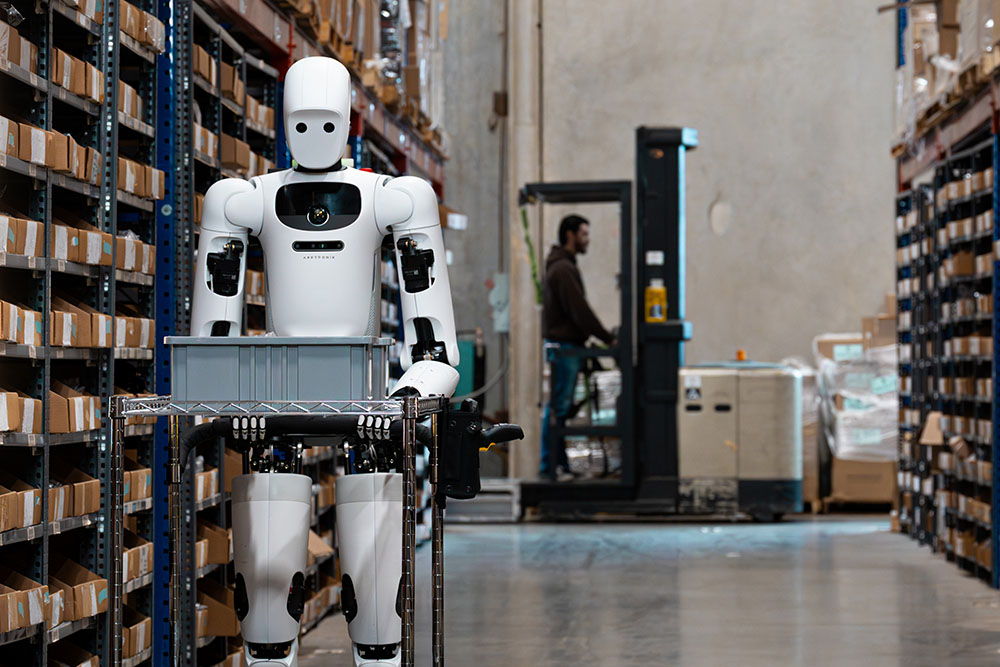
Still not done. Berkshire Grey automates pick/pack/sort (SoftBank-owned). Boost's robots maintain data centers. Tennibot collects tennis balls. Teradyne owns Universal Robots MiR. Acumino & Humanoid build robot workers. Urbx does e-comm 3PL. Sereact's Cortex powers picking bots.
1
2
236
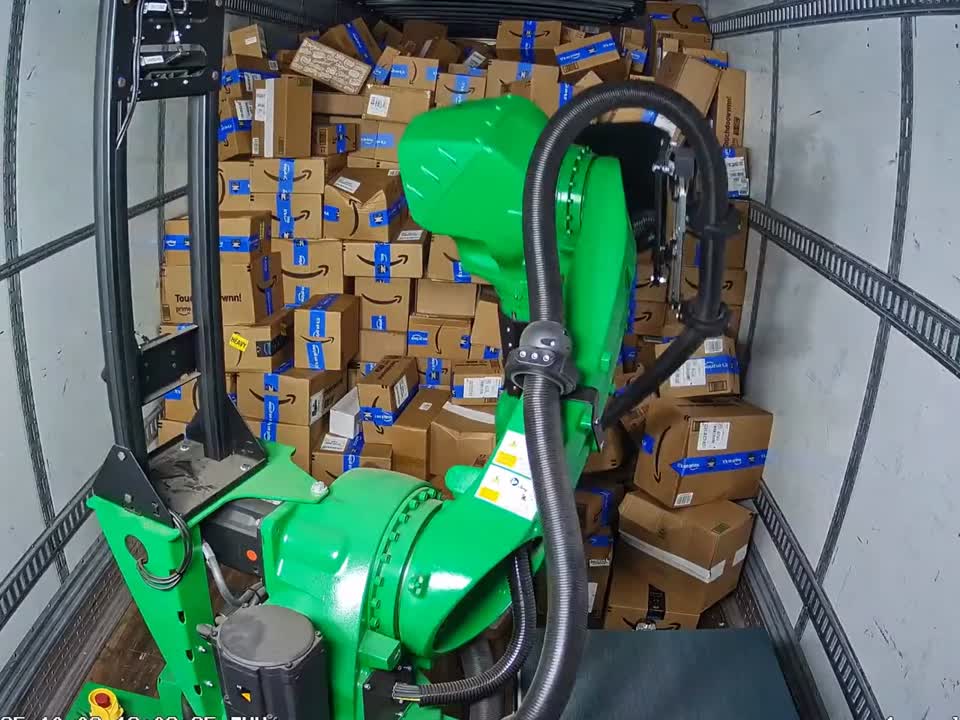
The list goes on. Vecna builds AMRs for warehouses and factories. Pickle Robot (in the pic!) automates parcel handling, The Information's Top Robotics Startup of 2025. RightHand does piece-picking, Tutor rents out AI robot workers ($34M from USV), and 6 River's "Chuck" now runs under Ocado.
2
7
729
Boston's robotics scene is stacked. Boston Dynamics is building Spot, Stretch and the Atlas humanoid. Amazon Robotics, born from the 2012 Kiva deal, powers Amazon's fulfillment centers. Locus makes warehouse AMRs, and Symbotic runs 25 mph bots as a public company.
2
11
1,007
Humanoid robots that can barely walk after 10 years of development, and grab a cup after 7th attempt. Meanwhile: specialized robots that have been dominating their specific task since 2008. That's one of the worst tasks to do! ~~ ♻️ Join the weekly robotics newsletter, and never miss any news → ziegler.substack.com
41
13
270
50,122
Smart mapping for robots exploring huge areas! 🗺️ This is called Rolling-Bonxai. When a drone or ground robot maps a massive area, say a whole city or massive warehouse, storing the entire map in memory gets expensive fast. You run out of RAM. This solution is simple, only keep the nearby map in memory. As the robot moves, old chunks save to disk and new chunks load. Like how video games only render what's close to the player. The system divides the map into chunks (imagine a 3D grid of boxes). As the robot explores, it keeps chunks around it loaded in memory. Chunks it's moving away from get saved to disk. When it comes back, they load again. Check the GH repo here 👉🏼 github.com/mukundbala/Rollin… ~~ ♻️ Join the weekly robotics newsletter, and never miss any news →
8
25
200
15,168